


Community hub
Recent from talks
Contribute something
Nothing was collected or created yet.
Montevallo, Alabama
View on Wikipedia
Montevallo is a city in Shelby County, Alabama, United States. A college town, it is the home of the University of Montevallo, a public liberal arts university with approximately 3,000 students. As of the 2020 census, the population of the city of Montevallo is 7,229.
Key Information


Geography
[edit]A plaque on Reynolds Cemetery Road, just off Alabama State Route 25, in the eastern corner of the town, marks the geographic center of the state of Alabama. Middle Street, formerly known as Main Street, had its name changed in 1899 for this reason, upon the completion of a new state survey.[3]
According to the U.S. Census Bureau, the city has a total area of 7.7 square miles (20 km2), of which 7.6 square miles (20 km2) is land and 0.1 square miles (0.26 km2) (0.66%) is water.
History
[edit] | This section needs additional citations for verification. (September 2025) |
The area where Montevallo is now was controlled by the Creek Indians. After being acquired in 1814, Jesse Wilson claimed a small hill on the northern bank of Wilson's Creek by the present Montevallo City Cemetery and created a homestead there, making it the oldest settlement in Shelby County. Wilson's friends and family followed afterwards and also settled in the area, and a settlement known as Wilson's Hill developed on the site. The settlement's location at almost the exact center of Alabama meant it was considered one of the potential sites for the University of Alabama. In an attempt to encourage the university to choose the site the settlement changed its name to Montevallo, which is Italian for the hill in the valley.
Montevallo was used by local farmers as a market town where they could sell and package their produce. It was incorporated as a city in 1848. In 1853 a railway was built between Montevallo and Selma which allowed further economic growth to Montevallo and in 1856 a coal mine was created nearby leading to further growth.
During the American Civil War, Union troops under the command of James H. Wilson camped in Montevallo in the spring of 1865 and skirmished with Confederates near the railroad depot. After the war, commercial life and growth was dominated by the coal mine owned by Truman Aldrich who leased the mine and attempted to increase production in response to the growing iron industry in the region and the growing city of Birmingham. Starting in 1890, company owned worker housing was built in Montevallo to house miners.
.jpg)
In the early 1890s, residents of Montevallo entered the city in a competition to be selected for the site of the Alabama Girl's Industrial School (later the University of Montevallo) a technical college for white women, raising funds to purchase land and antebellum buildings for the college they won and the college was founded in Montevallo in 1896. Commerce and economic growth increased in Montevallo after the establishment of the college, which was renamed Alabama College in 1919, started admitting men in 1956 and started admitting African Americans in 1968 and became the modern liberal arts University of Montevallo. The university became the main source of commerce in Montevallo and money generated by it was used by the municipal government to build schools. The university also allowed the community some stability during the Great Depression. It quickly took over the coal mine as the major employer in Montevallo, the coal mine closing in 1946.[4][5]
Demographics
[edit]| Census | Pop. | Note | %± |
|---|---|---|---|
| 1880 | 402 | — | |
| 1890 | 572 | 42.3% | |
| 1910 | 923 | — | |
| 1920 | 850 | −7.9% | |
| 1930 | 1,245 | 46.5% | |
| 1940 | 1,490 | 19.7% | |
| 1950 | 2,150 | 44.3% | |
| 1960 | 2,755 | 28.1% | |
| 1970 | 3,719 | 35.0% | |
| 1980 | 3,965 | 6.6% | |
| 1990 | 4,239 | 6.9% | |
| 2000 | 4,825 | 13.8% | |
| 2010 | 6,323 | 31.0% | |
| 2020 | 7,229 | 14.3% | |
| U.S. Decennial Census[6] 2013 Estimate[7] | |||
2000 census
[edit]As of the census[8] of 2000, there were 4,825 people, 1,711 households, and 946 families residing in the city. The population density was 638.5 inhabitants per square mile (246.5/km2). There were 1,897 housing units at an average density of 251.0 units per square mile (96.9 units/km2). The racial makeup of the city was 72.54% White, 25.89% Black or African American, 0.39% Native American, 0.39% Asian, 0.06% Pacific Islander, 0.15% from other races, and 0.58% from two or more races. 1.58% of the population were Hispanic or Latino of any race.
There were 1,711 households, out of which 25.6% had children under the age of 18 living with them, 37.4% were married couples living together, 15.1% had a female householder with no husband present, and 44.7% were non-families. 30.6% of all households were made up of individuals, and 9.9% had someone living alone who was 65 years of age or older. The average household size was 2.30 and the average family size was 2.96.
In the city, the age distribution of the population shows 18.3% under the age of 18, 36.0% from 18 to 24, 21.8% from 25 to 44, 14.1% from 45 to 64, and 9.8% who were 65 years of age or older. The median age was 23 years. For every 100 females, there were 78.1 males. For every 100 females age 18 and over, there were 72.2 males.
The median income for a household in the city was $30,541, and the median income for a family was $40,164. Males had a median income of $36,222 versus $23,705 for females. The per capita income for the city was $16,468. About 14.5% of families and 24.4% of the population were below the poverty line, including 27.6% of those under age 18 and 21.5% of those age 65 or over.
2010 census
[edit]As of the census[9] of 2010, there were 6,323 people, 2,346 households, and 1,325 families residing in the city. The population density was 832.0 inhabitants per square mile (321.2/km2). There were 2,654 housing units at an average density of 349.2 units per square mile (134.8 units/km2). The racial makeup of the city was 70.2% White, 24.6% Black or African American, 0.3% Native American, 0.6% Asian, 0.0% Pacific Islander, 2.5% from other races, and 1.8% from two or more races. 5.7% of the population were Hispanic or Latino of any race.
There were 2,346 households, out of which 24.0% had children under the age of 18 living with them, 39.0% were married couples living together, 13.9% had a female householder with no husband present, and 43.5% were non-families. 31.9% of all households were made up of individuals, and 9.9% had someone living alone who was 65 years of age or older. The average household size was 2.29 and the average family size was 2.94.
In the city, the age distribution of the population shows 17.7% under the age of 18, 29.1% from 18 to 24, 22.4% from 25 to 44, 19.8% from 45 to 64, and 11.0% who were 65 years of age or older. The median age was 27 years. For every 100 females, there were 82.2 males. For every 100 females age 18 and over, there were 79.0 males.
The median income for a household in the city was $40,417, and the median income for a family was $75,500. Males had a median income of $53,125 versus $31,361 for females. The per capita income for the city was $19,741. About 11.8% of families and 20.9% of the population were below the poverty line, including 23.6% of those under age 18 and 7.5% of those age 65 or over.
2020 census
[edit]| Race | Num. | Perc. |
|---|---|---|
| White (non-Hispanic) | 4,393 | 60.77% |
| Black or African American (non-Hispanic) | 1,638 | 22.66% |
| Native American | 24 | 0.33% |
| Asian | 52 | 0.72% |
| Pacific Islander | 13 | 0.18% |
| Other/Mixed | 339 | 4.69% |
| Hispanic or Latino | 770 | 10.65% |
As of the 2020 United States census, there were 7,229 people, 2,249 households, and 1,234 families residing in the city.
Places of interest
[edit] | This section needs additional citations for verification. (September 2025) |
Parnell Memorial Library
[edit]
The Montevallo Public Library was founded in March 1958 under the leadership of the City of Montevallo and the Montevallo Branch of the American Association of University Women. The library began modestly as a collection of several hundred books in a small room at City Hall. The first librarian was Lillian Ward.
In 1974 the public library was moved to the Depot-in-the-Park, where Mayme Yarbrough was the librarian. It remained there until a 1978 fire destroyed the building and all its contents. The library was relocated to the City Hall Annex until 1984. At that time, the library was moved to the renovated telephone company switching building. The renovation of the building was made possible through the efforts of many people in this community and beyond. From March 1984 until December 2006, that facility served as Montevallo's public library.
In response to the offer from Dr. L. C. Parnell, Jr., to house his Civil War collection in the existing library at 845 Valley Street if an expansion of the library were undertaken, Parnell Memorial Library Foundation was incorporated on March 23, 1998. The mission of the Foundation is to promote funding for expansion of the facilities, services, and programs of Parnell Memorial Library.
As community needs grew, and particularly as community arts programming expanded, it was apparent that Montevallo needed a facility that was more than a traditional library. One of the primary agents of community arts programming is the Montevallo Main Street Players. The community theater group began more than thirty years ago and has performed in various city locations, including the Depot-in-the-Park and the City recreational building. For years, members of the Montevallo Main Street Players have needed a theater, complete with an up-to-date lighting and sound system, that they can use consistently for producing plays and storing props.
In June 2001, representatives from the Foundation, the Montevallo Library Board, the Library Staff, the Montevallo Main Street Players, and the City of Montevallo agreed that the community needed a new library in a new location to meet diverse community needs and to house the Parnell Collection of historical books and documents. The group requested that the City locate property suitable for building a new library that would also serve as a community cultural center. Groundbreaking took place on November 1, 2004, and the Grand Opening was held February 25, 2007.
The new library includes an art gallery and a quality theater used by the Montevallo Main Street Players, the public schools, and other area groups. Along with the large meeting room, the theatre is a much-needed venue for productions by touring theatre companies and musical groups as well as for City of Montevallo meetings and other civic gatherings.
Shoal Creek Park
[edit]Shoal Creek Park is a historical 167-acre estate that provides a series of walking and biking trails, in addition to a Pavilion, Antebellum style house, known as Perry Hall, and parking lot, located on Highway 119 in Montevallo surrounding Shoal Creek.
Perry Hall was constructed in 1834 on an 800-acre farm owned by the Perry family. The ownership of the house and land were later transferred to the Mahler family in 1946, and later donated to the city of Montevallo in 2013 by Ms. Elizabeth “Betty” Mahler.[11]
Orr Park
[edit]
Orr Park, located in Montevallo along Shoal Creek offers residents and visitors a natural recreational environment.[12] Orr Park offers two playgrounds, six baseball/softball fields, a walking trail, a football field and a practice field.
Orr Park contains a local attraction dubbed "Tinglewood". In the early 1990s, local artist Tim Tingle, a coal miner by trade, took it upon himself to transform storm-damaged cedar trees into works of art. The carvings feature gnomes, a dragon, and a fish eating a snake, among others.[13]
American Village
[edit]The American Village is a classroom and American history and civics education center. The American Village serves the Nation as an educational institution whose mission is to strengthen and renew the foundations of American liberty and self-government by engaging and inspiring citizens and leaders, with a special emphasis on programs for young people.[14]
Notable people
[edit]- Slade Blackwell, member of the Alabama Senate
- Andrew Jackson Caldwell, U.S. Representative from Tennessee from 1883 to 1887
- James Hardy, surgeon who performed the first successful human lung transplant.
- Jim Hayes, former Major League Baseball player for the Washington Senators
- Polly Holliday, actress in TV series such as Alice and movies.
- Frank Ragan King, Commander in the US Navy who was awarded the Distinguished Service Medal
- Burwell Boykin Lewis, former politician and president of the University of Alabama from 1880 to 1885
- Robert M. Lightfoot, Jr., 11th director of NASA Marshall Space Flight Center
- Piano "C" Red, (1933–2013), Chicago blues and boogie-woogie singer and composer[15]
- Eugene Bondurant Sledge, United States Marine, university professor, and author
Sister city
[edit] Echizen Town, Fukui, Japan (since 2008) -- the friendly relationship between Echizen Town and Montevallo began in 1995 with a common interest in pottery. Echizen Town is well known for its unusual pottery and the University of Montevallo excels in teaching and creating the art.[16] Echizen Town is also well known in Japan for its high quality crab, rice, and daffodils. Many people often confuse Echizen Town with Echizen City, a larger city to the south of Echizen Town, known for its production of knives and paper.[citation needed]
Gallery
[edit]-
 Montevallo City Hall
 -
 Montevallo Post Office (ZIP code: 35115)
 -
 Parnell Memorial Library
 -
 Built in the Federal style in 1823, the King House is the oldest building on the campus of the University of Montevallo. It was added to the National Register of Historic Places on January 14, 1972.
 -
 Built in 1900, the McKibbon House is a historic Victorian home located in Montevallo. The home is now used as a bed and breakfast. It was added to the National Register of Historic Places on December 31, 2001.
 -
 Shoal Creek at Orr Park in Montevallo.
 -
 Tim Tingle's carving of a man's face in the trees at Orr Park.

.JPG)


References
[edit]- ^ a b c U.S. Geological Survey Geographic Names Information System: Montevallo, Alabama
- ^ "2020 U.S. Gazetteer Files". United States Census Bureau. Retrieved October 29, 2021.
- ^ "Alabama Department of Archives and History". state.al.us.
- ^ "Montevallo". Encyclopedia of Alabama.
- ^ "The Official Website of Montevallo, Alabama – Historical Commission". homestead.com.
- ^ "U.S. Decennial Census". Census.gov. Retrieved June 6, 2013.
- ^ "Annual Estimates of the Resident Population: April 1, 2010 to July 1, 2013". Retrieved June 3, 2014.
- ^ "U.S. Census website". United States Census Bureau. Retrieved January 31, 2008.
- ^ "U.S. Census website". United States Census Bureau. Retrieved August 8, 2015.
- ^ "Explore Census Data". data.census.gov. Retrieved December 11, 2021.
- ^ "Shoal Creek Park". Shoal Creek Park Foundation. Retrieved September 26, 2023.
- ^ "Orr Park". Shelby County Tourism. Archived from the original on February 1, 2014. Retrieved January 20, 2014.
- ^ "Orr Park". Parks and Recreation. cityofmontevallo.com. Retrieved January 25, 2019.
- ^ "American Village Citizenship Trust". americanvillage.org. Retrieved April 16, 2021.
- ^ "Piano C Red drove a taxi by day and played blues piano at night". Rockandrollparadise.com. October 10, 2016. Retrieved November 27, 2022.
- ^ Montevallo Sister City Commission, Montevallo Sister City Commission, retrieved February 25, 2012
External links
[edit]
- City of Montevallo: Official City Website
- Parnell Memorial Library Foundation:Parnell Memorial Library Foundation
Municipalities and communities of Shelby County, Alabama, United States | ||
|---|---|---|
| Cities | 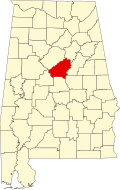 | |
| Towns | ||
| CDPs | ||
| Other unincorporated communities | ||
| Footnotes | ‡This populated place also has portions in an adjacent county or counties | |
| International | |
|---|---|
| National | |
| Geographic | |
| Other | |

Montevallo, Alabama
View on GrokipediaGeography
Location and Topography
Montevallo occupies a position in Shelby County, central Alabama, roughly 30 miles (48 km) south of Birmingham.[1] Its geographic coordinates center at 33°06′18″N 86°51′46″W, placing it near the state's approximate geographic midpoint.[5] The city's topography consists of gently rolling hills characteristic of Alabama's Piedmont Upland region, with elevations averaging 407 to 410 feet (124 to 125 meters) above sea level.[7][8] Local terrain rises modestly to surrounding forested ridges, shaped by erosion-resistant sedimentary rocks underlying the area.[9] Shoal Creek, a tributary of the Cahaba River, traverses the municipality, providing drainage and defining natural boundaries within parks such as Orr Park.[10] This waterway originates in nearby uplands and meanders through the low-relief valley, influencing flood patterns and supporting riparian ecosystems amid the otherwise upland setting.[11]Climate and Environmental Features
Montevallo has a humid subtropical climate, featuring hot, humid summers and mild winters with no prolonged cold periods. Average high temperatures reach 92°F in summer months, while winter lows average around 34°F.[12] Annual precipitation totals approximately 56 inches, distributed relatively evenly throughout the year, with January seeing about 5 inches on average; snowfall is negligible at 0 inches per year.[13][14] The city's environmental landscape includes rolling hills and surrounding forests typical of central Alabama's Piedmont region.[10] Shoal Creek, which flows through Montevallo, supports a diverse ecosystem with native wildflowers, grasses, and an oak-hickory forest tract spanning 18 acres in nearby Shoal Creek Park.[15] The creek's habitat hosts imperiled plant species such as Tennessee gladecress and serves as a key area for birdwatching, with over 150 species documented.[16] Adjacent to the city, the Ebenezer Swamp Ecological Preserve encompasses wetlands teeming with various plant and animal species, contributing to local biodiversity conservation efforts.[17] These features underscore Montevallo's position amid Alabama's varied natural terrain, including chert and sandstone outcrops along ridges near the creek.[18]History
Early Settlement and Founding (1817–1848)
The lands encompassing modern Montevallo were ceded by the Creek Indians to the United States following the Treaty of Fort Jackson in 1814, which concluded the Creek War and opened central Alabama to white settlement.[19] Jesse Wilson, a veteran of the Creek War under General Andrew Jackson, established the area's first known white settlement that same year by claiming a hill on the northern bank of Shoal Creek, initially known as Wilson's Hill; this site, near present-day Montevallo Cemetery, is recognized as Shelby County's oldest settlement, predating the county's formation in 1818 from portions of Cahaba County.[5][19] By the early 1820s, additional homesteaders arrived, drawn to the fertile soils and reliable water sources of Shoal Creek, fostering a small community centered on subsistence farming and basic mills; early residents included Edmond King, who built a log house and later a brick structure used as a store, as well as the McHenry family, who settled nearby in 1820 and lent their name to a local creek.[20][5] Further growth came around 1825 with settlers like Major Jacob Perry and William Moore, who established farms in the vicinity, contributing to the area's transition from isolated homesteads to a nascent crossroads hub for regional farmers.[20] The settlement, still referred to as Wilson's Hill, briefly vied for selection as the University of Alabama's site in the 1830s but lost by a single vote.[20] In 1826, the community adopted the name Montevallo, derived from Italian roots meaning "mountain in the valley," reflecting its topography of low hills amid valleys; this renaming, attributed to local figure Alva Wood, marked a formal identity shift amid increasing trade along emerging roads.[19][20] By the late 1840s, Montevallo's strategic location at wagon trails intersecting near Shoal Creek supported its evolution into a market town, culminating in formal incorporation on January 17, 1848, under Alabama state law, which established municipal governance for the growing population of several hundred.[19][5]Industrial Expansion and Civil War Era (1848–1900)
The arrival of the Alabama and Tennessee River Railroad in 1853, connecting Montevallo to Selma, stimulated economic activity by enabling efficient shipment of local agricultural goods and drawing industrial interest to the region.[19] This infrastructure development coincided with the onset of coal extraction, as early operations under William Phineas Browne utilized slave labor from 1849 to supply fuel for the nearby Little Cahaba Iron Works, laying groundwork for resource-based growth.[21] By 1856, the establishment of a formal coal mine adjacent to the town further diversified the economy beyond farming, with output directed toward emerging metallurgical demands in Shelby County.[19] The English mining engineer Joseph Squire's arrival in Montevallo in 1859 introduced advanced surveying and extraction methods, enhancing productivity at operations like those of the Alabama Coal Mining Company and supporting sustained development in the Cahaba coal field.[21] Local iron production also expanded, exemplified by Tharp & Hollingsworth's foundry, which manufactured pots, pans, and kettles for the Confederate government during the Civil War, powered by regional water and coal resources. These efforts underscored the area's strategic value amid wartime resource scarcity, though production remained modest compared to larger centers like Birmingham. The Civil War culminated in significant disruption for Montevallo's industries. On March 31, 1865, during General James H. Wilson's cavalry raid, Union forces defeated Confederate cavalry under General Nathan Bedford Forrest in a skirmish near the town's railroad depot, subsequently destroying one of the South's remaining ironworks and associated coal facilities.[22] This action, part of a broader campaign launched on March 22, 1865, aimed to dismantle Alabama's industrial base, effectively halting local manufacturing and contributing to the Confederacy's logistical collapse, though it occurred after General Robert E. Lee's surrender on April 9.[22] Postwar reconstruction revived coal operations, with Truman H. Aldrich leasing the Montevallo mine in 1873 and scaling production to supply the expanding iron sector, including his later ventures like the Pratt Coal and Coke Company founded in 1878.[19][21] Enhanced output facilitated coke production for blast furnaces, driving regional industrialization; by 1890, mine operators had constructed worker housing to accommodate a growing labor force, signaling stable economic integration with Alabama's mineral economy.[19] This period transformed Montevallo from a rural outpost into a modest industrial hub, reliant on coal's causal role in powering iron smelting and railroad-dependent trade.[21]Educational Development and 20th Century Growth (1900–2000)
The Alabama Girls' Industrial School, established in Montevallo in 1896, underwent significant expansions in the early 1900s that laid the foundation for its growth as a key educational institution. Under President Francis Marion Peterson (1899–1907), the campus added the Main Dormitory, wings to Reynolds Hall providing 27 classrooms, and new programs in physical culture, physiology, horticulture, and dairy farming, supported by the purchase of a farm for practical training.[23] Enrollment reached approximately 400 students by 1900, necessitating off-campus housing until additional dormitories were constructed.[24] In 1911, the institution was renamed the Alabama Girls' Technical Institute, reflecting its emphasis on practical vocational training alongside liberal arts.[3] President Thomas Waverly Palmer (1907–1926) further expanded facilities, including Bloch Hall and the iconic Tower (1910–1911), and introduced home economics courses in 1907–1908, while establishing a dairy operation.[23] By 1923, it became Alabama College, State College for Women, a degree-granting entity accredited in 1925, with the first degrees awarded in 1922; enrollment climbed to 689 by 1925.[3][25] The college pioneered programs in teacher education, social work (1925), and later speech pathology (1952), contributing to Montevallo's emergence as an education-focused community.[23] Montevallo's first public school opened in 1901 as a one-room schoolhouse, expanding to three rooms by 1907, complementing the college's influence on local education.[26] The institution's development drove town growth, with the campus serving educational needs and attracting faculty and students; population, under 600 in the late 1890s, expanded alongside post-World War II enrollment surges.[26][27] Mid-century shifts included admitting the first male students in 1956—two in January, growing to 35 by fall—transitioning to coeducation amid broader societal changes.[3] Enrollment dipped to 562 in 1953 but rebounded, reaching 2,600 by 1982 as the institution integrated in 1968 and complied with the Civil Rights Act in 1965.[25][23] In 1969, it was renamed the University of Montevallo, organizing into four colleges (Arts and Sciences, Education, Business, Fine Arts) and adding graduate programs, solidifying its role in regional educational and economic expansion through the late 20th century.[3] The university's growth correlated with Montevallo's population nearing 5,000 after 1950, primarily through education-related employment and services.[27]Recent Developments (2000–Present)
The population of Montevallo grew from 5,193 residents in the 2000 census to 6,338 in 2010, reflecting a 21.9% increase driven by regional economic expansion in Shelby County and proximity to the Birmingham metropolitan area.[28] By the 2020 census, the population reached 7,228, a further 14.1% rise, with estimates placing it at 7,761 as of July 1, 2024, amid ongoing annual growth of approximately 2%. This expansion has been supported by housing developments and infrastructure improvements, including efforts to address residential trends for both owners and renters as documented in local planning reports from 2020.[29] Economic activity in Montevallo has diversified beyond its historical reliance on the University of Montevallo and agriculture, with city officials reporting significant growth in commercial sectors during the 2010s and 2020s.[30] Public investments have focused on enhancing quality-of-life assets, such as Main Street revitalization projects promoting arts, local commerce, and tourism to bolster downtown vitality.[31][32] In 2025, construction began on a new hotel to accommodate visitors, particularly for university events and regional travelers, expected to generate additional revenue and support transient lodging needs.[33] The University of Montevallo, the city's primary economic anchor, opened a 90,000-square-foot Student Activity Center in 2004 and added a four-story residence hall in subsequent years to accommodate enrollment fluctuations.[34] However, by 2025, the institution faced financial strain from rising operational costs and aging infrastructure, prompting plans to sell nearly 200 acres of land, implement tuition increases, conduct staff layoffs, and eliminate select academic programs to address a multimillion-dollar deficit.[35] These measures followed years of stable operations but highlighted pressures from enrollment variability and maintenance backlogs in Alabama's public higher education sector.[34] Montevallo has experienced periodic severe weather, including tornado risks inherent to central Alabama, with 104 events of magnitude EF-2 or higher recorded in the vicinity since records began, though no catastrophic direct strikes on the city proper occurred post-2000 comparable to prior decades.[36] The April 27, 2011, super outbreak devastated parts of Shelby County, contributing to statewide economic losses exceeding $1 billion, but Montevallo sustained relatively minor impacts relative to neighboring areas like Birmingham.[37] Community resilience efforts, including university-led recovery initiatives, have since emphasized infrastructure hardening against such events.[38]Government and Politics
Municipal Government Structure
Montevallo operates under the mayor–council form of government, a common structure for Alabama municipalities.[39][19] The mayor is elected at-large by city voters and serves as the chief executive, responsible for administering city operations, enforcing ordinances, and recommending appointments to positions such as department heads.[39][40] The city council consists of five members, each elected from a single-member district to staggered four-year terms, exercising legislative powers that include adopting budgets, enacting local laws, and overseeing municipal policy.[39][41] Council meetings are held biweekly on the second and fourth Mondays of each month at City Hall, beginning with work sessions at 5:30 p.m. followed immediately by formal sessions at 6:00 p.m., during which public input is permitted at designated times.[39] Advisory bodies, including the Planning and Zoning Commission and the Arbor and Beautification Board, provide recommendations to the council on specialized matters such as land use and community aesthetics.[42]Political Demographics and Trends
Montevallo's political demographics reflect the broader conservative tilt of Shelby County, Alabama, where the city is located. The area is characterized as moderately conservative, with residents consistently supporting Republican candidates in national elections. In the 2020 presidential election, Shelby County voters favored Donald Trump over Joe Biden by approximately 72% to 24%, mirroring patterns from prior cycles where the county backed Republican nominees in every presidential contest since 2000.[43][44] Local elections in Montevallo are officially nonpartisan, but underlying partisan affiliations influence outcomes and campaigns. Republican Rusty Nix has served as mayor since defeating challenger Joyce Jones in the 2020 municipal election, securing 678 votes to her 503, and was reelected to a final term on August 26, 2025. Nix's victories underscore the persistence of conservative preferences in town leadership, even as the University of Montevallo's student body—comprising a significant portion of the population with a median age of 26.4—introduces younger voters who may lean more liberal on certain issues.[45][46][47] Recent trends indicate a shift from traditionally low-key, issue-focused local races to greater intrusion of national polarization. Prior to the Trump era, Montevallo's mayoral contests emphasized municipal concerns like infrastructure, but the 2020 race saw Jones, a Black candidate advocating social programs to curb crime, targeted with social media attacks falsely linking her to "defund the police" rhetoric associated with national Democrats and Black Lives Matter, despite her pro-law enforcement stance. This nationalization highlights how external partisan dynamics can amplify racial and ideological divides in small-town Alabama politics, though empirical voting data shows no erosion of the area's Republican dominance.[48][49]Economy
Key Industries and Employment
The economy of Montevallo centers on educational services, retail trade, and accommodation and food services, which dominate employment for local residents. In 2023, these sectors employed 544, 465, and 376 individuals respectively out of a total workforce of 3,181.[49] Overall employment declined by 4.87% from 2022 to 2023, amid broader trends in small-town economies reliant on public institutions and consumer-facing businesses.[49] The University of Montevallo constitutes the city's largest employer, supporting approximately 495 positions including faculty, staff, and administrators.[50] This public liberal arts institution drives much of the service-oriented activity, with common occupations among residents including sales and related roles (405 workers), office and administrative support (373), and food preparation and serving (300).[49] Retail establishments such as Dollar General and Publix, alongside national chains like McDonald's, fill supporting roles in trade and hospitality.[51] Manufacturing remains limited to smaller operations, with firms like Central Industrial Supply (annual revenue $5.19 million) and Lawler Specialties ($3.58 million) providing niche production but not significant job volumes relative to services.[52] Municipal efforts focus on attracting diverse projects to expand beyond university dependence, though growth has been modest in recent years.[30] Shelby County's broader economic base, including utilities and healthcare giants like Alabama Power, indirectly bolsters regional opportunities for Montevallo commuters.[53]University-Driven Economic Impact
The University of Montevallo serves as the primary economic engine for Montevallo, Alabama, anchoring local commerce through its operations and student body. With a total enrollment of 3,142 students in fall 2024—marking a 5.4 percent increase from the previous year—the institution drives demand for off-campus housing, dining, retail, and services in the surrounding area.[54] This student spending sustains small businesses in downtown Montevallo and nearby Shelby County communities, where the university's presence correlates with sustained local economic activity.[30] The university's employment of faculty, staff, and administrative personnel further bolsters the regional economy, with its slightly over 3,000 students generating measurable ripple effects through payroll, construction, and vendor contracts.[55] A 14-to-1 student-faculty ratio underscores the scale of professional staffing, which indirectly supports ancillary jobs in maintenance, transportation, and hospitality.[34] Partnerships between the university and local entities, such as Main Street Alabama initiatives, have facilitated entrepreneurship programs yielding 46 net new jobs in the district through co-starter collaborations as of 2024.[56] Despite internal financial challenges, including an $8 million budget shortfall addressed via tuition increases and program adjustments in 2025, the university's role in stabilizing Montevallo's economy remains prominent, with enrollment growth countering potential downturns in direct contributions.[57] International students, numbering 86 in the 2023-24 academic year, add a modest but targeted boost via tuition and living expenses, aligning with broader state-level impacts from such enrollment.[58] Overall, these dynamics position the university as a catalyst for long-term economic resilience in a town of approximately 7,000 residents, where higher education anchors diversification beyond traditional industries.Education
University of Montevallo
The University of Montevallo is a public liberal arts university in Montevallo, Alabama, founded on October 12, 1896, as the Alabama Girls' Industrial School to offer practical industrial education to young women from across the state.[59] Initially focused on home economics, teaching, and vocational skills, the institution expanded its curriculum amid growing enrollment and legislative support, leading to its renaming as the Alabama Girls' Technical Institute in 1911 and Alabama College in 1923, which emphasized broader liberal arts alongside technical training.[24] It transitioned to co-educational status by admitting men in 1956 and African American students in 1968, before adopting its current name in 1969 to signify its evolution into a comprehensive university with distinct colleges in arts and sciences, education, business, and fine arts.[3][19] Accredited by the Southern Association of Colleges and Schools Commission on Colleges since 1925, the university awards baccalaureate, master's, and specialist degrees across diverse fields.[60] Undergraduate programs include majors such as accounting (BBA), biology (BS), elementary education (BS), and theatre (BFA), while graduate offerings encompass speech-language pathology and occupational therapy.[61][62] The institution maintains a student-to-faculty ratio of 14:1, fostering small class sizes that support personalized instruction in its liberal arts framework.[34] Enrollment stands at 2,586 students, comprising 2,172 undergraduates and 414 graduate students as of the latest figures.[63] The campus preserves significant historical architecture, including the King House—built in 1823 with bricks from nearby Shoal Creek as the residence of planter Edmund King and later incorporated as a guest house—which exemplifies early 19th-century Federal-style construction and was added to the National Register of Historic Places in 1972.[64] This blend of heritage and modern facilities underscores the university's role as a cultural and educational anchor in central Alabama.[65]Public K-12 Schools and Literacy Rates
Public K-12 education in Montevallo is administered through the Shelby County Schools district, which serves the city with three primary institutions: Montevallo Elementary School (grades K-5), Montevallo Middle School (grades 6-8), and Montevallo High School (grades 9-12).[66][67][68] Montevallo Elementary enrolls students in a diverse setting with a student-teacher ratio of 15:1, emphasizing small class sizes.[69] Montevallo High School serves 516 students with a similar ratio of 15.4:1 and 33.5 full-time teachers.[68] Academic performance in these schools trails Shelby County and state averages on standardized assessments, particularly in reading and math proficiency, which serve as key indicators of foundational literacy skills. At Montevallo Elementary, 45% of students achieved proficiency in reading and 37% in math based on state tests.[70] Montevallo High School's proficiency rates are below both Shelby County (62% elementary reading proficiency district-wide) and Alabama averages, contributing to its national ranking of #7,065 out of high schools evaluated on test performance, graduation rates, and college readiness.[71][72] Despite these local outcomes, the overarching Shelby County district earned an A rating on the 2023-2024 Alabama state report card, driven by strong academic growth scores of 99.36, reflecting effective progress in student achievement across grades.[73] Literacy metrics for Montevallo specifically are limited, but county-level data from a 2009 study indicated Shelby County's adult illiteracy rate at 7%, the lowest in Alabama compared to the state's higher averages.[74] More recent proxies through school reading proficiency underscore variability: while district-wide elementary reading proficiency stands at 62%, Montevallo's schools report lower figures, such as 45% at the elementary level, aligning with Alabama's broader challenges in literacy recovery post-2019, where the state ranked third nationally in reading gains but remains below pre-pandemic baselines in absolute terms.[72][75] These disparities highlight the influence of local socioeconomic factors, including a 15.2% poverty rate in Montevallo, on educational outcomes.[49]Demographics
Population Trends and Growth
The population of Montevallo has exhibited consistent growth since the late 20th century, transitioning from a small industrial town to a college-dominated community anchored by the University of Montevallo. Decennial U.S. Census data illustrate this trajectory: 4,825 residents in 2000, rising to 6,323 in 2010 (a 31.1% increase), and further to 7,229 in 2020 (a 14.3% increase from 2010).[76][77][78] Post-2020 estimates indicate accelerated expansion, with the U.S. Census Bureau reporting 7,761 residents as of July 1, 2024—a 7.4% rise from the 2020 base of 7,228, equating to an average annual growth rate of approximately 1.8%. Independent analyses project continued momentum, estimating 8,030 by 2025 at a 2.05% annual clip, outpacing Alabama's statewide urban average of 0.47%.[78][28] This pattern reflects broader Shelby County dynamics, where net migration and natural increase have fueled suburban expansion near Birmingham, but Montevallo's trends are distinctly tied to university-driven influxes; enrollment at the University of Montevallo reached 3,142 in fall 2024, up 5.4% from the prior year, bolstering the local population through students and faculty.[54][79]| Census Year | Population | Percent Change from Prior Decade |
|---|---|---|
| 2000 | 4,825 | - |
| 2010 | 6,323 | +31.1% |
| 2020 | 7,229 | +14.3% |
Racial, Ethnic, and Socioeconomic Composition
As of the 2020 United States Census, Montevallo's population of 7,229 was composed of 69.7% White alone, 25.4% Black or African American alone, 1.0% Asian alone, 0.3% American Indian and Alaska Native alone, 0.1% Native Hawaiian and Other Pacific Islander alone, and 3.5% two or more races. Hispanic or Latino residents of any race accounted for 4.3% of the population. Foreign-born individuals represented 1.8% of residents in 2022 estimates, reflecting limited ethnic diversity beyond these groups.| Race/Ethnicity | Percentage (2020 Census) |
|---|---|
| White alone | 69.7% |
| Black or African American alone | 25.4% |
| Asian alone | 1.0% |
| Two or more races | 3.5% |
| Hispanic or Latino (any race) | 4.3% |
Public Safety
Crime Statistics and Rates
In 2023, Montevallo recorded 80 total crimes according to FBI Uniform Crime Reporting (UCR) data, yielding a rate of 1,019 per 100,000 residents based on a population of approximately 7,850.[80] This total encompasses both violent and property offenses, with the overall rate 45% higher than in 2022 but remaining below broader Alabama trends where state violent crime rates averaged around 453 per 100,000 in recent years.[81] [82] Violent crime in Montevallo was notably low, with 7 incidents reported in 2023 for a rate of 93 per 100,000 residents—about 75% below the national average of 370 and even lower relative to Alabama's higher baseline.[83] [84] These figures include offenses such as assault, with no reported murders or robberies in the dataset; the low volume reflects the small-town character, though small absolute numbers can lead to year-to-year volatility, as seen in the 2023 uptick.[85] Property crimes dominated, comprising the bulk of incidents like larceny and burglary, at a combined rate aligning with the total but still declining over the prior five years.[81] [86]| Category | 2023 Incidents | Rate per 100,000 |
|---|---|---|
| Violent Crime | 7 | 93 |
| Property Crime | ~73 | ~926 |
| Total Crime | 80 | 1,019 |