
Hubbry Logo
Morison equationMorison equationMain
Open search
Morison equation
Community hub
Morison equation
logo
7 pages, 0 posts
0 subscribers
Be the first to start a discussion here.
Morison equation
Morison equation
from Wikipedia
Flow forces according to the Morison equation for a body placed in a harmonic flow, as a function of time. Blue line: drag force; red line: inertia force; black line: total force according to the Morison equation. Note that the inertia force is in front of the phase of the drag force: the flow velocity is a sine wave, while the local acceleration is a cosine wave as a function of time.

In fluid dynamics the Morison equation is a semi-empirical equation for the inline force on a body in oscillatory flow. It is sometimes called the MOJS equation after all four authors—Morison, O'Brien, Johnson and Schaaf—of the 1950 paper in which the equation was introduced.[1] The Morison equation is used to estimate the wave loads in the design of oil platforms and other offshore structures.[2][3]

Description

[edit]
Wave loading on the steel jacket structure of a Production Utilities Quarters Compression (PUQC) platform in the Rong Doi oil field, offshore Vietnam (see Oil megaprojects (2010)).

The Morison equation is the sum of two force components: an inertia force in phase with the local flow acceleration and a drag force proportional to the (signed) square of the instantaneous flow velocity. The inertia force is of the functional form as found in potential flow theory, while the drag force has the form as found for a body placed in a steady flow. In the heuristic approach of Morison, O'Brien, Johnson and Schaaf these two force components, inertia and drag, are simply added to describe the inline force in an oscillatory flow. The transverse force—perpendicular to the flow direction, due to vortex shedding—has to be addressed separately.

The Morison equation contains two empirical hydrodynamic coefficients—an inertia coefficient and a drag coefficient—which are determined from experimental data. As shown by dimensional analysis and in experiments by Sarpkaya, these coefficients depend in general on the Keulegan–Carpenter number, Reynolds number and surface roughness.[4][5]

The descriptions given below of the Morison equation are for uni-directional onflow conditions as well as body motion.

Fixed body in an oscillatory flow

[edit]

In an oscillatory flow with flow velocity , the Morison equation gives the inline force parallel to the flow direction:[6]

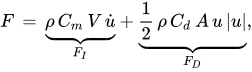
where

  • is the total inline force on the object,
  • is the flow acceleration, i.e. the time derivative of the flow velocity
  • the inertia force , is the sum of the Froude–Krylov force and the hydrodynamic mass force
  • the drag force according to the drag equation,
  • is the inertia coefficient, and the added mass coefficient,
  • A is a reference area, e.g. the cross-sectional area of the body perpendicular to the flow direction,
  • V is volume of the body.

For instance for a circular cylinder of diameter D in oscillatory flow, the reference area per unit cylinder length is and the cylinder volume per unit cylinder length is . As a result, is the total force per unit cylinder length:

Besides the inline force, there are also oscillatory lift forces perpendicular to the flow direction, due to vortex shedding. These are not covered by the Morison equation, which is only for the inline forces.

Moving body in an oscillatory flow

[edit]

In case the body moves as well, with velocity , the Morison equation becomes:[6]

where the total force contributions are:

  • a: Froude–Krylov force, due to the pressure gradient at the body's location induced by the fluid acceleration ,
  • b: hydrodynamic mass force,
  • c: drag force.

Note that the added mass coefficient is related to the inertia coefficient as .

Limitations

[edit]
  • The Morison equation is a heuristic formulation of the force fluctuations in an oscillatory flow. The first assumption is that the flow acceleration is more-or-less uniform at the location of the body. For instance, for a vertical cylinder in surface gravity waves this requires that the diameter of the cylinder is much smaller than the wavelength. If the diameter of the body is not small compared to the wavelength, diffraction effects have to be taken into account.[7]
  • Second, it is assumed that the asymptotic forms: the inertia and drag force contributions, valid for very small and very large Keulegan–Carpenter numbers respectively, can just be added to describe the force fluctuations at intermediate Keulegan–Carpenter numbers. However, from experiments it is found that in this intermediate regime—where both drag and inertia are giving significant contributions—the Morison equation is not capable of describing the force history very well. Although the inertia and drag coefficients can be tuned to give the correct extreme values of the force.[8]
  • Third, when extended to orbital flow which is a case of non uni-directional flow, for instance encountered by a horizontal cylinder under waves, the Morison equation does not give a good representation of the forces as a function of time.[9]

References

[edit]

Further reading

[edit]
Revisions and contributorsEdit on WikipediaRead on Wikipedia
from Grokipedia
The Morison equation is a semi-empirical used to calculate the hydrodynamic forces exerted by waves and currents on slender, cylindrical marine structures, such as offshore piles and legs of platforms, where the structure's is small compared to the (typically D/L < 0.2). Developed in 1950 by J.R. Morison, M.P. O'Brien, J.W. Johnson, and S.A. Schaaf based on laboratory experiments with model piles subjected to oscillatory wave motion, it addresses the limitations of inviscid potential flow theory by incorporating viscous effects. The equation assumes linear wave theory for fluid kinematics and neglects wave diffraction, making it suitable for non-breaking waves on vertical or near-vertical members. The total force per unit length ff on a structural element is given by f=fD+fIf = f_D + f_I, where the drag force fD=12ρCDDuuf_D = \frac{1}{2} \rho C_D D |u| u accounts for velocity-dependent viscous drag, and the inertia force fI=ρCM(πD24)u˙f_I = \rho C_M \left( \frac{\pi D^2}{4} \right) \dot{u} represents acceleration-dependent pressure and added mass effects. Here, ρ\rho is the fluid density, DD is the diameter, uu and u˙\dot{u} are the undisturbed horizontal fluid velocity and acceleration, CDC_D is the drag coefficient (typically 0.6–1.2 for rough cylinders), and CMC_M is the inertia coefficient (often 1.5–2.0 for circular sections). These empirical coefficients are determined from model tests or field data, varying with Reynolds number, Keulegan-Carpenter number, and surface roughness. Originally formulated for fixed vertical piles extending from the seabed through the water surface, the equation has been extended to moving structures by incorporating relative velocity and acceleration, as f=12ρCDDux˙(ux˙)+ρCMVu˙ρ(CM1)Vx¨f = \frac{1}{2} \rho C_D D |u - \dot{x}| (u - \dot{x}) + \rho C_M V \dot{u} - \rho (C_M - 1) V \ddot{x}, where xx is the structural motion and VV is the displaced volume. It remains a cornerstone of offshore engineering design standards, such as API RP 2A, for predicting loads on jackets, tension-leg platforms, and subsea templates under combined wave-current conditions. Despite its simplicity, limitations include inaccuracy for large-diameter members (where diffraction dominates), steep waves, or multi-member interactions, prompting ongoing refinements like wake effects and vortex-induced vibrations.

Introduction

Historical Development

The Morison equation was introduced in 1950 by J. R. Morison, M. P. O'Brien, J. W. Johnson, and S. A. Schaaf in their seminal paper titled "The Force Exerted by Surface Waves on Piles," published in the Journal of Petroleum Technology. This work presented an empirical formulation to estimate the hydrodynamic forces exerted by unbroken surface waves on cylindrical piles, combining drag and inertia components based on experimental observations. The equation emerged from studies aimed at understanding wave-induced loads on offshore pilings during the early expansion of petroleum exploration in coastal waters. The original development stemmed from wave tank experiments conducted at the University of California, Berkeley, where researchers measured forces on vertical circular piles under controlled oscillatory flows simulating ocean waves. These laboratory tests involved varying pile diameters, wave heights, and periods to fit an empirical model that captured the observed force profiles, revealing the relative contributions of velocity-squared drag and acceleration-proportional inertia terms. Initially referred to as the MOJS equation after its four authors, the formulation provided a practical tool for engineers designing pile-supported structures in wave environments. In the years following its publication, the equation underwent initial validations through field measurements on offshore structures during the 1950s, confirming its applicability beyond controlled settings. Notable efforts included the 1951 Monterey field tests by Snodgrass, Rice, and Hall, which recorded wave forces on instrumented pilings to assess real-sea conditions. Further laboratory studies were presented by Morison, Johnson, and O'Brien in 1953. These validations demonstrated reasonable agreement for non-breaking waves, establishing the equation's role in early offshore engineering practices, though impact forces from breakers required additional considerations.

Overview and Scope

The Morison equation is a semi-empirical relation for estimating the inline hydrodynamic forces acting on slender structures with a small diameter-to-wavelength ratio in oscillatory flows, such as those generated by ocean waves and currents. It combines two primary force components: an inertia force proportional to the acceleration of the surrounding fluid, and a drag force proportional to the square of the relative velocity between the fluid and the structure. This formulation allows for practical predictions of wave-induced loads on structural elements like piles and tubular members. The equation's scope is centered on ocean engineering applications where the diameter of the body is significantly smaller than the wavelength of the oscillatory flow—typically less than 20% of the wavelength—to ensure the slender body approximation holds and diffraction effects are negligible. It is widely applied in the design and analysis of offshore installations, including oil platforms and wind turbines, to assess hydrodynamic loading under combined wave and current conditions. For larger structures approaching the wavelength scale, diffraction effects become dominant, rendering the Morison approach less suitable. As a semi-empirical model, the Morison equation extends beyond inviscid potential flow theory by incorporating viscous effects through calibrated coefficients, enabling it to capture both added mass and frictional drag in real fluid environments. This distinction makes it a cornerstone tool for engineering approximations where full viscous simulations are computationally prohibitive.

Mathematical Formulation

Derivation

The derivation of the Morison equation begins from Newton's second law applied to the motion of a structure in a fluid, where the net hydrodynamic force equals the rate of change of momentum of the structure plus the surrounding fluid. This force arises from the integration of pressure and viscous shear stresses over the structure's surface, but for slender bodies where the diameter is much smaller than the wavelength, the interaction is simplified by decomposing the force into an inertial component proportional to fluid acceleration and a viscous drag component proportional to relative velocity squared. The inertial term originates from inviscid potential flow theory, capturing the unsteady pressure forces due to accelerating fluid. In undisturbed potential flow past a circular cylinder, the force includes the Froude-Krylov component from the pressure gradient in the incident flow, which is equivalent to the mass of displaced fluid times the fluid acceleration, plus an added mass component from the kinetic energy of the fluid induced by the body's motion. The added mass coefficient CaC_a quantifies the effective fluid mass entrained by the body; for a circular cylinder, Ca=1C_a = 1 in two-dimensional potential flow. Thus, the total inertia coefficient is given by Cm=1+Ca,C_m = 1 + C_a, where the "1" represents the displaced fluid mass and CaC_a the added mass. This formulation is extended to oscillatory flows by assuming the local flow acceleration dominates and potential flow approximations hold over short timescales. The drag term adopts an empirical quadratic form inspired by steady-flow viscous drag correlations, such as those for cylinders in uniform currents, where force scales with the square of velocity to account for boundary layer separation and wake formation. Morison et al. hypothesized that this nonlinear viscous effect persists in unsteady oscillatory flows, combining it with the inertial term to model the total local force per unit length without deriving it from first principles of viscous flow. The total force on an extended structure is obtained by integrating the local force contributions along its length, assuming spatial uniformity of the flow over each cross-section and gradual variation along the axis relative to the structure's diameter. This allows evaluation using depth-dependent velocity and acceleration from linear wave theory at each point. Finally, the drag and inertia coefficients are calibrated empirically via least-squares regression against experimental measurements of total force, using known incident flow kinematics to isolate and fit each term's contribution. This method, applied in early wave tank tests on piles, confirms the superposition assumption and determines coefficient values for specific conditions.

Fixed Structures

The Morison equation for fixed structures, such as stationary offshore piles or legs, estimates the hydrodynamic force exerted by oscillatory fluid flows, like waves, on slender bodies where the structure diameter is small compared to the wavelength. For a fixed body with zero velocity relative to the fluid, the total force FF is given by F=ρCmVu˙+12ρCdAuu,F = \rho C_m V \dot{u} + \frac{1}{2} \rho C_d A u |u|, where ρ\rho is the fluid density, CmC_m is the inertia coefficient, VV is the displaced volume of the body, u˙\dot{u} is the undisturbed fluid acceleration, CdC_d is the drag coefficient, AA is the projected area perpendicular to the flow, and uu is the undisturbed fluid velocity. This equation decomposes the total force into an inertia component FI=ρCmVu˙F_I = \rho C_m V \dot{u}, which arises from the pressure gradient in the accelerating fluid and the added mass effect around the body, and a drag component FD=12ρCdAuuF_D = \frac{1}{2} \rho C_d A u |u|, which accounts for the nonlinear viscous drag due to the relative flow past the structure. The inertia term dominates in low-velocity, high-acceleration regimes, such as deep-water waves, while the drag term becomes significant in shallower waters or with higher velocities. For vertical cylinders, common in fixed offshore platforms, the force is computed by integrating the local force per unit length along the submerged depth, as velocity and acceleration vary with elevation due to wave kinematics. Using linear wave theory, the horizontal velocity u(z,t)u(z, t) and acceleration u˙(z,t)\dot{u}(z, t) at depth zz (with z=0z = 0 at the mean water level and negative downward) for a sinusoidal wave of height HH, period TT, wavenumber kk, and water depth dd are u(z,t)=πHTcosh[k(z+d)]sinh(kd)cos(kxωt),u(z, t) = \frac{\pi H}{T} \frac{\cosh[k(z + d)]}{\sinh(kd)} \cos(kx - \omega t), u˙(z,t)=2π2HT2cosh[k(z+d)]sinh(kd)sin(kxωt),\dot{u}(z, t) = -\frac{2\pi^2 H}{T^2} \frac{\cosh[k(z + d)]}{\sinh(kd)} \sin(kx - \omega t), where ω=2π/T\omega = 2\pi / T is the angular frequency. The force per unit length f(z,t)f(z, t) on a cylinder of diameter DD is then f(z,t)=ρCm(πD24)u˙(z,t)+12ρCdDu(z,t)u(z,t)f(z, t) = \rho C_m \left( \frac{\pi D^2}{4} \right) \dot{u}(z, t) + \frac{1}{2} \rho C_d D u(z, t) |u(z, t)|, and the total horizontal force is F(t)=d0f(z,t)dzF(t) = \int_{-d}^{0} f(z, t) \, dz (or up to the wave crest if applicable). This integration captures the depth-dependent distribution, with maximum forces typically occurring near the surface where velocities peak. In practice, full depth integration often amplifies the forces by a factor related to the hyperbolic distribution, emphasizing the need for site-specific wave parameters.

Moving Structures

For moving structures, such as floating offshore platforms or risers, the Morison equation is extended to include the effects of body motion by replacing absolute fluid kinematics with relative values between the fluid and structure, enabling accurate prediction of hydrodynamic forces in dynamic conditions. This adaptation is essential for time-domain simulations where structural responses interact with wave-induced flows, distinguishing it from the fixed structure formulation by incorporating terms that account for the body's velocity and acceleration. The force FF on a moving body is expressed as: F=ρVu˙+ρCaV(u˙v˙)+12ρCdA(uv)uvF = \rho V \dot{u} + \rho C_a V (\dot{u} - \dot{v}) + \frac{1}{2} \rho C_d A (u - v) |u - v| where ρ\rho is the fluid density, VV is the volume of the body element, AA is the projected area normal to the flow, uu and u˙\dot{u} are the undisturbed fluid velocity and acceleration, vv and v˙\dot{v} are the corresponding body values, CaC_a is the added mass coefficient, and CdC_d is the drag coefficient. The first term, ρVu˙\rho V \dot{u}, represents the unsteady pressure gradient force (Froude-Krylov force) due to the fluid acceleration alone. The second term, ρCaV(u˙v˙)\rho C_a V (\dot{u} - \dot{v}), captures the relative inertia effect, arising from the added mass of fluid accelerated with the body. The third term is the nonlinear drag force based on the square of the relative velocity, modeling viscous effects. This form is integrated along the structure's length in time-domain simulations to compute dynamic responses, such as those of tension-leg platforms under wave loading. For instance, in studies of oscillating cylinders in regular waves, the relative terms highlight resonance effects when the body's natural frequency aligns with the wave frequency, amplifying forces by up to several times the static values and emphasizing the need for tuned damping.

Coefficients and Parameters

Drag Coefficient

The drag coefficient CdC_d in the Morison equation is a non-dimensional parameter that quantifies the magnitude of the viscous drag force acting on a slender structure, such as a circular cylinder, in a fluid flow. It appears in the drag force term, which is proportional to the square of the relative fluid velocity, and is defined such that the drag force per unit length is fd=12ρCdDuuf_d = \frac{1}{2} \rho C_d D |u| u, where ρ\rho is the fluid density, DD is the cylinder diameter, and uu is the fluid velocity normal to the cylinder axis. For smooth circular cylinders, typical values of CdC_d range from 0.6 to 1.2, depending on flow conditions; recommended design values from industry standards include 0.65 for smooth surfaces and up to 1.05 for roughened or marine-growth-covered cylinders. The value of CdC_d depends primarily on the Keulegan-Carpenter number KC=umaxTD\mathrm{KC} = \frac{u_{\max} T}{D} (where umaxu_{\max} is the maximum velocity amplitude and TT is the flow period), the Re=umaxDν\mathrm{Re} = \frac{u_{\max} D}{\nu} (where ν\nu is the kinematic viscosity), and surface roughness, with roughness increasing CdC_d by up to 50% in oscillatory flows. Empirical determination of CdC_d relies on experimental measurements from both steady uniform flow tests and oscillatory flow tests. In steady flow experiments, CdC_d is obtained by correlating drag forces with Re\mathrm{Re}, using approximations like Oseen's model for low-Re\mathrm{Re} regimes where viscous effects dominate without flow separation. For oscillatory flows relevant to waves, values are derived from specialized facilities like U-tube oscillators, with seminal curves developed by Sarpkaya in the 1970s and 1980s showing CdC_d as a function of KC\mathrm{KC} and Re\mathrm{Re} for both smooth and rough cylinders. Variations in CdC_d are pronounced at low KC\mathrm{KC} (< 10), where values are higher due to enhanced flow separation and initial vortex formation around the cylinder, leading to increased drag relative to inertial effects. In high-Re\mathrm{Re} flows (> 10510^5), typically post-critical, CdC_d stabilizes around 0.6–0.7 for smooth cylinders as suppresses separation, making the drag term dominant in regimes where velocity-squared effects prevail over acceleration-based forces.

Inertia Coefficient

The inertia coefficient CmC_m in the Morison equation quantifies the inertial loading on a due to the of the surrounding fluid. It is defined as Cm=1+CaC_m = 1 + C_a, where the value of 1 corresponds to the mass of fluid displaced by the , and CaC_a is the coefficient representing the additional fluid mass accelerated in the vicinity of the . In inviscid potential flow theory, Ca=1C_a = 1 for a two-dimensional circular cylinder, yielding an ideal Cm=2C_m = 2. This theoretical value assumes irrotational flow without viscous effects or flow separation. The coefficient's magnitude primarily depends on the Keulegan-Carpenter number (KC), which characterizes the oscillatory flow regime, and shows relatively low sensitivity to the Reynolds number compared to the drag coefficient. At high KC values, CmC_m decreases owing to vorticity generation and the formation of circulating flows around the structure, which reduce the effective added mass. Experimental determination of CmC_m integrates predictions with measurements from wave tank tests, as pioneered in the seminal work of Morison et al. (1950), which reported values near 2 for small-amplitude waves on piled structures. Subsequent validations, including large-scale experiments, have refined these estimates while confirming the theoretical baseline for low-KC conditions. For practical applications in oscillatory flows, Cm2C_m \approx 2 holds for KC < 6, with empirical relations depicting a progressive decline—such as to approximately 1.5 at KC ≈ 20—derived from regression analyses of force measurements. These variations underscore the need for KC-based selection in engineering design.

Applications

Offshore Engineering

The Morison equation is widely applied in offshore engineering to estimate wave and current loads on fixed platforms, jackets, and piles, particularly for slender members where the structure diameter is small relative to the wavelength. In regions like the North Sea, it facilitates the calculation of hydrodynamic forces on steel jacket platforms exposed to severe wave environments, enabling designers to assess structural integrity under combined environmental loading. This approach is essential for pile foundations in fixed offshore oil rigs, where currents and oscillatory waves contribute to both drag and inertia components of the force. Integration of the Morison equation with linear wave theory, such as , provides velocity profiles for input into force computations, allowing for the determination of total base shear and overturning moments on offshore structures. Airy theory approximates water particle kinematics under small-amplitude waves, which are then used in the fixed-structure form of the equation to predict distributed loads along vertical and horizontal members. These calculations are critical for evaluating global stability, such as the shear at the mudline and moments that could lead to foundation failure in deepwater installations. A notable early application occurred in the analysis of wave force data from Gulf of Mexico offshore platforms during the late 1960s and 1970s, where the Morison equation was calibrated against measured forces from hurricane events and used to predict responses to individual large waves, showing good agreement between observed and calculated values. This validation demonstrated the equation's reliability for irregular seas, with predicted forces aligning closely with instrumentation data after adjusting coefficients based on site-specific measurements. In modern practice, the Morison equation is implemented in software tools like OrcaFlex for time-domain simulations of offshore structures, incorporating wave-current interactions to model dynamic responses of fixed platforms. Similarly, ANSYS AQWA employs the equation for hydrodynamic load prediction in coupled analyses, supporting detailed assessments of base shear and moments under transient conditions.

Other Engineering Contexts

The Morison equation has been adapted to estimate hydrodynamic forces on tidal turbine blades operating in oscillatory tidal flows, where slender rotor elements experience combined steady current and wave-induced velocities. In experimental studies, an extended form of the equation separates drag into mean and oscillatory components to model blade root bending moments, assuming attached flow conditions and neglecting Froude-Krylov forces for simplicity. This approach reveals that inertia contributions are minor relative to drag, particularly at low reduced frequencies, allowing quasi-steady models to approximate loads effectively on stiff blades with constant rotational speed. For coastal structures such as breakwaters and piers, the Morison equation calculates wave and current forces on vertical cylinder arrays, which form essential components like pile-supported platforms. Experimental investigations demonstrate that inter-cylinder spacing significantly influences total forces, with reductions in gap-to-diameter ratios below 0.25 leading to rapid increases in array loading due to flow blockage, while currents of 0.15 m/s amplify individual cylinder forces by 10-20%. The equation applies to non-breaking waves on small-diameter piles (diameter/wavelength < 0.2), incorporating drag coefficients of 0.7-2.5 and inertia coefficients of 1.05-2.5 to predict horizontal forces per unit length. In cases of breaking waves on pier piles, it estimates impact forces based on local crest elevations, aligning with guidelines for piled jetties exposed to oscillatory flows. The drag component of the Morison equation finds analogy in wind engineering for estimating gust loads on slender towers, where quasi-steady aerodynamic forces are modeled by adapting the quadratic drag term to account for air density and wind velocity profiles, though the inertia term is typically negligible due to lower fluid mass. This adaptation supports load spectra analysis for offshore tower structures under combined wind and wave conditions, highlighting similarities in force superposition for dynamic response prediction. Post-2000 applications extend the Morison equation to floating wind turbines, where it computes viscous drag and inertia on platform members like barges in deepwater sites (200 m depth), integrated into tools such as HydroDyn for coupled aero-hydro-elastic simulations of the NREL 5-MW baseline turbine. For such systems, the equation handles nonlinear wave kinematics on slender cylinders but requires supplementation with potential flow methods for radiation and diffraction effects, revealing excessive pitch motions under extreme conditions that necessitate damping enhancements. Recent 2025 studies have incorporated frequency-dependent coefficients into the Morison equation for improved hydrodynamic modeling of offshore wind turbines. In subsea equipment, recent 2020s studies apply the equation within finite element models like OrcaFlex to assess hydrodynamic loads on deepwater steel catenary risers (2000 m depth) under 100-year return period waves and currents, optimizing designs via bio-inspired algorithms to reduce weight by 35.76% while evaluating stresses at hang-off and touchdown points, with drag coefficients of 1.6 and inertia coefficients of 2.0.

Limitations and Extensions

Key Limitations

The Morison equation relies on the fundamental assumption that the structure is slender, meaning its characteristic diameter DD must be significantly smaller than the incident wavelength λ\lambda, typically D/λ<0.2D/\lambda < 0.2, for the equation to accurately predict forces without diffraction effects dominating. When this ratio exceeds 0.2, wave diffraction around the body becomes significant, rendering the inertia and drag components unreliable as they fail to capture the altered pressure field. This limitation restricts the equation's use to small-diameter elements like piles or risers, excluding larger structures such as caissons or breakwaters where full diffraction theory is required instead. Another key constraint arises from the equation's neglect of non-uniform flow fields, assuming spatially uniform velocity and acceleration across the body's cross-section, which introduces errors in steep waves or near the free surface where vertical variations in kinematics are pronounced. In such conditions, the linear wave theory underpinning the velocity profile overpredicts or underpredicts local forces, particularly in the splash zone or under breaking waves, leading to inaccuracies in total load estimates. This assumption holds reasonably only for deep submergence or gentle wave slopes, but falters in realistic sea states with strong gradients. The equation performs poorly in the intermediate Keulegan-Carpenter (KC) number regime, specifically 6<KC<206 < \mathrm{KC} < 20, where oscillatory flow induces complex vortex shedding that the simple drag term cannot adequately model, often underpredicting peak forces. At these KC values, the flow transitions from inertia-dominated to a regime influenced by boundary layer separation and wake dynamics, which the empirical formulation overlooks, resulting in scattered experimental validation. This gap is particularly evident for rough or marine-growth-covered cylinders, amplifying discrepancies. Furthermore, the Morison equation exclusively computes inline (horizontal) forces, ignoring transverse components such as lift forces or those from vortex-induced vibrations (VIV), which can be substantial for KC > 6 and contribute to or dynamic amplification in flexible structures. Without accounting for these perpendicular loads, the model underestimates total hydrodynamic loading and stability risks, necessitating supplementary analyses for comprehensive . The reliance on empirical drag (CDC_D) and inertia (CMC_M) coefficients introduces inherent uncertainty, as their values exhibit significant variability—often 20-40% scatter—for non-standard geometries, such as inclined, roughened, or non-circular members, due to limited experimental data and sensitivity to or surface conditions. Calibration from canonical tests (e.g., smooth vertical cylinders) does not generalize well, leading to conservative or optimistic force predictions in unconventional applications like jacket legs with marine fouling.

Modern Extensions

Modern extensions of the Morison equation have addressed key limitations in handling complex flow regimes, particularly for high Keulegan-Carpenter (KC) numbers where wake effects become prominent. Sarpkaya's 1986 experimental study on smooth and rough cylinders in oscillatory flows at high Reynolds numbers introduced modifications to incorporate wake-induced forces for KC > 10, demonstrating through U-tube experiments that and in the wake significantly alter drag and inertia coefficients, leading to more accurate force predictions in regimes where the original equation underestimates nonlinear effects. To extend applicability to three-dimensional geometries, refinements have been developed for non-circular cross-sections and inclined structural members. For non-circular sections, such as rectangular or square profiles common in offshore platforms, the and form factors are adjusted in the drag term to account for shape-dependent , improving load estimates in validation studies against experimental data. For inclined members, the velocity components are resolved normal and tangential to the axis, with the normal component feeding into the standard Morison terms while tangential effects are often neglected or approximated via empirical reductions in coefficients, enabling reliable predictions for structures with sloped legs. Additionally, hybrid models combining theory with terms, such as the MacCamy-Fuchs approach adapted for intermediate body sizes, blend solutions for large-diameter cylinders (where KC < 2 and dominates) with Morison's component, providing a smooth transition for bodies where neither regime fully applies and reducing errors in wave force calculations by integrating analytical kernels with empirical drag. Numerical enhancements in the 2010s leveraged (CFD), particularly Reynolds-averaged Navier-Stokes (RANS) models, to validate and refine coefficient predictions. These simulations, often using k-ε or k-ω turbulence closures, have shown that traditional constant coefficients overlook flow unsteadiness and separation, allowing for dynamic tuning based on local KC and Reynolds numbers; for instance, RANS validations against towing tank experiments improved inertia coefficient accuracy for oscillatory flows around vertical piles, establishing CFD as a benchmark for calibrating Morison parameters in software. Recent advancements up to 2025 incorporate for coefficient tuning and coupled hydro-elastic formulations for flexible structures. models, trained on large datasets from CFD and experiments, predict drag and inertia coefficients as functions of KC, , and , achieving improved prediction accuracy across diverse scenarios and enabling real-time adjustments in simulations for irregular waves. Coupled hydro-elastic models integrate the Morison equation with finite element , accounting for deformation-induced changes in hydrodynamic loading on flexible elements like lines or VLFS connectors; for example, time-domain analyses of platforms reveal that flexibility amplifies local stresses under combined waves and currents, with the model iteratively updating geometry and velocities for enhanced fidelity.

References

Add your contribution
Related Hubs
User Avatar
No comments yet.




