Hubbry Logo
Mount LoftyMount LoftyMain
Open search
Mount Lofty
Community hub
Mount Lofty
logo
8 pages, 0 posts
0 subscribers
Be the first to start a discussion here.
Mount Lofty
Mount Lofty
from Wikipedia

Mount Lofty (34°58′S 138°42′E / 34.967°S 138.700°E / -34.967; 138.700, elevation 710 m (2,330 ft) AHD) is the highest point in the southern Mount Lofty Ranges. It is located about 15 km (9.3 mi) east of the Adelaide city centre, within the Cleland National Park in the Adelaide Hills area of South Australia.

Key Information

The mountain's summit has panoramic views of the city and the Adelaide plains to the west, and of the Picadilly Valley to the east. It is also popular destination for international tourists, as well as for cyclists coming up the old Mount Barker Road through Eagle on the Hill, and for walkers from Waterfall Gully. During winter, hail and sleet regularly occur on the mountain, and occasionally small dustings of light snow.[2]

History

[edit]
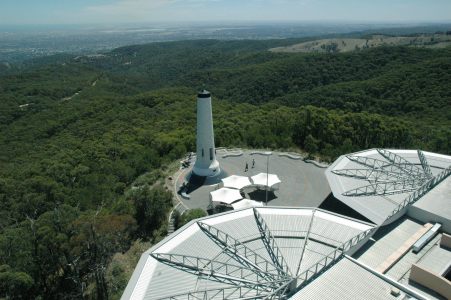
Flinders Column and viewing platform

Aboriginal significance

[edit]

The adjacent peaks of Mount Lofty and Mount Bonython form a prominent landmark visible across the Adelaide Plains, known to the local Kaurna people as Yuridla, 'two-ears', part of the body of an ancestral being called Nganu.[3][4] This Kaurna name has been preserved in its anglicised form as the name of the nearby town of Uraidla.

European discovery and use

[edit]

Mount Lofty was named by Matthew Flinders on 23 March 1802 during his circumnavigation of the Australian continent.[5] The explorer Collet Barker was the first European to climb it, in April 1831, almost six years before Adelaide was settled.

A stone cairn at the summit was originally used to mark the trig point, and in 1885 this was replaced by an obelisk which served as the central reference point for surveying purposes across Adelaide. In 1902 the obelisk was rededicated and renamed as the "Flinders Column".[6]

The summit was closed to the public during the Second World War, when the obelisk was considered an indispensable navigation aid. A flashing strobe was fitted to the top to improve visibility at night. This strobe was removed after the war, but then re-installed in the 1990s, when the obelisk was repainted and restored during construction of a new kiosk.

Access and description

[edit]

The summit can be accessed by road from the South Eastern Freeway at Crafers, and from the eastern suburbs via Greenhill Road and the Mount Lofty Scenic Route. There is a walking route up the gully from Waterfall Gully, through the Cleland National Park and from Chambers Gully. This is a 4 km uphill trek and one of Adelaide's most popular exercise circuits.

The summit provides panoramic views across Adelaide, a cafe-restaurant and a gift shop. Kangaroos are sometimes spotted on the trails leading up to the summit.

On the ridge near the summit are three television transmission towers (the northernmost being that of the ABC), and the Mount Lofty Fire Tower operated by the Country Fire Service.

Historic houses

[edit]

Summit Road, Mt Lofty, was historically one of the best-known addresses in South Australia, with the summer houses of several prominent families being located there. These were all destroyed or severely damaged by the Ash Wednesday bushfires in 1983, but have subsequently been restored.[7] They include:

Other buildings, such as St Michael's House (an Anglican theological college and priory) and "Arthur's Seat", for a time known as Stawell School, a private school for girls, were never rebuilt.[12] Part of this property was excised for the ABC-TV transmitter building and mast.

Note that historically, "Mount Lofty" addresses frequently referred to the area now known as Crafers and to parts of Stirling.

Climate

[edit]

Snow

[edit]
Snow on Mount Lofty in August 2008.

Mount Lofty is the coldest location in the Adelaide area; during winter months the temperature may not exceed 3-4 °C on some days.

Adelaide's metropolitan area experiences mild winters, with temperatures virtually never cold enough to produce snow; the nearest snowfields to Adelaide are in central Victoria, over 700 km away. However, Mount Lofty's summit is the most common location for snow in South Australia; rare snowfalls sometimes occur in other parts of the Mount Lofty Ranges, and occasionally further north, in the Flinders and Gammon Ranges.[13] Snowfall tends to be light (rarely lasting for more than a day) and does not take place every year. Sleet however is a regular occurrence.

General and rainfall

[edit]

Mount Lofty has a cool Mediterranean climate (Csb) in the Köppen climate classification, due to its elevation and very dry summers with a pronounced winter rainfall peak. The annual rainfall is nearly twice the amount, and the monthly rainfall during winter more than twice the amount, of the city of Adelaide. Cloud cover is particularly heavy during the winter months.

Climate data for Mount Lofty (1991−2020); 685 m AMSL; 34.98° S, 138.71° E
Month Jan Feb Mar Apr May Jun Jul Aug Sep Oct Nov Dec Year
Record high °C (°F) 41.1
(106.0)
38.9
(102.0)
36.0
(96.8)
31.0
(87.8)
24.5
(76.1)
20.1
(68.2)
16.9
(62.4)
24.0
(75.2)
27.0
(80.6)
34.3
(93.7)
37.1
(98.8)
39.0
(102.2)
41.1
(106.0)
Mean daily maximum °C (°F) 22.5
(72.5)
22.5
(72.5)
19.6
(67.3)
16.2
(61.2)
12.3
(54.1)
9.4
(48.9)
8.9
(48.0)
10.0
(50.0)
12.4
(54.3)
15.3
(59.5)
18.0
(64.4)
20.2
(68.4)
15.6
(60.1)
Daily mean °C (°F) 17.5
(63.5)
17.7
(63.9)
15.4
(59.7)
13.1
(55.6)
10.0
(50.0)
7.5
(45.5)
7.0
(44.6)
7.6
(45.7)
9.3
(48.7)
11.4
(52.5)
13.7
(56.7)
15.5
(59.9)
12.1
(53.9)
Mean daily minimum °C (°F) 12.4
(54.3)
12.9
(55.2)
11.2
(52.2)
9.9
(49.8)
7.7
(45.9)
5.6
(42.1)
5.0
(41.0)
5.2
(41.4)
6.1
(43.0)
7.5
(45.5)
9.3
(48.7)
10.8
(51.4)
8.6
(47.5)
Record low °C (°F) 4.5
(40.1)
4.4
(39.9)
3.8
(38.8)
2.5
(36.5)
−0.4
(31.3)
0.0
(32.0)
−0.1
(31.8)
−0.5
(31.1)
0.3
(32.5)
0.4
(32.7)
1.4
(34.5)
3.0
(37.4)
−0.5
(31.1)
Average precipitation mm (inches) 38.5
(1.52)
36.5
(1.44)
38.2
(1.50)
58.0
(2.28)
109.9
(4.33)
143.5
(5.65)
147.9
(5.82)
139.0
(5.47)
114.1
(4.49)
65.6
(2.58)
43.0
(1.69)
44.8
(1.76)
986.4
(38.83)
Average rainy days 6.9 8.1 10.0 12.9 17.3 20.2 22.1 21.5 18.1 13.8 11.0 10.0 171.9
Average relative humidity (%) (at 3pm) 51 50 56 60 73 82 80 72 70 64 58 53 64
Source: [14]
[edit]

See also

[edit]

References

[edit]
[edit]
Revisions and contributorsEdit on WikipediaRead on Wikipedia
from Grokipedia
Mount Lofty is the highest peak in the southern of , rising to an elevation of 710 metres above sea level and located approximately 15 kilometres east of in the . This prominent summit provides spectacular panoramic views of Adelaide's skyline, the , and the surrounding coastal plains, making it a key natural landmark in the region. It forms part of , which encompasses diverse native and attracts over 350,000 visitors annually for its scenic walking trails, including connections to the nearby Waterfall Gully and the long-distance Heysen Trail. Geographically, Mount Lofty lies within the broader and region, a 6,700 area that stretches from Kersbrook in the north to Cape Jervis in the south, including 170 kilometres of coastline along the . The ranges, including Mount Lofty, result from ancient tectonic uplift along major fault lines, elevating the terrain more than 700 metres above and creating a dramatic western scarp that borders the Plains. This area is one of Australia's 15 recognised biodiversity hotspots, supporting half of South Australia's native plant species—such as rare orchids and the Mount Compass oak-bush—and three-quarters of its native bird species, alongside 147 threatened bird species. The peak's location also plays a vital role in local water resources, contributing to ecosystems like the swamps and the nearby Coorong wetlands. Historically, the Mount Lofty area holds deep cultural significance as part of the traditional lands of the people to the west and the people to the east, who utilised the landscape for food, medicines, and materials long before European settlement in 1836. European exploration began in the early , with the peak, which was named by in 1802, overlooking the new colony. The saw early activities in the ranges, marking Australia's first post-colonial mining era, though Mount Lofty itself became renowned for and recreation by the late , with the establishment of summit facilities and the Mount Lofty Botanic Garden in 1977. Today, the site supports a thriving valued at over $400 million annually for the region, while ongoing conservation efforts highlight its importance as a working agricultural and .

Geography

Location and topography

Mount Lofty is situated in the region of , at coordinates 34°58′S 138°42′E, approximately 15 km east of Adelaide's city center. As the highest point in the southern , it rises to an elevation of 710 m (2,330 ft) above . The topography of Mount Lofty features prominent steep escarpments along its western face, forming a dramatic scarp that drops toward the Plains, while the broader consist of undulating ridges and valleys shaped by tectonic uplift and erosion. These ridges extend northward, creating a rugged backbone to the ranges that contrasts with the flatter plains to the west. At the , Mount Lofty offers expansive panoramic views encompassing the Plains, the city skyline, , and to the west, as well as the surrounding hills and Piccadilly Valley to the east. The peak integrates seamlessly with the boundaries of , which encompasses the summit and adjacent bushland, preserving the natural contours and providing continuity across the landscape.

Geology

Mount Lofty, the highest peak in the , formed as part of the Adelaide , a major that developed along the eastern margin of the ancient Australian continent during the to early eras, spanning from approximately 850 to 500 million years ago. This accumulated thick sequences of sediments in a subsiding trough, influenced by rifting and subsequent tectonic activity. The predominant rock types exposed at Mount Lofty consist of metamorphosed sedimentary layers, including quartzites, sandstones, and schists, derived from original and deposits such as the Stonyfell Quartzite and related formations. These rocks underwent low- to medium-grade , transforming sandstones into durable and shales into schists, with forming resistant ridges and summits due to their hardness. Interbedded layers of arkosic sandstones and chloritic schists contribute to the varied outcrops observed in the area. The tectonic history of Mount Lofty is dominated by the Delamerian Orogeny, a major compressional event around 500 million years ago during the late to early , which folded and thrust the geosynclinal sediments into the north-south trending . This resulted from the collision of continental margins, uplifting the basement rocks and creating a fold-thrust belt that defines the ranges' structure. Subsequent erosion and weathering over hundreds of millions of years have sculpted the current landforms of Mount Lofty, exposing the resistant quartzite caps while incising valleys into softer schists and sandstones, contributing to the rugged topography observed today.

History

Indigenous significance

Mount Lofty, located within the Mount Lofty Ranges, holds profound cultural and spiritual importance to the Peramangk people, the traditional custodians of the region, as well as the neighboring Kaurna people of the Adelaide Plains and foothills. The ranges, including Mount Lofty, are known to both groups as Yuridla, meaning "two ears," referring to the peaks of Mount Lofty and nearby Mount Bonython as the ears of the creator ancestor Nganu, whose fallen body formed the landscape in Dreamtime stories. This narrative underscores the site's sacred role, portraying it as a protective spiritual entity overseeing life on the plains below, and serving as a key landmark for navigation across the traditional territories. The mountain and surrounding ranges were central to pre-colonial ceremonies and social practices among the and . Ceremonial gatherings, including corroborees for initiation rites, marriages, trade, and resolving disputes, took place in significant locations within the ranges, emphasizing Mount Lofty's role in maintaining cultural continuity and spiritual connection to . These sites facilitated seasonal assemblies where groups from across the region convened, sharing knowledge and resources tied to the land's cycles. Practically, Mount Lofty provided essential resources for sustenance and daily life. The utilized the area's diverse for hunting animals such as possums in the wet forests, while managing the landscape through controlled burns to regenerate vegetation and promote food sources. Water was sourced from protected rock holes and springs, which were carefully maintained to ensure clean supplies, supporting both permanent and seasonal occupation. The ranges also yielded materials like timber, resins, and for tool-making, shelter construction, and body adornment. Archaeological evidence attests to long-term Indigenous occupation of Mount Lofty and the broader ranges, dating back thousands of years. Surveys have documented over 70 sites featuring shelter paintings, alongside scatters of stone tools and modified scar trees indicative of resource extraction and habitation. These artifacts, including engravings and deposits, reflect sustained use for ceremonial, , and residential purposes prior to European contact.

European exploration and development

European of Mount Lofty commenced with its naming by British navigator on 23 March 1802, as he circumnavigated the Australian continent aboard HMS Investigator. Sighting the prominent peak from while charting Investigator Strait and the , Flinders designated it Mount Lofty to reflect its elevated position above the surrounding plains, contributing to early European mapping of South Australia's coastline. The first recorded European ascent occurred in April 1831, undertaken by British explorer Collet Barker, then commandant at King George's Sound (now ), along with his servant Mills and associate Mr. Kent. Barker's expedition aimed to survey the uncolonized South Australian coast and interior, crossing the Adelaide Plains and ascending via a spur to confirm the mountain's position and views over the region; this predated the formal founding of the South Australian colony by six years. Following the colony's establishment in , 19th-century development transformed Mount Lofty into a key site for infrastructure and recreation. The summit road was built in the 1870s, providing carriage access that spurred early initiatives; affluent residents constructed summer residences along the route, seeking respite from urban heat and capitalizing on the peak's scenic vistas, with guesthouses and excursions promoting the area as a colonial retreat by the . In the 20th century, technological and commemorative additions further shaped the summit. The Flinders Column, an obelisk initially erected in 1885 as a trigonometrical survey marker atop the earlier 1840 stone cairn, was formally dedicated in 1902 to honor Flinders' centenary; it underwent restoration in the 1990s, including repainting, structural reinforcement, and integration of aviation warning lights amid surrounding kiosk redevelopment. Broadcasting infrastructure expanded with the installation of radio towers in the 1950s and television transmitters in the late 1950s to 1960s, exemplified by the NWS-9 tower constructed around 1959 to broadcast signals across metropolitan Adelaide and beyond.

Ecology

Flora

Mount Lofty's flora is characterized by temperate and ecosystems, supporting approximately 1500 native plant within the broader and region. These communities thrive in a of habitats influenced by the area's varied , from elevated ridges to sheltered gullies, contributing to high plant diversity despite historical clearance reducing native cover to fragmented remnants. Dominant vegetation consists of eucalypt forests, particularly those dominated by messmate stringybark (), which forms extensive stands on cooler, higher-elevation slopes and gullies, often reaching heights of 30 meters with fibrous bark and lance-shaped leaves. This species is one of the most frequently recorded eucalypts in surveys of the southern , co-occurring with pink gum (Eucalyptus fasciculosa) in drier, lower sites. These forests provide the structural backbone of the landscape, with open canopies allowing light penetration to support diverse understories. The in these eucalypt-dominated areas features a mix of native grasses such as wallaby grass (Rytidosperma spp.), ferns like the hard water-fern (Blechnum wattsii), and shrubs including tea-trees ( myrsinoides and related species), which form dense thickets adapted to the hilly, nutrient-poor soils. Ground covers and sedges, such as those from the genus , add to the layered structure, enhancing soil stability on slopes. These elements create resilient communities capable of regenerating after disturbance, though many sites show impacts from past . Biodiversity hotspots occur in wet gullies, where moist conditions foster lush fern communities including tree ferns () and orchids such as the pink-lip spider-orchid (Caladenia behrii), alongside mosses and liverworts on rocky outcrops. In contrast, dry ridges support sparser vegetation with acacias like blackwood () and silver banksia (), forming open woodlands that transition to heathlands on exposed summits. These contrasting habitats highlight the ecological gradient across Mount Lofty, with gullies preserving more intact, humid refugia. Notable endemic or rare plants include the Mount Lofty speedwell (Veronica derwentiana ssp. homalodonta), a vulnerable restricted to damp, shaded sites in the ranges, and the Mount Lofty phebalium (Leionema hillebrandii), a small with aromatic leaves found only in localized populations on rocky slopes. Other , such as clover glycine (Glycine latrobeana), underscore the region's conservation value, with several orchids and listed under national and state protections due to .

Fauna

Mount Lofty, situated in the southern of , supports a diverse array of native adapted to its , , and riparian habitats. The region's animal life includes mammals, birds, reptiles, amphibians, and , many of which rely on the dense and canopy provided by native flora for shelter and . Among the mammals, the (Macropus fuliginosus) is a prominent commonly sighted in open woodlands and grasslands around the summit. Koalas (Phascolarctos cinereus), introduced to the in the 1950s and 1960s from populations, have since naturalized and established a significant presence, feeding primarily on eucalypt leaves in forested areas. Possums, including the (Trichosurus vulpecula) and (Pseudocheirus peregrinus), are nocturnal arboreal species that inhabit tree hollows and dense foliage, contributing to and insect control. The avifauna of Mount Lofty is particularly rich, with over 100 bird species recorded across the ranges, including many woodland-dependent taxa. The superb fairy-wren (Malurus cyaneus) is a small, vibrant often seen in pairs or family groups foraging in the for . Raptors such as the (Aquila audax) soar over the ridges, preying on small mammals and utilizing cliffs for nesting. The endemic Adelaide rosella (Platycercus elegans subsp. adelaide), with its striking red and green plumage, frequents eucalypt woodlands, feeding on seeds and fruits. Reptiles thrive in the warmer, rocky terrains of Mount Lofty, exemplified by the sleepy lizard (), a robust known for its slow movements and in burrows during cooler months. Amphibians, concentrated in moist gullies and watercourses, include the common spadefoot toad (Neobatrachus pictus), which breeds in temporary pools and exhibits a distinctive spade-like foot for burrowing. Invertebrates form a vital component of the ecosystem's understory, with notable butterflies such as the wanderer (Danaus plexippus) clustering in eucalypt groves during autumn migrations. Diverse insects, including beetles, ants, and native bees, inhabit the leaf litter and bark, supporting pollination and decomposition processes essential to the forest floor.

Climate and hydrology

Climate patterns

Mount Lofty exhibits a cool (Köppen Csb), defined by mild, wet winters and warm, dry summers, influenced by its elevated position in the . This classification reflects the region's seasonal temperature regime, where the warmest month averages below 22°C, distinguishing it from hotter variants like Csa found in nearby lower elevations such as . The climate supports diverse ecosystems adapted to periodic and reliable winter , with frontal systems from the driving much of the variability. Temperature patterns at Mount Lofty show an annual average of approximately 12.5°C, derived from long-term mean maximum and minimum temperatures of 16.2°C and 8.8°C, respectively, over the period 1990–2025. Summers (December–February) feature warm days with mean maxima around 23°C, though highs can exceed 30°C during occasional heatwaves, as recorded in extreme events up to 41.1°C in January. Winters (June–August) are cool, with mean minima near 5°C and daytime maxima averaging 9–10°C, fostering conditions for frost on clear nights. These averages, based on Bureau of Meteorology observations, highlight the moderating effect of elevation compared to coastal Adelaide. Seasonal variations are pronounced, with cool winters often shrouded in frequent , particularly in the mornings, due to topographic influences trapping moist air from upslope flows and nocturnal drainage. Hot summers bring dry conditions punctuated by heatwaves, where temperatures can rise sharply under high-pressure systems, increasing and risk. Prevailing westerlies from the dominate year-round but strengthen in winter, delivering cooler, moist air that enhances and fog formation while moderating extremes. Rainfall, concentrated in the winter months with annual totals around 984 mm, reinforces the Mediterranean pattern but is addressed in detail under .

Water resources

Mount Lofty receives an average annual rainfall of 986.4 mm, with the majority concentrated during the winter months from May to , contributing significantly to regional water collection. The mountain forms a critical part of the Western Prescribed Water Resources Area, a designated catchment that supplies over 50% of metropolitan Adelaide's needs through runoff captured in storage reservoirs. Key nearby reservoirs, such as Millbrook Reservoir constructed between 1914 and 1918, store this water, building on earlier 19th-century damming efforts in the to secure urban supply. Although rare snow events occur, the last significant snowfall on August 21, 2008, provided only minimal additional runoff to the system due to its light and short-lived nature.

Conservation

Protected areas

Mount Lofty forms a core part of Cleland National Park, which encompasses the summit and surrounding bushland in the , providing essential protection for the area's native ecosystems and cultural sites. The park was officially proclaimed as a in 2021 under the National Parks and Wildlife Act 1972, incorporating the former Cleland Conservation Park (proclaimed in 1978) and Eurilla Conservation Park (proclaimed in 1977), with roots tracing back to the original reservation of the Obelisk Estate in 1945 that covered much of the current area. In August 2025, the park was expanded by approximately 3.5 hectares along Mount Lofty Summit Road, adding land for enhanced conservation and recreational opportunities. Covering approximately 1,036 hectares, it represents one of the largest contiguous areas of native vegetation on the ' hills face, safeguarding amid urban pressures. Management of Cleland National Park, including Mount Lofty, is handled by the South Australian Department for Environment and Water (), which assumed responsibility following its formation in 2018 through the merger of prior environmental agencies. oversees conservation strategies, visitor management, and compliance with the National Parks and Wildlife Act 1972, emphasizing sustainable use while prioritizing ecological integrity and cultural heritage preservation. The department's 2022 management plan outlines zoning systems—such as Conservation Zone A for minimal intervention and Visitor Use Zones for controlled access—to balance protection with public enjoyment. The broader Mount Lofty area receives additional oversight through the Adelaide and Natural Resources Management (NRM) region, established under the Landscape South Australia Act 2019 to coordinate regional and funding for protection. This framework recognizes the as a critical , integrating local efforts with state and federal initiatives to address threats like . Eligible ecological communities within the park, such as peat-forming bogs, are considered for listing as threatened under the federal Environment Protection and Conservation Act 1999, enhancing cross-jurisdictional safeguards. Access to Cleland National Park is regulated to minimize environmental impact, with all vehicles required to stay on designated sealed roads and trails; off-trail driving is strictly prohibited to prevent , weed spread, and disturbance. Other restricted activities include collecting firewood, flying drones, bringing pets (except assistance animals), and lighting fires outside designated areas, all enforced to maintain the park's ecological and scenic integrity. These rules are supported by signage, ranger patrols, and entry fees that fund ongoing conservation.

Threats and recovery efforts

Mount Lofty and the surrounding ranges face significant environmental threats, primarily from bushfires and invasive species. The 2019-2020 Black Summer bushfires, particularly the Cudlee Creek fire that began on December 20, 2019, devastated over 25,000 hectares in the Mount Lofty Ranges, destroying vegetation, wildlife habitats, and infrastructure while causing major social and economic impacts near Adelaide. Invasive species, such as the European red fox (Vulpes vulpes), pose a persistent threat to native biodiversity by preying on small mammals, birds, and reptiles, exacerbating pressures on endangered species in the region. Recovery efforts following the 2019-2020 fires have focused on ecosystem restoration and infrastructure repair. Organizations like Trees For Life have led initiatives, distributing over 83,000 native seedlings across fire-affected areas including Cudlee Creek in the since 2020, with planting events involving volunteers and landholders to restore habitats. Trail rehabilitation in the Cudlee Creek area has been prioritized through strategies developed by ForestrySA, addressing the destruction of over 60% of forest trails and related facilities to enable safe recreational access and support ecological recovery. Additional risks include climate change-induced droughts and urban encroachment from Adelaide's expansion. Projected reductions in annual rainfall of 1-10% in the and region are intensifying conditions, altering vegetation patterns and increasing vulnerability. into the ranges contributes to and heightened development pressures, compounded by challenges like unsustainable and sprawl. To mitigate these threats, management strategies have incorporated Indigenous fire knowledge into prescribed burns since 2021. The community's cultural burn in Adelaide's Park Lands in May 2021 marked the first such practice in a since European , using smaller, cooler fires to manage landscapes and reduce bushfire risks while honoring traditional custodianship of the . This approach integrates with broader prescribed burning programs to enhance resilience against future fires.

Access and recreation

Transportation routes

Mount Lofty is primarily accessed by road via Summit Road, a sealed route originating from Crafers that provides a 3.1-kilometer ascent with an average gradient of 4.9 percent, making it a steep but paved climb suitable for vehicles. This road connects directly from the Crafers Interchange on the South Eastern Freeway, approximately 15 kilometers east of Adelaide's , allowing a 20-minute drive under normal conditions. For pedestrians, the Waterfall Gully to Mount Lofty Summit trail offers a popular option, spanning 7.8 kilometers return with a duration of 1.5 to 3 hours, featuring steep sections through native bushland. Sections of the Heysen Trail also lead to the summit, providing longer multi-day connections across the . Public transport from includes bus routes 863 and 864, which run from the city center to the Crafers Interchange every 15 to 30 minutes, followed by the 823 route from Crafers to stops along Summit Road and directly at the Mount Lofty Summit, operating several times daily except on Day. Limited shuttle-like services are available via these connecting buses, with fares around $5 for the full journey using tickets. Cycling enthusiasts frequently use Summit Road for road climbs, while is supported on shared-use trails in the surrounding Cleland Conservation Park, including sections of the Heysen Trail network that allow biking access to the summit area.

Visitor activities and facilities

Mount Lofty offers a variety of recreational activities for visitors, including along well-maintained trails such as the popular Waterfall Gully to Summit track and sections of the Heysen Trail, which provide opportunities to explore native bushland and enjoy panoramic views. is a favored pursuit, with the surrounding hosting one of Australia's highest concentrations of threatened woodland bird species, supported by ongoing habitat restoration efforts that enhance sightings of native avifauna. Picnicking is facilitated by designated spots amid the scenic landscapes, allowing visitors to relax while taking in the natural surroundings. The summit platform is particularly renowned for sunset viewing, offering unobstructed vistas of Adelaide's skyline and the as the sun sets over the hills. On-site facilities cater to visitor needs, featuring the Summit Cafe for meals and refreshments, a stocking local souvenirs and regional information materials, and accessible restrooms including disabled options. Entry to the summit area is free, though parking incurs a fee managed by , with ample spaces available near the to accommodate day trippers. The site attracts over 350,000 visitors annually, a figure consistent with pre-2020 levels, reflecting its enduring appeal as a key attraction in the . Following the 2019-2020 bushfires, recovery initiatives have emphasized eco-tourism, with projects like ReBird the Ranges restoring habitats and drawing interest in sustainable nature-based experiences by 2025. Seasonal events include guided wildflower tours in spring at the adjacent Mount Lofty Botanic Garden, showcasing blooming native flora, and occasional guided night walks in nearby Cleland Conservation Park to observe nocturnal wildlife.

Cultural heritage

Historic houses

Mount Lofty House, constructed in 1852 by Arthur Hardy, a prominent South Australian pastoralist and , served as a gentleman's summer residence overlooking the Piccadilly Valley. Designed as a British-style country manor, it featured expansive grounds originally spanning 400 hectares used for agriculture and exotic gardens, reflecting the affluent colonial lifestyle of the era. The property changed hands multiple times, including ownership by banker Arthur Waterhouse from 1865 to 1922, who added modern amenities like electricity and telephones, before being severely damaged in the 1983 . Restored over three years by architect Ross Sands using original plans, it reopened in 1988 as a luxury heritage hotel and was formally entered on the South Australian Heritage Register in 2000. Other significant historic houses on or near Mount Lofty include Eurilla, built in 1884 as a two-storey stone summer residence for politician and businessman Sir William Milne, and Carminow House, erected in 1885 by pastoral magnate Sir Thomas Elder as a Scottish baronial-style retreat initially named "The Pinnacle." Eurilla, named after the word for Mount Lofty, later passed to the Bonython family, who owned it from 1917 onward, while Carminow was acquired by newspaper proprietor Sir Langdon Bonython in 1897 and renamed after his Cornish ancestral home. Both structures, like early 1890s settler homes and former ranger quarters in adjacent areas such as Summertown and Crafers, were impacted by the 1983 fires but have been preserved as part of the region's heritage landscape. The architectural styles of these houses blend Colonial Georgian influences—characterized by symmetrical facades, hipped roofs, and verandas—with site-specific adaptations to the hilly terrain, such as terraced foundations and elevated views. Carminow notably incorporates Scottish baronial elements like turrets and crenellated towers, evoking medieval estates, while Mount Lofty House evolved through extensions into a more elaborate manor form. These designs prioritized cool summer retreats amid the ' climate, using local stone and timber for durability. Preservation efforts intensified in the following the bushfires, with restorations emphasizing historical accuracy and integration into modern uses like hospitality. Mount Lofty House, Eurilla, and Carminow are protected under the South Australian Heritage Register, ensuring their ongoing maintenance amid the ' environmental pressures. Local heritage surveys, such as the 1997 Stirling District assessment, have further supported the recognition of these sites for their role in illustrating 19th-century European settlement patterns.

Monuments and landmarks

The Flinders Column, a on the summit of Mount Lofty, was erected in 1885 initially as a trigonometric station to mark the peak and commemorate its naming by explorer in 1802 during his circumnavigation of . Originally built to aid efforts, the structure was rededicated as the Flinders Column in 1902 by South Australian Governor Lord Tennyson during centenary celebrations honoring Flinders' voyage, at which a bronze memorial tablet was unveiled bearing an inscription about the explorer's sighting from . The column, visible from afar across the Adelaide Plains and , underwent restoration in the amid broader summit improvements, including repainting and structural reinforcement following earlier damage from weather and bushfires. Other notable landmarks include the television transmission towers, established starting in the late as modern icons dominating the skyline. The first tower was constructed for NWS-9 (Channel 9) in 1959, enabling broadcast signals across and beyond, with additional towers for ABC (1959), Channel 7 (1965), and Channel 10 added in subsequent years to support expanding services. These structures, reaching heights over 200 meters, have become integral to the region's communication infrastructure while serving as visual references for the . Natural lookouts such as First Falls contribute to the area's landmarks, featuring a cascade waterfall on First Creek in Waterfall Gully that offers scenic viewpoints amid native bushland. The falls, part of , have historically drawn attention for their picturesque setting and role in early European exploration routes through the ranges. These sites hold cultural significance as venues for commemorative events, exemplified by the 1902 Flinders centenary gathering at the column, which included speeches, unveilings, and public assemblies attended by thousands to celebrate South Australia's exploratory heritage. Purpose-built viewing platforms, developed in the late 1990s and early 2000s during the Mount Lofty Summit redevelopment, enhance safe access to panoramic vistas over , the plains, and the sea, incorporating landscaped surrounds and interpretive elements around key monuments.

References

Add your contribution
Related Hubs
User Avatar
No comments yet.