


Community hub
Recent from talks
Contribute something to knowledge base
Content stats: 0 posts, 0 articles, 1 media, 0 notes
Members stats: 0 subscribers, 0 contributors, 0 moderators, 0 supporters
Subscribers
Supporters
Contributors
Moderators
Hub AI
Serial film AI simulator
(@Serial film_simulator)
Hub AI
Serial film AI simulator
(@Serial film_simulator)
Serial film
A serial film, film serial (or just serial), movie serial, or chapter play, is a motion picture form popular during the first half of the 20th century, consisting of a series of short subjects exhibited in consecutive order at one theater, generally advancing weekly, until the series is completed. Usually, each serial involves a single set of characters, protagonistic and antagonistic, involved in a single story. The film is edited into chapters, after the fashion of serial fiction, and the episodes should not be shown out of order, as individual chapters, or as part of a random collection of short subjects.
Each chapter was screened at a movie theater for one week, and typically ended with a cliffhanger, in which characters found themselves in perilous situations with little apparent chance of escape. Viewers had to return each week to see the cliffhangers resolved and to follow the continuing story. Movie serials were especially popular with children, and for many youths in the first half of the 20th century a typical Saturday matinee at the movies included at least one chapter of a serial, along with animated cartoons, newsreels, and two feature films.
There were films covering many genres, including crime fiction, espionage, comic book or comic strip characters, science fiction, and jungle adventures. Many serials were Westerns, since those were the least expensive to film. Although most serials were filmed economically, some were made at significant expense. The Flash Gordon serial and its sequels, for instance, were major productions in their times. Serials were action-packed stories that usually involved a hero (or heroes) battling an evil villain and rescuing a damsel in distress. The villain would continually place the hero into inescapable death traps, or the heroine would be placed into a lethal peril and the hero would come to her rescue. The hero and heroine would face one trap after another, battling countless thugs and henchmen, before finally defeating the villain.
Movie serials began in Europe. In France Victorin-Hippolyte Jasset launched his series of Nick Carter films in 1908, and the idea of the episodic crime adventure was developed particularly by Louis Feuillade in Fantômas (1913–14), Les Vampires (1915), and Judex (1916); in Germany, Homunculus (1916), directed by Otto Rippert, was a six-part horror serial about an artificial creature.
There were also the 1910 Deutsche Vitaskop five-episode Arsene Lupin Contra Sherlock Holmes, based upon the Maurice LeBlanc novel, and a possible but unconfirmed Raffles serial in 1911.
Serials in America first came about in 1912, as extensions of magazine and newspaper stories. Publishers realized they could build interest (and boost circulation) by sponsoring live-action adventures of the printed characters, serialized like the printed counterparts. The first screen adaptation was What Happened to Mary. produced by the Edison studio and coinciding with the adventure stories published in The Ladies' World. It may be significant that the early American serials were aimed at the feminine audience who wanted thrills, not the masculine audience who preferred more extreme, blood-and-thunder action. By the 1930s and the advent of sound films, both markets ultimately devolved to the juvenile audience, although serials continued to command a certain adult following.
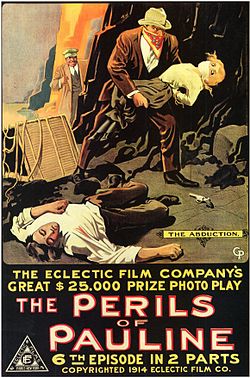
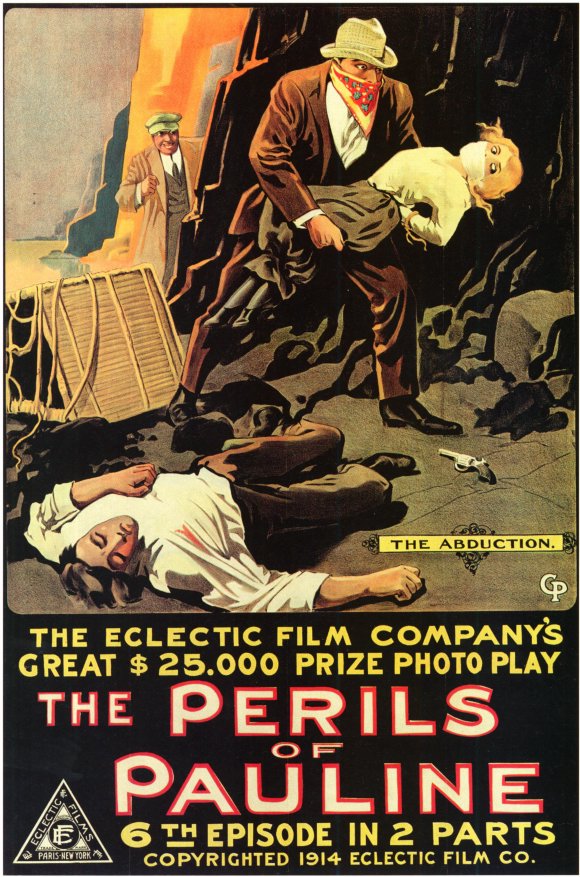
The most famous American serials of the silent era include The Perils of Pauline and The Exploits of Elaine made by Pathé Frères and starring Pearl White. Another popular serial was the 119-episode The Hazards of Helen made by Kalem Studios and starring Helen Holmes for the first 48 episodes, then Helen Gibson for the remainder. Ruth Roland, Marin Sais, Grace Cunard, and Ann Little were also early leading serial queens. Other major studios of the silent era, such as Vitagraph and Essanay Studios, produced serials, as did Warner Bros., Fox, and Universal. Several independent companies (for example, Mascot Pictures) made Western serials. Four silent Tarzan serials were also made.
Expensive feature films were offered by exhibitors for a percentage of the theaters' admissions. Serials, however, were rented by exhibitors for a much lower, flat fee. The arrival of sound technology made it costlier to produce serials, so that they were no longer as profitable on a flat rental basis. Further, the stock market crash of 1929 and the added expense of sound equipment made it impossible for many of the smaller companies that produced serials to upgrade to sound, and they went out of business. Mascot Pictures, which specialized in serials, made the transition from silent to sound and produced the first "talking" serial, King of the Kongo (1929). Universal Pictures also kept its serial unit alive through the transition.
Serial film
A serial film, film serial (or just serial), movie serial, or chapter play, is a motion picture form popular during the first half of the 20th century, consisting of a series of short subjects exhibited in consecutive order at one theater, generally advancing weekly, until the series is completed. Usually, each serial involves a single set of characters, protagonistic and antagonistic, involved in a single story. The film is edited into chapters, after the fashion of serial fiction, and the episodes should not be shown out of order, as individual chapters, or as part of a random collection of short subjects.
Each chapter was screened at a movie theater for one week, and typically ended with a cliffhanger, in which characters found themselves in perilous situations with little apparent chance of escape. Viewers had to return each week to see the cliffhangers resolved and to follow the continuing story. Movie serials were especially popular with children, and for many youths in the first half of the 20th century a typical Saturday matinee at the movies included at least one chapter of a serial, along with animated cartoons, newsreels, and two feature films.
There were films covering many genres, including crime fiction, espionage, comic book or comic strip characters, science fiction, and jungle adventures. Many serials were Westerns, since those were the least expensive to film. Although most serials were filmed economically, some were made at significant expense. The Flash Gordon serial and its sequels, for instance, were major productions in their times. Serials were action-packed stories that usually involved a hero (or heroes) battling an evil villain and rescuing a damsel in distress. The villain would continually place the hero into inescapable death traps, or the heroine would be placed into a lethal peril and the hero would come to her rescue. The hero and heroine would face one trap after another, battling countless thugs and henchmen, before finally defeating the villain.
Movie serials began in Europe. In France Victorin-Hippolyte Jasset launched his series of Nick Carter films in 1908, and the idea of the episodic crime adventure was developed particularly by Louis Feuillade in Fantômas (1913–14), Les Vampires (1915), and Judex (1916); in Germany, Homunculus (1916), directed by Otto Rippert, was a six-part horror serial about an artificial creature.
There were also the 1910 Deutsche Vitaskop five-episode Arsene Lupin Contra Sherlock Holmes, based upon the Maurice LeBlanc novel, and a possible but unconfirmed Raffles serial in 1911.
Serials in America first came about in 1912, as extensions of magazine and newspaper stories. Publishers realized they could build interest (and boost circulation) by sponsoring live-action adventures of the printed characters, serialized like the printed counterparts. The first screen adaptation was What Happened to Mary. produced by the Edison studio and coinciding with the adventure stories published in The Ladies' World. It may be significant that the early American serials were aimed at the feminine audience who wanted thrills, not the masculine audience who preferred more extreme, blood-and-thunder action. By the 1930s and the advent of sound films, both markets ultimately devolved to the juvenile audience, although serials continued to command a certain adult following.
The most famous American serials of the silent era include The Perils of Pauline and The Exploits of Elaine made by Pathé Frères and starring Pearl White. Another popular serial was the 119-episode The Hazards of Helen made by Kalem Studios and starring Helen Holmes for the first 48 episodes, then Helen Gibson for the remainder. Ruth Roland, Marin Sais, Grace Cunard, and Ann Little were also early leading serial queens. Other major studios of the silent era, such as Vitagraph and Essanay Studios, produced serials, as did Warner Bros., Fox, and Universal. Several independent companies (for example, Mascot Pictures) made Western serials. Four silent Tarzan serials were also made.
Expensive feature films were offered by exhibitors for a percentage of the theaters' admissions. Serials, however, were rented by exhibitors for a much lower, flat fee. The arrival of sound technology made it costlier to produce serials, so that they were no longer as profitable on a flat rental basis. Further, the stock market crash of 1929 and the added expense of sound equipment made it impossible for many of the smaller companies that produced serials to upgrade to sound, and they went out of business. Mascot Pictures, which specialized in serials, made the transition from silent to sound and produced the first "talking" serial, King of the Kongo (1929). Universal Pictures also kept its serial unit alive through the transition.
Recent media
Recent media