Hubbry Logo
search
logo
Mudpot
Mudpot
current hub
2233758

Mudpot

logo
Community Hub0 Subscribers
Read side by side
from Wikipedia
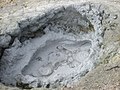
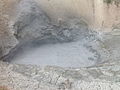
Mudpot in Lassen Volcanic National Park
Mudpots lined up above a volcanic fissure at Hverarönd, Iceland

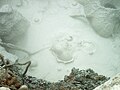
A mudpot, or mud pool, is a type of acidic hot spring, or fumarole, with limited water. It usually takes the form of a pool of bubbling mud, as a result of the acid and microorganisms decomposing surrounding rock into clay and mud.

Description

[edit]

The mud of a mudpot takes the form of a viscous, often bubbling, slurry. As the boiling mud is often squirted over the brims of the mudpot, a form resembling a mini-volcano of mud starts to build up, sometimes reaching heights of 1 to 1.5 m (3+12 to 5 ft).[1] Although mudpots are often called "mud volcanoes", true mud volcanoes are very different in nature. The mud of a mudpot is generally of white to greyish color, but is sometimes stained with reddish or pink spots from iron compounds. When the slurry is particularly colorful, the feature may be referred to as a paint pot.[2]

Geology

[edit]

Mudpots form in high-temperature geothermal areas where water supply is short. The little water that is available rises to the surface at a spot where the soil is rich in volcanic ash, clay, and other fine particulates. The thickness of the mud usually changes along with seasonal changes in the water table.[3][4]

Notable sites

[edit]

The geothermal areas of Yellowstone National Park contain several notable examples of both mudpots and paint pots, as do some areas of Azerbaijan, Iceland, New Zealand and Nicaragua.

Several locations in and around the Salton Sea in California are also home to active mudpots,[5] including the moving Niland Geyser.[6][7] In the case of Niland Geyser, its name is somewhat of a misnomer, as the release of carbon dioxide by seismic activity from the nearby San Andreas Fault is responsible for its behaviour, rather than through geothermal activity. The fluid contained within it is near ambient atmospheric temperature, rather than boiling, measuring around 27 °C (80 °F).[8]

[edit]

References

[edit]
[edit]
Revisions and contributorsEdit on WikipediaRead on Wikipedia
from Grokipedia
A mudpot, also known as a mud pool or paint pot, is a geothermal feature consisting of a shallow depression filled with hot, bubbling mud formed by the interaction of geothermal heat, steam, and limited surface water in acidic environments.[1] These features occur where an impermeable clay lining traps rainwater or snowmelt, which is then heated by rising steam from underlying thermal waters, creating a viscous, gurgling mixture often colored by minerals like iron oxides.[1] Hydrogen sulfide gas emanating from the depths imparts a characteristic rotten-egg odor and is converted by thermophilic microbes into sulfuric acid, which erodes surrounding rock into fine clay particles that form the mud.[1][2] Mudpots are distinct from mud volcanoes, which are cooler formations driven primarily by tectonic pressure or hydrocarbon gases rather than magmatic heat, and from mud seeps, which exhibit slower, non-eruptive mud flow without significant bubbling.[3] They typically develop in volcanic or tectonically active regions with high geothermal activity, such as those associated with subduction zones or hotspots, and their acidity (pH often below 3) limits biodiversity to extremophile microorganisms adapted to extreme heat and low pH.[3][4] Notable examples include the Fountain Paint Pots in Yellowstone National Park, USA, where colorful mud bubbles intermittently and draws visitors for its dynamic display, and the Hverir area in Iceland's Namafjall geothermal field, featuring expansive fields of steaming mud pots amid sulfurous landscapes.[1][5] Other significant sites are found at California's Salton Sea mud pots, powered by geothermal fluids in a rift zone, and Utah's Roosevelt Hot Springs, where boiling mud pots highlight subsurface magma influence.[6][7] Mudpots serve as indicators of underlying hydrothermal systems and are valued for scientific study of geothermal energy potential, though their acidic nature poses hazards like burns or inhalation risks from gases.[3][1]

Physical Characteristics

Appearance and Behavior

Mudpots present as shallow pools or depressions filled with a thick, viscous mixture of clay, water, and minerals, often exhibiting a gooey, semi-liquid consistency that resembles boiling paint or porridge.[1] The surface mud typically displays a range of colors influenced by mineral content, including grays and browns from clay, yellows from sulfur deposits, and reds, pinks, or oranges from iron oxides, creating a mottled or streaked appearance.[8] These features vary in size from small pools just a few meters in diameter to expansive fields covering tens of meters, depending on the underlying basin structure.[8] The dynamic behavior of mudpots is characterized by continuous or intermittent bubbling, popping, and splattering as gases rise through the thick mud, forming visible bubbles that burst on the surface and occasionally eject small amounts of mud.[1] Accompanying these actions are distinctive sounds, such as gurgling from gas movement, plopping from bursting bubbles, and occasional hissing or sizzling as steam escapes.[8] Gas emissions manifest as rising steam plumes or persistent bubbles, often carrying a strong sulfurous odor from hydrogen sulfide.[1] Surface temperatures in mudpots generally range from 70°C to 100°C, hot enough to sustain the ongoing agitation without widespread boiling over.[8] Activity levels can fluctuate with seasonal or weather conditions, often increasing during wet periods when additional water enhances mud liquidity and promotes more vigorous bubbling and splattering.[8]

Variations in Mudpot Types

Mudpots exhibit variations in activity levels, primarily classified as active or dormant based on their bubbling patterns. Active mudpots display continuous bubbling driven by escaping steam and gases, creating persistent pools of agitated mud, as observed in geothermal areas like Yellowstone National Park's Fountain Paint Pot.[1] In contrast, dormant mudpots show intermittent activity or periods of dryness, where bubbling may cease for weeks or months before resuming, reflecting dynamic shifts in subsurface conditions; for example, some features in Yellowstone transition temporarily to fumaroles before reactivating.[9] The viscosity of mud in these features also varies significantly, influencing their physical behavior and appearance. Thinner, soupy mud allows for more fluid movement and frequent surface disruptions, often seen in water-abundant settings where the mixture resembles a loose slurry.[1] Thicker, paint-like consistencies, on the other hand, result in slower, more viscous flows that cling to surfaces, producing a gooey texture that resists rapid bubbling and forms stable pools.[1] A distinct subtype of mudpots is paint pots, characterized by colorful mud splatters with artistic patterns, where the viscous material erupts in bursts to create vibrant, streaked formations, as exemplified by Yellowstone's iron-tinted pools.[1] Empirical observations indicate that elevation and local hydrology play key roles in these variations. Higher elevations may limit water influx, leading to thicker mud and reduced activity, while lower elevations closer to heat sources promote more consistent bubbling in active features.[10] Local hydrology, particularly groundwater availability, empirically affects mud viscosity and eruption frequency by altering the water-to-clay ratio in the pools.[1] Mudpots share geothermal origins with hot springs but are distinguished by their limited water supply, resulting in mud-dominated surfaces rather than clear pools.[1]

Geological and Chemical Formation

Underlying Geological Processes

Mudpots primarily form in tectonically active regions where volcanic processes drive hydrothermal activity, including subduction zones, rift valleys, and mantle hotspots.[11] In subduction zones, such as the Cascade volcanic arc, descending oceanic plates generate magma that heats overlying crust, facilitating geothermal features like mudpots.[12] Rift valleys, exemplified by extensional settings like the Salton Sea in California, allow magma ascent through thinned crust, promoting groundwater heating and gas release.[6] Hotspots, like the Yellowstone plume, create intraplate volcanism independent of plate boundaries, sustaining long-term hydrothermal systems.[13] Volcanic activity plays a central role by providing the heat source through shallow magma chambers or intrusions, which raise subsurface temperatures to over 400°F (204°C), heating groundwater percolating from surrounding highlands.[14] This magmatic heat releases gases such as hydrogen sulfide (H₂S) and carbon dioxide (CO₂) from molten rock, which dissolve into groundwater and contribute to the acidic conditions essential for mudpot development.[13] The gases ascend through fractures, mixing with limited surface water to alter the subsurface environment. Groundwater interacts with these hot rocks and gases, leading to boiling and steam formation as pressure decreases with upward migration through permeable pathways like faults and fractures.[14] In areas of restricted water supply, this process dissolves surrounding volcanic rocks—primarily rhyolite or basalt—into fine clays and silica, creating the viscous slurry characteristic of mudpots while steam escapes to the surface.[13] The formation timeline begins with initial volcanic intrusions that establish the heat and gas regime, often spanning geological epochs, but stable mudpot development typically occurs over years to centuries as hydrothermal circulation evolves and rock alteration intensifies.[12] Features can shift or stabilize in response to ongoing tectonic adjustments and seasonal water variations, reflecting the dynamic nature of these systems.[14]

Chemical Composition and Reactions

Mudpots are characterized by highly acidic environments resulting from the interaction of geothermal gases with water and surrounding rocks. The primary acidic component is sulfuric acid (H₂SO₄), formed through the oxidation of hydrogen sulfide (H₂S) that ascends from depth and reacts with atmospheric oxygen and water, often mediated by thermophilic microorganisms at shallow levels. This process generates acidity that weathers host rocks, producing fine-grained clays that constitute the viscous mud. Common clays include kaolinite (Al₂Si₂O₅(OH)₄) and montmorillonite ((Na,Ca)₀.₃₃(Al,Mg)₂(Si₄O₁₀)(OH)₂·nH₂O), which form via hydrolytic alteration of feldspars and other silicates under acidic conditions.[15][16][17][18] The gaseous emissions in mudpots are dominated by water vapor, typically comprising ~90-95% of the total output, with significant contributions from carbon dioxide (CO₂) and hydrogen sulfide (H₂S), alongside trace amounts of hydrogen chloride (HCl). These gases mix with meteoric water to produce steam-heated acid-sulfate systems, resulting in mud with a pH range of 1-5. The low pH arises from the dissociation of sulfuric acid and the presence of dissolved sulfates, which further enhance rock dissolution and clay formation.[19][20][13] Key geochemical reactions driving mudpot formation involve the oxidation of sulfur species, primarily H₂S. A simplified reaction for acidity generation is 2H₂S + 4O₂ → 2H₂SO₄. These processes occur primarily at shallow levels where geothermal steam interacts with surface oxygen, leading to intense acid alteration without significant deep fluid upflow.[21][22] Mineral precipitation within the mud is governed by the supersaturation of solutions with respect to certain phases under varying temperature and pH conditions. Elemental sulfur (S) forms through partial oxidation of H₂S, often depositing as yellow encrustations around vents. Gypsum (CaSO₄·2H₂O) precipitates when calcium ions from rock dissolution combine with abundant sulfate ions, particularly in cooler margins of the pot. Silicate minerals, including additional kaolinite and amorphous silica, accrete as the acidic fluids leach and reprecipitate silicon from weathered rhyolite or basalt substrates.[17][23][24]

Global Distribution

Primary Geothermal Regions

Mudpots are predominantly concentrated in the Ring of Fire along the Pacific Rim, a horseshoe-shaped zone of intense tectonic and volcanic activity encircling the Pacific Ocean, where subduction and associated volcanism drive the formation of geothermal features. This region accounts for the majority of global geothermal manifestations due to its high heat flow and frequent magmatic intrusions, fostering conditions for acidic steam and gases to interact with surface sediments and create bubbling mud pools.[25] Beyond the Ring of Fire, significant mudpot occurrences are found in other tectonically active areas, including Iceland's mid-ocean ridge system, where divergent plate boundaries allow magma to rise close to the surface, producing widespread hydrothermal activity. The East African Rift, a continental rift zone characterized by extensional tectonics, also hosts mudpots amid its volcanic fields, while the Yellowstone hotspot in the United States represents an intraplate volcanic province with exceptional geothermal output.[25][25] Local climate influences the expression of mudpots, with arid environments enhancing their visibility through sparse vegetation and exposed terrain, whereas humid conditions promote greater water influx, resulting in more fluid and dynamic mud behaviors.[25]

Notable Mudpot Sites

One of the most renowned mudpot sites is the Fountain Paint Pot area in Yellowstone National Park, USA, where a cluster of acidic mudpots has been actively bubbling since the 1870s, when early explorers first documented the park's hydrothermal features during the Washburn-Langford-Doane Expedition. These mudpots exhibit striking multicolored mud due to mineral deposits, including iron oxides that produce pinks, yellows from sulfur, and greens from other compounds, creating a palette that has earned them the nickname "paint pots." The site's ongoing activity reflects the underlying volcanic heat that keeps the mud in a semi-liquid state, with seasonal variations making the mixture thinner in early summer from snowmelt.[1][26] In Rotorua, New Zealand, Hell's Gate geothermal reserve hosts what is described as the largest mud volcano in the country and features extensive boiling mud pools across a barren landscape shaped by geothermal forces. The area, known to Māori as Tikitere for over 800 years, saw its modern geothermal profile influenced by the 1886 Mount Tarawera eruption, which reshaped nearby thermal landscapes and enhanced activity in the Rotorua region through seismic disturbances and faulting. This event contributed to the development of prominent mudpot fields, with the site's nutrient-rich, grey mud violently bubbling from depths as shallow as 1.5–2 km, distinguishing it as one of the most active reserves in the Southern Hemisphere.[27][28] The Seltún geothermal area in Iceland, part of the Krýsuvík volcanic system on the Reykjanes Peninsula, showcases vibrant mudpots with high sulfur emissions that deposit yellow crusts and create colorful streaks of red, orange, and white across the terrain. Activity at Seltún was notably reactivated following the magnitude 6.5 earthquakes in South Iceland's seismic zone in June 2000, which triggered ground deformations and renewed hydrothermal flows in the region, including increased venting and mud pot formation after periods of dormancy. These mudpots, fed by shallow groundwater interacting with magmatic gases, emit strong hydrogen sulfide odors and demonstrate the area's position along the Mid-Atlantic Ridge.[29][30] Danau Linow, a volcanic crater lake in North Sulawesi, Indonesia, near Tomohon, features surrounding mudpots and hydrothermal vents that contribute to its distinctive blue-green hues, resulting from mineral-rich waters influenced by sulfur and other volcanic elements that oxidize variably with sunlight and temperature. The site's mudpots bubble with hot gases from the lake's edges and depths within the Lokon-Empung volcanic complex, creating a dynamic geothermal environment where the water and adjacent mud shift colors from emerald green to light blue throughout the day due to changing chemical compositions. This color variability underscores the active volcanic setting, with the mudpots serving as surface expressions of subsurface heat and mineral transport.[31][32] Historical changes in mudpot sites often stem from 20th-century seismic events, such as the 1959 magnitude 7.3 Hebgen Lake earthquake near Yellowstone, which induced new mudpot formations and intensified activity at Fountain Paint Pot by altering subsurface pressures and pathways for hydrothermal fluids. Similarly, the 2000 South Iceland earthquakes led to reactivation and expansion of features like those at Seltún through fault reactivation and pore-pressure changes that enhanced gas and mud emissions. These examples illustrate how seismic disturbances can rapidly modify mudpot scale and vigor, with post-event monitoring revealing sustained growth in affected geothermal zones.[33][30]

Ecological and Human Dimensions

Microbial Life and Environmental Role

Mudpots, as acidic geothermal features, harbor unique communities of extremophile microorganisms, primarily acidophilic archaea and bacteria adapted to pH levels below 3 and temperatures exceeding 80°C. Prominent examples include archaea from the genera Sulfolobus and Acidianus, which dominate in environments like Yellowstone National Park's mudpots and solfataric fields in Indonesia's Kamojang geothermal area, where they form dense populations in the boiling, sulfur-rich mud. These organisms possess specialized cell membranes and enzymes that protect against acidity and heat, enabling survival in conditions lethal to most life forms.[34][35] Microbial processes in mudpots revolve around sulfur oxidation and reduction cycles, where these extremophiles generate energy through chemosynthesis by oxidizing reduced sulfur compounds like hydrogen sulfide to sulfate, often producing sulfuric acid that further acidifies the environment. Sulfolobus species, for instance, couple this oxidation to carbon dioxide fixation, sustaining primary production in the absence of sunlight, while bacteria such as Acidithiobacillus contribute to iron and sulfur metabolism, perpetuating redox gradients essential for community stability. These cycles not only drive local geochemistry but also release energy that supports the microbial food web.[34][35] Despite the harsh conditions, mudpot microbial biodiversity features a low count of dominant species—often just 5-6 taxa comprising over 1% of the community—yet high overall adaptation, with over 630 species detected in Yellowstone mudpots alone, reflecting specialized niches. These communities form resilient biofilms on mud surfaces, creating colorful layers from pigments like carotenoids and chlorophyll derivatives that protect against UV radiation and oxidative stress, as observed in nearby geothermal springs where such mats exhibit vibrant greens, yellows, and oranges.[36][37][38] Ecologically, these microbes play a pivotal role in nutrient cycling within geothermal soils, facilitating the transformation of sulfur, nitrogen, and iron into bioavailable forms through processes like nitrogen fixation and organic matter decomposition, which gradually ameliorate soil infertility. This microbial activity influences surrounding plant succession by enhancing soil organic carbon and nutrient retention, allowing pioneer species such as mosses and lichens to colonize adjacent areas over time, as seen in volcanic and hydrothermal terrains where initial prokaryotic dominance precedes eukaryotic establishment.[37][39]

Tourism, Hazards, and Conservation

Mudpots attract significant tourism interest due to their unique bubbling and colorful displays, with visitors drawn to accessible sites in geothermal areas like Yellowstone National Park, where boardwalks and viewing platforms provide safe vantage points. For instance, the Fountain Paint Pot trail features a short boardwalk loop allowing close observation of mudpots alongside geysers and hot springs, contributing to the park's appeal as a premier destination for hydrothermal exploration.[1][40] Tourism to Yellowstone generates substantial economic value, with 4,744,353 visitors in 2024 spending $710 million in nearby communities, supporting 6,563 local jobs and yielding a cumulative economic benefit of $903 million.[41][42] Park entrance fees average $12.1 million annually, funding infrastructure such as boardwalks and visitor facilities that enhance access to these features.[43] Hazards associated with mudpots include severe burns from scalding mud temperatures reaching up to 100°C (212°F), as well as inhalation risks from toxic hydrogen sulfide (H₂S) gas, which imparts a rotten-egg odor and can cause respiratory distress or poisoning at high concentrations. The thin, fragile crust overlying these features often conceals superheated water and steam, leading to instability; more than 20 fatalities from thermal burns have occurred in Yellowstone's hydrothermal areas since records began, with incidents like the 2019 severe scalding of a man near Old Faithful Geyser highlighting the dangers of straying from paths.[1][44][45] Seismic activity can further exacerbate ground instability around mudpots, though such events are monitored to mitigate broader risks.[14] Conservation efforts for mudpots emphasize protective measures to preserve these delicate ecosystems, including Yellowstone's designation as a UNESCO World Heritage Site in 1978, which recognizes its geothermal phenomena for global significance and mandates safeguarding natural processes. Strict restrictions prohibit off-trail access in thermal basins to prevent soil erosion and damage to fragile crusts, with violations punishable by fines or imprisonment; for example, a 2024 case resulted in a seven-day jail sentence for thermal trespass near Steamboat Geyser.[46][14][47] Climate change poses emerging threats, with warmer temperatures and reduced precipitation observed in 2020s studies potentially leading to drying of geothermal features, including mudpots, by hindering water replenishment in wetlands that feed hydrothermal systems.[48][49]

References

User Avatar
No comments yet.