


Community hub
Recent from talks
Contribute something
Nothing was collected or created yet.
Murupara
View on Wikipedia

Key Information


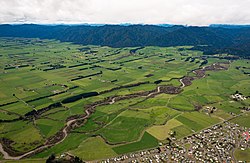
Murupara is a town in the Whakatāne District and Bay of Plenty Region of New Zealand's North Island. The town is in an isolated part of the region between the Kaingaroa Forest and Te Urewera protected area, on the banks of the Rangitaiki River, 65 kilometres southeast of Rotorua. Indigenous Māori make up over 90% of the population.
It is on SH38 and is the terminus of the Murupara Railway Branch. The town's principal industries are all related to forestry.[6]
Murupara is in the rohe (tribal area) of the Ngāti Manawa iwi.[7]
The Māori language name Murupara means "to wipe off mud".[8]
History and culture
[edit]History
[edit]Murupara was previously a staging post on the road between Rotorua and Napier. In the early 1900s, the planting of exotic trees began on the surrounding scrubland. This area is now known as the Kaingaroa Forest, with 1,400 square kilometres of planted pines. As the main service centre for the many forestry workers and their families, Murupara grew to a population of over 3,000. Recent changes to the forestry contracting system have brought about a decrease in the number of permanent residents.
The settlements of Galatea, Horomanga, Kopuriki, Aniwhenua, Waiohau and Murupara lie between the boundary of the Kaingaroa Forest, the popular Te Urewera and Whirinaki Te Pua-a-Tāne Conservation Park. Earlier history is also evident around Murupara. In a rock shelter approximately eight kilometres west of the town centre are a number of early Māori rock carvings.[9]
Murupara was regarded as being a "gang town" but local iwi have placed a rāhui (ban) on gang patches from being worn at the local marae and school.[10][11]
Marae
[edit]Murupara has four marae, which are meeting places for Ngāti Manawa hapū:[7][12]
- Moewhare or Karangaranga marae and Moewhare meeting house are affiliated with Moewhare.
- Painoaiho marae and Ruatapu meeting house are affiliated with Ngāti Koro.
- Rangitahi marae and Apa Hapai Taketake meeting house are affiliated with Ngāti Hui.
- Tīpapa marae and Tangiharuru meeting house are affiliated with Ngāi Tokowaru.
In October 2020, the Government committed $1,327,283 from the Provincial Growth Fund to upgrade the four marae, creating 12 jobs.[13]
Demographics
[edit]Stats NZ describes Murupara as a small urban area, which covers 6.26 km2 (2.42 sq mi).[4] It had an estimated population of 1,910 as of June 2025,[14] with a population density of 305 people per km2.
| Year | Pop. | ±% p.a. |
|---|---|---|
| 2006 | 1,872 | — |
| 2013 | 1,671 | −1.61% |
| 2018 | 1,815 | +1.67% |
| 2023 | 1,884 | +0.75% |
| Source: [15][16] | ||
Murupara had a population of 1,884 in the 2023 New Zealand census, an increase of 69 people (3.8%) since the 2018 census, and an increase of 213 people (12.7%) since the 2013 census. There were 936 males, 939 females, and 9 people of other genders in 579 dwellings.[17] 1.4% of people identified as LGBTIQ+. The median age was 32.8 years (compared with 38.1 years nationally). There were 450 people (23.9%) aged under 15 years, 432 (22.9%) aged 15 to 29, 783 (41.6%) aged 30 to 64, and 216 (11.5%) aged 65 or older.[15]
People could identify as more than one ethnicity. The results were 25.0% European (Pākehā); 89.8% Māori; 4.1% Pasifika; 0.8% Asian; 0.2% Middle Eastern, Latin American and African New Zealanders (MELAA); and 1.3% other, which includes people giving their ethnicity as "New Zealander". English was spoken by 95.5%, Māori by 31.7%, Samoan by 0.5%, and other languages by 1.8%. No language could be spoken by 2.2% (e.g. too young to talk). New Zealand Sign Language was known by 1.1%. The percentage of people born overseas was 2.1, compared with 28.8% nationally.[15]
Religious affiliations were 36.1% Christian, 0.2% Islam, 11.5% Māori religious beliefs, 0.6% Buddhist, 0.3% New Age, and 0.5% other religions. People who answered that they had no religion were 44.7%, and 7.3% of people did not answer the census question.[15]
Of those at least 15 years old, 84 (5.9%) people had a bachelor's or higher degree, 840 (58.6%) had a post-high school certificate or diploma, and 510 (35.6%) people exclusively held high school qualifications. The median income was $27,700, compared with $41,500 nationally. 27 people (1.9%) earned over $100,000 compared to 12.1% nationally. The employment status of those at least 15 was 480 (33.5%) full-time, 189 (13.2%) part-time, and 174 (12.1%) unemployed.[15]
Education
[edit]Murupara Area School is a co-educational state area school for Year 1 to 13 students,[18][19] with a roll of 188 as of July 2025.[20] It opened in 2013, when the local primary and secondary schools merged.[21]
Te Kura Kaupapa Motuhake o Tāwhiuau is a co-educational state Māori language immersion school,[22] with a roll of 87.[23] The school opened in 2000, and was the first Designated Character School (Kura ā-Iwi) in the country.[24][25]
Notable people
[edit]- Jacinda Ardern (born 1980), Former Prime Minister of New Zealand and leader of the Labour Party 2017–2023
- Pem Bird, president of the Te Pāti Māori 2010–2013
- Bradley Iles, professional golfer
- Percy Marunui Murphy, former borough mayor, first Māori mayor in the country.
- Willie Ripia, Rugby union player
Climate
[edit]| Climate data for Murupara (1973–1987) | |||||||||||||
|---|---|---|---|---|---|---|---|---|---|---|---|---|---|
| Month | Jan | Feb | Mar | Apr | May | Jun | Jul | Aug | Sep | Oct | Nov | Dec | Year |
| Record high °C (°F) | 34.0 (93.2) |
33.0 (91.4) |
30.0 (86.0) |
26.0 (78.8) |
20.9 (69.6) |
19.0 (66.2) |
17.5 (63.5) |
18.1 (64.6) |
25.7 (78.3) |
26.0 (78.8) |
28.7 (83.7) |
29.7 (85.5) |
34.0 (93.2) |
| Mean maximum °C (°F) | 30.8 (87.4) |
30.1 (86.2) |
26.8 (80.2) |
23.1 (73.6) |
18.9 (66.0) |
16.7 (62.1) |
15.8 (60.4) |
17.0 (62.6) |
20.0 (68.0) |
23.2 (73.8) |
26.5 (79.7) |
28.0 (82.4) |
31.3 (88.3) |
| Mean daily maximum °C (°F) | 24.9 (76.8) |
24.7 (76.5) |
22.4 (72.3) |
19.2 (66.6) |
15.4 (59.7) |
12.9 (55.2) |
12.4 (54.3) |
13.7 (56.7) |
15.7 (60.3) |
18.2 (64.8) |
20.8 (69.4) |
22.9 (73.2) |
18.6 (65.5) |
| Daily mean °C (°F) | 18.4 (65.1) |
18.5 (65.3) |
16.5 (61.7) |
13.1 (55.6) |
9.3 (48.7) |
7.5 (45.5) |
6.8 (44.2) |
8.1 (46.6) |
10.0 (50.0) |
12.5 (54.5) |
14.8 (58.6) |
16.9 (62.4) |
12.7 (54.9) |
| Mean daily minimum °C (°F) | 11.9 (53.4) |
12.2 (54.0) |
10.5 (50.9) |
7.0 (44.6) |
3.2 (37.8) |
2.1 (35.8) |
1.1 (34.0) |
2.4 (36.3) |
4.3 (39.7) |
6.8 (44.2) |
8.7 (47.7) |
10.9 (51.6) |
6.8 (44.2) |
| Mean minimum °C (°F) | 5.5 (41.9) |
6.0 (42.8) |
2.2 (36.0) |
−0.2 (31.6) |
−2.8 (27.0) |
−4.5 (23.9) |
−4.6 (23.7) |
−3.6 (25.5) |
−1.6 (29.1) |
−0.2 (31.6) |
1.0 (33.8) |
4.5 (40.1) |
−5.3 (22.5) |
| Record low °C (°F) | 1.7 (35.1) |
1.2 (34.2) |
−4.3 (24.3) |
−3.0 (26.6) |
−4.8 (23.4) |
−6.3 (20.7) |
−5.7 (21.7) |
−4.8 (23.4) |
−2.7 (27.1) |
−2.5 (27.5) |
−1.6 (29.1) |
2.0 (35.6) |
−6.3 (20.7) |
| Average rainfall mm (inches) | 91.1 (3.59) |
81.3 (3.20) |
111.1 (4.37) |
106.8 (4.20) |
102.7 (4.04) |
112.9 (4.44) |
101.3 (3.99) |
109.9 (4.33) |
101.7 (4.00) |
99.3 (3.91) |
82.2 (3.24) |
125.1 (4.93) |
1,225.4 (48.24) |
| Source: Earth Sciences NZ (rainfall 1971–2000)[26] | |||||||||||||
References
[edit]- ^ "Elections 2025 - Results". Whakatāne District Council. Retrieved 29 October 2025.
- ^ "East Coast - Official Result". Electoral Commission. Retrieved 1 June 2025.
- ^ "Waiariki – Official Result". Electoral Commission. Retrieved 12 May 2025.
- ^ a b "Stats NZ Geographic Data Service". Urban Rural 2023 (generalised). Retrieved 10 July 2025.
- ^ "Subnational population estimates - Aotearoa Data Explorer". Statistics New Zealand. Retrieved 29 October 2025.
- ^ "Murupara Travel Guide". Jasons Travel Media. Archived from the original on 22 May 2011.
- ^ a b "Te Kāhui Māngai directory". tkm.govt.nz. Te Puni Kōkiri.
- ^ Discover New Zealand:A Wises Guide (9th ed.). 1994. p. 116.
- ^ Mills, John (19 February 2019). "The Kaingaroa Rock Carvings". Medium. Archived from the original on 4 December 2023.
- ^ Shanks, Katee; Taipari, Greg (20 November 2009). "Big push for ban on gang patches". The Daily Post.
- ^ Davison, Isaac (15 November 2012). "School backs ban on gang regalia". APN New Zealand. New Zealand Herald.
- ^ "Māori Maps". maorimaps.com. Te Potiki National Trust.
- ^ "Marae Announcements" (Excel). growregions.govt.nz. Provincial Growth Fund. 9 October 2020.
- ^ "Subnational population estimates - Aotearoa Data Explorer". Statistics New Zealand. Retrieved 29 October 2025.
- ^ a b c d e "Totals by topic for individuals, (RC, TALB, UR, SA3, SA2, Ward, Health), 2013, 2018, and 2023 Censuses". Stats NZ – Tatauranga Aotearoa – Aotearoa Data Explorer. Murupara (1262). Retrieved 3 October 2024.
- ^ "Statistical area 1 dataset for 2018 Census". Statistics New Zealand. March 2020. Murupara (203600). 2018 Census place summary: Murupara
- ^ "Totals by topic for dwellings, (RC, TALB, UR, SA3, SA2, Ward, Health), 2013, 2018, and 2023 Censuses". Stats NZ – Tatauranga Aotearoa – Aotearoa Data Explorer. Retrieved 3 October 2024.
- ^ "Murupara Area School Official School Website". mas.school.nz.
- ^ "Murupara Area School Ministry of Education School Profile". educationcounts.govt.nz. Ministry of Education.
- ^ "New Zealand Schools Directory". New Zealand Ministry of Education. Retrieved 1 July 2025.
- ^ "Murupara Area School Education Review Office Report". ero.govt.nz. Education Review Office. Archived from the original on 4 February 2018.
- ^ "Te Kura Kaupapa Motuhake o Tawhiuau Ministry of Education School Profile". educationcounts.govt.nz. Ministry of Education.
- ^ "Te Kura Kaupapa Motuhake o Tawhiuau Education Review Office Report". ero.govt.nz. Education Review Office.
- ^ "Mōku te Awatea". Te Kura Kaupapa Motuhake o Tāwhiuau. 14 April 2020.
- ^ "Members of the Independent Panel - Pembroke (Pem) Bird". Te Puni Kōkiri. 8 March 2018. Archived from the original on 1 March 2021.
- ^ "Datahub (Agent number: 1820)". Earth Sciences New Zealand. Retrieved 9 October 2025.
| International | |
|---|---|
| National | |

Murupara
View on GrokipediaGeography and Environment
Location and Topography
Murupara is situated in the Whakatāne District of the Bay of Plenty Region on New Zealand's North Island, at coordinates 38°28′S 176°42′E.[8] The town lies along the banks of the Rangitāiki River, approximately 55 km east of Rotorua.[5] It occupies a relatively isolated position amid expansive forestry lands, bordered by the Kaingaroa Forest to the west and the Te Urewera ranges to the east.[9] The local topography is characterized by the Kāingaroa Plateau, a gently undulating expanse formed from volcanic ash deposits with elevations ranging from 150 to 750 meters.[10] Murupara itself stands at an elevation of 201 meters above sea level.[11] To the east, the plateau terminates abruptly at the foothills of the Ikawhenua Range, while the nearby Galatea Plains and Whirinaki River valley provide lower-lying terrain suitable for agriculture and recreation.[5] The surrounding landscape is dominated by dense exotic pine plantations, reflecting the plateau's historical conversion from tussock grassland for forestry purposes.[12]Climate
Murupara features a temperate oceanic climate (Köppen Cfb) with short, warm summers and cool, wet winters marked by frequent frosts inland. Mean annual temperatures in the surrounding Bay of Plenty region, including areas near Murupara, range from 9 to 14°C, with colder winter nights averaging daily minimums of 1–7°C.[13] Summer highs in January average 24°C, with lows of 13°C, while July winter highs average 12°C and lows 4°C; temperatures rarely drop below -1°C or exceed 29°C annually.[14] Annual precipitation totals less than 1,300 mm around Murupara, drier than coastal Bay of Plenty sites (e.g., 1,189 mm at Tauranga) or adjacent ranges exceeding 2,200 mm, due to rain shadow effects from surrounding topography and descending airflow on the plains.[13] Rainfall peaks in winter, accounting for about 30% of the yearly total (June–August), with summer convection showers common inland; dry spells average 19 days, though longer periods occur, such as 33 days in early 1999 near Whakatane.[13] Sunshine hours approximate 2,000 annually, slightly less than coastal areas due to inland elevation and cloud cover.[13] Winds are generally light, with mean speeds around 13 km/h, contributing to the region's relative sheltering.[13] Recorded extremes include a regional low of -9.4°C at nearby Kaingaroa Forest on 9 July 1960, and severe weather events like ex-Tropical Cyclone Bernie in April 1982, which caused significant damage in the Kaingaroa area.[13]Forestry Impacts
The establishment of extensive radiata pine (Pinus radiata) plantations surrounding Murupara, particularly in the Kaingaroa Forest initiated in the 1920s, transformed the local pumice plateau landscape from erosion-prone grasslands and shrublands into a managed exotic forest estate covering over 150,000 hectares.[15] These plantations replaced areas historically degraded by fires and grazing, stabilizing volcanic pumice soils that were previously subject to severe wind erosion and dust storms.[16] Empirical studies indicate that afforestation with radiata pine reduces soil erosion rates significantly, with root systems binding loose pumice and improving soil structure on marginal lands similar to those around Murupara.[17] Radiata pine plantations exert mixed effects on local water resources. The dense canopy and high evapotranspiration rates of mature pines reduce stream base flows in dry periods and alter hydrological regimes compared to pre-plantation open lands, potentially exacerbating low flows in rivers like the Whirinaki.[18] However, they enhance water quality by increasing soil infiltration, reducing sediment runoff during storms, and shading streams to maintain cooler temperatures beneficial for aquatic life.[17] Clear-felling operations, common in the rotation cycle of 25-30 years, can temporarily increase erosion and sedimentation if not managed with buffers and snig tracks, though regional guidelines mitigate these risks on steeper pumice slopes.[19] Biodiversity in the plantation-dominated environment is generally lower than in native forests, with monocultures supporting fewer understory plants and native invertebrates due to shading, soil acidification, and altered nutrient cycling.[20] Radiata pine's propensity to self-seed into adjacent native shrublands and forest edges poses an invasion risk, potentially displacing lower-stature indigenous vegetation in the Galatea Plains and Whirinaki margins.[21] Nonetheless, plantations host some threatened native species, such as certain birds and fungi, and serve as corridors connecting protected areas like Whirinaki Forest Park, with underplanting and riparian management enhancing habitat value over unmanaged scrub.[17] Overall, while providing ecosystem services like carbon sequestration exceeding 200 tonnes per hectare over rotations, the net biodiversity outcome favors targeted conservation integration rather than reliance on plantations alone.[22]History
Pre-Colonial Māori Era
The region encompassing modern Murupara, situated in the upper Rangitaiki Valley and adjacent to Te Urewera, was traditionally occupied by hapū of the Ngāti Manawa iwi prior to European contact. Ngāti Manawa trace their whakapapa (genealogy) to early Polynesian ancestors arriving via the Mataatua waka around the 14th century, with subsequent migrations establishing mana whenua (customary authority) over inland territories including the Galatea Plains, Tawhiuau Range, and river systems.[23] Oral traditions record a lineage of ariki (paramount chiefs) from the 17th century, beginning with Tangiharuru (circa 1630–1635), who exercised leadership amid a network of allied hapū focused on resource stewardship and defense.[23] The pre-contact landscape featured dense podocarp-hardwood forests, volcanic soils, and wetland margins along the Rangitaiki and Whirinaki rivers, supporting a hunter-gatherer economy integral to Ngāti Manawa sustenance and cultural practices. Primary mahinga kai (food resources) included forest birds such as kererū (wood pigeon) and kākā (parrot) hunted with snares and decoys, eels and freshwater fish from riverine habitats, and gathered foods like aruhe (fern root) and berries, with seasonal camps facilitating access to these taonga (treasures).[24] Kaitiakitanga (guardianship) principles governed sustainable use, with rāhui (temporary prohibitions) enforced to preserve stocks during breeding seasons or after conflicts. Inter-hapū warfare, often over resources or utu (retribution), prompted the construction of pā (defensive sites) on elevated ridges, though inland density limited large-scale pā compared to coastal areas.[24] Archaeological surveys in the Bay of Plenty indicate early Māori occupation from circa 1300 AD was sparse in forested inland valleys like that of Murupara, with evidence of ovens, storage pits, and cultivation terraces increasing in the later pre-European period (post-1500 AD), reflecting population growth and intensified land modification for kūmara (sweet potato) gardens on fertile ash soils.[24] Ngāti Manawa hapū maintained whanaungatanga (kinship ties) with neighboring iwi such as Ngāti Whare and Tūhoe, facilitating trade in preserved birds and greenstone tools, while spiritual connections to the whenua (land) underscored whakapapa links to tūpuna (ancestors) embodied in mountains and rivers.[23] This era of relative isolation preserved distinct tikanga (customs) until early 19th-century musket wars disrupted traditional patterns.[24]Colonial Development and Forestry Boom
European settlement in the Murupara area began with land acquisitions in the early 20th century, initially intended for agricultural development on the Kaingaroa Plains, which were purchased from Māori owners.[2] However, from 1925 to 1936, these lands were instead converted to exotic forestry plantations, predominantly Pinus radiata, as part of New Zealand's broader push to establish a sustainable timber resource amid declining native forest supplies.[2] This shift reflected government policy prioritizing export-oriented industries, with the New Zealand Forest Service overseeing afforestation efforts that transformed vast tracts of open country into monoculture pine forests covering over 150,000 hectares in the Kaingaroa region by the 1940s.[25] The forestry boom accelerated in the 1950s with the onset of large-scale harvesting operations in the maturing Kaingaroa Forest. Murupara was established as a service town in 1953 to support the Kaingaroa Logging Company and Forest Service activities, providing housing, infrastructure, and logistics for loggers and mill workers.[26] Government approval in 1951 for pulp and paper development further catalyzed investment, leading to the construction of access roads, rail links, and worker accommodations that drew a predominantly Pākehā workforce into the previously sparsely populated area.[25] Population surged from 225 residents in 1951 to 2,961 by 1971, driven by employment in felling, hauling, and initial processing, which created a self-contained economy reliant on state-owned enterprises.[27] This period marked a rapid industrialization of the landscape, with mechanized logging techniques enabling annual harvests exceeding 1 million cubic meters of timber by the late 1960s, fueling exports and domestic construction.[15] Socially, the influx disrupted traditional Māori land-use patterns in the Ngāti Manawa rohe, as forestry operations expanded onto adjacent areas without equivalent benefits for iwi, exacerbating tensions over resource control.[27] Economically, Murupara thrived as a company town, with peak employment in forestry reaching several thousand, though dependence on cyclical timber markets foreshadowed vulnerabilities.[26] The Galatea Plains, visible in this panorama, underwent extensive pine afforestation during the colonial-era planting drives, underpinning the subsequent logging boom.[2]Post-1980s Restructuring and Decline
In the mid-1980s, New Zealand's Labour government implemented sweeping economic reforms that profoundly affected the state-owned forestry sector, including the corporatization of the New Zealand Forest Service (NZFS) under the State-Owned Enterprises Act 1986.[28] The NZFS, which had employed thousands in Murupara through logging, milling, and plantation management tied to the nearby Kaingaroa Forest, was restructured into a commercial entity, leading to immediate workforce reductions as inefficient practices were curtailed.[26] By 1987, NZFS operations in associated settlements like Kaingaroa ceased, exacerbating local job losses as logging rights were privatized and sold off.[29] The transition to private ownership intensified decline through the 1990s, with major forests including portions of Kaingaroa divested via entities like the New Zealand Forestry Corporation, prioritizing mechanization and export-oriented efficiency over labor-intensive local processing.[30] This shift displaced over 5,000 forestry jobs nationwide, with Murupara—once a "timber town" sustained by NZFS social responsibilities—experiencing acute impacts, including mill downsizing and population outflow as residents sought work elsewhere.[27] Māori Affairs officials had warned in the 1980s that such restructuring would devastate Central North Island communities like Murupara, where forestry had employed a majority of Ngāti Awa and Ngāti Manawa locals.[31] Unemployment in Murupara surged amid these changes, contributing to entrenched poverty and welfare dependency, as the town's economy, lacking diversification, failed to absorb the labor surplus from a sector that had provided semi-skilled roles for generations.[2] The market-driven reforms, while boosting overall forestry productivity, exposed structural vulnerabilities in single-industry towns, with Murupara's population dropping sharply from its 1970s peak of around 3,000 as families migrated amid chronic job scarcity.[32] Recovery efforts remained limited, underscoring the causal link between policy-induced efficiency gains and localized socioeconomic contraction.[26]Demographics and Socioeconomics
Population Trends
Murupara experienced rapid population growth from the 1950s to the early 1980s, driven by its role as a hub for logging operations in the adjacent Kaingaroa Forest. The usually resident population rose from 643 in 1951 to a peak of 3,003 in 1981, reflecting influxes of forestry workers and their families amid state-led expansion of the timber industry.[26] Following corporatization of the forestry sector in the mid-1980s, which prioritized efficiency and reduced manual labor needs through mechanization, the population began a prolonged decline. By 1986, it had fallen to 2,592—a 13.7% drop from 1981—continuing to 2,208 by 1996 amid mill closures and job losses. This downward trend persisted into the 2000s, with the population reaching 1,836 in 2006 and further decreasing to 1,656 in 2013, a 9.8% reduction over the seven-year interval (extended due to the canceled 2011 census).[26][33] Recent censuses indicate a modest stabilization and slight rebound, potentially tied to limited economic diversification and regional migration patterns. The population stood at 1,815 in 2018 before increasing to 1,884 in 2023, a gain of 69 people or 3.8%. Subnational estimates project continued low growth, with around 2,060 residents as of mid-2024.[34]| Census Year | Usually Resident Population | Change from Prior Census |
|---|---|---|
| 1951 | 643 | - |
| 1961 | 1,571 | +144.5% |
| 1971 | 2,760 | +75.8% |
| 1981 | 3,003 | +8.8% |
| 1991 | 2,376 | -20.9% (from 1981) |
| 2006 | 1,836 | - |
| 2013 | 1,656 | -9.8% |
| 2018 | 1,815 | +9.6% |
| 2023 | 1,884 | +3.8% |
Ethnic Composition
Murupara exhibits a markedly high proportion of Māori residents compared to national averages, reflecting its location within the rohe of Ngāti Awa and Tūhoe iwi and historical patterns of forestry-related migration and settlement. According to the 2023 New Zealand Census, 89.8% of the usually resident population (1,691 individuals out of 1,884) identified as Māori, with the remainder comprising smaller shares across other groups.[34] European ethnicity was reported by 25.0% (471 individuals), Pacific peoples by 4.1% (77 individuals), Asian by 0.8% (15 individuals), Middle Eastern/Latin American/African by 0.2% (4 individuals), and Other ethnicity by 0.6% (11 individuals).[34] These figures account for multiple ethnic identifications permitted in the census, resulting in totals exceeding 100% of the population; for instance, many residents likely reported both Māori and European ancestries.[34] The dominance of Māori ethnicity underscores Murupara's role as a key community for iwi affiliations in the Bay of Plenty region, where forestry development since the mid-20th century drew significant Māori labor from rural areas.[35] In contrast to New Zealand's overall ethnic distribution—where Māori comprise approximately 19.6% of the population—this composition highlights localized demographic concentrations driven by cultural and economic factors rather than broader national trends.[36]Poverty, Crime, and Welfare Metrics
Murupara ranks among New Zealand's most deprived communities, falling within the highest deprivation quintile based on 2013 Census metrics including income, home ownership, and access to communications and transport.[2] The 2023 Census records a median household income of $64,400, with personal medians of $22,100 for ages 15–29 and $33,700 for ages 30–64, both substantially below national figures exceeding $40,000 for working-age adults.[34] These indicators reflect persistent poverty linked to the post-1980s forestry downturn, where structural unemployment entrenched low earnings and limited asset accumulation. Welfare dependency remains elevated, with historical peaks seeing nearly two-thirds of residents on benefits by 1993 amid mass job losses.[2] The 2013 Census showed heavy reliance on unemployment and domestic purposes benefits, compounded by 40% of families being sole-parent households versus 16% nationally, a factor correlating with prolonged benefit receipt.[2] The 2023 labour force data indicates 41.4% of those aged 15+ not participating, alongside a 12.1% unemployment rate among the active workforce, sustaining high income support uptake in a town where alternative employment options are scarce.[34]| Labour Force Status (Aged 15+, 2023 Census) | Percentage |
|---|---|
| Employed full-time | 33.5% |
| Employed part-time | 13.2% |
| Unemployed | 12.1% |
| Not in labour force | 41.4% |
Economy
Forestry and Resource Industries
Murupara's economy relies heavily on the forestry sector, with the town functioning as a logistical and operational base for activities in the neighboring Kaingaroa Forest, New Zealand's largest exotic plantation estate spanning approximately 196,000 hectares, of which 180,000 hectares are planted predominantly with radiata pine. Harvesting operations extract logs for domestic processing and export, supporting national wood production that reached 14.2 million tons of processed logs annually as of recent industry data. Kaingaroa targets annual production of up to 9 million cubic meters, driven by sustainable management practices amid global timber demand.[39][40][39] Local forestry jobs encompass log loading, machine operation, and transport, with casual roles offering rates around $41.51 per hour and full-time positions in log yards requiring skilled operators on rotating shifts. Mechanized harvesting has diminished manual labor needs since the mid-20th century peaks, when the Kaingaroa Logging Company and state Forest Service employed most residents, contributing to post-1980s mill closures and employment contraction. The Bay of Plenty region, including Murupara's catchment, hosts at least 27 wood processing facilities, though larger-scale milling has shifted to sites like Kawerau, reducing on-site operations in Murupara itself.[41][42][3][26][43] No significant non-forestry resource extraction industries, such as mining or substantial agriculture beyond small-scale farming, operate in Murupara, reinforcing the town's vulnerability to fluctuations in global log prices and domestic policy shifts favoring export over local value-added processing. Ongoing iwi partnerships, including post-2009 Treaty settlements returning forest lands, aim to bolster sustainable yields and community reinvestment.[30]Employment and Unemployment Data
According to the 2023 New Zealand Census, 12.1% of the population aged 15 years and over in Murupara was unemployed, reflecting challenges in a locality historically dependent on forestry employment.[44] This figure equates to approximately 228 individuals, based on the area's usually resident population of 1,884.[34] The labour force participation rate stands at roughly 58.8%, with 41.4% not in the labour force, indicating significant detachment from formal employment.[44]| Labour Force Status (Aged 15+) | Percentage |
|---|---|
| Employed full-time | 33.5% |
| Employed part-time | 13.2% |
| Unemployed | 12.1% |
| Not in the labour force | 41.4% |