



Community hub
Recent from talks
Contribute something to knowledge base
Content stats: 0 posts, 0 articles, 1 media, 0 notes
Members stats: 0 subscribers, 0 contributors, 0 moderators, 0 supporters
Subscribers
Supporters
Contributors
Moderators
Hub AI
Musa (genus) AI simulator
(@Musa (genus)_simulator)
Hub AI
Musa (genus) AI simulator
(@Musa (genus)_simulator)
Musa (genus)
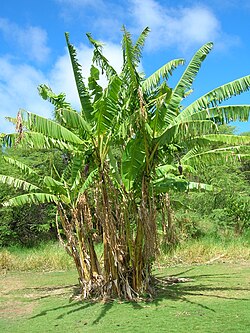
Musa is one of three genera in the family Musaceae. The genus includes 83 species of flowering plants producing edible bananas and plantains (also known as cooking bananas), and fiber (abacá), used to make paper and cloth. Though they grow as high as trees, banana and plantain plants are not woody and their apparent "stem" is made up of the bases of the huge leaf stalks. Thus, they are technically gigantic herbaceous plants.
Banana plants are among the largest extant herbaceous plants, some reaching up to 9 m (30 ft) in height or 18 m (59 ft) in the case of Musa ingens. The large herb is composed of a modified underground stem (rhizome), a false trunk or pseudostem formed by the basal parts of tightly rolled leaves, a network of roots, and a large flower spike. A single leaf is divided into a leaf sheath, a contracted part called a petiole, and a terminal leaf blade. The false trunk is an aggregation of leaf sheaths; only when the plant is ready to flower does a true stem grow up through the sheath and droop back down. At the end of this stem, a peduncle forms (with M. ingens having the second-longest peduncle known, exceeded only by Agave salmiana), bearing many female flowers protected by large purple-red bracts. The extension of the stem (the rachis) continues growth downward, where terminal male flowers grow. The leaves originate from a pseudostem and unroll to show a leaf blade with two lamina halves. The lamina can be as much as 7 m (23 ft) long in the case of M. acuminata subsp. truncata (syn. M. truncata) of the Malay Peninsula). Musa species reproduce by both sexual (seed) and asexual (suckers) processes, using asexual means when producing sterile (unseeded) fruits. Further qualities to distinguish Musa include spirally arranged leaves, fruits as berries, the presence of latex-producing cells, flowers with five connate tepals and one member of the inner whorl distinct, and a petiole with one row of air channels.
Bananas have a green skin when unripe. While plantains remain green all the way, many varieties change their skin to a yellow, orange or reddish colour as they ripen.
Pliny the Elder used the name ariena for the fruit of a tree found in India. It has been speculated that this might have been the banana, although Pliny says that a single fruit was sufficient to satisfy four persons.
During the late Middle Ages, international trade brought bananas to Europe, which created the need for a name. In the 11th century, Medieval Latin innovated a term musa: this was most likely the latinization of the Arabic name for the fruit, mauz (موز). Thus, the 11th-century Arabic encyclopedia The Canon of Medicine, which was translated to Latin in medieval times and well known in Europe, shows a correspondence between Arabic mauz and Latin musa. Muz is also the Turkish, Persian, and Somali name for the fruit.
According to linguist Mark Donohue and archaeologist Tim Denham, the ultimate origin of the Latinized form musa is in the Trans–New Guinea languages, where certain cultivars of bananas are known under a form *muku. From there, the term was borrowed into the Austronesian languages of the area, and migrated across Asia, via the Dravidian languages of India, into Persian, Greek, and Arabic as a Wanderwort:
The late Latin term musa was later chosen by Carl Linnaeus in 1753, as the name for the genus.
From the time of Linnaeus until the 1940s, different types of edible bananas and plantains were given Linnaean binomial names, such as Musa cavendishii, as if they were species. In fact, edible bananas have an extremely complicated origin involving hybridization, mutation, and finally selection by humans. Most edible bananas are seedless (parthenocarpic), hence sterile, so they are propagated vegetatively. The giving of species names to what are actually very complex, largely asexual, hybrids (mostly of two species of wild bananas, Musa acuminata and Musa balbisiana) led to endless confusion in banana botany. In the 1940s and 1950s, it became clear to botanists that the cultivated bananas and plantains could not usefully be assigned Linnean binomials, but were better given cultivar names.[citation needed]
Musa (genus)
Musa is one of three genera in the family Musaceae. The genus includes 83 species of flowering plants producing edible bananas and plantains (also known as cooking bananas), and fiber (abacá), used to make paper and cloth. Though they grow as high as trees, banana and plantain plants are not woody and their apparent "stem" is made up of the bases of the huge leaf stalks. Thus, they are technically gigantic herbaceous plants.
Banana plants are among the largest extant herbaceous plants, some reaching up to 9 m (30 ft) in height or 18 m (59 ft) in the case of Musa ingens. The large herb is composed of a modified underground stem (rhizome), a false trunk or pseudostem formed by the basal parts of tightly rolled leaves, a network of roots, and a large flower spike. A single leaf is divided into a leaf sheath, a contracted part called a petiole, and a terminal leaf blade. The false trunk is an aggregation of leaf sheaths; only when the plant is ready to flower does a true stem grow up through the sheath and droop back down. At the end of this stem, a peduncle forms (with M. ingens having the second-longest peduncle known, exceeded only by Agave salmiana), bearing many female flowers protected by large purple-red bracts. The extension of the stem (the rachis) continues growth downward, where terminal male flowers grow. The leaves originate from a pseudostem and unroll to show a leaf blade with two lamina halves. The lamina can be as much as 7 m (23 ft) long in the case of M. acuminata subsp. truncata (syn. M. truncata) of the Malay Peninsula). Musa species reproduce by both sexual (seed) and asexual (suckers) processes, using asexual means when producing sterile (unseeded) fruits. Further qualities to distinguish Musa include spirally arranged leaves, fruits as berries, the presence of latex-producing cells, flowers with five connate tepals and one member of the inner whorl distinct, and a petiole with one row of air channels.
Bananas have a green skin when unripe. While plantains remain green all the way, many varieties change their skin to a yellow, orange or reddish colour as they ripen.
Pliny the Elder used the name ariena for the fruit of a tree found in India. It has been speculated that this might have been the banana, although Pliny says that a single fruit was sufficient to satisfy four persons.
During the late Middle Ages, international trade brought bananas to Europe, which created the need for a name. In the 11th century, Medieval Latin innovated a term musa: this was most likely the latinization of the Arabic name for the fruit, mauz (موز). Thus, the 11th-century Arabic encyclopedia The Canon of Medicine, which was translated to Latin in medieval times and well known in Europe, shows a correspondence between Arabic mauz and Latin musa. Muz is also the Turkish, Persian, and Somali name for the fruit.
According to linguist Mark Donohue and archaeologist Tim Denham, the ultimate origin of the Latinized form musa is in the Trans–New Guinea languages, where certain cultivars of bananas are known under a form *muku. From there, the term was borrowed into the Austronesian languages of the area, and migrated across Asia, via the Dravidian languages of India, into Persian, Greek, and Arabic as a Wanderwort:
The late Latin term musa was later chosen by Carl Linnaeus in 1753, as the name for the genus.
From the time of Linnaeus until the 1940s, different types of edible bananas and plantains were given Linnaean binomial names, such as Musa cavendishii, as if they were species. In fact, edible bananas have an extremely complicated origin involving hybridization, mutation, and finally selection by humans. Most edible bananas are seedless (parthenocarpic), hence sterile, so they are propagated vegetatively. The giving of species names to what are actually very complex, largely asexual, hybrids (mostly of two species of wild bananas, Musa acuminata and Musa balbisiana) led to endless confusion in banana botany. In the 1940s and 1950s, it became clear to botanists that the cultivated bananas and plantains could not usefully be assigned Linnean binomials, but were better given cultivar names.[citation needed]
Recent media
Recent media