
Recent from talks
Mutiny on the Bounty
Knowledge base stats:
Talk channels stats:
Members stats:
Mutiny on the Bounty
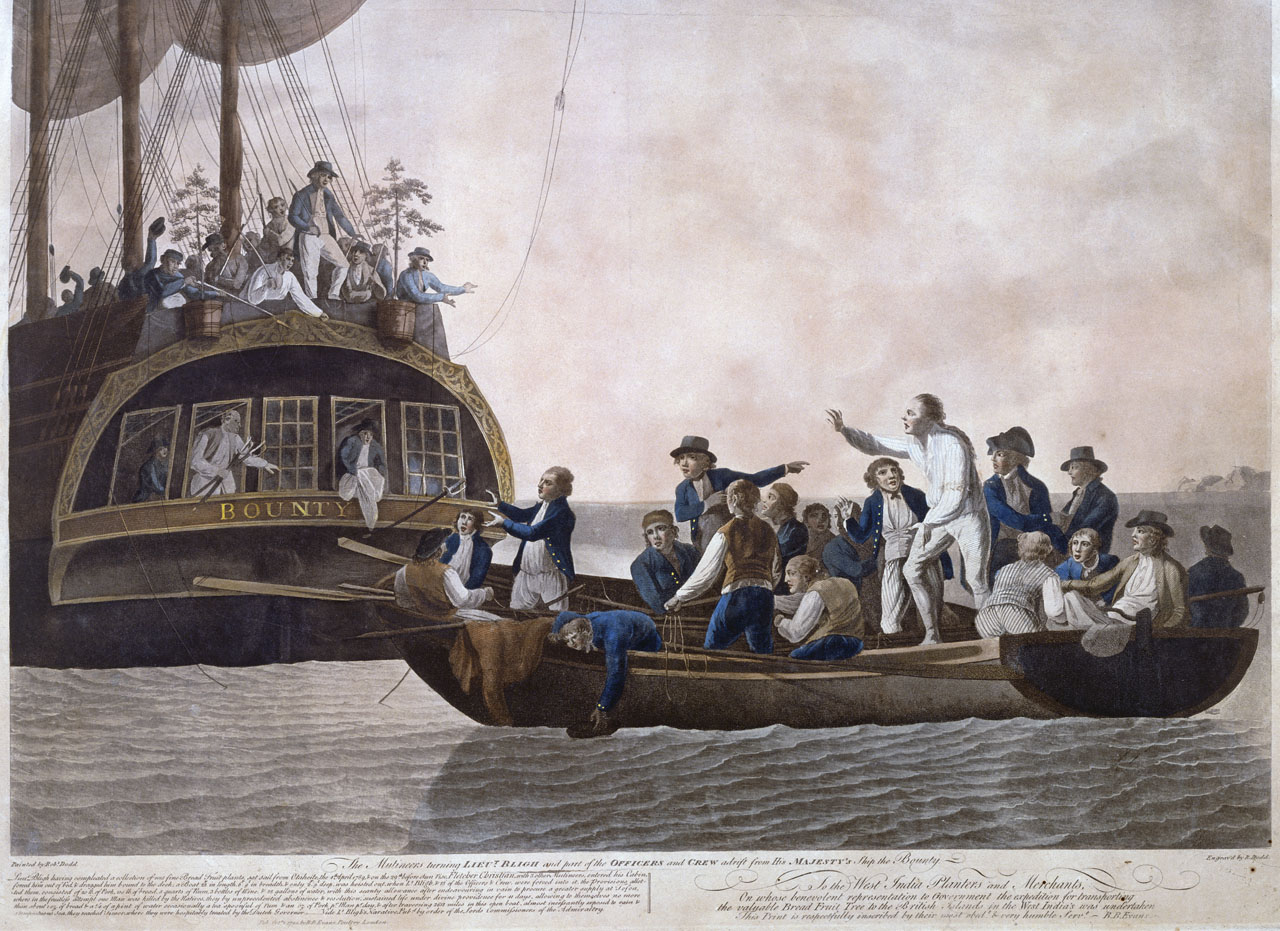
The Mutiny on the Bounty occurred in the Pacific Ocean on 28 April 1789. Disaffected crewmen, led by acting-Lieutenant Fletcher Christian, seized control of HMS Bounty from the captain, Lieutenant William Bligh, and set him and eighteen loyalists adrift in the ship's open launch. The reasons behind the mutiny are still debated. Bligh and his crew stopped for supplies on Tofua, where a crew member was killed. Bligh navigated more than 3,500 nautical miles (6,500 km; 4,000 mi) in the launch to reach safety and began the process of bringing the mutineers to justice. The mutineers variously settled on Tahiti or on Pitcairn Island.
Bounty had left England in 1787 on a mission to collect and transport breadfruit plants from Tahiti to the West Indies. A five-month layover in Tahiti, during which many of the men lived ashore and formed relationships with native Polynesians, led those men to be less amenable to naval discipline. Relations between Bligh and his crew deteriorated after he reportedly began handing out increasingly harsh punishments, criticism, and abuse, with Christian being a particular target. After three weeks back at sea, Christian and others forced Bligh from the ship. Twenty-five men remained on board afterwards, including loyalists held against their will, and others for whom there was no room in the launch.
After Bligh reached England in April 1790, the Admiralty despatched HMS Pandora to apprehend the mutineers. Fourteen were captured in Tahiti and imprisoned on board Pandora, which then searched without success for Christian's party that had hidden on Pitcairn Island. After turning back towards England, Pandora ran aground on the Great Barrier Reef, with the loss of 31 crew and four Bounty prisoners. The ten surviving detainees reached England in June 1792 and were court-martialled; four were acquitted, three were pardoned, and three were hanged.
Christian's group remained undiscovered on Pitcairn until 1808, by which time only one mutineer, John Adams, remained alive. His fellow mutineers, including Christian, were dead, killed either by one another or by their Polynesian companions. No action was taken against Adams. Descendants of the mutineers and their accompanying Tahitians have lived on Pitcairn into the 21st century.
His Majesty's Armed Vessel (HMAV) Bounty, or HMS Bounty, was built in 1784 at the Blaydes shipyard in Hull, Yorkshire, as a collier named Bethia. It was renamed after being purchased by the Royal Navy for £1,950 in May 1787 (equivalent to £312,986 in 2023). It was three-masted, 91 feet (28 m) long overall and 25 feet (7.6 m) across at its widest point, and registered at 230 tons burthen. Its armament was four short four-pounder carriage guns and ten half-pounder swivel guns, supplemented by small arms such as muskets. As it was rated by the Admiralty as a cutter, the smallest category of warship, its commander would be a lieutenant rather than a post-captain and would be the only commissioned officer on board. Nor did a cutter warrant the usual detachment of Royal Marines that naval commanders could use to enforce their authority.
Bounty had been acquired to transport breadfruit plants from Tahiti, then rendered "Otaheite", a Polynesian island in the South Pacific Ocean, to the British colonies in the West Indies. The expedition was promoted by the Royal Society and organised by its president Sir Joseph Banks, who shared the view of Caribbean plantation owners that breadfruit might grow well there and provide cheap food for the slaves. Bounty was refitted under Banks' supervision at Deptford Dockyard on the River Thames. The great cabin, normally the quarters of the ship's captain, was converted into a greenhouse for over a thousand potted breadfruit plants, with glazed windows, skylights, and a lead-covered deck and drainage system to prevent the waste of fresh water. The space required for these arrangements in the small ship meant that the crew and officers would endure severe overcrowding for the duration of the long voyage.
With Banks' agreement, command of the expedition was given to Lieutenant William Bligh, whose experiences included Captain James Cook's third and final voyage (1776–80) in which he had served as sailing master, or chief navigator, on HMS Resolution. Bligh was born in Plymouth in 1754 into a family of naval and military tradition. Appointment to Cook's ship at the age of 21 had been a considerable honour, although Bligh believed that his contribution was not properly acknowledged in the expedition's official account. With the 1783 ending of the eight-year American War of Independence—in which the French Navy fought from 1778—the vast Royal Navy was reduced in size, and Bligh found himself ashore on half-pay.
After a period of idleness, Bligh took temporary employment in the mercantile service and in 1785 was captain of the Britannia, a vessel owned by his wife's uncle, Duncan Campbell. Bligh assumed the prestigious Bounty appointment on 16 August 1787, at a considerable financial cost. His lieutenant's pay of four shillings a day (£70 a year) contrasted with the £500 a year he had earned as captain of Britannia. Because of the limited number of warrant officers allowed on Bounty, Bligh was also required to act as the ship's purser. To survey an important but under-explored passage, Bligh's sailing orders stated that he was to enter the Pacific via Cape Horn around South America and then, after collecting the breadfruit plants, sail westward through the Endeavour Strait. He was then to cross the Indian and South Atlantic Oceans to the West Indies islands in the Caribbean. Bounty would thus complete a circumnavigation of the Earth in the Southern Hemisphere.
Hub AI
Mutiny on the Bounty AI simulator
(@Mutiny on the Bounty_simulator)
Mutiny on the Bounty
The Mutiny on the Bounty occurred in the Pacific Ocean on 28 April 1789. Disaffected crewmen, led by acting-Lieutenant Fletcher Christian, seized control of HMS Bounty from the captain, Lieutenant William Bligh, and set him and eighteen loyalists adrift in the ship's open launch. The reasons behind the mutiny are still debated. Bligh and his crew stopped for supplies on Tofua, where a crew member was killed. Bligh navigated more than 3,500 nautical miles (6,500 km; 4,000 mi) in the launch to reach safety and began the process of bringing the mutineers to justice. The mutineers variously settled on Tahiti or on Pitcairn Island.
Bounty had left England in 1787 on a mission to collect and transport breadfruit plants from Tahiti to the West Indies. A five-month layover in Tahiti, during which many of the men lived ashore and formed relationships with native Polynesians, led those men to be less amenable to naval discipline. Relations between Bligh and his crew deteriorated after he reportedly began handing out increasingly harsh punishments, criticism, and abuse, with Christian being a particular target. After three weeks back at sea, Christian and others forced Bligh from the ship. Twenty-five men remained on board afterwards, including loyalists held against their will, and others for whom there was no room in the launch.
After Bligh reached England in April 1790, the Admiralty despatched HMS Pandora to apprehend the mutineers. Fourteen were captured in Tahiti and imprisoned on board Pandora, which then searched without success for Christian's party that had hidden on Pitcairn Island. After turning back towards England, Pandora ran aground on the Great Barrier Reef, with the loss of 31 crew and four Bounty prisoners. The ten surviving detainees reached England in June 1792 and were court-martialled; four were acquitted, three were pardoned, and three were hanged.
Christian's group remained undiscovered on Pitcairn until 1808, by which time only one mutineer, John Adams, remained alive. His fellow mutineers, including Christian, were dead, killed either by one another or by their Polynesian companions. No action was taken against Adams. Descendants of the mutineers and their accompanying Tahitians have lived on Pitcairn into the 21st century.
His Majesty's Armed Vessel (HMAV) Bounty, or HMS Bounty, was built in 1784 at the Blaydes shipyard in Hull, Yorkshire, as a collier named Bethia. It was renamed after being purchased by the Royal Navy for £1,950 in May 1787 (equivalent to £312,986 in 2023). It was three-masted, 91 feet (28 m) long overall and 25 feet (7.6 m) across at its widest point, and registered at 230 tons burthen. Its armament was four short four-pounder carriage guns and ten half-pounder swivel guns, supplemented by small arms such as muskets. As it was rated by the Admiralty as a cutter, the smallest category of warship, its commander would be a lieutenant rather than a post-captain and would be the only commissioned officer on board. Nor did a cutter warrant the usual detachment of Royal Marines that naval commanders could use to enforce their authority.
Bounty had been acquired to transport breadfruit plants from Tahiti, then rendered "Otaheite", a Polynesian island in the South Pacific Ocean, to the British colonies in the West Indies. The expedition was promoted by the Royal Society and organised by its president Sir Joseph Banks, who shared the view of Caribbean plantation owners that breadfruit might grow well there and provide cheap food for the slaves. Bounty was refitted under Banks' supervision at Deptford Dockyard on the River Thames. The great cabin, normally the quarters of the ship's captain, was converted into a greenhouse for over a thousand potted breadfruit plants, with glazed windows, skylights, and a lead-covered deck and drainage system to prevent the waste of fresh water. The space required for these arrangements in the small ship meant that the crew and officers would endure severe overcrowding for the duration of the long voyage.
With Banks' agreement, command of the expedition was given to Lieutenant William Bligh, whose experiences included Captain James Cook's third and final voyage (1776–80) in which he had served as sailing master, or chief navigator, on HMS Resolution. Bligh was born in Plymouth in 1754 into a family of naval and military tradition. Appointment to Cook's ship at the age of 21 had been a considerable honour, although Bligh believed that his contribution was not properly acknowledged in the expedition's official account. With the 1783 ending of the eight-year American War of Independence—in which the French Navy fought from 1778—the vast Royal Navy was reduced in size, and Bligh found himself ashore on half-pay.
After a period of idleness, Bligh took temporary employment in the mercantile service and in 1785 was captain of the Britannia, a vessel owned by his wife's uncle, Duncan Campbell. Bligh assumed the prestigious Bounty appointment on 16 August 1787, at a considerable financial cost. His lieutenant's pay of four shillings a day (£70 a year) contrasted with the £500 a year he had earned as captain of Britannia. Because of the limited number of warrant officers allowed on Bounty, Bligh was also required to act as the ship's purser. To survey an important but under-explored passage, Bligh's sailing orders stated that he was to enter the Pacific via Cape Horn around South America and then, after collecting the breadfruit plants, sail westward through the Endeavour Strait. He was then to cross the Indian and South Atlantic Oceans to the West Indies islands in the Caribbean. Bounty would thus complete a circumnavigation of the Earth in the Southern Hemisphere.
Recent media