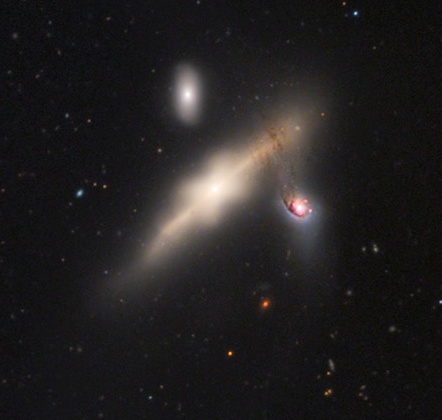

NGC 128
View on Wikipedia| NGC 128 | |
|---|---|
 | |
| Observation data (J2000 epoch) | |
| Constellation | Pisces |
| Right ascension | 00h 29m 15.047s[1] |
| Declination | +02° 51′ 50.60″[1] |
| Redshift | 0.01466[1] |
| Heliocentric radial velocity | 4363 km/s[1] |
| Distance | 190 Mly (58 Mpc)[2] |
| Apparent magnitude (V) | 11.63[3] |
| Apparent magnitude (B) | 12.65[3] |
| Characteristics | |
| Type | S0[1] |
| Other designations | |
| UGC 292, MCG +00-02-051, PGC 1791[1] | |
NGC 128 is a lenticular galaxy in the constellation Pisces. It is approximately 190 million light-years from the Sun and has a diameter of about 165,000 light-years.[2]
Discovery
[edit]NGC 128 was discovered by astronomer William Herschel on 25 December 1790 using a reflecting telescope with an aperture of 18.7 inches. At the time of discovery, its coordinates were recorded as 00h 22m 05s, +87° 54.6′ -20.0″.[4] It was later observed by John Herschel on 12 October 1827.[2]
Visual appearance
[edit]The galaxy is described as "pretty bright", "very small" with a "brighter middle". It is approximately 165,000 light years in diameter and is elongated.[5][2] The galaxy is famous for its (peanut shell)-shaped bulge, and in 2016 it was discovered that there are two such nested structures, possibly associated with two stellar bars.[6]
Galaxy group information
[edit]NGC 128 is the largest member, and the namesake of, the NGC 128 group which also includes the galaxies NGC 127 and NGC 130. NGC 128 has a strong tidal bridge with NGC 127 and there is evidence of interaction between all three galaxies in the group. NGC 128 has a noticeable peanut shape that is likely to be caused by gravitational effects of the other two galaxies.[7]
Gallery
[edit]-
 NGC 128 group with labels
 -
 NGC 128 group without labels


See also
[edit]References
[edit]- ^ a b c d e f "NGC 128". SIMBAD. Centre de données astronomiques de Strasbourg. Retrieved 2021-02-12.
- ^ a b c d "New General Catalog Objects: NGC 100 - 149". Celestial Atlas. Retrieved 25 January 2016.
- ^ a b "Search specification: NGC 128". HyperLeda. Université Claude Bernard Lyon 1. Retrieved 2021-02-12.
- ^ "NGC 128". The NGC/IC Project. Archived from the original on 28 May 2009. Retrieved 5 January 2016.
- ^ Aranda, Ted (2011). 3,000 Deep-Sky Objects: An Annotated Catalogue. Springer Science & Business Media. p. 54. ISBN 9781441994196.
- ^ Bogdan C. Ciambur; Alister W. Graham (2016), Quantifying the (X/peanut)-shaped structure in edge-on disc galaxies: length, strength, and nested peanuts
- ^ Jarvis, B (1990). "The NGC 128 Group of Galaxies". Dynamics and Interactions of Galaxies. Springer-Verlag Berlin. pp. 416–417. doi:10.1007/978-3-642-75273-5_104. ISBN 978-3-642-75275-9.
External links
[edit] Media related to NGC 128 at Wikimedia Commons
