


Community hub
Recent from talks
Contribute something
Nothing was collected or created yet.
NGC 708
View on Wikipedia| NGC 708 | |
|---|---|
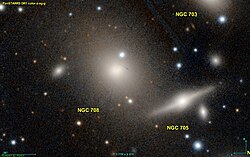
 NGC 708 imaged by Pan-STARRS | |
| Observation data (J2000 epoch) | |
| Constellation | Andromeda |
| Right ascension | 01h 52m 46.4467s[1] |
| Declination | +36° 09′ 06.581″[1] |
| Redshift | 0.015886[1] |
| Heliocentric radial velocity | 4762 km/s[1] |
| Distance | 232.05 ± 16.32 Mly (71.147 ± 5.005 Mpc)[1] |
| Group or cluster | Abell 262 |
| Apparent magnitude (V) | 13.70[1] |
| Characteristics | |
| Type | E[1] |
| Size | ~200,000 ly (62 kpc) (estimated)[1] |
| Apparent size (V) | 3.0′ × 2.5′[1] |
| Other designations | |
| B2 0149+35, HOLM 049A, UGC 1348, MCG +06-05-031, PGC 6962, CGCG 522-039[1] | |
NGC 708 is an elliptical galaxy located 240 million light-years away[1] in the constellation Andromeda. It was discovered by German-British astronomer William Herschel on September 21, 1786.[2] It is classified as a cD galaxy[3][4] and is the brightest member of Abell 262.[5][6] NGC 708 is a weak[7] FR I radio galaxy[8][9][10][11][12] and is also classified as a type 2 Seyfert galaxy.[7][13][1]
NGC 708 is surrounded by 4,700 globular clusters.[14]
Dust lane
[edit]
Discovered in 1979 by Kotanyi et al., NGC 708 has a thin dust lane[15] with an irregular structure.[16][17][18][4] Besides the dust lane, there are also patches of dust that cross the nucleus.[16][17][18] These features are oriented nearly perpendicular to the radio emission of the galaxy.[19][20][12][7][5] The lane appears to be a nearly edge-on dust disk[21] with a length of 16,000 ly (5 kpc).[22]
The dust lane appears to have formed from a cooling accretion flow of intracluster medium (ICM) onto NGC 708.[22]
Supermassive black hole
[edit]NGC 708 has a supermassive black hole with an estimated mass of (2.9×10⁸ M☉) (108.46) M☉.[23][9]
The supermassive black hole is powering the radio jets and lobes in the galaxy.[9]
Radio morphology
[edit]NGC 708 contains two radio jets[22] that are mildly bent[22][24] and extend into ''s'' shaped[7][11] double radio lobes[9][10][12][11] with a total length of 200,000 ly (60 kpc).[11]
Chandra observations have shown that the lobes have created a cavity in the intracluster medium of Abell 262.[10]
Possible interaction
[edit]NGC 708 may be interacting with NGC 705 which lies about 67,000 ly (20.6 kpc) to the south-west.[20]
See also
[edit]References
[edit]- ^ a b c d e f g h i j k l "Results for object NGC 0708". NASA/IPAC Extragalactic Database. NASA and Caltech. Retrieved 2018-12-22.
- ^ "New General Catalog Objects: NGC 700 – 749". cseligman.com. Retrieved 2018-11-21.
- ^ Lyskova, N.; Churazov, E.; Moiseev, A.; Sil'chenko, O.; Zhuravleva, I. (2014-05-15). "Stellar kinematics of X-ray bright massive elliptical galaxies". Monthly Notices of the Royal Astronomical Society. 441 (3): 2013–2033. arXiv:1404.2729. Bibcode:2014MNRAS.441.2013L. doi:10.1093/mnras/stu717. ISSN 0035-8711.
- ^ a b Goullaud, Charles F.; Jensen, Joseph B.; Blakeslee, John P.; Ma, Chung-Pei; Greene, Jenny E.; Thomas, Jens (2018-03-20). "The MASSIVE Survey. IX. Photometric Analysis of 35 High-mass Early-type Galaxies with HST WFC3/IR". The Astrophysical Journal. 856 (1): 11. arXiv:1801.08245. Bibcode:2018ApJ...856...11G. doi:10.3847/1538-4357/aab1f3. ISSN 1538-4357. S2CID 119458429.
- ^ a b West, M. J. (1994-05-01). "Anisotropic Mergers at High Redshifts - the Formation of CD Galaxies and Powerful Radio Sources". Monthly Notices of the Royal Astronomical Society. 268: 79–102. Bibcode:1994MNRAS.268...79W. doi:10.1093/mnras/268.1.79. ISSN 0035-8711.
- ^ "NGC 708". SIMBAD Astronomical Database. Retrieved 2018-12-23.
- ^ a b c d Durret, F. (1994-05-01). "Nuclear and extranuclear ionized gas in nine Seyfert 2 galaxies". Astronomy and Astrophysics Supplement Series. 105: 57–66. Bibcode:1994A&AS..105...57D. ISSN 0365-0138.
- ^ Parma, P.; Morganti, R.; Fanti, R.; Ruiter, De; R, H.; Chiaberge, M.; Celotti, A.; Capetti, A. (2001-12-06). "The HST survey of the B2 sample of radio-galaxies: optical nuclei and the FRI/BL Lac unified scheme". Astronomy & Astrophysics. 383: 104–111. arXiv:astro-ph/0112151. Bibcode:2002A&A...383..104C. doi:10.1051/0004-6361:20011714. S2CID 2457431.
- ^ a b c d Hu, C.; Wang, J.-M. (2005-08-01). "Captures of Red Giant Stars by Black Holes in Elliptical Galaxies: Feedback to the Hot Gas". The Astrophysical Journal. 630 (2): L125 – L128. arXiv:astro-ph/0508021. Bibcode:2005ApJ...630L.125W. doi:10.1086/491670. S2CID 119078675.
- ^ a b c Clarke, T. E.; McNamara, Brian R.; Sarazin, Craig L.; Blanton, Elizabeth L. (2004-05-21). "Chandra Observation of the Central Region of the Cooling Flow Cluster Abell 262: A Radio Source that is a Shadow of its Former Self?". The Astrophysical Journal. 612 (2): 817–824. arXiv:astro-ph/0405425. Bibcode:2004ApJ...612..817B. doi:10.1086/422677. S2CID 2628446.
- ^ a b c d Kassim, N. E.; Douglass, E. M.; Gopal-Krishna; Anderson, L. D.; Sarazin, C. L.; Blanton, E. L.; Clarke, T. E. (2009-03-04). "Tracing Multiple Generations of AGN Feedback in the Core of Abell 262". The Astrophysical Journal. 697 (2): 1481–1492. arXiv:0903.0844. Bibcode:2009ApJ...697.1481C. doi:10.1088/0004-637X/697/2/1481. S2CID 14636695.
- ^ a b c Taylor, G. B.; Giroletti, M.; Giovannini, G.; Liuzzo, E. (2010-06-01). "Parsec-scale properties of brightest cluster galaxies". Astronomy & Astrophysics. 516: A1. arXiv:1002.1380. Bibcode:2010A&A...516A...1L. doi:10.1051/0004-6361/200913888. ISSN 1432-0746. S2CID 14536396.
- ^ Reddy, Naveen A.; Yun, Min S. (2004-01-10). "Radio and Far-Infrared Emission as Tracers of Star Formation and AGN in Nearby Cluster Galaxies". The Astrophysical Journal. 600 (2): 695–715. arXiv:astro-ph/0309649. Bibcode:2004ApJ...600..695R. doi:10.1086/379871. ISSN 0004-637X. S2CID 15068448.
- ^ Harris, William E.; Harris, Gretchen L. H.; Alessi, Matthew (2013-07-09). "A Catalog of Globular Cluster Systems: What Determines the Size of a Galaxy's Globular Cluster Population?". The Astrophysical Journal. 772 (2): 82. arXiv:1306.2247. Bibcode:2013ApJ...772...82H. doi:10.1088/0004-637X/772/2/82. ISSN 0004-637X. S2CID 119113886.
- ^ Kotanyi, C. G.; Ekers, R. D. (1979-03-01). "Radio galaxies with dust lanes". Astronomy and Astrophysics. 73: L1 – L3. Bibcode:1979A&A....73L...1K. ISSN 0004-6361.
- ^ a b Capetti, A.; de Ruiter, H. R.; Fanti, R.; Morganti, R.; Parma, P.; Ulrich, M.-H. (2000-09-05). "The HST snapshot survey of the B2 sample of low luminosity radio-galaxies: a picture gallery". Astronomy and Astrophysics. 362: 871. arXiv:astro-ph/0009056. Bibcode:2000A&A...362..871C.
- ^ a b Taylor, G. B.; Giroletti, M.; Giovannini, G.; Liuzzo, E. (2009-10-01). "The Bologna complete sample of nearby radio sources – II. Phase referenced observations of faint nuclear sources". Astronomy & Astrophysics. 505 (2): 509–520. arXiv:0908.4391. Bibcode:2009A&A...505..509L. doi:10.1051/0004-6361/200912586. ISSN 1432-0746. S2CID 5288263.
- ^ a b Taylor, G. B.; Capetti, A.; Giroletti, M.; Giovannini, G.; Buttiglione, S.; Liuzzo, E. (2013-02-01). "Compact sources in the Bologna Complete Sample: high-resolution VLA observations and optical data". Astronomy & Astrophysics. 550: A76. arXiv:1209.4204. Bibcode:2013A&A...550A..76L. doi:10.1051/0004-6361/201220012. ISSN 1432-0746. S2CID 119233588.
- ^ Parma, P.; de Ruiter, H. R.; Fanti, C.; Fanti, R. (1986-04-01). "VLA observations of low luminosity radio galaxies. I – Sources with angular size smaller than two arcminutes". Astronomy and Astrophysics Supplement Series. 64: 135–171. Bibcode:1986A&AS...64..135P. ISSN 0365-0138.
- ^ a b Colina, L.; Perez-Fournon, I. (January 1990). "Optical observations of galaxies containing radio jets – A catalog of sources with redshift smaller than 0.15". The Astrophysical Journal Supplement Series. 72: 41–59. Bibcode:1990ApJS...72...41C. doi:10.1086/191408. ISSN 0067-0049.
- ^ Wegner, G. A.; Corsini, E. M.; Thomas, J.; Saglia, R. P.; Bender, R.; Pu, S. B. (2012). "Further Evidence for Large Central Mass-to-light Ratios in Early-type Galaxies: The Case of Ellipticals and Lenticulars in the A262 Cluster". The Astronomical Journal. 144 (3): 78. arXiv:1206.5768. Bibcode:2012AJ....144...78W. doi:10.1088/0004-6256/144/3/78. hdl:11577/2526313. ISSN 1538-3881. S2CID 118679035.
- ^ a b c d McCarthy, P. J.; van Bruegel, W. J. M.; Heckman, T.; Miley, G. K.; Filippenko, A. V. (1985-09-01). "Optical and Radio Observations of the Cooling-Flow Galaxy NGC 708". Bulletin of the American Astronomical Society. 17: 865. Bibcode:1985BAAS...17..865M.
- ^ Woo, Jong-Hak; Urry, C. Megan (2002). "Active Galactic Nucleus Black Hole Masses and Bolometric Luminosities". The Astrophysical Journal. 579 (2): 530–544. arXiv:astro-ph/0207249. Bibcode:2002ApJ...579..530W. doi:10.1086/342878. ISSN 0004-637X. S2CID 118160249.
- ^ Sofue, Yoshiaki; Wakamatsu, Ken-Ichi (August 1993). "CO in elliptical galaxies and the universal CO-to-dust ratio". Publications of the Astronomical Society of Japan. 45 (4–6264): 529–538. Bibcode:1993PASJ...45..529S. doi:10.1093/pasj/45.4.529.
External links
[edit]
- NGC 708 on WikiSky: DSS2, SDSS, GALEX, IRAS, Hydrogen α, X-Ray, Astrophoto, Sky Map, Articles and images
| Stars |
| ||||||||||||
|---|---|---|---|---|---|---|---|---|---|---|---|---|---|
| |||||||||||||
| Star clusters |
| ||||||||||||
| Nebulae |
| ||||||||||||
| Galaxies |
| ||||||||||||
| |||||||||||||
| |||||||||||||
