


Community hub
Recent from talks
Contribute something
Nothing was collected or created yet.
NGC 157
View on Wikipedia| NGC 157 | |
|---|---|
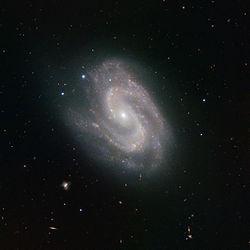
 VLT image of NGC 157 | |
| Observation data (J2000 epoch) | |
| Constellation | Cetus |
| Right ascension | 00h 34m 46.751s[1] |
| Declination | −08° 23′ 47.36″[1] |
| Redshift | 0.0055[2] |
| Heliocentric radial velocity | 1651 km/s[3] |
| Distance | 39.4 Mly (12.1 Mpc)[3] 75 Mly (23 Mpc)[4] |
| Apparent magnitude (V) | 10.4[5] |
| Apparent magnitude (B) | 11.07[3] |
| Characteristics | |
| Type | SAB(rs)bc[6] |
| Size | 90 kly[7] |
| Apparent size (V) | 4.0′ × 2.4′[5] |
| Other designations | |
| MCG -02-02-056, PGC 2081, 2MASSX J00344675-0823473[2] | |
NGC 157 is an intermediate spiral galaxy in the constellation of Cetus, positioned about 4° east of the star Iota Ceti. This galaxy can be viewed from suburban skies using a moderate-sized telescope.[5] It was discovered on December 13, 1783 by William Herschel. The compiler of the New General Catalogue, John Louis Emil Dreyer noted that NGC 157 was "pretty bright, large, extended, between 2 considerably bright stars".[7] It is a relatively isolated galaxy; the nearest other galaxy of comparable luminosity lies at a separation of 4.2 Mly (1.3 Mpc).[8]

The morphological classification of NGC 157 is SAB(rs)bc,[6] indicating this is a weakly-barred spiral galaxy (SAB) with a transitional ring structure (rs) and moderate to loosely-wound arms (bc). The plane of the galaxy is inclined at an angle of 61.8° to the line of sight from the Earth.[6] It has symmetric arms that become flocculent in the outer parts, breaking into multiple arms. The rotation curve for this galaxy undergoes a sharp decline, suggesting a low mass or a small dark matter halo.[8] It is considered a quiescent galaxy, showing little star formation activity.[9] However, there is a starburst region in the nucleus forming new stars at the rate of about one solar mass per year.[10]
This galaxy has been host to two observed supernova events. The first, 2009em, was discovered 5 May 2009, about 34″ west and 10″ south of the galaxy core.[11] It was determined to be a Type Ic supernova.[12] On 5 May 2022, Type Ic supernova event SN 2022jli was observed in NGC 157, reaching a peak magnitude of 14.4.[13]
References
[edit]- ^ a b Skrutskie, Michael F.; et al. (1 February 2006). "The Two Micron All Sky Survey (2MASS)". The Astronomical Journal. 131 (2): 1163–1183. Bibcode:2006AJ....131.1163S. doi:10.1086/498708. ISSN 0004-6256. S2CID 18913331.
- ^ a b "NGC 157". SIMBAD. Centre de données astronomiques de Strasbourg. Retrieved 2015-09-30.
- ^ a b c Tully, R. Brent; et al. (August 2016). "Cosmicflows-3". The Astronomical Journal. 152 (2): 21. arXiv:1605.01765. Bibcode:2016AJ....152...50T. doi:10.3847/0004-6256/152/2/50. S2CID 250737862. 50.
- ^ Moore, T.; et al. (October 2023). "SN 2022jli: A Type Ic Supernova with Periodic Modulation of Its Light Curve and an Unusually Long Rise". The Astrophysical Journal Letters. 956 (1): L31. arXiv:2309.12750. Bibcode:2023ApJ...956L..31M. doi:10.3847/2041-8213/acfc25. ISSN 2041-8205.
- ^ a b c O'Meara, Stephen James (June 14, 2007). Herschel 400 Observing Guide. Cambridge University Press. p. 303. ISBN 9780521858939.
- ^ a b c Crowther, Paul A. (January 2013). "On the association between core-collapse supernovae and H ii regions". Monthly Notices of the Royal Astronomical Society. 428 (3): 1927–1943. arXiv:1210.1126. Bibcode:2013MNRAS.428.1927C. doi:10.1093/mnras/sts145.
- ^ a b ">New General Catalog Objects: NGC 150 - 199". Retrieved 2015-09-30.
- ^ a b Zobnina, D. I.; Zasov, A. V. (April 2020). "Galaxies with Declining Rotation Curves". Astronomy Reports. 64 (4): 295–309. arXiv:2003.08845. Bibcode:2020ARep...64..295Z. doi:10.1134/S1063772920050054.
- ^ Zhu, Ming; et al. (December 2009). "Tracing Molecular Gas Mass in Extreme Extragalactic Environments: An Observational Study". The Astrophysical Journal. 706 (2): 941–959. arXiv:0908.1600. Bibcode:2009ApJ...706..941Z. doi:10.1088/0004-637X/706/2/941.
- ^ Sempere, M. J.; Rozas, M. (January 1997). "Dynamical model of the grand-design spiral galaxy NGC 157". Astronomy and Astrophysics. 317: 405–415. Bibcode:1997A&A...317..405S.
- ^ Monard, L. A. G. (May 2009). Green, D. W. E. (ed.). "Supernova 2009em in NGC 157". Central Bureau Electronic Telegrams (1798): 1. Bibcode:2009CBET.1798....1M.
- ^ "Transient Name Server entry for SN 2022jli". Retrieved 21 March 2023.
External links
[edit] Media related to NGC 157 at Wikimedia Commons

