Recent from talks
Nothing was collected or created yet.
NGC 2748
View on Wikipedia| NGC 2748 | |
|---|---|
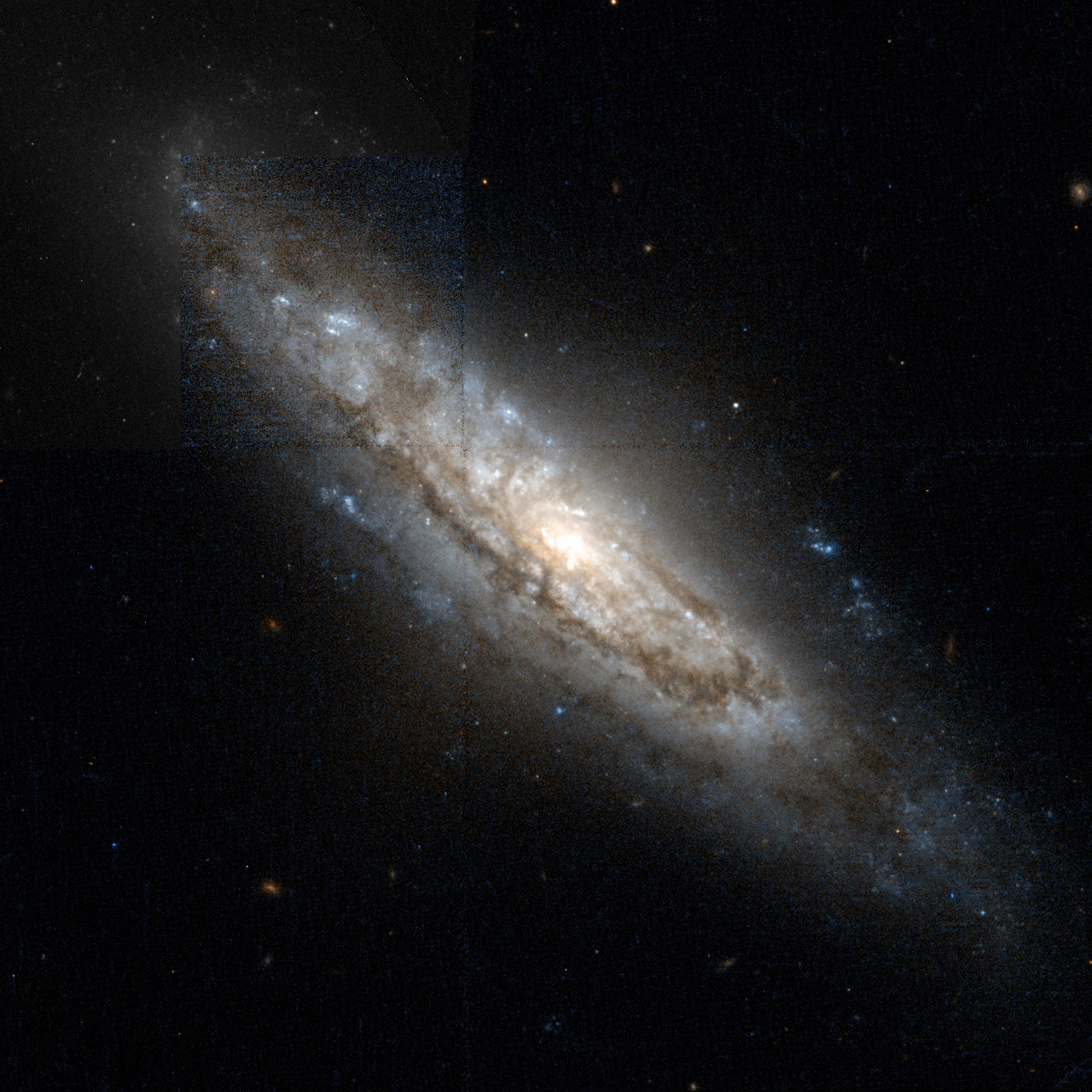
NGC 2748 imaged by the Hubble Space Telescope | |
| Observation data (J2000.0 epoch) | |
| Constellation | Camelopardalis |
| Right ascension | 09h 13m 43.037s[1] |
| Declination | +76° 28′ 31.23″[1] |
| Redshift | 0.004930[2] |
| Heliocentric radial velocity | 1,473 km/s[3] |
| Distance | 61.3 Mly (18.79 Mpc)[3] |
| Apparent magnitude (V) | 11.7[4] |
| Characteristics | |
| Type | SAbc[5] |
| Size | ~67,200 ly (20.61 kpc) (estimated)[6] |
| Apparent size (V) | 2.250′ × 0.720′[2] |
| Other designations | |
| IRAS 09080+7640, UGC 4825, MCG +13-07-019, PGC 26018, CGCG 350-014[2] | |
NGC 2748 is a spiral galaxy in the northern circumpolar constellation of Camelopardalis,[7] located at a distance of 61.3 megalight-years from the Milky Way.[3] It was discovered September 2, 1828 by British astronomer John Herschel.[7]
Characteristics
[edit]The morphological classification of SAbc[5] indicates NGC 2748 is an unbarred spiral with moderate to loosely-wound spiral arms. It is a disk-like peculiar galaxy with a stellar shell that is rotating about the main galactic axis. This shell was most likely formed through the capture and disruption of a dwarf companion.[8] The galactic nucleus likely contains a supermassive black hole with a mass of 4.4+3.5
−3.6×10⁷ M☉, or 44 million times the mass of the Sun.[5]
Supernovae and Luminous Red Nova
[edit]Three supernovae and one luminous red nova have been observed in NGC 2748.
- SN 1985A (Type Ia, mag. 14.5) was discovered by Thomas Schildknecht on January 25, 1985, located 3″ west and 10″ south of the galaxy's nucleus.[9][10][11]
- SN 2013ff (Type Ic, mag. 16) was discovered by Raffaele Belligoli and Flavio Castellani on August 31, 2013. It was positioned 19″ west and 21″ north of the core of NGC 2748, and eventually reached magnitude 15.2.[12][13][14]
- AT 2015xf (type LRN, mag. 18.3) was discovered by Kōichi Itagaki on 10 February 2015.[15] The transient was originally classified as a luminous blue variable, a type of supernova impostor.[16][17] Later analysis concluded that it was actually a luminous red nova.[18]
- SN 2017gkk (Type IIb, mag. 14.7) was discovered by MASTER on 19 August 2017,[19] and independently by Kōichi Itagaki on 31 August 2017.[20][21]
See also
[edit]References
[edit]- ^ a b Skrutskie, Michael F.; Cutri, Roc M.; Stiening, Rae; Weinberg, Martin D.; Schneider, Stephen E.; Carpenter, John M.; Beichman, Charles A.; Capps, Richard W.; Chester, Thomas; Elias, Jonathan H.; Huchra, John P.; Liebert, James W.; Lonsdale, Carol J.; Monet, David G.; Price, Stephan; Seitzer, Patrick; Jarrett, Thomas H.; Kirkpatrick, J. Davy; Gizis, John E.; Howard, Elizabeth V.; Evans, Tracey E.; Fowler, John W.; Fullmer, Linda; Hurt, Robert L.; Light, Robert M.; Kopan, Eugene L.; Marsh, Kenneth A.; McCallon, Howard L.; Tam, Robert; Van Dyk, Schuyler D.; Wheelock, Sherry L. (1 February 2006). "The Two Micron All Sky Survey (2MASS)". The Astronomical Journal. 131 (2): 1163–1183. Bibcode:2006AJ....131.1163S. doi:10.1086/498708. ISSN 0004-6256. S2CID 18913331.
- ^ a b c "NGC 2748". SIMBAD. Centre de données astronomiques de Strasbourg. Retrieved 2020-04-16.
- ^ a b c Tully, R. Brent; et al. (August 2016). "Cosmicflows-3". The Astronomical Journal. 152 (2): 21. arXiv:1605.01765. Bibcode:2016AJ....152...50T. doi:10.3847/0004-6256/152/2/50. S2CID 250737862. 50.
- ^ Frommert, Hartmut. "NGC 2748". SEDS. Retrieved 2020-04-16.
- ^ a b c Atkinson, J. W.; et al. (May 2005). "Supermassive black hole mass measurements for NGC 1300 and 2748 based on Hubble Space Telescope emission-line gas kinematics". Monthly Notices of the Royal Astronomical Society. 359 (2): 504–520. arXiv:astro-ph/0502573. Bibcode:2005MNRAS.359..504A. doi:10.1111/j.1365-2966.2005.08904.x. S2CID 16193663.
- ^ "Results for object NGC 2748". NASA/IPAC Extragalactic Database. NASA and Caltech. Retrieved 28 August 2025.
- ^ a b Seligman, Courtney. "Celestial Atlas: NGC Objects: NGC 2700 - 2749". cseligman.com. Retrieved 2020-04-15.
- ^ Merkulova, O. A.; et al. (September 2009). "2-D spectroscopy of polar-ring galaxies candidates. II. The peculiar galaxies NGC 2748 and UGC 4385". Astronomy Letters. 35 (9): 587–598. Bibcode:2009AstL...35..587M. doi:10.1134/S1063773709090023. S2CID 121033172.
- ^ Wild, P.; Schildknecht, T. (January 1985). Marsden, B. G. (ed.). "Supernova 1985A in NGC 2748". IAU Circular. 4031: 3. Bibcode:1985IAUC.4031....3W.
- ^ "SN 1985A". Transient Name Server. IAU. Retrieved 5 August 2025.
- ^ Wegner, Gary; McMahan, Robert K. (February 1987). "Spectroscopy of the Supernova 1982V, 1984A, and 1985B". Astronomical Journal. 93: 287. Bibcode:1987AJ.....93..287W. doi:10.1086/114312.
- ^ Green, D. W. E. (2013). "Supernova 2013ff in NGC 2748 = PSN J09133888+7628108". Central Bureau Electronic Telegrams (3656): 1. Bibcode:2013CBET.3656....1G.
- ^ Brimacombe, J.; et al. (September 2013). Green, D. W. E. (ed.). "Supernova 2013ff in NGC 2748 = Psn J09133888+7628108". Central Bureau Electronic Telegrams. 3647: 1. Bibcode:2013CBET.3647....1B.
- ^ "SN 2013ff". Transient Name Server. IAU. Retrieved 5 August 2025.
- ^ Itagaki, K. (2025). "Padova-Asiago Transient Discovery Report for 2025-04-19". Transient Name Server Discovery Report. 2025–1440: 1. Bibcode:2025TNSTR1440....1I.
- ^ Tartaglia, L.; Pastorello, A.; Benetti, S.; Cappellaro, E.; Elias-Rosa, N.; Ochner, P.; Terreran, G.; Tomasella, L.; Turatto, M. (12 February 2015). "Asiago spectroscopic observation of PSN J09132750+7627410". The Astronomer's Telegram. 7051: 1. Bibcode:2015ATel.7051....1T.
- ^ Tartaglia, L.; et al. (June 2016). "The Supernova Impostor PSN J09132750+7627410 and Its Progenitor". The Astrophysical Journal Letters. 823 (2): 7. arXiv:1604.04628. Bibcode:2016ApJ...823L..23T. doi:10.3847/2041-8205/823/2/L23. S2CID 118392026. L23.
- ^ "AT 2015xf". Transient Name Server. IAU. Retrieved 20 April 2025.
- ^ Balanutsa, P.; et al. (2017). "MASTER discovery bright SN in NGC2748". The Astronomer's Telegram. 10667: 1. Bibcode:2017ATel10667....1B.
- ^ "SN 2017gkk". Transient Name Server. IAU. Retrieved 17 August 2024.
- ^ Onori, F.; et al. (September 2017). "Spectroscopic observation of SN2017gkk by NUTS (NOT Un-biased Transient Survey)". The Astronomer's Telegram. 10698: 1. Bibcode:2017ATel10698....1O.
External links
[edit]
Media related to NGC 2748 at Wikimedia Commons- Images
- Spectral data
- Supermassive black hole mass measurements for NGC 1300 and NGC 2748 based on HST emission-line gas kinematics
