


Community hub
Recent from talks
Contribute something
Nothing was collected or created yet.
Messier 67
View on Wikipedia| Messier 67 | |
|---|---|
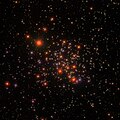
 Open cluster Messier 67 in Cancer | |
| Observation data (J2000.0 epoch) | |
| Right ascension | 08h 51.3m |
| Declination | +11° 49′ |
| Distance | ~2.61–2.93 kly (800–900 pc[1][2][3][4]) |
| Apparent magnitude (V) | 6.1 |
| Apparent dimensions (V) | 30.0′ |
| Physical characteristics | |
| Radius | 10 ly[citation needed] |
| Estimated age | 3.2 to 5 billion years |
| Other designations | NGC 2682, Cr 204 |
| Associations | |
| Constellation | Cancer |
Messier 67 (also known as M67 or NGC 2682) and sometimes called the King Cobra Cluster or the Golden Eye Cluster[5] is an open cluster in the southern, equatorial half of Cancer. It was discovered by Johann Gottfried Koehler in 1779. Estimates of its age range between 3.2 and 5 billion years. Distance estimates are likewise varied, but typically are 800–900 parsecs (2,600–2,900 ly).[1][2][3][4] Estimates of 855, 840, and 815 pc were established via binary star modelling and infrared color-magnitude diagram fitting.[2][3][4]
Description
[edit]M67 is not the oldest known open cluster; several Milky Way clusters are known to be older, yet farther than M67. It is a paradigm study object in stellar evolution:[6]
- it is well-populated
- has negligible amounts of dust obscuration
- all its stars are at the same distance and age, save for approximately 30 anomalous blue stragglers
M67 is one of the most-studied open clusters, yet estimates of its physical parameters such as age, mass, and number of stars of a given type, vary substantially. Richer et al. estimate its age to be 4 billion years, its mass to be 1080 solar masses (M☉), and number its white dwarfs at 150.[7] Hurley et al. estimate its current mass to be 1,400 M☉ and its initial mass to be approximately 10 times as great.[8]
It has more than 100 stars similar to the Sun, and numerous red giants. The total star count has been estimated at well over 500.[9] The ages and prevalence of Sun-like stars had led some astronomers to theorize it as the possible parent cluster of the Sun.[10] However, computer simulations disagree on whether the outer Solar System would have survived an ejection from M67,[11][12] and the cluster itself would probably not have survived such an ejection event.[13]
The cluster contains no main sequence stars bluer (hotter) than spectral type F, other than perhaps some of the blue stragglers, since the brighter stars of that age have already left the main sequence. In fact, when the stars of the cluster are plotted on the Hertzsprung-Russell diagram, there is a distinct "turn-off" representing the stars which have terminated hydrogen fusion in the core and are destined to become red giants. As a cluster ages, the turn-off moves progressively down the main sequence to cooler stars.
It appears that M67 has a bias toward heavier stars. One cause of this is mass segregation, the process by which lighter stars gain speed at the expense of more massive stars during close encounters, which moves them to greater average distance from the center of the cluster or allows escape altogether.[14]
A March 2016 joint AIP/JHU study by Barnes et al. on rotational periods of 20 Sun-like stars, measured by the effects of moving starspots on light curves, suggests that these approximately 4 billion-year old stars spin in about 26 days – like the Sun, which has a period at the equator of 25.38 days.[15] Measurements were carried out as part of the extended K2 mission of Kepler space telescope. This reinforces the applicability of many key properties of the Sun to stars of the same size and age, a fundamental principle of modern solar and stellar physics.[16] The authors abbreviate this as the "solar-stellar connection".[16]
Exoplanets
[edit]
A radial velocity survey of M67 has found exoplanets around five stars in the cluster: YBP 1194, YBP 1514, YBP 401, Sand 978, and Sand 1429.[17][18][19][20] A sixth star, Sand 364, was also thought to have a planet, but a follow-up study did not find evidence for it and concluded that the radial velocity variations have a non-planetary origin, likely stellar variability.[21]
Gallery
[edit]-
-
 Hertzsprung-Russell diagram for two open clusters, M67 and NGC 188, showing color-magnitude data
 -
Artist's impression video showing a hot Jupiter exoplanet orbiting close to a star in Messier 67
-
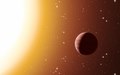 Artist's impression of a hot Jupiter exoplanet in the star cluster Messier 67
.jpg)

See also
[edit]References
[edit]- ^ a b Paunzen, E.; Mermilliod, J.-C. "WEBDA page for open cluster NGC 2682". WEBDA. Retrieved 2022-10-12.
- ^ a b c Sarajedini, Ata; Dotter, Aaron; Kirkpatrick, Allison (2009). "Deep 2MASS Photometry of M67 and Calibration of the Main-Sequence J - KS Color Difference as an Age Indicator". The Astrophysical Journal. 698 (2): 1872–1878. arXiv:0904.2907. Bibcode:2009ApJ...698.1872S. doi:10.1088/0004-637X/698/2/1872. S2CID 11654120.
- ^ a b c Yakut, K.; Zima, W.; Kalomeni, B.; Van Winckel, H.; Waelkens, C.; De Cat, P.; Bauwens, E.; Vučković, M.; Saesen, S.; Le Guillou, L.; Parmaksızoğlu, M.; Uluç, K.; Khamitov, I.; Raskin, G.; Aerts, C. (2009). "Close binary and other variable stars in the solar-age Galactic open cluster M 67". Astronomy and Astrophysics. 503 (1): 165. arXiv:0906.4908. Bibcode:2009A&A...503..165Y. doi:10.1051/0004-6361/200911918. S2CID 1136371.
- ^ a b c Majaess, Daniel J.; Turner, David G.; Lane, David J.; Krajci, Tom (2011). "Deep Infrared ZAMS Fits to Benchmark Open Clusters Hosting delta Scuti Stars". Journal of the American Association of Variable Star Observers (Jaavso). 39 (2): 219. arXiv:1102.1705. Bibcode:2011JAVSO..39..219M.
- ^ Martina McGovern. "M67 Open cluster". British Astronomical Association. Retrieved 2022-10-12.
- ^ Xiao-Bin Zhang; Rong-Xian Zhang & Zhi-Ping Li (2005). "S1280 and S1284: Two Oscillating Blue Stragglers in the Open Cluster M67". Chinese Journal of Astronomy and Astrophysics. 5 (6): 579–586. Bibcode:2005ChJAA...5..579Z. doi:10.1088/1009-9271/5/6/003.
- ^ Harvey B. Richer; Gregory G. Fahlman; Joanne Rosvick; Rodrigo Ibata (1998). "The White Dwarf Cooling Age of M67". The Astrophysical Journal. 504 (2): L91. arXiv:astro-ph/9806172. Bibcode:1998ApJ...504L..91R. doi:10.1086/311586. S2CID 17309096.
- ^ Jarrod R. Hurley; Onno R. Pols; Sverre J. Aarseth; Christopher A. Tout (2005). "A Complete N-body Model of the Old Open Cluster M67". Monthly Notices of the Royal Astronomical Society. 363 (1): 293–314. arXiv:astro-ph/0507239. Bibcode:2005MNRAS.363..293H. doi:10.1111/j.1365-2966.2005.09448.x. S2CID 17632739.
- ^ W. L. Sanders (1977). "Membership of the open cluster M67". Astronomy & Astrophysics Supplement Series. 27: 89–116. Bibcode:1977A&AS...27...89S.
- ^ "Did Our Solar System Originate in a Distant Star Cluster?". Daily Galaxy. 30 September 2014. Archived from the original on 10 May 2016. Retrieved 30 March 2016.
- ^ Jørgensen, Timmi G; Church, Ross P (11 March 2020). "Stellar escapers from M67 can reach solar-like Galactic orbits". Monthly Notices of the Royal Astronomical Society. 492 (4): 4959–4974. arXiv:1905.09586. doi:10.1093/mnras/staa185.
- ^ Pichardo, Bárbara; Moreno, Edmundo; Allen, Christine; Bedin, Luigi R.; Bellini, Andrea; Pasquini, Luca (February 2012). "The Sun was not born in M 67". The Astronomical Journal. 143 (3): 73. arXiv:1201.0987. Bibcode:2012AJ....143...73P. doi:10.1088/0004-6256/143/3/73. S2CID 119266159. article ID 73.
- ^ Webb, Jeremy J; Price-Jones, Natalie; Bovy, Jo; Portegies Zwart, Simon; Hunt, Jason A S; Mackereth, J Ted; Leung, Henry W (11 May 2020). "Searching for solar siblings in APOGEE and Gaia DR2 with N-body simulations". Monthly Notices of the Royal Astronomical Society. 494 (2): 2268–2279. arXiv:1910.01646. doi:10.1093/mnras/staa788.
- ^ Ch. Bonatto & E. Bica (2003). "Mass segregation in M67 with 2MASS" (PDF). Astronomy and Astrophysics. 405 (2): 525. Bibcode:2003A&A...405..525B. doi:10.1051/0004-6361:20030205.
- ^ Sydney A. Barnes; Jörg Weingrill; Dario Fritzewski; Klaus G. Strassmeier; Imants Platais (2016). "Rotation periods for cool stars in the 4 Gyr-old open cluster M67, the solar-stellar connection, and the applicability of gyrochronology to at least solar age". The Astrophysical Journal. 823 (1): 16. arXiv:1603.09179. Bibcode:2016ApJ...823...16B. doi:10.3847/0004-637X/823/1/16. S2CID 89613927.
- ^ a b "Stars nearly as old as Sun found to have similar spin rates". Astronomy Now. 17 May 2016.
- ^ Brucalassi, A.; Pasquini, L.; et al. (January 2014). "Three planetary companions around M 67 stars". Astronomy & Astrophysics. 561: L9. arXiv:1401.4905. Bibcode:2014A&A...561L...9B. doi:10.1051/0004-6361/201322584.
- ^ Brucalassi, A.; Pasquini, L.; et al. (July 2016). "Search for giant planets in M67. III. Excess of hot Jupiters in dense open clusters". Astronomy & Astrophysics. 592: L1. arXiv:1606.05247. Bibcode:2016A&A...592L...1B. doi:10.1051/0004-6361/201527561.
- ^ Brucalassi, A.; Koppenhoefer, J.; et al. (July 2017). "Search for giant planets in M 67. IV. Survey results". Astronomy & Astrophysics. 603: A85. arXiv:1703.04296. Bibcode:2017A&A...603A..85B. doi:10.1051/0004-6361/201527562.
- ^ Thomas, Luis; Saglia, Roberto; et al. (March 2024). "Search for giant planets in M67 V: a warm Jupiter orbiting the turn-off star S1429". Astronomy & Astrophysics. 686: A19. arXiv:2403.02911. Bibcode:2024A&A...686A..19T. doi:10.1051/0004-6361/202449233.
- ^ Zhou, Qijia; Latham, David W.; et al. (October 2023). "False Planets around Giant Stars: A Case Study of Sanders 364 in M67". The Astronomical Journal. 166 (4): 160. Bibcode:2023AJ....166..160Z. doi:10.3847/1538-3881/acf291.
External links
[edit] Media related to Messier 67 at Wikimedia Commons
- Messier 67, SEDS Messier pages
- Merrifield, Mike. "M67 – Open Cluster". Deep Sky Videos. Brady Haran.
- Messier 67 on WikiSky: DSS2, SDSS, GALEX, IRAS, Hydrogen α, X-Ray, Astrophoto, Sky Map, Articles and images

| List |
|  |
|---|---|---|
| See also | ||


Messier 67
View on GrokipediaDiscovery and Observation
Discovery
Messier 67 was first recorded as a distinct celestial object by the German astronomer Johann Gottfried Koehler before 1779, who described it as "a rather conspicuous nebula in elongated figure, near Alpha of Cancer" using his limited instrumentation, which prevented him from resolving it into individual stars.[6] The cluster was independently rediscovered by French astronomer Charles Messier on April 6, 1780, during his systematic search for comets, when he noted it as a "cluster of small stars with nebulosity, below the southern claw of Cancer," with its position determined relative to Alpha Cancri. This observation led to its formal inclusion as the 67th entry in Messier's renowned catalog of nebulae and star clusters, published in the Connaissance des Temps for 1781.[6] In 1784, British astronomer William Herschel observed Messier 67 using his 20-foot reflecting telescope and described it as "a most beautiful cluster of stars; not less than 200 in view," highlighting its stellar nature more clearly than prior accounts and contributing to early understandings of open clusters.[6] The cluster received its New General Catalogue designation as NGC 2682 from observations conducted by John Herschel between 1826 and 1830, where he characterized it as a "pretty rich cluster of scattered stars between 10th and 15th magnitude," with estimates of up to 200 member stars filling the field of view.[6]Historical Observations
Following its initial cataloging by Charles Messier in 1780, Messier 67 became a subject of detailed telescopic scrutiny in the 19th century, particularly through the observations of John Herschel. Using his 20-foot reflector during sweeps between 1826 and 1830, Herschel resolved the cluster into a "pretty rich cluster of scattered stars between 10th and 15th magnitude," estimating 100 to 200 stars that filled the field of view and noting its remarkable brightness and extent.[6] His father, William Herschel, had earlier described it in 1784 as a "most beautiful cluster of stars; not less than 200 in view" with his larger instrument, emphasizing its stellar richness over nebulous appearance. Other astronomers, such as William Smyth in 1836, reinforced these findings, portraying it as a "rich but loose cluster... consists principally of a mass of stars of the 9th and 10th magnitude, gathered somewhat in the form of a Phrygian cap."[6] Advancements in astrophotography during the late 19th and early 20th centuries allowed for the detection of fainter members beyond visual limits. The Harvard College Observatory's extensive plate collection, initiated in the 1880s under Edward C. Pickering, captured images of Messier 67 that revealed dimmer stars down to 15th magnitude or fainter, enabling more complete membership assessments. These early dry-plate exposures, part of broader sky surveys, highlighted the cluster's sparse outer envelope and contributed to quantitative star counts, distinguishing true members from field stars.[7] Spectroscopic investigations in the early 20th century, led by Annie Jump Cannon as part of the Henry Draper Catalogue (published 1918–1924), classified the spectral types of prominent stars in Messier 67. Cannon's system, refining earlier schemes, identified dominant G- and K-type giants among the brighter members, with spectra showing strong absorption lines indicative of cooler, evolved stars. This work, based on Harvard's photographic spectra, provided the first systematic typing for dozens of cluster stars, revealing a paucity of hot O- and B-type objects. By the 1920s, analyses of color-magnitude data from these photographic plates led to the recognition of Messier 67 as an old open cluster. Harlow Shapley's studies, including photoelectric and photographic photometry published in 1917 and 1919, constructed early color indices for Messier 67 stars, showing a main sequence turnoff at cooler temperatures and an elevated giant branch compared to younger clusters like the Pleiades.[8][9] This morphology, lacking blue giants and featuring red giants, indicated an age of several billion years, positioning it as a key example of galactic cluster evolution akin to the Hyades but older.[10]Modern Studies
In the mid-20th century, the development of photoelectric photometry enabled the construction of detailed color-magnitude diagrams (CMDs) for Messier 67 (M67), providing early quantitative insights into its advanced age and stellar evolution. A seminal study by Johnson and Sandage in 1955 derived the first such diagram from observations of over 100 stars, revealing a main-sequence turnoff indicative of an age exceeding 4 billion years and a horizontal branch populated by evolved stars, which highlighted M67's role as a benchmark for understanding chemical composition effects on evolution. This work confirmed M67 as one of the oldest known open clusters, with its CMD morphology suggesting minimal ongoing star formation and significant dynamical relaxation. Advancements in space-based imaging during the 1990s further resolved faint stellar populations in M67, particularly through Hubble Space Telescope (HST) observations. Using the Wide Field Planetary Camera 2, Richer et al. in 1998 imaged the cluster's core to depths reaching V ≈ 28, clearly delineating the white dwarf cooling sequence for the first time and identifying over 20 blue stragglers as brighter, hotter outliers on the CMD. These findings quantified the cluster's white dwarf population, estimating a total of approximately 100 such remnants and supporting mass-transfer or collision scenarios for blue straggler formation, while establishing M67's distance at around 900 parsecs based on the sequence's luminosity. The European Space Agency's Gaia mission, beginning with Data Release 2 in 2018, revolutionized membership determination and astrometry for M67 by providing precise proper motions and parallaxes for thousands of stars across a wide field. Carrera et al. in 2019 analyzed Gaia DR2 data to select over 1,000 probable members up to 150 parsecs from the cluster center, revealing an extended halo twice the previously known size and refining the distance to 840 ± 40 parsecs through isochrone fitting. Subsequent releases, including DR3 in 2022, enhanced proper motion accuracy to below 0.1 mas yr⁻¹, enabling detailed dynamical modeling and confirmation of low-mass star retention, which underscores M67's evolutionary history without significant mass loss. Recent theoretical work has leveraged M67's well-characterized stellar parameters to probe uncertainties in evolution models. A 2024 study by Byrom et al. compared four isochrone grids—DSEP, GARSTEC, MIST, and YREC—applied to observed CMD positions of M67 main-sequence and giant stars, finding age discrepancies up to 20% across grids, particularly for red giants where YREC and MIST yielded younger estimates (around 2.6 Gyr) than the cluster's accepted 4 Gyr value.[11] This highlights sensitivities to convective overshoot and opacity treatments, advocating for hybrid models to better match empirical data from M67.[11] In 2025, asteroseismology emerged as a powerful tool for probing M67's interiors, with Reyes et al. detecting solar-like acoustic oscillations (p-modes) in 27 evolved stars spanning subgiants to red giants using space- and ground-based photometry. The analysis revealed large frequency separations (Δν) decreasing from ~8 μHz in subgiants to ~4 μHz in giants, tracing a rapid deepening of convective envelopes that evolves the acoustic cavity depth by over 50% during this phase, consistent with models of envelope expansion but revealing unexpected plateaus in mode ratios. These detections, with individual mode frequencies resolved to ~0.1 μHz precision, provide direct constraints on convective zone evolution, affirming M67's age at 4.0 ± 0.2 Gyr without reliance on surface parameters.Physical Characteristics
Location and Visibility
Messier 67 resides in the constellation Cancer, positioned near the border with Hydra.[1] Its equatorial coordinates in the J2000.0 epoch are right ascension 08h 51m 23s and declination +11° 48′ 54″.[3] The cluster lies at a distance of approximately 850 parsecs (2,770 light-years) from Earth, with recent refinements from Gaia DR3 data placing it at 834 ± 37 pc.[12][13] With an apparent visual magnitude of 6.1, Messier 67 appears as a faint, fuzzy patch visible to the naked eye under dark skies, though binoculars or a small telescope reveal it more clearly as a loose grouping of stars.[1] The cluster spans an apparent size of approximately 25–30 arcminutes across the sky, comparable to the full Moon's diameter, allowing observers to discern its extent even in modest instruments.[3] From northern latitudes, Messier 67 is best observed between March and June, when the constellation Cancer rises high in the evening sky amid its notably faint stars.[1] During this period, the cluster's position facilitates optimal visibility, free from significant atmospheric interference near the zenith.[14]Structure and Dimensions
Messier 67 exhibits a compact structure typical of old open clusters, with a core radius of approximately 1.1 parsecs and a tidal radius of about 8.4 parsecs, delineating the spatial extent beyond which stars are more likely to escape due to galactic tidal forces.[15] The overall physical radius of the cluster, encompassing the main body of member stars, spans roughly 7 to 10 light-years (approximately 2 to 3 parsecs), corresponding to the half-mass or half-light radius where half the cluster's stellar mass or light is contained.[16] Recent Gaia data reveal an extended halo reaching up to 50 parsecs, suggesting ongoing dynamical evolution and possible tidal interactions, though the core remains well-defined.[16] The total mass of the cluster is estimated at 1 to 2 × 10³ solar masses, distributed among approximately 500 confirmed member stars within the half-light radius, with Gaia observations identifying up to 800 probable members overall.[17][16] This mass supports the cluster's gravitational binding against dissolution over its age of several billion years. The stellar density profile follows a King model with a concentration parameter c ≈ 0.9, indicating moderate central concentration where density decreases from a high core value of several stars per cubic parsec to negligible levels at the tidal boundary.[15][17] Interstellar dust within the cluster is negligible, with low reddening (E(B-V) ≈ 0.04 mag) enabling unobscured views of its stellar content across the electromagnetic spectrum.[18] This transparency facilitates detailed studies of the cluster's morphology, revealing no significant obscuration in the line of sight.Age and Metallicity
Messier 67 is an old open cluster with an age estimated at 3.2–4.5 billion years, primarily determined through isochrone fitting to the color-magnitude diagram, focusing on the main-sequence turnoff point where stars have exhausted their hydrogen fuel. This method calibrates the cluster's evolutionary stage against theoretical stellar models such as PARSEC and BaSTI, which account for parameters like metallicity and helium abundance to match observed stellar distributions.[19][20] An independent age estimate comes from the white dwarf cooling sequence, where the faintest white dwarfs provide a clock based on their post-main-sequence cooling times; for Messier 67, this yields a cooling age of approximately 4.3 billion years, consistent with the turnoff age of about 4.0 billion years.[21] The cluster's metallicity is solar, with [Fe/H] = 0.0 ± 0.1, derived from high-resolution spectroscopy of member stars using instruments like VLT/FLAMES-UVES to measure iron and other elemental abundances relative to the Sun.[22][23] Messier 67 formed in the galactic disk roughly 4 billion years ago and has persisted due to its dominance by low-mass stars, which resist dynamical disruption, and its position approximately 1,500 light-years above the plane, reducing interactions with dense interstellar material.[20][1]Stellar Population
Member Stars and Types
Messier 67 contains approximately 500 probable member stars, as determined from astrometric data including proper motions and parallaxes provided by the Gaia Data Release 3 (DR3).[24] Membership in the cluster is primarily established through these proper motion criteria, which help distinguish cluster stars from foreground and background field stars within the cluster's spatial extent. The main sequence members span an apparent visual magnitude range of roughly 8 to 15, with over 200 stars brighter than V=15 magnitude contributing significantly to the cluster's observed stellar inventory. The stellar population of Messier 67 is dominated by main-sequence dwarfs of spectral types G and K, resembling the Sun in composition and evolutionary stage, with about 100 such Sun-like stars identified.[1] These G-K dwarfs form the bulk of the lower main sequence, reflecting the cluster's advanced age. The population also includes numerous red giants, primarily of K-type, with at least 11 bright examples exhibiting absolute magnitudes between +0.5 and +1.5.[25] Among the evolved stars, Messier 67 hosts approximately 200 white dwarfs, consistent with predictions from single- and binary-star evolution models for a solar-metallicity cluster of this age.[20] Additionally, approximately 30 blue stragglers are present, appearing brighter and bluer than the main-sequence turnoff due to processes such as binary mass transfer or mergers.[1] The binary fraction is notably high, reaching about 38% among main-sequence solar-type stars, indicating a significant role for binary systems in the cluster's dynamics and evolution.[26]Evolutionary Features
Messier 67 serves as a benchmark for understanding stellar evolution in an old open cluster, with its main-sequence turnoff occurring at approximately 1.2 solar masses, corresponding to an age of about 4 billion years. This turnoff point marks the stage where stars of that mass have exhausted their core hydrogen fuel and begin evolving off the main sequence, providing a direct indicator of the cluster's age through comparison with theoretical isochrones. The position of the turnoff reflects the cluster's solar metallicity, which influences the evolutionary timescales and positions in color-magnitude diagrams. The red giant branch in Messier 67 is well-populated, featuring evolved stars that have ascended after leaving the main sequence, with prominent K-type giants dominating the upper portions. These giants result from the expansion and cooling of post-turnoff stars as they ignite helium in shells around inert carbon-oxygen cores. Additionally, the cluster hosts a scattering of horizontal branch stars, which represent a later phase where core helium burning occurs in a stable shell, following mass loss on the red giant branch; these stars provide insights into mass-loss efficiency and core masses around 0.5 solar masses. The white dwarf sequence in Messier 67 forms a distinct cooling track in the color-magnitude diagram, comprising progenitors that evolved from stars above the turnoff mass, with cooling ages aligning closely with the cluster's total age of approximately 4.3 billion years. This sequence, extending from luminosities near absolute magnitude to fainter limits, has been instrumental in calibrating white dwarf cooling models due to the cluster's well-constrained distance and membership, revealing a mean white dwarf mass of about 0.6 solar masses consistent with solar-metallicity progenitors.[27][20] Approximately 20–30 blue stragglers populate Messier 67, appearing brighter and bluer than the main-sequence turnoff, and are interpreted as products of binary mass transfer or stellar mergers that rejuvenate their evolution. These objects challenge standard single-star evolution by occupying regions above the turnoff, with masses estimated 1.2–1.5 times the turnoff value, and recent studies highlight uncertainties in evolutionary grids for their post-merger tracks, particularly in overshooting and rotation effects.[1] Recent asteroseismology of subgiants and giants in Messier 67, leveraging Kepler K2 observations, has revealed acoustic modes that trace the deepening of convective envelopes as stars evolve from subgiant to red giant phases. These p-modes show frequency shifts indicating rapid expansion of the convective zone, from depths comparable to the Sun in subgiants to encompassing nearly the entire star in giants, offering empirical constraints on mixing and structural changes during this transition.[28]Cluster Dynamics
Messier 67 exhibits clear signs of mass segregation, a dynamical process where more massive stars sink toward the cluster center while lower-mass stars are preferentially distributed in the outskirts. This segregation is evident in the central concentration of blue stragglers and binaries compared to single main-sequence stars, with the former showing a smaller half-mass radius of approximately 1.1 pc versus 3.8 pc for the overall stellar population. The process is quantified by the cluster's internal velocity dispersion of about 0.59 km/s, which facilitates energy equipartition among stars of varying masses.[29][30] The half-mass relaxation time for Messier 67 is approximately 100 Myr, over which two-body encounters drive the observed mass segregation and overall dynamical evolution. Given the cluster's age of around 4 Gyr, it has undergone roughly 40 relaxation times, rendering it a highly relaxed system where gravitational interactions have profoundly shaped its structure.[29] Messier 67 follows an eccentric orbit within the Milky Way, with a perigalacticon of about 6.8 kpc and an apogalacticon of 9.1 kpc, keeping it on a relatively stable path that largely avoids severe tidal disruptions from the Galactic disk or bulge. This orbital configuration contributes to the cluster's longevity despite its advanced age. Due to tidal forces from the Galaxy, Messier 67 is experiencing ongoing evaporation, losing approximately 1% of its member stars per Gyr through dynamical ejection. At its current mass of roughly 2,000 M⊙ and with about 1,000 members, the cluster is expected to remain bound for another approximately 5 billion years. Stellar binaries play a supportive role in maintaining stability by injecting energy during close encounters, counteracting some relaxation-driven losses.[30][25]Exoplanets
Known Exoplanets
A radial velocity survey of Messier 67 has identified four confirmed exoplanets and one candidate orbiting member stars: YBP1194, YBP401, YBP1514, S1429, and S978. These detections, primarily achieved through high-precision spectroscopy, reveal a population of close-in giant planets, with no transiting exoplanets confirmed to date. The survey utilized instruments such as HARPS at the ESO 3.6 m telescope and SOPHIE at the Observatoire de Haute-Provence, supplemented by additional facilities like HARPS-N and HRS for follow-up observations.[31][32][33][34] The planets around YBP1194 and YBP1514 were the first confirmed in the cluster, announced in 2014 after a six-year monitoring campaign of 88 probable members. YBP1194 b is a sub-Neptune-mass world with a minimum mass (m sin i) of 0.34 MJ and an orbital period of 6.9 days, while YBP1514 b has a minimum mass (m sin i) of 0.40 MJ and a period of 5.1 days; both orbit solar-like G-type dwarfs and exhibit moderate eccentricities (0.24 and 0.39, respectively). In 2016, a hot Jupiter was confirmed around the main-sequence star YBP401, with a minimum mass (m sin i) of approximately 0.42 MJ and a short period of 4.1 days, contributing to evidence of an elevated occurrence rate for such planets in dense clusters like M67. A giant planet candidate around the red giant S978, with an orbital period of about 510 days, was identified in 2017 through radial velocity monitoring but remains unconfirmed pending a full orbital solution. Most recently, in 2024, a warm Jupiter was confirmed orbiting the turn-off star S1429 using combined radial velocity and direct imaging constraints, yielding a minimum mass (m sin i) of 1.80 ± 0.20 MJ, period of 77.5 days, and semi-major axis of 0.38 AU.[31][32][33][34] A planet candidate around Sand 364, initially reported in 2014 with a minimum mass of 1.54 MJ and period of 122 days, was later disproved in 2023 as a false positive attributable to stellar activity rather than an orbiting companion. This case underscores the challenges of distinguishing planetary signals from intrinsic stellar variability in evolved stars. The confirmed planets' close orbits highlight potential dynamical stability issues in the cluster's dense environment, influenced by its ~4 Gyr age.[31][35]| Host Star | Planet | Minimum Mass (MJ) | Orbital Period (days) | Detection Method | Discovery Year | Reference |
|---|---|---|---|---|---|---|
| YBP1194 | b | 0.34 | 6.9 | Radial Velocity | 2014 | Brucalassi et al. (2014) |
| YBP1514 | b | 0.40 | 5.1 | Radial Velocity | 2014 | Brucalassi et al. (2014) |
| YBP401 | b | 0.42 ± 0.05 | 4.1 | Radial Velocity | 2016 | Brucalassi et al. (2016) |
| S978 | b | Jovian-mass (exact value pending full orbital solution) | ~510 | Radial Velocity | 2017 (candidate) | Brucalassi et al. (2017) |
| S1429 | b | 1.80 ± 0.20 | 77.5 | Radial Velocity + Imaging | 2024 | Pasquini et al. (2024) |