
Recent from talks
Naked mole-rat
Knowledge base stats:
Talk channels stats:
Members stats:
Naked mole-rat
The naked mole-rat (Heterocephalus glaber), also known as the sand puppy, is a burrowing rodent native to the Horn of Africa and parts of Kenya, notably in Somali regions. It is closely related to the blesmols and is the only species in the genus Heterocephalus.
The naked mole-rat exhibits a highly unusual set of physiological and behavioral traits that allow it to thrive in a harsh underground environment, most notably its being the only mammalian thermoconformer with an almost entirely ectothermic (cold-blooded) form of body temperature regulation, as well as exhibiting eusociality, a complex social structure including a reproductive division of labor, separation of reproductive and non-reproductive castes, and cooperative care of young. The closely related Damaraland mole-rat (Fukomys damarensis) is the only other known eusocial mammal. Naked mole-rats lack pain sensitivity in their skin, and have very low metabolic and respiratory rates. The animal also is remarkable for its longevity and resistance to cancer and oxygen deprivation.
While formerly considered to belong to the same family as other African mole-rats, Bathyergidae, more recent investigation places it in a separate family, Heterocephalidae.
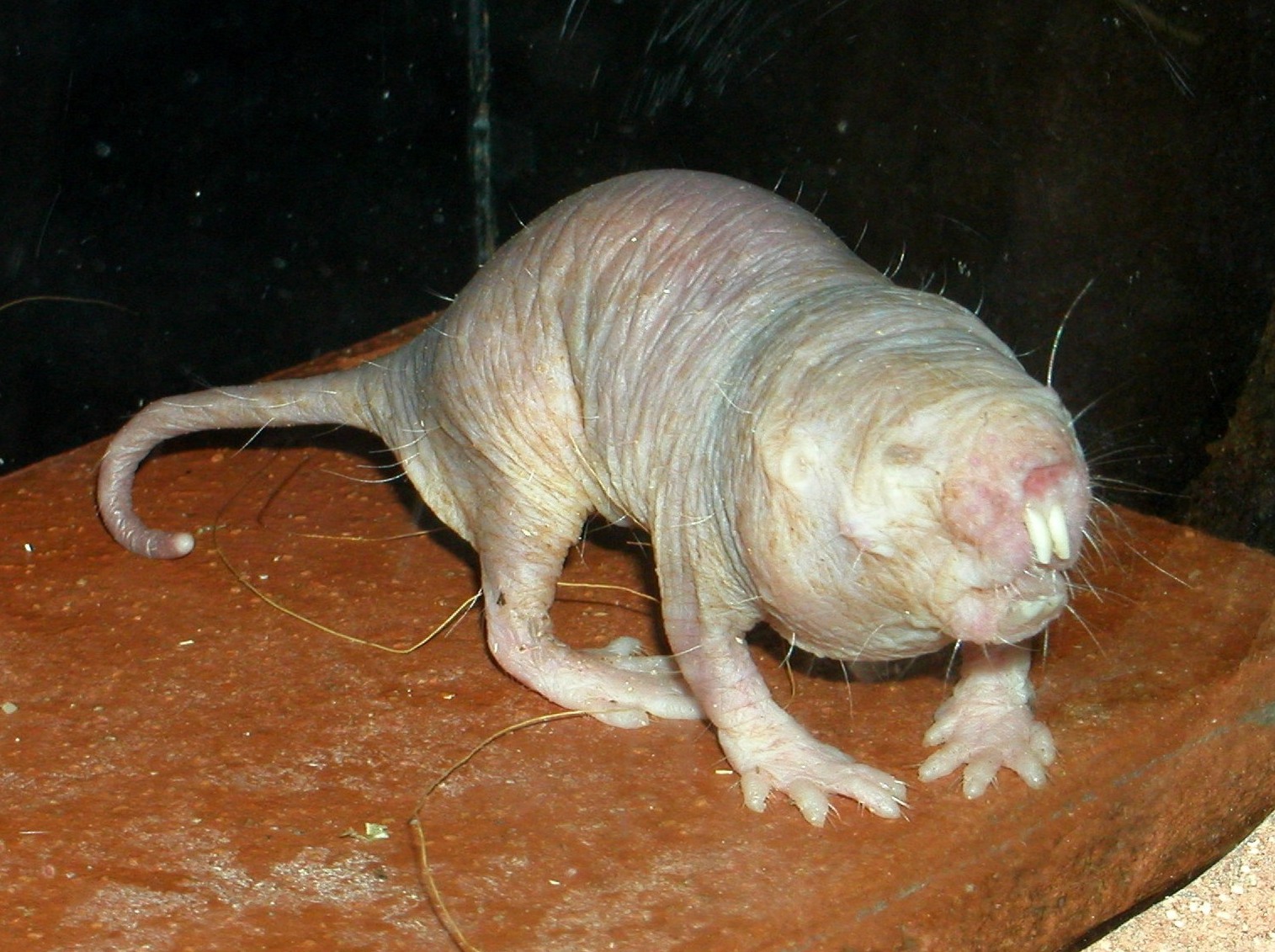
Typical naked mole-rat individuals are 8 to 10 cm (3 to 4 in) long and weigh 30 to 35 grams (1.1 to 1.2 oz). Breeding females are larger and may weigh well over 50 grams (1.8 oz), the largest reaching 80 grams (2.8 oz). They are well adapted to their underground existence. Their eyes are quite small, and their visual acuity is poor. Their legs are thin and short; however, they are highly adept at moving underground and can move backward as fast as they can move forward. Their large, protruding teeth are used to dig and their lips are sealed just behind the teeth, preventing soil from filling their mouths while digging. About a quarter of their musculature is used in the closing of their jaws while they dig. They have little hair (hence the common name) and wrinkled pink or yellowish skin. They lack an insulating layer in the skin.
The naked mole-rat is well adapted to the limited availability of oxygen within the tunnels of its typical habitat. It has underdeveloped lungs and its hemoglobin has a high affinity for oxygen, increasing the efficiency of oxygen uptake. It has a very low respiration and metabolic rate for an animal of its size, about 70% that of a mouse, thus using oxygen minimally. In response to long periods of hunger, its metabolic rate can be reduced by up to 25 percent.
The naked mole-rat survives for at least 5 hours in air that contains only 5% oxygen; it does not show any significant signs of distress and continues normal activity. It can live in an atmosphere of 80% CO
2 and 20% oxygen. In zero-oxygen atmosphere, it can survive 18 minutes apparently without suffering any harm (but none survived a test of 30 minutes). During the anoxic period it loses consciousness, its heart rate drops from about 200 to 50 beats per minute, and breathing stops apart from sporadic breathing attempts. When deprived of oxygen, the animal uses fructose in its anaerobic glycolysis, producing lactic acid. This pathway is not inhibited by acidosis as happens with glycolysis of glucose. As of 2017, it was not known how the naked mole-rat survives acidosis without tissue damage.
The naked mole-rat does not regulate its body temperature in typical mammalian fashion. They are thermoconformers rather than thermoregulators in that, unlike other mammals, body temperature tracks ambient temperatures. The relationship between oxygen consumption and ambient temperature switches from a typical poikilothermic pattern to a homeothermic mode when temperature is at 29 °C or higher. At lower temperatures, naked mole-rats can use behavioral thermoregulation. For example, cold naked mole-rats huddle together or seek shallow parts of the burrows that are warmed by the sun. Conversely, when they get too hot, naked mole-rats retreat to the deeper, cooler parts of the burrows.
The skin of naked mole-rats lacks neurotransmitters in their cutaneous sensory fibers. As a result, the naked mole-rats feel no pain when they are exposed to acid or capsaicin. When they are injected with substance P, a type of neurotransmitter, the pain signaling works as it does in other mammals but only with capsaicin and not with acids. This is proposed to be an adaptation to the animal living in high levels of carbon dioxide due to poorly ventilated living spaces which would cause acid to build up in their body tissues.
Hub AI
Naked mole-rat AI simulator
(@Naked mole-rat_simulator)
Naked mole-rat
The naked mole-rat (Heterocephalus glaber), also known as the sand puppy, is a burrowing rodent native to the Horn of Africa and parts of Kenya, notably in Somali regions. It is closely related to the blesmols and is the only species in the genus Heterocephalus.
The naked mole-rat exhibits a highly unusual set of physiological and behavioral traits that allow it to thrive in a harsh underground environment, most notably its being the only mammalian thermoconformer with an almost entirely ectothermic (cold-blooded) form of body temperature regulation, as well as exhibiting eusociality, a complex social structure including a reproductive division of labor, separation of reproductive and non-reproductive castes, and cooperative care of young. The closely related Damaraland mole-rat (Fukomys damarensis) is the only other known eusocial mammal. Naked mole-rats lack pain sensitivity in their skin, and have very low metabolic and respiratory rates. The animal also is remarkable for its longevity and resistance to cancer and oxygen deprivation.
While formerly considered to belong to the same family as other African mole-rats, Bathyergidae, more recent investigation places it in a separate family, Heterocephalidae.
Typical naked mole-rat individuals are 8 to 10 cm (3 to 4 in) long and weigh 30 to 35 grams (1.1 to 1.2 oz). Breeding females are larger and may weigh well over 50 grams (1.8 oz), the largest reaching 80 grams (2.8 oz). They are well adapted to their underground existence. Their eyes are quite small, and their visual acuity is poor. Their legs are thin and short; however, they are highly adept at moving underground and can move backward as fast as they can move forward. Their large, protruding teeth are used to dig and their lips are sealed just behind the teeth, preventing soil from filling their mouths while digging. About a quarter of their musculature is used in the closing of their jaws while they dig. They have little hair (hence the common name) and wrinkled pink or yellowish skin. They lack an insulating layer in the skin.
The naked mole-rat is well adapted to the limited availability of oxygen within the tunnels of its typical habitat. It has underdeveloped lungs and its hemoglobin has a high affinity for oxygen, increasing the efficiency of oxygen uptake. It has a very low respiration and metabolic rate for an animal of its size, about 70% that of a mouse, thus using oxygen minimally. In response to long periods of hunger, its metabolic rate can be reduced by up to 25 percent.
The naked mole-rat survives for at least 5 hours in air that contains only 5% oxygen; it does not show any significant signs of distress and continues normal activity. It can live in an atmosphere of 80% CO
2 and 20% oxygen. In zero-oxygen atmosphere, it can survive 18 minutes apparently without suffering any harm (but none survived a test of 30 minutes). During the anoxic period it loses consciousness, its heart rate drops from about 200 to 50 beats per minute, and breathing stops apart from sporadic breathing attempts. When deprived of oxygen, the animal uses fructose in its anaerobic glycolysis, producing lactic acid. This pathway is not inhibited by acidosis as happens with glycolysis of glucose. As of 2017, it was not known how the naked mole-rat survives acidosis without tissue damage.
The naked mole-rat does not regulate its body temperature in typical mammalian fashion. They are thermoconformers rather than thermoregulators in that, unlike other mammals, body temperature tracks ambient temperatures. The relationship between oxygen consumption and ambient temperature switches from a typical poikilothermic pattern to a homeothermic mode when temperature is at 29 °C or higher. At lower temperatures, naked mole-rats can use behavioral thermoregulation. For example, cold naked mole-rats huddle together or seek shallow parts of the burrows that are warmed by the sun. Conversely, when they get too hot, naked mole-rats retreat to the deeper, cooler parts of the burrows.
The skin of naked mole-rats lacks neurotransmitters in their cutaneous sensory fibers. As a result, the naked mole-rats feel no pain when they are exposed to acid or capsaicin. When they are injected with substance P, a type of neurotransmitter, the pain signaling works as it does in other mammals but only with capsaicin and not with acids. This is proposed to be an adaptation to the animal living in high levels of carbon dioxide due to poorly ventilated living spaces which would cause acid to build up in their body tissues.
Recent media