
Recent from talks
Nature fakers controversy
Knowledge base stats:
Talk channels stats:
Members stats:
Nature fakers controversy
The nature fakers controversy was an early 20th-century American literary debate highlighting the conflict between science and sentiment in popular nature writing. The debate involved important American literary, environmental and political figures. Dubbed the "War of the Naturalists" by The New York Times, it revealed seemingly irreconcilable contemporary views of the natural world: while some nature writers of the day argued as to the veracity of their examples of anthropomorphic wild animals, others questioned an animal's ability to adapt, learn, teach, and reason.
The controversy arose from a new literary movement, which followed a growth of interest in the natural world beginning in the late 19th century, and in which the natural world was depicted in a compassionate rather than realistic light. Works such as Ernest Thompson Seton's Wild Animals I Have Known (1898) and William J. Long's School of the Woods (1902) popularized this new genre and emphasized sympathetic and individualistic animal characters. In March 1903, naturalist and writer John Burroughs published an article entitled "Real and Sham Natural History" in The Atlantic Monthly. Lambasting writers such as Seton, Long, and Charles G. D. Roberts for their seemingly fantastical representations of wildlife, he also denounced the booming genre of realistic animal fiction as "yellow journalism of the woods". Burroughs' targets responded in defense of their work in various publications, as did their supporters, and the resulting controversy raged in the public press for nearly six years.
The constant publicity given to the debate contributed to a growing distrust of the truthfulness of popular nature writing of the day, and often pitted scientist against writer. The controversy effectively ended when President Theodore Roosevelt publicly sided with Burroughs, publishing his article "Nature Fakers" in the September 1907 issue of Everybody's Magazine. Roosevelt popularized the negative colloquialism by which the controversy would later be known to describe one who purposefully fabricates details about the natural world. The definition of the term later expanded to include those who depicted nature with excessive sentimentality.
A renewed public interest in nature and its promise of aesthetic and recreational enjoyment began in the United States during the late 19th century. The country's first national park, Yellowstone, was established in 1872, and by 1900 it had been followed by half a dozen more. Railroads made it easy to get to the parks, and their advertising promoted the wonders of nature that could be seen courtesy of their trains. Tourists frequented the parks regularly, but there were also numerous opportunities for people to enjoy nature and outdoor recreation closer to home. City parks, such as New York City's Central Park, became popular destinations because of their accessibility, and camps like the ones owned by the YMCA were frequented by children of all ages.
Wilderness protection and the conservation movement, led by figures such as John Muir, founder of the Sierra Club, also began to appear at this time. By the turn of the century, those in favor of recreational ideals of nature began to clash with conservationists such as Muir. Likewise, critics and natural scientists became skeptical of what they saw as a growing cult of nature, which was thought to wrongly champion sentimentality and aesthetics rather than scientific facts. Sympathy for animals and their survival also became a developing thought in the 19th century, due in part to wide acceptance of theories pertaining to organic evolution. In 1837, Charles Darwin wrote in his diary that "If we choose to let conjecture run wild, then animals, our fellow brethren in pain, disease, death, suffering and famine—our slaves in the most laborious works, our companions in our amusements—they may partake of our origin in one common ancestor—we may be all melted together."
As the popularity and marketability of the natural world rose during the late 19th century, books dedicated to nature came to be in great demand. One reviewer noted in 1901 that "It is a part of the progress of the day that the nature study is coming into prominence in our schemes of education, and, beyond these, is entering into our plans for coveted diversion, yet it is a real surprise that so large and increasing a number of each season's publications are devoted to the purpose." Such literature was regularly published in a wide variety of subjects: children's animal books, wilderness novels, nature guides, and travelogues were all immensely popular. The study of nature quickly became part of the public school curriculum, making nature writing increasingly profitable. As the public's hunger for such imaginative works grew, a new genre in which nature was depicted in a compassionate, rather than realistic, light began to take form.
The tendency to portray animals as having human traits was not new; Aesop's moralistic animal tales were still popular with readers of the day, and inspired such works as Rudyard Kipling's The Jungle Book (1894). However, one of the features separating the turn-of-the-century animal writers from those before them was the desire to have their animals set an example through their noble, sympathetic characteristics. Anna Sewell's Black Beauty, for example, told the story of a gentle horse seemingly from the animal's own point of view; after being published in the United States by the American Humane Education Society in 1890, Sewell's book helped further the cause against animal cruelty. The budding animal welfare movement helped establish a climate for wider public support of wildlife conservation, and soon nature writers similarly sought to gain sympathy for wild animals—specifically those who seemingly displayed honorable human traits—by depicting them in a positive light. One popular nature writer of the day, Mabel Osgood Wright, told of wolves nobly taking their own lives after losing their mates.
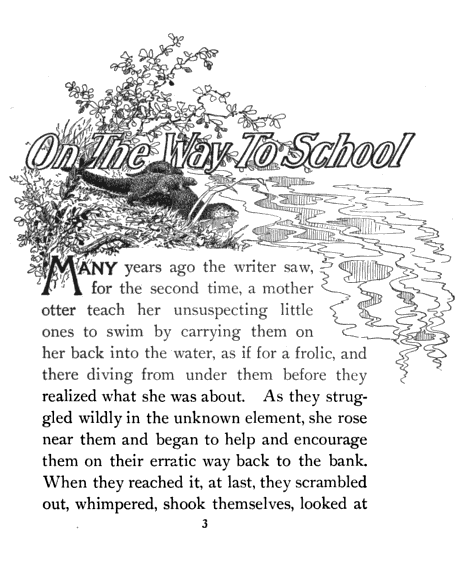
Author and illustrator Ernest Thompson Seton published his first book, the bestselling Wild Animals I Have Known, in 1898. The first entry in a new genre of realistic wild-animal stories, Seton's collection of short stories quickly became one of the most popular books of its day. Although he had considered himself "a naturalist of the usual type, trying merely to accumulate specimens and facts" during his early career, he later began to write factual material "in the form of romantic stories—fiction in the form of presentation, but solid in fact in their basis and their message." The first story in the collection, "Lobo, The King of Currumpaw" was based upon Seton's experience hunting wolves in the Southwest. It became a classic, setting the tone for his future works that would similarly depict animals—especially predators who were often demonized in literature—as compassionate, individualistic beings. Seton was reportedly denounced by readers for having killed Lobo, only to write about the experience; however, as biographer Brian Morris stated, the readers' sympathies "are directed, as Seton meant them to be, toward the wild animal, rather than against the teller of the tale".
Hub AI
Nature fakers controversy AI simulator
(@Nature fakers controversy_simulator)
Nature fakers controversy
The nature fakers controversy was an early 20th-century American literary debate highlighting the conflict between science and sentiment in popular nature writing. The debate involved important American literary, environmental and political figures. Dubbed the "War of the Naturalists" by The New York Times, it revealed seemingly irreconcilable contemporary views of the natural world: while some nature writers of the day argued as to the veracity of their examples of anthropomorphic wild animals, others questioned an animal's ability to adapt, learn, teach, and reason.
The controversy arose from a new literary movement, which followed a growth of interest in the natural world beginning in the late 19th century, and in which the natural world was depicted in a compassionate rather than realistic light. Works such as Ernest Thompson Seton's Wild Animals I Have Known (1898) and William J. Long's School of the Woods (1902) popularized this new genre and emphasized sympathetic and individualistic animal characters. In March 1903, naturalist and writer John Burroughs published an article entitled "Real and Sham Natural History" in The Atlantic Monthly. Lambasting writers such as Seton, Long, and Charles G. D. Roberts for their seemingly fantastical representations of wildlife, he also denounced the booming genre of realistic animal fiction as "yellow journalism of the woods". Burroughs' targets responded in defense of their work in various publications, as did their supporters, and the resulting controversy raged in the public press for nearly six years.
The constant publicity given to the debate contributed to a growing distrust of the truthfulness of popular nature writing of the day, and often pitted scientist against writer. The controversy effectively ended when President Theodore Roosevelt publicly sided with Burroughs, publishing his article "Nature Fakers" in the September 1907 issue of Everybody's Magazine. Roosevelt popularized the negative colloquialism by which the controversy would later be known to describe one who purposefully fabricates details about the natural world. The definition of the term later expanded to include those who depicted nature with excessive sentimentality.
A renewed public interest in nature and its promise of aesthetic and recreational enjoyment began in the United States during the late 19th century. The country's first national park, Yellowstone, was established in 1872, and by 1900 it had been followed by half a dozen more. Railroads made it easy to get to the parks, and their advertising promoted the wonders of nature that could be seen courtesy of their trains. Tourists frequented the parks regularly, but there were also numerous opportunities for people to enjoy nature and outdoor recreation closer to home. City parks, such as New York City's Central Park, became popular destinations because of their accessibility, and camps like the ones owned by the YMCA were frequented by children of all ages.
Wilderness protection and the conservation movement, led by figures such as John Muir, founder of the Sierra Club, also began to appear at this time. By the turn of the century, those in favor of recreational ideals of nature began to clash with conservationists such as Muir. Likewise, critics and natural scientists became skeptical of what they saw as a growing cult of nature, which was thought to wrongly champion sentimentality and aesthetics rather than scientific facts. Sympathy for animals and their survival also became a developing thought in the 19th century, due in part to wide acceptance of theories pertaining to organic evolution. In 1837, Charles Darwin wrote in his diary that "If we choose to let conjecture run wild, then animals, our fellow brethren in pain, disease, death, suffering and famine—our slaves in the most laborious works, our companions in our amusements—they may partake of our origin in one common ancestor—we may be all melted together."
As the popularity and marketability of the natural world rose during the late 19th century, books dedicated to nature came to be in great demand. One reviewer noted in 1901 that "It is a part of the progress of the day that the nature study is coming into prominence in our schemes of education, and, beyond these, is entering into our plans for coveted diversion, yet it is a real surprise that so large and increasing a number of each season's publications are devoted to the purpose." Such literature was regularly published in a wide variety of subjects: children's animal books, wilderness novels, nature guides, and travelogues were all immensely popular. The study of nature quickly became part of the public school curriculum, making nature writing increasingly profitable. As the public's hunger for such imaginative works grew, a new genre in which nature was depicted in a compassionate, rather than realistic, light began to take form.
The tendency to portray animals as having human traits was not new; Aesop's moralistic animal tales were still popular with readers of the day, and inspired such works as Rudyard Kipling's The Jungle Book (1894). However, one of the features separating the turn-of-the-century animal writers from those before them was the desire to have their animals set an example through their noble, sympathetic characteristics. Anna Sewell's Black Beauty, for example, told the story of a gentle horse seemingly from the animal's own point of view; after being published in the United States by the American Humane Education Society in 1890, Sewell's book helped further the cause against animal cruelty. The budding animal welfare movement helped establish a climate for wider public support of wildlife conservation, and soon nature writers similarly sought to gain sympathy for wild animals—specifically those who seemingly displayed honorable human traits—by depicting them in a positive light. One popular nature writer of the day, Mabel Osgood Wright, told of wolves nobly taking their own lives after losing their mates.
Author and illustrator Ernest Thompson Seton published his first book, the bestselling Wild Animals I Have Known, in 1898. The first entry in a new genre of realistic wild-animal stories, Seton's collection of short stories quickly became one of the most popular books of its day. Although he had considered himself "a naturalist of the usual type, trying merely to accumulate specimens and facts" during his early career, he later began to write factual material "in the form of romantic stories—fiction in the form of presentation, but solid in fact in their basis and their message." The first story in the collection, "Lobo, The King of Currumpaw" was based upon Seton's experience hunting wolves in the Southwest. It became a classic, setting the tone for his future works that would similarly depict animals—especially predators who were often demonized in literature—as compassionate, individualistic beings. Seton was reportedly denounced by readers for having killed Lobo, only to write about the experience; however, as biographer Brian Morris stated, the readers' sympathies "are directed, as Seton meant them to be, toward the wild animal, rather than against the teller of the tale".
Recent media