


Community hub
Recent from talks
Contribute something
Nothing was collected or created yet.
New Flyer Xcelsior
View on Wikipedia
| New Flyer Xcelsior | |
|---|---|
 New Flyer XD40 Demonstrator | |
| Overview | |
| Manufacturer | New Flyer |
| Production | 2008–present |
| Body and chassis | |
| Class | Transit bus |
| Body style | Monocoque stressed-skin |
| Layout |
|
| Platform | Xcelsior |
| Doors | 2 doors (35-foot) 2 or 3 doors (40-foot) 2, 3 or 5 doors (60-foot) |
| Floor type | Low-floor |
| Powertrain | |
| Engine |
|
| Electric motor |
|
| Transmission | Allison B 400 (35- & 40-foot), B 500 (60-foot), Voith or ZF |
| Dimensions | |
| Wheelbase |
|
| Length | over bumpers:
|
| Width | 102 in (2.59 m) |
| Height | 10 ft 6 in (3.20 m) (diesel) 11 ft 1 in (3.38 m) (all others) |
| Curb weight |
|
| Chronology | |
| Predecessor | New Flyer Low Floor |
The New Flyer Xcelsior is a line of transit buses available in 35-foot rigid, 40-foot rigid, and 60-foot articulated nominal lengths manufactured by New Flyer Industries since 2008. In addition to the different available lengths, the buses are sold with a variety of propulsion systems: conventional diesel, compressed natural gas (CNG), diesel-electric hybrid, hydrogen fuel cell, overhead electric wire (Trolleybus) and battery electric. A future autonomous bus variant was announced in January 2021.
Model codes
[edit]| Model | Power | Length | Generation |
|---|---|---|---|
| X: Xcelsior | D: diesel DE: diesel-electric hybrid E: battery-electric HE: hydrogen fuel cell N: compressed natural gas T: electric trolleybus |
35: 35 feet (10.7 m) 40: 40 feet (12.2 m) 60: 60 feet (18.3 m) articulated |
none: original design NG: Next Generation |
For example, a New Flyer XE40 CHARGE NG is a 40-foot (nominal) rigid Next Generation Xcelsior with battery-electric power, or an XN60 is a 60-foot articulated Original Generation Xcelsior with CNG power. All power sources had 40- and 60-foot models until late 2024, but not all power sources have 35-foot models: XHE35s (hydrogen-powered) and XT35s (trolleybus) do not exist. In XDE60's will stop production in 2026 (see History Section below)
History
[edit]The Xcelsior was introduced October 2008 APTA Expo held in San Diego. The Xcelsior started off as a set of improvements to the company's prior product, the New Flyer Low Floor, but over the development process the company said it ended up designing a new bus. Compared to the Low Floor, the Xcelsior was 10% lighter, boosting fuel economy by about 7%.[1]
The bus was also designed to allow a much larger cooling system and the addition of a SCR system, both required to meet the more stringent EPA mandates that were coming in 2010. To accommodate the change, the Thermo King air conditioning system was moved from the rear of the bus to a roof mount location over the front axle. New Flyer found that the move improved the weight balance of the bus, and when combined with enhanced insulation, contributed to the vehicle running quieter.[2]
The interior of the bus was also modified. By moving the fuel tank and modifying the rear suspension, seating capacity was increased from 39 to 42 (on the 40-foot model), with more forward-facing seats. To improve accessibility, the floor height was lowered to 14 inches (360 mm) with the ability to kneel down to 10 inches (250 mm), and the front entry door was widened, allowing a wider wheelchair ramp. To improve interior aesthetics, visible fasteners were eliminated and molded plastic surfaces were introduced. The utilitarian instrument panel was replaced with an automotive-style electronic dashboard.[2]
The bus also had a redesigned front face, bumpers, and roof shrouds that also offered better aerodynamics and the front improved visibility for the driver.[2]
At launch, the Xcelsior was only available in a 40-foot (12 m) length with power from the Cummins ISL 280 and a Allison B400 conventional transmission or the Allison EP-40 hybrid drive. Brampton Transit, serving Brampton, Ontario, was the first agency to order the Xcelsior.[2]
The first trolleybus version of the Xcelsior was an XT40 built in 2014 for the Seattle trolleybus system, operated by King County Metro,[3] the first unit of an order placed in 2013.[4] King County Metro also purchased the XT60 (articulated trolleybus),[4] and both XT40s and XT60s were subsequently purchased by the San Francisco Municipal Railway, for the San Francisco trolleybus system.[5]
In August 2024, New Flyer quietly updated their brochure to say that beginning with the 2026 model year, the XDE60 will be discontinued as New Flyer was unable to find a powertrain compliant with new regulations taking effect around that time. With the 2027 model year, the XDE35 will be discontinued due to projected low demand.[6] New Flyer originally planned to simultaneously discontinue the XN35 for the same reason, but they would quietly reverse their decision in May 2025.[7]
Xcelsior CHARGE
[edit]
The first Xcelsior battery electric buses (XE40) were built in 2014 and delivered to the Chicago Transit Authority and Winnipeg Transit.[8] Massachusetts Bay Transportation Authority was the lead agency for the XE60, ordered in January 2019[9] and placed into service on July 31, 2019.[10] The Toronto Transit Commission operates 25 XE40 buses.
The first battery electric Xcelsior buses were a powertrain option within the regular Xcelsior line; development was announced in 2011, a prototype was shown in 2012, and regular production began in 2014.[11] The original battery electric Xcelsior bus, offered as an XE40, used a permanent magnet traction motor built by Siemens.[12] In October 2017, the Xcelsior CHARGE sub-line was introduced.[11]
The Xcelsior CHARGE variant (XE) uses the Siemens ELFA2 electric drive system with different options for battery capacity, depending on the charging speed and range required.[13] The traction motor used has an output of either 210 or 280 hp (213 or 284 PS; 157 or 209 kW) and 1,033 or 1,475 lb⋅ft (1,401 or 2,000 N⋅m; 143 or 204 kg⋅m).[14] Batteries are supplied by XALT Energy[15] or A123 Systems (XE60 long-range models and XHEnn fuel cell models).[14] On-route rapid charging is provided through an overhead pantograph designed to be interoperable with the SAE J3105 standard supplying 300–450 kW. Shop or depot charging may be performed using SAE J3068 and J1772 connectors supplying up to 150 kW.[14][8]
At Altoona[clarification needed], the as-tested empty weight of an XE40 was measured at 32,770 lb (14,860 kg) with a capacity of 76 (38 seated passengers + 37 standing passengers + 1 driver) for a total GVW of 43,550 lb (19,750 kg). It was equipped with 4 XALT Xsyst 7 (7 kWh) batteries and a SPHEROS fuel-fired heater. When accelerating from a constant speed, the bus emitted an average maximum noise level of 66.1 dB(A),[16] considerably lower than the average maximum noise level of 70.4 dB(A) measured from a conventionally-powered XD40.[17]
XE60
[edit]

The articulated XE60 adds a second driven axle, using the ZF AxTrax AVE[18][19] uses two electric motors (one per wheel), each with a maximum continuous/peak output of 160 / 340 hp (162 / 345 PS; 119 / 254 kW) and maximum continuous/peak torque of 6,000 / 16,200 lb⋅ft (8,135 / 21,964 N⋅m; 830 / 2,240 kg⋅m).[20] Each motor is an asynchronous three-phase AC motor operating on 650 VDC with an input current of 250 (continuous) to 340 (peak) amps, using a single-speed reduction gear ratio of 22.66:1. The complete axle assembly weighs 2,760 lb (1,250 kg)[21]
The as-tested empty weight of an XE60 was 52,070 lb (23,620 kg) with a capacity of 120 (50 seated passengers + 69 standing passengers + 1 driver) for a total GVW of 70,170 lb (31,830 kg).[20] Compared to the diesel-powered equivalent XD60, the XE60 is heavier (XD60 GVW is 58,600 lb (26,600 kg)) and holds slightly fewer people (XD60 capacity is 123 people: 49 seated, 73 standing, 1 driver).[22] Depending on the driving route/style, the XE60 tested at Altoona had a predicted range of 145 to 246 miles (233 to 396 km).[20]
The MBTA and NYMTA were the first to order the XE60, with the former ordering 5 and the latter ordering 15.
Xcelsior CHARGE NG
[edit].jpg)
Xcelsior CHARGE NG is New Flyer's next generation battery electric, zero-emission bus. It is lighter, simpler and has longer range with better energy recovery. It has a capacity of 32-61 passengers with 2 wheelchair locations. It is available in 35-, 40-, and 60-foot configurations. It has a Siemens ELFA3 traction motor, Lithium Manganese Cobalt (NMC) batteries, and electric roof-mounted HVAC(s).[23]
Xcelsior CHARGE H2
[edit]The CHARGE model can be equipped with a hydrogen fuel cell (model code XHE), which acts as an on-board charger to extend range.[24] Earlier New Flyer fuel cell buses were based on the preceding Low Floor chassis, designated H40LFR, and integrated by an outside vendor. In 2016, New Flyer received an order for 25 XHE40 buses under the California Air Resources Board Air Quality Improvement Program (AQIP).[14] The XHE40 uses a MAN SE model 1350 rear axle with a traction motor from Siemens; like the XE60, the XHE60 also uses a MAN 1350 rear axle as a pusher, but adds a ZF AxTrax AVE middle axle as a puller for traction-challenged conditions.[25]
An XHE60 tested at Altoona weighed 49,890 lb (22,630 kg) empty; with a total capacity of 132 (1 driver, 50 seated, 81 standing), the estimated GVW was 69,750 lb (31,640 kg). The fuel cell was a Ballard HD85 with an 85 kW output.[25]
Development of the electric fuel cell buses is centered in California, with AC Transit serving as the lead agency for one XHE60, and SunLine Transit Agency, AC Transit, and Orange County Transportation Authority testing several variants of XHE40.[8]
Xcelsior AV
[edit]New Flyer and Robotic Research announced a partnership in May 2019 to develop automated bus technology.[26] In January 2021, New Flyer introduced the Xcelsior AV, New Flyer's first ever autonomous bus.[27] New Flyer claims the AV meets the SAE J3016 Level 4 of autonomy. The AV is based on the XE40 chassis, and uses Robotic Research's AutoDrive suite of sensors and AutoDrive ByWire mechanical actuators.[28] Project management was performed by The Center for Transportation and Environment (CTE) with support from the Federal Transit Administration, who provided a US$2 million grant under the Integrated Mobility Innovation Program.[29]
The first three Xcelsior AV buses are scheduled to be tested by CTtransit in 2021 on the CTfastrak bus rapid transit (BRT) line, over a dedicated right-of-way 9 miles (14 km) long, connecting New Britain and Hartford, Connecticut. The deployment on a BRT line is anticipated to test the vehicles' ability to perform precision docking at station platforms and platooning multiple vehicles.[29]
Gallery
[edit]-
 XE60, NYMTA
 -
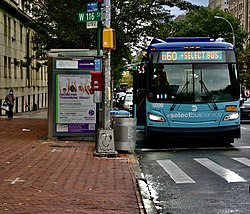 XD60, NYMTA
 -

-
 XE40, TriMet
 -

-
 XDE40, SEPTA
 -
 XDE60, MBTA Silver Line
 -
 XHE40, AC Transit
 -
 XT40, King County Metro
 -
 XT60, SF Muni
 -
 XN40, NYMTA
 -
 Blank XD40 in Montreal
 -
 XD60, Winnipeg Transit
 -
 XN60, Metro Transit (Omaha)
 -
 XDE35, Suffolk County Transit
 -
 XE60, Spokane Transit
 -
 XD40 interior, DART
 -
 XE60 interior, Spokane Transit
 -
 XE40 interior, TriMet
 -
 XD60, METRORapid Silver Line
 -
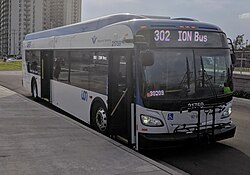 XD40, Grand River Transit
 -
 Los Angeles Metro Bus Line 40 at Redondo Beach
 -
![XE60NG[30], Miami-Dade Transit](//upload.wikimedia.org/wikipedia/commons/thumb/4/4c/New_Flyer_Xcelsior_as_MetroExpress_bus_in_training_on_Florida%27s_Turnpike.jpg/250px-New_Flyer_Xcelsior_as_MetroExpress_bus_in_training_on_Florida%27s_Turnpike.jpg) XE60NG[30], Miami-Dade Transit
XE60NG[30], Miami-Dade Transit


.jpg)


.jpg)


![XE60NG[30], Miami-Dade Transit](https://en.wikipedia.org/wiki/File:New_Flyer_Xcelsior_as_MetroExpress_bus_in_training_on_Florida%27s_Turnpike.jpg)
See also
[edit]References
[edit]- ^ Starcic, Janna; Roman, Alex; Schlosser, Nicole (November–December 2008). "Transportation's Green Future on Display at APTA EXPO" (PDF). Metro Magazine. pp. 20–50. Retrieved December 10, 2018.
- ^ a b c d Hubbard, David (March 1, 2009). "Xcelsior gives a spirited ride". Bus Ride. Retrieved December 10, 2018.
- ^ "Trolleynews [regular news section]". Trolleybus Magazine. No. 318. UK: National Trolleybus Association. November–December 2014. p. 164. ISSN 0266-7452.
- ^ a b "Trolleynews [regular news section]". Trolleybus Magazine. No. 311. UK: National Trolleybus Association. September–October 2013. pp. 136–137. ISSN 0266-7452.
- ^ "Trolleynews [regular news section]". Trolleybus Magazine. No. 335. UK: National Trolleybus Association. September–October 2017. p. 197. ISSN 0266-7452.
- ^ "ICE powertrain portfolio" (PDF). August 1, 2024. Retrieved October 16, 2024.
- ^ "ICE powertrain portfolio" (PDF).
- ^ a b c New Flyer Industries (August 15, 2018). "New Flyer Electric Buses" (PDF). California Fuel Cell Partnership. Retrieved December 24, 2018.
- ^ electric-buses-from-new-flyer/ "MBTA leads Boston's evolution in transit with battery electric buses from New Flyer" (Press release). New Flyer Industries. January 7, 2019. Retrieved August 9, 2019.
{{cite press release}}: Check|url=value (help) - ^ electric-buses-join-the-mbta-silver-line-fleet "First Zero-emission, battery electric Buses Join the MBTA Silver Line Fleet" (Press release). Massachusetts Bay Transportation Authority. July 31, 2019. Retrieved August 9, 2019.
{{cite press release}}: Check|url=value (help) - ^ a b Plachno, Larry (April 2018). "Charging Ahead with Electric Buses" (PDF). National Bus Trader. pp. 16–25. Retrieved December 24, 2018.
- ^ "Siemens electric Drive System to Power New Line of Transit Buses" (Press release). Siemens. October 28, 2014. Retrieved December 24, 2018.
- ^ "Xcelsior CHARGE" (PDF). New Flyer Industries. October 2018. Retrieved December 10, 2018.
- ^ a b c d Warren, David (November 9, 2017). "Zero-Emission Implementations" (PDF). California Transit Association. Retrieved December 24, 2018.
- ^ New Flyer Industries (June 26, 2018). "New Flyer Xcelsior CHARGE™" (PDF). American Public Transportation Association. Retrieved December 24, 2018.
- ^ Federal Transit Bus Test: New Flyer XE40 (PDF) (Report). The Thomas D. Larson Pennsylvania Transportation Institute, The Pennsylvania State University. July 2015. Retrieved December 24, 2018.
- ^ Federal Transit Bus Test: New Flyer XD40 (PDF) (Report). The Thomas D. Larson Pennsylvania Transportation Institute, The Pennsylvania State University. November 2012. Retrieved December 24, 2018.
- ^ ZumMallen, Ryan (September 19, 2018). "New Flyer and ZF Building 100 Electric Buses for U.S." Trucks. Retrieved December 24, 2018.
- ^ Thoma, Frank (December 11, 2018). "Electric mobility in size XL". Vision Magazine. ZF. Retrieved December 24, 2018.
- ^ a b c Federal Transit Bus Test: New Flyer XE60 (PDF) (Report). The Thomas D. Larson Pennsylvania Transportation Institute, The Pennsylvania State University. April 2019. Retrieved August 9, 2019.
- ^ "Product Overview: Axle & Transmission Systems for Buses & Coaches" (PDF). ZF. November 2018. Retrieved December 24, 2018.
- ^ Federal Transit Bus Test: New Flyer XD60 (PDF) (Report). The Thomas D. Larson Pennsylvania Transportation Institute, The Pennsylvania State University. July 2013. Retrieved December 24, 2018.
- ^ "New Flyer Unveils its Most Advanced EV Bus". New Flyer | North America's Bus Leader. March 17, 2021. Retrieved April 6, 2021.
- ^ "Xcelsior hydrogen fuel cell-electric bus" (PDF). New Flyer Industries. October 2017. Retrieved December 10, 2018.
- ^ a b Federal Transit Bus Test: New Flyer XHE60 (PDF) (Report). The Thomas D. Larson Pennsylvania Transportation Institute, The Pennsylvania State University. August 2018. Retrieved December 24, 2018.
- ^ "New Flyer announces Robotic Research partnership to revolutionize public transit using automated bus technology" (Press release). New Flyer. May 15, 2019. Retrieved February 9, 2021.
- ^ "Xcelsior AV™". New Flyer Industries. Retrieved February 6, 2021.
- ^ Borrás, Jo (February 2, 2021). "New Flyer Xcelsior AV Is America's First Autonomous Bus". Clean Technica. Retrieved February 9, 2021.
- ^ a b Wanek-Libman, Mischa (June 24, 2020). "CTDOT scheduled to deploy first full-size automated transit bus in North America". Mass Transit. Retrieved February 9, 2021.
- ^ "Miami-Dade Transit awards NFI a contract for 100 zero-emission, high-capacity New Flyer buses and associated charging infrastructure" (Press release). GlobeNewswire. June 23, 2023. Retrieved August 31, 2025 – via NFI Group.

External links
[edit]- "xcelsior®" (PDF). New Flyer. September 2017. Retrieved December 10, 2018.
- Xcelsior NG: https://www.newflyer.com/bus/xcelsior-charge-ng/
Brochures
[edit]New Flyer Xcelsior
View on GrokipediaOverview
Introduction and Development
The New Flyer Xcelsior is a family of low-floor transit buses developed by New Flyer Industries as the successor to the company's earlier Low Floor series, which had been in production since 1991.[4] The platform was introduced in October 2008 at the American Public Transportation Association (APTA) Expo in San Diego, California, marking a significant evolution in North American transit bus design with an emphasis on enhanced efficiency, accessibility, and adaptability to regional standards.[11] Key design improvements in the initial Xcelsior models included an 8% reduction in overall weight compared to the Low Floor predecessors, achieved through optimized structure and lighter components, which contributed to improved operational performance.[12] Additionally, the platform pioneered the use of LED headlights in the transit bus industry, offering better visibility and durability while accommodating modern accessories like bike racks without interference.[4] The initial launch centered on the 40-foot diesel-electric hybrid variant, with the first production order secured by Brampton Transit in Ontario, Canada, for deployment in its Züm bus rapid transit service starting in 2010.[13] At its core, the Xcelsior platform embodies a modular construction philosophy tailored to North American transit needs, featuring a low-floor design for seamless accessibility, including ramps and kneeling suspension, while supporting customization across various lengths and propulsion types to meet diverse urban and suburban requirements.[1] This approach ensures compliance with standards such as those from the Americans with Disabilities Act, prioritizing passenger comfort and operational reliability. The buses are available in 35-foot, 40-foot, and 60-foot configurations, with propulsion options ranging from diesel to electric systems.[1]Production and Sales
The New Flyer Xcelsior platform is manufactured at the company's primary facilities in Winnipeg, Manitoba, Canada, and St. Cloud, Minnesota, USA, where assembly lines produce various configurations including diesel, hybrid, electric, and alternative fuel variants.[14][4] Production began following the platform's introduction in 2008, with the first deliveries occurring in 2009 to early adopters in North American transit agencies.[2] As of 2025, New Flyer has delivered over 22,000 Xcelsior units across all variants, marking a significant production milestone that underscores the platform's rapid market penetration.[3] This total continued to grow with ongoing output, reflecting sustained demand from major operators such as the Chicago Transit Authority and Toronto Transit Commission, which have integrated hundreds of Xcelsior buses into their fleets for urban and suburban service. Recent contracts include a 2025 order from the Washington Metropolitan Area Transit Authority for up to 500 low- and zero-emission units.[10][15] The Xcelsior quickly achieved commercial success, becoming New Flyer's flagship platform by 2010 due to its versatile design and alignment with evolving transit needs, including cleaner propulsion options.[4] This rapid adoption propelled the model to dominate New Flyer's sales portfolio, contributing the majority of the company's heavy-duty transit bus deliveries in North America and forming a cornerstone of NFI Group's overall revenue stream, which reached $3.12 billion in 2024 largely driven by Xcelsior variants.[4][16]Model Designations
Length and Configuration Codes
The New Flyer Xcelsior transit bus line employs a standardized naming convention where the model designation begins with "XD" for diesel-powered variants or "XDE" for hybrid-electric, followed by a two-digit code representing the nominal length in feet. This system facilitates quick identification of the bus's size and basic configuration, with available options limited to 35-foot and 40-foot rigid buses, as well as 60-foot articulated buses. The rigid configurations apply to the shorter models, providing straightforward, non-jointed structures suitable for standard routes, while the 60-foot articulated design incorporates a flexible center joint to enhance maneuverability on congested urban streets.[1]| Nominal Length | Model Codes | Actual Length (over bumpers) | Configuration | Approximate Seated Capacity |
|---|---|---|---|---|
| 35 feet | XD35/XDE35 | 36 feet 3 inches (11.0 m) | Rigid | 32 passengers |
| 40 feet | XD40/XDE40 | 41 feet (12.5 m) | Rigid | 40 passengers |
| 60 feet | XD60/XDE60 | 60 feet 10 inches (18.5 m) | Articulated | 61 passengers |
Propulsion Type Codes
The New Flyer Xcelsior bus lineup employs a standardized nomenclature for model designations, where the prefix "X" denotes the Xcelsior series, followed by a propulsion type suffix and a numeral indicating the nominal length in feet (35, 40, or 60 for articulated configurations).[1] This structure allows for clear identification of powertrain variants across the family. For instance, the full code XDE60 refers to a 60-foot hybrid-electric articulated model.[6] The propulsion type codes encompass a range of conventional, alternative fuel, and zero-emission options, reflecting the Xcelsior's adaptability to diverse transit needs. Below is a summary of the primary codes, their associated propulsion systems, and key components.| Code | Propulsion Type | Example Model | Key Components |
|---|---|---|---|
| XD | Diesel | XD40 | Cummins L9 engine, ultra-low sulfur diesel fuel.[22] |
| XN | Compressed Natural Gas (CNG) | XN40 | Cummins Westport L9N engine.[7][23] |
| XDE | Hybrid-electric | XDE40 | Series hybrid system with Cummins B6.7 engine and BAE Systems HybriDrive or Allison components.[6][24] |
| XE | Battery-electric | XE40 | Xcelsior CHARGE NG branding, with electric drive systems such as Accelera or ZF AVE130.[9] |
| XHE | Hydrogen fuel cell | XHE40 | Ballard FCmove-HD+ fuel cell modules integrated with battery-electric technology.[3][25] |
| XT | Trolley-electric | XT40 | Overhead wire power via trolley poles, with Kiepe Electric propulsion and 71 kWh onboard batteries for in-motion charging and off-wire operation.[8] |