


Community hub
Recent from talks
Contribute something
Nothing was collected or created yet.
CT Transit
View on Wikipedia | This article needs additional citations for verification. (December 2013) |
 | |
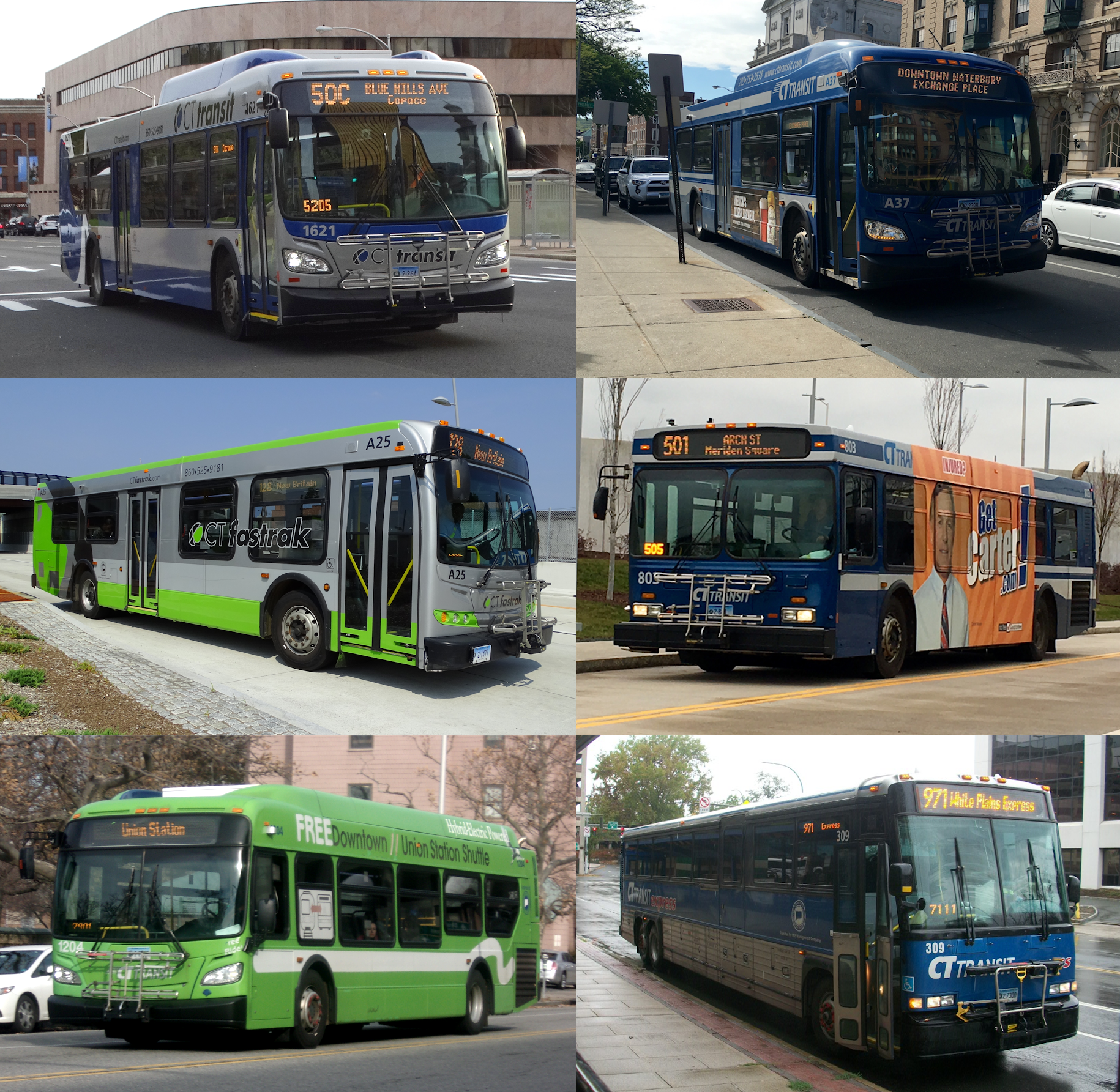
 A collage of different CT Transit services. Clockwise from top-left:
a Hartford local bus; a Waterbury local bus; New Britain to Meriden; the White Plains express; the Union Station shuttle; CT Fastrak to New Britain. | |
| Parent | Connecticut Department of Transportation |
|---|---|
| Founded | 1976 |
| Headquarters | Hartford, Connecticut |
| Locale | Connecticut |
| Service area | Metropolitan areas of Stamford, Hartford, New Haven, Waterbury, Meriden, New Britain, Bristol, and Wallingford |
| Service type | Intrastate bus service |
| Routes | 177 unique scheduled routes and shuttles as of 2023 |
| Operator | Various |
| Chief executive | Thomas E. Stringer, Jr., HNS |
| Website | www.cttransit.com |
CT Transit (styled as CTtransit) is a public transportation bus system serving many metropolitan areas and their surrounding suburbs in the state of Connecticut. CT Transit is a division of the Connecticut Department of Transportation, although it contracts a number of private companies for most of its operations. CT Transit began operations in 1976 as Connecticut Transit after the Connecticut DOT's acquisition of the Connecticut Company. Initially serving only the Hartford, New Haven, and Stamford areas, CT Transit's service now extends throughout much of Connecticut. CT Transit provides local "city bus" service in Bristol, Hartford, Meriden, New Britain, New Haven, Stamford, Wallingford and Waterbury in addition to a number of express routes connecting to outlying suburbs and other regions of the state.
In 2015, CT Transit began operation of CT Fastrak, the first bus rapid transit system in Connecticut and second in New England.
History
[edit]Background (1901–1950s)
[edit]Although private transportation has existed in Connecticut since its initial settlement, public transportation in Connecticut dates back to the 19th Century with the introduction of horse-drawn trolley lines in many towns across the state. In 1901 the Connecticut Railway and Lighting Company (CR&L) was formed to operate and extend electric powered trolley services. These operations were leased to the Consolidated Railway Company in 1906 and, a year later, merged with the New York, New Haven and Hartford Railroad.
In 1910, the New Haven Railroad formally sublet all of its street railway operations, including CR&L, to the Connecticut Company. By 1924, the Connecticut Company operated some 1,640-passenger cars over a network of 834 miles of track.[1]
Although street railway services remained through much of Connecticut, as early as the 1920s underperforming street- and heavy-rail lines began to be replaced by motor coach services. The first replacement of street railways with buses in Connecticut occurred in Stamford in 1921, with the rate of replacement accelerating during the 1930s and 1940s.
In 1936, following financial setbacks during the Great Depression and being unable to maintain lease payments, the Connecticut Company was forced to divest the CR&L, representing nearly 35% of line mileage it operated prior to the divestment (152 miles of a total 438).[2] The newly independent CR&L no longer operated any rail services, while its former lessee began eliminating street railway lines as a cost-cutting measure. Although World War II put a pause on significant service changes, it was not long after the last trolley lines were taken out of service.
Immediate predecessors (1950s–1976)
[edit]
Although Connecticut's bus services were still profitable in the early-1950s,[3] by the 1960s profitability had significantly decreased.[4] In June 1964 the Connecticut Company was sold to transportation and insurance magnate E. Clayton Gengras for $3,225,000.[5] It was hoped by Hartford's chamber of commerce that under Gengras the Connecticut Company could become the core of a new "mass transit district" since it was no longer affiliated with the bankrupt New Haven Railroad.[6] Pursuant to Gengras' plan to "make some money with [the Connecticut Company]",[5] revenues did increase significantly following his acquisition.[4] Despite these higher revenues, even in 1964 there were concerns over the long-term viability of Hartford's bus operations in private hands. George J. Ritter, a member of the "in standby" Greater Hartford Mass Transit District (MTD/GHTD), stated that "the new Connecticut Company is no savior for mass transit in Hartford... we still have a sick company."[7] Gengras' reduction in Connecticut Company expenses was mostly through the discontinuation of less profitable services,[8] although there were notable layoffs,[9] fare increases,[10] and attempts to capitalize through a number of experimental services. Some of these experimental services included deluxe express buses with free newspapers, downtown Hartford shuttles,[11] the Railbus, which could run both on rail and road,[12] vacation tours,[13] and park-and-ride commuter on-demand express bus reservations using computers ("bus by request").[14]
These changes, notably service reductions and layoffs, created much dissatisfaction among employees,[15][16] resulting in a 27-day long strike in 1965 among all Connecticut Company divisions.[17]
Under Gengras the company first expanded in October 1967 when it acquired the Middletown area H&W Transit Company,[18] although even this was ineffective at increasing ridership with declines in riders' perceived quality of Connecticut Company services and the reduction of its routes' frequencies.[19] In September 1968 the Connecticut Company expanded again when it acquired the Silver Lane Bus Company of Manchester.[20]
In August 1971 a "massive"[21] reduction in service was planned, with all Sundays trips to be eliminated, as well as most on evenings and Saturdays. In total the cuts represented around two thirds of all evening trips from Monday to Saturday should they be implemented.[22] The drastic nature of these cuts prompted many in state and local government to propose action. State Senator Joe Lieberman urged the consideration of the state to at least subsidize bus services, but even go so far as to assume some of their operations or operate them outright if necessary.[23] The still "in standby" GHTD sought to gather funds from the state to acquire the Connecticut Company before any service cuts could be approved by the Connecticut Public Utilities Commission (PUC).[24]
Although there was considerable support for GHTD to acquire the Connecticut Company,[25][26] the PUC ruled that the Connecticut Company "could continue to provide service" while GHTD "could not do so".[27] On September 4 the Connecticut Company's reduced schedules were implemented, although four Hartford routes were run with marginal daytime service on Sundays.[21]
In September 1971, days before its reduced schedules took effect, the Connecticut Company filed a request with the PUC in an attempt to suspend all of its services in its Stamford division,[28] as well as to increase fares in Hartford and New Haven.[29] Neither of these requests were approved.[29]
The first state relief for the Connecticut Company came in April 1972 when it paid for new buses, although no further subsidy was provided.[30]
Particularly due to the 1973 strikes of the employees of the Connecticut Company and CR&L, the Connecticut Department of Transportation became more involved with bus services in Connecticut.[31] CTDOT noted in its annual Transportation Master Plan that year that "if the present trend continues, there will be minimal local bus service by 1980" and that "the service that exists today has not been capable of attracting or persuading the automobile driver to abandon his auto ride to the bus".[31] In the following years, CTDOT began providing more aid to Connecticut transit districts.
The CR&L surrendered its last operating transit franchises in 1973, and in June 1976 Gengras sold the three remaining divisions of the Connecticut Company (Hartford, New Haven, and Stamford) to the State of Connecticut.
Public ownership (1976–present)
[edit]
When the Connecticut Department of Transportation acquired the assets of the Connecticut Company, it contracted with a private management company to operate the system. Beginning in 1979, First Transit operated CT Transit's three original divisions in Hartford, New Haven, and Stamford through its subsidiary HNS Management.[citation needed] Although HNS Management operates the buses and operations themselves, it is CTDOT which manages matters such as procurement, routes, and planning. In December 2022, CTDOT announced it had switched its operating contract from First Transit to RATP Dev USA, an American subsidiary of France's state-owned RATP Group.[32]
On April 1, 2022, CTDOT announced it had suspended fares on all public transit buses in Connecticut,[33] which was launched in response to sharp ridership decreases following the outbreak of the COVID-19 pandemic, and heightened inflation.[34] By September 2022, bus ridership in some CT Transit Divisions had exceeded pre-Covid levels.[35] Fares resumed on April 1, 2023.[33]

Organization
[edit]CT Transit is managed by CTDOT and HNS Management is the company's largest contractor, (largely) operating the Hartford, New Haven, and Stamford divisions. However, CT Transit contracts a number of different companies and agencies with the CTDOT-led "core" providing supervision and coordination between them. In some ways CT Transit serves as a "brand" under which companies can operate their services while being part of a larger system. Because of its reliance on contractors however, CTDOT route planning can be significantly impacted by operators' decisions, and contract disputes have led to service cuts when agreements could not be reached.
Routes were first assigned letter designations in the Hartford area by the Connecticut Company in December 1964.[36]
Divisions
[edit]CT Transit is arranged into five divisions, although some divisions serve more than one city. In addition, some divisions' services are operated by a single contractor while others are operated by multiple. Given CTDOT's supervisory role however, changes to improve consistency among the different divisions were made in the 2000s and 2010s, and today the divisions themselves have little effect beyond administration and direct operations. CT Transit's divisions are:
- Hartford: Operated by RATP Dev USA, an American subsidiary of France's state-owned RATP Group.[32] Inter-agency connections to Enfield, NWCTD, PVTA, RVT, WRTD.
- New Britain and Bristol: Operated by HNS, New Britain Transportation, Dattco. Inter-agency connection to RVT.
- New Haven: Operated by RATP Dev USA.[32] Inter-agency connections to GBT, Milford, Norwalk, RVT.
- Stamford: Operated by RATP Dev USA.[32] Inter-agency connections to Bee-Line, GBT, HART, Hudson Link, Milford, Norwalk.
- Waterbury, Meriden and Wallingford: Operated by Northeast Transportation Company. Interagency connections to NWCTD, RVT.
Funding
[edit]CTtransit's annual revenue is primarily made up of fare revenue, advertising, and reimbursements for services through contracts with state agencies (primarily access to jobs). The State of Connecticut funds the operations of CTtransit in the amount of the annual operating deficit.
Services
[edit].jpg)
CT Fastrak
[edit]Although originally conceived in the late-1990s, CT Fastrak opened in 2015 as the first bus rapid transit system in Connecticut and second in New England.
Express Routes
[edit]
Although early attempts at deluxe commuter express buses by the Connecticut Company were a failure, the organization did begin to seriously consider regularly-operating express buses as early as 1970 with plans for an express bus from Unionville and Farmington to Hartford via I-84.[37]
The first express routes operated by CT Transit were those inherited from the Connecticut Company which were initiated from 1972 until the company's acquisition by the Connecticut Department of Transportation (CTDOT) in 1976. The creation of the routes was prompted by the CTDOT hoping to "decrease automobile traffic into the major urban areas".[38] The first express route operated was from Hartford to the Corbins Corner area of West Hartford, and began operation on January 17, 1972.[39] The route was initially part of a pilot program which was extended due to promising results.[40] 15 express routes were in operation by the time CT Transit (then Connecticut Transit) was created, with 13 operating around Hartford, and 2 operating around New Haven respectively.[39]
CT Transit's first new express route came in 1998 with the creation of the I-Bus (now Route 971) between Stamford and White Plains, New York.[41] Originally begun as a pilot funded by the Departments of Transportation of Connecticut and New York,[41] the route would be added to regular service as CT Transit's only interstate express route.
Despite the introduction of the I-Bus, a number of express routes were combined or eliminated over the years following their initial introductions.[42] Although some new routes such as the CI (Correctional Institutes) and IND (Windsor/Bloomfield Industrial) briefly existed around the turn of the millennium,[43] the total number of express routes in 2003 was down to 12, all of which were in the Hartford area.[44] Still intended mostly for commuters, only three routes offered any sort of mid-day service alongside that during rush hour.[44] To meet its budget that year, schedules were constrained even further despite the reduced number of routes. Although unsuccessful, the proposed cuts also originally included eliminating express service to Unionville.[45]
Around 2008, previously having all of its express services operated by HNS, CT Transit began contracting commuter services from other operators in Connecticut including Dattco and Peter Pan. With other operators' services, new routes extended the CT Transit system, such as to Torrington and Winsted. These new routes also provided express connections between CT Transit divisions, such as with the Hartford-New Haven Express and Waterbury Express respectively.
After the creation of CT Fastrak, some routes were altered to serve new CT Fastrak stations. Also, express service to UConn began, operated by Peter Pan, Dattco, and HNS, which was originally planned to be part of an expanded Fastrak service known as "Fastrak East"

In August 2021, due to the decreased ridership resulting from the COVID-19 pandemic, many of CT Transit's routes were consolidated or had their service reduced, and express routes were no exception. Routes 917 (Tolland Express), 924 (Southington-Cheshire Express), 925 (Waterbury Express) were suspended, and their services were partially integrated into other routes. Beginning in August 2021, CT Transit contracted Peter Pan's services in the state of Connecticut along its Hartford-Providence route. Designated Route PPB, Peter Pan buses are used, although both Peter Pan and CT Transit fares are accepted for intrastate travel in Connecticut.

A contract dispute between the CTDOT and Dattco in late-2021 caused the Dattco-operated express routes, which were contracted by CT Transit starting in 2008, to be dropped from CT Transit. The three routes affected by the contract dispute were 921 (Middletown/Old Saybrook Express), 923 (Bristol Express), and 928 (Southington-Cheshire-Waterbury Express). Although Dattco continued operating the routes themselves in the immediate aftermath, service was significantly reduced, operating only a few times per day on each route, and in the case of the former Route 928, it was shortened from Waterbury only to Cheshire. Citing mounting costs, Dattco ended service on all three routes on February 18, 2022. After a four-month gap in service, a contract agreement was reached in June. With a new contract, Route 928 resumed operation as part of CT Transit once more on June 22, and Routes 921 and 923 resumed later in August 2022.
-
 A CT Transit Express bus serving Route 2 (now 902) in 2007. The bus uses CT Transit's blue, green, white, and yellow color scheme from that time.
 -
 A CT Transit express bus in Hartford serving Route 928 in 2018. The bus uses CT Transit's current blue and silver color scheme.


Paratransit
[edit]
CT Transit and GHTD
[edit]In 1991 the Greater Hartford Transit District (GHTD), began paratransit services through a collaboration between CT Transit and the CTDOT.[46] The GHTD's paratransit dial-a-ride services intend to provide ADA access to areas where CT Transit's routes cannot by deviating .75 miles from existing routes and utilizing accessible vehicles.[47] However, unlike many other paratransit services, the GHTD's operation as an accessible "alternative" to CT Transit's routes means that it mirrors where CT Transit buses already serve, at the same times the buses normally operate.[47] GHTD's mirroring of CT Transit services has created difficulties for some riders who live in areas underserved by CT Transit bus services.[48]
NETPS/CT Transit Paratransit
[edit]
In most areas of Connecticut, CT Transit does not operate paratransit services. However, in the Meriden, Wallingford, and Waterbury areas the Northeast Transportation Company (NET), operates paratransit services under CT Transit livery. NET's service provides dial-a-ride access to residents living in specific Waterbury-area towns as well as accessible alternatives to CT Transit routes for those who within .75 miles of them. NET's paratransit is officially referred to as NETPS (Northeast Transportation Paratransit Service), synonymous with the service offered before NET became a CT Transit contractor.[49]
Environment
[edit]In February 2012, CT Transit acquired a PureCell stationary fuel cell system for their headquarters on Leibert Road in Hartford.[50] The fuel cell provides 400 kilowatts (kW) of power to the 330,000 square feet (31,000 m2) facility.[50] Thermal energy from the fuel cell will be used to pre-heat two boilers that support the building's primary heating system.[51]
By generating power on-site with a fuel cell, CTtransit will prevent the release of more than 827 metric tons of carbon dioxide annually – the equivalent of planting more than 191 acres (77 ha) of trees.[50] The reduction in nitrogen oxide emissions compared to a conventional power plant are equal to the environmental benefit of removing more than 102 cars from the road.[50] In addition to the reduction in greenhouse gas emissions, the PureCell system will enable CTtransit to save nearly 3.6 million gallons of water annually.[50]
As of July 2022, CT Transit operated 12 electric buses. In July 2022, one caught fire, requiring the hospitalization of three people.[52] This incident resulted in the temporary suspension of electric buses from CT Transit's fleet, which ended on July 31, 2023.[53]
References
[edit]- ^ Report of the Public Utilities Commission - 1924. Hartford: State of Connecticut. 1925. pp. 472–473.
- ^ Report of the Public Utilities Commission - 1936. Hartford: State of Connecticut. 1937. p. 332.
- ^ Report of the Public Utilities Commission - 1953. Hartford: State of Connecticut. 1954. pp. 125–134.
- ^ a b Report of the Public Utilities Commission - 1964. Hartford: State of Connecticut. 1965. p. 137.
- ^ a b "Gengras Buys Bus Co., 28 Vehicles Ordered". Hartford Courant. 5 Jun 1964. p. 23. ProQuest 548424102. Retrieved 21 Oct 2023.
- ^ "CofC to Push Plans For Transit District". Hartford Courant. 10 Apr 1964. p. 1. ProQuest 548355948. Retrieved 21 Oct 2023.
- ^ "Council Names 4 to Transit District: GOP Minority Opposes Membership". Hartford Courant. 7 Jul 1964. p. 23. ProQuest 548456486. Retrieved 21 Oct 2023.
- ^ "Cutback Asked on Bus Runs". Hartford Courant. 17 Dec 1965. pp. 4A. ProQuest 548985772. Retrieved 21 Oct 2023.
- ^ "45 Employes Of Bus Firm Are Laid Off". Hartford Courant. 25 Aug 1964. p. 21. ProQuest 548480591. Retrieved 21 Oct 2023.
- ^ "Connecticut Co. To Ask PUC For Fare Rise in 3 Cities". Hartford Courant. 24 Jan 1971. pp. 23A. ProQuest 550687630. Retrieved 21 Oct 2023.
- ^ Bernstein, Michael (16 Sep 1966). "City Bus Loop Rider Rate Proves To Be Disappointing". Hartford Courant. p. 21. ProQuest 549251299. Retrieved 21 Oct 2023.
- ^ O'Hara, James D. (7 May 1966). "Rail-Bus Experiment Planned". Hartford Courant. pp. 7 May 1966. ProQuest 549134249. Retrieved 21 Oct 2023.
- ^ "Connecticut Co. Enters Vacation Bus Tour Field". Hartford Courant. 12 May 1968. pp. 59A. ProQuest 549808752. Retrieved 21 Oct 2023.
- ^ "Bus By Request Gets Computer Test". Hartford Courant. 16 Oct 1970. p. 37. ProQuest 550623218. Retrieved 21 Oct 2023.
- ^ "Bus Walkout Climaxes 13 Years Of Company and Union Wrangling". Hartford Courant. 13 Oct 1965. p. 27. ProQuest 548935576. Retrieved 21 Oct 2023.
- ^ "Union Fighting Connecticut Co. Schedule Cuts". Hartford Courant. 25 Dec 1965. pp. 23A. ProQuest 548977704. Retrieved 21 Oct 2023.
- ^ Morse, Charles F. J. (14 Nov 1965). "Marathon, Not Law, Ended Bus Strike". Hartford Courant. pp. 3B. ProQuest 548970583. Retrieved 21 Oct 2023.
- ^ "Connecticut Co. Start Bus Runs On H&W Routes". Hartford Courant. 29 Oct 1967. pp. 4B3. ProQuest 549606315. Retrieved 21 Oct 2023.
- ^ "Dooley to Protest Bus Run Drop". Hartford Courant. 10 Jan 1968. pp. 14F. ProQuest 549695793. Retrieved 21 Oct 2023.
- ^ Daly, Don E. (20 Sep 1968). "Bus Company Sold, Ends Era". Hartford Courant. pp. 10B. ProQuest 549908284. Retrieved 21 Oct 2023.
- ^ a b "Bus Service Cut To Begin Sept. 4". Hartford Courant. 11 Aug 1971. p. 27. ProQuest 550906346. Retrieved 21 Oct 2023.
- ^ "Conn. Co. Asks to End Sunday, Holiday Buses: Cuts Sought For Nights, Saturdays". Hartford Courant. 8 May 1971. pp. 1A. ProQuest 550817690. Retrieved 21 Oct 2023.
- ^ "Buy or Subsidize Buses, State Senator Proposes". Hartford Courant. 11 May 1971. p. 9. ProQuest 550822492. Retrieved 21 Oct 2023.
- ^ "Transit District Seeks State Aid To Buy Bus Line". Hartford Courant. 5 Jun 1971. p. 16. ProQuest 550859124. Retrieved 21 Oct 2023.
- ^ "Council Backs Bus Takeover, State PUC Told". Hartford Courant. 9 Jul 1971. p. 23. ProQuest 550881156. Retrieved 21 Oct 2023.
- ^ "Mayor Asks Meskill To Sign Transit Bill". Hartford Courant. 15 Jun 1971. p. 15. ProQuest 550834756. Retrieved 21 Oct 2023.
- ^ "Transit Bus Franchise Ruled Out". Hartford Courant. 14 Jul 1971. p. 31. ProQuest 550875171. Retrieved 21 Oct 2023.
- ^ "Bus Firm Plans Down-State Cuts". Hartford Courant. 3 Sep 1971. p. 16. ProQuest 550940928. Retrieved 21 Oct 2023.
- ^ a b "Conn. Co. 'Drained' Bus Firm, PUC Told". Hartford Courant. 21 Feb 1972. p. 8. ProQuest 551063207. Retrieved 21 Oct 2023.
- ^ Driscoll, Theodore A. (21 April 1972). "State Will Buy Buses, But Give No Subsidies". Hartford Courant. p. 63. ProQuest 551129072. Retrieved 21 Oct 2023.
- ^ a b Connecticut Department of Transportation Master Transportation Plan 1973. Connecticut Department of Transportation. 1973. pp. V-15.
- ^ a b c d "CTDOT Announces Contract with RATP Dev USA to Manage the Hartford, New Haven, and Stamford Divisions of CTtransit". CT.gov. Connecticut Department of Transportation. 2022-12-27. Retrieved 2023-08-27.
- ^ a b "CTDOT Shares Fare Payment and Cost Information". CT.gov. Connecticut Department of Transportation. 2023-03-20. Retrieved 2023-12-25.
- ^ Hernandez, Samaia (2023-03-21). "'It helps everybody save money' | Free CT Transit bus service to end April 1". fox61.com. WTIC-TV. Retrieved 2023-12-25.
- ^ Explains, CT Mirror (2022-09-26). "Bus ridership in some CT cities now tops pre-COVID totals". CT Mirror. Retrieved 2023-12-25.
- ^ "New Letters Designate Destination of Buses". Hartford Courant. 22 Dec 1964. p. 30. ProQuest 548663253. Retrieved 21 Oct 2023.
- ^ "Bus May Run Express Line". Hartford Courant. 17 Apr 1970. pp. 22C. ProQuest 550434787. Retrieved 21 Oct 2023.
- ^ Connecticut Department of Transportation Master Transportation Plan 1974. Connecticut Department of Transportation. 1974. pp. III-3.
- ^ a b Connecticut Department of Transportation Master Transportation Plan 1977. Connecticut Department of Transportation. 1977. p. 63.
- ^ Keifer, William W. (9 Mar 1972). "Commuter Bus Extension Recommended by State". Hartford Courant. p. 15. ProQuest 551104948. Retrieved 21 Oct 2023.
- ^ a b "New Routes for Moving the Workers to Work, Bus Style". The New York Times. 6 Dec 1998. ProQuest 2235350793. Retrieved 25 May 2023.
- ^ Reitz, Stephanie (13 Jan 2003). "BUS WON'T STOP HERE; TRANSIT BUDGET SLOWS COMMUTERS". Hartford Courant. pp. B1. ProQuest 256631799. Retrieved 25 May 2023.
- ^ "Commuter Express". CTtransit. Archived from the original on 4 Jun 2000. Retrieved 25 May 2023.
- ^ a b "Commuter Express Routes". CTtransit. 9 Apr 2003. Archived from the original on 2 Jun 2003. Retrieved 25 May 2023.
- ^ Davis, Trish (19 Apr 2003). "RESIDENTS' FEARS ABOUT BUS ROUTE GET COUNCIL'S ATTENTION". Hartford Courant. pp. B3. ProQuest 256709545. Retrieved 25 May 2023.
- ^ "To: Residents of the Municipalities of Bloomfield, East Hartford, East Windsor, Farmington, Glastonbury, Hartford, Manchester, Newington, Rocky Hill, South Windsor, Vernon, West Hartford, Wethersfield, and Windsor". Hartford Courant. 17 Oct 1991. pp. B2D. ProQuest 1851385622. Retrieved 26 May 2023.
- ^ a b Transportation under the Americans with Disabilities Act - ADA PARATRANSIT (PDF). Greater Hartford Transit District. 2023. pp. 8–12.
- ^ Reitz, Stephanie (15 May 2005). "HOUSE VOTE MAY BE NEAR ON TRANSIT AID FOR AGING". Hartford Courant. pp. B3. ProQuest 256945419. Retrieved 26 May 2023.
- ^ NORTH EAST TRANSPORTATION CO., INC. PARATRANSIT SERVICES (PDF) (Revised 2023 ed.). Northeast Transportation Company. 2003. p. 1.
- ^ a b c d e "CT Transit purchases fuel-cell system". Metro Magazine. 2012-02-28. Archived from the original on 2021-05-07. Retrieved 2023-12-25.
- ^ "CT TRANSIT sets Another Green Example: Installs PureCell? System from UTC Power and Expands Commitment to Reducing Environmental Impact". istockanalyst.com.
- ^ "After massive bus fire, CT pulls electric fleet from service". 26 July 2022.
- ^ "Battery Electric Buses to Return to Service on Connecticut's Roadways". www.cttransit.com. CT Transit. 2023-08-01. Retrieved 2023-12-25.
External links
[edit]Public transportation in Connecticut | |||||||||||||||||||
|---|---|---|---|---|---|---|---|---|---|---|---|---|---|---|---|---|---|---|---|
| Bus services |
| ||||||||||||||||||
| Rail services |
| ||||||||||||||||||
| Other | |||||||||||||||||||


| International | |
|---|---|
| National | |

CT Transit
View on GrokipediaCTtransit is the branded public bus transportation system serving Connecticut, operated by private companies under contract to the Connecticut Department of Transportation (CTDOT).[1][2] It provides an extensive network of local, express, regional, and specialized services, including bus rapid transit and paratransit for accessibility needs, connecting communities across the state to workplaces, educational institutions, and rail systems.[1][2] Formed in 1976 when the state acquired the assets of the private Connecticut Company, CTtransit has evolved into a coordinated operation spanning multiple divisions, with a focus on reliable fixed-route and on-demand microtransit options.[3] The system operates through distinct divisions tailored to major urban areas: the Hartford division runs over 30 local routes and 13 express lines serving 26 towns with seven-day availability; New Haven covers more than 22 local routes with similar extended service and rail linkages; Stamford manages 15 local routes including cross-border I-Bus service to New York; and additional branches handle Waterbury, New Britain-Bristol, and Meriden-Wallingford locales.[1] A hallmark achievement is CTfastrak, Connecticut's inaugural bus rapid transit corridor launched in 2015, utilizing dedicated busways for enhanced speed and reliability between Hartford and surrounding suburbs.[4] These services collectively support daily commutes and intercity travel, subsidized by state funds to promote accessible mobility without reliance on personal vehicles.[2] While CTtransit emphasizes operational efficiency and integration with other transit modes, such as Amtrak and commuter rail, it faces typical challenges of public systems including funding dependencies and route optimization amid demographic shifts.[2] Ongoing expansions, like proposed service adjustments in Hartford and New Haven divisions, aim to address equity and demand through data-driven planning.[5] The system's contractor-based model allows flexibility in fleet management and maintenance, ensuring a fleet capable of handling peak loads across Connecticut's diverse geography.[1]
History
Early Private Operations (1901–1950s)
The Connecticut Company emerged as the dominant private operator of streetcar services in Connecticut following its incorporation in the early 1900s, leasing operations from the Connecticut Railway and Lighting Company to manage urban and interurban rail lines across cities such as New Haven, Hartford, and Waterbury.[6] As a subsidiary linked to the New York, New Haven and Hartford Railroad, it oversaw the expansion of electric trolley networks that facilitated commuter and freight transport, peaking with extensive mileage that connected key population centers by the 1920s.[7] Facing rising competition from automobiles and jitney buses, the Connecticut Company introduced motorized bus services in 1921, initially as supplements to existing trolley routes, such as parallel operations along coastal paths to counter informal competitors.[8] This marked the onset of a gradual shift toward rubber-tired vehicles, driven by lower infrastructure costs and greater route flexibility, though streetcars remained the backbone for high-density corridors through the Great Depression era. By the 1940s, postwar economic pressures and advancing bus technology accelerated the phase-out of streetcars, with the Connecticut Company deploying streamlined Presidents' Conference Committee (PCC) cars in select lines before converting them to bus operations.[9] The final trolley services in major areas like New Haven ended in 1948, completing the transition to an all-bus fleet by the mid-1950s amid declining ridership and urban sprawl.[10] This private-era evolution laid the groundwork for Connecticut's modern transit systems, emphasizing efficiency over fixed-rail legacies.Transition to Predecessors (1950s–1976)
In the post-World War II era, the Connecticut Company, which had dominated intrastate passenger transport since 1907, shifted entirely to bus operations after discontinuing most streetcar lines by the early 1950s, amid rising automobile use and suburbanization that eroded ridership. By the mid-1950s, the company operated over 100 bus routes across urban centers like Hartford, New Haven, and Bridgeport, but faced mounting deficits from labor costs, fuel prices, and competition from private vehicles, with annual losses exceeding operational revenues in several districts.[11][12] To avert widespread service abandonments, the Connecticut General Assembly passed Public Act 507 in 1961, empowering municipalities to establish transit districts as quasi-public entities to acquire, subsidize, and manage failing private bus operations, granting them exclusive authority over local motor bus services pending Public Utilities Commission approval. This legislation facilitated the creation of regional districts, such as the Greater Hartford Transit District (established under Chapter 103a by the mid-1960s) and the Danbury-Bethel Transit District (formed in 1972, later HARTransit), which assumed control of routes from private operators to ensure continuity.[13][14] These districts introduced public funding mechanisms, including local taxes and state aid, stabilizing services in areas like Hartford and Danbury where private firms had sought PUC permission to curtail unprofitable lines.[15] Public Act 261 of 1972 further empowered districts by transferring regulatory oversight from the PUC, allowing control over fares, routes, and infrastructure, while expanding scope to potential rail or other modes. Meanwhile, the Connecticut Company experimented with innovations like railbuses in the late 1960s to blend bus and rail efficiencies on underused tracks, but persistent financial strain—exacerbated by 1970s fuel crises—culminated in state acquisition of its assets in April 1976, transitioning operations to the newly formed Connecticut Transit under the Department of Transportation. This marked the shift from fragmented private and district management to centralized public control, preserving over 80 routes initially.[13]State Acquisition and Initial Public Era (1976–2000)
In April 1976, the Connecticut Department of Transportation (CTDOT) acquired the Connecticut Company, a private bus operator that had provided service in key urban areas but faced financial insolvency, thereby establishing Connecticut Transit as the state's inaugural public bus system.[16][17] The takeover ensured continuity of essential routes primarily in the Hartford, New Haven, Waterbury, and Stamford regions, where the predecessor had concentrated operations amid declining ridership from postwar automobile dominance.[17] Federal assistance through the Urban Mass Transportation Administration facilitated the acquisition, including funding for 280 new 45-passenger, air-conditioned diesel buses to replace aging vehicles and improve reliability.[18] CTDOT assumed ownership of rolling stock, facilities, and routes, shifting from private to public control while contracting daily operations to private firms for efficiency.[19] The initial public phase emphasized stabilization over expansion, with service frequencies adjusted to match demand in dense corridors and introductory fare structures set at 60 cents for local rides.[18] By 1979, contracts with operators like First Transit (via subsidiary HNS Management) covered the Hartford, New Haven, and Stamford divisions, introducing professional management practices while CTDOT retained policy oversight.[19] Into the 1980s and 1990s, focus turned to infrastructure renewal; pre-1988 buses were fully phased out by 1995, supplemented by models such as MCI Classics that formed the fleet's core.[20] Maintenance garages in Hartford and New Haven underwent modernization to support higher standards, though ridership remained modest at around 20-25 million annual trips, reflecting limited suburban penetration and competition from personal vehicles.[20] This period solidified CTtransit's role as a subsidized urban lifeline, with incremental improvements in accessibility and scheduling but no statewide extension until later decades.[17]Expansion and Modernization (2000–present)
The period from 2000 onward marked significant infrastructure investments and service enhancements for CTtransit, culminating in the development of CTfastrak, Connecticut's first bus rapid transit (BRT) system. Planning for CTfastrak began in the early 2000s, with construction starting in 2012 and the 9.4-mile dedicated busway between Hartford and New Britain opening on March 28, 2015.[4] This $570 million project featured dedicated lanes, 11 stations, and specialized 62-foot buses, aiming to improve reliability and speed in the Hartford region. By its third anniversary in 2018, CTfastrak had exceeded ridership projections, fostering transit-oriented development including new retail, offices, and housing along the corridor.[21][22] Its tenth anniversary in 2025 highlighted sustained growth in connectivity and economic activity.[23] Fleet modernization accelerated with a shift toward sustainable technologies, including the deployment of battery-electric buses (BEBs) to replace diesel models. Connecticut aims to fully decarbonize its CTtransit fleet by 2035, reducing emissions and fossil fuel dependence.[24] As of December 2024, 50 BEBs operated statewide, with a $38.9 million federal grant in 2024 funding 46 additional electric buses specifically for CTfastrak and expanded charging infrastructure.[25][26] Earlier efforts included fuel cell bus pilots in Hartford and a 2020 demonstration of the first U.S. automated transit bus using three 40-foot BEBs.[27][28] In 2025, plans included 80 more BEBs and 750 new shelters, alongside retro-inspired designs for incoming buses evoking historical Hartford Whalers colors.[16] Service expansions broadened CTtransit's reach, evolving from urban-focused operations to a statewide network spanning eight regions and over 140 routes. Key additions in March 2024 introduced four new routes—dubbed the "Career Corridor"—connecting New Britain, Berlin, Meriden, Plainville, and Southington to enhance workforce access, alongside extended paratransit and increased frequencies in Stamford.[29][30] These changes included expanded Sunday service and crosstown links like proposed Route 285 in New Haven.[31] Ongoing studies, such as the CTfastrak expansion east of the Connecticut River, signal further growth in high-capacity corridors.[32] By 2025, CTtransit provided approximately 400,000 rides periodically across its expanded system.[16]Organization and Governance
Operational Divisions
CTtransit maintains eight operational divisions, corresponding to key metropolitan areas across Connecticut, with services delivered by private contractors under contract to the Connecticut Department of Transportation (CTDOT). These divisions handle local fixed-route bus operations, express services, and paratransit, focusing on urban cores and surrounding suburbs while integrating with rail and intercity connections. Management contracts emphasize fleet maintenance, scheduling, and rider services, with CTDOT retaining oversight for standards, fares, and expansions.[1][33] The Hartford Division, the largest in the system, serves 26 towns in the Capital Region with over 30 local routes operating seven days a week and 13 express routes linking suburbs to downtown Hartford and Bradley International Airport. It manages a fleet exceeding 200 buses and coordinates with CTfastrak bus rapid transit. Since December 2022, operations have been handled by RATP Dev USA, a subsidiary of the French state-owned RATP Group, under a multi-year contract covering management, maintenance, and staffing for this and two other major divisions.[1][33] The New Haven Division provides more than 22 local routes across the Greater New Haven area, connecting urban neighborhoods, Yale University, and Union Station for rail transfers, with many routes running daily. Stamford Division operates 15 local routes in the southwestern Connecticut metro area, including feeder services to Metro-North Railroad stations and the I-Bus express to White Plains, New York; both divisions share the RATP Dev USA management contract effective from late 2022, overseeing approximately 520 buses and 1,250 employees across the three regions combined.[1][33] Smaller divisions include Waterbury, operated by Northeast Transportation Company, which delivers fixed-route and ADA-compliant paratransit services oriented toward the urban core with 23 routes. Meriden and Wallingford form a combined division, also under Northeast Transportation, running four local routes linking to New Haven services. New Britain and Bristol operate as a joint division managed primarily by New Britain Transportation Company, with DATTCO handling select routes like portions of the Hartford-New Britain connector; this covers 10 routes across four towns in central Connecticut. These contracts ensure localized expertise while adhering to statewide branding and fare policies.[1]Management Structure and Workforce
CTtransit is overseen by the Connecticut Department of Transportation's (CTDOT) Bureau of Public Transportation, which directs policy, funding allocation, and strategic planning for the state's bus services.[34] The Bureau Chief, Benjamin T. Limmer, leads this unit, managing coordination between state objectives and contractor performance, including oversight of bus transit programs.[35] Operational management is delegated to private contractors under CTDOT agreements, with HNS Management Company serving as the primary operator for the Hartford, New Haven, and Stamford divisions, handling day-to-day administration, scheduling, and service delivery.[36] HNS's General Manager, Thomas E. Stringer Jr., reports to CTDOT while directing division-specific teams focused on maintenance, finance, and customer service. Other key roles include directors for maintenance (Jacinto Torres), technology and innovation (Jason O'Connell), and marketing (Marie Bonelli), emphasizing efficiency in contracted operations.[37][38] ![CTtransit driver assisting a passenger aboard a bus][float-right]The workforce consists mainly of contractor employees, totaling approximately 1,400 personnel across divisions, including bus operators, mechanics, and administrative staff.[39] These employees support a fleet of over 500 buses, with roles distributed across fixed-route services, paratransit, and maintenance facilities.[39] HNS Management, as the largest contractor, employs the majority, with demographics indicating 53% male and 47% female workers, predominantly White (65%) but with notable representation from Black (15%) and Hispanic (12%) groups.[40] Labor relations involve union representation, such as the Amalgamated Transit Union Local 671, which has advocated for operator safety and wages through collective bargaining.[41] Training programs emphasize safety compliance and customer service, aligned with CTDOT standards to ensure reliable service amid varying ridership demands.[42]
Regulatory Oversight
CTtransit, as a state-subsidized public bus system, falls under the primary regulatory oversight of the Connecticut Department of Transportation (CTDOT), which owns the assets and contracts private operators—such as HNS Management Company for the Hartford, New Haven, and Stamford divisions—to manage daily services. The CTDOT's Bureau of Public Transportation, through its Office of Transit and Ridesharing, directly supervises CTtransit and CTfastrak operations, including route planning, service quality, and integration with other mobility options to reduce traffic congestion.[43][44][36] Federally, the Federal Transit Administration (FTA) enforces oversight via compliance with grant conditions, safety protocols, and performance standards for recipients of federal funding, which constitutes a significant portion of CTtransit's capital and operating budgets. This includes mandatory adherence to the National Public Transportation Safety Program, under which CTtransit maintains a Public Transportation Agency Safety Plan (PTASP) addressing risk mitigation, incident reporting, and corrective actions, as required by FTA Circular 4800.1.[45][36][46] Additional regulatory layers encompass Title VI of the Civil Rights Act of 1964, prohibiting discrimination in service provision, with CTtransit required to monitor demographics, conduct disparity analyses, and ensure equitable access across protected classes. Vehicle operations must comply with Connecticut General Statutes and FTA-mandated standards for maintenance, emissions, and accessibility under the Americans with Disabilities Act, including paratransit coordination.[47][48] The CTDOT's Regulatory and Compliance Unit, while focused on non-CTtransit operators like liveries and rideshares, indirectly supports broader public transportation enforcement, ensuring CTtransit aligns with state licensing and safety rules to prevent service disruptions or safety lapses. Annual FTA National Transit Database reporting further enables federal monitoring of ridership, finances, and safety metrics, with non-compliance risking funding reductions.[49][50]Services
Fixed-Route Local and Regional Buses
CTtransit's fixed-route local bus services operate frequent stops, typically every two to three blocks, connecting neighborhoods to urban centers, malls, hospitals, shopping centers, and transit hubs across multiple divisions.[51] These routes facilitate daily commuting and intra-regional travel, with some incorporating limited- or skip-stop patterns for efficiency on busier corridors.[51] All buses feature wheelchair lifts or ramps for accessibility, and up to two bicycles are allowed per vehicle on a first-come, first-served basis.[19] Fares are paid upon boarding, and schedules are available in PDF format via the system's trip planner or route-specific listings.[51] The services are divided into regional operations, including the Hartford division with over 30 local routes serving 26 towns in the Capital Region and operating seven days a week on many lines; the New Haven division covering the Greater New Haven area with routes linking to state-wide connections, also frequently running seven days a week; the New Britain-Bristol division with 12 fixed routes spanning New Britain, Bristol, Plainville, and Berlin, providing ties to Hartford services; and additional coverage in Stamford, Waterbury-Meriden, and coastal areas like Norwalk via contracted operators.[1][2][52] Regional elements emerge in routes that extend across municipal boundaries, such as those integrating with Park & Ride lots offering free parking for commuters.[51] Many routes emphasize weekday peak-hour service, though weekend and evening extensions exist in denser areas to support broader accessibility.[51]Express Routes and CTfastrak
CTtransit operates express bus services primarily as commuter routes connecting suburban park-and-ride lots to downtown Hartford and other urban centers in the Capital Region, serving 27 towns with limited stops along highways to reduce travel time.[2] These routes, such as the 900-series and others like 903, 904, 905, 906, 907, 910, 914, and 915, facilitate quick transfers at key points like Pearl Street in Hartford.[53] Fares for express services are structured by zones traveled, with a minimum of two zones and a maximum of five, encouraging efficient regional commuting.[54] Additional express options include the I-Bus service linking Stamford to White Plains, New York, and the 30-Bradley Flyer to Bradley International Airport.[19] CTfastrak, Connecticut's inaugural bus rapid transit (BRT) system, launched on March 29, 2015, and operates along a 9.8-mile dedicated busway from downtown Hartford to New Britain, supplemented by high-occupancy vehicle (HOV) lanes.[4] The $567 million project, funded 80% by federal grants, features eight bus routes in the 900-series providing limited-stop service with one-seat rides to major employment, shopping, and healthcare hubs, plus connections to local transit.[55] Designed for proof-of-payment with all-door boarding at stations, it achieves high fare compliance of 99.4% and minimizes dwell times for operational efficiency.[56] In its first year, CTfastrak doubled corridor ridership to an average of 16,000 weekday passenger trips, reaching 4 million total riders by 2018.[57][58]Paratransit Services
CT Transit operates ADA complementary paratransit services across its regional divisions to provide origin-to-destination transportation for individuals with disabilities who are unable to use fixed-route buses independently.[59] These services comply with the Americans with Disabilities Act (ADA) requirements, offering shared-ride, advance-reservation trips within a 3/4-mile corridor of operating fixed-route services and during the same days and hours.[60] Eligibility is determined through an application process assessing whether the applicant's disability prevents independent use of fixed-route transit due to inability to board, navigate, or adhere to routes; categories include temporary or permanent conditions, with certifications issued by regional providers.[61] Services require reservations made at least one day in advance, up to 14 days ahead, via phone to designated regional coordinators, such as those for Greater Hartford or Waterbury divisions.[62] In the Greater Hartford area, for instance, paratransit operates seven days a week, with trips contracted to third-party providers to ensure capacity.[63] Fares are set at half the comparable fixed-route one-way fare or a fixed amount like $3 in many districts, with options for cash, tickets, or apps in select areas; visitors certified elsewhere under ADA may access local services for up to 21 days.[60][64] The paratransit fleet consists primarily of cutaway vans and minivans equipped with wheelchair lifts or ramps and securement positions for typically two wheelchairs per vehicle, along with features like securement cameras and GPS tracking.[65] In regions like Greater Hartford, the dedicated fleet includes around 56 such vehicles, maintained to ADA standards for accessibility and safety.[65] Operations emphasize on-time performance and capacity management, though national ADA audits have noted occasional compliance challenges in similar systems, such as data discrepancies affecting trip reporting.[66] Regional variations exist, with providers like North East Transportation handling Waterbury services and Southeast Area Transit District managing eastern Connecticut routes.[67][68]Infrastructure
Dedicated Busways and Facilities
 exclusive guideway designed for bus rapid transit operations.[4] This bus-only roadway extends from Downtown New Britain to Newington Junction in Hartford, following an abandoned railroad right-of-way to minimize traffic interference and enhance reliability.[4] Construction began in May 2012, and the busway opened to service on March 28, 2015, marking the state's first BRT infrastructure.[69][70] The guideway consists of two lanes—one in each direction—with bus pullouts at eight stations to facilitate passenger boarding and alighting without impeding through traffic.[4] Stations total ten, featuring level boarding platforms, pre-paid fare collection, and amenities such as WiFi on associated low-floor hybrid buses.[4] A dedicated bus exit ramp from highways supports express service integration, while a 5-mile multi-use recreational trail parallels the southern portion, promoting ancillary community use.[4] Peak-period headways are under 10 minutes, enabling high-capacity transit with reduced travel times compared to mixed-traffic routes.[4] CT Transit supports its operations through multiple bus storage and maintenance facilities aligned with its regional divisions. The Waterbury Bus Maintenance Facility, spanning 276,000 square feet, houses and services a mixed fleet of 98 vehicles, including full-size buses and paratransit units.[71] In Stamford, separate structures provide administration, storage for dozens of buses, and dedicated maintenance capabilities.[72] The Hamden garage at 2061 State Street serves the Greater New Haven division, handling routine fleet upkeep.[73] Additional projects include rehabilitation of Hartford-area facilities and a new 48,000-square-foot headquarters with bus operations in Torrington for northwestern services, ensuring distributed maintenance to cover the system's geographic scope.[72][74] No other dedicated busways beyond CTfastrak exist in the CT Transit network, though select routes incorporate temporary or partial bus-priority lanes in urban corridors.[4]Fleet Composition and Maintenance
The Connecticut Department of Transportation (CTDOT) owns the rolling stock for CTtransit services, which as of January 2024 comprised 617 vehicles across four primary types: 476 standard transit buses, 51 articulated buses, 54 over-the-road coaches, and 36 cutaway vehicles for paratransit and demand-response services.[75] The standard transit bus fleet, averaging 12 years in age with 77% within useful life benchmarks, forms the core of fixed-route operations and includes models from manufacturers such as New Flyer, with recent additions like 66 XDE40 hybrid-electric buses delivered starting in 2025 across divisions including Hartford and New Britain.[75][76] Articulated buses, used for high-capacity routes like CTfastrak, average 12 years old but only 31% remain within benchmarks, prompting replacements with battery-electric variants.[75] Over-the-road coaches support express services, while cutaways—all exceeding their 5-year useful life—handle accessible paratransit, with the fleet facing a $206 million state-of-good-repair backlog in 2024.[75]| Vehicle Type | Quantity (Jan 2024) | Average Age | % Within Useful Life Benchmark |
|---|---|---|---|
| Transit Bus | 476 | 12 years | 77% |
| Articulated Bus | 51 | 12 years | 31% |
| Over-the-Road Bus | 54 | 12 years | 57% |
| Cutaway | 36 | N/A | 0% |
| Total | 617 | - | - |
Funding and Economics
Revenue Sources and Subsidies
CT Transit's primary operating revenue sources include passenger fares, advertising income, and reimbursements for contracted services with state agencies. Fares historically covered approximately 22% of operating costs prior to the COVID-19 pandemic, with a typical local bus fare of $1.75 as of 2014.[81][82] The State of Connecticut provides the bulk of operating funding through subsidies allocated via the Department of Transportation's Bus Operations account, which covers the annual deficit after non-subsidy revenues. This state support increased by an average of 3.1% annually from fiscal years 2016 to 2022, reflecting rising expenses and fluctuating fare recovery. During the COVID-19 pandemic, fares were temporarily eliminated starting in 2020, shifting the full operating burden to state subsidies and increasing costs by an estimated $35–45 million annually statewide.[83] Federal contributions to operations are limited, primarily flowing through formula grants under programs like the Federal Transit Administration's Section 5307, which support urbanized area transit but emphasize capital over recurrent expenses; Connecticut's transit agencies reported $835.6 million in total revenues across urban and rural operations in 2023, incorporating these sources alongside state aid. Local district contributions and minor ancillary revenues, such as paratransit reimbursements, supplement the funding mix but remain secondary to state subsidies.[84]Operational Costs and Efficiency
In fiscal year 2023, the Hartford Division of CTtransit reported total operating expenses of $119,594,171, representing a significant portion of the system's costs given its status as one of the largest operational units.[85] Labor accounted for the majority at $94,503,997 or 79.0% of expenses, followed by materials and supplies at $13,366,786 (11.2%) and other operating expenses at $11,723,388 (9.8%).[85] Statewide, bus operations within Connecticut's Special Transportation Fund saw expenses increase by $19.2 million from fiscal year 2022, contributing to overall transportation fund spending of $1.9 billion on a statutory basis, though this encompasses broader activities beyond CTtransit buses.[86] Efficiency metrics from National Transit Database reporting highlight challenges in cost recovery relative to service delivery. For the Hartford Division in 2023, operating cost per vehicle revenue mile stood at $12.79, while cost per passenger mile traveled was $1.79, with 9,351,773 vehicle revenue miles logged against 15,128,480 unlinked passenger trips.[85] These figures indicate heavy reliance on subsidies, as directly generated revenue covered none of the operating funds in this division, with costs per passenger trip reaching $7.91.[85] Similar patterns appear in other divisions, such as Stamford, where labor expenses alone exceeded $17 million, underscoring labor-intensive operations amid Connecticut's dispersed urban and suburban service areas that limit passenger density.[87] Efforts to enhance efficiency include route optimizations and service adjustments, as outlined in state-funded studies proposing changes to reduce fuel costs and improve operations in divisions like Hartford and New Haven.[88] However, systemic factors such as low ridership per mile in less dense regions contribute to elevated costs per rider compared to denser urban systems elsewhere, with Connecticut's transit operations generally incurring higher expenses per passenger than national benchmarks for similar services.[89] CTtransit's fiscal year 2023 report noted a modest surplus of $1,453,001 against total operating expenses of $140,338,780, primarily from non-fare revenues like Medicaid transport, but this masks underlying dependencies on state funding exceeding $2 billion annually for broader transportation activities.[90][86]Fare Policies and Their Effects
CTtransit operates a fare structure differentiated by service type, with local bus fares typically at $1.75 for a single ride, express routes at $3.00–$6.00 depending on distance, and CTfastrak at $2.50 for local segments or higher for premium services, as of late 2023 following the end of statewide free fares.[91] Prepaid options include all-day passes at $3.50, two-hour passes at $1.75, and multi-day passes up to $14.00 for five days, available via the Go CT card or mobile app for contactless payments under the Tap and Ride pilot launched in 2023.[91] Reduced fares apply to seniors (65+), students, and persons with disabilities at half rates, while children under 5 ride free and low-income programs offer further discounts, reflecting efforts to address equity in a system where 63% of riders qualify as low-income.[92] [93] Fare policies have demonstrated high price elasticity in ridership, particularly among price-sensitive demographics. Statewide free fares from April 1, 2022, to March 31, 2023—funded by federal COVID-19 relief—drove ridership surges, reaching 103% of August 2019 pre-pandemic levels by August 2022, with Hartford up 52%, New Haven 37%, and Stamford 40%.[94] [95] Upon resumption of fares on April 1, 2023, ridership declined sharply, totaling 33.3 million trips in 2024—a 6% drop from 2023—indicating that zero fares attracted casual and low-income users who subsequently reduced usage due to cost barriers.[96] [95] Economically, fares contribute modestly to operations, covering approximately 22% of bus running costs as of 2014 data, with the remainder reliant on state subsidies from the Special Transportation Fund, which averaged 3.1% annual increases from FY 2016–2022 to offset deficits.[81] [97] The free fare period reduced farebox revenue to zero, necessitating sustained subsidies without proportional service expansions, and post-resumption analyses under Title VI equity reviews found no disparate impacts from standard fares but highlighted risks for low-income and minority riders in potential future increases.[98] Higher fares could further suppress ridership in underserved areas, limiting transit's role in economic mobility, though historical increases since 1983—typically tied to inflation—have not triggered equivalent service cuts when subsidized adequately.[99] Overall, policies prioritize accessibility over revenue recovery, with effects underscoring subsidies' necessity for viability amid low farebox ratios common in U.S. transit systems.[100]Performance and Impact
Ridership Data and Trends
CT Transit's bus ridership plummeted during the COVID-19 pandemic, reflecting national trends driven by lockdowns, remote work adoption, and reduced urban mobility, with unlinked passenger trips (UPT) falling to roughly half or less of 2019 levels across divisions by 2020-2021.[101] Recovery has been gradual and uneven, influenced by factors including the temporary suspension of fares from 2020 to mid-2023 in many areas, which artificially inflated usage during low-demand periods before a subsequent drop upon reinstatement.[102] By 2022, the share of Connecticut residents commuting via transit rose to 3.3% from 2.5% in 2021, yet remained below pre-pandemic benchmarks of approximately 4-5%, as persistent hybrid work arrangements and economic shifts suppressed demand.[103] National Transit Database (NTD) reports from the Federal Transit Administration provide granular division-level data, confirming ongoing lags in full recovery. For instance, the Stamford division recorded 3,487,909 annual UPT in 2023, serving a 397-square-mile area with a focus on urban corridors.[87] The New Britain division, encompassing CTfastrak operations, reported 3,513,852 passenger miles traveled (PMT) in 2024, indicative of sustained but sub-pre-pandemic volumes in the Hartford area.[104] Post-fare reinstatement data from early 2024 showed mixed short-term shifts, with Hartford-area ridership rising 52%, New Haven 37%, Stamford 40%, and Waterbury 28% compared to equivalent 2023 periods, though overall system-wide figures continued to trail 2019 peaks amid higher operational costs and competition from personal vehicles.[102] CTfastrak, the system's bus rapid transit corridor, has demonstrated relative resilience, exceeding initial projections and achieving 2.8 million passengers in 2023 despite pandemic disruptions.[55] Monthly corridor trips averaged around 300,000 in late 2021-2022, recovering from lows but still below 2019 highs of nearly 490,000 in October, with average weekday ridership reaching 14,000 by early 2025 and cumulative trips surpassing 28.5 million since 2015 launch.[56] This segment's trends highlight the appeal of dedicated infrastructure, contrasting with local routes' slower rebound, though express services like routes 923-928 faced suspensions and variable uptake post-2021.[56] Overall, empirical data from NTD and state sources underscore that while service expansions and fare policies have spurred localized gains, broader ridership stagnation ties to structural demand suppressors rather than operational shortcomings alone.[105]Economic Contributions and Transit-Oriented Development
CT Transit contributes to Connecticut's economy by facilitating workforce mobility, particularly for low-income and carless residents, enabling access to employment centers in urban areas like Hartford. In 2022, approximately 3.3% of Connecticut workers commuted via public transit, supporting connectivity to high-wage sectors such as healthcare and education along key corridors.[103] The system's operations connect major employers, including Aetna's 6,100-employee campus near Sigourney Street station, fostering economic activity through reliable transport for over 20,000 weekday CTfastrak riders as of 2016.[106] Empirical analyses indicate that investments in Connecticut's public transit yield economic returns, with each dollar invested generating up to $3 in broader benefits via reduced congestion, increased business productivity, and job access.[107] Transit-oriented development (TOD) around CT Transit's infrastructure, notably the CTfastrak bus rapid transit line operational since March 2015, has catalyzed mixed-use projects despite initial controversies over the $567 million construction cost. The 9.4-mile busway's 10 stations in Hartford, West Hartford, Newington, and New Britain offer redevelopment potential on underutilized parcels, with zoning supportive of higher-density housing and retail near transit hubs.[106] [108] In New Britain, CTfastrak spurred a development boom, including the Berkowitz Building's conversion to 52 mixed-use units with retail and the proposed 168-unit Columbus Commons project, leveraging proximity to Central Connecticut State University's 1,000 employees.[106] Hartford's Parkville and Sigourney Street areas saw infill such as 24-unit residential developments with 11,500 square feet of retail, enhancing local business viability through pedestrian-oriented designs.[106] The CTfastrak corridor, encompassing 41,600 residents and adding 15,000 jobs in education and healthcare from 2002 to 2013, demonstrates TOD's role in economic revitalization, with potential to attract over $1 in private investment per $1 of public transit funding based on comparable systems.[106] [22] A $15 million state TOD Fund targets site acquisition and predevelopment along the busway, prioritizing inclusive growth in areas with median incomes around $29,700 and unemployment rates up to 14%.[109] [106] These efforts promote density that sustains small businesses, as evidenced by West Hartford's 200 retail outlets near stations generating $10–$24 per square foot in rents, though barriers like highway adjacency and legacy industrial uses limit full realization in some zones.[106] Overall, CT Transit's integration with TOD supports long-term competitiveness by aligning land use with transit, yielding measurable gains in property utilization and employment access despite uneven market responses across stations.[22]Reliability and Service Quality Metrics
CT Transit's reliability is primarily assessed through on-time performance (OTP), defined as bus departures within 30 seconds early and up to 5 minutes 30 seconds late at multiple points along routes.[110] The agency targets 80% OTP systemwide.[110] For January to June 2025, overall OTP across the Hartford-New Haven-Stamford (HNS) system stood at 71.8%, with weekday performance at 72.2%, Saturday at 70.5%, and Sunday at 68.5%.[110] Division-specific figures showed Hartford at 78.7% (weekdays 79.0%), New Haven at 62.3% (weekdays 64.3%), and Stamford at 74.3%, reflecting a 2.32% increase from 2024.[110] Efforts to enhance reliability include adoption of Swiftly transit analytics software, which yielded a 5% OTP improvement and 19% reduction in late departures, alongside schedule adjustments adding recovery time on select routes starting fall 2022.[111] In August 2024, revised timetables for routes 38, 72, and 87 aimed to boost punctuality by addressing operational constraints.[112] Further adjustments, such as earlier departures on route 215 in May 2025 and introduction of limited-stop service on route 34x, targeted efficiency amid overcrowding.[112] Service quality metrics derive from customer surveys, with a 2022 Connecticut Department of Transportation study of over 4,300 respondents reporting bus riders' overall satisfaction at 7.8 out of 10, though stations and stops scored lower at 57% satisfaction compared to 74% for rail services.[113] Riders frequently cited needs for better frequency, real-time tracking, and infrastructure like lighted shelters.[113] A spring 2025 rider happiness benchmark involving 574 respondents (92.7% CTtransit users) indicated frequent usage (93% riding at least three days weekly) but highlighted ongoing gaps in real-time information tied to reliability perceptions.[110] Swiftly implementation also correlated with reduced customer complaints and call volumes, supporting qualitative gains in perceived service quality.[111]Controversies and Criticisms
Cost Overruns and Financial Sustainability
CT Transit's bus operations consistently generate operating deficits, with the Connecticut Department of Transportation (CTDOT) subsidizing approximately 90% of deficits for urban transit districts, supplemented by federal grants.[43] [114] These deficits arise primarily from low farebox recovery ratios, where passenger fares cover only a fraction of expenses; for instance, the CTfastrak bus rapid transit line recorded an 18% recovery rate in fiscal year 2016, with the remainder funded through subsidies.[115] Across the system, cash fares represent a minimal share of revenues, as evidenced by the Greater Hartford Transit District (operating CT Transit services in the Hartford area), where fares and charges for services totaled about $1.5 million in fiscal year 2024 against total revenues of $36.9 million, or roughly 4%.[82] Financial sustainability hinges on sustained state appropriations from the Special Transportation Fund and federal aid, which covered the bulk of the Hartford division's $23.4 million in purchased transportation expenses in fiscal year 2024.[82] However, broader transportation funding faces pressures, including projected deficits in related programs like the bus and rail transit account, estimated at $177 million by fiscal year 2027-28 without additional revenue measures.[116] Operating expenses have risen, with the Hartford district experiencing a 7.5% increase to $36.6 million in fiscal year 2024, driven by higher contracted services and project costs, underscoring vulnerability to inflation and labor expenses not offset by ridership gains.[82] While capital projects like CTfastrak construction completed under budget at 3% below estimates, ongoing operational costs have drawn scrutiny for exceeding initial projections relative to usage, contributing to debates on long-term viability amid Connecticut's constrained budgets.[117] The system's heavy reliance on subsidies—state funding alone comprising over 84% of the Hartford division's revenues—raises concerns about fiscal independence, as reduced appropriations could necessitate service cuts or fare hikes, patterns observed nationally post-pandemic.[82] [118]Service Disruptions and Public Safety Issues
In August 2022, CTtransit experienced significant service disruptions, canceling 96 trips across 20 routes on a single day due to operational challenges, prompting an official apology from the agency.[119] Following a battery fire on one electric bus in July 2022, the entire fleet of 11 electric buses was removed from service, remaining sidelined through at least November 2022 pending federal investigation and safety reviews, which contributed to route delays and reduced capacity.[120] Major accidents have periodically halted service and raised reliability concerns. On September 24, 2025, a CTtransit bus struck a light pole in a Bristol commuter parking lot, injuring six passengers who required hospitalization, leading to temporary route suspensions while authorities investigated.[121] Similarly, on September 26, 2025, a sedan collided with a CTtransit bus at the intersection of Middletown Avenue and Clinton Avenue in New Haven, resulting in the death of the sedan's 25-year-old driver, Jordan Betancourt-Escorza, and hospitalization of seven others, including bus passengers; the incident closed roads and disrupted multiple routes for hours.[122][123] Public safety issues on CTtransit vehicles and facilities have included assaults and crime. Between 2016 and 2018, 42 assaults were reported on CTtransit buses, but only five led to arrests or charges, highlighting enforcement gaps as noted by agency data and driver advocacy.[124] In April 2019, a passenger assaulted a bus driver outside a Hamden garage, injuring him and resulting in the driver's termination despite union protests over self-defense claims.[125] A June 2023 unprovoked attack on a female passenger aboard a Bristol bus, captured on surveillance, caused injuries and drew police appeals for suspect identification.[126] In June 2025, an assault occurred on a Vernon bus, prompting a police search for the perpetrator.[127] At the New Britain CTfastrak station, September 2025 reports documented rising disorder, including drug offenses and shoplifting by transients using the facility as shelter, leading to multiple arrests but persistent complaints from riders and locals about inadequate security.[128] Broader trends in Connecticut mass transit, including CTtransit, showed increasing violence against operators, with 2022 data from comparable systems like Metro-North logging 16 assaults, underscoring systemic vulnerabilities exacerbated by post-pandemic ridership patterns and urban decay factors.[129]Debates on Expansion vs. Alternatives
Proponents of CT Transit expansion argue that enhancing bus rapid transit (BRT) systems like CTfastrak offers a cost-effective means to improve connectivity in medium-density corridors, leveraging existing infrastructure such as HOV lanes on I-84 and I-384 for service east of the Connecticut River, targeting areas including East Hartford, Manchester, and the University of Connecticut at Storrs.[32] This approach emphasizes phased improvements—starting with service enhancements and progressing to BRT features like dedicated stations and signal priority—without constructing new dedicated guideways, which supporters claim provides greater flexibility than fixed-rail alternatives for adapting to changing demand patterns.[32] State officials have implemented such expansions, including new routes and increased frequencies effective March 10, 2024, across Hartford and New Haven divisions, aiming to boost ridership by addressing unmet needs in suburban and urban links.[29] [130] Critics, including fiscal watchdogs, contend that expansions like the original $565 million CTfastrak project yield marginal returns relative to taxpayer costs, with operating expenses rising as ridership grows but failing to justify the capital outlay in low-to-moderate density regions where bus systems struggle with reliability compared to highways or personal vehicles.[131] [132] Republican legislators have sustained opposition, viewing the dedicated busway as an inefficient precedent that diverts funds from road maintenance, especially given implementation flaws such as unfulfilled street improvements in New Britain.[132] [133] Recent rider complaints highlight service disruptions and overcrowding post-expansion, questioning whether incremental bus additions adequately address congestion without broader infrastructure overhauls.[134] Alternatives to bus-centric expansion include prioritizing commuter rail investments, such as extensions to the Hartford Line or Shore Line East, which offer higher capacity for intercity travel and potential for private-sector involvement via Amtrak partnerships, though these face higher upfront costs and longer timelines.[135] Planning documents advocate integrating feeder buses with rail to form intermodal hubs, arguing that bus enhancements alone cannot substitute for rail's role in reducing highway dependency in Connecticut's linear geography, but bus remains favored for its shorter rollout—potentially adding 1.8 million service hours annually versus years for rail electrification or track upgrades.[107] [107] Some analyses suggest reallocating funds to highway capacity or demand-responsive microtransit in underserved areas, citing empirical data from similar systems where BRT underperforms rail in attracting choice riders due to perceived inferiority in speed and permanence.[136] [137]Environmental Aspects
Fleet Emissions and Electrification Efforts
The operations of CTtransit's bus fleet generate approximately 0.05 million metric tons of CO₂ equivalent (MMTCO₂e) in annual greenhouse gas emissions from mobile sources, with total fleet and facility emissions reaching 0.07 MMTCO₂e; this constitutes less than 1% of Connecticut's transportation sector GHG output, which comprises 38% of the state's overall emissions.[138][139][140] In response, Connecticut launched a statewide Battery Electric Bus (BEB) program under the Department of Transportation to transition to zero-tailpipe-emission vehicles, targeting full fleet decarbonization by 2035 and at least 30% electrification by 2030.[78][141] CTtransit has integrated BEBs into service, including deployments across districts like Hartford and New Haven, with quieter operation and lower maintenance than diesel counterparts.[24] Lifecycle analyses indicate BEBs yield the lowest GHG emissions among propulsion options for the fleet, outperforming diesel and hybrids when powered by the state's grid, though total impacts hinge on grid decarbonization.[138] Deployment accelerated post-2023, following a 2022-2023 suspension of initial BEBs due to a thermal event design flaw addressed via national recall and repairs; by late 2024, approximately 50 BEBs operated statewide, with plans for expansion to 80 units.[24][16] Earlier initiatives included fuel cell hybrid buses introduced in 2007, which eliminated tailpipe emissions through hydrogen power but were limited in scale.[142] Infrastructure upgrades, including charging via partnerships with utilities like Eversource, support ongoing rollout, prioritizing routes and facilities for resilience and efficiency.[78]Empirical Assessment of Environmental Benefits
Empirical evaluations of CTtransit's environmental benefits primarily focus on operational efficiencies from fleet technologies rather than comprehensive mode-shift analyses, revealing modest GHG reductions attributable to hybrid buses but highlighting challenges in achieving net system-wide savings. A 2014 Federal Transit Administration assessment of CTtransit's hybrid-electric bus deployments, including 85 vehicles across divisions, quantified annual avoided CO₂ equivalent emissions at 4,500 metric tons compared to equivalent diesel operations, driven by 30% lower fuel consumption and emissions per vehicle.[143] This equates to first-year savings of 242 tons CO₂e and 2,802 million British thermal units (MBtu) of energy for a subset of 14 New Haven Division hybrids, with projected lifetime benefits of 2,899 tons CO₂e over 12 years.[143] These gains stem from improved fuel economy (4.87 miles per gallon versus 3.93 for diesels) but represent operational optimizations rather than total transit-induced reductions.[143] Broader assessments underscore that bus transit's net GHG benefits hinge on high passenger occupancy to offset empty or low-load miles, a factor where U.S. systems like CTtransit often underperform. Average bus occupancies below 20 passengers—typical for many routes—yield per-passenger-mile emissions comparable to or exceeding solo-driven cars (approximately 0.4-0.6 kg CO₂e per passenger-mile for buses versus 0.2-0.4 kg for average car occupancy), limiting causal reductions in total vehicle miles traveled (VMT) or emissions.[144] In Connecticut, where transportation constitutes 38% of statewide GHG emissions (peaking at 42% in recent inventories), CTtransit's fleet emitted about 0.05 million metric tons CO₂e annually from mobile sources as of 2018 analyses, but no verified studies quantify avoided car-based emissions from its ridership, which would require evidence of substantial trip displacement.[139][138] Statewide transportation emissions declined 2% in 2023 despite rising VMT, attributed partly to cleaner fuels and efficiencies, though public transit's isolated contribution remains unparsed in official reports.[145]| Metric | Diesel Baseline | Hybrid Buses (CTtransit) | Reduction |
|---|---|---|---|
| Fuel Economy (mpg) | 3.93 | 4.87 | 24% |
| Annual CO₂e per Vehicle (tons, fleet avg.) | N/A | ~53 (implied for 85 vehicles yielding 4,500 tons total) | 30% vs. diesel |
| Passenger-Mile Efficiency (kg CO₂e, low occupancy scenario) | 0.2-0.4 (car) | 0.4-0.6 (bus) | Potential net loss if <10-15 passengers |