Hubbry Logo
New York TRACONNew York TRACONMain
Open search
New York TRACON
Community hub
New York TRACON
logo
8 pages, 0 posts
0 subscribers
Be the first to start a discussion here.
New York TRACON
New York TRACON
from Wikipedia

New York TRACON
Map
Agency overview
JurisdictionMuch of the New York metropolitan area
Headquarters1515 Stewart Avenue, Westbury, New York 11590
East Garden City, New York
40°44′17″N 73°35′12″W / 40.73806°N 73.58667°W / 40.73806; -73.58667
Parent agencyFederal Aviation Administration
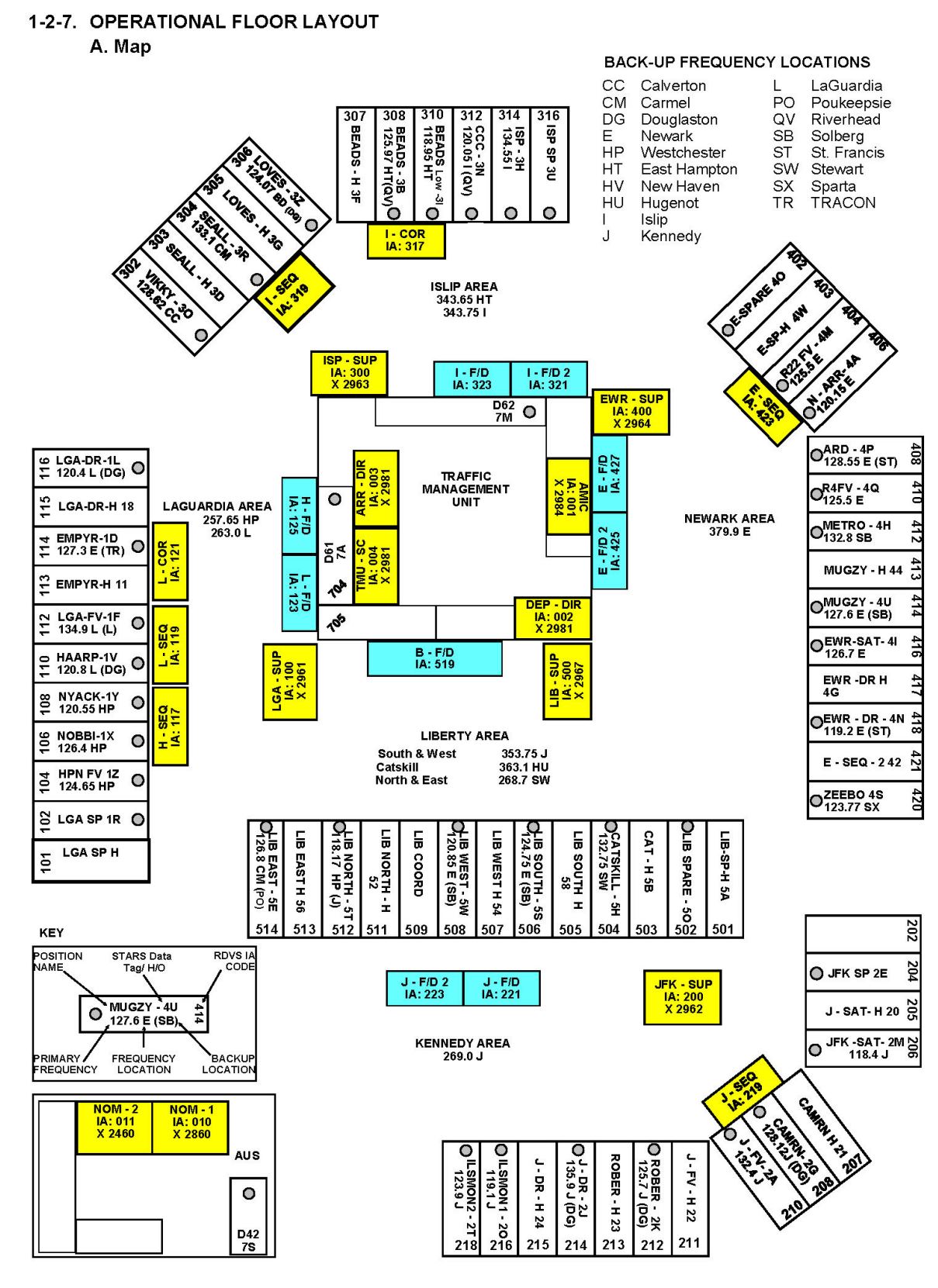
Floorplan of controller stations at the New York TRACON

New York TRACON (NYT or N90, radio communications New York Approach or New York Departure) is a terminal radar approach control (TRACON) facility located in East Garden City, New York.

Overview

[edit]

The primary responsibility of the New York TRACON is the safe, orderly, and expeditious flow of arrival, departure, and en-route traffic. N90 is responsible for two major airports, all located within the same New York Class B airspace: John F. Kennedy International Airport and LaGuardia Airport. Additionally, N90 is responsible for dozens of smaller but busy fields, including Long Island MacArthur Airport, Tweed New Haven Regional Airport, and Westchester County Airport. N90 also controls the large number of VFR aircraft that fly through the New York Class B airspace every day.[1] New York TRACON previously handled arrival and departure for Newark Liberty International Airport and Teterboro Airport, however, due to staffing shortages at New York TRACON, in June 2024 the Philadelphia TRACON was assigned the Newark area under the new callsign Newark Approach and Newark Departure. New York TRACON is the second largest TRACON facility in the United States. In 2024, New York TRACON handled 1,770,862 aircraft operations, handling more aircraft than 5 of the 22 Area control centers in the United States.

The New York TRACON is a Level 12 facility and one of seven "Large TRACONs" currently existing throughout the United States. The others include the Atlanta Large TRACON (A80), the Boston Consolidated TRACON (A90), the Potomac Consolidated TRACON (PCT), the Southern California TRACON (SCT), the Lone Star TRACON (D10), and the Northern California TRACON (NCT). Unlike smaller TRACONs which only utilize one radar, the New York TRACON uses many different airport surveillance radar(ASR) sites, including:[1]

Area breakdown

[edit]

The New York TRACON is divided into five areas. Sectors, along with their frequencies and radio sites, are given below.[2][1]

LaGuardia Area

[edit]

The LaGuardia area of the TRACON controls LaGuardia Airport and several busy satellite airports and heliports: JRA (West 30th Street Heliport) JRB (Wall Street Heliport), 6N5 (East 34th Street Heliport). To the North is HPN (Westchester County Airport) and DXR (Danbury Municipal Airport).[1]

  • 100 LGA - SUP (Supervisor)
  • 101 LGA SP H
  • 102 LGA SP 1S / 19
  • 104 HPN FV 1Z
  • 106 NOBBI - 1X—126.4000 at HPN
  • 108 NYACK - 1Y—120.5500 at HPN
  • 110 HAARP - 1V—120.8000 at LGA Backup at Douglaston
  • 112 LGA - FV - 1F—134.9000 at LGA Backup also at LGA
  • 113 EMPYR - H 11 (Handoff)
  • 114 EMPYR - 1D—127.3000 at EWR Backup at Mount Freedom
  • 115 LGA - DR - H 18 (Handoff)
  • 116 LGA - DR - 1 L -- 120.4000 at LGA Backup at Douglaston
  • 117 H-SEQ (Sequencer)
  • 119 L-SEQ (Sequencer)
  • 121 L-COR (Coordinator)
  • 123 L - F/D LaGuardia Flight Data
  • 125 H - F/D HPN Flight Data

257.65000 at White Plains

263.0000 at LaGuardia

Kennedy Area

[edit]

The Kennedy area controls John F. Kennedy International Airport and its only major satellite, Republic Airport.[1] This area controls many international flights from Europe because Kennedy is known in the aviation community as the "Gateway to America".[3]

  • 200 JFK - SUP (Supervisor)
  • 202 SP1 2V/2E 126.2200 at JFK
  • 204 SP2 2D/2Y 127.9200 at JFK
  • 205 J-SAT-H 20
  • 206 JFK - SAT - 25 118.4 at JFK
  • 207 CAMRN H 22
  • 208 CAMRN - 2G 128.1250 at JFK backup at Douglaston
  • 210 J - FV - 2A 132.4000 at JFK
  • 211 J - FV - H25
  • 212 ROBER - 2K 125.7000 at JFK backup at Douglaston
  • 213 ROBER - H23
  • 214 J - DR - 2J 135.9000 at JFK backup at Douglaston
  • 215 J - DR - H24
  • 216 ILSMON1 - 2O 119.100 at JFK
  • 218 ISLMON2 - 2T 123.9 at JFK
  • 219 J-SEQ (Sequencer)
  • 221 JFK - F/D (Flight Data)
  • 223 JFK F/D 2 (Flight Data)

269.0000 at JFK

Islip Area

[edit]

The Islip area controls all low altitude flights along Long Island including Long Island MacArthur Airport (formerly known as Islip Airport), East Hampton Airport, Brookhaven Airport, Francis S. Gabreski Airport, Sikorsky Memorial Airport, Tweed New Haven Airport, Montauk Airport, Waterbury–Oxford Airport, and Chester Airport.[1]

  • 300 ISP Supervisor
  • 302 VIKKY - 3Z 128.6200 at CCC (Calverton)
  • 303 SEALL - H36
  • 304 SEALL - 3R 133.100 at CMK (Carmel)
  • 305 LOVES - H34
  • 306 LOVES - 31 124.0750 at BDR (Bridgeport) Backup at Douglaston
  • 307 BEADS - H 32
  • 308 BEADS - 3B 125.9750 at HTO (Hampton) backup at QV (Riverhead)
  • 310 BEADS Low - 3N 118.9500 at HTO (Hampton)
  • 312 CCC - 3E 134.5500 at Islip Backup at QV (Riverhead)
  • 314 ISP - 3H 120.0500 at ISP
  • 316 ISP SP 3S/30
  • 317 ISP COR (Coordinator)
  • 319 I - SEQ (Sequencer)
  • 321 I - F/D 2 (Flight Data 2)
  • 323 I F/D (Flight Data)

343.6500 at HT

343.7500 at ISP

Former areas

[edit]

Newark Area

[edit]

The Newark area of the TRACON covers Newark Liberty International Airport along with the majority of the TRACON's satellite airports including Teterboro Airport, Morristown Municipal Airport, and Essex County Airport.[4][5]

In June 2024, the control over the Newark Area was transferred to Philadelphia TRACON.[4][5]

  • 400 EWR - SUP
  • 402 E-SPARE - 4O
  • 403 E-SP-H - 4W
  • 404 R22 FV- 4M 125.5000 AT EWR
  • 406 N-ARR- 4A 120.1500 AT EWR
  • 408 ARD - 4P 128.5500 AT EWR Backup at ST (St. Francis)
  • 410 R4FV - 4Q 125.5000 at EWR
  • 412 METRO - 4H 132.8000 AT SBJ (Solberg)
  • 413 MUGZY - H
  • 414 MUGZY - 4U 127.6000 at EWR Backup at Mount Freedom
  • 416 EWR - SAT - 4E 126.7000 at EWR
  • 417 EWR - DR - H 4D
  • 418 EWR - DR - 4N 119.2000 at EWR (Backup at St. Francis)
  • 421 E - SEQ - 2
  • 420 ZEEBO 4S 123.7750 at SAX Sparta
  • 423 E-SEQ (Sequencer)
  • 425 E - F/D 2 (Flight Data 2)
  • 427 E - F/D (Flight Data)

379.9000 AT EWR

Traffic Management Unit

[edit]

TMU - SC[1]

ARR - DIR[1]

AMIC[1]

DEP - DIR[1]

[edit]

New York TRACON was the setting for the 1999 comedy-drama film Pushing Tin.[6]

References

[edit]
Revisions and contributorsEdit on WikipediaRead on Wikipedia
from Grokipedia
The New York Terminal Radar Approach Control (TRACON), designated as facility N90, is a (FAA) center located in , on . It is responsible for providing separation, sequencing, and vectoring services to aircraft operating within designated terminal airspace, typically extending 30 to 50 miles from airports and up to altitudes of around 10,000 feet, facilitating safe transitions between en route centers and airport towers. As of 2025, N90 primarily oversees arrivals and departures at major New York City-area airports including (JFK) and (LGA), along with smaller facilities such as (TEB), (HPN), and (ISP). One of the busiest TRACON facilities in the United States, N90 manages complex, high-density amid the New York metropolitan region's intense activity, which includes over 1.1 million operations annually across top facilities. The center employs advanced systems and communication networks to handle diverse , from commercial airliners to , while coordinating with the New York Air Route Traffic Control Center (ZNY) for handoffs. In July 2024, due to chronic understaffing and training challenges at N90, the FAA transferred oversight of (EWR) —previously a key sector for the facility—to the Philadelphia TRACON (), reducing N90's workload but prompting ongoing audits and infrastructure upgrades, including new fiber optic links between facilities. These changes aim to enhance reliability in one of the nation's most demanding air traffic environments, where delays and outages have historically impacted regional operations.

Overview

Role and Responsibilities

The New York TRACON, designated as facility identifier N90, is a terminal radar approach control (TRACON) operated by the Federal Aviation Administration (FAA) within the U.S. National Airspace System. It provides radar-based air traffic control services to aircraft operating within approximately 30 to 50 nautical miles of major airports, with a primary focus on managing arrivals, departures, and transitions between terminal airspace and en route environments. This includes oversight of instrument flight rules (IFR) traffic in designated airspace sectors around key New York-area airports such as LaGuardia, John F. Kennedy, Teterboro, and Westchester County. Core responsibilities of the New York TRACON encompass sequencing to achieve a , , and expeditious flow of ; issuing clearances for instrument approaches; and applying vectoring instructions, speed adjustments, and altitude assignments to ensure proper separation between . Controllers also coordinate handoffs with adjacent facilities, including the New York Air Route Traffic Control Center (ZNY), to facilitate seamless transitions for en route entering or exiting terminal airspace. In terms of operational scope, the New York TRACON manages approximately 1.77 million aircraft operations annually based on 2024 data, positioning it as the second busiest TRACON in the United States after the TRACON. Its callsign is N90, with radio communications typically using "New York Approach" or "New York Departure."

Significance and Statistics

The New York TRACON (N90) oversees serving major airports in the densely populated New York-New Jersey metropolitan area— International (JFK), LaGuardia (LGA), MacArthur (ISP), Teterboro (TEB), and Westchester (HPN)—following the July 2024 transfer of Newark Liberty International (EWR) responsibilities to the TRACON. This constitutes the most congested and complex sector in the U.S. (NAS), driven by the tight clustering of airports within a 25-mile radius, conflicting configurations, and limited arrival/departure fixes that constrain maneuverability. Prior to the EWR transfer, the facility managed over 1,300 daily flights amid chronic delays, accounting for approximately 75% of NAS-wide delays originating from New York-area bottlenecks. In 2024, New York TRACON handled 1,770,862 operations, positioning it as the second-largest TRACON in the nation by volume after TRACON, and a vital node in the East Coast air corridor connecting to facilities in , , and Washington. Post-transfer, average daily operations stabilized at around 4,386 movements, encompassing a diverse mix of commercial airliners, , and occasional military flights, with peaks exceeding 4,000 during high-demand periods. These metrics underscore N90's role in facilitating efficient throughput in one of the world's highest-density terminal environments, where operations decreased by 2.9% in FY2024 due to the airspace reconfiguration. The facility's operations bolster a regional economy exceeding $1.5 trillion annually, with New York State aviation supporting over 454,000 high-wage jobs and generating tens of billions in economic output through passenger travel, cargo, and related industries. Safety remains paramount amid this intensity; adherence to FAA radar separation minima—typically 3 nautical miles between aircraft in terminal airspace, reducible to 1.5 nautical miles on final approach under approved procedures—has sustained low incident rates, with unreported operational errors posing no jeopardy to aviation safety. This performance highlights N90's critical contribution to NAS reliability, coordinating briefly with the local Traffic Management Unit to mitigate cascading delays across the corridor.

History

Establishment and Early Years

The New York Common IFR Room, a precursor to the New York Terminal Radar Approach Control (TRACON) designated as N90, was established on July 15, 1968, as part of the Federal Aviation Administration's (FAA) initiative to centralize terminal air traffic control operations amid surging post-World War II aviation growth in high-density areas. This consolidation addressed fragmented control at individual airports by merging manual Instrument Flight Rules (IFR) operations from the existing radar facilities at John F. Kennedy International Airport, LaGuardia Airport, and Newark Liberty International Airport into a single entity. The setup relied on basic primary radar systems without automated data processing, enabling controllers to provide separation and sequencing for arriving and departing aircraft within the terminal airspace. Initially located at John F. Kennedy International Airport, the Common IFR Room operated from temporary quarters to manage the immediate demands of the New York area's complex airspace, which overlapped jurisdictions from multiple Air Route Traffic Control Centers (ARTCCs). Early operations faced significant challenges from the aviation boom, including severe congestion that caused widespread delays—such as 1,927 aircraft affected on July 19, 1968—and tensions with the newly formed Professional Air Traffic Controllers Organization (PATCO), which led to work slowdowns exacerbating system strains. Staffing was limited in these formative years, with controllers handling increased traffic volumes using non-automated tools, highlighting the need for improved coordination in the region's busy terminal environment. The New York TRACON (N90) became operational on January 10, 1981, in a new $25 million facility equipped with advanced radar and automation systems in (near Garden City, ), consolidating and modernizing the terminal control functions from the Common IFR Room to better handle the metropolitan area's growing air traffic. By , a key milestone was achieved through enhanced integration with the New York ARTCC, which had relocated to a new facility in Ronkonkoma, , on July 26, 1970, facilitating smoother handoffs between en route and terminal control sectors. This period also saw initial expansions to include coverage for additional airports like Islip, building on the core setup for LaGuardia and Kennedy while preparing for future redesigns.

Airspace Redesigns and Expansions

In April 1998, the (FAA) launched the NY/NJ/PHL Metropolitan Area Airspace Redesign, the first major overhaul of the region's terminal and en route airspace in over a decade, aimed at improving safety, efficiency, and capacity to handle projected growth. This initiative was planned to streamline sectors by integrating the New York TRACON with the New York Air Route Traffic Control Center into a unified structure known as the New York Integrated Control Complex (NYICC), which was projected to reduce inter-facility handoffs by up to 30% during peak hours—from as many as 525 to 382 per hour—through face-to-face controller coordination and minimized voice communications. The redesign proposed a cohesive terminal airspace up to flight level 230 using terminal separation rules, transitioning to en route rules above, and new arrival and departure routes, including the Exclusion Corridor for north- and eastbound departures from to extend over-water routing and reduce land-based noise. Implementation was to occur in phases starting in 2007, with projected reductions in average delays by about 20% across affected airports like , , Newark Liberty, and Philadelphia International. However, due to environmental concerns and community opposition, the project was suspended in May 2013 and officially ended in December 2020 without achieving these benefits. During the 2000s, as part of ongoing planning and to accommodate rising traffic, the New York TRACON added dedicated sectors for high-demand reliever airports such as Teterboro (TEB) and Westchester County (HPN), including new departure gates and arrival procedures to enhance separation from major carrier operations. Concurrently, the introduction of (RNAV) procedures, leveraging GPS for precise routing, improved utilization and increased overall capacity by enabling tighter spacing and more flexible paths. Following the September 11, 2001, attacks, the New York TRACON implemented enhanced security protocols, including stricter aircraft identification requirements and coordinated emergency procedures with military and federal partners to manage heightened threats. Temporary flight restrictions (TFRs) were immediately imposed over the , prohibiting non-essential flights and establishing no-fly zones around key landmarks, which persisted in various forms for months and required new coordination protocols for resuming operations. These adjustments, while temporarily disrupting traffic, integrated air defense identification zones and real-time threat assessments into routine TRACON workflows. In the 2010s, the New York TRACON advanced integration with the FAA's (NextGen), focusing on performance-based navigation (PBN) to modernize procedures amid persistent congestion. PBN, encompassing RNAV and (RNP), enabled optimized descent profiles and arrival spacing, such as continuous descent approaches that reduced burn and emissions while boosting throughput in dense sectors. By the mid-2010s, over 80% of operations at major New York airports were PBN-capable, allowing for more predictable trajectories and integration with tools like Time-Based Flow Management for better delay absorption. Prior to 2024, the New York TRACON managed five primary areas—encompassing LaGuardia, , Islip, Teterboro/Hudson, and Newark—covering approximately 8,000 square miles up to 10,000 feet , a configuration shaped by the cumulative effects of these redesigns. This scope included the Newark area until its partial reassignment, which briefly alleviated staffing pressures but highlighted ongoing capacity challenges in the core regions.

Facilities and Infrastructure

Location and Physical Setup

The New York TRACON facility is located at 1515 Stewart Avenue in 11590, on [Long Island](/page/Long Island) in Nassau County. This site was selected for its central position relative to the major airports it serves, including (approximately 21 miles away) and (approximately 22 miles away), facilitating efficient oversight of terminal airspace within 20 to 40 miles. The location avoids dense urban interference while providing accessibility via major highways such as the Long Island Expressway (I-495) and the . Constructed in 1978, the facility is a dedicated air traffic control building designed to support terminal radar operations in a high-density environment. It features a secure for monitoring, along with areas for and administrative functions, though physical expansions have been limited due to structural constraints like non-removable flooring in key areas. The site includes coordination with local emergency services but is not open to the public for security reasons. No major relocations have occurred since its establishment, despite periodic discussions about modernization and potential consolidation with other facilities, as the location supports operational continuity and .

Equipment and Technology

The New York TRACON employs primary and systems, including the Airport Surveillance Radar Model 11 (ASR-11), an integrated digital radar deployed at terminal sites to provide real-time aircraft tracking and weather data. These systems deliver coverage extending up to 60 nautical miles horizontally and to altitudes of 24,000 feet, with data feeds that integrate seamlessly with the FAA's En Route Automation Modernization (ERAM) system to support handoffs between terminal and en route controllers. Communication infrastructure at the facility includes VHF and UHF radios operating on more than 20 dedicated frequencies for approach and departure sectors, enabling clear pilot-controller interactions across the busy airspace. A digital voice switching system, part of the FAA's Voice Switching and Control System (VSCS), manages these communications with automated routing and coordination lines to adjacent airport towers and air route traffic control centers (ARTCCs). Recent enhancements under the Voice over Internet Protocol Communications Enterprise (VoICE) program have transitioned elements to digital VoIP for improved reliability and reduced latency. In July 2025, the FAA completed installation of new fiber optic links between the New York TRACON and the Philadelphia TRACON to support the transfer of Newark airspace oversight, improving data and voice communication reliability. Automation relies on the Standard Terminal Automation Replacement System (STARS), a digital platform that processes data, generates conflict alerts, and displays information on controller workstations to enhance in high-density terminal environments. STARS fully supports operations at the New York TRACON since its operational readiness declaration in April 2017. Integration with NextGen capabilities includes the Traffic Flow Management System (TFMS) for optimizing arrival sequencing and Automatic Dependent Surveillance-Broadcast (ADS-B) surveillance, which has been operational in terminal areas since the early 2010s to supplement traditional with GPS-based positioning for greater precision. Backup measures ensure continuity, featuring redundant power supplies maintained under FAA Order JO 6980.33B and off-site data links for during outages. Cybersecurity upgrades in the , aligned with broader FAA digital modernization efforts, have fortified network protections against threats through enhanced and intrusion detection in and communication systems.

Current Airspace Areas

LaGuardia Area

The LaGuardia Area within the New York Terminal Radar Approach Control (TRACON), designated N90, encompasses a sector centered on (KLGA) with boundaries extending approximately 20-30 nautical miles in radius, integrating into the broader New York Class B airspace. This area operates from the surface up to 10,000 feet, facilitating arrivals and departures while incorporating specialized visual corridors such as the East River VFR corridor for low-altitude operations and the Flushing Bay region adjacent to the airport for sequencing traffic. Positioned between to the west and to the east, the sector manages constrained airspace to the south and west, with more expansive availability to the north, enabling efficient channeling of aircraft from en route centers like Washington ARTCC (ZDC) via the RBV fix and New York ARTCC (ZNY) via fixes such as LIZZI. Traffic in the LaGuardia Area is dominated by domestic short-haul flights, serving as a primary hub for and American Airlines, which operate the majority of services to regional destinations across the . Peak operations reach up to 71 scheduled arrivals and departures per hour during slot-controlled periods, reflecting the sector's high-density environment where equal inbound and outbound flows maintain a "one-in-one-out" balance to optimize capacity. Special procedures, including Authorization Required (RNP-AR) approaches such as the RNAV (RNP) X RWY 31, are implemented for noise abatement, allowing precise curved paths that minimize overflight of noise-sensitive areas while adhering to visual segment requirements below 3,000 feet ceiling and 5 miles visibility. Approach and departure services utilize frequencies including 120.8 MHz, 120.05 MHz, 124.95 MHz, 127.3 MHz, and 128.8 MHz for arrivals, with 132.7 MHz dedicated to final vectoring, while departures operate on 120.4 MHz, 124.45 MHz, and 127.05 MHz. Sectors are structured into arrival configurations covering downwind, base, and final legs for sequencing, alongside dedicated departure sectors handling initial climb-outs to assigned gates. Unique operational features include close coordination with the adjacent Area to manage crossing traffic, such as eastward route shifts for departures to avoid conflicts, and integration of helicopter routes like the Throgs Neck and paths, which weave through the urban terminal environment under while maintaining separation from fixed-wing operations.

John F. Kennedy Area

The John F. Kennedy Area within the New York TRACON manages the terminal airspace surrounding (KJFK), covering a radius of approximately 30 to 50 nautical miles centered on the airport. This sector extends upward to 10,000 feet MSL and encompasses key geographical features such as to the north and oceanic approaches over the Atlantic Ocean to the south and east. Traffic in this area is characterized by a high volume of international and domestic flights, featuring major U.S. carriers like and Airways alongside numerous foreign-flag operators serving global routes. Peak hourly operations often exceed 50 aircraft, with the airport's total annual movements reaching 468,570 in 2024, including over 192,000 international operations (arrivals and departures). Arrivals from transatlantic routes are guided via RNAV Standard Terminal Arrival Routes (), such as the PARCH and LENDY procedures, which facilitate efficient sequencing into the busy hub. Primary communication frequencies for the sector include 125.7 MHz and 128.125 MHz for approach control, with specialized sub-sectors dedicated to ILS approaches for runways 4/22 and 13/31, as well as for outbound traffic. Unique operational aspects involve close coordination for oceanic handoffs to Gander Oceanic and Shanwick Oceanic centers, ensuring seamless transitions for transatlantic departures and arrivals. Additionally, noise mitigation efforts incorporate tailored vertical flight profiles during arrivals and departures to minimize impacts on surrounding communities. Inter-sector handoffs with adjacent TRACON areas, such as LaGuardia, maintain continuous radar coverage and traffic separation.

Islip Area

The Islip Area encompasses airspace over eastern , extending approximately 25 to 40 nautical miles from (KISP), from the surface up to 11,000 feet MSL, and borders the TRACON to the south and west. This sector primarily serves arrivals and departures at KISP along with smaller airports on , managing lower-altitude operations distinct from the higher-density corridors near . Traffic in the Islip Area consists mainly of regional jets operated by airlines such as and , alongside a significant portion of flights, with an average of around 20 operations per hour during typical periods. Annual operations at KISP totaled 161,486 in 2024, reflecting a relatively modest volume compared to major hubs, and include overwater (VFR) routes along the coast. The sector operates as a single unit handling mixed (IFR) and VFR traffic, utilizing visual approaches where applicable, with the primary frequency of 120.05 MHz and callsign New York Approach. Unique aspects of the Islip Area include overlaps with military training activities at Francis S. Gabreski Air National Guard Base (KFOK), home to the 106th Rescue Wing, which conducts air defense and rescue operations within the sector's boundaries. Seasonal traffic surges occur during peak travel periods, such as holidays, increasing demand for general aviation and regional flights to eastern Long Island destinations. Coordination with the John F. Kennedy Area is routine for eastward-transiting departures.

Teterboro and Hudson Area

The Teterboro and Hudson Area sector within the New York TRACON covers over northern and the , serving as a key reliever for traffic in the densely populated New York metropolitan region. This sector includes (KTEB), a primary hub for business located approximately 12 miles from , and extends to nearby facilities such as White Plains Airport (HPN), which handles regional commercial and private flights. The supports both (IFR) and (VFR) operations up to altitudes around 3,000 feet MSL for VFR traffic, integrating with surrounding Class B while accommodating the high volume of local movements. Traffic in this sector is characterized by a mix of corporate jets, private charters, and , with Teterboro serving as the busiest U.S. airport for private jet operations, hosting major operators such as for nationwide and international flights. Peak hourly volumes can reach around 30 operations, dominated by unscheduled business arrivals and departures, alongside a high density of VFR flights and helicopter traffic navigating the urban environment. Helicopter operations are segregated from fixed-wing traffic to enhance safety, reflecting the area's role as a that diverts non-commercial movements from major hubs. Sightseeing flights and aerial tours are prevalent, particularly along the , where pilots conduct scenic passes over landmarks like the and skyline. Primary frequencies for the sector include 119.2 MHz for departures and 127.6 MHz for approaches associated with Teterboro, with clearance delivery on 128.05 MHz; additional TRACON communications may utilize 126.7 MHz or 128.55 MHz for coordination. The corridor operates under a dedicated "Hudson" sector designation, where VFR traffic self-announces on 123.05 MHz in the Special Flight Rules Area (SFRA). Strict altitude rules apply in this exclusion from Class B airspace: must maintain between 1,100 feet MSL and 1,250 feet MSL, flying along the west shoreline when southbound and the east shoreline when northbound, while helicopters typically operate below 800 feet MSL to avoid conflicts. A unique aspect of this sector is its integration with (LGA) operations through designated shelf airspace in the Class B structure, allowing VFR traffic in the Hudson corridor to transit safely below arriving and departing commercial flights. This shelf provides a low-altitude corridor for to avoid the busier IFR streams, ensuring efficient flow for sightseeing tours and local flights without disrupting major airline schedules. The design facilitates seamless handoffs between sectors, supporting the area's role in managing diverse, high-density VFR activity amid one of the nation's most congested airspaces.

Former Airspace Areas

Newark Area

The Newark Area within the New York Terminal Radar Approach Control (TRACON), designated as N90, historically managed airspace encompassing (KEWR) and several satellite facilities, including Teterboro (KTEB), Morristown (KMMU), Caldwell (KCDW), and Linden (KLDJ). This sector covered approximately 30 to 40 nautical miles around KEWR, extending up to 10,000 feet mean sea level (MSL), and incorporated key low-altitude corridors over regions such as to the south and Hackensack to the north, facilitating arrivals and departures for New Jersey-based operations prior to the transfer. As a primary hub for , with significant operations from , the Newark Area handled a high volume of traffic, including more than 70 scheduled international and domestic flights per hour during peak periods, making it critical for managing New Jersey arrivals via established routes along the and surrounding corridors. This dense mix of commercial, , and cargo movements required precise coordination to navigate the congested Northeast airspace. The transfer of the Newark sector to the TRACON (PHL) was completed on July 28, 2024, through a seamless system cutover that shifted control overnight, with the callsign changing from "New York Approach" to "Philadelphia Approach." This move reduced N90's operational responsibilities by reassigning the sector, effectively lowering the number of certified controllers needed at the facility from 33 to 24 for its remaining , representing a workload reduction of approximately 27 percent. The (FAA) initiated the transfer as a response to chronic staffing shortages at N90, where persistent understaffing and low training success rates had strained operations across the New York region's complex airspace. The process involved the mandatory relocation of 12 experienced air traffic controllers from N90 in , to PHL for up to two years. No immediate safety incidents were reported during the transfer. In 2025, the FAA extended the relocation period, asking 14 controllers to remain in longer amid ongoing staffing challenges. A and communication blackout at Newark in May 2025 lasted over a minute, prompting an FAA safety review and the imposition of flight caps limiting operations to 72 per hour through October 2026 to reduce delays. The U.S. Department of Transportation's Office of Inspector General initiated an audit in July 2025 to assess the transfer's effectiveness and infrastructure readiness.

Other Historical Adjustments

In the 1980s, the New York TRACON underwent significant consolidations to integrate control of smaller airports and towers into its operations. During the 1990s, boundary tweaks addressed overlaps with adjacent facilities, particularly for coastal traffic. Adjustments were made to coordinate with the Boston Air Route Traffic Control Center (ZBW) along the northeastern seaboard, incorporating elements of the Expanded East Coast Plan (EECP) implemented in phases from 1987 to 1988 and further refined into the decade, which rerouted high-altitude traffic to reduce congestion in New York airspace. Temporary expansions also occurred to accommodate increased military transits during the 1991 Gulf War, allowing N90 to handle surges in eastbound deployments and return flights through enhanced sector coordination without permanent boundary shifts. Sector overlaps with the Philadelphia TRACON were resolved during the ongoing NY/NJ/Philadelphia airspace redesign, initiated in , which streamlined low-altitude handoffs and reduced procedural delays for southbound departures. (HPN) is managed within N90's LaGuardia Area. Overall, these adjustments contributed to an evolution enhancing efficiency through consolidated sectors and better alignment with en route centers, as part of broader FAA efforts to manage growing traffic volumes. The major redesign provided a foundational framework for many of these changes, though detailed implementation spanned subsequent years.

Operations and Management

Daily Controller Duties

Air traffic controllers at the New York Terminal Radar Approach Control (TRACON), designated as N90, operate in a 24/7 environment to manage high-volume terminal airspace around major New York-area airports. Shifts typically last 6 to 10 hours, rotating through day, evening, and midnight periods to ensure continuous coverage, with mandatory off-duty periods of at least 10 hours between shifts, 10 hours before midnight shifts, and 12 hours after midnight shifts to mitigate fatigue, in accordance with updated (FAA) guidelines as of 2025. Core duties revolve around maintaining safe aircraft separation within the TRACON's airspace, which extends 20 to 50 miles from airports and up to 17,000 feet altitude. Controllers continuously monitor radar scopes using the Standard Terminal Automation Replacement System () to detect potential conflicts, issuing precise vectors—heading instructions—to guide along arrival and departure paths. They assign altitudes, speeds, and clearances to prevent collisions, handle pilot requests for deviations due to or mechanical issues, and log flight progress including handoffs to adjacent facilities like airport towers or en route centers. Position relief briefings occur regularly, where incoming controllers receive verbal updates on active traffic, sector status, and ongoing coordinations to ensure seamless transitions. Teams of 4 to 6 controllers staff each sector, including , data, and coordination positions, allowing for overlapping coverage during peak times and position reliefs every 1 to 2 hours. New controllers undergo rigorous to achieve certification, beginning with 3 to 5 months at the FAA Academy in for foundational classroom and simulator instruction on procedures and phraseology. Upon assignment to the New York TRACON, they complete 1 to 2 years of (OJT) under certified instructors, progressing through simulated scenarios on facility-specific equipment to master local airspace complexities. Full certification as a Certified Controller requires demonstrating proficiency in all positions, followed by annual recurrent and proficiency checks to maintain currency, including a minimum of 8 hours per quarter on operational positions. During peak periods, such as weather diversions or seasonal surges, controllers implement surge management techniques to handle increased volumes safely. This includes coordinating ground stops to halt departures at originating when arrival rates exceed capacity, or applying miles-in-trail spacing restrictions—typically 5 to 10 miles between aircraft—to meter flows into congested sectors. These measures, directed via FAA traffic management protocols, prioritize separation while minimizing delays in the dense New York .

Traffic Management Unit

The Traffic Management Unit (TMU) of the New York TRACON serves as a specialized group responsible for monitoring system-wide across its to prevent overloads and issuing proactive advisories to maintain efficiency. This unit coordinates directly with the FAA's System Command (ATCSCC) in , particularly given the New York TRACON's oversight of two major airports (JFK and LGA), allowing it to implement initiatives without always routing through intermediate Air Route Traffic Control Centers (ARTCCs). Key functions of the TMU include directing the implementation of ground delay programs and airborne reroutes to balance arrival and departure flows, as well as optimizing and configurations in coordination with towers. The unit employs the (TFMS) for predictive modeling that anticipates traffic volumes and potential bottlenecks based on . It also manages adjustments for special events, such as the , where temporary flight restrictions and enhanced coordination are required to accommodate heightened activity around . Staffed by a team of coordinators and specialists, the TMU provides continuous oversight with access to feeds from , systems, and flight plans. These personnel conduct daily briefings to review forecasts on impacts and volumes, enabling informed to adjust operations preemptively. The TMU integrates TRACON sectors with overlying ARTCCs by balancing en route and terminal flows, establishing airport arrival rates, and facilitating collaborative (CDM) processes that enhance overall system coordination and reduce unnecessary delays.

Challenges and Future Developments

Staffing Shortages and Delays

The New York Terminal Radar Approach Control (N90), located in , has faced chronic understaffing, with only 125 certified professional controllers (CPCs) on board as of April 2025 against a target of 226, representing approximately 55% staffing levels. This shortfall is part of a broader nationwide FAA controller of approximately 3,000 positions as of November 2025, exacerbated by high attrition rates from retirements and burnout in one of the most demanding facilities overseeing the country's busiest . FAA hiring efforts have lagged, with the agency falling short of recruitment goals despite plans to add 2,000 new controllers in fiscal year 2025 as part of a four-year initiative to hire at least 8,900 overall. Contributing factors include the high-stress environment of managing dense, complex traffic around New York City airports, which leads to elevated burnout and voluntary separations. Recruitment challenges are acute due to the facility's location on , where high living costs and limited appeal deter candidates, compounded by post-2020 workforce exits that accelerated turnover. The FAA has identified low training success rates at N90 as a persistent issue, further hindering efforts to build capacity. These shortages have imposed significant operational strains, including mandatory shifts extending to six days per week for many controllers, increasing risks in an already intense setting. Understaffing has necessitated sector closures and reduced capacity, resulting in average delays of 20 to 30 minutes at affected airports, with cascading effects across the . Notably, N90's limits contributed to FAA-imposed flight caps at (EWR) and slot usage waivers allowing flight reductions at (LGA) during 2023 and 2024, which were extended through October 2026 to mitigate safety risks from overburdened operations. This understaffing also played a role in the FAA's decision to transfer Newark-area responsibilities to another facility. A from October to November 17, 2025, further strained staffing, leading to nationwide flight reductions of up to 6% at major airports, including those in the New York area, before restrictions were lifted as controllers returned to work. To address the crisis, the FAA and the (NATCA) reached a May 2025 agreement introducing incentives such as 20% salary bonuses for retirement-eligible CPCs who stay on duty and $10,000 awards for academy graduates assigned to hard-to-staff sites like N90. Additional measures include $5,000 graduation bonuses for all new FAA Academy completers and targeted recruitment drives in the New York area to "supercharge" hiring at the facility. The FAA is also expanding training capacity through collegiate programs and enhanced instructor incentives to accelerate onboarding and reduce the staffing gap.

Newark Airspace Transfer

The Newark airspace transfer involved relocating control of the airspace surrounding (EWR) from the New York Terminal Radar Approach Control (N90) to the Terminal Radar Approach Control (P90). The (FAA) first announced plans for the reassignment in 2023 to address chronic understaffing at N90. The transfer was executed overnight from July 27 to July 28, 2024, during a period of reduced traffic to minimize disruptions. P90 absorbed the responsibilities by establishing new sectors dedicated to the Newark area, integrating it into its existing operations; this included the mandatory temporary relocation of 12 N90 controllers to for up to two years. The operational changes significantly alleviated pressure on N90, reducing its overall workload and improving sector staffing ratios amid ongoing controller shortages. Initial teething issues, including potential delays during the transition period, were reported, but these were resolved shortly after implementation, with normal operations resuming by early August 2024. The shift also streamlined procedures by reducing the number of handoffs between facilities, as Newark traffic no longer required coordination across N90 and P90 boundaries. In terms of safety and efficiency, the transfer resulted in no major incidents in the immediate aftermath, maintaining high standards despite the complexity of the airspace. The U.S. Department of Transportation's Office of Inspector General initiated an audit on July 28, 2025, to evaluate the FAA's planning, execution, and oversight of the relocation; as of November 2025, preliminary findings highlight ongoing staffing challenges at P90 but no major execution flaws. Stakeholder reactions were mixed: airlines generally welcomed the move as a necessary step to mitigate delays stemming from N90's staffing challenges, while the (NATCA) criticized it as a short-term measure that failed to resolve underlying shortages and introduced new safety risks.

Facility Replacement Initiatives

The New York Terminal Radar Approach Control (TRACON), designated N90, is included in the Federal Aviation Administration's (FAA) Facility Replacement Program, which evaluates the need for constructing or modernizing facilities to address aging infrastructure and operational demands. A review of options for a new TRACON facility in the New York region began in as part of broader airspace redesign efforts, with FAA officials estimating at the time that a decision on construction would be made by September 2008 and completion targeted for September 2015, though these timelines were not met. In May 2025, the FAA unveiled the Brand New Air Traffic Control System (BNATCS) plan, a three-year initiative to overhaul the nation's , explicitly encompassing the replacement of aging TRACON facilities like N90 to mitigate issues such as deteriorating HVAC systems, roofs, and presence. The program prioritizes seismic resilience through upgraded building standards and cyber resilience via modern digital systems and IP-based networks, aiming to reduce vulnerabilities highlighted in prior Government Accountability Office (GAO) assessments of FAA's outdated technology. Estimated costs for the overall BNATCS exceed $30 billion, with facility replacements forming a key component funded through annual Facilities and Equipment budgets of approximately $3 billion, though specific figures for N90 remain undisclosed pending congressional appropriations. Proposed options under historical and current reviews include constructing a standalone new TRACON or consolidating it into an integrated facility, potentially co-located with en route centers like New York Air Route Traffic Control Center (ZNY) using shared automation platforms such as the Integrated Control Complex concept evaluated in 2008. A central site has been considered in past discussions to enhance staffing attractiveness and reduce controller commutes from the current location, though no final selection has been confirmed. Integration with ZNY operations under the En Route Automation Modernization (ERAM) system is projected to streamline handoffs and support NextGen technologies for improved efficiency. The BNATCS timeline targets full system modernization by , with TRACON replacements accelerated to replace facilities every 80 years instead of the previous 300-year pace, though N90-specific implementation depends on funding and site evaluations. Projected benefits include a projected increase in overall system capacity, enhanced through reduced outages, and full NextGen deployment for better , potentially alleviating delays in the high-volume New York airspace. As of November 2025, a report from March 2025 urged the FAA to expedite modernization efforts amid ongoing concerns, prompting the BNATCS response, while environmental impact studies for new facility sites remain in progress as required under the .

Depictions in Media

Film and Television

The most notable fictional depiction of the New York TRACON is in the 1999 comedy-drama film , directed by Mike Newell. Set at the facility's N90 radar room in Westbury, , the story centers on air traffic controllers Nick "The Zone" Falzone (played by ) and Russell Bell (), who navigate intense professional rivalries and personal stresses while managing high-volume sectors around LaGuardia (LGA) and (JFK) International Airports. The narrative highlights the controllers' high-stakes environment, where they juggle multiple aircraft simultaneously amid constant pressure to maintain separation and efficiency in one of the world's busiest airspaces. Pushing Tin was adapted from Darcy Frey's 1996 New York Times Magazine article "," which explored the grueling daily realities at New York TRACON, including outdated 1960s-era scopes, six-day workweeks, and the mental toll of handling up to eight jets and five propeller at once during peak periods like post-Thanksgiving rushes. While the film amplifies these elements for dramatic and comedic effect—such as exaggerated interpersonal conflicts and procedural liberties—it authentically conveys the facility's congestion and the controllers' reliance on rituals, like eating at their scopes, to cope with overload risks like "going down the pipes" (a sudden mental breakdown). Critics noted that this portrayal, though heightened, effectively underscored the real operational intensity of guiding planes through New York's crowded skies. The film's release brought greater public attention to the demanding nature of air traffic control work, particularly at high-density facilities like New York TRACON, by blending workplace tension with personal drama and spotlighting the profession's underappreciated role in . It faced mixed reviews for prioritizing romance over procedural depth. Television portrayals of New York TRACON remain sparse, with no major series featuring dedicated storylines or on-location sequences focused on the facility.

Journalism and Literature

Journalism on the New York Terminal Radar Approach Control (TRACON), designated N90, has frequently highlighted the intense operational pressures faced by air traffic controllers, particularly in the context of staffing shortages and technological vulnerabilities. A seminal 1996 New York Times article, "," detailed the chronic understaffing at N90, describing how controllers managed overwhelming traffic volumes in a high-stress environment that led to burnout and concerns. This exposé prompted the (FAA) to announce pay incentives for controllers at high-stress facilities like N90, aiming to attract and retain personnel amid recruitment challenges. The article's influence extended to broader policy discussions, contributing to intensified FAA training programs and hiring initiatives in the late . In 2009, magazine published "Traffic: How Air Traffic Control Works," which provided an in-depth look at the demanding routines of controllers at New York's tower, underscoring the mental and physical toll of coordinating dense airspace similar to N90's operations. The piece, based on observations within the facility, illustrated the precision required amid rising air traffic, implicitly addressing controller fatigue through vivid accounts of shift pressures. Complementing this, publications from the (NATCA) have repeatedly addressed N90 staffing shortfalls; for instance, a 2016 NATCA testimony emphasized the facility's below-target controller numbers, advocating for priority transfers to alleviate workload burdens. More recent NATCA statements in 2024 criticized mandatory relocations of N90 controllers to , arguing that such moves exacerbated local shortages without resolving systemic understaffing. Recent journalism has focused on N90's ongoing issues, particularly the 2024 transfer of Newark airspace oversight to 's TRACON and subsequent radar outages. A Wall Street Journal article in August 2024 explained the FAA's decision to shift jurisdiction as a response to N90's persistent staffing deficits, which had caused widespread delays at . In 2025, coverage detailed multiple and communication failures at the facility managing former N90 , including a May incident where controllers lost contact with aircraft, leading to hundreds of cancellations and highlighting unresolved technology and staffing vulnerabilities. These reports have influenced aviation policy debates, echoing earlier coverage by amplifying calls for FAA modernization and recruitment reforms to prevent future disruptions.

References

Add your contribution
Related Hubs
User Avatar
No comments yet.