Hubbry Logo
NianNianMain
Open search
Nian
Community hub
Nian
logo
8 pages, 0 posts
0 subscribers
Be the first to start a discussion here.
Nian
Nian
from Wikipedia
Not found
Revisions and contributorsEdit on WikipediaRead on Wikipedia
from Grokipedia
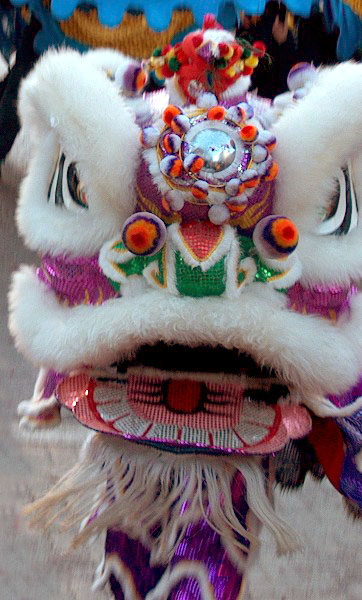
Nian (Chinese: 年; : Nián) is a mythical beast in , depicted as a ferocious creature resembling a with a sharp horn, that emerges annually from the or mountains to devour villagers, , and crops on the of the . According to , ancient villagers placated the beast by leaving offerings outside their homes, but eventually discovered its vulnerabilities to the color red, loud noises, and fire, prompting the use of red decorations, firecrackers, and lanterns to scare it away. These practices form the basis of key customs, transforming a tale of fear into a celebration of renewal and protection. The core legend recounts that Nian, meaning "year" in Chinese, would surface on the last day of the , forcing terrified residents to flee to the mountains while abandoning their homes. In one prominent version, a wise elderly man—revealed to be a celestial being—remained in a village during Nian's approach, using clothing, bright flares, and explosive firecrackers to repel the beast, thereby instructing the people on effective defenses against future attacks. This event led to the widespread adoption of couplets on doors, illuminated lanterns, and the detonation of firecrackers (originally burning that crackled loudly) during the Spring Festival, symbolizing the triumph over evil and the arrival of spring. Variations of the include descriptions of Nian as a dragon- or unicorn-like monster that terrorized on the first and fifteenth days of each , or one that was ultimately subdued and tamed by the Taoist monk , who made it his mount after exploiting its fears. Culturally, the Nian story underscores themes of communal resilience and renewal, influencing not only observances but also the of phrases like "guo nian" (to pass the year safely) and serving as an educational tool in Chinese heritage to explain seasonal rituals. Today, these traditions persist globally among Chinese communities, reinforcing the festival's role as a major cultural event marking the end of winter and the promise of prosperity.

Etymology and Origins

Linguistic Roots

The Chinese character 年 (nián), denoting "year," originated in ancient Chinese with meanings tied to agriculture, specifically referring to "grain," "harvest," or "crop yield," which underscored the centrality of agrarian cycles in early society. In its earliest forms, as seen in oracle bone inscriptions from the Shang dynasty (c. 1600–1046 BCE), the character was a pictograph depicting a person carrying a bundle of grain, symbolizing the labor and bounty of the harvest season. These inscriptions often appeared in ritual contexts, such as divinations seeking favorable crop outcomes, highlighting 年's role in harvest-related ceremonies. The Han dynasty dictionary Shuowen Jiezi (c. 100 CE) defines it as "mature grain" (穀孰也), composed of the radical 禾 (grain plant) for semantic indication and 千 (thousand) as a phonetic component, further linking it to the ripening of crops as described in classical texts like the Spring and Autumn Annals. During the (c. 1046–256 BCE), 年 underwent phonetic and semantic shifts in texts, expanding from literal references to encompass the passage of time and annual cycles. This evolution occurred through , where the harvest event first represented seasonal changes and then a complete yearly period, reflecting the growing awareness of time's cyclical nature in agricultural planning. For instance, in Zhou-era commentaries like the Guliang Zhuan, 年 denotes temporal intervals tied to bountiful or lean s, marking a transition toward its modern temporal connotation. The character's association with the lunar calendar further solidified its meaning as "year" in the context of seasonal renewal, as the lunisolar system was designed to synchronize lunar phases with solar agricultural rhythms. In this framework, 年 captures the full cycle from planting to harvest, aligning calendrical reckoning with the renewal of natural and agrarian life. Bronze inscriptions from the Zhou period exemplify this, using 年 in references to annual rituals that anticipated yields and temporal progression.

Historical Development

The term "nian," meaning "year" or "ripe grains," first appears in inscriptions from the (c. 1600–1046 BCE), reflecting its roots in ancient agricultural cycles and seasonal transitions. By the Dynasty (1046–771 BCE), the concept evolved to encompass the passage of time, laying the groundwork for later associations with renewal at the year's end. The name of the mythical beast Nian derives from this word due to its annual emergence, though the legend itself is primarily oral first recorded in collections from the (618–907 CE), with no earlier textual attestations. During the (206 BCE–220 CE), New Year customs developed in the context of agrarian societies, where rituals addressed fears of famine, cold, and renewal, incorporating protective practices that later became associated with warding off threats like Nian. This period marked a shift toward integrating such observances with the lunar calendar's end, emphasizing survival through . Cultural and philosophical influences shaped lore during later dynasties, with narratives circulating in literary collections and oral traditions that reinforced themes of chaos and at the year's close. By the (960–1279 CE), oral traditions increasingly merged with written records, consolidating elements of New Year lore central to festival practices. Scholarly compilations and documented rituals to "pass the Nian" (guonian), transforming regional stories into unified customs that explained firecrackers, red decorations, and lion dances as defenses against peril. This era's emphasis on cultural documentation solidified the enduring place of these practices in , bridging ancient agrarian anxieties with formalized festival observances.

Mythological Characteristics

Physical Appearance

In Chinese folklore, the Nian is commonly depicted as a formidable mythical beast with a lion-like head adorned with a long, sharp horn, a robust bull or ox-like body, and overall form covered in scales or thick fur, creating a silhouette that evokes terror and power. These features blend elements of known animals, such as the unicorn's horn for goring prey, underscoring its predatory essence in oral traditions. Variations often incorporate dragon-like or unicorn elements. The Nian's sensory traits further amplify its fearsome reputation, including rows of sharp teeth and ferocious eyes, as described in ancient bestiaries and folk tales.

Behaviors and Habitat

In , the Nian is depicted as inhabiting remote and isolated locales, such as the depths of the ocean or the heights of mountains, where it spends the majority of the year in seclusion. This allows the creature to remain hidden from human settlements, emerging only during the harsh transition from winter to spring. The Nian's behaviors portray it as a formidable nocturnal predator, active primarily under the cover of night as it raids villages in search of sustenance. Driven by intense , it devours , destroys crops, and preys on humans. These actions underscore its role as a manifestation of and calamity, ravaging communities at a time when resources are scarcest after winter. The creature follows a strict annual cycle, awakening specifically on Chuxi—the eve of the —to launch its assaults, thereby linking its predations to the renewal of the . This timing amplifies its disruptive impact, as villages face the beast at the culmination of the old year. Among its innate vulnerabilities are an aversion to bright lights, explosive sounds, and the color red, sensitivities that exploit its primal responsiveness to intense stimuli.

Legends and Narratives

Core Legend

The core legend of Nian describes a ferocious beast that emerges from the sea or mountains on the eve of the Lunar New Year to devour human flesh, livestock, and crops. Terrified villagers would flee to the hills, locking their doors and leaving food offerings to appease the monster. In a pivotal event, a wise elderly traveler—often depicted as a deity in disguise—stayed behind in a village, adorning the doors with red paper, lighting fires, and igniting bamboo to create loud explosions. These elements frightened Nian away, revealing its vulnerabilities. The elder instructed the villagers to continue these practices annually, leading to the adoption of red decorations, lanterns, and firecrackers as protective customs during the Spring Festival.

Ancient and Variant Sources

The legend of Nian as a mythical beast lacks direct attestation in ancient Chinese literary compilations such as the (Classic of Mountains and Seas, compiled ca. 4th–1st century BCE), which describes various sea monsters and mountain creatures but does not reference Nian specifically. Instead, the term "nian" appears in inscriptions from the (ca. 1600–1046 BCE), where it denotes the ripeness of grains, reflecting agricultural cycles that later influenced calendrical concepts of the year. By the (1046–256 BCE), "nian" had evolved to signify the annual cycle, with year-end rituals involving sacrifices and communal gatherings to ensure prosperity, as evidenced in ritual texts like the (Rites of Zhou). These practices, documented in (206 BCE–220 CE) historical records, prefigure elements of the Nian narrative through noise-making and fire to dispel malevolent forces, though without mention of a specific beast. Tang Dynasty (618–907 CE) collections like the Taiping Guangji (Extensive Records of the Taiping Era, compiled 978 CE) preserve tales of flood-related monsters and seasonal calamities, such as dragon-like entities causing inundations, which scholars link indirectly to Nian's destructive persona as a harbinger of chaos at year's end. However, no explicit Nian story appears in these texts; instead, they compile earlier motifs of aquatic or mountainous beasts tied to , suggesting the Nian legend amalgamated such motifs over time. For instance, narratives of river dragons in southern myths parallel Nian's reputed emergence to devour villagers, emphasizing themes of renewal through survival. Variant narratives of Nian diverge primarily in habitat and emergence patterns, with southern Chinese versions portraying it as a dragon-like entity dwelling in rivers or the , emerging during floods to ravage coastal communities and symbolizing cyclical destruction akin to seasonal deluges. In contrast, northern tales depict Nian hibernating in remote mountains, awakening at winter's close to prey on and humans, underscoring themes of enduring harsh winters. These differences highlight geographic influences: southern accounts tie Nian to watery perils, while northern ones evoke terrestrial isolation and scarcity. Scholarly analysis positions these sources—spanning 4th-century BCE compilations to Tang-era anthologies—as precursors to the unified core legend, providing mythological frameworks for warding off chaos through communal action. Yet, they notably omit the red pigmentation and explosive noises central to later versions, which emerged as folk etymologies to rationalize established customs. Scholars suggest the unified Nian beast narrative likely developed later, possibly during the Tang Dynasty or as a folk etymology in subsequent periods, without ancient textual attestation for the specific monster, blending ancient ritual logic with narrative embellishments to reinforce cultural continuity, as seen in comparative studies of apotropaic traditions across East Asia.

Cultural Significance

Connection to Chinese New Year

The legend of Nian, a ferocious mythical beast that terrorized villages at the turn of each year, forms the foundational myth for many core traditions observed during , also known as the Spring Festival. According to ancient dating back to the (1046–256 BCE), villagers discovered that Nian could be repelled by the color red, which symbolized vitality and warded off malevolent forces, and by loud, thunderous noises that mimicked the beast's feared adversaries. These discoveries directly inspired practical customs aimed at protection, transforming the festival into a communal ritual of expulsion and renewal. Key practices rooted in the Nian narrative include the widespread hanging of red lanterns and the pasting of red couplets—poetic inscriptions on red paper affixed to doorways and windows. These red elements serve as symbolic barriers, believed to intimidate and deter Nian from entering homes, a that evolved from early uses of red peach wood charms in the to more elaborate decorations by the (202 BCE–220 CE). Similarly, the explosive bursts of firecrackers and replicate the crackling used in ancient times to produce startling sounds, a practice formalized with the introduction of gunpowder-based firecrackers during the (618–907 CE). By the (1368–1644 CE), these customs had become nationwide staples, integrated into imperial and folk observances across as standardized means of communal defense against the mythical threat. Family rituals further embed the Nian legend in daily observances, with participants donning clothing to embody the protective aura of the color and thereby shield themselves from harm. Red envelopes, or hongbao, filled with and given to children, extend this symbolism, acting as talismans that distribute good fortune while invoking the red hue's power to repel Nian-like evils. These acts of gifting and attire reinforce familial bonds during the festival's eve, ensuring the household's safety through shared rituals passed down generations. In global Chinese diaspora communities, these Nian-inspired traditions persist as vital links to ancestral heritage, particularly in urban Chinatowns worldwide. Overseas families in places like and maintain the custom of illuminating red lanterns, igniting firecrackers during parades, and exchanging hongbao, adapting them to multicultural settings while preserving their apotropaic purpose against the beast. Such observances, often culminating in vibrant street festivals, underscore the enduring global reach of the Spring Festival as a bulwark against misfortune.

Symbolism and Interpretations

In , the Nian beast symbolizes the culmination of the old year's misfortunes, fears, and chaotic forces, with its ritualistic expulsion embodying renewal and the hope for a prosperous . This interpretation underscores the cyclical transition from hardship to optimism, as the encourages communities to confront and banish the past's burdens through . The beast's emergence at winter's end reflects broader cultural anxieties about survival, transforming personal and societal dread into a of triumph and fresh beginnings.

Modern Depictions

In Media and Literature

In modern literature, the Nian beast has been reimagined in numerous children's books that adapt the traditional legend for young audiences, often emphasizing themes of bravery and . For instance, The Nian Monster (2016) by Andrea Wang, illustrated by Alina Chau, relocates the creature to contemporary , where it threatens the city during , and a young girl named Xingling uses firecrackers and red decorations to repel it, blending with urban adventure. Similarly, Nian: The Chinese New Year Dragon (2019) by Virginia Loh-Hagan portrays a clever village girl named Mei who outwits the dragon-like Nian emerging from its underwater prison, highlighting the origins of customs through vibrant illustrations and a focused on . These English-language works have popularized the Nian story in Western markets, serving as educational tools for multicultural storytelling. In the realm of film and television, animated adaptations have brought the Nian to life with dynamic visuals and narratives. The 2016 Chinese animated feature Mr. Nian, directed by Zhang Yang, depicts the Nian beast attempting to disrupt the Spring Festival by entering the human world, where it encounters a young girl named Shaguo, leading to themes of redemption and celebration amid comedic escapades. This film, released during the holiday, grossed significantly at the and reinforced the beast's role in holiday entertainment. While direct appearances in Journey to the West adaptations are absent, Nian-inspired elements occasionally appear in broader animations, such as short episodes in educational series that weave myths into episodic adventures. Western media has incorporated the Nian into multicultural narratives, particularly in and themed products that introduce global holiday traditions. The graphic novel Jia and the Nian Monster (2020) by Mike Richardson, with art by Megan Huang and published by , follows a young inventor named Jia who confronts the ancient beast using ingenuity and early technology, drawing on the legend to explore friendship and innovation in a fantasy setting. Additionally, LEGO's "The Story of Nian" set (2021) recreates the beast's defeat through fireworks and red lanterns in a buildable village scene, making it accessible for play-based learning about . Although Disney has not produced a dedicated Nian , its Lunar New Year celebrations at feature dragon dances and folklore-inspired decor that evoke the beast's defeat, integrating it into immersive holiday experiences. Recent trends in have seen the Nian emerge as a formidable in video games, particularly during seasonal events tied to . In Soul Knight (2017 onward), developed by ChillyRoom, Nian serves as a recurring boss in the Kingdom and modes, appearing exclusively during updates with attacks mimicking fireworks and beastly roars, challenging players to defeat it for exclusive rewards. Similarly, Soul Knight Prequel (2023 onward), with Nian, the Yearbeast, appearing as a limited-time boss during events, such as roaming the Forest of Tranquility from February 5 to 16, 2024, requiring strategic combat to overcome its elemental abilities. Other titles like Knights & Dragons (2012) featured Nian as an epic water-air boss in 2014, dropping horns for crafting gear, while Last Day on Earth: Survival (2017) included it in update 1.7.6 as a challenging raid target. On social media platforms in the 2020s, Nian has inspired viral content during , including animated shorts and humorous edits depicting the beast fleeing from red envelopes and firecrackers, amplifying its cultural resonance among global audiences.

Contemporary Observances

In urban centers like , traditional fireworks displays intended to scare away the mythical Nian beast have increasingly been replaced by drone light shows, which offer a low-pollution alternative while maintaining the festive spirit of warding off evil. For instance, in 2020, staged a pre-recorded drone performance featuring 2,000 drones forming firework-like animations over the , praised as a modern, eco-friendly substitute that reduces air and noise during celebrations. Similar events continued into 2024 and 2025, with drone swarms depicting animated stories in the , aligning with broader efforts to adapt Nian-scaring customs to urban environmental constraints. In , partial fireworks bans since 2018 have promoted such innovations, leading to a 16% decrease in values during the festival period compared to pre-ban years. Among Chinese diaspora communities, Nian-themed elements persist in parades and have evolved to include virtual formats, particularly following restrictions from 2020 to 2025. The Parade, the largest outside , features lion dances and bursts symbolizing the repulsion of Nian, drawing over 500,000 attendees annually and incorporating the legend in its cultural narrative. In , community events reference the Nian myth through storytelling and dragon processions, as seen in festivals organized by Asian American groups. Post-pandemic, virtual celebrations surged; for example, the hosted online programs in 2021 with streamed performances and Nian legend discussions, while offered virtual craft activities tied to the festival's origins. In , such as Singapore's River Hong Bao event, Nian-inspired light installations and parades blend local customs with the beast's legend, with hybrid virtual elements introduced during 2020–2022 lockdowns to sustain community ties. Educational initiatives play a key role in transmitting the Nian legend to younger generations, integrating it into curricula and programs to preserve amid modernization. In schools, Lunar New Year-themed lessons often include musical activities recounting the Nian story, as implemented in primary classrooms under the Education Bureau's cultural education framework since 2023. contribute through targeted exhibits; for example, a 2025 art exhibition inspired by the Nian legend showcased works depicting a young driving away the beast, aimed at engaging with . The Heritage Museum supports broader education via programs like outreach on festival traditions, though specific Nian-focused displays rotate with seasonal events. These efforts emphasize the legend's role in fostering identity, with over 10,000 students participating annually in related workshops across the region. Twenty-first-century environmental concerns have reshaped Nian symbolism, prompting "green" New Year campaigns that reinterpret noise-making traditions to prioritize and reduction. In , nationwide fireworks restrictions since 2016 have lowered PM2.5 concentrations by up to 24.76% during the , framing eco-friendly alternatives like displays as modern ways to "scare" Nian without harming air quality. Campaigns such as those promoted by environmental NGOs encourage reduced use, linking the to conservation by advocating for low-emission celebrations that minimize in densely populated areas. For instance, Beijing's 2021–2025 initiatives replaced widespread private with centralized light shows, resulting in sustained improvements in urban air quality and inspiring similar drives in communities.

References

Add your contribution
Related Hubs
User Avatar
No comments yet.