Hubbry Logo
Nightmare CreaturesNightmare CreaturesMain
Open search
Nightmare Creatures
Community hub
Nightmare Creatures
logo
7 pages, 0 posts
0 subscribers
Be the first to start a discussion here.
Nightmare Creatures
Nightmare Creatures
from Wikipedia
Nightmare Creatures
DeveloperKalisto Entertainment
PublisherActivisionGameloft (mobile)
ProducerNicolas Gaume
ProgrammerEric Thommerot
ComposerFrédéric Motte
PlatformsPlayStation, Windows, Nintendo 64, Mobile
ReleasePlayStation
Microsoft Windows
Nintendo 64
Mobile
  • WW: September 2003
GenreSurvival horror
ModeSingle-player

Nightmare Creatures is a 1997 survival horror video game developed by Kalisto Entertainment for PlayStation, Windows, and Nintendo 64. A sequel, Nightmare Creatures II, was released three years later. A mobile phone version of Nightmare Creatures was developed and published by Gameloft in 2003. A third sequel, Nightmare Creatures III: Angel of Darkness, was cancelled in 2004.[7]

Plot

[edit]

The story behind Nightmare Creatures draws upon gothic horror elements of the 19th century and begins in 1666, when a devil-worshiping cult called the Brotherhood of Hecate were conducting sinister experiments in London so as to take over the city, and then the world. The Brotherhood tried to develop an elixir that would endow them with superhuman powers. However, rather than creating their intended superhumans, their experiments instead created grotesque monsters called nightmare creatures. When they decided to use these creatures as an army of conquest, one of their members, Samuel Pepys, set their headquarters on fire, resulting in the First Great Fire of London.

The game takes place in 1834 when London falls victim to several evil occurrences. Monster sightings are reported along with news of people mutating into ungodly creatures, and that the dead are waking from their graves and walking among the living. All of London is in a panic and vulnerable to the schemes of Adam Crowley (who was based on occultist Aleister Crowley),[8] a mad scientist and occultist enlisting the help of the Brotherhood.

A book is dropped off at the home of Ignatius Blackward, a priest and occult expert. He finds it is the lost diary of Samuel Pepys, which contains the Brotherhood's research. Knowing he needs help, Ignatius sends the diary to a renowned American immunologist named Dr. Jean Franciscus of New Orleans, who shows up with his daughter, Nadia Franciscus. However, Jean was killed and the book was stolen. Ignatius and Nadia are at Jean's funeral, where they are approached by a man who gives them a note reading: "Know about Adam Crowley, Brotherhood of Hecate --- HVHJ". Ignatius and Nadia head out to an address listed on the note, hoping to seek out Crowley and neutralize the monsters.

Gameplay

[edit]

A single-player only game, Nightmare Creatures allows the player to control either Ignatius or Nadia.[9] Secondary weapons such as pistols, mines, fire bombs, and magic spells can be used in addition to each character's primary weapon.[10] The game features an optional adrenaline bar which causes health to be lost if it runs out, and players are forced to continuously seek out and win battles to keep the adrenaline bar full.

Development

[edit]

Nightmare Creatures was the first video game to be created with LibSys, Kalisto's own proprietary 3D development program.[11] The game's environments were modeled from 19th century maps and blueprints.[9]

Release

[edit]

Bidding for the game's publication rights was reportedly fierce.[12] Initially Mindscape was slated to be the publisher,[13] but the publication rights to Nightmare Creatures were acquired by Activision just before the 1997 Electronic Entertainment Expo.[14] Nightmare Creatures was published by Activision in North America and Sony Computer Entertainment in Europe.

In North America the PlayStation version was promoted with a television commercial featuring a voice-over by Maurice LaMarche.[15]

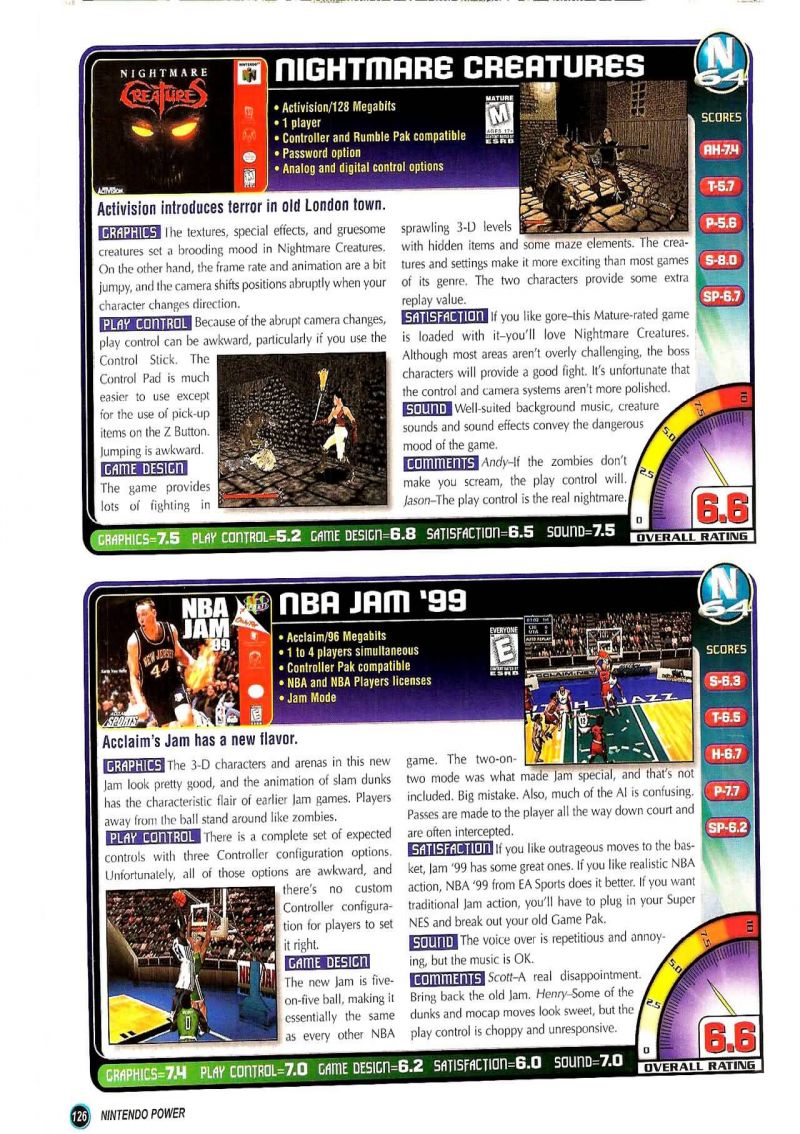
While the PlayStation and Microsoft Windows versions are essentially the same, the Nintendo 64 version saw a handful of minor changes. Given the limited storage capacity of the Nintendo 64's cartridge system, all full-motion videos were removed. Brief segments of scrolling text are used at the game's start and following each level to advance the plot. The platforming elements were made much easier in the Nintendo 64 version, and the health-depleting adrenaline meter could also be turned off in the options menu, allowing players to explore the environments at a more leisurely pace. Also graphically, the Nintendo 64 version is more crisp, clear and detailed than the PlayStation version, without the pixelization and texture-warping.

The PlayStation version was released in Japan on February 26, 1998.[16]

Reception

[edit]

Nightmare Creatures was a commercial hit, with global sales above 1.5 million units by January 2000.[45][46]

The PlayStation version of Nightmare Creatures received "favorable" reviews, while the Nintendo 64 and PC versions received "mixed" reviews, according to the review aggregation website GameRankings.[17][18][19]

The PlayStation release divided critics. They almost uniformly praised the game's spooky atmosphere[26][8][37][47] and the monster designs,[26][34][37][47] though many found that the controls had issues[26][34][37] and the camera, while effective the vast majority of the time, would occasionally frustrate the player with a poor view of the action.[8][37][47] However, they were evenly split on whether to recommend the game, with some saying that the fighting gets old quickly, making it an overall disappointment in light of the promise it showed during development,[26][34][37] and some saying that the game's flaws are minor compared to its strengths.[26][8][47] Next Generation stated that "While the visuals are compelling enough to drive many players forward, the repetitive action is enough to make most wait for a level select code and a weekend rental."[37] Taking the other side, IGN concluded, "Ultimately, the positives far outweigh the negatives in Nightmare Creatures. It's spooky, challenging, and a hell of a lot of fun."[8]

The division between recommendations stemmed at least partially from differing experiences with the game's extensive move sets. For example, GameSpot stated that "Since the more complex moves are significantly harder to pull off (especially with those attacking creatures interfering and all), you'll end up jamming on the kick or slash buttons with an occasional block or dodge."[34] On the other side, GamePro said even the more elaborate combos "are a breeze to perform", and give the game a 4.5 out of 5 for control and a perfect 5.0 in every other category (graphics, sound, and fun factor). They summarized that "With its speedy gameplay and fast-moving enemy interaction, not to mention the intense, creepy nature of the backgrounds, Nightmare Creatures is sure to haunt your dreams for months to come."[47] The disagreement extended between Electronic Gaming Monthly's four reviewers; Sushi-X and Kelly Rickards gave the game a 8.0 and 7.5, respectively, saying that the special attacks are all easy to perform and useful in combat, while Joe Fielder and Crispin Boyer both gave it a 5.5, with Fielder arguing that the player is driven to either button mashing or sticking to a handful of basic moves and Boyer saying the game is too difficult unless the player quickly masters the use of the block.[26] Critics overwhelmingly agreed that the game is extremely difficult (though some of them considered this a positive rather than a negative).[26][34][8][47]

Next Generation reviewed the Nintendo 64 version of the game, rating it three stars out of five, and stated that "Nightmare Creatures does grow bland after the first few levels, but the variety of items and new combos keep the game from diving into tedium. All in all, it's a welcome addition to the N64."[38]

Entertainment Weekly gave the game a B−, praising the 3D environments, and saying Castlevania: Symphony of the Night is dated and flat in comparison.[42]

Film adaptation

[edit]

On December 8, 2000, a film adaptation based on the game was announced, but never went into production.[48]

References

[edit]
[edit]
Revisions and contributorsEdit on WikipediaRead on Wikipedia
from Grokipedia
Nightmare Creatures is a survival horror action video game series developed by the French studio Kalisto Entertainment and published primarily by Activision. The inaugural title, Nightmare Creatures, was released on October 31, 1997, for PlayStation, followed by ports to Windows and Nintendo 64 in 1998. Set in 1834 London, the game follows protagonists Ignatius Blackward, a priest of the Brotherhood of Hecate, or Nadia Franciscus, a young biologist, as they battle grotesque monsters spawned by a demonic contagion unleashed by the villainous bio-sorcerer Adam Crowley, inspired by the real-life occultist Aleister Crowley. Gameplay emphasizes third-person melee combat with character-specific combos and weapons, powered by an adrenaline meter that requires defeating enemies to sustain, across levels featuring exploration and boss fights in gothic environments. The series continued with Nightmare Creatures II in 2000 for PlayStation and Dreamcast, shifting the setting to 1934 with protagonist Herbert Wallace, an escaped victim of Crowley's experiments, confronting a revived Crowley and Nazi occult experiments, with enhanced combo systems. Both games received generally positive critical reception for their atmospheric horror, gory visuals, and fluid combat, though criticized for repetitive level design and technical issues on some platforms, earning an average critic score of 74% for the first entry. The franchise influenced early third-person action-horror titles and remains notable for its blend of historical occult themes with beat 'em up mechanics, though no further sequels were produced after Kalisto's closure in 2002.

Narrative

Plot

In 1834 London, a demonic plague erupts, transforming ordinary citizens into grotesque nightmare creatures through a transmortification virus unleashed by the Brotherhood of , a secret society devoted to dark sorcery. The plague originates from an arcane formula hidden in the diary of historical figure , which details a ritual for creating superhuman beings but instead produces murderous monstrosities. At the center of this horror is Adam Crowley, a once-respected who has fallen into and now leads the Brotherhood, using the formula to sow chaos across the city in pursuit of ultimate power. The story ignites with the assassination of Dr. Jean Franciscus, a renowned immunologist and expert on secret societies, who is murdered by Crowley while decoding Pepys' diary and investigating the emerging threat. Dr. Franciscus's daughter, Nadia Franciscus, a young biologist seeking vengeance, joins forces with Ignatius Blackward, a priest and occult scholar who has returned to London to probe reports of missing parishioners and monstrous sightings. Together, they uncover the Brotherhood's role in the plague and embark on a perilous quest, tracking cult members and battling the infected hordes through fog-shrouded districts of Victorian London, including Spitalfields, the Thames Tunnel, India Docks, Highgate Cemetery, Hampstead Heath, Smithfield, Regent's Canal, London Zoo, and Westminster. Key conflicts arise during confrontations with Brotherhood enforcers, such as the sword-wielding Jose Manuel, and aberrant beasts like the serpentine Sewer Snake and a hulking Yeti-like Snowman, as the duo pieces together Crowley's grand design to overrun the city. The narrative unfolds along dual paths determined by the player's choice of protagonist—either Ignatius, with his knowledge of ancient rites, or Nadia, driven by personal loss—though their objectives converge in pursuing Crowley across the plagued streets. Crowley repeatedly evades capture, fleeing after initial clashes, until the climax on the rooftops of burning Westminster, where he consumes a potent that mutates him into a demonic form. The protagonists ultimately vanquish him, halting the plague's spread and quelling the inferno that threatens to consume . The resolution varies subtly based on the selected hero: Ignatius's path emphasizes and redemption, ending with a solemn reflection on the city's fragile peace, while Nadia's concludes with a vow of continued vigilance against lingering shadows of the Brotherhood. In both cases, the unsung heroes witness 's tentative rebuilding, as the nightmare recedes but the scars of occult terror remain.

Characters and Setting

The protagonists of Nightmare Creatures are Blackward and Nadia Franciscus, each driven by personal convictions to confront the supernatural threats plaguing . Blackward is a devout priest and the last surviving member of the Ordo , a secretive order dedicated to combating and demonic forces. His background as an expert in rituals, languages, and fuels his motivations rooted in faith and a quest for redemption, compelling him to investigate mysterious disappearances and monstrous sightings in the city. Nadia Franciscus, the daughter of the renowned immunologist Dr. Jean Franciscus, inherits a legacy of scientific inquiry into mystical substances. Her personal vendetta stems from her father's assassination by agents of the Brotherhood of , propelling her to ally with Blackward in a bid to dismantle the cult responsible. The primary antagonist, Adam Crowley, embodies a tragic fall from intellectual pursuit to malevolent ambition. Once a respected , Crowley undergoes a profound transformation after discovering ancient texts, evolving into the charismatic leader of the Brotherhood of Hecate. His experiments blend bio-sorcery with forbidden , aiming to engineer soldiers but resulting in grotesque mutations that unleash chaos upon . Supporting the narrative are elements like the Brotherhood of Hecate, a clandestine society of devil-worshippers comprising influential businessmen and enthusiasts, originally founded in the to harness dark powers for . Minor non-player characters, such as terrified infected civilians scarred by the contagion, populate the world, highlighting the human cost of the cult's resurgence and adding layers of desperation to encounters. The game's setting immerses players in a meticulously recreated , drawing from historical maps to authentically depict districts like Chelsea and the East End. This Victorian-era backdrop features foggy, cobblestone streets shrouded in perpetual mist, evoking an atmosphere of dread and isolation, with —towering spires, ornate facades, and decaying tenements—silhouetted against stormy skies. Plague-ridden areas amplify the horror, as the demonic contagion spreads through shadowed alleys and abandoned wharves, transforming the bustling into a labyrinth of terror where everyday locales become hunting grounds for the unnatural.

Gameplay

Combat Mechanics

Nightmare Creatures employs a third-person perspective, allowing players manual control over character movement and aiming during encounters. Players navigate environments in real-time, engaging enemies through close-quarters attacks or limited ranged options, with the camera positioned behind the character for visibility of surroundings and incoming threats. The playable characters, Ignatius Blackward and Franciscus, wield distinct primary weapons that influence style: Ignatius uses a heavy staff for powerful strikes, while employs a for agile, multi-hit slashes. Both can access secondary weapons such as pistols for ranged shots, or proximity mines for area damage, firebombs for incendiary effects, and occasional pickups like torches or freeze spells to stun foes. Weapon upgrades, represented as Brotherhood symbols collected throughout levels, enhance damage output and increase the likelihood of dismembering enemies; there are three tiers available, with the final upgrade granting an additional bar. Central to the is the adrenaline bar, a meter that depletes over time outside of active engagements, leading to loss and potential if fully exhausted; it refills completely upon defeating an enemy and pauses depletion during sustained near foes. When sufficiently charged, the bar enables regeneration or execution of super moves, such as Ignatius's Ahab's Revenge spin attack or Nadia's Sever Slash, which deliver high damage to groups or bosses. This mechanic encourages aggressive, continuous fighting to maintain momentum and avoid attrition. Enemies comprise approximately 15 varieties, including zombies that shamble with persistent grabs, werewolves delivering claw swipes, giant rats that chew and swarm, and harpies that swoop with tail whips and cries; each exhibits unique attack patterns, such as demons hurling fireballs or hellhounds breathing flames, requiring players to block, dodge, or exploit weaknesses like low-altitude vulnerability for demons or susceptibility for spiders. Strategies often involve baiting attacks, cornering foes against walls, and using jump strikes for aerial threats like gargoyles. The combo system rewards chaining attacks for increased efficiency; basic sequences include triple strikes (B repeated) or triple kicks (A repeated) for and , while advanced inputs like 's Spin Strike (A, B, A, B) or 's Gymnast Strike build toward finishing moves that dismember weakened enemies for bonus rewards. Blocking with the R trigger sets up counters, emphasizing timing and positioning over button-mashing.

Level Design and Progression

The game features 16 levels set in various districts of Victorian-era London, including Chelsea, (near ), the (adjacent to areas like ), India Docks, , and Westminster, progressing sequentially as the player pursues the antagonist through the city. These levels incorporate linear pathways that guide the player from one objective to the next, often along fog-shrouded streets, tunnels, and rooftops, while incorporating semi-open districts with branching side paths to encourage exploration. For instance, in Chelsea, players navigate residential alleys with optional detours into courtyards, and in the , submerged corridors split into side chambers accessible via jumps or breaks in walls. Exploration is integral to survival and advancement, with players encouraged to search for health pickups in the form of glowing spheres hidden behind destructible crates or in alcoves, as well as weapon upgrades that enhance melee damage and extend the health meter upon collection. These upgrades are concealed in specific locations, such as atop ship masts in India Docks or within side passages in Westminster, requiring players to deviate from the main path and interact with the environment, like breaking barrels or climbing ledges. Branching paths in districts like Smithfield market or allow access to these items but are limited by an adrenaline meter that depletes during idle exploration, refilling only through enemy kills to prevent virus progression and health loss. Player progression occurs primarily through level completion and item acquisition, with successful navigation unlocking access to subsequent stages and permanent upgrades that scale combat effectiveness. There are no mid-level checkpoints; saves occur automatically only upon finishing a level, emphasizing careful resource management across the approximately 10-minute stages. The game offers two difficulty modes—Easy and Hard—with Hard increasing enemy health without altering level layouts, thus scaling challenge through heightened risk during traversal. Boss encounters punctuate the progression at the end of specific level clusters, pitting players against enhanced nightmare creatures or Brotherhood of Hecate members in dedicated arenas, such as the multi-headed Sewer Snake in underground pipes or Adam Crowley atop burning rooftops. These fights utilize unique environmental hazards, like collapsing platforms in the Abandoned Church or flames in the Burning Warehouse, demanding adaptation beyond standard navigation while maintaining the linear momentum of the preceding level. Level access remains identical regardless of the selected protagonist, Blackward or Franciscus, though their differing attributes—'s greater strength for heavier strikes versus 's for quicker dodges—influence traversal efficiency in branching sections without altering routes or objectives.

Development

Conception

The development of Nightmare Creatures originated at , where the core concept emerged as a 3D action-horror that blended combat with elements, set against a backdrop of terror. The 's creative vision drew heavily from classic horror influences, including Films productions and John Carpenter's horror soundtracks, which informed the atmospheric tension and monstrous threats. Central to the early planning was the selection of 1834 as the primary setting, chosen for its historical authenticity and evocative Victorian aesthetics, including fog-shrouded streets and that evoked the era's undercurrents of mystery and violence reminiscent of later lore. This temporal choice allowed the team to ground the horror in a semi-realistic 19th-century , where a fictional Brotherhood of unleashes a demonic contagion inspired by real occult figure . The contagion serves as the game's bio-sorcery theme, mutating human victims into grotesque creatures through alchemical and biological corruption, deliberately steering away from traditional fantasy to create more visceral, body-horror designs like zombies and werewolves. Early prototypes emphasized monster variety to heighten combat diversity, with enemies designed as mutated abominations that required adaptive strategies, enhancing the survival elements. A key innovation was the inclusion of dual protagonists— Blackward, a wielding a massive staff for melee-focused play, and Franciscus, a using a for agile, acrobatic attacks—to cater to varied player preferences and replayability. This dual-character system was integral from the outset, allowing players to experience the narrative through contrasting perspectives on the threat.

Production and Technical Features

, based in , , developed Nightmare Creatures using their proprietary LibSys 3D engine, which enabled full 3D environments and for characters, making it the studio's first major title to incorporate these advanced features. The development team navigated challenges posed by the PlayStation's hardware constraints, including limited polygon counts that required optimization for detailed creature models and environments, as well as rudimentary AI systems for enemy behavior. The sound design incorporated a score composed by Frédéric Motte to evoke gothic horror and custom sound effects for the nightmare creatures, often derived from manipulated vocalizations. To ensure authenticity in the game's setting, the team referenced period maps and architectural details for level design accuracy. The project commenced in and took approximately 18 months to complete; planning for the N64 port involved overcoming cartridge size limitations, resulting in the omission of cutscenes to fit within the hardware's capacity.

Release

Initial Platforms

Nightmare Creatures was initially released for the PlayStation in on October 31, 1997, and in on January 15, 1998, published by . The game marked one of the early 3D action-horror titles for the console, developed by . A Windows PC version followed on December 11, 1997 in and March 5, 1998 in , also published by , featuring support for keyboard and controls to accommodate PC hardware. While the PC port retained the core gameplay, it leveraged the platform's capabilities for input flexibility, though it did not introduce significant graphical overhauls beyond standard adaptations. Marketing efforts highlighted the game's gothic horror atmosphere through official trailers that showcased its dark, Victorian-era London setting and monstrous enemies, positioning it as a tense survival experience. The title received an ESRB Mature rating due to animated blood and gore as well as animated violence, underscoring its intense combat and thematic elements. Pre-release previews at the 1997 Electronic Entertainment Expo (E3) emphasized the novelty of its 3D horror-action hybrid, with demonstrations focusing on combo-based combat and polygonal monster designs. Activision showcased the game as part of its lineup, drawing attention to its immersive levels and boss encounters. The PlayStation version launched at the standard retail price of $49.99 USD, typical for major first-party and third-party titles on the platform at the time. Promotional demos were bundled with gaming magazines, such as the Official PlayStation Magazine, allowing players to sample early levels and build anticipation.

Ports and Variants

The port of Nightmare Creatures, developed by and published by , was released in November 1998 in and April 1999 in Europe. This version adapted the original PlayStation game to the N64's 64 MB cartridge format by removing full-motion video cutscenes to conserve storage space, resulting in a more streamlined presentation without introductory cinematics. were adjusted for the hardware, incorporating heavy fog effects to enhance atmospheric tension while mitigating limitations and improving performance on the N64's cartridge-based system. In 2003, developed and published a mobile adaptation for Java-enabled phones, reimagining the game as a 2D side-scrolling set in a condensed version of the original's 19th-century universe. The mobile variant featured simplified 2D graphics optimized for low-resolution screens, with six shortened levels across three environments— streets, a , and a graveyard—focusing on core combat against demonic foes using combos, blocks, jumping attacks, and special moves unlocked via collectible items. Controls were adapted for numeric keypads typical of early feature phones, emphasizing quick, button-based inputs for accessibility on portable devices. No full ports beyond the initial platforms were released for other consoles, though a prototype of the sequel appeared on in 2000, but this did not extend to the first game. The PC version from 1997 has seen no official digital re-releases on platforms like GOG or in the 2010s or later, remaining available only through physical copies or archives. Regional PAL versions across platforms exhibited no verified differences in gore or content compared to releases.

Reception

Critical Response

Upon its release, Nightmare Creatures for the PlayStation garnered generally positive reviews from critics, with an average score of 74% on based on 48 ratings. Reviewers frequently praised the game's atmospheric tension and the diverse array of grotesque monsters, which contributed to its gothic horror appeal, but commonly criticized the clunky camera angles and imprecise controls that hindered navigation and combat fluidity. IGN assigned the title a 7.8 out of 10, highlighting the intensity and satisfaction derived from its fast-paced melee combat sequences against hordes of enemies. In 2020s retrospectives, Nightmare Creatures has been recognized as an early pioneer in PlayStation-era horror-action hybrids, valued for its immersive Victorian London setting and innovative blend of exploration and brawling, though its tank-style controls and fixed camera perspectives feel notably dated by contemporary standards. Critics and later analysts specifically commended the gothic visuals, featuring fog-shrouded streets and detailed creature designs that evoked classic horror literature, as well as the adrenaline system, which encouraged aggressive play by depleting health if not replenished through kills, adding urgency to encounters. However, detractors noted persistent AI glitches, such as enemies clipping through environments or failing to pathfind effectively, alongside the game's brevity, clocking in at 6-8 hours for a standard playthrough. The title is often viewed in comparative analysis as a precursor to stylish action games like , influencing later hack-and-slash mechanics with its combo-based fighting and supernatural themes. Its reception has fostered a among retro enthusiasts drawn to its unique horror elements.

Commercial Performance

Nightmare Creatures achieved strong commercial success shortly after its launch, with global sales surpassing 1.5 million units across all platforms by April 2000. The PlayStation version accounted for the majority of these sales, performing particularly well in and amid the burgeoning genre popularized by titles like . supported the release with promotional efforts, including television commercials, which helped capitalize on the game's gothic horror appeal. The PC port, released in late 1997, saw more moderate uptake compared to the console editions, contributing to overall figures but without the same market dominance. Sales from the title played a key role in developer Kalisto Entertainment's expansion during 1997–1998, including the opening of international offices, though the company filed for in 2002 amid broader financial challenges. A mobile adaptation by followed in 2003, extending the franchise's reach to Java-enabled phones.

Legacy

Sequels and Adaptations

, developed by and published by , was released for the PlayStation in on May 23, 2000, and for the in June 2000. The sequel expands the original game's narrative by advancing the timeline to 1934, one century after the events of the first installment, shifting the setting to various European locales including , , and . Players control the tormented Herbert Wallace, a man who escaped from Adam Crowley's genetics hospital after horrific experiments, as he battles the resurfaced occultist Adam Crowley and his army of grotesque, alchemically mutated demons. The game's story builds on the series' gothic horror roots, emphasizing themes of and brotherhoods amid industrial-era decay. A planned third entry, Nightmare Creatures III: Angel of Darkness, was announced for release in spring 2003 on , , and . Set in 19th-century , it would have featured a new female lead character investigating mysteries involving Adam Crowley, with innovative mechanics like merging with a pet raven for enhanced abilities during nighttime sequences. Development halted after Kalisto Entertainment's bankruptcy in 2002, prompting to acquire the and briefly continue work before cancelling the project entirely in late 2004. The was acquired by following Kalisto's bankruptcy, but no further official games have been released as of 2025. Beyond gaming, the franchise briefly ventured into film with an adaptation announced on December 8, 2000, by . Intended to follow the malevolent surgeon Adam Crowley's experiments unleashing nightmare beasts upon , the project was slated for direction by —known for his work on Disney's —and a screenplay by Matt Cirulnick, but it stalled after scripting and never entered production. The series also included minor promotional tie-in content in 1990s gaming magazines, though no full official novels or television series materialized. Throughout its run, the Nightmare Creatures series maintained a consistent focus on occult horror, blending historical European settings with visceral combat against bio-alchemical abominations, but official extensions ceased after the cancellation of the third game.

Modern Developments

In 2017, independent developer Albino Moose Games announced a revival of the Nightmare Creatures series during a panel at PAX West titled "Reboot! Bringing Back Older Game Genres and IPs." The project aimed to update the original game's graphics and controls for modern platforms, including and PC, while incorporating prequel and sequel story elements centered on the ongoing battle against the Brotherhood of . Development continued for three years, but in May 2020, Albino Moose Games shelved the remake citing insufficient funding and challenges in securing publisher support. The studio expressed disappointment over the pause, noting it as a passion project that required additional resources to reach completion. Community-driven initiatives have sustained interest in the series since the project's cancellation. Fans have developed PC mods, including high-definition texture packs for PS1 emulators such as DuckStation, which upscale visuals and improve compatibility with modern hardware; one such pack was shared in early 2025 to enhance the original game's gothic environments. Emulation has further boosted accessibility, with the title frequently played via tools like and DuckStation, allowing 60 FPS gameplay and support on PCs. These efforts reflect ongoing fan appreciation for the game's atmospheric horror, distinct from its official sequels.

References

Add your contribution
Related Hubs
User Avatar
No comments yet.