
Recent from talks
Noisetier Cave
Knowledge base stats:
Talk channels stats:
Members stats:
Noisetier Cave
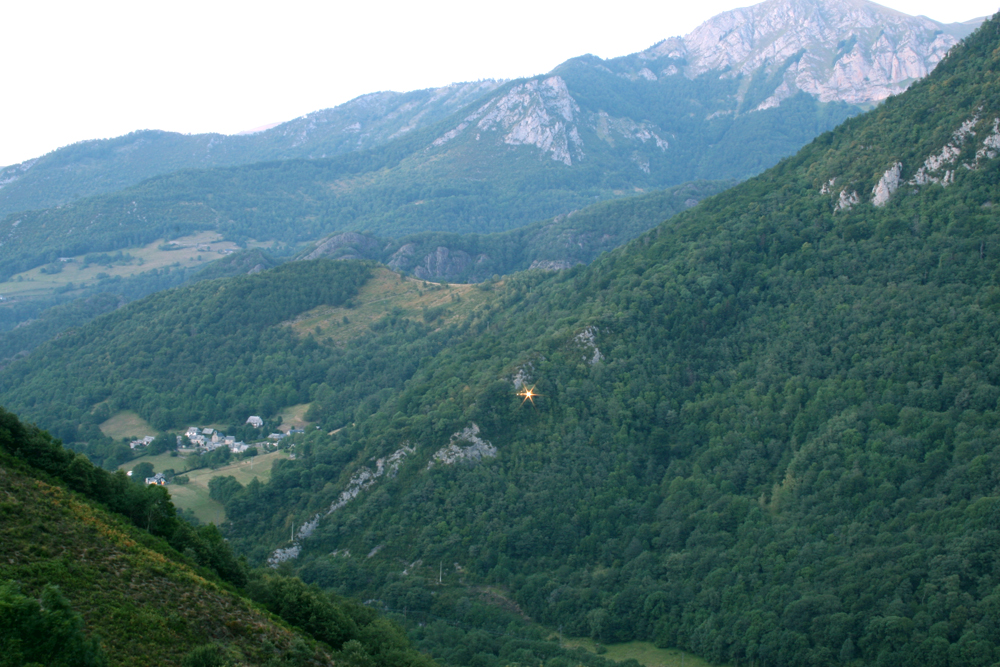
The Noisetier Cave (French: Grotte du Noisetier, lit: Hazel cave, also Grotte de Peyrère or Grotte de Serrat de la Toue), owing its popular name to the hazel trees that grow in front of its entrance, is located in a mountainside 145 m (476 ft) atop the Vallée d'Aure in the Ardengost commune, Hautes-Pyrénées department in the region Occitania, Southern France. During systematic excavations since 1992 Middle Paleolithic stone tools and artifacts attributed to the Neanderthal Mousterian culture were discovered among numerous faunal remains.
Sheltered by the Ardengost limestones which rise to 1,450 m (4,760 ft) the cave is located at 825 m (2,707 ft) above sea level on the western slopes and overlooks the Neste d'Aure river valley, a tributary of the Garonne. The cave is a sub-horizontal gallery, oriented north to south and its entrance opens towards the south. It is 20 m (66 ft) long, 3 to 4 m (9.8 to 13.1 ft) in width and 3 to 6 m (9.8 to 19.7 ft) in height.
The Grotto is entrenched within the Pyrenean Primary Axial Zone as part of the Ardengost limestone massif, that contains a rich microfauna of foraminifera, brachiopods and polyps and floral (algae) elements. The age of this formation was revised during the 2004 excavation based on this paleontological content and re-dated within the Carboniferous from the upper Visean to the Serpukhovian at around 300 Million years ago. The calcareous particles of these organic components supported the formation of micrite mud, a limestone constituent that enabled the development of the local karst.
The presence of paleo-human remains in the cave was first suggested in 1898 by Armand Viré but only in 1985 it was visited again by caver E. Casteret who reported to the Regional Archaeology Service of the Midi-Pyrénées department. An initial survey operation was conducted in 1987 under the direction of Michel Allard in order to investigate the extent and impact of decades of illegal levies. Two field sessions in 1992 and 1993 were undertaken to assess the archaeological significance of the site and to determine appropriate protection measures. The subsequent excavation probe of a few square meters lead to the discovery of several cultural layers, relatively rich in Mousterian lithic vestiges and faunal remains and it was determined to permanently protect the site with a strong barred gate at the entrance. This rescue campaigns's results remained mainly unpublished. In a few brief notes the site is usually presented as a temporary occupation site or hunting camp specialized on chamois (Rupicapra pyrenaica) and ibex (pyrenaica pyrenaica). In 2004, another interdisciplinary research excavation was launched at the site, that lead to a number of new discoveries, in some cases results were contrary to earlier ones. The discovery of juvenile Neanderthal teeth, for example contradicts the hunting camp hypothesis of the site.
Dates, that were obtained by the Carbon-14 dating method indicate a range between of about 30,000 and 50,000 years ago for the entire archaeological sequence. Biochronological data of microfauna and larger animals, similarity association with layers of the Combe-Grenal site allow to propose an allocation of deposits during the interglacial period between the Würm II and Würm III ice ages. Based on AMS radiocarbon dates and biochronological data, the archaeological levels are attributed to a temperate phase of the Oxygen isotope stage 3.
The stone tool industry of local raw materials from the alluvial formations of the Neste river, such as quartzites, lydites, cinerites, and schists is considered to be of a mediocre quality. Flint, as found in the cultural sediments is naturally absent in the immediate environment and must have been imported from several sources. The most exploited flint quarry is the Montagaillard flysch, located 40 km (25 mi) away in the Hibarette community of the Montgaillard region. This flysch flint is of good quality and is found in slabs of different sizes. The presence of Lepidorbitoid fossils in some flints indicates even more distant sources located in the Béarn province, more than 100 km (62 mi) away. Apparently, the flint outcrops of the Petites Pyrénées to the northeast were not used
The tooling is simple and consists mainly of scrapers and denticulates, the execution is often incomplete and irregular. The main production method is the discoid bifacial breakdown. Tools and products of full Levallois debitage, debris, by-products and retouching shards are present in large numbers, as are sandstone and granite hammering tools, although in smaller numbers. The Levallois technique is also attested on quartzite, schist or lydite cutting devices, regular parallel surface products and faceted heels. Noteworthy is the discovery of a two-sided cleaver.
Noisetier Cave has yielded more than 10,000 fossils of large animals and an additional 80,000 determinable remains of small rodents. Dominant are mountain species, especially chamois (Rupicapra pyrenaica) and ibex (Capra pyrenaica pyrenaica) followed by deer and large bovines. Moderate amounts of carnivore fossils of cave bear (Ursus spelaeus), red fox (Vulpes vulpes), leopard and dhole (Cuon alpinus) are documented.
Hub AI
Noisetier Cave AI simulator
(@Noisetier Cave_simulator)
Noisetier Cave
The Noisetier Cave (French: Grotte du Noisetier, lit: Hazel cave, also Grotte de Peyrère or Grotte de Serrat de la Toue), owing its popular name to the hazel trees that grow in front of its entrance, is located in a mountainside 145 m (476 ft) atop the Vallée d'Aure in the Ardengost commune, Hautes-Pyrénées department in the region Occitania, Southern France. During systematic excavations since 1992 Middle Paleolithic stone tools and artifacts attributed to the Neanderthal Mousterian culture were discovered among numerous faunal remains.
Sheltered by the Ardengost limestones which rise to 1,450 m (4,760 ft) the cave is located at 825 m (2,707 ft) above sea level on the western slopes and overlooks the Neste d'Aure river valley, a tributary of the Garonne. The cave is a sub-horizontal gallery, oriented north to south and its entrance opens towards the south. It is 20 m (66 ft) long, 3 to 4 m (9.8 to 13.1 ft) in width and 3 to 6 m (9.8 to 19.7 ft) in height.
The Grotto is entrenched within the Pyrenean Primary Axial Zone as part of the Ardengost limestone massif, that contains a rich microfauna of foraminifera, brachiopods and polyps and floral (algae) elements. The age of this formation was revised during the 2004 excavation based on this paleontological content and re-dated within the Carboniferous from the upper Visean to the Serpukhovian at around 300 Million years ago. The calcareous particles of these organic components supported the formation of micrite mud, a limestone constituent that enabled the development of the local karst.
The presence of paleo-human remains in the cave was first suggested in 1898 by Armand Viré but only in 1985 it was visited again by caver E. Casteret who reported to the Regional Archaeology Service of the Midi-Pyrénées department. An initial survey operation was conducted in 1987 under the direction of Michel Allard in order to investigate the extent and impact of decades of illegal levies. Two field sessions in 1992 and 1993 were undertaken to assess the archaeological significance of the site and to determine appropriate protection measures. The subsequent excavation probe of a few square meters lead to the discovery of several cultural layers, relatively rich in Mousterian lithic vestiges and faunal remains and it was determined to permanently protect the site with a strong barred gate at the entrance. This rescue campaigns's results remained mainly unpublished. In a few brief notes the site is usually presented as a temporary occupation site or hunting camp specialized on chamois (Rupicapra pyrenaica) and ibex (pyrenaica pyrenaica). In 2004, another interdisciplinary research excavation was launched at the site, that lead to a number of new discoveries, in some cases results were contrary to earlier ones. The discovery of juvenile Neanderthal teeth, for example contradicts the hunting camp hypothesis of the site.
Dates, that were obtained by the Carbon-14 dating method indicate a range between of about 30,000 and 50,000 years ago for the entire archaeological sequence. Biochronological data of microfauna and larger animals, similarity association with layers of the Combe-Grenal site allow to propose an allocation of deposits during the interglacial period between the Würm II and Würm III ice ages. Based on AMS radiocarbon dates and biochronological data, the archaeological levels are attributed to a temperate phase of the Oxygen isotope stage 3.
The stone tool industry of local raw materials from the alluvial formations of the Neste river, such as quartzites, lydites, cinerites, and schists is considered to be of a mediocre quality. Flint, as found in the cultural sediments is naturally absent in the immediate environment and must have been imported from several sources. The most exploited flint quarry is the Montagaillard flysch, located 40 km (25 mi) away in the Hibarette community of the Montgaillard region. This flysch flint is of good quality and is found in slabs of different sizes. The presence of Lepidorbitoid fossils in some flints indicates even more distant sources located in the Béarn province, more than 100 km (62 mi) away. Apparently, the flint outcrops of the Petites Pyrénées to the northeast were not used
The tooling is simple and consists mainly of scrapers and denticulates, the execution is often incomplete and irregular. The main production method is the discoid bifacial breakdown. Tools and products of full Levallois debitage, debris, by-products and retouching shards are present in large numbers, as are sandstone and granite hammering tools, although in smaller numbers. The Levallois technique is also attested on quartzite, schist or lydite cutting devices, regular parallel surface products and faceted heels. Noteworthy is the discovery of a two-sided cleaver.
Noisetier Cave has yielded more than 10,000 fossils of large animals and an additional 80,000 determinable remains of small rodents. Dominant are mountain species, especially chamois (Rupicapra pyrenaica) and ibex (Capra pyrenaica pyrenaica) followed by deer and large bovines. Moderate amounts of carnivore fossils of cave bear (Ursus spelaeus), red fox (Vulpes vulpes), leopard and dhole (Cuon alpinus) are documented.
Recent media