


Community hub
Recent from talks
Contribute something
Nothing was collected or created yet.
Cave bear
View on Wikipedia
| Cave bear Temporal range: Middle to Late Pleistocene,
| |
|---|---|

| |
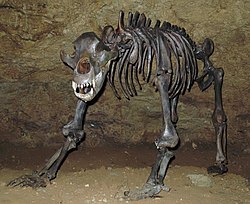
| Mounted cave bear skeleton at Devil's Cave, Germany | |
Scientific classification 
| |
| Kingdom: | Animalia |
| Phylum: | Chordata |
| Class: | Mammalia |
| Order: | Carnivora |
| Family: | Ursidae |
| Subfamily: | Ursinae |
| Genus: | Ursus |
| Species: | †U. spelaeus
|
| Binomial name | |
| †Ursus spelaeus Rosenmüller, 1794
| |
The cave bear (Ursus spelaeus) is a prehistoric species of bear that lived in Europe and Asia during the Pleistocene and became extinct about 24,000 years ago during the Last Glacial Maximum.
The common and scientific name for the species comes from their remains having been largely been found caves. This reflects the views of experts that cave bears spent more time in caves than the brown bear, frequently using them to hibernate during the winter months. Unlike brown bears, cave bears are thought to have been almost entirely or exclusively herbivorous.
Cave bears exhibit a great degree of size, morphological and genetic variability, and Late Pleistocene cave bears are often (though not universally) considered to be species complex of up to 6 different species.[1][2]
Taxonomy
[edit]
Cave bear skeletons were first described in 1774 by Johann Friedrich Esper, in his book Newly Discovered Zoolites of Unknown Four Footed Animals. While scientists at the time considered that the skeletons could belong to apes, canids, felids, or even dragons or unicorns, Esper postulated that they actually belonged to polar bears. Twenty years later, Johann Christian Rosenmüller, an anatomist at Leipzig University, gave the species its binomial name. The bones were so numerous that most researchers had little regard for them. During World War I, with the scarcity of phosphate dung, earth from the caves where cave bear bones occurred was used as a source of phosphates. When the "dragon caves" in Austria’s Styria region were exploited for this purpose, only the skulls and leg bones were kept.[3]
Many caves in Central Europe have skeletons of cave bears inside, such as the Heinrichshöhle in Hemer and the Dechenhöhle in Iserlohn, Germany. A complete skeleton, five complete skulls, and 18 other bones were found inside Kletno Bear Cave, in 1966 in Poland.[4] In Romania, in a cave called Bears' Cave, 140 cave bear skeletons were discovered in 1983.[5][failed verification]
Remains assigned to "cave bears" sensu lato from the Late Pleistocene exhibit a strong degree of morphological and size variability, and have often been assigned to their own species, including Ursus rossicus (Eastern Europe, Central Asia and Siberia), Ursus ingressus (Central Europe to the Urals), Ursus kanivetz, (Urals) Ursus kudarensis (the Caucasus), Ursus eremus (Central Europe, possibly a subspecies of U. spelaeus s.s.) and Ursus spelaeus sensu stricto (Western, Central and Southeast Europe).[6][2] These populations/species show considerable genetic divergence from each other, (with genetic divergences estimated at hundreds of thousands to a million years)[2] though whether these species should be regarded as synonyms of U. spelaeus is debated.[6]
Evolution
[edit]Both the cave bear and the brown bear are thought to be descended from the Early Pleistocene species Ursus etruscus.[7][8][9][10] The date of divergence between the ancestors of cave bears and brown bears has been estimated at around 1.2–1.5 million years ago.[11][2] The earliest remains of the cave bear lineage are assigned to the species Ursus deningeri (sometimes called Deninger's bear), which first appears in the fossil record at the end of the Early Pleistocene, around 1.2-0.8 million years ago.[12][6] U. deningeri is known from remains spanning from Europe to China.[13] The transition between Ursus deningeri and Ursus spelaeus is often given as the Last Interglacial (130-115,000 years ago), although the boundary between these forms is arbitrary, and intermediate or transitional taxa have been proposed, e.g. Ursus spelaeus deningeroides,[14] while other authorities consider both taxa to be chronological variants of the same species.[15]
Cave bears found anywhere will vary in age, thus facilitating investigations into evolutionary trends. The three anterior premolars were gradually reduced, then disappeared, possibly in response to a largely vegetarian diet. In a fourth of the skulls found in the Conturines, the third premolar is still present, while more derived specimens elsewhere lack it. The last remaining premolar became conjugated with the true molars, enlarging the crown and granting it more cusps and cutting borders. This phenomenon, called molarization, improved the mastication capacities of the molars, facilitating the processing of tough vegetation. This allowed the cave bear to gain more energy for hibernation, while eating less than its ancestors.[16]
In 2005, scientists recovered and sequenced the nuclear DNA of a cave bear that lived between 42,000 and 44,000 years ago. The procedure used genomic DNA extracted from one of the animal's teeth. Sequencing the DNA directly (rather than first replicating it with the polymerase chain reaction), the scientists recovered 21 cave bear genes from remains that did not yield significant amounts of DNA with traditional techniques.[17] This study confirmed and built on results from a previous study using mitochondrial DNA extracted from cave bear remains ranging from 20,000 to 130,000 years old.[11] Both show that the cave bear was more closely related to the brown bear and polar bear than it was to the American black bear, but had split from the brown bear lineage before the distinct eastern and western brown bear lineages diversified, and before the split of brown bears and polar bears..[11] However, a recent study showed that both species had some hybridization between them.[18]
Description
[edit]
The cave bear had a very broad, domed skull with a steep forehead; its stout body had long thighs, massive shins and in-turning feet, making it similar in skeletal structure to the brown bear.[19] Cave bears were comparable in size to, or larger than, the largest modern-day bears, measuring up to 2 m (6.6 ft) in length.[20] The average weight for males was 350 to 600 kg (770 to 1,320 lb),[21] while females weighed 225 to 250 kg (495 to 550 lb).[21] Of cave bear skeletons in museums, 90% are classified as male due to a misconception that the female skeletons were merely "dwarfs". Cave bears grew larger during glaciations and smaller during interglacials, probably to adjust heat loss rate.[22]
The morphology of the mandible of cave bears varied depending on climate; individuals in colder, drier, and more seasonal climates possessed more slender mandibles and a dorsoventrally smaller mandibular ramus relative to individuals living in warmer and wetter conditions.[23] Cave bears of the last Ice Age lacked the usual two or three premolars present in other bears; to compensate, the last molar is very elongated, with supplementary cusps.[24] The humerus of the cave bear was similar in size to that of the polar bear, as were the femora of females. The femora of male cave bears, however, bore more similarities in size to those of Kodiak bears.[21]
Behaviour
[edit]Dietary habits
[edit]
Cave bear teeth were very large and show greater wear than most modern bear species, suggesting a diet of tough materials. However, tubers and other gritty food, which cause distinctive tooth wear in modern brown bears, do not appear to have constituted a major part of cave bears' diets on the basis of dental microwear analysis.[25] Seed fruits are documented to have been consumed by cave bears.[26] Cave bear dental microwear from the high altitude site of Ramesch-Knochenhöhle in the Totes Gebirge indicates that some cave bears living in mountains ingested large amounts of sand as a result of feeding on alpine vegetation. The results from Ramesch-Knochenhöhle also indicate two very distinct patterns of microwear among the same subspecies, which may potentially reflect differences in feeding behaviour between male and female cave bears.[27]
The morphological features of the cave bear chewing apparatus, including loss of premolars, have long been suggested to indicate their diets displayed a higher degree of herbivory than the Eurasian brown bear.[8] Indeed, a solely vegetarian diet has been inferred on the basis of tooth morphology.[9] Results obtained on the stable isotopes of cave bear bones also point to a largely vegetarian diet in having low levels of nitrogen-15 and carbon-13, which are accumulated at a faster rate by carnivores as opposed to herbivores.[28][29][30] Among Mediterranean cave bears such as those found in Toll Cave in northeastern Spain, the particularly low δ15N values may be a result of their high intake of nitrogen-fixing plants.[31]

However, some evidence points toward the occasional inclusion of animal protein in cave bear diets. For example, toothmarks on cave bear remains in areas where cave bears are the only recorded potential carnivores suggests occasional cannibalistic scavenging,[32][33] possibly on individuals that died during hibernation, and dental microwear analysis indicates the cave bear may have fed on a greater quantity of bone than its contemporary, the smaller Eurasian brown bear.[34] The dental microwear patterns of cave bear molars from the northeastern Iberian Peninsula show that cave bears may have consumed more meat in the days and weeks leading up to hibernation.[35] Cave bear dental microwear from Belgium has also showed clear evidence of their omnivory during predormancy, with bone, insect, and mammal meat consumption being inferred from the microwear patterns.[36] Comparisons of the dental microwear and macrowear of brown bears and cave bears in northern Spain found that the latter were significantly more osteophagous than the former.[37] Additionally, cave bear remains from Peștera cu Oase in the southwestern tip of the Romanian part of the Carpathian Mountains had elevated levels of nitrogen-15 in their bones, indicative of omnivorous diets,[30][38][39] although the values are within the range of those found for the strictly herbivorous mammoth.[40] One stable isotopic study concluded that the degree of omnivory in cave bears was similar to that in modern brown bears.[41]
Although the current prevailing opinion concludes that cave bears were largely herbivorous, and more so than any modern species of the genus Ursus,[42] increasing evidence points to omnivorous diets, based both on regional variability of isotopic composition of bone remains indicative of dietary plasticity,[30][38] and on a recent re-evaluation of craniodental morphology that places the cave bear squarely among omnivorous modern bear species with respect to its skull and tooth shapes.[43]
Mortality
[edit]
Death during hibernation was a common end for cave bears, mainly befalling specimens that failed ecologically during the summer season through inexperience, sickness or old age.[44] Some cave bear bones show signs of numerous ailments, including spinal fusion, bone tumours, cavities, tooth resorption, necrosis (particularly in younger specimens), osteomyelitis, periostitis, rickets and kidney stones.[19] There is also evidence that cave bears suffered from tuberculosis.[45] Male cave bear skeletons have been found with broken bacula, probably due to fighting during the breeding season.[44] Cave bear longevity is unknown, though it has been estimated that they seldom exceeded twenty years of age.[46] Paleontologists doubt adult cave bears had any natural predators, save for pack-hunting wolves and cave hyenas, which would probably have attacked sick or infirm individuals.[46] Cave hyenas are thought to be responsible for the disarticulation and destruction of some cave bear skeletons. Such large carcasses were an optimal food resource for the hyenas, especially at the end of the winter, when food was scarce.[47] The presence of fully articulated adult cave lion skeletons, deep in cave bear dens, indicates the lions may have occasionally entered dens to prey on hibernating cave bears, with some dying in the attempt.[48]
Range and habitat
[edit]The cave bear's range stretched across Europe; from Spain[49] and the British Isles in the west,[42] Belgium,[50] Italy,[51] parts of Germany,[52] Poland,[53] the Czech Republic,[54][55] the Balkans,[56][57] Romania,[58][59] Georgia, and parts of Russia,[60] including the Caucasus; and northern Iran.[61] No traces of cave bears have been found in the northern British Isles, Scandinavia or the Baltic countries, which were all covered in extensive glaciers at the time. The largest numbers of cave bear remains have been found in Austria, Switzerland, northern Italy, northern Spain, southern France, and Romania, roughly corresponding with the Pyrenees, Alps, and Carpathians. The huge number of bones found in southern, central and eastern Europe has led some scientists to think Europe may have once had herds of cave bears. Others, however, point out that, though some caves have thousands of bones, they were accumulated over a period of 100,000 years or more, thus requiring only two deaths in a cave per year to account for the large numbers.[46]
The cave bear inhabited low mountainous areas, especially in regions rich in limestone caves. They seem to have avoided open plains, preferring forested or forest-edged terrains.[46]
Relationship with humans
[edit]
Cave bear and brown bear remains that are modified by Neanderthals to be used as tools have been found in various regions across Europe, indicating the exploitation of bear carcasses by Paleolithic humans.[62][63][64] Probable evidence of Neanderthals' opportunistic hunting and/or competition against cave bears and brown bears have also been reported.[65][66]
Between the years 1917 and 1923, the Drachenloch cave in Switzerland was excavated by Emil Bächler. The excavation uncovered more than 30,000 cave bear skeletons. It also uncovered a stone chest or cist, consisting of a low wall built from limestone slabs near a cave wall with a number of bear skulls inside it. A cave bear skull was also found with a femur bone from another bear stuck inside it. Scholars speculated that it was proof of prehistoric human religious rites involving the cave bear, or that the Drachenloch cave bears were hunted as part of a hunting ritual, or that the skulls were kept as trophies.[67] In Archaeology, Religion, Ritual (2004), archaeologist Timothy Insoll strongly questions whether the Drachenloch finds in the stone cist were the result of human interaction. Insoll states that the evidence for religious practices involving cave bears in this time period is "far from convincing". Insoll also states that comparisons with the religious practices involving bears that are known from historic times are invalid.[68]
A similar phenomenon was encountered in Regourdou, southern France. A rectangular pit contained the remains of at least twenty bears, covered by a massive stone slab. The remains of a Neanderthal lay nearby in another stone pit, with various objects, including a bear humerus, a scraper, a core, and some flakes, which were interpreted as grave offerings.[69]
An unusual discovery in a deep chamber of Basura Cave in Savona, Italy, is thought to be related to cave bear worship, because there is a vaguely zoomorphic stalagmite surrounded by clay pellets. It is thought to have been used by Neanderthals for a ceremony; bear bones scattered on the floor further suggests it was likely to have had some sort of ritual purpose.[70]
Extinction
[edit]
Reassessment of fossils in 2019 indicate that the cave bear probably died out 24,000 years ago.[71] A complex set of factors, rather than a single factor, are suggested to have led to the extinction.[72]
Compared with other megafaunal species that also became extinct during the Last Glacial Maximum, the cave bear was believed to have had a more specialized diet of high-quality plants and a relatively restricted geographical range. This was suggested as an explanation as to why it died out so much earlier than the rest.[42] Some experts have disputed this claim, as the cave bear had survived multiple climate changes prior to extinction. Additionally, mitochondrial DNA research indicated that the genetic decline of the cave bear began long before it became extinct, demonstrating habitat loss due to climate change was not responsible.[72] Finally, high δ15N levels were found in cave bear bones from Romania, indicating wider dietary possibilities than previously believed.[30]

Some evidence indicates that the cave bear used only caves for hibernation and was not inclined to use other locations, such as thickets, for this purpose, in contrast to the more versatile brown bear. This specialized hibernation behavior would have caused a high winter mortality rate for cave bears that failed to find available caves. Therefore, as human populations slowly increased, the cave bear faced a shrinking pool of suitable caves, and slowly faded away to extinction, as both Neanderthals and anatomically modern humans sought out caves as living quarters, depriving the cave bear of vital habitat. This hypothesis is being researched as of 2010[update]. According to the research study, published in the journal Molecular Biology and Evolution, radiocarbon dating of the fossil remains shows that the cave bear ceased to be abundant in Central Europe around 35,000 years ago.[73]
In addition to environmental change, human hunting has also been implicated in the ultimate extinction of the cave bear.[74] In 2019, the results of a large scale study of 81 bone specimens (resulting in 59 new sequences) and 64 previously published complete mitochondrial genomes of cave bear mitochondrial DNA remains found in Switzerland, Poland, France, Spain, Germany, Italy and Serbia, indicated that the cave bear population drastically declined starting around 40,000 years ago at the onset of the Aurignacian, coinciding with the arrival of anatomically modern humans.[75][76] It was concluded that human hunting and/or competition played a major role in their decline and ultimate disappearance, and that climate change was not likely to have been the dominant factor.[76] In a study of Spanish cave bear mtDNA, each cave used by cave bears was found to contain almost exclusively a unique lineage of closely related haplotypes, indicating a homing behaviour for birthing and hibernation. The conclusion of this study is cave bears could not easily colonize new sites when in competition with humans for these resources.[77]
Overhunting by humans has been dismissed by some as human populations at the time were too small to pose a serious threat to the cave bear's survival. However, the two species may have competed for living space in caves.[46][72] The Chauvet Cave contains around 300 "bear hollows" created by cave bear hibernation.[78] Unlike brown bears, cave bears are seldom represented in cave paintings, leading some experts to believe the cave bear may have been avoided by human hunters[79] or their habitat preferences may not have overlapped. Paleontologist Björn Kurtén hypothesized cave bear populations were fragmented and under stress even before the advent of the glaciers.[46] Populations living south of the Alps possibly survived significantly longer.[42]
See also
[edit]References
[edit]- ^ Knapp, Michael (2019-04-21). "From a molecules' perspective – contributions of ancient DNA research to understanding cave bear biology". Historical Biology. 31 (4): 442–447. Bibcode:2019HBio...31..442K. doi:10.1080/08912963.2018.1434168. ISSN 0891-2963.
- ^ a b c d Barlow, Axel; Paijmans, Johanna L.A.; Alberti, Federica; Gasparyan, Boris; Bar-Oz, Guy; Pinhasi, Ron; Foronova, Irina; Puzachenko, Andrey Y.; Pacher, Martina; Dalén, Love; Baryshnikov, Gennady; Hofreiter, Michael (2021-04-26). "Middle Pleistocene genome calibrates a revised evolutionary history of extinct cave bears". Current Biology. 31 (8): 1771–1779.e7. Bibcode:2021CBio...31E1771B. doi:10.1016/j.cub.2021.01.073. PMID 33592193.
- ^ Bernd Brunner (2007). Bears: A Brief History. Yale University Press. p. 41. ISBN 978-0-300-12299-2.
- ^ Praca Zbiorowa (1989). Jaskinia Niedźwiedzia w Kletnie. Badanie i udostępnianie (in Polish). Wrocław: Polska Akademia Nauk, Ossolineum. ISBN 8304030373. with summary (in English)
- ^ Cave Bears. Jan Kowalski. psu.edu
- ^ a b c Galdies, Johann (2022-03-01). "The bears of the European steppe: a review". Quaternaire. 33 (1): 47–62. doi:10.4000/quaternaire.16605. ISSN 1142-2904. Retrieved 2025-02-07.
- ^ Gimranov, Dmitry; Lavrov, Alexander; Prat-Vericat, Maria; Madurell-Malapeira, Joan; Lopatin, Alexey V. (2023-06-03). "Ursus etruscus from the late Early Pleistocene of the Taurida сave (Crimean Peninsula)". Historical Biology. 35 (6): 843–856. Bibcode:2023HBio...35..843G. doi:10.1080/08912963.2022.2067993. ISSN 0891-2963.
- ^ a b Kurtén, B. (1976). The Cave Bear Story: Life and death of a vanished animal. New York, NY: Columbia University Press.
- ^ a b Rabeder G, Nagel D, Pacher M (2000). Der Höhlenbär. Species 4. Stuttgart, DE: Thorbecke Verlag.
- ^ Argant A, Crégut-Bonnoure E (1996). "Famille des Ursidae". In Guérin, C., Patou-Mathis, M. (eds.). Les grands mammiferes Plio-Pleistocenes d'Europe. Paris, FR: Masson. pp. 167–177.
- ^ a b c Loreille, O.; et al. (2001). "Ancient DNA analysis reveals divergence of the cave bear, Ursus spelaeus, and brown bear, Ursus arctos, lineages". Current Biology. 11 (3): 200–203. Bibcode:2001CBio...11..200L. doi:10.1016/S0960-9822(01)00046-X. PMID 11231157.
- ^ van Heteren, Anneke H.; Arlegi, Mikel; Santos, Elena; Arsuaga, Juan-Luis; Gómez-Olivencia, Asier (2019-04-21). "Cranial and mandibular morphology of Middle Pleistocene cave bears ( Ursus deningeri ): implications for diet and evolution". Historical Biology. 31 (4): 485–499. doi:10.1080/08912963.2018.1487965. ISSN 0891-2963.
- ^ Jiangzuo, Qigao; Wagner, Jan; Chen, Jin; Dong, Cuiping; Wei, Jianhua; Ning, Juan; Liu, Jinyi (1 November 2018). "Presence of the Middle Pleistocene cave bears in China confirmed – Evidence from Zhoukoudian area". Quaternary Science Reviews. 199: 1–17. Bibcode:2018QSRv..199....1J. doi:10.1016/j.quascirev.2018.09.012.
- ^ Argant, A. (1991). "Carnivores quaternaires de Bourgogne". Documents des Laboratoires de Géologie de la Faculté des Sciences de Lyon. 115: 1–301.
- ^ Mazza, P.; Rustioni, M. (1994). "On the phylogeny of Eurasian bears". Palaeontographica Abteilung A. 230 (1–3): 1–32. Bibcode:1994PalAA.230....1M. doi:10.1127/pala/230/1994/1. S2CID 247508689.
- ^ "Gli orsi spelèi delle Conturines / Ursus Spelaeus". Altabadia.it. Retrieved 26 September 2011.
- ^ Noonan, James P.; et al. (2005). "Genomic Sequencing of Pleistocene Cave Bears". Science. 309 (5734): 597–599. Bibcode:2005Sci...309..597N. doi:10.1126/science.1113485. OSTI 860974. PMID 15933159. S2CID 34704597.
- ^ Barlow, Axel; Cahill, James A.; Hartmann, Stefanie; Theunert, Christoph; Xenikoudakis, Georgios; Fortes, Gloria G.; Paijmans, Johanna L. A.; Rabeder, Gernot; Frischauf, Christine (27 August 2018). "Partial genomic survival of cave bears in living brown bears" (PDF). Nature Ecology & Evolution. 2 (10): 1563–1570. Bibcode:2018NatEE...2.1563B. doi:10.1038/s41559-018-0654-8. hdl:11392/2401130. ISSN 2397-334X. PMC 6590514. PMID 30150744.
- ^ a b Brown, Gary (1996). Great Bear Almanac. Lyons & Burford. p. 340. ISBN 1-55821-474-7.
- ^ Palmer, D., ed. (1999). The Marshall Illustrated Encyclopedia of Dinosaurs and Prehistoric Animals. London: Marshall Editions. p. 217. ISBN 1-84028-152-9.
- ^ a b c Per Christiansen (1999). "What size were Arctodus simus and Ursus spelaeus (Carnivora: Ursidae)?". Annales Zoologici Fennici. 36 (2): 93–102. JSTOR 23735739.
- ^ Macdonald, David (1992). The Velvet Claw. New York: Parkwest. p. 256. ISBN 0-563-20844-9.
- ^ Charters, Daniel; Brown, Richard P.; Abrams, Grégory; Di Modica, Kévin; Pirson, Stéphane; De Groote, Isabelle; Ghiraldi, Luca; Meloro, Carlo (3 June 2025). "Mandibular ecomorphology in the genus Ursus (Ursidae, Carnivora): relevance for the palaeoecological adaptations of cave bears ( U. spelaeus ) from Scladina cave". Historical Biology. 37 (6): 1553–1567. doi:10.1080/08912963.2024.2377703. hdl:1854/LU-01J9958FYFBSYBP56A0SSTG1N1. ISSN 0891-2963. Retrieved 17 January 2026 – via Taylor and Francis Online.
- ^ Gli orsi spelèi delle Conturines/ Ursus Spelaeus. Altabadia.it. Retrieved on 2011-09-26.
- ^ Pinto Llona, A. C., Andrews, P. & Etxeberrı´a, P. 2005: Taphonomy and Palaeoecology of Cave Bears from the Quaternary of Cantabrian Spain. Fondacio´n de Asturias/Du Pont Ibe´rica/The Natural History Museum, Grafinsa, Oviedo.
- ^ Duñó-Iglesias, Paulo; Ramírez-Pedraza, Iván; Rivals, Florent; Mirea, Ionuț-Cornel; Faur, Luchiana-Maria; Constantin, Silviu; Robu, Marius (15 February 2024). "Palaeodiet during the pre-dormancy period of MIS 3 Romanian cave bears as inferred from dental microwear analysis". Palaeogeography, Palaeoclimatology, Palaeoecology. 636 111988. Bibcode:2024PPP...63611988D. doi:10.1016/j.palaeo.2023.111988.
- ^ Münzel, Susanne C.; Rivals, Florent; Pacher, Martina; Döppes, Doris; Rabeder, Gernot; Conard, Nicholas J.; Bocherens, Hervé (7 August 2014). "Behavioural ecology of Late Pleistocene bears (Ursus spelaeus, Ursus ingressus): Insight from stable isotopes (C, N, O) and tooth microwear". Quaternary International. 339–340: 148–163. Bibcode:2014QuInt.339..148M. doi:10.1016/j.quaint.2013.10.020. Retrieved 29 September 2025 – via Elsevier Science Direct.
- ^ Bocherens, Hervé; Billiou, Daniel; Patou-Mathis, Marylène; Bonjean, Dominique; Otte, Marcel; Mariotti, André (November 1997). "Paleobiological Implications of the Isotopic Signatures ( 13 C, 15 N) of Fossil Mammal Collagen in Scladina Cave (Sclayn, Belgium)". Quaternary Research. 48 (3): 370–380. doi:10.1006/qres.1997.1927. ISSN 0033-5894. Retrieved 19 November 2025 – via Cambridge Core.
- ^ Bocherens, H.; et al. (2006). "Bears and humans in Chauvet Cave (Vallon-Pont-d'Arc, Ardeche, France): Insights from stable isotopes and radiocarbon dating of bone collagen". Journal of Human Evolution. 50 (3): 370–376. Bibcode:2006JHumE..50..370B. doi:10.1016/j.jhevol.2005.12.002. PMID 16442587.
- ^ a b c d Trinkaus, Erik; Richards, Michael P. (2008). "Reply to Grandal and Fernández: Hibernation can also cause high δ15N values in cave bears". Proceedings of the National Academy of Sciences of the United States of America. 105 (11): E15. Bibcode:2008PNAS..105E..15T. doi:10.1073/pnas.0801137105. PMC 2393794.
- ^ Ramírez-Pedraza, Iván; Tornero, Carlos; Pappa, Spyridoula; Talamo, Sahra; Salazar-García, Domingo C.; Blasco, Ruth; Rosell, Jordi; Rivals, Florent (5 April 2019). "Microwear and isotopic analyses on cave bear remains from Toll Cave reveal both short-term and long-term dietary habits". Scientific Reports. 9 (1). doi:10.1038/s41598-019-42152-7. ISSN 2045-2322. PMC 6450970. PMID 30952915. Retrieved 28 November 2025 – via Nature.
- ^ "Prehistoric Cave Bears Weren't So Cuddly After All". FOXNews. 9 January 2008. Archived from the original on 1 January 2010. Retrieved 11 January 2008.
- ^ Pacher, M. (2000). "Taphonomische Untersuchungen der Höhlenbären-Fundstellen in der Schwabenreith-Höhle bei Lunz am See (Niederösterreich)". Beiträge zur Paläontologie. 25: 11–85.
- ^ Pinto Llono, A.C. (2006). "Comparative dental microwear analysis of cave bears Ursus spelaeus Rosenmüller, 1794 and brown bears Ursus arctos Linnaeus ,1758" (PDF). Scientific Annals, School of Geology Aristotle University of Thessaloniki. Special. 98: 103–108. Archived from the original (PDF) on 2011-06-28. Retrieved 2008-01-11.
- ^ Ramírez-Pedraza, Iván; Pappa, Spyridoula; Blasco, Ruth; Arilla, Maite; Rosell, Jordi; Millán, Ferran; Maroto, Julià; Soler, Joaquim; Soler, Narcís; Rivals, Florent (20 August 2020). "Dietary habits of the cave bear from the Late Pleistocene in the northeast of the Iberian Peninsula". Quaternary International. 557: 63–69. Bibcode:2020QuInt.557...63R. doi:10.1016/j.quaint.2019.09.043. S2CID 204261124. Retrieved 4 February 2024 – via Elsevier Science Direct.
- ^ Peigné, Stéphane; Goillot, Cyrielle; Germonpré, Mietje; Blondel, Cécile; Bignon, Olivier; Merceron, Gildas (8 September 2009). "Predormancy omnivory in European cave bears evidenced by a dental microwear analysis of Ursus spelaeus from Goyet, Belgium". Proceedings of the National Academy of Sciences of the United States of America. 106 (36): 15390–15393. Bibcode:2009PNAS..10615390P. doi:10.1073/pnas.0907373106. ISSN 0027-8424. PMC 2741261. PMID 19706401.
- ^ Pinto-Llona, Ana C. (15 January 2013). "Macrowear and occlusal microwear on teeth of cave bears Ursus spelaeus and brown bears Ursus arctos: Inferences concerning diet". Palaeogeography, Palaeoclimatology, Palaeoecology. 370: 41–50. doi:10.1016/j.palaeo.2012.11.017. Retrieved 4 November 2025 – via Elsevier Science Direct.
- ^ a b Richards, Michael P.; Pacher, Martina; Stiller, Mathias; Quilès, Jérôme; Hofreiter, Michael; Constantin, Silviu; Zilhão, João; Trinkaus, Erik (15 January 2008). "Isotopic evidence for omnivory among European cave bears: Late Pleistocene Ursus spelaeus from the Pestera cu Oase, Romania". Proceedings of the National Academy of Sciences of the United States of America. 105 (2): 600–604. Bibcode:2008PNAS..105..600R. doi:10.1073/pnas.0711063105. PMC 2206582. PMID 18187577.
- ^ Robu, Marius; Wynn, Jonathan G.; Mirea, Ionuţ C.; Petculescu, Alexandru; Kenesz, Marius; Puşcaş, Cristina M.; Vlaicu, Marius; Trinkaus, Erik; Constantin, Silviu (10 November 2017). O'Regan, Hannah (ed.). "The diverse dietary profiles of MIS 3 cave bears from the Romanian Carpathians: insights from stable isotope (δ 13 C and δ 15 N) analysis". Palaeontology. 61 (2): 209–219. doi:10.1111/pala.12338. ISSN 0031-0239. Retrieved 24 March 2024 – via Wiley Online Library.
- ^ Bocherens, H. 2003: Isotopic biogeochemistry and the paleoecology of the mammoth steppe fauna. In Reumer, F., Braber, F., Mol, D. & de Vos, J. (eds.): Advances in Mammoth Research, 57–76. Deinsea 9.
- ^ Robu, Marius; Fortin, Jennifer K.; Richards, Michael P.; Schwartz, Charles C.; Wynn, Jonathan G.; Robbins, Charles T.; Trinkaus, Erik (13 February 2013). "Isotopic evidence for dietary flexibility among European Late Pleistocene cave bears ( Ursus spelaeus )". Canadian Journal of Zoology. 91 (4): 227–234. Bibcode:2013CaJZ...91..227R. doi:10.1139/cjz-2012-0222. ISSN 0008-4301. Retrieved 13 January 2024.
- ^ a b c d Pacher M.; Stuart A.J. (2009). "Extinction chronology and palaeobiology of the cave bear (Ursus spelaeus)". Boreas. 38 (2): 189–206. Bibcode:2009Borea..38..189P. doi:10.1111/j.1502-3885.2008.00071.x. S2CID 128603825.
- ^ Figueirido, B.; et al. (2009). "Ecomorphological correlates of craniodental variation in bears and paleobiological implications for extinct taxa: an approach based on geometric morphometrics". Journal of Zoology. 277 (1): 70–80. doi:10.1111/j.1469-7998.2008.00511.x.
- ^ a b Kurten, Bjorn (1968). Pleistocene Mammals of Europe. New Brunswick, N.J.: AldineTransaction. p. 325. ISBN 0-202-30953-3.
- ^ Marciszak, Adrian; Mackiewicz, Paweł; Borówka, Ryszard K.; Capalbo, Chiara; Chibowski, Piotr; Gąsiorowski, Michał; Hercman, Helena; Cedro, Bernard; Kropczyk, Aleksandra; Gornig, Wiktoria; Moska, Piotr; Nowakowski, Dariusz; Ratajczak-Skrzatek, Urszula; Sobczyk, Artur; Sykut, Maciej T.; Zarzecka-Szubińska, Katarzyna; Kovalchuk, Oleksandr; Barkaszi, Zoltán; Stefaniak, Krzysztof; Mazza, Paul P. A. (29 April 2024). "Fate and preservation of the Late Pleistocene cave bears from Niedźwiedzia Cave in Poland, through taphonomy, pathology, and geochemistry". Scientific Reports. 14 (1) 9775. Bibcode:2024NatSR..14.9775M. doi:10.1038/s41598-024-60222-3. ISSN 2045-2322. PMC 11059340. PMID 38684693.
- ^ a b c d e f Bieder, Robert (2005). Bear. London: Reaktion Books. p. 192. ISBN 1-86189-204-7.
- ^ "Prey deposits and den sites of the Upper Pleistocene hyena Crocuta crocuta spelaea (Goldfuss, 1823)in horizontal and vertical caves of the Bohemian Karst" (PDF). CAJUSG. DIEDRICH & KARELŽÁK. Retrieved 2008-01-20.[permanent dead link]
- ^ 15th International Cave Bear Symposium – Spišská Nová Ves, Slovakia Archived March 31, 2010, at the Wayback Machine. 17–20 September 2009. (PDF). Retrieved on 2011-09-26.
- ^ Rodríguez-Almagro, Manuel; Gómez-Olivencia, Asier; Villalba de Alvarado, Mónica; Arsuaga, Juan Luis; Sala, Nohemi (January 2024). "Taphonomic study of the cave bears (Ursus cf. deningeri and U. spelaeus) from the Sima I of the El Polvorín cave (Northern Iberian Peninsula)". Quaternary Science Advances. 13 100171. Bibcode:2024QSAdv..1300171R. doi:10.1016/j.qsa.2024.100171.
- ^ Bray, Fabrice; Flament, Stéphanie; Abrams, Grégory; Bonjean, Dominique; Rolando, Christian; Tokarski, Caroline; Auguste, Patrick (19 June 2022). "Extinct species identification from late middle Pleistocene and earlier Upper Pleistocene bone fragments and tools not recognizable from their osteomorphological study by an enhanced proteomics protocol". Archaeometry. 65 (1): 196–212. doi:10.1111/arcm.12800. hdl:20.500.12210/77657. ISSN 0003-813X. Retrieved 13 May 2024 – via Wiley Online Library.
- ^ Martini, Ivan; Coltorti, Mauro; Mazza, Paul P.A.; Rustioni, Marco; Sandrelli, Fabio (January 2014). "The latest Ursus spelaeus in Italy, a new contribution to the extinction chronology of the cave bear". Quaternary Research. 81 (1): 117–124. Bibcode:2014QuRes..81..117M. doi:10.1016/j.yqres.2013.10.003. ISSN 0033-5894. Retrieved 3 May 2024 – via Cambridge Core.
- ^ Münzel, Susanne C.; Stiller, Mathias; Hofreiter, Michael; Mittnik, Alissa; Conard, Nicholas J.; Bocherens, Hervé (6 December 2011). "Pleistocene bears in the Swabian Jura (Germany): Genetic replacement, ecological displacement, extinctions and survival". Quaternary International. 245 (2): 225–237. Bibcode:2011QuInt.245..225M. doi:10.1016/j.quaint.2011.03.060. Retrieved 3 May 2024 – via Elsevier Science Direct.
- ^ Baca, Mateusz; Popović, Danijela; Stefaniak, Krzysztof; Marciszak, Adrian; Urbanowski, Mikołaj; Nadachowski, Adam; Mackiewicz, Paweł (11 October 2016). "Retreat and extinction of the Late Pleistocene cave bear (Ursus spelaeus sensu lato)". The Science of Nature. 103 (11–12) 92. Bibcode:2016SciNa.103...92B. doi:10.1007/s00114-016-1414-8. ISSN 0028-1042. PMC 5059403. PMID 27730265.
- ^ Cermak, S.; Tásler, R. (2013). Bear Cave in the Eastern Krkonoše Mts (Czech Republic), a Preliminary report. Opera Corcontica. 50: 227–233.
- ^ Sabol, M. (2014). Basic population and taphonomic analysis of bear assemblages from Za Hájovnou Cave (Moravia, the Czech Republic): a fossil record from 1987 – 2007. Fossil Imprint / Acta Musei Nationalis Pragae, Series B – Historia Naturalis Praha: Národní muzeum. 70 (1-2): 91-102.
- ^ Cvetković, Nevena J.; Dimitrijević, Vesna M. (7 August 2014). "Cave bears (Carnivora, Ursidae) from the Middle and Late Pleistocene of Serbia: A revision". Quaternary International. 339–340: 197–208. Bibcode:2014QuInt.339..197C. doi:10.1016/j.quaint.2013.10.045. Retrieved 3 May 2024 – via Elsevier Science Direct.
- ^ Seetah, T. Krish; Cardini, Andrea; Miracle, Preston T. (February 2012). "Can morphospace shed light on cave bear spatial-temporal variation? Population dynamics of Ursus spelaeus from Romualdova pećina and Vindija, (Croatia)". Journal of Archaeological Science. 39 (2): 500–510. Bibcode:2012JArSc..39..500S. doi:10.1016/j.jas.2011.10.005. hdl:11380/776310. Retrieved 3 May 2024 – via Elsevier Science Direct.
- ^ Quilès, Jérôme; Petrea, Catalin; Moldovan, Oana; Zilhão, João; Rodrigo, Ricardo; Rougier, Hélène; Constantin, Silviu; Milota, Ştefan; Gherase, Mircea; Sarcină, Laurenţiu; Trinkaus, Erik (December 2006). "Cave bears (Ursus spelaeus) from the Peştera cu Oase (Banat, Romania): Paleobiology and taphonomy". Comptes Rendus Palevol. 5 (8): 927–934. Bibcode:2006CRPal...5..927Q. doi:10.1016/j.crpv.2006.09.005. Retrieved 3 May 2024 – via Elsevier Science Direct.
- ^ Bojar, Ana-Voica; Piotrowska, Natalia; Barbu, Victor; Bojar, Hans-Peter; Pawełczyk, Fatima; Smeu, Andrei; Guja, Ovidiu (24 July 2024). "Ursus spelaeus (Rosenmüller, 1794) during the MIS 3: new evidence from the Cioclovina Uscată Cave and radiocarbon age overview for the Carpathians*". Isotopes in Environmental and Health Studies. 61 (1): 101–113. doi:10.1080/10256016.2024.2376730. ISSN 1025-6016. PMID 39049521.
- ^ Kosintsev, P.A.; Gasilin, V.V.; Gimranov, D.O.; Bachura, O.P. (28 October 2016). "Carnivores (Mammalia, Carnivora) of the Urals in the Late Pleistocene and Holocene". Quaternary International. 420: 145–155. Bibcode:2016QuInt.420..145K. doi:10.1016/j.quaint.2015.10.089. Retrieved 3 May 2024 – via Elsevier Science Direct.
- ^ Amiri, S.; Biglari, F.; Argant, A.; Crégut-Bonnoure, E.; Mohaseb, A. F.; Noseda, A.; Moradi Bistouni, A.; Mashkour, M. (November 2022). "The Pleistocene Biodiversity of the Zagros Mountains: Carnivores of the Chenar Cave (Kermanshah- Iran)". ASWA Archaeozoology of SouthWest Asia and Adjacent Areas. Tokyo Japan. Tokyo, Japan.
- ^ Abrams, G.; Bello, S.M.; Modica, K.D.; Pirson, S.; Bonjean, D. (2014). "When Neanderthals used cave bear (Ursus spelaeus) remains: Bone retouchers from unit 5 of Scladina Cave (Belgium)". Quaternary International. 326–327: 274–287. Bibcode:2014QuInt.326..274A. doi:10.1016/j.quaint.2013.10.022.
- ^ Toniato, G.; Russo, G.; Verheijen, I.; Serangeli, J.; Conard, N.J.; Leder, D.; Terberger, T.; Starkovich, B.M.; Münzel, S.C. (2024). "A diachronic study of human-bear interactions: An overview of ursid exploitation during the Paleolithic of Germany". Quaternary Science Reviews. 333 108601. Bibcode:2024QSRv..33308601T. doi:10.1016/j.quascirev.2024.108601.
- ^ Lateur, N.; Daujeard, C.; Fourvel, J.-P.; Moncel, M.-H. (2024). "Evidence of bears exploitation by early Neanderthals at the middle pleistocene site of payre (MIS 8-6, Southeastern France)". Quaternary Science Reviews. 332 108653. Bibcode:2024QSRv..33208653L. doi:10.1016/j.quascirev.2024.108653.
- ^ Münzel, S.C.; Conard, N.J. (2004). "Cave bear hunting in the Hohle Fels, a cave site in the Ach Valley, Swabian Jura". Revue de Paléobiologie, Genève. 23 (2): 877–885. ISSN 0253-6730.
- ^ Romandini, M.; Terlato, G.; Nannini, N.; Tagliacozzo, A.; Benazzi, S.; Peresani, M. (2018). "Bears and humans, a Neanderthal tale. Reconstructing uncommon behaviors from zooarchaeological evidence in southern Europe". Journal of Archaeological Science. 90: 71–91. Bibcode:2018JArSc..90...71R. doi:10.1016/j.jas.2017.12.004. hdl:11392/2381729.
- ^ "Caves of Switzerland: Drachenloch". Archived from the original on 2013-05-08. Retrieved 2013-04-10.
- ^ Insoll, Timothy, Archaeology, Religion, Ritual (2004), Routledge (London), ISBN 0415253136
- ^ Cavanhié, N. (2010). "L'ours qui a vu l'homme ? Étude archéozoologique et taphonomique du site paléolithique moyen de Regourdou (Montignac, Dordogne, France)". Paléo. 21: 39–63. doi:10.4000/paleo.1742.
- ^ B.G. Campbell; J.D. Loy (1996). Humankind emerging (7th ed.). New York: HarperCollins. pp. 440–441. ISBN 0-673-52364-0.
- ^ Terlato, Gabriele; Bocherens, Hervé; Romandini, Matteo; Nannini, Nicola; Hobson, Keith A.; Peresani, Marco (21 April 2019). "Chronological and Isotopic data support a revision for the timing of cave bear extinction in Mediterranean Europe". Historical Biology. 31 (4): 474–484. Bibcode:2019HBio...31..474T. doi:10.1080/08912963.2018.1448395. ISSN 0891-2963. S2CID 90029163.
- ^ a b c Stiller, Mathias; et al. (2010). "Withering Away—25,000 Years of Genetic Decline Preceded Cave Bear Extinction". Molecular Biology and Evolution. 27 (5): 975–978. doi:10.1093/molbev/msq083. PMID 20335279.
- ^ "True Causes for Extinction of Cave Bear Revealed: More Human Expansion Than Climate Change". ScienceDaily. Plataforma SINC. 25 August 2010.
- ^ Mondanaro, Alessandro; Di Febbraro, Mirko; Melchionna, Marina; Carotenuto, Francesco; Castiglione, Silvia; Serio, Carmela; Danisi, Simone; Rook, Lorenzo; Diniz-Filho, Jose Alexandre F.; Raia, Pasquale (9 February 2019). "Additive effects of climate change and human hunting explain population decline and extinction in cave bears". Boreas. 48 (3): 605–615. Bibcode:2019Borea..48..605M. doi:10.1111/bor.12380. ISSN 0300-9483. Retrieved 15 March 2024 – via Wiley Online Library.
- ^ Briggs, Helen (16 August 2019). "Extinction: Humans played big role in demise of the cave bear". BBC News. Retrieved 17 August 2019.
- ^ a b Gretzinger, J.; Molak, M.; Reiter, E.; Pfrengle, S.; Urban, C.; Neukamm, J.; Blant, M.; Conard, N. J.; Cupillard, C.; Dimitrijević, V.; Drucker, D. G.; Hofman-Kamińska, E.; Kowalczyk, R.; Krajcarz, M. T.; Krajcarz, M.; Münzel, S. C.; Peresani, M.; Romandini, M.; Rufí, I.; Soler, J.; Terlato, G.; Krause, J.; Bocherens, H.; Schuenemann, V. J. (15 August 2019). "Large-scale mitogenomic analysis of the phylogeography of the Late Pleistocene cave bear". Scientific Reports. 9 (1): 10700. Bibcode:2019NatSR...910700G. doi:10.1038/s41598-019-47073-z. PMC 6695494. PMID 31417104.
- ^ Fortes, Gloria G.; Grandal-d'Anglade, Aurora; Kolbe, Ben; Fernandes, Daniel; Meleg, Ioana N.; García-Vázquez, Ana; Pinto-Llona, Ana C.; Constantin, Silviu; Torres, Trino J. de (10 August 2016). "Ancient DNA reveals differences in behaviour and sociality between brown bears and extinct cave bears" (PDF). Molecular Ecology. 25 (19): 4907–4918. Bibcode:2016MolEc..25.4907F. doi:10.1111/mec.13800. ISSN 1365-294X. PMID 27506329. S2CID 18353913.
- ^ "Bear hollows | The Chauvet-Pont d'Arc cave". archeologie.culture.gouv.fr. Retrieved 6 September 2023.
- ^ The Walking Larder: Patterns of Domestication, Pastoralism, and Predation by Juliet Clutton-Brock, published by Routledge, 1990, ISBN 0-04-445900-9
External links
[edit]

| International | |
|---|---|
| National | |
| Other | |
