


Community hub
Recent from talks
Contribute something
Nothing was collected or created yet.
OSE Class 120
View on Wikipedia| OSE Class 120 (Siemens Hellas Sprinter) | |||||||||||||||||||||||||
|---|---|---|---|---|---|---|---|---|---|---|---|---|---|---|---|---|---|---|---|---|---|---|---|---|---|
 120 030 at Thessaloniki railway station, 22 May 2016 | |||||||||||||||||||||||||
| |||||||||||||||||||||||||
| |||||||||||||||||||||||||
| |||||||||||||||||||||||||
| |||||||||||||||||||||||||
Hellenic Train Class 120, also known as Hellas Sprinter, is a class of electric locomotives operated by Hellenic Train. It is part of OSE's rolling stock. They were manufactured by Siemens and Krauss-Maffei in Germany.[1]
They are equipped with electric motors with a total power of 5000 kW and have been used in both passenger and freight trains on the Greek railways since 1999. It was the first and is currently the only class of fully electric locomotives of the Hellenic Railway Network and the main locomotives used between Athens and Thessaloniki. There are two other types of electric trains in the National Rail Network of Greece, the Siemens Desiro EMU (460 series) and the ΕΤR 470 (in service since 2022).
Origins
[edit]The HellasSprinter, strongly resembles the first generation EuroSprinter (and therefore is considered as such by many), a series of electric locomotives that also operated on the DB AG, RENFE (Serie 252) and CP (Serie 5600) networks.[1]
In 1993, with the proclamation 2002/93, the Hellenic Railways Organization (OSE) held a tender for the supply of thermal and electrical locomotives, in the general context of the modernization of the normal amplitude network, and in the middle of a program for the renewal of engines, due to operating problems of its diverse and aging fleet. The collection included 25 diesel-electric locomotives, which constituted the series A.471 (Later 220) and 6 electric locomotives. The diesel locomotives have a continuous power of 2100 kW, while the electric ones 5000 kW. OSE's goal was low maintenance costs, low fuel / electricity consumption, line protection, heating of passenger trains, execution of commercial and passenger trains at a speed of 160 km / h for diesels and 200 for the electrics and the convertibility of diesels to electrics. The winners of the competition were Siemens and Krauss-Maffei for the electrics and ABB Henschel AG (later ADtranz, now Bombardier) for the diesels.[2]
In service
[edit]The construction of the first unit was completed in 1997 and as soon as it completed its trials in Germany, it came to Greece, to be routed on the electrified line Thessaloniki - Eidomeni - Gevgelija. Another 5 units followed, and along with CFR 060-EA1-056, an electric locomotive leased from Romania, they began their service in 1998 on the said route, primarily hauling cross-border traffic into North Macedonia. Their locale extended between 2009 and 2018 towards Larissa, Domokos and eventually Athens and Piraeus. A follow-up order was delivered between 2004 and 2005, save for 120 008 which for unexplained reasons had stayed in Munich at the Siemens-Krauss Maffei workshops up to 2007, before entering service in 2008.
In 2019, with the completion of the new Piraeus-Platy line and the units being used on all Athens-Thessaloniki trains, some locomotives were painted with the new dark blue livery of TRAINOSE.[3] At the same time, in the same year, GAIAOSE announced the renovation of 120 001, 120 002, 120 003, 120 005, 120 006, 120 009, 120 013, 120 025 and 120 026.[4]
Accidents
[edit]- Sometime in 2000, unit Η564 derailed in the Paionia municipality on the Thessaloniki-Gevgelija line. Not much is known about the details of the accident but since then the unit has been placed into storage due to light accident damage.
- On 28 February 2023, three units (120 022, 120 012, 120 023)[5] were destroyed in a head-on collision near Evangelismos, Larissa just outside the Tempe Valley, in a train accident that led to the deaths of 57 people and left over 85 people injured. 120 023 was hauling an Athens to Thessaloniki InterCity train at a speed estimated to be around 140 km/h when it collided with 120 012 and 120 022 hauling an intermodal train.
Fleet details
[edit]| Key: | In service | In storage | Scrapped |
|---|
List as per 20 July 2023, note it might contain some errors.
| Original number |
Works number |
Builder | Year built | Depot allocation | Livery | Notes |
|---|---|---|---|---|---|---|
| Η561 | 20323 | Krauss-Maffei, ABB | 1997 | Menemeni, Thessaloniki | Original OSE third logo variant |
Current running number 120 001. |
| Η562 | 20324 | Krauss-Maffei, ABB | 1997 | Menemeni, Thessaloniki | Original OSE third logo variant |
Current running number 120 002. |
| Η563 | 20325 | Krauss-Maffei, ABB | 1997 | Menemeni, Thessaloniki | Original OSE third logo variant |
Current running number 120 003. |
| Η564 | 20326 | Krauss-Maffei, ABB | 1997 | Menemeni, Thessaloniki | Original OSE first logo variant |
Damaged in an accident at Paionia in 2000, has been in storage since. Due to this, it has no UIC running number and is on temporary bogies. |
| Η565 | 20327 | Krauss-Maffei, ABB | 1997 | Menemeni, Thessaloniki | Original OSE third logo variant |
Current running number 120 005. |
| Η566 | 20328 | Krauss-Maffei, ABB | 1997 | Menemeni, Thessaloniki | Original OSE third logo variant |
Current running number 120 006. |
| 120 007 | 20645 | Siemens Mobility | 2004 | Menemeni, Thessaloniki | Rail Cargo red | Currently leased to Rail Cargo Austria's local division, Rail Cargo Logistics - Goldair SA |
| 120 008 | 20646 | Siemens Mobility | 2004 | Menemeni, Thessaloniki | Original OSE
Hellenic Train logo |
Sat in storage from 2004 to 2007 in Germany before entering service in Greece the next year. |
| 120 009 | 20647 | Siemens Mobility | 2004 | Menemeni, Thessaloniki | Unknown | |
| 120 010 | 20648 | Siemens Mobility | 2004 | Menemeni, Thessaloniki | Unknown | |
| 120 011 | 20649 | Siemens Mobility | 2004 | Menemeni, Thessaloniki | Original OSE second logo variant |
Placed on temporary bogies. |
| 120 012 | 20650 | Siemens Mobility | 2004 | Menemeni, Thessaloniki | New OSE (blue) Hellenic Train logo |
Destroyed in the Tempi train disaster on 28 February 2023. |
| 120 013 | 20651 | Siemens Mobility | 2004 | Menemeni, Thessaloniki | Unknown | |
| 120 014 | 20652 | Siemens Mobility | 2004 | Menemeni, Thessaloniki | Original OSE
Hellenic Train logo |
|
| 120 015 | 20653 | Siemens Mobility | 2004 | Menemeni, Thessaloniki | Unknown | |
| 120 016 | 20654 | Siemens Mobility | 2004 | Menemeni, Thessaloniki | New OSE (blue) TrainOSE logo |
|
| 120 017 | 20655 | Siemens Mobility | 2004 | Menemeni, Thessaloniki | Unknown | |
| 120 018 | 20656 | Siemens Mobility | 2004 | Menemeni, Thessaloniki | Unknown | |
| 120 019 | 20657 | Siemens Mobility | 2004 | Menemeni, Thessaloniki | Unknown | |
| 120 020 | 20658 | Siemens Mobility | 2004 | Menemeni, Thessaloniki | New OSE (blue) TrainOSE logo |
First locomotive to wear the new TrainOSE livery since May 2019 |
| 120 021 | 20659 | Siemens Mobility | 2004 | Menemeni, Thessaloniki | New OSE (blue) TrainOSE logo |
|
| 120 022 | 20660 | Siemens Mobility | 2004 | Menemeni, Thessaloniki | Original OSE Hellenic Train logo |
Destroyed in the Tempi train disaster on 28 February 2023. |
| 120 023 | 20661 | Siemens Mobility | 2004 | Menemeni, Thessaloniki | Unknown | Destroyed in the Tempi train disaster on 28 February 2023 |
| 120 024 | 20662 | Siemens Mobility | 2004 | Menemeni, Thessaloniki | New OSE (blue)
Hellenic Train logo |
|
| 120 025 | 20663 | Siemens Mobility | 2004 | Menemeni, Thessaloniki | Unknown | |
| 120 026 | 20664 | Siemens Mobility | 2004 | Menemeni, Thessaloniki | Unknown | |
| 120 027 | 20665 | Siemens Mobility | 2004 | Menemeni, Thessaloniki | Unknown | |
| 120 028 | 20666 | Siemens Mobility | 2004 | Menemeni, Thessaloniki | New OSE (blue) Hellenic Train logo |
|
| 120 029 | 20667 | Siemens Mobility | 2004 | Menemeni, Thessaloniki | New OSE (blue) Hellenic Train logo |
|
| 120 030 | 20668 | Siemens Mobility | 2005 | Menemeni, Thessaloniki | New OSE (blue) Hellenic Train logo |
Gallery of liveries
[edit]-
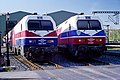 120 001 (left) and Η565 (right) with original and UIC-compliant running numbers, Menemeni Depot, 2005
 -
 120 006 (then H566) with the original OSE livery, Thessaloniki, 2002
 -
 120 016 with the revised OSE livery (noticing two variations of the new OSE logo) having arrived with a train from Belgrade at Thessaloniki, 2008
 -
 H564 placed in long term storage after the accident in Paionia, Menemeni, 2016
 -
 120 022 with the original livery and Hellenic Train logos at Athens station a few months prior to the accident at Tempi, 2023
 -
 120 030 with the new TRAINOSE blue livery, 2020
 -
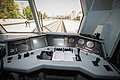 View of the drivers controls
 -
 120 030 With the Hellenic Train Blue Livery at Tithorea Station. 2024
.jpg)


See also
[edit]
- EuroSprinter
- CP Class 5600 similar locomotives built at the same time for the Portuguese railways, operating only on 25 kV AC
- Renfe Class 252 Similar locomotives built from 1991-1996 for the Spanish Railways
References
[edit]
- ^ a b "Η πρώτη ηλεκτράμαξα των σιδηροδρόμων μας" [The first electric train of our railways]. Σιδηροτροχιά (Siderotrochia) (in Greek) (15). Σύλλογος Φίλων Σιδηροδρόμων (Σ.Φ.Σ.) (Railway Friends Club): 13. July 1997.
- ^ Maganaris, Giannis (July 1997). "θερμοηλεκτρικές και ηλεκτρικές ελκτικές μονάδες με τριφασικούς ασύγχρονους ηλεκτροκινητήρες έλξης, μια επιλογή του ΟΣΕ με τεχνολογία του 2000. (Thermoelectric and electric locomotives with three-phase asynchronous traction motors, a selection of OSE with 2000 technology.)". Σιδηροτροχιά (Sidirotrochia).
- ^ "[GR / Expert] In the picture: TrainOSE's HellasSprinter in new livery". Railcolor News. 2019-05-31. Retrieved 2020-11-16.
- ^ "ΓΑΙΑΟΣΕ : Η Siemens θα κάνει "λίφτινγκ" σε 9 ηλεκτράμαξες του ΟΣΕ – Προσπάθεια να μπει …τάξη στο τροχαίο υλικό". Moved.gr (in Greek). 2019-12-31. Retrieved 2020-11-16.
- ^ "OSE 120". elektrolokarchiv.de. Retrieved 2 February 2023.
OSE Class 120
View on GrokipediaThe OSE Class 120, known as the Hellas Sprinter, comprises 30 Bo-Bo electric locomotives built by Siemens Mobility in collaboration with Krauss-Maffei for the Hellenic Railways Organisation (OSE), representing Greece's initial adoption of high-performance electric traction technology with deliveries commencing in 1999.[1][2]
These lightweight units, constrained to a maximum axle load of 20 tonnes and total weight of 80 tonnes to suit Greece's infrastructure, deliver 5,000 kW of continuous power and achieve a top speed of 200 km/h, enabling efficient hauling of intercity passenger trains and freight on the 25 kV AC electrified network.[2][2]
Produced in two batches—the first of six locomotives completed around 1997-1999 and the second of 24 units delivered from 2004 to 2005—the class marked a shift toward modern EuroSprinter-derived designs tailored for mixed-traffic duties, though operational challenges including underutilization and involvement in derailments have underscored limitations in maintenance and systemic rail safety.[1][2][1]
Originally classified under OSE's H.560/H.561 series, the locomotives transitioned to Hellenic Train operations in 2017, continuing service primarily on key routes like Athens-Thessaloniki despite fleet storage issues and accident-related withdrawals.[3][1]
Development and Procurement
Design Origins
The OSE Class 120 locomotives, branded as Hellas Sprinter, trace their design origins to Siemens' EuroSprinter family, a modular electric locomotive platform conceived in 1993 through collaboration with Krauss-Maffei to enable cost-effective customization for diverse European rail systems using standardized components.[4] This approach emphasized adaptability in power systems, traction equipment, and structural elements, drawing from prior Siemens developments in three-phase asynchronous motor technology for high-performance traction.[2] The specific Hellas Sprinter variant derives directly from the ES 64 P prototype within the EuroSprinter lineup, with mechanical construction handled by Krauss-Maffei and electrical systems by Siemens.[2] Adaptations for Greek operations included a reduced continuous power rating of 5,000 kW to balance performance with infrastructure limits, a total weight of 80 tonnes—the lightest in its power class—to comply with axle load restrictions of 20 tonnes per axle on OSE bridges and tracks, and compatibility with 25 kV 50 Hz AC overhead electrification.[2] The Bo'Bo' wheel arrangement and lightweight monocoque body facilitated a maximum speed of 200 km/h while prioritizing reliability in mixed passenger and freight duties.[2] This modular foundation enabled Siemens to engineer and deliver the initial six-unit batch within approximately two years of contract award in 1996, minimizing development risks by integrating proven subsystems such as water-cooled IGBT-based traction converters and self-ventilated asynchronous motors.[2] The design's emphasis on interchangeability supported subsequent expansions, though early units highlighted the platform's sensitivity to non-standard national adaptations, influencing later refinements in crashworthiness and pantograph dynamics for Hellenic networks.[2]Procurement and Siemens Bribery Scandal
The Hellenic Railways Organisation (OSE) initiated procurement of the Class 120 locomotives, known as Hellas Sprinters, to modernize its fleet with electric traction amid plans for network electrification. In 1996, OSE placed an initial order for six units from a consortium led by Siemens Mobility and Krauss-Maffei, with deliveries commencing that year and completing by 2001. By late 1997, OSE awarded a follow-on contract for 24 additional units, incorporating local production elements through cooperation with Hellenic Halyvourgia, and these were delivered between 2004 and 2005, bringing the total to 30 locomotives.[2][1] The acquisitions aimed to support freight and passenger services on electrified lines, though critics later highlighted mismatches with incomplete electrification coverage at the time, limiting early utilization.[5] These procurements occurred during a period of documented corruption involving Siemens' Greek operations, part of the company's global bribery scheme exposed in 2006. Siemens systematically paid bribes to foreign officials, including in Greece, to secure public contracts, budgeting €10-15 million annually for such activities there from the 1990s onward.[6] In the Greek context, investigations revealed bribes totaling up to €100 million to influence state deals, with specific evidence of payments to OSE officials to favor Siemens in railway contracts.[7] The scandal, uncovered amid Siemens' €1.3 billion in suspect payments across Europe from 1999-2006, implicated high-level executives and led to U.S. and German fines exceeding $1.6 billion against the firm in 2008 for Foreign Corrupt Practices Act violations.[8][9] Greek probes into OSE-specific corruption tied to Siemens highlighted procurement irregularities, including overvalued or rushed contracts that strained public finances, though direct indictments for the Class 120 deal remain limited in public records. In 2012, Greece settled civil claims against Siemens for €270 million, clearing the company to bid on future projects despite ongoing criminal inquiries into recipients.[10][11] The episode exemplified broader institutional vulnerabilities in Greek public procurement, where empirical evidence from parliamentary and judicial reviews points to quid pro quo arrangements rather than competitive merit, contributing to inefficiencies in rail infrastructure development. No senior OSE executives faced conviction specifically for the locomotive orders, but the scandal eroded trust in the process and fueled retrospective critiques of the fleet's cost-effectiveness given persistent under-electrification.[7]Initial Orders and Delivery Timeline
In January 1996, the Hellenic Railways Organisation (OSE) placed an initial order with Siemens for six electric locomotives of what would become Class 120, marking the first procurement of high-performance electric units for the Greek network.[2] These units, initially numbered H 561 to H 566, were designed and constructed by Siemens-KraussMaffei in Munich-Allach, with delivery completed within 17 months of the order in November and December 1997.[2] By the end of 1997, OSE issued a follow-up order for 24 additional locomotives to expand the class, bringing the total fleet to 30 units.[2] Production of this second batch, numbered 120 007 to 120 030, was originally intended to involve collaboration with Hellenic Shipyards but proceeded entirely at Siemens' Munich-Allach facility due to partner financial and organizational constraints.[2] Deliveries for the second batch faced multiyear delays stemming from production and contractual issues, with the first unit (120 007) outshopped in August 2004 and transported to Greece via Linz for weighing en route.[2] The remaining units followed progressively, with full completion by November 2005, after which the locomotives received UIC-compliant numbering as 120 001 to 120 030.[2]Technical Specifications
Electrical and Mechanical Features
The OSE Class 120 locomotives operate on a 25 kV 50 Hz AC electrification system, drawing single-phase power from overhead catenary lines standard in Greece.[2] [12] This power is processed through onboard converters to supply three-phase alternating current to the traction motors.[2] The locomotives feature four asynchronous AC traction motors, delivering a continuous power output of 5,000 kW.[2] [12] Mechanically, the Class 120 employs a Bo'Bo' axle arrangement with two two-axle bogies, suitable for standard-gauge tracks at 1,435 mm.[2] [12] The overall length measures 19.58 meters, with a bogie center distance of 9.9 meters, and the total service weight is 80 tonnes.[2] [12] Designed for a maximum speed of 200 km/h, they achieve a starting tractive effort of 300 kN, enabling effective haulage of both passenger and freight trains.[2] [12] The body structure, derived from the EuroSprinter platform, incorporates a self-supporting frame with minor adaptations for Greek operational needs, such as the absence of rear mirrors.[2]Performance and Capabilities
The OSE Class 120 locomotives deliver a continuous power output of 5,000 kW from four three-phase asynchronous traction motors, enabling efficient operation under Greece's 25 kV 50 Hz AC electrification system.[2] [12] This power rating supports versatile deployment, with a maximum operating speed of 200 km/h designed primarily for passenger services on upgraded lines.[2] [12] Starting tractive effort reaches 300 kN, allowing the 80-tonne Bo'Bo' locomotives to accelerate freight trains effectively on gradients typical of Greek terrain, while the power-to-weight ratio facilitates rapid attainment of line speeds for intercity passenger hauls.[2] [12] In practice, these capabilities have enabled mixed-traffic use, including towing heavy freight consists on electrified mainlines and pulling express passenger formations, though actual performance is constrained by infrastructure limitations such as signaling and track conditions rather than locomotive limits.[12] The locomotives incorporate regenerative braking, which recovers energy during deceleration to improve overall efficiency, particularly beneficial for frequent stop-start operations in passenger roles.[2] Electric train heating and advanced control systems further enhance capabilities for comfort in passenger service, with the design prioritizing reliability for extended runs across Greece's varied topography.[12]Adaptations for Greek Infrastructure
The OSE Class 120 locomotives, derived from the Siemens EuroSprinter ES 64 P platform, incorporate modifications to align with the structural and operational constraints of Greek railway infrastructure, including track strength, electrification standards, and signaling compatibility.[2][13] A primary adaptation is the reduced total weight of 80 tonnes, lower than the 86-88 tonnes typical of comparable EuroSprinter variants, yielding an axle load of 20 tonnes to prevent excessive stress on Greek tracks and bridges, which often feature varying load capacities due to historical construction and maintenance practices.[2][14] This lighter design facilitates operations on routes with mixed freight and passenger traffic, where infrastructure upgrades have been gradual.[2] Power output was calibrated at 5,000 kW, a de-rated figure from higher-capacity EuroSprinter models, to match the traction demands of Greece's electrified lines while respecting speed limits and gradient profiles, such as those on the Athens-Thessaloniki corridor with its hilly sections.[13][2] The locomotives are equipped for Greece's standard 25 kV 50 Hz AC overhead electrification, with pantographs suited to the local catenary geometry and wire heights.[2][12] Signaling integration is tailored exclusively for Hellenic systems, lacking multi-national homologation features found in export variants, to interface with OSE's legacy train control and protection mechanisms predominant at delivery in the late 1990s and early 2000s.[2] Cab adaptations include reshaped side windows for improved peripheral visibility on curvy Greek alignments, dual upper headlights for enhanced forward illumination in variable weather, and omitted rear mirrors, reflecting route-specific operational priorities.[2] These changes support a maximum speed of 200 km/h on upgraded sections while ensuring reliability across the 1,435 mm standard gauge network.[2]Operational History
Early Deployment and Infrastructure Challenges
The first batch of six OSE Class 120 locomotives, delivered by Siemens-Krauss-Maffei in 1997, underwent trials in Germany before transfer to Greece, entering regular service in 1999 primarily on electrified segments of the Athens-Thessaloniki main line for passenger and freight duties.[1] Operations were initially restricted to the limited electrified network, which at the time encompassed only partial sections of key corridors, such as Athens northward to approximately Inoi or further in stages, necessitating hybrid diesel-electric workings for complete routes.[15] Infrastructure constraints significantly hampered early deployment, including incomplete catenary installations prone to reliability issues and track geometries with tight curves and low permissible speeds that prevented exploitation of the locomotives' 200 km/h design capability, often limiting actual operations to 120-160 km/h.[16] Signaling systems, largely manual or semi-automatic, lacked integration with the advanced onboard diagnostics of the Class 120, contributing to operational inefficiencies and safety concerns amid OSE's organizational challenges.[17] A second batch of 24 units arrived between 2004 and 2005, but persistent underutilization persisted due to the slow pace of network electrification, with the full 500 km Athens-Thessaloniki line not achieving complete electric operation until 2019, leaving many locomotives in storage or low-intensity service.[18] Maintenance demands for the sophisticated three-phase asynchronous drive systems strained OSE's facilities and expertise, exacerbating downtime and costs in an era of fiscal austerity.[2] These factors underscored a mismatch between the high-performance locomotives and Greece's underdeveloped rail infrastructure, delaying realization of their intended universal traction role.Shift to Passenger and Freight Roles
The OSE Class 120 locomotives, upon delivery of the initial six units in November-December 1997, commenced operations primarily on the electrified Thessaloniki-Idomeni line to the former Yugoslav border, hauling both international passenger trains and freight services amid ongoing infrastructure limitations.[2] This early phase was constrained by incomplete electrification and compatibility issues with Greek track gauges and signaling, restricting widespread deployment.[2] The procurement of a second batch of 24 locomotives between September 2004 and November 2005 enabled a broader transition to mixed-traffic roles across expanding electrified corridors, including domestic routes toward Athens and Domokos.[2] [16] These units, with a top speed capability of 200 km/h and 5,000 kW power output, proved suitable for InterCity passenger workings, such as Thessaloniki-Athens expresses, while also handling heavy freight loads on lines like Athens-Tithorea.[16] By the mid-2000s, operational data indicated routine assignments to passenger consists requiring higher acceleration and reliability compared to legacy diesel traction.[2] Under Hellenic Train's management following the 2017 privatization of TrainOSE, the full fleet of 30 units solidified its dual-role emphasis, with examples like locomotive 120-022 documented in both InterCity passenger hauls in early 2023 and subsequent freight duties.[16] This adaptability addressed prior underutilization stemming from economic downturns and delayed maintenance, though fleet availability remained challenged by accidents and storage of damaged units.[1] Freight applications focused on bulk commodities via northern corridors, while passenger services prioritized electrified mainlines for efficiency gains over older classes.[16]Electrification Completion and Expanded Use
The electrification of the Athens–Thessaloniki railway line, spanning 500 km, was fully completed in early 2019, with electric services commencing on the final Leianokladi–Domokos section by February of that year.[19] This milestone addressed prior limitations that confined Class 120 locomotives to shorter electrified segments, such as the Thessaloniki–Idomeni border line, where they had operated since the late 1990s primarily for freight and limited passenger duties.[2] With the infrastructure upgrade, Hellenic Train expanded Class 120 deployments to haul InterCity passenger trains on the upgraded main line, achieving operational speeds of up to 200 km/h.[16] Examples include IC55 services between Thessaloniki and Athens, leveraging the locomotives' 5,000 kW power output for efficient long-distance operations.[18] Freight utilization also increased on electrified corridors, reducing reliance on diesel alternatives and improving overall fleet efficiency following periods of storage and underutilization in the 2010s.[1] Subsequent electrification efforts, such as the Kiato–Aigio section opened in 2020, further broadened the locomotives' scope to regional passenger and mixed-traffic roles across Greece's expanding 25 kV AC network. By 2024, Class 120 units remained integral to Hellenic Train's operations on key routes, supporting higher service frequencies amid ongoing infrastructure modernization.[20]Incidents and Criticisms
Major Accidents
The most prominent accident involving OSE Class 120 locomotives was the head-on collision on 28 February 2023 near Tempi in central Greece, which claimed 57 lives and injured dozens more, marking the deadliest rail disaster in the country's history.[21] The northbound InterCity passenger train from Athens to Thessaloniki, consisting of locomotive 120-023 hauling passenger coaches, collided at high speed with a southbound freight train powered by locomotives 120-022 and 120-012.[22] Both trains were traveling on the same track for several kilometers due to a signaling error, with the passenger train unable to stop in time.[23] The impact caused derailment, fire, and structural failure of the leading locomotives and forward cars, rendering 120-023, 120-022, and 120-012 beyond repair.[24] An earlier derailment incident occurred in 2000 at Paionia station, where locomotive H564 (later renumbered in the 120 series) left the tracks, sustaining damage that led to its indefinite storage without return to service.[2] No fatalities were reported from this event, which involved operational factors at the station but lacked the systemic signaling failures seen in Tempi.[2]Operational Shortcomings and Underutilization
The OSE Class 120 fleet has experienced significant underutilization, with not all 30 procured units actively deployed due to limited operational needs and leasing arrangements by operators such as TrainOSE and later Hellenic Train.[1] In 2017, reports indicated that multiple locomotives were stored without assignment at depots including Thessaloniki, reflecting reduced rail traffic volumes amid Greece's economic constraints and incomplete network electrification at the time of initial deliveries.[1] This surplus stemmed from ambitious procurement amid a Siemens bribery scandal that influenced contracts, yet subsequent infrastructure delays and fiscal austerity limited full deployment.[5] Operational shortcomings include recurrent wheel profile issues, which have compromised reliability and prompted derating of maximum speeds to mitigate wear and safety risks.[2] These mechanical problems, combined with broader maintenance challenges in the Greek rail system, have led to intermittent withdrawals for repairs, further exacerbating underuse.[2] Certain units, such as those involved in derailments like the 2016 Paionia incident, have been relegated to long-term storage on auxiliary bogies, reducing the effective fleet availability. Systemic factors, including deferred infrastructure upgrades and inconsistent electrification progress, have historically constrained the locomotives' high-power capabilities on non-electrified or substandard sections.[16]Economic and Managerial Critiques
The procurement of the OSE Class 120 locomotives, manufactured by Siemens as EuroSprinter derivatives and delivered between 1996 and 1998, occurred amid widespread corruption scandals involving Siemens Hellas and Greek public entities, including railway contracts. Siemens faced allegations of paying bribes totaling up to €100 million to secure state deals, contributing to an estimated €2 billion economic loss to Greece through inflated contract values and inefficiencies. While direct evidence linking bribes to the Class 120 tender is limited, the contemporaneous Siemens-OSE interactions raised concerns over procurement integrity, with parliamentary probes highlighting systemic graft that undermined competitive bidding and value for money.[7][10] Economically, the 30-unit fleet represented a significant capital outlay—estimated in the hundreds of millions of euros—yet yielded suboptimal returns due to prolonged underutilization. Delivered when only about 20% of the Greek network was electrified, the locomotives, requiring 25 kV AC overhead lines, operated at reduced capacity for over a decade, with many stored idle amid incomplete infrastructure upgrades. This mismatch exacerbated OSE's chronic debt, which reached €12 billion by 2010 (equivalent to 5% of GDP), as fixed costs for maintenance and storage accrued without proportional revenue from traffic. Utilization rates remained low even post-2010s electrification expansions, averaging below optimal levels for high-speed electric locos, reflecting poor return on investment compared to diesel alternatives that could have bridged infrastructure gaps.[25][26] Managerially, OSE's decision to prioritize advanced electric rolling stock ahead of network-wide electrification exemplified flawed sequencing and oversight, prioritizing prestige projects over pragmatic integration. Critics attribute this to entrenched corruption and bureaucratic inertia within OSE, where procurement decisions favored politically connected suppliers like Siemens without rigorous cost-benefit assessments tied to infrastructure timelines. The resultant operational silos—evident in delayed deployment and ad-hoc shifts to freight roles—amplified inefficiencies, with fleet management hampered by understaffing and fragmented responsibilities post-privatization to [Hellenic Train](/page/Hellenic Train) in 2017. Such lapses contributed to broader railway underperformance, including route suspensions for unviable lines, underscoring a failure to align acquisitions with fiscal realities and demand forecasts.[27][7]Fleet and Maintenance
Current Fleet Details
The OSE Class 120 fleet consists of 30 Siemens EuroSprinter electric locomotives owned by the Hellenic Railways Organisation (OSE). Hellenic Train leases a portion for passenger services, including InterCity trains on electrified routes such as Athens to Thessaloniki, while freight operators like Rail Cargo Logistics Goldair utilize others for cargo haulage on lines to Idomeni and Domokos.[28][29] As of December 2022, 18 of the 24 later units (numbered 120 007 to 120 030) were reported active, primarily for mixed-traffic duties.[30] The Tempi collision on 28 February 2023 resulted in the destruction of at least one unit, 120 022, which was hauling the involved freight train, with a second locomotive, 120 021, also likely written off due to severe damage.[24] Earlier prototype units (originally H 561–566, later partially renumbered to 120 001–006) include operational examples like 120 006, though some, such as H 564, have been in storage since accidents dating back to 2000.[1] Several locomotives have undergone refurbishments, including repainting in Hellenic Train's blue livery, as evidenced by unit 120 030 operating in this scheme as late as March 2024. Continued sightings in 2025 confirm the class's role in both passenger and freight operations amid Greece's ongoing rail electrification efforts.[31][32] Many non-active units are stored at depots like Menemeni near Thessaloniki, reflecting surplus capacity relative to current demand on the electrified network.[1]Liveries and Refurbishments
The OSE Class 120 locomotives, known as Hellas Sprinters, were delivered between 1996 and 2001 in the original OSE livery, which featured a design typical of Greek state railway electric locomotives at the time. Initially numbered as H 561 to H 590, some units retained this scheme into the early 2000s while others transitioned to UIC-compliant numbering as Class 120 001 to 120 030, often accompanied by minor livery updates including revised OSE logos. A revised OSE livery appeared on units like 120 016 by 2008, incorporating variations of the updated OSE logo. In 2009-2010, units 120 001-003 and 120 005-006 underwent overhauls that included repainting in a yellow and light grey scheme with new OSE logos and UIC numbers, marking the primary refurbishment effort for the early batch to extend service life and align with standardization. These overhauls focused on maintenance rather than extensive upgrades, with no fleet-wide modernization programs documented subsequently. Under TrainOSE operations from 2017, select locomotives received a new blue livery starting in 2019, as seen on 120 016 hauling InterCity expresses, featuring a blue body with white accents for enhanced branding visibility. This scheme persisted after TrainOSE's rebranding to Hellenic Train in 2022, with units like 120 030 operating in the Hellenic Train blue variant by 2024, reflecting operator transitions rather than technical refurbishments. Not all units adopted the blue livery, with some retaining earlier schemes until withdrawal or accident-related storage.[2][33]