


Community hub
Recent from talks
Contribute something
Nothing was collected or created yet.
Vale of Tempe
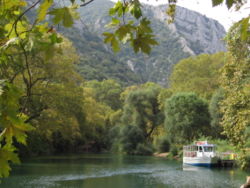
View on WikipediaThe Vale of Tempe or Tembi (/ˈtɛmpi/;[1] Greek: Τέμπη, Κοιλάδα των Τεμπών; Ancient Greek: Τέμπεα, Τέμπη[2]) is a gorge in the Tempi municipality of northern Thessaly, Greece, located between Olympus to the north and Ossa to the south, and between the regions of Thessaly and Macedonia.
Key Information


In the Greek municipality of Tempi, the valley is ten kilometers long and as narrow as 25 metres in places, with cliffs nearly 500 metres high. Through it flows the Pineios River on its way to the Aegean Sea. Historically the gorge has provided a strategic route through the mountains and its impressive rugged beauty is poetically renowned.
Local history and legend
[edit]
In legend, the Vale of Tempe was cut through the rocks by the trident of Poseidon.[3] It was home for a time to Aristaeus, son of Apollo and Cyrene, and it was here that he chased Eurydice, wife of Orpheus, who, in her flight, was bitten by a serpent and died. In ancient times, it was celebrated by Greek poets as a favorite haunt of Apollo and the Muses. On the right bank of the Pineios sat a temple to Apollo, near which the laurels used to crown the victorious in the Pythian Games were gathered.[3]
Two places of pilgrimage developed later in the area. At the southern entrance of the valley lie the remains of the Ottoman-era Hasan Baba Tekke, a 14-15th century mosque built about the tomb of a dervish saint. Traditionally it was visited particularly by women who wanted to conceive and children that could not walk. Within the gorge itself is the ancient cave shrine and holy spring of the Christian saint, Aghia Paraskevi, protector of the eyes and of gypsies. It is approached by a narrow footbridge over the river and sheltered by a chapel built about 1910.[4]
The Tempe Pass is a strategic point in Greece since it is the main route from Larissa through the mountains to the coast. Though it can be bypassed via the Sarantoporo Pass, the alternative route takes longer. Because of this, it has been the scene of numerous battles throughout history. In 480 BC, 10,000 Athenians and Spartans gathered at Tempe to stop Xerxes's invasion. However, once there, they were warned by Alexander I of Macedon that the vale could be bypassed and that the army of Xerxes was overwhelmingly large; accordingly, the Greeks retreated.[5]
During the Third Macedonian War in 169 BC, the Romans broke through Perseus of Macedon's defences here and later defeated him in the Battle of Pydna. During the revolution of Andriskos in 148 BC the valley was the site of another conflict. Then, following some centuries of Roman peace, the pass was penetrated again during the first Gothic War (376–382) when, in the words of the poet Claudian, "Thessaly grieved because the Vale of Tempe was no help, while the Goths laughed at Mount Oeta's conquered crags".[6] Other battles were fought there too during Byzantine and Ottoman times. The gorge was known to the Byzantines as Λυκόστομο (Wolf's Throat) and was called simply Boğaz (Gorge) by the Turks.[7]
Communications
[edit]Until recently the road through the gorge followed the track of the ancient military road made by the Romans, running along the right bank of the river.[8] By the time of the Battle of Tempe Gorge in 1941, it had hardly improved and later, as the Greek National Road 1, had still the reputation of being narrow and dangerous, with one particular road accident causing the deaths of 21 schoolchildren in April 2003.[9] Only with the opening of the A1 motorway and its bypassing tunnels in 2017 was there a change for the better.[10] Also running through the gorge is the Athens–Thessaloniki mainline. Originally built as single-tracked in the 1910s, it was closed on 27 November 2003 and the following day trains were routed through the new double-tracked line, featuring two long tunnels that allow speeds of up to 160 km/h. Nevertheless, it was the scene of what was reported as Greece's deadliest rail disaster on 28 February 2023.
Ideal scenes
[edit]The Classical idealisation of the Vale of Tempe continued to inform the European imagination over two millennia. In his illustrated atlas, Theatrum Orbis Terrarum (1590), Abraham Ortelius pictured the gorge as "The Paradise of Tempe at the foot of Mount Olympus", inhabited by a pious and happy people.[11] Much the same impression of the location is given in The Pleasures of the Imagination (1744) by Mark Akenside, which is derivative of many prior poetical descriptions:

Fair Tempe! haunt belov'd of sylvan powers,
Of nymphs and fauns; where in the golden age
They play'd in secret on the shady brink
With ancient Pan: while round their choral steps,
Young hours and genial gales with constant hand
Shower'd blossoms, odours; shower'd ambrosial dews,
And spring’s elysian bloom.[12]
The English romantic poet John Keats cites in his famed 1819 work Ode on a Grecian Urn, writing .."deities or mortals, or of both, In Tempe or the dales of Arcady? What men or gods are these? What maidens loth?...."[13]
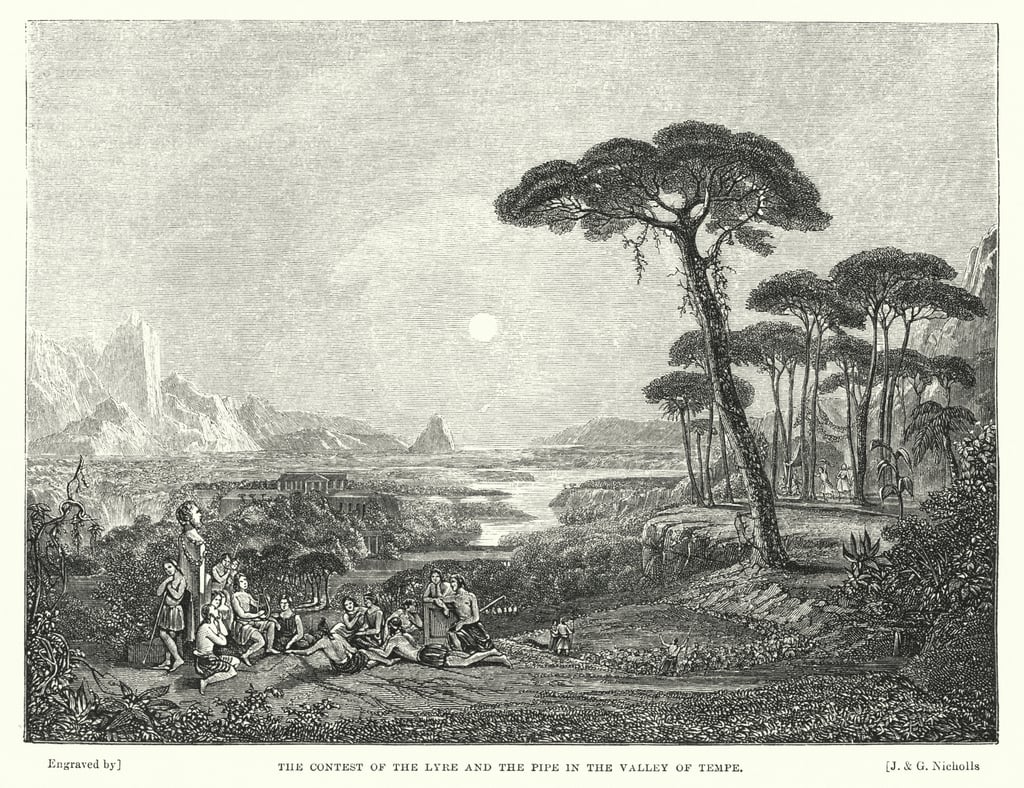
Painters of the 19th century also contributed to this mythologising tradition. They include J. M. W. Turner, whose The story of Apollo and Daphne (1837)[14] is based on Ovid's account in the Metamorphoses.[15] In his painting, the broad valley is rimmed by mountains and dissolves in light, while the characters meeting on the road are dwarfed by the scene that opens behind them. Francis Danby's The Contest of the Lyre and the Pipe in the Valley of Tempe (1842)[16] pictures a similar scene, as it is described in a contemporary publication. Behind the competing musicians in the foreground, "the sun is setting over Ossa, and the river Peneus, steeped in its departing light, is flowing below".[17]
The convention of the valley's pleasant nature has also been used to underline the discomfiture of Pompey's flight after his defeat at the Battle of Pharsalus, as recounted by Plutarch.[18] A later historian embroidered on his bare statement of fact with the reflection that "Pompey passed on through the Vale of Tempe to the sea, regardless of the beauty and splendour that surrounded him".[19] He was, however, doing no more than poets before. John Edmund Reade, for example, whose long narrative in "The Vale of Tempe" records the fugitive's desperate appearance as glimpsed by a bystander;[20] and William Dale of Newlyn, whose "Pompey in the Vale of Tempe" calls on the "delightful valley" to mourn the misfortune of the vanquished leader.[21]
In reality, William Smith sets such accounts straight in his Dictionary of Greek and Roman Geography (1854), commenting that the vale's "scenery is distinguished rather by savage grandeur than by the sylvan beauty which [some authors] attribute to it…None of these writers appear to have drawn their pictures from actual observation". In corroboration he cites Edward Dodwell's account of A Classical and Topographical Tour through Greece (1819) and the accompanying engravings based on the drawings he made on his journey.[22] In the course of his passage through the gorge, Dodwell notes, "the traveller beholds on either side a stupendous wall of mighty precipices rising in prodigious grandeur, shattered into deformities and sprinkled with a wild profusion of trees and aromatic shrubs."[23]
References
[edit]
- ^ "Tempe". Random House Webster's Unabridged Dictionary.
- ^ Τέμπεα, Τέμπη
- ^ a b Chisholm, Hugh, ed. (1911). . Encyclopædia Britannica. Vol. 27 (11th ed.). Cambridge University Press. p. 578.
- ^ Go Tempi
- ^ Herodotus VII, 173
- ^ De Bello Gothico, lines 195-6
- ^ "Vale of Tempe", Encyclopedia Britannica
- ^ William Smith, “Tempe”, Dictionary of Greek and Roman Geography (1854)
- ^ "Village mourns lost generation". BBC News. April 14, 2003.
- ^ "Safe, modern motorway cuts journey time from Athens to Thessaloniki", European Commission, 2 November 2018
- ^ "Tempe", Carta Historica
- ^ The Pleasures of the Imagination, 1.298-305
- ^ "John Keats: "Ode on a Grecian Urn"". The Poetry Foundation. March 13, 2020.
- ^ Tate Gallery
- ^ "Ovid (43 BC–17) - The Metamorphoses: Book 1". www.poetryintranslation.com.
- ^ "An engraving by J. and G. Nicholls after the original".
- ^ Men of the Time: biographical sketches, London 1856, p.193
- ^ The Life of Pompey, Loeb Classical Library, section 73
- ^ Jacob Abbott, The History of Julius Caesar, Harper and Brothers, New York 1863, p.176
- ^ The Broken Heart, with other poems, London 1825, pp.56-60
- ^ Wild Flowers and Fruits, London 1856, pp.29-32
- ^ "English: Edward Dodwell. A Classical and Topographical Tour through Greece, during the Years 1801, 1805, and 1806, vol. ΙΙ, London, Rodwell and Martin, 1819". November 26, 1819 – via Wikimedia Commons.
- ^ A Classical and Topographical Tour through Greece, "The Vale of Tempe", p.109

Vale of Tempe
View on GrokipediaGeography
Location and Physical Description
The Vale of Tempe is a narrow gorge in the municipality of Tempi, northern Thessaly, Greece, situated between Mount Olympus to the north and Mount Ossa (also known as Kissavos) to the south, at coordinates approximately 39.88° N latitude and 22.58° E longitude.[10] [11] It functions as the principal defile for the Pineios River, which drains the Thessalian plain eastward into the Aegean Sea near Stomio.[4] [3] The gorge extends roughly 10 kilometers in length, narrowing to widths of 25 to 50 meters at its constricted sections, with sheer limestone cliffs ascending to heights of up to 500 meters on both sides.[4] [2] [12] This configuration creates a dramatic, enclosed landscape characterized by vertical rock faces and a riverine corridor that influences local hydrology and supports a distinct riparian ecosystem. Along the Pineios River banks, vegetation includes dense stands of plane trees, elms, and willows, contributing to a shaded, verdant environment amid the arid surrounding terrain.[1] The gorge's topography fosters a cooler, more humid microclimate relative to the adjacent plains, though the river is prone to seasonal flooding, as evidenced by events damaging infrastructure in 2023.[13]Geological Formation
The Vale of Tempe formed primarily through fluvial erosion by the Peneus River during the Quaternary Period, particularly the Pleistocene epoch, as the river incised a narrow gorge into the carbonate rock formations separating Mount Olympus and Mount Ossa. This incision deepened the pre-existing topographic low amid regional tectonic uplift, driven by the convergence of the African (Apulian) and Eurasian plates, which folded and thrust the underlying sedimentary sequences upward. Geological mapping of the Olympus tectonic window documents these processes, with the area's carbonate platform—deposited during Mesozoic marine conditions—subsequently deformed into nappes and exposed for erosion.[14] Surveys indicate intensively karstified limestone comprising much of the cliffs, evidenced by dissolution features, sinkholes, and karstic springs along the valley floor, alongside fault lines that bound the gorge and control its alignment. Sedimentary rock layers, including Triassic-Jurassic limestones and overlying flysch deposits, exhibit stratigraphic evidence of uplift rates exceeding erosion in places, with leveling data from 1964–1989 confirming ongoing domal uplift of 1–2 mm/year in the Olympus-Tempi area. The gorge's narrow profile (as little as 25 meters wide) and vertical cliffs (up to 500 meters) reflect this differential incision, accelerated by the river's capture and drainage of a vast Thessalian paleolake, whose overflow progressively lowered the base level and entrenched the channel.[15][16][4] While ancient accounts invoke sudden seismic or divine cleavage, geological evidence supports no isolated cataclysmic event as the primary mechanism; instead, sustained stream erosion and tectonic rebound dominate, akin to gorge formation in other convergent margins like the Zagros or Himalayan forelands, where river downcutting outpaces lateral spreading over 10^5–10^6 years.[4][2]Mythology and Legends
Divine Origins and Associations
Ancient Greek legends attributed the Vale of Tempe's formation to Poseidon, who struck the rocks with his trident to carve a passage for the Peneus River, averting its entrapment by encircling mountains.[3] Some traditions alternatively ascribed the gorge's origin to seismic activity, reflecting folk explanations of geological features through natural cataclysms. The valley bore strong ties to Apollo, whom myths described as purifying himself there following the slaying of the serpent Python, performing rites in its waters to atone for the act.[3] This connection manifested in rituals, including periodic delegations from Delphi undertaking pilgrimages to Tempe for expiatory ceremonies reenacting Apollo's cleansing, as part of the god's cult practices.[17] The site also served as a temporary residence for Aristaeus, the son of Apollo and the nymph Cyrene, associating the vale with divine figures linked to beekeeping, herding, and rustic arts.[3] Located at Mount Olympus's base, Tempe occupied a threshold position between the Olympian divine sphere and human domains, enhancing its sanctity.[2] Religious installations included a temple to Apollo on the Peneus's right bank and altars evoking the Muses, fostering veneration for prophecy, music, and poetic inspiration in ancient Greek piety.[18][19]Key Myths Involving the Vale
In Greek mythology, the Vale of Tempe features prominently in the tale of Apollo's pursuit of the nymph Daphne, daughter of the river god Peneus, whose waters flow through the gorge. According to Ovid's Metamorphoses, Daphne, fleeing Apollo's advances after being struck by Cupid's arrow of disdain, sought refuge in her father's realm within the enclosed valley of Tempe, where the god transformed her into a laurel tree to evade capture, its roots entwining with Peneus' banks as Apollo fashioned a wreath from its leaves for eternal symbol of poetic victory.[20] This narrative underscores themes of unrequited divine desire and metamorphosis, with the laurel's sacred branches later carried from Tempe to Apollo's oracle at Delphi for ritual use.[21] The vale also served as a site of purification for Apollo following acts of divine retribution, such as slaying the serpent Python, where he bathed in the Peneus to cleanse ritual pollution, establishing Tempe's sanctity in his cult as a locus of renewal and healing.[22] Ancient poets invoked Tempe as a favored haunt of Apollo and the Muses, portraying it as an idyllic realm of inspiration amid its precipitous forests and cascading waters, where the goddesses of arts and song dwelt alongside the god of music and prophecy.[20] This association imbued the landscape with cosmological symbolism as a threshold between mortal realms and Olympian heights, facilitating encounters between gods and humans, exile for the impure, and transitions marked by the river's passage from mountainous source to sea.[23]Historical Role
Ancient and Classical Periods
The Vale of Tempe functioned as a critical natural defile in ancient Greece, serving as the primary route linking the Thessalian plain to Macedonia and enabling the movement of armies, merchants, and pilgrims between northern and central regions. Its narrow gorge, formed by the Peneus River between Mount Olympus and Mount Ossa, offered inherent defensibility against large-scale invasions while posing logistical challenges for extended campaigns, as noted in ancient geographical accounts.[2] Strabo, in his Geography, portrayed the valley as a densely wooded, shaded expanse approximately 40 stadia long, with towns like Gonnos and Cymé along its course, underscoring its scenic allure and role as a conduit for regional connectivity rather than frequent battlegrounds.[24] During the Second Persian Invasion in 480 BCE, the Hellenic League initially positioned around 10,000 hoplites under Themistocles and the Spartan polemarch Euenetus at Tempe to block Xerxes I's advance from Macedonia into Thessaly, viewing it as a stronger barrier than alternative passes. Intelligence from Macedonian allies, including Alexander I, revealed multiple flanking paths through the mountains, prompting the Greeks to abandon the site without combat and retreat southward to Thermopylae; this decision reflected the vale's tactical limitations despite its symbolic value as an early bulwark in Persian War narratives, as detailed by Herodotus.[10] The episode highlighted Thessaly's precarious position, with local forces ultimately submitting to Persian overlordship, though the pass saw no direct sieges due to its precipitous terrain deterring prolonged engagements.[25] Textual evidence attests to sanctuaries within the vale, particularly dedicated to Apollo Tempæus, where annual epiphanic festivals involved sacrifices and athletic contests, integrating the site into Thessalian cult practices and broader Hellenic religious networks. Votive dedications and inscriptions referenced in ancient sources suggest ritual activity tied to the god's purification myths, reinforcing Tempe's cultural prominence without substantial archaeological monumental remains, likely owing to erosion and limited excavations in the flood-prone area. In the Classical and early Hellenistic eras, Macedonian rulers like Philip II exploited the pass for consolidating control over Thessaly, while Alexander III traversed it during his 335 BCE campaigns southward, reportedly employing stratagems or sacrifices en route, as preserved in Polyaenus's tactical anecdotes, affirming its enduring utility for rapid military transits.[26]Medieval to Modern Eras
During the Byzantine era, the Vale of Tempe retained its strategic value as a narrow defile controlling access between Thessaly and Macedonia, prompting the construction of fortifications including castles at key points such as Platamonas at the gorge's southern entrance.[27] Archaeological evidence from the Middle Byzantine period (circa 9th-12th centuries) includes a complex featuring a traveler's inn and an adjacent basilica church, underscoring the area's function as a vital rest and transit hub along trade and pilgrimage routes.[28] A church dedicated to Saint Paraskevi, erected in the 13th century, further attests to monastic presence amid the rugged terrain.[18] Following the Ottoman conquest of Thessaly in the late 14th to early 15th centuries, the pass—renamed Boğaz or "Gorge"—continued serving as a critical corridor for commerce and troop movements, with layered fortifications at Platamonas adapted for Turkish control.[27] The region's isolation fostered persistent insecurity from local unrest, though it saw no large-scale industrialization before the 19th century, relying instead on agriculture and passage tolls in the broader Ottoman network. In the 19th century, amid Greece's push for independence from Ottoman rule (1821-1830), the Vale functioned primarily as a peripheral transit link rather than a primary theater of revolt, preserving its role as a conduit between northern and southern regions. The 20th century reaffirmed its military choke-point status during the Axis invasion of Greece; on April 17-18, 1941, Allied forces from the Australian 16th Brigade, New Zealand 21st and 24th Battalions, and supporting Greek units fought a desperate rearguard action in Tempe (Pinios) Gorge against the German 9th Panzer Division, cratering roads and using terrain to delay the panzer thrust southward and enable evacuations via the eastern ports.[29][30] This engagement, part of Operation Marita, resulted in heavy Allied losses but temporarily disrupted German momentum, after which the area fell under occupation until liberation in October 1944.[29] Throughout these eras, the Vale's geography ensured its enduring utility for movement over settlement or economic transformation.Transportation Infrastructure
Railway Development and Operations
The Athens–Thessaloniki railway line, traversing the Vale of Tempe, formed part of Greece's broader network expansion initiated in the late 19th century under Prime Minister Charilaos Trikoupis, with construction contracts awarded to foreign consortia including English and later Greek firms.[31] The challenging terrain of the narrow gorge necessitated extensive tunneling—over a dozen tunnels in the Tempe section alone—and multiple bridges spanning the Peneus River to maintain alignment along the valley floor.[32] These engineering works, involving blasting through limestone cliffs and stabilizing riverbank embankments, were completed in stages amid delays from funding shortfalls and geopolitical tensions, with the full 506-kilometer standard-gauge line operational for through services by 1918.[31] The Tempe segment remains predominantly single-track, imposing operational constraints that require precise timetabling for bidirectional traffic, often resulting in delays from overtaking maneuvers or minor disruptions.[33] Passenger services, primarily InterCity expresses, and freight trains utilize the route daily, handling thousands of tons of cargo annually as the primary north-south artery linking Athens to northern Greece and international corridors.[34] Infrastructure management falls to the state-owned Hellenic Infrastructure and Railways (OSE), while rolling stock and operations are concessioned to Hellenic Train S.A., acquired by Italy's Ferrovie dello Stato Italiane in 2017 for €45 million, marking a shift from prior state control.[35] Signaling and remote traffic control systems, reliant on outdated electromechanical technology in much of the network, fell short of European Union interoperability standards (ERTMS/ETCS), despite allocated EU funds exceeding €57 million for upgrades between 2014 and 2020.[36] Pre-2023 audits by Greece's National Safety Authority highlighted persistent maintenance gaps, including deferred track inspections and incomplete telematics integration, contributing to reliability issues on high-traffic sections like Tempe.[37] Efforts to double-track bypasses and modernize signals, such as Contract 717 with Alstom, faced protracted implementation, leaving the line vulnerable to capacity bottlenecks.[38]Road Networks and Connectivity
The European route E75, forming Greece's A1 motorway, serves as the principal arterial road traversing the Vale of Tempe, linking Athens and Thessaloniki over approximately 490 kilometers nationally. Within the valley's confines—spanning roughly 10 kilometers between Mount Olympus and Mount Ossa—the alignment necessitated significant engineering to navigate the steep, limestone-dominated gorge and the meandering Pinios River. A 30-kilometer upgraded section from Evangelismos to Skotina incorporates 11 kilometers of tunnels, including a 6-kilometer tunnel complex at Tempi, along with viaducts to span ravines and minimize surface disruption.[39][40] Construction of these Tempi tunnels and associated infrastructure began under a contract signed in 2007, with completion in 2017 after delays from Greece's financial crisis; the works replaced an older, accident-prone open-road path characterized by tight curves and exposure to falling debris.[41][42] Viaducts and tunnel portals feature reinforced concrete and rock stabilization techniques to address erosion from the river and seasonal torrents, reducing previous risks that contributed to over 20% of national highway fatalities in the pre-upgrade era.[40][41] Secondary local roads branch from the A1 to connect villages like Tempi, situated along the southern valley floor, and Rapsani at the northern Olympus foothills, facilitating access to agricultural lands and riverbanks via shorter bridges over the Pinios. These routes, upgraded incrementally since the mid-20th century, include drainage culverts and retaining walls for landslide mitigation in the seismically active karst terrain.[43][3] The pre-tunnel national road alignment persists in part as a tourism feeder, offering pull-offs at scenic overlooks, though it demands cautious navigation due to persistent geological hazards like slope instability. EU Cohesion Fund investments exceeding €200 million for the Tempi section have integrated advanced monitoring systems, yet the valley's narrow profile and high precipitation continue to necessitate regular interventions for debris clearance and slope reinforcement.[39][42]The 2023 Tempi Train Crash
Incident Details and Immediate Causes
On February 28, 2023, shortly before midnight, a northbound InterCity passenger train (IC-62) traveling from Athens to Thessaloniki collided head-on with a southbound freight train near Tempi station in the Vale of Tempe, Greece.[6] The passenger train carried 342 passengers and 10 onboard staff, primarily university students returning from a holiday weekend.[44] The collision occurred on a single-track section of the Athens-Thessaloniki railway line, where the passenger train was traveling at approximately 150 km/h and the freight train at around 90 km/h.[45] The immediate cause was a dispatching error at Larissa station, where the station master manually routed the passenger train onto the same track as the oncoming freight train, failing to switch it to a parallel siding as required.[46] No automated signaling or collision avoidance systems, such as the European Train Control System (ETCS), were operational on this stretch, leaving no technical safeguards to prevent the overlap.[7] The station master was reportedly handling multiple duties simultaneously, including issuing reversal orders for another train, which contributed to the oversight.[5] Upon impact, both trains derailed violently, with the lead locomotives and several carriages crumpling into each other, resulting in a massive fireball from ruptured fuel tanks and cargo.[47] The fire and twisted wreckage trapped many inside, while the gorge's narrow terrain and rocky cliffs hindered emergency access, delaying rescue efforts by firefighters, ambulances, and heavy machinery.[8] The incident claimed 57 lives—46 passengers and 11 railway staff—and injured over 80 others, marking Greece's deadliest rail disaster.[48]Investigations, Systemic Failures, and Aftermath
The Greek accident investigation authority EODASAAM released its report on February 27, 2025, attributing the crash primarily to human error by the Larissa stationmaster, who failed to authorize the correct train routes despite warnings, compounded by the absence of remote blocking systems and inadequate operational protocols.[5] [46] The European Union Agency for Railways (ERA) similarly highlighted deficiencies in operational cooperation between Hellenic Train and infrastructure manager OSE, noting a lack of systematic safety management across the network, including unaddressed risks from single-track sections without modern signaling.[49] These findings underscored immediate causal factors like the stationmaster's oversight—where dispatchers issued contradictory instructions—but emphasized broader institutional lapses, such as the failure to implement European Train Control System (ETCS) signaling mandated years earlier.[46] Systemic failures traced to decades of underinvestment in rail infrastructure, exacerbated by the 2017 privatization of passenger services to Hellenic Train (an Italian state-owned subsidiary), which prioritized cost-cutting over safety upgrades despite prior union warnings of deteriorating conditions.[46] EODASAAM identified chronic issues including outdated rolling stock, incomplete track separations, and falsified maintenance records at regional depots, with evidence of deferred repairs dating to pre-privatization austerity measures that reduced OSE staffing by over 50% since 2010.[5] Government responses faced scrutiny for alleged cover-ups, including wiretapping of journalists and opposition figures probing the crash via spyware like Predator, which coincided with suppressed evidence of flammable cargo on the freight train; official probes dismissed isolated incompetence claims, citing empirical data on 17 safety recommendations for network-wide reforms.[50] While some attributed faults to individual negligence, reports favored systemic rot, evidenced by Greece's rail accident rate exceeding EU averages pre-2023 due to unheeded maintenance backlogs.[51] In the aftermath, nationwide protests and strikes persisted into 2025, with a general strike on February 28, 2025, halting transport and drawing tens of thousands demanding ministerial resignations and accountability beyond the stationmaster, whom protesters viewed as a scapegoat for institutional negligence.[52] [53] Victim families pursued lawsuits against Hellenic Train and OSE, with five agreeing to exhumations by October 2025 for forensic re-examination of fire causes, amid Supreme Court probes into report manipulations.[54] [55] Criminal trials for 36 indicted officials, including railway executives, commenced scheduling for March 23, 2026, focusing on manslaughter and negligence charges.[56] The EU enforced upgrades, mandating ETCS rollout and safety audits by 2027, though implementation lagged, reflecting ongoing debates over whether privatization accelerated or merely exposed pre-existing decay in funding allocation.[57]Cultural and Scenic Significance
Representations in Art, Literature, and Philosophy
In ancient Greek literature, the Vale of Tempe was extolled for its scenic beauty and mythological associations, serving as a favored retreat for Apollo and the Muses.[2] Ancient accounts describe laurel wreaths from the Vale awarded at the Pythian Games in Delphi, underscoring its symbolic link to Apollo's purification rites following the slaying of the Python.[58] This purification, enacted by Zeus's decree, positioned the Vale as a site of transition from primordial chaos to ordered harmony, embodied in the Muses' patronage of arts and inspiration.[59] During the Romantic era, European writers and artists drew on the Vale's classical allure to evoke sublime natural grandeur. Lord Byron, in his travels through Greece around 1809–1810, referenced the Vale in correspondence and inspired illustrations that romanticized its lush, enclosed vistas as a paradise bridging mortal and divine realms.[60] Painters like William Purser depicted it in works such as The Vale of Tempe, capturing the era's fascination with untamed yet harmonious landscapes reminiscent of ancient ideals.[61] Philosophically, these portrayals symbolized a dialectic between the gorge's constricted chaos and the riverine valley's cultivated serenity, mirroring tensions in human reason versus nature's wild forces. Nineteenth-century travelogues reinforced the Vale's reputation for pristine, myth-infused scenery, influencing Western aesthetic appreciation. Explorers like Sir Henry Holland, in his 1812–1819 accounts of Thessaly, detailed its verdant gorges and mythological echoes, emphasizing unspoiled panoramic views that evoked classical poetry.[62] In modern Greek literature, the Vale recurs as an emblem of enduring Hellenic continuity, linking natural beauty to post-independence national revival narratives amid philhellenic currents.[63] This symbolism underscores a philosophical ideal of landscape as a repository of cultural identity, harmonizing historical reverence with contemporary self-conception.Tourism and Environmental Considerations
The Vale of Tempe draws visitors primarily for its natural beauty, offering hiking opportunities along the Pinios River, exploration of riverside forests, and access to chapels such as those featuring holy springs.[1][4] These activities support eco-tourism, with trails and river-based pursuits providing low-impact ways to experience the gorge's 10-kilometer length between Mount Olympus and Mount Ossa.[1] Local monasteries near Rapsani, accessible via nearby paths, further enhance appeal for cultural-nature hybrids, though primary draw remains the valley's cliffs and flora.[1] Designated as a Natura 2000 site under code GR1420005, the Tempi aesthetic forest and Pinios River area receives protection for its biodiversity, including monitoring of visitor traffic to mitigate human impacts.[64] Preservation efforts balance tourism with ecological integrity, addressing risks like erosion from foot traffic in the narrow gorge and potential flooding in the river valley, which could intensify under climate variability.[64] Post-2023 Tempi train crash cleanup has raised concerns over localized pollution from debris, prompting debates on infrastructure upgrades for safer access versus limiting development to protect habitats. Following the crash, persistent railway safety issues have reduced reliance on train travel for accessing the site, shifting some tourism toward guided nature tours and road-based visits, though overall economic contributions from visitors continue via local accommodations and services.[66] Efforts to enhance rail and road networks emphasize safety without compromising the area's environmental status, reflecting tensions between economic viability and conservation priorities.[64][66]References
- https://en.wikisource.org/wiki/The_Geography_of_Strabo/Fragments
- https://www.reuters.com/world/[europe](/page/Europe)/year-after-greeces-worst-train-disaster-railway-safety-fears-persist-2024-02-28/