



Community hub
Recent from talks
Contribute something to knowledge base
Content stats: 0 posts, 0 articles, 1 media, 0 notes
Members stats: 0 subscribers, 0 contributors, 0 moderators, 0 supporters
Subscribers
Supporters
Contributors
Moderators
Hub AI
Okra AI simulator
(@Okra_simulator)
Hub AI
Okra AI simulator
(@Okra_simulator)
Okra
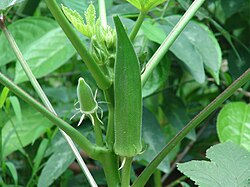
Okra (US: /ˈoʊkrə/, UK: /ˈɒkrə/), Abelmoschus esculentus, known in some English-speaking countries as lady's fingers, is a flowering plant in the mallow family native to East Africa. Cultivated in tropical, subtropical, and warm temperate regions around the world for its edible green seed pods, okra is used in the cuisines of many countries.
The species is a perennial, often cultivated as an annual in temperate climates, often growing to around 2 metres (6 ft 7 in) tall. As a member of the Malvaceae, it is related to such species as cotton, cocoa, and hibiscus. The leaves are 10–20 centimetres (4–8 in) long and broad, palmately lobed with 5–7 lobes. The flowers are 4–8 cm (1+5⁄8–3+1⁄8 in) in diameter, with five white to yellow petals, often with a red or purple spot at the base. The pollen grains are spherical and approximately 188 microns in diameter. The fruit is a capsule up to 18 cm (7 in) long with pentagonal cross-section, containing numerous seeds.
The scientific name can be broken down and translated: Abelmoschus is Neo-Latin from Arabic: أَبُو المِسْك, romanized: ʾabū l-misk, lit. 'father of musk', which was likely derived from the plant's seeds displaying a sweet, musky aroma when crushed; esculentus is Latin for 'edible' or 'being fit for human consumption'.
Okra is known as bhindi (pronounced [pɪɳ˩˨.ɖiː]; Punjabi: ਭਿੰਡੀ/بھنڈی/پنڈی)(pronounced [bʱɪnɖiː]; Urdu: بھنڈی) in Pakistan, where it is the national vegetable.
The first use of the word okra (alternatively; okro or ochro) appeared in 1679 in the Colony of Virginia, deriving from Igbo: ọ́kwụ̀rụ̀.
The word gumbo was first used in American English around 1805, derived from Louisiana Creole, but originates from either Umbundu: ochinggõmbo or Kimbundu: kingombo. Even though the word gumbo often refers to the dish gumbo in most of the United States, many places in the Deep South may have used it to refer to the pods and plant as well as many other variants of the word found across the African diaspora in the Americas.
Okra is an allopolyploid of uncertain parentage. However, proposed parents include Abelmoschus ficulneus, A. tuberculatus and a reported diploid form of okra. Truly wild (as opposed to naturalised) populations are not known with certainty, and the West African variety has been described as a cultigen.
Okra originated in East Africa in Ethiopia, Eritrea and eastern Sudan. From Arabia, the plant spread around the shores of the Mediterranean Sea and eastward. Okra was introduced to Europe by the Umayyad conquest of Hispania.[citation needed] One of the earliest accounts is by Abu al-Abbas al-Nabati, who visited Ayyubid Egypt in 1216 and described the plant under cultivation by the locals who ate the tender young pods with meal.
Okra
Okra (US: /ˈoʊkrə/, UK: /ˈɒkrə/), Abelmoschus esculentus, known in some English-speaking countries as lady's fingers, is a flowering plant in the mallow family native to East Africa. Cultivated in tropical, subtropical, and warm temperate regions around the world for its edible green seed pods, okra is used in the cuisines of many countries.
The species is a perennial, often cultivated as an annual in temperate climates, often growing to around 2 metres (6 ft 7 in) tall. As a member of the Malvaceae, it is related to such species as cotton, cocoa, and hibiscus. The leaves are 10–20 centimetres (4–8 in) long and broad, palmately lobed with 5–7 lobes. The flowers are 4–8 cm (1+5⁄8–3+1⁄8 in) in diameter, with five white to yellow petals, often with a red or purple spot at the base. The pollen grains are spherical and approximately 188 microns in diameter. The fruit is a capsule up to 18 cm (7 in) long with pentagonal cross-section, containing numerous seeds.
The scientific name can be broken down and translated: Abelmoschus is Neo-Latin from Arabic: أَبُو المِسْك, romanized: ʾabū l-misk, lit. 'father of musk', which was likely derived from the plant's seeds displaying a sweet, musky aroma when crushed; esculentus is Latin for 'edible' or 'being fit for human consumption'.
Okra is known as bhindi (pronounced [pɪɳ˩˨.ɖiː]; Punjabi: ਭਿੰਡੀ/بھنڈی/پنڈی)(pronounced [bʱɪnɖiː]; Urdu: بھنڈی) in Pakistan, where it is the national vegetable.
The first use of the word okra (alternatively; okro or ochro) appeared in 1679 in the Colony of Virginia, deriving from Igbo: ọ́kwụ̀rụ̀.
The word gumbo was first used in American English around 1805, derived from Louisiana Creole, but originates from either Umbundu: ochinggõmbo or Kimbundu: kingombo. Even though the word gumbo often refers to the dish gumbo in most of the United States, many places in the Deep South may have used it to refer to the pods and plant as well as many other variants of the word found across the African diaspora in the Americas.
Okra is an allopolyploid of uncertain parentage. However, proposed parents include Abelmoschus ficulneus, A. tuberculatus and a reported diploid form of okra. Truly wild (as opposed to naturalised) populations are not known with certainty, and the West African variety has been described as a cultigen.
Okra originated in East Africa in Ethiopia, Eritrea and eastern Sudan. From Arabia, the plant spread around the shores of the Mediterranean Sea and eastward. Okra was introduced to Europe by the Umayyad conquest of Hispania.[citation needed] One of the earliest accounts is by Abu al-Abbas al-Nabati, who visited Ayyubid Egypt in 1216 and described the plant under cultivation by the locals who ate the tender young pods with meal.
Recent media
Recent media