Hubbry Logo
Olivary bodyOlivary bodyMain
Open search
Olivary body
Community hub
Olivary body
logo
8 pages, 0 posts
0 subscribers
Be the first to start a discussion here.
Contribute something
Olivary body
Olivary body
from Wikipedia
Olivary body
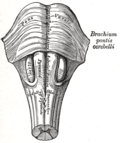
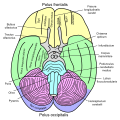
The medulla, showing the olives lying adjacent to the pyramids.
Animation shows the location of the olives in green.
Details
Part ofMedulla
Identifiers
Latinoliva
MeSHD009847
Anatomical terms of neuroanatomy

The olivary bodies or simply olives (Latin oliva and olivae, singular and plural, respectively) are a pair of prominent oval structures on either side of the medullary pyramids in the medulla, the lower portion of the brainstem. They contain the olivary nuclei.

Structure

[edit]

Each olivary body is located on the anterior surface of the medulla lateral to the pyramid, from which it is separated by the antero-lateral sulcus and the fibers of the hypoglossal nerve.

Behind (dorsally), it is separated from the postero-lateral sulcus by the ventral spinocerebellar fasciculus. In the depression between the upper end of the olive and the pons lies the vestibulocochlear nerve.

In humans, it measures about 1.25 cm in length, and between its upper end and the pons there is a slight depression to which the roots of the facial nerve are attached.

The external arcuate fibers wind across the lower part of the pyramid and olive and enter the inferior peduncle.

Olivary nuclei

[edit]

The olive consists of two parts:

The inferior olive in itself is divided to 3 main nuclei:

  • The primary olivary nucleus (PO) which consist of the major laminar structure.
  • The medial accessory olivary nucleus (MAO) lies between the primary olivary nucleus and the pyramid, and forms a curved lamina, the concavity of which is directed laterally.
  • The dorsal accessory olivary nucleus (DAO) is the smallest, and appears on transverse section as a curved lamina behind the primary olivary nucleus.

Small additional inferior olivary structures consist of the dorsal cap of Kooy and the ventrolateral outgrowth.

Additional images

[edit]

References

[edit]
[edit]
Revisions and contributorsEdit on WikipediaRead on Wikipedia
from Grokipedia
The olivary body, also known as the inferior olive, is a paired, oval-shaped prominence located on the ventral surface of the in the , lateral to the medullary pyramids. It consists primarily of the , a complex of gray matter that includes the principal olivary nucleus and medial and dorsal accessory olivary nuclei, forming a distinctive crenated or crumpled "C"-shaped structure. This nucleus serves as a key relay station in the cerebello-rubro-olivary pathway, integrating sensory and motor inputs from the and to facilitate precise and coordination by projecting climbing fibers to the via the inferior cerebellar peduncle. Distinguished from the smaller superior olivary complex in the pons, which is primarily involved in auditory processing such as sound localization, the inferior olivary body is essential for fine-tuning voluntary movements and timing muscle actions. Lesions or degeneration of the olivary body, often associated with conditions like multiple system atrophy or essential tremor, can lead to cerebellar ataxia, tremors, and impaired motor control due to disrupted cerebellar inputs.

Anatomy

Location and gross anatomy

The olivary bodies, also known as the inferior olives, are paired, prominent oval swellings located on the anterior (ventral) surface of the in the , positioned lateral to the medullary pyramids and separated from them by the anterolateral (preolivary) sulcus. These structures mark the ventrolateral aspect of the upper medulla, just inferior to the , and contribute to the characteristic contour of the brainstem's ventral surface. The swellings arise from the underlying olivary nuclei, which consist of folded gray matter forming a corrugated, C-shaped configuration with a medially directed hilum. In humans, each olivary body measures approximately 1.25 cm in length along its long axis, presenting as elongated, bulbous elevations that are more prominent than the superior olives. The surface features include a subtle central groove, and the bodies are bounded laterally by the inferior cerebellar peduncle (restiform body). Key relations include the (cranial nerve XII), whose rootlets emerge from the preolivary sulcus between the olivary body and the adjacent , typically along the lower two-thirds of the olive's anterior margin. Near the upper border of the olivary body, the (cranial nerve VII) rootlets attach at the pontomedullary junction, while the (cranial nerve VIII) is positioned laterally between the olive and the . Additionally, external arcuate fibers, originating from the arcuate nuclei, course superficially across the inferior cerebellar peduncle adjacent to the olive, contributing to the olivocerebellar pathway.

Olivary nuclei

The inferior olivary complex is subdivided into three primary nuclei: the principal olivary nucleus (PON), which constitutes the main laminar structure resembling a folded sheet of gray matter; the medial accessory olivary nucleus (MAO), appearing as a curved lamina positioned adjacent to the medullary pyramid; and the dorsal accessory olivary nucleus (DAO), the smallest of the three and situated posterior to the PON. These nuclei collectively form the core of the complex, with the PON dominating in size and extent. In addition to the main nuclei, the inferior olivary complex includes smaller components such as the dorsal cap of Kooy, a of cells located dorsally on the PON, and the ventrolateral outgrowth, a minor extension projecting ventrolaterally from the principal nucleus. These accessory structures, though less prominent, contribute to the overall architectural diversity of the complex. Histologically, the olivary nuclei consist of large neurons, typically with pear-shaped somata and featuring extensive, sparsely branched dendrites that can extend up to 1 mm, often exhibiting a varicose and spiny appearance. These neurons are organized in a characteristic laminar pattern, forming convoluted, folded sheets of cellular layers that give the complex its distinctive wavy contour in cross-section. The principal projection neurons are , providing excitatory climbing fiber outputs, while a subset of local elements, including , are , contributing to intranuclear inhibition. The PON accounts for the majority of the complex's volume. This swelling produced by the nuclei manifests externally as the prominent olivary body on the ventral medullary surface.

Development

Embryological origins

The olivary body, comprising the inferior olivary complex, originates from the alar plate of the within the , or , specifically from the rhombic lip neuroepithelium in the caudal rhombomeres (r7–r8 in vertebrates). This dorsal germinal zone generates precerebellar neuroblasts that contribute to the formation of the olivary nuclei. In human embryogenesis, the inferior olivary complex becomes discernible from around the 8th week of gestation, with neuroblasts proliferating from the ventricular zone and migrating to form the nuclear structures. The principal nucleus develops before the accessory nuclei, establishing the basic nuclear framework during the first trimester before mid-gestational folding. Genetic regulation of olivary development involves transcription factors such as Ptf1a, which specifies the lineage of inferior olivary neurons from dorsal alar plate progenitors, and Gsx2, which is essential for their proper differentiation. contribute to rostrocaudal patterning of the . Additionally, Engrailed-1 (En1) modulates neuronal survival and positioning in related brainstem nuclei, supporting the broader context for olivary formation. Signaling pathways like FGF and Wnt provide inductive cues at the midbrain- boundary, promoting proliferation and patterning of rhombic lip progenitors destined for the inferior olive. Olivary precursors undergo ventral migration from the dorsal rhombic lip along a submarginal stream, guided by attractants such as netrin-1 from the floor plate, to reach their final position in the ventral medulla and coalesce into the inferior olivary nuclei. This tangential migration, conserved across vertebrates, occurs concurrently with extension and nuclear translocation, ensuring topographic organization of the complex.

Postnatal maturation

During the early postnatal period, the olivary body experiences rapid structural growth, characterized by an increase in nuclear volume driven by dendritic arborization and . In rat models, which serve as a key reference for understanding development due to conserved mechanisms, the volume of the three main inferior olivary subnuclei expands four-fold from birth to postnatal day 21, reflecting maturation of neuronal processes and synaptic connections. In humans, this growth phase continues beyond the prenatal period, with exponential increases in nuclear volume and surface area observed in preterm infants up to 43 postmenstrual weeks, suggesting further postnatal expansion through similar cellular mechanisms. Myelination of the olivary body's key projections, including the arcuate fibers and olivocerebellar pathways, occurs progressively during infancy, stabilizing neural connections and supporting functional integration with the . In human infants, brainstem myelination follows a caudal-to-rostral and ventral-to-dorsal sequence, with significant maturation in medullary structures like the inferior olive by the end of the first postnatal year, as evidenced by patterns of basic protein expression and development up to 2 years of age. This process enhances signal transmission efficiency, coinciding with the refinement of pathways. As individuals age into adulthood and beyond, the olivary body undergoes gradual changes, including minimal neuronal loss and potential alterations in nuclear morphology. Studies of the human principal indicate no significant reduction in neuronal numbers from infancy through the ninth decade, with cell counts remaining stable around 360,000.

Physiology

Role in

The plays a pivotal role in motor coordination by generating climbing fiber inputs that convey error signals to Purkinje cells in the , facilitating and precise timing of movements. Neurons in the inferior olive fire action potentials that propagate along climbing fibers, eliciting complex spikes in Purkinje cells to instruct adaptive changes in cerebellar output. These signals act as teaching inputs, highlighting discrepancies between intended and actual movements to refine motor performance. Subthreshold oscillations in inferior olive neurons, occurring at frequencies of 1-10 Hz and synchronized through gap junctions, contribute to the temporal coordination required for smooth motor execution. These oscillations enable the nucleus to generate rhythmic patterns that align with cerebellar processing, supporting the suppression of unintended tremors and the of muscle activity during voluntary movements. The electrical coupling via gap junctions ensures coherent activity across olivary clusters, which is essential for maintaining the precision of motor timing. The olivary body contributes to adaptive through its involvement in cerebellar loops that correct errors in tasks such as eyeblink conditioning and limb movements. In eyeblink conditioning, olivary error signals via climbing fibers drive plasticity in Purkinje cells, allowing the to associate sensory cues with protective responses and adjust timing accordingly. Similarly, in limb coordination, these signals enable corrective adjustments to ongoing movements by integrating sensory feedback, promoting accurate trajectory formation and adaptive refinement. Experimental evidence from lesion studies demonstrates the critical function of the inferior olive in , as disruptions lead to and , impairing movement accuracy and smoothness. Animals with inferior olive s exhibit pronounced errors in reach-and-grasp tasks and reduced ability to adapt to perturbations, underscoring the nucleus's role in . Optogenetic activation of olivary neurons further reveals its influence on timing, as artificial stimulation disrupts synchronized cerebellar activity, leading to impaired motor precision and altered movement trajectories.

Neural connections and pathways

The inferior olivary nucleus receives a variety of afferent inputs that integrate motor command signals with sensory feedback. Major afferents originate from the ipsilateral via the rubro-olivary tract, which travels through the to convey rubral motor signals to the ipsilateral inferior olive. Additional inputs come from the contralateral dentate nucleus of the through the dentato-olivary tract, forming a reciprocal connection that modulates olivary activity based on cerebellar output. Somatosensory feedback is provided by the spino-olivary tract, arising primarily from spinal border cells in the intermediate gray matter (laminae VII-VIII), which relay proprioceptive and tactile information from contralateral body regions to the dorsal accessory olivary nucleus. Efferent projections from the inferior olivary nucleus primarily target the cerebellum, serving as the exclusive source of climbing fibers that excite Purkinje cells. These axons exit via the contralateral inferior cerebellar peduncle, with the majority synapsing directly on Purkinje cells in the cerebellar cortex to influence motor timing and error signaling; minor collaterals project to the deep cerebellar nuclei for additional excitatory input. These connections contribute to motor coordination by providing precise temporal modulation to cerebellar circuits. Within the olivary complex, internal circuitry facilitates synchronized activity essential for coordinated output. Olivary neurons are electrically coupled via gap junctions, primarily composed of connexin36, which enable subthreshold oscillations and synchronize membrane potentials across neuronal clusters to generate rhythmic firing patterns. Bilateral coordination is supported by olivo-olivary connections, including commissural axons and trans-midline gap junctions that link the principal and accessory olivary nuclei across hemispheres. The olivocerebellar tract follows a specific : olivary axons emerge from the nucleus hilum, decussate in the medullary raphe dorsal to the pyramids, and ascend as internal arcuate fibers through or around the contralateral inferior before entering the inferior cerebellar peduncle to reach the . This ensures contralateral targeting, with somatotopic organization preserved such that medial olivary regions project to vermal cortex and lateral regions to hemispheric areas.

Clinical significance

Associated disorders

Hypertrophic olivary degeneration (HOD) is a rare trans-synaptic degenerative process affecting the , arising from lesions that disrupt the Guillain-Mollaret triangle, such as damage to the dentate nucleus, , or . This disruption leads to initial olivary and , typically evident on MRI as T2 around 1 month post-insult, with subsequent enlargement () of the nucleus developing around 6 months, progressing to atrophy over 3-4 years. HOD commonly results in symptomatic , characterized by involuntary, rhythmic contractions of the and pharyngeal muscles due to olivary hyperactivity and abnormal synchronous firing. Symptomatic palatal , often a direct consequence of HOD, manifests as persistent, rhythmic palatal oscillations at 1-3 Hz, persisting during and frequently accompanied by audible palatal clicks or symptoms from tensor veli palatini involvement. This emerges from lesions in the Guillain-Mollaret triangle, including infarcts, hemorrhages, or tumors, which induce olivary degeneration and subsequent hyperexcitability in inferior olivary neurons. The condition highlights the olivary nucleus's critical role in generating oscillatory motor signals when its inhibitory dentato-rubro-olivary feedback loop is impaired. The has been hypothesized to play a central role in (ET), potentially through abnormal oscillatory activity in olivocerebellar circuits generating rhythms. However, postmortem studies show no significant olivary degeneration in ET cases, and the traditional "olivary hypothesis" is increasingly debated, with evidence suggesting cerebellar or cortical origins may predominate. Olivopontocerebellar atrophy (OPCA), a cerebellar form of (MSA-C), involves significant neuronal loss and in the inferior olivary nuclei, alongside degeneration of pontine and cerebellar structures, leading to progressive , , and bulbar dysfunction. This olivary neuronal depletion disrupts climbing fiber inputs to Purkinje cells, exacerbating the ataxic symptoms central to the disorder's motor impairment. Rare tumors, including primary low-grade gliomas of the medulla or metastatic deposits, can infiltrate the , causing direct neuronal disruption and secondary motor control deficits such as , , or . These lesions, though infrequent, compromise the olivary body's integrative functions within motor pathways.

Imaging and diagnosis

Magnetic resonance imaging (MRI) serves as the cornerstone for visualizing the olivary body and diagnosing pathologies such as hypertrophic olivary degeneration (HOD), a transsynaptic degeneration affecting the . T2-weighted sequences characteristically demonstrate within the in HOD, often evolving from initial signal changes without enlargement to overt . This reflects and vacuolar changes, with the nucleus appearing normal in the first month post-injury before T2 alterations emerge between 1 and 6 months. Diffusion tensor imaging (DTI), an advanced MRI technique, evaluates the microstructural integrity of olivary-connected tracts, such as the , by quantifying metrics like to detect disruptions in fiber organization. Volumetric MRI analysis further aids in assessing olivary during later degenerative stages, measuring nucleus volume reductions that follow the hypertrophic phase and correlate with progressive tissue loss. Functional MRI (fMRI) captures olivary activation during tasks, particularly those involving timing and error detection, underscoring the nucleus's integration with cerebellar circuits. (PET) with 18F-fluorodeoxyglucose (FDG) reveals metabolic alterations in olivary degeneration, including hypermetabolism in hypertrophic nuclei during active phases of HOD. Diagnosis of HOD relies on MRI identification of lesions within the Guillain-Mollaret triangle alongside olivary changes, including delayed manifesting 3 to 5 months post-injury, peaking between 6 and 12 months. Recent advances, such as 7T MRI, enhance microstructural visualization of olivary nuclei and tracts, enabling finer detection of early degenerative features. These imaging correlates with symptoms like , where T2 hyperintensity and align with clinical severity in affected pathways.

References

Add your contribution
Related Hubs
Contribute something
User Avatar
No comments yet.