Hubbry Logo
Operation FishOperation FishMain
Open search
Operation Fish
Community hub
Operation Fish
logo
8 pages, 0 posts
0 subscribers
Be the first to start a discussion here.
Operation Fish
Operation Fish
from Wikipedia
Operation Fish
Part of Second World War

HMS Bonaventure was forced to remain stationary for a time to protect a treasure ship
Location
Between UK and Canadian Ports
Result Successfully completed
Belligerents
United Kingdom
Canada
 Germany
Casualties and losses
0 ships sunk

Operation Fish was the relocation of British money and gold ingots from the United Kingdom to Canada for safekeeping during the Second World War. It was the largest known movement of physical wealth in history.[1]

Background

[edit]

In September 1939, the British government decreed that all people living in the UK had to declare their securities with the Treasury.[2] Even before Operation Fish, convoys had been sent with gold and money worth millions of pounds to purchase weapons from the United States. One such run involved Commodore Augustus Agar and his ship, the light cruiser HMS Emerald. At 23:18 on 3 October 1939, Emerald dropped anchor in Plymouth, England. A short time later, Agar was briefed by Rear Admiral Lancelot Holland on his mission. The written instructions are below.

Two million pounds in gold bars [GBP138,000,000 in 2023] is to be embarked in each ship to Halifax. A railway truck is expected to be placed alongside each ship about 01.00 October 7. Each truck is expected to contain 148 boxes each weighing 130 lbs. The total number of boxes is numbered Z 298 to Z 741 inclusive. Guards are to be put on each truck on arrival at the ship. Embarkation is to commence about 06.30 or as soon as daylight permits. Adequate steps are to be taken for supervision of each box from unloading from truck to stowage in ship. Finally a receipt is to be forwarded to C in C Western Approaches on the attached form.[3]

On 7 October 1939, Emerald sailed from Plymouth for Halifax, Nova Scotia, with the gold bullion from the Bank of England, bound for Montreal, Quebec, Canada, to be used to pay for American war materials. As this voyage was under the strictest secrecy, the crew were outfitted with "tropical white" uniforms, to confuse German agents. In the company of the two old battleships HMS Revenge and HMS Resolution and her sister ship HMS Enterprise, as well as the old cruiser HMS Caradoc, the Emerald ran into some of the heaviest seas that Agar encountered. By the time the convoy reached Halifax, the Emerald had lost her ship's boats, rafts, and various depth charges, wires, shackles, and other valuable equipment, as well as her spotter plane, a Fairey Seafox.[3]

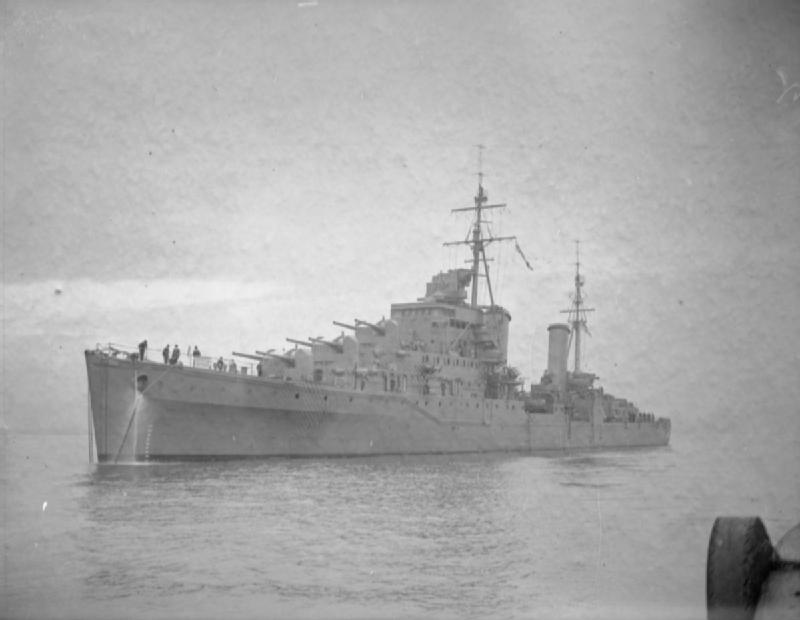
A black white photo of a warship
HMS Enterprise, one of the treasure ships

Winston Churchill formed his government as a guarantee that the Empire could continue the fight if the UK was overrun. With the Empire, he devised a plan to ship British wealth to the safety of Canada.[4] Using their wartime powers, the Churchill government confiscated the securities that the British people were forced to register at the beginning of the year, and under the cover of secrecy, moved them to the port of Greenock in Scotland. Then, men sworn to secrecy loaded the wealth onto HMS Emerald. The ship departed on 24 June 1940 and with an escort of some destroyers sailed to Canada. Again another fierce storm endangered the operation when high seas forced the ships to slow their speed, making them easy targets for any prowling U-boats. When they finally reached Halifax, on 1 July 1940, the British treasure was transferred to trains and the gold sent to Ottawa, while the securities were shipped to the Sun Life Building in Montreal.[4]

Another Operation Fish convoy sailed[where?] on 5 July 1940, comprising five ships loaded with $1.7 billion (US$38.16 billion in 2024),[clarification needed] which was the largest movement of wealth in history.[1] Offshore, they met their escort, which included the battleship HMS Revenge, a cruiser and several destroyers. Trouble arose when one of the convoy ships, a Polish ship, the Batory, loaded with treasure, had engine trouble and had to drop out of the convoy, escorted by only HMS Bonaventure; the two ships then encountered heavy fog and, because of the dangers of icebergs, came to a halt, making them easy targets for any U-boats that might find them; eventually, repairs were made and both ships were able to make it to Halifax days after the other treasure ships had landed.[1]

Old picture of a large building
The Sun Life Building in Montreal in 1942
Commemorative plaque at the Martins Bank Building in Liverpool

Storage

[edit]

The British securities were locked in a specially constructed underground vault that was rushed into existence three storeys beneath the Sun Life Building in Montreal, and were guarded around the clock by the Royal Canadian Mounted Police. A persistent rumour that the Crown Jewels of the United Kingdom were stored there was deliberately spread in Montreal to account for increased activity at the building.[5] The extremely secretive United Kingdom Security Deposit, operating in the vault, arranged for the sale of Britain's negotiable securities on the New York Stock Exchange over the next few years to pay for Britain's war expenses. The 5,000 employees of Sun Life never suspected what was stored in their basement,[dubiousdiscuss] and while unloading the treasure ships, not one crate of the cargo went missing. Even though thousands of people were involved, Axis intelligence agencies never found out about the operation.[6] Hundreds of government accountants and bankers worked tirelessly to catalogue the contents of thousands of crates taken off the ships. When they were finished it was determined that $2.5 billion (US$56.11 billion in 2024) had been shipped from the UK to Canada without one gold bar being lost.[1]

Commemoration

[edit]

A stone plaque on the outer wall of the Martins Bank Building on Water Street in Liverpool commemorates the gold stored there en route to Canada: "In May 1940 when this country was threatened with invasion part of the nation's gold reserve was brought from London and lowered through the hatch for safe keeping in the vaults of Martins Bank."[7]

In fiction

[edit]

The 1993 BBC drama The Bullion Boys depicts the 1940 transport of Bank of England gold to Canada via Liverpool, and a plot by a group of Liverpool dock workers to steal some of it.[8]

Operation Fish features significantly in the 2022 crime novel The Twyford Code by Janice Hallett.[9]

See also

[edit]

References

[edit]

Bibliography

[edit]
[edit]
Revisions and contributorsEdit on WikipediaRead on Wikipedia
from Grokipedia
Operation Fish was a covert operation conducted by the to evacuate its national gold reserves and securities to , safeguarding them from potential capture by amid fears of a successful invasion of Britain. Initiated in June 1940 following the fall of , the operation transported approximately 1,500 tonnes of gold bullion and coins—equivalent to over $20 billion in contemporary value—along with securities worth billions more, across the U-boat-threatened using armed merchant cruisers and vessels. All 23 shipments completed between 1940 and 1941 arrived without loss, constituting the largest physical transfer of wealth in history and enabling Britain to sustain wartime financing through sales of assets from secure North American vaults, primarily the in for gold and the Sun Life Building in for securities. Under the codenames "Fish" for gold and "Fruit" for securities, the mission exemplified strategic foresight, as its success ensured economic continuity for the Allied war effort even if the were overrun.

Historical Context

Britain's Pre-War Gold Reserves

Prior to the outbreak of the Second World War, Britain's reserves were primarily composed of bullion bars and coins, accumulated by the acting as custodian for the and the Exchange Equalisation Account (EEA). These holdings included acquired through purchases from Empire territories such as , where approximately £30 million in was obtained by March 1939, as well as inflows from settlements and pre-war efforts to bolster reserves amid global economic uncertainty following the abandonment of the standard in 1931. The reserves also encompassed sovereigns and other coinage, though bullion dominated, reflecting systematic accumulation to support monetary stability rather than direct convertibility. In , the 's gold holdings were valued at approximately £280 million, with subsequent reports indicating a figure of £326 million by , stored in secure vaults beneath the in . These reserves represented a significant portion of Britain's liquid financial assets, equivalent to roughly 24-25 million fine ounces at prevailing market valuations, and were maintained to underpin the sterling area's operations, where and allied nations held balances in . The physical storage in Threadneedle Street's underground facilities ensured centralized control and rapid access for exchange operations. Strategically, these pre-war gold reserves served to sustain international creditworthiness and the pound's as a , even after , by enabling interventions in foreign exchange markets and settling balances with -exporting nations. They facilitated financing and rearmament purchases requiring , providing a against sterling and bolstering confidence among sterling bloc members who relied on London's -backed liquidity for their own reserves. This accumulation, driven by the EEA's mandate to stabilize the , positioned as a critical asset for defending economic amid rising geopolitical tensions.

The Fall of France and Invasion Fears

The German Blitzkrieg offensive in commenced on May 10, 1940, with rapid armored thrusts through the Ardennes Forest bypassing the and overrunning Dutch, Belgian, and defenses within weeks. This advance encircled the British Expeditionary Force and remaining Allied troops near , prompting Operation Dynamo, which evacuated approximately 338,000 soldiers from May 26 to June 4, 1940, albeit abandoning most heavy equipment and leaving Britain's ground forces severely depleted. The success of these German maneuvers exposed Britain's continental allies to collapse, amplifying fears of a direct cross-Channel assault on the as the only remaining major opponent. Paris fell on June 14, 1940, and signed an with on June 22, 1940, effectively isolating Britain and eliminating any immediate prospect of a Western front to divert German resources. With bases now in northern and the , the threat of invasion—codename —loomed realistically in the summer of 1940, as German forces could potentially seize key assets including the Bank of England's gold reserves held in vaults. Such a capture mirrored Nazi practices in occupied territories, where officials confiscated central bank holdings, including 205 metric tons from and 137 metric tons from the to finance further aggression. Britain's post-Dunkirk isolation compounded these risks, as a successful or prolonged could enable to plunder national reserves, denying funds for procurement from neutral suppliers like the under cash-and-carry policies. Concurrently, German operations in the Atlantic, which sank over 100 Allied merchant vessels by the end of , posed severe hazards to any overseas asset transfer, underscoring the urgency of preemptive safeguarding amid escalating naval interdiction.

Planning and Decision-Making

Key Decision Points and Figures

In late June 1940, following the French armistice with Germany on June 22, British Treasury and officials conducted urgent assessments of the nation's gold reserves amid acute fears of a German invasion of the . These evaluations balanced the escalating probability of successful —Germany's planned cross-Channel assault—against the perils of maritime transport across the Atlantic, where wolf packs posed a direct threat to unescorted or lightly protected vessels. The core calculus prioritized retention of liquid assets to sustain wartime procurement and international credibility, recognizing that seizure by advancing German forces would terminate Britain's ability to finance resistance independently. Montagu Norman, Governor of the since 1920, played a pivotal role in these deliberations, leveraging his pre-war experience in dispersing reserves to overseas custodians and his oversight of the Bank's Threadneedle Street vaults holding approximately 1,500 tonnes of . Norman's advocacy emphasized empirical precedents from earlier evacuations, such as partial shipments to begun in 1939, arguing that inaction risked total forfeiture while dispersal mitigated existential financial paralysis. His assessments informed the operational framework, focusing on causal factors like Germany's rapid conquests in as indicators of imminent threat rather than relying on optimistic defensive projections. Prime Minister , assuming office on May 10, 1940, ultimately authorized the full-scale evacuation as a high-stakes contingency, overriding reservations about shipping vulnerabilities in favor of securing assets for a potential administration or prolonged imperial coordination. Churchill's directive reflected a pragmatic recognition that gold's utility in procuring arms and loans from neutral parties outweighed static storage risks, grounded in the reality that Britain's island defenses, though formidable, could not guarantee against capitulation or blockade-induced collapse. This decision crystallized by mid-June, setting the stage for Operation Fish without public disclosure to avert panic or enemy intelligence gains.

Coordination with Canadian Authorities

Canada was chosen as the primary destination for Britain's safeguarded assets due to its status within the , which ensured political reliability and alignment, combined with its geographical isolation from potential European threats and the relatively mature banking infrastructure of the newly established . This selection facilitated pragmatic bilateral cooperation, building on pre-war precedents where Britain had begun earmarking gold in Canadian vaults as early as for safety and logistical ease. Coordination commenced in earnest in late June 1940, involving high-level agreements between British and Canadian officials, including Governor Montagu Norman and Governor Graham Towers, who developed a particularly close working relationship to manage the transfer under utmost secrecy. Canadian Prime Minister W.L. Mackenzie King's government provided overarching approval and support, enabling the use of federal resources while maintaining operational discretion through diplomatic channels between and . These arrangements emphasized confidentiality protocols, with limited knowledge even among involved personnel, to prevent any risk of interception or compromise. The alliance yielded mutual strategic advantages: for Britain, secure access to reserves that could finance essential wartime purchases from and the under cash-and-carry terms; for , reinforcement of its position as a key Empire partner in collective defense without imposing storage fees, thereby enhancing transatlantic financial interdependence amid escalating global conflict. This coordination exemplified focused logistical diplomacy, prioritizing asset preservation over broader military integration.

Execution of the Operation

Transatlantic Shipments

The transatlantic shipments under Operation Fish involved the covert transport of Britain's gold bullion and securities across the North Atlantic to , primarily departing from ports like and in multiple phases starting in late and continuing through 1941. The operation utilized warships such as HMS Emerald and HMS Bonaventure, alongside escorted merchant vessels including SS Antonia and SS Duchess of Liverpool, to carry the assets amid heightened German threats. The inaugural wartime shipment departed on 24 1940 aboard HMS Emerald, which conveyed approximately £30 million in gold bullion—equivalent to hundreds of tons stored in ammunition lockers—and £200 million in securities concealed throughout the vessel, arriving in Halifax on 1 July without incident under . Subsequent convoys followed rapidly, such as those in early and mid-July involving HMS Revenge (£40 million in June and £192 million shared in July), HMS Furious (£20 million), and a group including HMS Bonaventure, SS Sobieski, and SS Batory, each navigating irregular routes to evade detection. In total, the shipments transferred nearly 2,000 tonnes of gold bullion and coins alongside securities valued at around £425–450 million in contemporary terms, executed in four primary phases to distribute risk. These voyages confronted acute empirical hazards, including pervasive wolfpack tactics that sank over 100 Allied ships in May 1940 alone—exceeding 40% of transatlantic tonnage—yet Operation Fish incurred zero losses through stringent secrecy, zigzag maneuvers, high-speed dashes, and fortified escorts that contrasted with the era's average attrition rates. Overloading strained vessel stability, and uninsured cargoes amplified stakes, but tactical diversions and preserved the consignments' integrity upon reaching Canadian waters.

Inland Transport and Security in Canada

Upon arrival in Halifax harbor, the gold and securities from Operation Fish shipments were unloaded at a remote pier under conditions of utmost , with no entries recorded for the guarding personnel to avoid drawing attention. representatives meticulously weighed and inspected the crates—each containing gold bars typically weighing around 400 troy ounces (approximately 12.4 kg), though some larger bars reached 866 ounces (about 27 kg)—before loading them onto special sealed trains operated by the Canadian National Railway. These trains departed Halifax bound for , with securities destined for unloading there and gold proceeding to , all under wartime blackout restrictions that limited visibility and operational knowledge to a minimal number of vetted individuals. Security for the rail journeys relied heavily on detachments of the Royal Canadian Mounted Police (RCMP), who provided armed escorts numbering approximately 50 officers per convoy, working in shifts to maintain 24-hour vigilance. For major shipments, such as the £192 million transfer in July 1940, up to five trains were required due to load constraints, with each rail car restricted to 150–200 boxes to ensure safe handling and prevent mechanical strain. Additional safeguards included blending the special trains with routine rail traffic where possible and spreading disinformation, such as rumors that the vaults at Montreal's Sun Life Building contained the British Crown Jewels, to deter potential espionage or theft attempts. Chain-of-custody protocols were rigorously enforced at every transfer point, involving dual verification by British and Canadian officials to confirm without opening sealed containers. Military and police coordination extended to perimeter controls at loading sites and stations, with no reliance on shipments but strict compartmentalization ensuring that even guards knew only their immediate responsibilities. Across the operation's multiple inland transits, which cumulatively handled 186,332 bars and equivalent securities by 1945, there were no reported incidents of loss, damage, or compromise, underscoring the robustness of these measures amid heightened Axis intelligence threats.

Storage and Management

Facilities and Protocols in Canada

The gold from Operation Fish, totaling over 1,500 tonnes by the operation's end, was stored in the fortified vaults of the in . This facility was selected for its secure infrastructure, including reinforced construction designed to withstand physical threats, and Ottawa's inland location, which offered protection from potential naval or coastal attacks. Securities, encompassing billions in negotiable bonds, stock certificates, and other financial instruments, were housed in the extensive sub-basement vaults of the Sun Life Building in . The site's choice leveraged the building's substantial underground storage capacity, engineered for durability, and its relative distance from primary urban or industrial targets that might attract enemy action. Security protocols featured continuous surveillance by armed guards from the Royal Canadian Mounted Police, with access controls compartmentalized such that no individual possessed complete knowledge of the assets' locations or quantities. Holdings were subject to rigorous verification processes, including initial weighings, counts, and manifest reconciliations upon deposit, followed by periodic audits to confirm condition and quantity without interruption. These arrangements preserved the assets' integrity and accessibility for liquidity needs, such as funding Allied purchases, throughout their storage from 1940 to 1945. No losses or compromises were recorded during this period.

Wartime Oversight

The oversight of British assets under Operation Fish during emphasized preservation while permitting controlled access for critical expenditures, managed jointly by the and representatives. Gold reserves, totaling over 1,500 tonnes by 1941, were stored in the 's vault, with securities housed in a fortified sub-basement of the Sun Life Building in . Access was strictly limited to facilitate payments for essential war supplies, particularly under U.S. cash-and-carry policies requiring or settlements for like and munitions, as Britain lacked credit options from the neutral . Secrecy protocols remained rigorous to counter Axis espionage, employing code names such as "" for shipments and restricting detailed knowledge even among Canadian staff and guards; communications used euphemisms, and operational details were compartmentalized across minimal personnel. The Royal Canadian provided 24-hour armed at storage sites, supplemented by vault reinforcements and procedural audits, ensuring no unauthorized transactions occurred beyond approved withdrawals for Allied . This framework achieved complete integrity, with zero reported thefts, damages, or losses across 186,332 bars and millions of ounces in coins held from 1940 to 1945, contrasting sharply with Axis seizures of national reserves in occupied and validating the operation's high-security gamble in sustaining Britain's financial autonomy.

Repatriation and Post-War Outcomes

Return of Assets to the United Kingdom

Following the Allied victory in on May 8, 1945, the repatriation of British and securities from Canadian custody commenced under coordinated efforts between the and the . The process involved meticulous verification procedures to reconcile holdings against original shipment manifests and pre-war inventories, ensuring no discrepancies in the approximately 1,500 tonnes of bullion and coins, alongside securities valued at over £500 million at the time of deposit. Joint teams comprising officials from both central banks conducted physical audits in vaults, cross-referencing serial numbers on ingots and detailed ledgers maintained throughout the war to confirm integrity and completeness. ![Flag of the United Kingdom][center] Return shipments mirrored outbound in security protocols but adapted to peacetime conditions, utilizing commercial vessels rather than heavily escorted convoys, with transatlantic crossings prioritized amid lingering risks from and disrupted maritime routes. Initial consignments departed Halifax and ports in late 1945, with systematic transfers continuing through 1946 and 1947 to accommodate vessel availability and clearances. Inland transport within relied on armored rail cars under escort, similar to wartime protocols, before loading at eastern ports for delivery to . Post-war shipping constraints, including vessel shortages from and global trade reallocations, delayed some sailings but did not result in losses. The operation concluded with full repatriation by 1948, as all physical assets were restored to vaults without reported shortfalls or disputes, validating the dual-custody system's efficacy. Securities, stored separately in facilities like the Sun Life Building in , underwent analogous verification and phased return, with documentation confirming exact matches to outbound records. This seamless reversal underscored the safeguards implemented, including segregated storage and continuous auditing, which prevented any wartime attrition or postwar claims.

Financial and Economic Ramifications

The safeguarding of approximately 2,000 tons of and securities valued at over £450 million (equivalent to roughly $10 billion in 1940 U.S. dollars) through Operation Fish enabled the to sustain critical payments for war from and the neutral prior to the Act's full effect in 1941. Britain, lacking credit terms from American suppliers, liquidated portions of these reserves to acquire , tanks, ammunition, and other armaments, thereby funding the war effort amid depleting domestic resources. This preserved the credibility of sterling reserves, signaling to international markets the UK's capacity to honor debts despite the threat of and , which facilitated ongoing borrowing from allies. Operational costs remained negligible relative to the assets' value, with transatlantic shipping and inland rail transport totaling over C$1 million, primarily covered by Canadian National Railways for secure conveyance from Halifax to and . The waived fees for processing 186,332 gold bars and over 8,000 boxes of securities, imposing only minimal handling charges beyond transport, as the deposits bolstered North American confidence in Allied . No explicit insurance premiums were required, with risks absorbed by the British Treasury given the operation's secrecy and naval escorts, though contemporary analyses note the potential for total loss exceeded operational expenses by orders of magnitude. The net economic benefit manifested in zero verifiable losses across multiple convoys in 1940, despite U-boat sinkings of over 100 merchant vessels in May alone, averting a hypothetical depletion of reserves that could have crippled equivalent to the operation's full value. Critics highlighted single-point vulnerabilities in Atlantic routing, yet empirical success—without alternative strategies proving viable in occupied —demonstrated the relocation's superiority over retention in the UK, where seizure by Axis forces loomed. Post-repatriation audits confirmed intact recovery, underscoring the operation's role in averting fiscal collapse amid wartime expenditures exceeding £7 billion annually by 1941.

Legacy and Assessment

Strategic and Historical Significance

Operation Fish exemplified Britain's strategic foresight in safeguarding national assets amid the existential threat of German invasion in 1940, ensuring the continuity of financial operations essential for procuring war supplies from . By relocating and securities valued at approximately £450 million—equivalent to about $160 billion in dollars—the operation prevented potential seizure by Axis forces, which would have crippled the Allied at a critical juncture following the fall of . This preservation of liquid reserves, primarily in physical bullion totaling over 1,500 metric tons, underscored 's role as a reliable during crises, when currencies risked devaluation or confiscation under occupation. In contrast to the Nazi regime's systematic of sovereign reserves across occupied —beginning with Austria's in 1938 and extending to billions in plundered assets from central banks in , the , and elsewhere—Operation Fish represented a proactive defense that denied the Axis similar windfalls from British holdings. German acquisitions, which funded rearmament and wartime expenditures, highlighted the causal link between control of precious metals and prolonged military capability; Britain's transfer thus bolstered Allied endurance by maintaining access to hard assets for transactions unhindered by or risks. The operation's secrecy, executed without losses despite U-boat threats, further demonstrated logistical efficacy in high-stakes . Historically, Operation Fish stands as the largest documented physical transfer of wealth, reinforcing the enduring preference for tangible commodities like in geopolitical upheavals over vulnerable paper instruments. While entailing significant logistical demands, including armed escorts and covert inland routing, its unblemished execution—free of verified theft or compromise—outweighed operational strains, contributing to Britain's capacity to sustain resistance and eventual victories without the fiscal paralysis that afflicted looted nations.

Commemorations and Modern Recognition

The Museum maintains exhibits and digital resources on Operation Fish, illustrating the 1940 transfer of approximately 1,500 tonnes of British gold to Canadian vaults as a safeguard against Nazi . These materials emphasize the logistical feats, including armed escorts and secure , drawing from declassified wartime records released in the post-war period. Historians such as James Powell, a former archivist, have contributed detailed accounts in publications and blogs, underscoring the operation's empirical success in preserving assets worth billions in today's terms without loss to enemy action. Powell's 2022 analysis for the of highlights the covert shipments' role in sustaining Allied financing, based on primary documents from the and Canadian records. In the , renewed has manifested through media productions, including a 2020 BBC documentary segment featuring eyewitness descendants recounting the securement of securities in facilities, and contemporaneous articles in outlets like CBC affirming the venture's vindication amid U-boat threats. These efforts, grounded in archival footage and interviews, portray the operation as a pivotal, low-casualty strategic maneuver, with no substantiated claims of mishandling emerging in recent scholarship.

References

Add your contribution
Related Hubs
User Avatar
No comments yet.