Hubbry Logo
Coincidence rangefinderCoincidence rangefinderMain
Open search
Coincidence rangefinder
Community hub
Coincidence rangefinder
logo
8 pages, 0 posts
0 subscribers
Be the first to start a discussion here.
Coincidence rangefinder
from Wikipedia
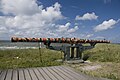
American soldiers using a coincidence rangefinder with its distinctive single eyepiece during army maneuvers in the 1940s.

A coincidence rangefinder or coincidence telemeter is a type of rangefinder that uses the principle of triangulation and an optical device to allow an operator to determine the distance to a visible object. There are subtypes split-image telemeter, inverted image, or double-image telemeter with different principles how two images in a single ocular are compared. Coincidence rangefinders were important elements of fire control systems for long-range naval guns and land-based coastal artillery circa 1890–1960. They were also used in rangefinder cameras.

A stereoscopic rangefinder looks similar, but has two eyepieces and uses a different principle, based on binocular vision. The two can normally be distinguished at a glance by the number of eyepieces.

Principle

[edit]

Coincidence rangefinders work through the principle of triangulation. In the pictured example, triangulation can be used to determine the range of the ship 𝑑. The position of the lenses A and B are known, and the angle of the lenses α and/or β is set by the operator so that both are aimed at the target. Because the distance between A and B on a coincidence rangefinder is typically fixed, once the angle is set correctly the operator need only read the range from the scale.

Design

[edit]
Schematic diagram of a coincidence range finder

The device consists of a long tube with a forward-facing lens at each end and an operator eyepiece in the center. Two prism wedges which, when aligned result in no deviation of the light, are inserted into the light path of one of the two lenses. By rotating the prisms in opposite directions using a differential gear, a degree of horizontal displacement of the image can be achieved.

Applications

[edit]

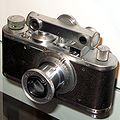
Optical rangefinders using this principle, while applicable to several purposes, were widely used for military purposes—determining the range of a target—and for photographic use, determining the distance of a subject to photograph to allow focusing on it. Photographic rangefinders were initially accessories, from which the distance read off could be transferred to the camera's focusing mechanism; later they were built into rangefinder cameras, so that the image was in focus when the images were made to coincide.

Usage

[edit]
Eyepiece image of a naval rangefinder, showing the displaced image when not yet adjusted for range

The coincidence rangefinder uses a single eyepiece. Light from the target enters the rangefinder through two windows located at either end of the instrument. At either side the incident beam is reflected to the center of the optical bar by a pentaprism. The optical bar is ideally made from a material with a low coefficient of thermal expansion so that optical path lengths do not change significantly with temperature. This reflected beam first passes through an objective lens and is then merged with the beam of the opposing side with an ocular prism sub-assembly to form two images of the target which are viewed by the observer through the eyepiece. Since either beam enters the instrument at a slightly different angle the resulting image, if unaltered, will appear blurry. Therefore, in one arm of the instrument a compensator is adjusted by the operator to tilt the beam until the two images match. At this point the images are said to be in coincidence. The degree of rotation of the compensator determines the range to the target by simple triangulation.[1] Coincidence rangefinders made by Barr and Stroud used two eyepieces, and may be confused with stereoscopic units. The second eyepiece showed the operator a range scale so the user could range and read the range scale simultaneously.[2][3]

Coincidence vs stereoscopic rangefinders

[edit]

In November and December 1941, the United States National Defense Research Committee conducted extensive tests between the American Bausch and Lomb M1 stereoscopic rangefinder and the British Barr and Stroud FQ 25 and UB 7 coincidence rangefinders, and concluded "that the tests indicate no important difference in the precision obtainable from the two types of instrument — coincidence and stereoscopic. They do indicate, however, that the difference in performance between large and small instruments is by no means as great as would be anticipated from simple geometrical optics. The report concludes with the belief that stereoscopic and coincidence acuities are about equal. Under favourable conditions existing instruments of the two types perform about equally well, and the choice between them for any given purpose must be based on matters of convenience related to the particular conditions under which they are to be used."[4]

See also

[edit]

References

[edit]
[edit]
Revisions and contributorsEdit on WikipediaRead on Wikipedia
from Grokipedia
A coincidence rangefinder is an optical instrument that determines the distance to a target by means of triangulation, employing a fixed baseline between two objective lenses to capture separate images of the target, which the operator aligns into a single coincident view through an eyepiece by adjusting optical elements such as prisms or wedges. The principle relies on geometrical optics, where the angular displacement required for alignment is inversely proportional to the target's range, allowing precise measurements without relying on the observer's stereoscopic depth perception, unlike stereoscopic rangefinders. This design typically features a monocular eyepiece for simplicity and can achieve accuracies on the order of 1% of the range under optimal conditions, though performance varies with factors like target contrast, atmospheric haze, and operator skill. The invention of the modern coincidence rangefinder is credited to Scottish engineers Archibald Barr and William Stroud, who founded Barr & Stroud in Glasgow in 1888 and developed the first practical model, the FA Mark I, in 1892, building on earlier concepts such as Patrick Adie's 1860 design. Adopted by the Royal Navy in 1893 after successful trials on HMS Arethusa, early production models such as the FQ2 enabled ranges up to 14,500 yards with a 3-yard baseline. During World War I, models like the FQ2 and FT24 were standard on British battleships, contributing to fire control at the Battle of Jutland in 1916, while German counterparts such as the Zeiss Bg used similar principles. By World War II, refinements including helium-filled tubes to reduce thermal errors and Invar components for stability improved precision to within 5-10 yards at 1,000 yards, with widespread use in antiaircraft directors, tank sights, and height finders. Primarily a military tool, the coincidence rangefinder enhanced artillery and naval targeting by providing rapid, passive ranging independent of illumination, outperforming visual estimation by factors of 2-4 in accuracy during combat. It was favored over stereoscopic types for its lower dependence on individual visual acuity, allowing broader operator selection—though only about 4% of tested personnel met stereoscopic standards for related systems—and was integrated into vehicles, ships, and infantry equipment by nations including the U.S., Britain, and Japan. Post-World War II, it was largely supplanted by radar and laser rangefinders due to greater speed and all-weather reliability, but its legacy persists in historical military optics and modern surveying instruments.

History

Early Inventions

The coincidence rangefinder was first invented by German instrument maker Georg Friedrich Brander in 1778, marking a significant advancement in optical distance measurement. Brander's device featured two mirrors positioned a fixed distance apart—typically around 1 meter—within a long, slim box resembling a subtense bar. By viewing a distant target through the instrument, the observer adjusted the alignment until the two images formed by reflection from each mirror coincided, allowing the parallax angle to be measured and converted to distance via basic triangulation geometry. The setup relied on the principle that the target's apparent displacement relative to the fixed baseline between mirrors directly corresponded to its range, with the coincidence point indicating the required angle for calculation. This basic mirror configuration provided a portable means for single-station ranging, with the geometric foundation rooted in similar triangles: the baseline BB between mirrors formed the base of one triangle, while the line of sight to the target formed the apex, yielding distance D=BtanθD = \frac{B}{\tan \theta}, where θ\theta is half the parallax angle at coincidence. Early prototypes were constructed from brass and wood, emphasizing simplicity for field use. Around 1860, Italian inventor Ignazio Porro developed a prototype coincidence rangefinder using prisms at his Institut Technomatique in Paris. In the same year, Scottish instrument maker Patrick Adie created the first practical prism-based coincidence rangefinder, which replaced or supplemented mirrors with compound prisms, such as direct-vision configurations, to redirect light paths without requiring mechanical adjustments or moving parts, thereby reducing friction and wear while maintaining optical precision. This prism arrangement allowed for more compact instruments that superimposed target images more reliably through refraction and total internal reflection, improving usability in varied lighting conditions. These early inventions found primary applications in surveying for mapping terrain and establishing baselines in civil engineering projects, as well as in astronomy for estimating distances to celestial bodies or terrestrial references during observations. The mirror and prism setups enabled non-contact measurements essential for large-scale land division and stellar positioning, with Brander's model particularly valued for its affordability in routine geodetic tasks. However, early models suffered from key limitations, including high sensitivity to vibration, which could disrupt delicate image coincidence and introduce errors in unstable environments like windy fields. Additionally, their effective range was generally restricted to under 1 km, constrained by the small baseline and limited optical resolution that made distant targets appear too indistinct for accurate alignment. These foundational devices laid the groundwork for later adaptations in military applications during the 20th century.

20th-Century Developments

Around the turn of the 20th century, coincidence rangefinders saw widespread adoption by major navies, driven by the need for precise naval gunnery at extended ranges. The British firm Barr & Stroud, which developed its coincidence design in the early 1890s, supplied instruments to the Royal Navy starting in 1893 after successful trials, with models featuring elongated tubes up to approximately 3 meters in length to accommodate the optical path for accurate targeting. French naval designs, such as those integrated into director control towers on dreadnought battleships like the Courbet class, also employed coincidence rangefinders with bases around 4.57 meters for main battery fire control, enhancing range estimation in fleet engagements. These instruments were prized for their portability relative to earlier systems, allowing installation on ship turrets and spotting tops, and were licensed for production by other nations, including the U.S. Navy, which adopted Barr & Stroud models in 1903. During World War I, innovations in coincidence rangefinder technology focused on integration with battleship fire control systems and enhancements in optical precision. British models like the FT 24, with a 5-yard (4.57-meter) base length and up to 28x magnification, were mounted in director towers on capital ships, enabling reliable ranging beyond 20,000 yards (approximately 18 km) under combat conditions, as demonstrated at the Battle of Jutland. Improvements in prism quality and mechanical stability reduced parallax errors, allowing for faster image coincidence and better performance in rough seas, while production scaled to equip most Royal Navy vessels, with licensed manufacturing by firms like Cooke, Troughton & Simms yielding thousands of units across Allied forces. These advancements marked a shift from handheld infantry tools to sophisticated naval systems, prioritizing length-to-base ratios around 10:1 to optimize accuracy without excessive bulk. In World War II, coincidence rangefinders reached peak refinement amid massive production for global conflict, though Allied forces increasingly supplemented them with radar. The U.S. Navy produced coincidence rangefinders, often licensed from Barr & Stroud, with bases typically 1 to 4 meters and maintained 10:1 length-to-base ratios for high accuracy at 20-30 km ranges, with thousands of units deployed for battleships, cruisers, and coastal artillery. British and Commonwealth navies continued relying on evolved Barr & Stroud designs, while German forces favored stereoscopic alternatives from Carl Zeiss, though some coincidence variants were tested; overall, wartime demands led to thousands of instruments deployed, emphasizing ruggedized prisms and quick-alignment mechanisms for anti-aircraft and surface gunnery. Following World War II, the rise of electronic rangefinders and radar accelerated the decline of optical coincidence systems in naval applications, rendering them obsolete by the 1950s due to limitations in all-weather performance and speed. However, they persisted in land-based artillery, particularly for field guns and howitzers, where low-cost and simplicity suited non-electronic environments; U.S. and NATO forces used variants like the M1A1 until the mid-1960s, when laser and infrared alternatives fully supplanted them. This gradual phase-out reflected broader shifts toward integrated electronic fire control, though coincidence rangefinders' legacy endured in training and reserve equipment into the Vietnam era.

Principle of Operation

Triangulation Fundamentals

The principle of triangulation in rangefinders relies on measuring the parallax effect, which arises from the apparent shift in the position of a target when viewed from two slightly separated viewpoints. This angular separation creates a measurable displacement in the target's image that is inversely proportional to its distance from the observer. In optical systems like coincidence rangefinders, light rays from the target enter two objective lenses separated by a fixed baseline, forming two slightly offset images that can be analyzed to compute range. The core geometric relationship for distance calculation is derived from similar triangles in the optical path: the distance DD to the target is given by D=BfdD = \frac{B \cdot f}{d}, where BB is the baseline separation between the objective lenses, ff is the focal length of the objectives, and dd is the apparent displacement of the target image in the focal plane when the views are not coincided. This formula stems from the small-angle approximation of the parallax angle θdf\theta \approx \frac{d}{f}, such that DBθD \approx \frac{B}{\theta}, linking the physical separation to the observed image shift. In coincidence rangefinders, the baseline BB is fixed, providing a constant reference for triangulation and enabling precise, repeatable measurements without mechanical adjustment of the separation, unlike some other rangefinder types that employ variable baselines for different ranges. This fixed configuration simplifies the optics while relying on internal adjustments, such as rotating prisms, to align the images. Light paths in these devices follow a structured trajectory: rays from the distant target diverge and enter the two end objective lenses, separated by the baseline BB; each ray bundle is then reflected internally (often via penta prisms to maintain orientation) and focused by the objective lenses onto a common plane near the eyepiece. At this plane, a coincidence prism splits and superimposes the images, allowing the operator to observe the parallax-induced displacement directly; adjustment mechanisms shift one image until coincidence is achieved, corresponding to zero effective dd. This setup ensures the parallax triangle is resolved optically in the instrument's focal plane.

Image Coincidence Process

In a coincidence rangefinder, the target is observed through a single eyepiece using one eye, with light rays entering via two objective lenses located at opposite ends of the instrument to capture offset fields of view based on the fixed separation between the lenses. These objective lenses form separate magnified images of the target, which are then directed inward via reflecting elements such as pentaprisms that deflect the rays by 90 degrees without inverting the image. The rays proceed to a central coincidence prism assembly, where semi-reflecting surfaces or mirrors split each incoming image into complementary halves—typically suppressing the upper half of the image from the right objective and the lower half from the left—to create two partial views of the target. The split half-images are superimposed within the coincidence prism to form a single composite erect image visible in the eyepiece, with a distinct halving line separating the two halves along the horizontal midline. The operator achieves coincidence by rotating an adjustable prism or mirror in one optical path, which laterally shifts the position of one half-image relative to the other until prominent target features align precisely along the halving line—for instance, the vertical edges of a ship's silhouette merging seamlessly. This alignment corresponds to the point where the two lines of sight intersect at the target, calibrated against the instrument's triangulation baseline to yield a direct range reading from an internal scale. The optical paths incorporate Porro prisms or roof prisms to reflect, invert, and merge the images, ensuring the final view is upright and free from left-right reversal or chromatic aberrations that could distort alignment. Potential errors in the process arise from atmospheric refraction, which bends light rays unevenly due to variations in air density, causing the apparent position of the target to shift and leading to misalignment of the half-images. Such distortions are particularly pronounced over long ranges or in non-uniform atmospheric conditions, qualitatively reducing accuracy unless mitigated by environmental corrections.

Design and Components

Optical Elements

The optical elements of a coincidence rangefinder form the core of its light-gathering and image-alignment system, enabling the precise superposition of views from two separated perspectives to measure distance via triangulation. These components typically include paired objective lenses, specialized prisms for image erection and field division, and a central eyepiece, all constructed from high-quality optical glass to minimize aberrations and ensure clarity over extended ranges. Objective lenses consist of paired high-quality achromatic doublets, typically with diameters ranging from 5 to 15 cm, positioned at a fixed baseline separation of 0.5 to 2 m depending on the instrument's intended range and portability. These lenses, often composed of crown glass (such as BK7) combined with flint glass (such as SF2) to control chromatic dispersion, focus incoming light from distant targets onto an intermediate image plane, forming sharp, inverted images without significant color fringing. The achromatic design corrects for spherical and chromatic aberrations, allowing effective operation up to several kilometers in clear conditions. Prisms play a critical role in erecting the inverted images and dividing the field of view into left and right halves for coincidence alignment. Roof prisms, also known as Amici prisms, are employed for image erection, reflecting light twice to revert the orientation while maintaining a constant deviation angle; these are machined with precise roof angles (accurate to 1-2 arcseconds) to prevent image doubling. For field division, a coincidence prism splits the incoming light into two non-inverted halves, creating a sharp dividing line in the observer's view, while penta prisms at the ends deviate the light paths by exactly 90 degrees without inversion, using silvered surfaces for efficient reflection. The eyepiece provides monocular viewing of the merged image, typically a single wide-field ocular with magnification of 10-20x, designed as a doublet (field and eye lenses) using crown or borosilicate glass for a flat field and long eye relief. Adjustable diopter settings, often from +2 to -4, accommodate user vision, while the overall system ensures the superimposed images appear at infinity for comfortable observation. In mid-20th-century developments, particularly for low-light naval applications, anti-glare coatings—such as magnesium fluoride layers—and neutral-density filters were introduced on lenses and prisms to reduce surface reflections and internal stray light, improving transmission efficiency to over 90% in visible wavelengths and enhancing performance in dim conditions. These coatings, pioneered in the 1930s and widely adopted during World War II, minimized glare from bright sources like searchlights or sun reflections on water.

Mechanical and Structural Features

Coincidence rangefinders incorporate adjustment knobs that utilize helical gears or cams linked to rotating prisms, enabling precise shifting of the observed images to achieve coincidence. These mechanisms are typically calibrated to linear or drum scales for range readout, delivering an accuracy of ±1% at distances up to 10 km. The core structural design consists of tubular housings constructed from aluminum or brass, with overall lengths scaled to the instrument's baseline to optimize ranging capability; for instance, a 2 m tube supports effective operation out to 10 km. In marine environments, these housings feature waterproof seals and robust enclosures to withstand exposure to saltwater and humidity. For enhanced thermal stability, especially in naval applications, components like Invar alloys were used for low expansion, and some designs incorporated helium-filled tubes to reduce air refraction errors due to temperature fluctuations. Mounting interfaces vary by application, including stable tripod bases for artillery spotting and gimbal mounts for integration into ship fire-control directors, alongside adaptations for handheld portable models versus permanent fixed installations. Maintenance provisions include protective dust covers to shield internal components from contaminants and temperature compensation screws that adjust for thermal expansion in the mechanical structure. These elements ensure alignment with the optical paths during field use.

Usage and Operation

Step-by-Step Procedure

To operate a coincidence rangefinder, begin with proper setup by removing any protective covers from the objective lenses and ensuring the device is securely mounted on a level tripod for fixed installations or held steadily using a shoulder harness for portable models. Clean the optics gently with a camel's hair brush and lens paper to avoid scratches, and test the internal illumination if available for low-light conditions. For handheld use, position the rangefinder against the shoulder or chest to minimize vibration, whereas fixed mounts provide inherent stability for prolonged observations in naval or artillery settings. Next, align the rangefinder on the target by training the device using an auxiliary trainer telescope or open sights for rapid acquisition, especially in combat scenarios where quick spotting is essential. Center the eye properly in the eyepiece to avoid parallax errors, then adjust the eyepiece focus—typically ranging from +2 to -4 diopters—on a high-contrast feature of the target until the internal halving line or reticle appears sharp. Through the single eyepiece, the operator views two superimposed half-images of the target, split by the coincidence prism, such as the separated upper-right and lower-left portions representing distinct views from the device's objective lenses. To measure the range, rotate the measuring knob or wedge adjustment in a smooth, continuous motion—either directly in one direction for simple targets or alternately back-and-forth for precision—until the split images coincide perfectly along a vertical or horizontal line, aligning features like a ship's mast with its hull. Once coincidence is achieved, read the distance directly from the internal or external range scale, calibrated in yards or meters, which corresponds to the angular adjustment made by the knob. This superposition of images, derived from the optical design's triangulation baseline, yields the target distance without requiring stereoscopic depth perception. For reliable results, take multiple readings—typically three to five—by repeating the alignment and coincidence process on the same target, then average them to account for minor operator variations or transient conditions. Note environmental factors such as atmospheric haze, heat waves, or glare, which can blur the images and degrade accuracy; in such cases, apply ray filters (e.g., yellow for mist or dark smoke for bright light) or switch to lower magnification modes. In combat, handheld rangefinders demand practice for steady holding to enable fast acquisition within seconds, while fixed units allow for more deliberate averaging under fire.

Calibration and Error Correction

Initial calibration of a coincidence rangefinder involves zeroing the instrument at known distances to ensure accurate scale alignment, typically performed using a test range or verified landmarks such as a 100-meter baseline. This process requires adjusting the prism tilt or internal correction wedges to achieve precise image coincidence on a target at the known distance, often verified through multiple readings by trained operators to account for individual variations in perception. Common error types include collimation drift, which arises from mechanical shifts due to shock, vibration, or temperature changes, leading to misalignment of the optical axes and inaccurate range readings; this is corrected through re-zeroing procedures using a double collimator to measure and adjust deviations to within tolerances of ±15 arcminutes vertically and ±30 arcminutes horizontally. Another key error source is baseline expansion caused by thermal effects on the fixed distance between objective lenses, typically requiring application of correction factors based on the material's coefficient of thermal expansion—such as approximately 0.0012% per °C for steel baselines—to adjust the range scale and maintain linearity across temperatures. In field conditions, parallax errors due to improper eye positioning are mitigated by adjusting the diopter setting and ensuring proper eye centering at the eyepiece to the operator's specifications, ensuring clear and aligned views without strain, while magnification checks confirm optical integrity. Verification procedures involve comparing rangefinder outputs against independent measures, such as tape measures for short ranges or known landmarks for longer distances, with multiple observations (e.g., five readings at 500 m, 1000 m, 2000 m, and 3000 m) averaged to detect and correct systematic biases. Typical accuracy for naval coincidence rangefinder models, after proper calibration and error correction, achieves errors on the order of 0.5% to 1% of the range under optimal conditions, enabling reliable targeting in operational scenarios when environmental factors like temperature and humidity are accounted for through internal adjustment mechanisms.

Applications

Military Implementations

Coincidence rangefinders played a pivotal role in naval gunnery during World War I, particularly in the British Royal Navy, where they were integrated into fire control directors such as the Dreyer Fire Control Table. These systems processed range data from the rangefinders to compute firing solutions for main battery guns, including the 15-inch naval guns on dreadnought battleships, which could engage targets at spotting ranges exceeding 20,000 yards. The Barr & Stroud FT 24 model, with a 15-foot baseline, was specifically employed on Queen Elizabeth-class ships for enhanced accuracy at long distances, feeding data into the Dreyer Table to adjust gun elevation and bearing amid ship motion and vibration. In artillery spotting during World War I, portable coincidence rangefinders enabled forward observers in trenches to adjust indirect fire for field guns, with models like the Barr & Stroud FT 27 providing short-base measurements suitable for man-portable use up to approximately 10-15 km. These devices, often Zeiss-inspired in design across European armies including French units, allowed spotters to triangulate enemy positions obscured by terrain, improving barrage accuracy in static warfare environments. During World War II, compact coincidence rangefinders were incorporated into some tank periscopes and sights to assist gunners in ranging main guns against armored targets at typical combat distances of 500-1,000 yards. In the Battle of Jutland (1916), British coincidence rangefinders, primarily the 9-foot FQ 2 models supplemented by FT 24 on select ships, contributed to early ranging but suffered from visibility issues and smoke, resulting in hit probabilities around 3% at 16,000 yards during the fleet action. The Fifth Battle Squadron achieved notable success with 15-foot rangefinders, scoring three hits on German battlecruisers Moltke and Von der Tann at extended ranges, while HMS Iron Duke registered seven hits on SMS König at 11,000 yards using Dreyer Table integration. By the Pacific Theater in World War II, advancements in rangefinder design and fire control elevated U.S. Navy hit probabilities in gunnery exercises to approximately 20%, a fourfold improvement over World War I baselines, enabling effective engagements against Japanese forces in battles like those at Guadalcanal and Leyte Gulf.

Civilian and Surveying Uses

Coincidence rangefinders found significant application in civilian photography through their integration into compact 35mm cameras, particularly Leica models developed in the early 20th century. Oskar Barnack, who joined Ernst Leitz Optische Werke in 1908, prototyped the Ur-Leica in 1913 as a portable camera using 35mm cinema film, addressing the need for discreet image capture. The Leica I, introduced in 1925, laid the foundation, but the Leica II in 1932 incorporated a built-in coincidence rangefinder coupled to the lens focusing mechanism, allowing photographers to align two superimposed images in the viewfinder for precise distance measurement and focus adjustment. This innovation enabled rapid, accurate focusing essential for street photography, where photographers like Henri Cartier-Bresson captured candid moments without the bulk of larger view cameras. In surveying and civil engineering, optical instruments employing triangulation principles, such as the Hilger & Watts Microptic theodolite introduced in the 1950s, integrated optical micrometers for high-precision angular readings and supported subtense bar methods that achieved accuracies around 10 meters at 1 kilometer distances in field conditions. These devices facilitated efficient baseline establishment and contour plotting in rugged terrains, aiding infrastructure projects such as road and dam construction during the mid-20th century. Beyond photography and surveying, coincidence rangefinders served in specialized civilian fields including forestry for range estimation and tree height measurement. Historical optical devices, utilizing lenses and mirrors for image superposition, allowed foresters to determine distances to tree tops via trigonometric principles, supporting inventory and yield calculations in pre-laser eras. In sports optics, early 20th-century models provided golfers with portable yardage estimates to hazards or greens, enhancing shot planning on courses without relying on caddies or pacing. For meteorology, optical theodolites equipped with rangefinder capabilities tracked pilot balloons from the early 1900s, enabling wind speed and direction profiling aloft by correlating ascent rates with angular observations. The enduring appeal of coincidence rangefinders in these applications stemmed from their mechanical simplicity, requiring no external power source and thus operating reliably in remote or adverse conditions. Their lightweight construction—often under 1 kilogram—promoted portability for field users, contrasting with bulkier alternatives and allowing quick deployments in dynamic scenarios like urban photography or balloon ascents.

Comparisons

Versus Stereoscopic Rangefinders

Coincidence rangefinders operate on a monocular viewing principle, where the operator aligns two superimposed images of the target—typically split horizontally or vertically—into a single coincident image through a single eyepiece, relying on precise mechanical adjustment rather than depth perception. In contrast, stereoscopic rangefinders employ a binocular viewing method, presenting separate images to each eye that the operator fuses into a three-dimensional view using natural parallax and depth cues, with a movable reticle or mark adjusted to match the target's perceived distance. This monocular alignment in coincidence systems simplifies training and reduces perceptual demands, making it accessible to a broader range of operators without requiring strong stereopsis, whereas stereoscopic systems demand good binocular vision, leading to rejection rates of about 96% (or acceptance rates of only about 4%) among potential users due to insufficient depth perception acuity. Regarding accuracy and effective range, coincidence rangefinders generally offer higher precision for long-distance measurements, achieving errors of less than 1% up to 14,500 yards in clear conditions, with minimal subjective variability from the operator. Stereoscopic rangefinders, while capable of ranges up to 17,500-20,000 yards, exhibit slightly higher errors—such as 165 meters at 16,000 meters—and perform better in medium ranges of 5,000-15,000 yards, particularly for moving or low-contrast targets like shell splashes, though they are more susceptible to atmospheric distortions like haze. Coincidence types excel in stable, high-visibility scenarios due to their reliance on edge alignment, but stereoscopic instruments provide faster initial ranging and greater consistency in adverse weather, albeit with increased operator fatigue over prolonged use. Design trade-offs highlight the mechanical precision required in coincidence rangefinders, which use fewer optical components and compensator wedges for image superposition, resulting in lighter, more compact units that are less prone to eye strain but demand exact calibration to avoid misalignment errors from temperature or vibration. Stereoscopic rangefinders, conversely, incorporate dual optical paths and interocular adjustments, making them heavier and more complex, with performance heavily dependent on the operator's stereo acuity—requiring training periods of several days to weeks—and vulnerability to psychological biases in depth judgment. Both share a common triangulation base for distance calculation, but the stereoscopic approach leverages human perceptual intuition at the cost of higher rejection and fatigue rates, while coincidence prioritizes reliability through objective alignment. Historically, the British predominantly favored rangefinders for their reliability and ease of use in naval gunnery, with British systems like the Barr & Stroud FT 24 achieving widespread in control directors. German forces, however, preferred stereoscopic designs from Zeiss, such as the 10-meter base models on battleships like the Bismarck, valuing their speed and against varied despite the need for skilled operators; this persisted through both wars, influencing tactical advantages in engagements like and subsequent WWII actions.

Relation to Modern Technologies

The introduction of laser rangefinders in the 1960s marked a significant transition from optical coincidence rangefinders, providing enhanced precision and reliability for military applications. The AN/GVS-5, a handheld laser rangefinder developed for the U.S. Army, exemplifies this shift; introduced in the early 1970s following initial military demonstrations in 1961, it achieved a range accuracy of ±10 meters up to 10 kilometers, eliminating the need for subjective image alignment required in coincidence systems. Unlike coincidence rangefinders, which demanded precise operator adjustment to merge split images, laser devices simply required pointing at the target, reducing human error and enabling faster measurements in combat scenarios. By the 1980s, non-optical alternatives like radar further supplanted coincidence designs in military use, offering all-weather operability that optical systems lacked due to their dependence on clear visibility. Radar rangefinders, integrated into fire control systems, provided continuous ranging without line-of-sight restrictions, rendering passive optical methods obsolete for most tactical applications as electronic advancements proliferated. Despite their , rangefinders retain a legacy as educational tools in and courses, where simple, low-cost replicas demonstrate principles for students. In niche low-tech environments, such as in developing regions, they persist to their affordability and lack of power requirements, serving as reliable alternatives where modern are impractical. Key differences highlight the trade-offs: coincidence rangefinders operate passively without batteries or emissions, relying on ambient light for silent, undetectable use, but require seconds for manual alignment and yield variable accuracy based on operator skill and conditions. In contrast, modern active systems like lasers emit pulses for millisecond-speed measurements with consistent sub-meter precision over kilometers, though they demand power sources and can reveal the user's position through detectable signals.

References

Add your contribution
Related Hubs
User Avatar
No comments yet.