Recent from talks
Nothing was collected or created yet.
View-Master
View on Wikipedia
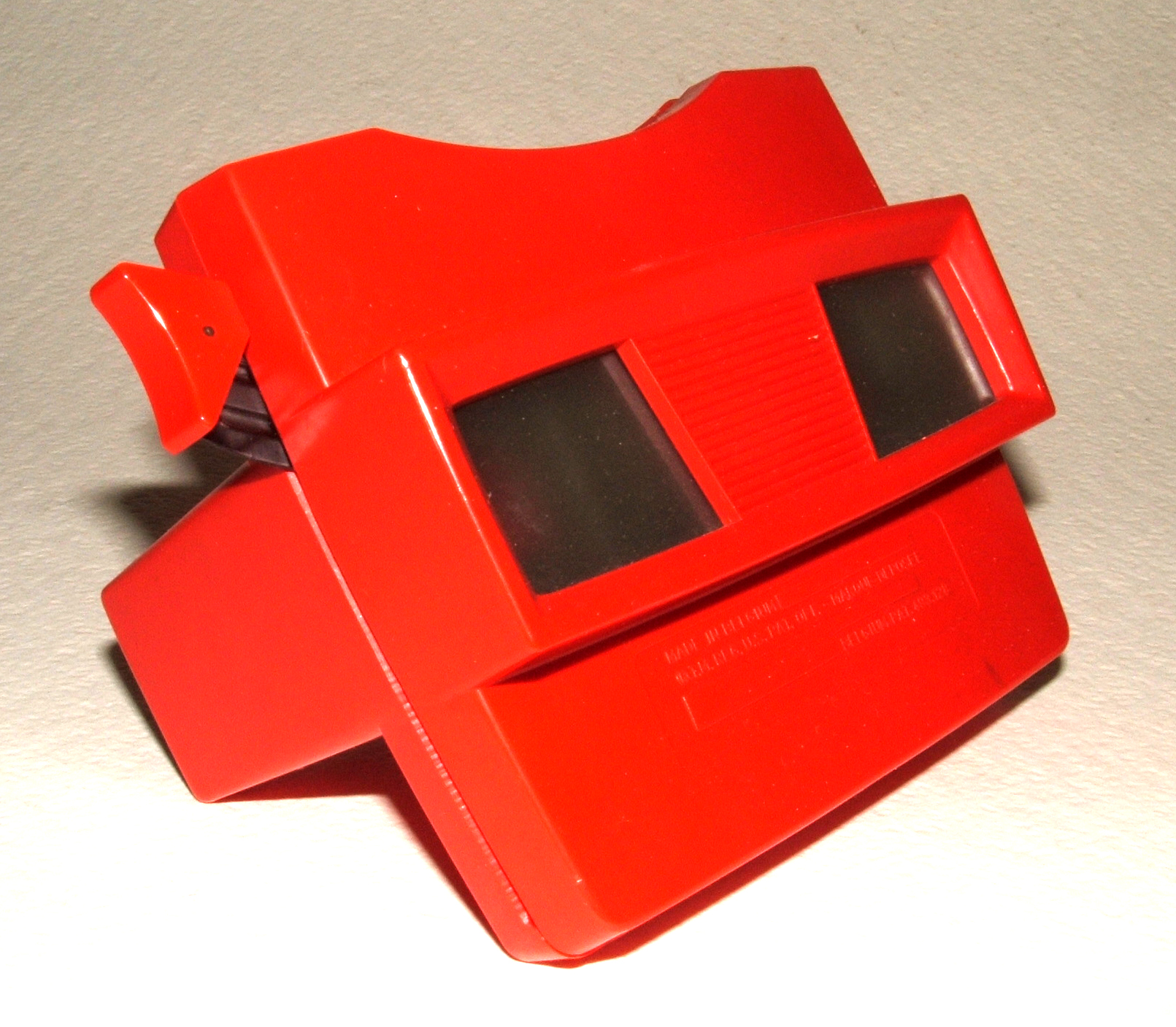
A View-Master Model G, introduced in 1962 | |
| Type | Stereoscope |
|---|---|
| Invented by | William Gruber |
| Company | Mattel |
| Country | United States |
| Availability | 1939–present |
View-Master is the trademark name of a line of special-format stereoscopes and corresponding View-Master "reels", which are thin cardboard disks containing seven Stereoscopic 3-D pairs of small transparent color photographs on film.[1] It was originally manufactured and sold by Sawyer's.
The View-Master system was introduced in 1939, four years after the advent of Kodachrome color film made the use of small, high-quality photographic color images practical. Tourist attraction and travel views predominated in View-Master's early lists of reels, most of which were meant to be of interest to users of all ages. Most current View-Master reels are intended for children.[citation needed]
History
[edit]1919–1956: early photo services
[edit]This section needs additional citations for verification. (November 2021) |
Edwin Eugene Mayer worked as a pharmacist at Owl Drug store in downtown Portland, Oregon, after serving in the U.S. Army in World War I. He built up a photo-finishing business there, and bought into Sawyer's Photo Finishing Service in 1919 with the help of his father August Mayer, his fiancée Eva McAnulty, and her sister Vi McAnulty.
Edwin described how he started the business in a letter dated April 1, 1954: "Suffice to say that in 1919, what little it was, was purchased with borrowed ($3,500) money from Dad, aided by about $1,600 in insurance money Eva got when her father died and which was left in permanently, and $1,600 borrowed from Vi and repaid, along with Dad's notes, within a few years."[2]
As the business grew, Ed Mayer incorporated in about 1926, taking on partners Harold and Beulth F. Graves, Thomas and Pauline Meyer, and Augusta and Raymond F. Kelly, renaming the business Sawyer Service, Inc. The company relocated to a large two-story building at 181 Ella St., near Morrison Street in Portland, Oregon.[3]
The company was producing photographic postcards and album sets as souvenirs by 1926, when Harold Graves joined Sawyer's. Graves handled marketing for the products while Mayer ran the business. Later, photographic greeting cards were added to the Sawyer's product line, marketed to major department stores. Sawyer's was the nation's largest producer of scenic postcards in the 1920s and the future View-Master viewer eventually became an extension of the two-dimensional cards.

The company took the first steps towards developing the View-Master after Edwin Mayer and Graves met with William Gruber, an organ maker of German origin trained by Welte & Sons and an avid photographer living in Portland.[4] Mayer and Gruber had both developed devices for viewing stereo images, but Gruber had made up a stereo imaging rig out of two Kodak Bantam Specials mounted together on a tripod. He designed a machine that mounted the tiny pieces of Kodachrome color transparency film into reels made from heavy paper stock. A special viewer was also designed and produced. He had the idea of updating the old-fashioned stereoscope by using the new Kodachrome 16-mm color film, which had recently become available.
New business venture
[edit]This section needs additional citations for verification. (November 2021) |
A View-Master reel holds 14 film transparencies in seven pairs that create the seven stereoscopic images. The components of each pair are viewed simultaneously, one by each eye, thus simulating binocular depth perception.
According to a 1960 court document, the Gruber-Sawyer partner venture began from that first meeting in 1938. Thereafter, Ed Mayer negotiated with Gruber while production methods and some marketing were developed. A formal agreement was signed in February 1942 between Gruber and Sawyer partners, doing business as Sawyer's.
Mayer and people within the Sawyer's organization were uncertain about what to call the new product, but they eventually settled on the name of View-Master. The View-Master brand name eventually came to be recognized by 65% of the world's population, but Gruber disliked the name, believing that it sounded too much like Toast-Master, Mix-Master or some other kitchen appliance.[5]
The View-Master was introduced at the 1939 New York World's Fair, marked "Patent Applied For". It was intended as an alternative to the scenic postcard, and was originally sold at photography shops, stationery stores and scenic-attraction gift shops. The main subjects of View-Master reels were Carlsbad Caverns and the Grand Canyon.[1]
The View-Master was marketed through Mayer's photo-finishing, postcard and greeting card company Sawyer's Service, Inc., known eventually as Sawyer's, Inc. The partnership led to the retail sales of View-Master viewers and reels. The patent for the viewing device was issued in 1940, and this original model came to be called the Model A viewer. Within a very short time, the View-Master supplanted the postcard business at Sawyer's.
Expansion
[edit]Mayer gave details of the company's expansion in a letter dated April 1, 1954:
In 1939, 20 years after starting the business, we had, by dint of hard work and long hours and frugal living, accumulated a business (Sawyer's) worth about $58,000.00 and Western Photo Supply Co. owning the buildings, worth about $30,000.00. The above figures were for the total business and buildings owned by the Kellys, Graves, Mayers and Meyers. In 1946, we had already grown a lot from 1939, and Sawyer's made a lease with Western Photo Supply Co., they to build and lease two new buildings to Sawyer's, in addition to the two we already had. At this point, Sawyer's also decided to change its structure from a partnership to a corporation, for various good reasons, one of which was to permit our children to participate in the stock ownership.[3]
In the 1940s, the United States military recognized the potential for View-Master products for personnel training, purchasing 100,000 viewers and nearly six million reels from 1942 to the end of World War II in 1945.[1]
After the development of the View-Master, Sawyer's, Inc. moved into a new building at 735 S.W. 20th Place in downtown Portland. The company also occupied a building next door at 740 S.W. 21st Avenue. In 1951, Mayer and his Sawyer's partners built a large plant in Washington County, Oregon. After moving to the new plant, Mayer leased the building on 20th Place to Oregon Television, Inc.[citation needed]
1950s
[edit]In 1951, Sawyer's purchased Tru-Vue, the main competitor of View-Master. The takeover included Tru-Vue's licensing rights to Walt Disney Studios properties.[6] Sawyer's capitalized on the opportunity and produced numerous reels featuring Disney characters. In 1955, reels of the newly opened Disneyland were produced.[1]
Joe Liptak was the artist responsible for most of the Disney and the early Hanna-Barbera reels.[7][8]
In 1952, Sawyer's began its View-Master Personal line, which included the View-Master Personal Stereo Camera for users to make their own View-Master reels. It was successful at first, but the line was discontinued in ten years. This line spawned the Model D viewer, View-Master's highest-quality viewer, which was available until the early 1970s, and the Stereomatic 500, View-Master's only 3D projector.[1] The other projectors were 2D and used only one of the images.
The Model E was introduced in 1955 with a more modern design, large ivory buttons on the picture-changer levers and a large "V" slot on top for easier reel insertion. It was released in brown and black in the United States, and some other colors elsewhere.[9] It was about four inches high, five inches wide and four inches deep.
The Model F was introduced in 1958. It used C-cell batteries to power an internal lighting source. Industrial designer Chuck Harrison led the team designing the Model F View-Master.[10]


1962–present: stereoscopic toy
[edit]The View-Master had been originally constructed from Kodak Tenite plastic and then Bakelite, a hard, sturdy, somewhat heavy plastic. In 1962, lighter thermoplastic versions were introduced, beginning with the Model G, a change driven by Sawyer's president Bob Brost.[1][11]
In 1966, Sawyer's was acquired by the General Aniline & Film (GAF) Corporation and became a wholly owned subsidiary. Under GAF's ownership, View-Master reels began to feature fewer scenic and more child-friendly subjects, such as toys and cartoons. Television series were featured on View-Master reels, such as Doctor Who (sold only in the U.K.), Rowan & Martin's Laugh-In, Star Trek, The Man from U.N.C.L.E., Family Affair, Here's Lucy and The Beverly Hillbillies. Actor Henry Fonda appeared in a series of TV commercials for the GAF View-Master.[1]
From 1970 to around 1997, GAF produced the Talking View-Master, which included audio technology along with the reels. Three major designs were produced, with increasing sophistication.[12] In the early 1970s, GAF introduced the View-Master Rear Screen Projector, a tabletop projector that displayed images from picture wheels.[13]
In 1980, View-Master released the Show Beam Projector, a toy that combined the company's stereoscopic images and flashlight technology to produce a portable handheld projector. The Show Beam used small film cartridges that were plugged into the side of the toy. Each cartridge contained 30 full-color 2D images.[14]
In 1981, GAF sold View-Master to a group of investors headed by Arnold Thaler, and the company was reconstituted as the View-Master International Group.[15]
In 1985, View-Master Video was introduced. Through a partnership with Warner Bros. Records, a live-action educational video series was produced by Together Again Productions and titled Kidsongs, designed for the educational market.[16]
View-Master International acquired the Ideal Toy Company in 1984 and became known as the View-Master Ideal Group, and the combined company was purchased by Tyco Toys in 1989.[17] Tyco, including the View-Master Ideal Group, merged with Mattel in 1997. View-Master was assigned to Mattel's preschool division and is now marketed under the Fisher-Price imprint, with a continued emphasis on children's content.
In 1998, during the purchase of the Tyco-owned plant by Mattel, the EPA investigated the View-Master factory supply well for the toxic chemical trichloroethylene (TCE). The plant was closed in 2001.[18]
In December 2008, Mattel ceased production of the scenic reels depicting tourist attractions that were descendants of the first View-Master reels sold in 1939. However, Mattel continued to produce reels featuring animated characters.[19]
2015–2019: Virtual reality
[edit]
In February 2015, Mattel announced a collaboration with Google to produce a new version of the View-Master called the View-Master Virtual Reality Viewer, based on virtual reality using smartphones. The new View-Master is an implementation of the Google Cardboard VR platform and is accompanied by a mobile app built using its SDK. Content is displayed on a smartphone screen; the phone itself is inserted into the back of the unit. Instead of being inserted directly into the View-Master, reels are scanned using an augmented reality interface that enables access to content from the reel, such as 360-degree panoramas, 3D models and minigames.[20][21]
Greenbot considered the View-Master to be the best low-cost Cardboard viewer, citing its build quality and comfort over models actually constructed from cardboard, but noting that the latch mechanism for securing the phone inside was not tight enough, and that there was no headphone-jack access. It was felt that the View-Master VR was "the kind of thing you might grab as a gift for the kids, but if you're curious about VR on your phone, chances are you'll use it as much as they do."[22]
In 2016, an updated iteration known as the DLX was released; it features improvements to its compatibility with smaller phones, a more secure latch for the phone compartment, and also adds focal adjustment and a headphone port.[23]
Both editions of the View-Master VR were discontinued in November 2019, and the Experience packs can no longer be installed by new users.[24]
In 2019, Mattel partnered with MGM to announce an upcoming feature film based on the View-Master. The project will be co-piloted by Robbie Brenner of Mattel's Films division and MGM's Cassidy Lange.[25]
Cumulative production
[edit]There have been some 25 viewer models, thousands of titles, and 1.5 billion reels produced. The basic design remained the same for reels and internal mechanisms, despite its long history and many changes in models and materials, ensuring that every reel will work in every model.[1]
Recognition
[edit]In 1999, View-Master was part of the second year of inductees added to the National Toy Hall of Fame.[26]
The View-Master is in The Strong National Museum of Play, The Henry Ford museum in Dearborn, Smithsonian National Museum of American History, Denver Art Museum, Museum of Modern Art (MoMA) in New York, amongst other collections.[27][28][29][30][31][32][33]
In 2025, the Chuck Harrison designed models from the early 1960s were included in Pirouette: Turning Points in Design, an exhibition at MoMA featuring "widely recognized design icons [...] highlighting pivotal moments in design history."[34][35][36][37]
Notable uses
[edit]
Reels have been produced for Disneyland, many TV shows (such as The Flying Nun, Lost in Space, and The Munsters), blockbuster movies (such as The Poseidon Adventure, E.T. the Extra-Terrestrial, and Jurassic Park), and the U.S. military (for airplane and ship identification as well as range estimation).
David L. Bassett, an expert on anatomy and dissection, collaborated with Gruber to create a 25-volume atlas of human anatomy using the View-Master system.[38]
View-Master produced custom reels for commercial customers to show 3-D images of products and services to potential clients. For example, in the early 1990s, Canadian restaurant chain East Side Mario's used a View-Master reel as their dessert menu.[39]
Among the newest View-Master products are a Discovery Channel View-Master, the new Virtual Viewer, the Discovery Channel View-Master Projector and Telescope, and the View-Master 3-D Pocket Viewer, which feature images of popular performers in concert and backstage.
See also
[edit]References
[edit]- ^ a b c d e f g h Mary Ann & Wolfgang Sell and Charley Van Pelt, "View-Master Memories" , M.A. and W. Sell, ISBN B0006S314I, 2000 Self-Published
- ^ Document written by Edwin E. Mayer, dated April 1, 1954, stating history of Sawyers, Inc. Published in the family history "The Morris and McAnulty Connection", by Peggy Savage, 2013, Canby, OR.
- ^ a b Document written by Edwin E. Mayer, dated April 1, 1954, stating history of Sawyers, Inc.
- ^ Gretchen Jane Gruber: The Biography of William B. Gruber. Mill City Press, Inc., 2015. ISBN 978-1634130097
- ^ 285 F.2d 683 Eva R. MAYER, Executrix of the Estate of Edwin E. Mayer, deceased, Harold J. Graves and Beulah F. Graves, Thomas O. Meyer and Pauline Meyer, Augusta Kelly, and The Estate of Raymond F. Kelly, deceased, Augusta Kelly, Residuary Legatee, Appellants, v. UNITED STATES of America, Appellee. No. 16103. United States Court of Appeals Ninth Circuit. Dec. 9, 1960.
- ^ Mary Ann Sell (November 10, 2017). "Focusing on View-Master history and value". Antique Trader. Retrieved November 2, 2019.
- ^ Joe Liptak - The View-Master Database
- ^ Hollis, Tim (March 25, 2015). Toons in Toyland: The Story of Cartoon Character Merchandise. Jackson, Mississippi: University Press of Mississippi. ISBN 978-1-62674-500-1.
- ^ "View-Master Model E - Replacement for the Model C ViewMaster". viewmaster.co.uk. Retrieved February 8, 2014.
- ^ Jonathan Glancey (July 31, 2008). "Classics of everyday design No 48: Jonathan Glancey on the View-Master | Art and design | guardian.co.uk". London: Guardian. Retrieved May 23, 2011.
- ^ a b Harrison, Charles. "Charles Harrison. View-master (model G). 1962 | MoMA". The Museum of Modern Art. Retrieved August 5, 2025.
- ^ Clatworthy, Keith. "Talking View-Master". 20th Century Stereo Viewers. Retrieved December 12, 2012.
- ^ Coopee, Todd (November 6, 2017). "GAF View-Master Rear Screen Projector". ToyTales.ca.
- ^ Coopee, Todd (February 24, 2020). "View-Master Show Beam Projector (1980)". Toy Tales.
- ^ Scott, Sharon M. (2010). Toys and American Culture: An Encyclopedia (Illustrated ed.). Greenwood. p. 330. ISBN 9780313347986.
- ^ "WB Records Teams With View-Master on Kidvid Projects". Variety. September 18, 1985. p. 44.
- ^ "View-Master Purchased" (PDF). Stereo World. 3. Vol. 16 (July/August ed.). 1989. p. 22. Retrieved November 20, 2021.
- ^ "ATSDR-PHA-HC-View-Master Factory Supply Well-p1". Atsdr.cdc.gov. Archived from the original on March 6, 2010. Retrieved May 23, 2011.
- ^ Doug Whiteman. "View-Master 3-D travel reels head into the sunset". pantagraph.com. Retrieved January 5, 2016.
- ^ Baig, Edward C. (February 13, 2015). "View-Master rides Google Cardboard into virtual reality". USA Today. Retrieved May 30, 2015.
- ^ "The VR View-Master is Google Cardboard for kids". The Verge. October 9, 2015. Retrieved October 10, 2015.
- ^ Hayward, Andrew (November 5, 2015). "The best cheap Cardboard VR viewer is… Mattel's View-Master?". Greenbot. Retrieved December 24, 2018.
- ^ Vincent, James (February 15, 2016). "Mattel's upgraded View-Master VR headset now comes with extra dinosaurs". The Verge. Retrieved December 24, 2018.
- ^ "View-Master™ VR Starter Pack & Deluxe VR Viewer". www.mattel.com. Retrieved July 17, 2020.
- ^ Kit, Boris (February 27, 2019). "View-Master Movie In the Works at MGM and Mattel Films (Exclusive)". The Hollywood Reporter. Retrieved March 25, 2019.
- ^ View-Master. "National Toy Hall of Fame". Strongmuseum.org. Retrieved January 16, 2023.
- ^ "View-Master". The Strong National Museum of Play. Retrieved August 4, 2025.
- ^ "Expanding Views: Charles Harrison's Redesign of the View-Master - Blog - The Henry Ford". www.thehenryford.org. Retrieved August 4, 2025.
- ^ "View-Master Model L viewer". americanhistory.si.edu. Retrieved August 4, 2025.
- ^ "Sawyer's View-Master | Smithsonian Institution". www.si.edu. Retrieved August 4, 2025.
- ^ "A New View: Charles Harrison's View-Master | Denver Art Museum". www.denverartmuseum.org. February 25, 2025. Retrieved August 4, 2025.
- ^ "Charles Harrison. View-master (model G). 1962 | MoMA". The Museum of Modern Art. Retrieved August 4, 2025.
- ^ "Tru-Vue and View-Master | ACMI collection". www.acmi.net.au. Retrieved August 4, 2025.
- ^ Harrison, Charles. "Charles Harrison. View-master (model G). 1962 | MoMA". The Museum of Modern Art. Retrieved August 5, 2025.
- ^ "Pirouette: Turning Points in Design". The Museum of Modern Art. Retrieved August 4, 2025.
- ^ "NASA Worm as Art, Museum of Modern Art Opens Exhibition Featuring NASA Worm". NASA. January 23, 2025. Retrieved August 4, 2025.
- ^ Feeney, Mark (July 23, 2025). "At MoMA, designs for living". The Boston Globe. Archived from the original on July 24, 2025. Retrieved August 4, 2025.
- ^ Schwartz, John (April 22, 2008). "The Body in Depth - New York Times". The New York Times. Retrieved May 23, 2011.
- ^ "The View-Master Ultimate Reel List - Commercial Reels". Retrieved August 12, 2012.
External links
[edit]View-Master
View on GrokipediaOrigins and Invention
Early Photo Services (1919–1939)
Sawyer's Photo Service was established in Portland, Oregon, in 1919 when Edwin Eugene Mayer, along with his brothers Fred and Al Mayer and associate Ray F. Kelly, acquired the existing photo-finishing business originally founded by Carleton Sawyer in 1914. Initially focused on commercial photography services, including tintype production and photo finishing for the Owl Drug Company, the firm quickly expanded its operations to serve over 350 drug stores across Oregon, Washington, and Idaho by the mid-1920s.[5][6] The company evolved from basic photo processing into a leader in postcard and scenic photography during the 1920s, capitalizing on the growing tourism industry with hand-colored images and sepia-toned scenic cards designed for early stereoscopes. Harold Graves joined in 1926, driving the shift toward souvenir production, and by 1927, Sawyer's had become the largest producer of photographic postcards and packet sets in the United States, emphasizing natural landscapes and tourist attractions to meet demand for affordable mementos. These efforts included early stereoscopic experiments, where photographers adapted cameras for paired-image capture to simulate depth without advanced viewers, overcoming challenges like alignment precision and exposure consistency in field conditions.[5][6][7] A pivotal partnership formed in 1938 when company president Harold Graves met inventor William B. Gruber at Oregon Caves National Monument, leading to a collaboration that introduced Kodachrome film techniques for vibrant color photography in multi-image formats. Gruber, leveraging the newly available 16mm Kodachrome transparency film, proposed innovations in stereo imaging that built on Sawyer's existing expertise in scenic capture, enabling the production of full-color transparencies despite technical hurdles such as film processing limitations and reel mounting accuracy. This alliance marked the culmination of two decades of photographic service growth, positioning the company for advancements in stereoscopic viewing.[8][6]Development of the Stereoscopic Viewer (1939–1940s)
The development of the View-Master stereoscopic viewer emerged from a pivotal collaboration between photographer and inventor William B. Gruber and Harold A. Graves, president of Sawyer's Photo Service, which began in 1938 during a chance meeting at Oregon Caves National Monument in southern Oregon. Gruber had been experimenting with stereoscopic photography using a custom rig of two cameras mounted together to capture paired images for depth perception, inspired by 19th-century stereoscopes but aiming to modernize them with vibrant color slides. Graves recognized the commercial potential of integrating this technology with the newly available Kodachrome color film, developed by Kodak in 1935, and partnered with Gruber to adapt Sawyer's existing photo printing expertise for a portable viewer. By early 1939, they produced the first working prototype: a handheld device with a rotating cardboard reel containing seven pairs of 16mm Kodachrome transparencies, enabling viewers to see 14 sequential 3D images by advancing the reel manually.[6][2][9] On January 20, 1939, Gruber filed for a U.S. patent on the core invention, describing a "stereoscopic viewing device" with a circular reel system that aligned paired images precisely for each eye to create the illusion of three-dimensional depth, a significant advancement over bulky single-slide stereoscopes. The patent, numbered 2,189,285, was granted on February 6, 1940, solidifying the technical foundation of the seven-disc reel format that became View-Master's hallmark. This innovation allowed for compact, reusable reels that could hold multiple scenes, making the device suitable for educational and entertainment purposes. The prototype's design emphasized affordability and portability, with the viewer constructed from lightweight Bakelite plastic and the reels from durable cardboard, facilitating mass production.[9] The device made its public debut at the 1939 New York World's Fair, where it was showcased as a modern marvel of color photography and 3D imaging, attracting attention from tourists and photographers alike. It was also featured at the 1940 Golden Gate International Exposition in San Francisco, further boosting early visibility through Sawyer's distribution networks in camera shops and souvenir outlets. Initial reception was strong, with the product positioning itself as an armchair travel aid for scenic and cultural subjects, though exact early sales figures are sparse; by 1941, it had expanded to over 100,000 retail stores nationwide.[2][3] World War II profoundly shaped the View-Master's early trajectory, as U.S. entry into the conflict in December 1941 prompted a pivot from consumer sales to military applications amid material shortages for civilian goods. The U.S. armed forces commissioned Sawyer's to produce training reels for tasks like aircraft identification and artillery spotting, leveraging the 3D format for realistic visual recognition in dim conditions. Between 1942 and 1945, the military acquired approximately 100,000 Model B viewers and nearly six million reels, which were distributed to troops for instructional purposes and even used in field manuals. This wartime demand not only sustained the company but also refined production techniques for higher volume and durability.[6][3][10] Following the war's end in 1945, View-Master resumed consumer-focused production with a full launch in 1946, reorienting toward family entertainment and leisure to capitalize on postwar economic recovery and increased leisure time. Early postwar reels emphasized whimsical and narrative themes, including fairy tale adaptations such as the 1946 "Snow White and the Seven Dwarfs" packet in the Fairy Tale series, which featured three-reel sets with accompanying story booklets created using clay figure models to engage children and families in immersive 3D storytelling. This shift marked View-Master's transition from a niche photographic tool to a mainstream household staple, highlighting its versatility for both education and play.[3]Commercial Growth and Ownership
Sawyer's Expansion (1940s–1960s)
Following World War II, Sawyer's Inc. capitalized on the success of View-Master's military applications, where approximately 100,000 Model B viewers and 6 million reels were produced for training purposes such as artillery spotting and aircraft identification.[3][11] This wartime demand transitioned into robust civilian growth, with the company relocating to a larger factory near Beaverton, Oregon, in 1951 to accommodate surging production.[6] By the late 1940s, Sawyer's introduced personalized reel services, allowing customers to submit photos for custom stereoscopic production via mail-order or using the newly developed View-Master Personal Stereo Camera launched in 1952.[11] Partnerships with national park services facilitated scenic tourism series, featuring destinations like the Grand Canyon and Carlsbad Caverns to promote 3D views of American landmarks.[6] In the 1950s, product diversification accelerated under Sawyer's stewardship, with the Model C viewer—introduced in 1946 and refined through the decade—offering improved Bakelite construction and a slotted reel-loading mechanism for enhanced durability and user convenience.[12] Educational content expanded significantly, incorporating packets on history, science, and natural phenomena, such as mushroom identification, floral studies, and anatomical dissections, building on the device's wartime instructional roots.[11] The 1951 acquisition of competitor Tru-Vue not only eliminated rivalry but also secured licensing for Disney characters, enabling child-oriented reels that shifted View-Master from adult souvenir to family entertainment staple.[3][6] International market penetration began in earnest during the mid-1950s, with reels depicting European landmarks and global cultures—such as British sites, Dutch festivals, and Yucatán artisans—distributed through export channels to appeal to overseas tourists and collectors.[11] Marketing strategies emphasized tie-ins with Hollywood, producing promotional reels for the 1950s 3D film boom, including previews of Disney productions tied to the 1955 Disneyland opening, alongside exclusives sold in department stores, pharmacies, and gift shops.[6][11] These efforts propelled View-Master to become one of America's most popular toys by the early 1960s, with billions of reels ultimately produced under Sawyer's, though specific annual civilian sales figures from the era remain undocumented in primary records.[6]GAF and Subsequent Acquisitions (1966–1997)
In 1966, Sawyer's Inc., the longtime producer of View-Master, was acquired by General Aniline & Film Corporation (GAF), a major player in film processing and cameras, which integrated the brand into its Photo Consumer Division as a wholly owned subsidiary.[13] This transition marked a strategic pivot, as GAF leveraged its resources to expand production and distribution while phasing out less profitable scenic and tourist-oriented reels in favor of content targeted at children, including tie-ins with popular television shows and films.[14] A notable innovation under GAF was the 1970 launch of the Talking View-Master, an audio-enhanced model that used special transparent phonograph records embedded in the reels to provide synchronized narration, enhancing the educational and entertainment value for young users.[15] By the late 1970s, shifting market dynamics prompted GAF to divest non-core assets, leading to the 1981 sale of View-Master to a group of investors headed by Arnold Thaler, former head of Ekco Housewares, for $24 million; the operation was reorganized as View-Master International Group (VMI).[16] Under Thaler's leadership, VMI prioritized cost reductions through process automation and targeted marketing, while introducing fresh reel themes aligned with 1980s pop culture, such as licensed properties from television and emerging media franchises.[13] In 1984, VMI expanded via its acquisition of the Ideal Toy Company, a prominent manufacturer of dolls and action figures, forming the View-Master Ideal Group to broaden its portfolio in the competitive toy industry.[17] The View-Master Ideal Group faced intensifying economic pressures in the late 1980s, culminating in its 1989 purchase by Tyco Toys for $54.3 million, which repositioned the brand within a larger mass-market toy ecosystem emphasizing affordable, high-volume products.[18] Tyco accelerated the shift toward licensed character-based reels, moving away from original scenic content to capitalize on blockbuster franchises like Star Wars and Barbie by the early 1990s, thereby appealing to a younger, media-savvy audience.[19] To enhance efficiency amid rising costs, Tyco implemented automation in reel and viewer assembly, with production elements gradually relocating to Mexico during the decade.[20] This era of consolidation peaked in 1997 with Tyco's merger into Mattel Inc., transferring View-Master to the Fisher-Price division and redirecting initial efforts toward preschool-aged demographics through simplified, durable designs.[21]Mattel Era (1997–present)
In 1997, Mattel acquired Tyco Toys, which included the View-Master Ideal Group, integrating the brand into its portfolio.[2] By 1998, View-Master was placed under the Fisher-Price division, Mattel's preschool subsidiary, to align with its focus on toys for young children. This shift prompted redesigns emphasizing child safety, such as softer edges and durable, non-toxic materials to meet stricter toy standards for ages 3 and up.[22] Under Fisher-Price, View-Master production emphasized educational content, particularly in the 2000s, with reels tied to science and discovery themes. Examples include partnerships with National Geographic and Discovery Channel for sets on endangered animals and natural habitats, promoting STEM learning through 3D imagery of wildlife and ecosystems.[23] These efforts positioned the product as a tool for visual and conceptual education rather than mere entertainment. In December 2008, Mattel halted production of scenic and tourist attraction reels, a staple since 1939, due to the rise of digital photography and declining demand for physical travel souvenirs.[23] The company pivoted to licensed media partnerships, producing reels featuring characters from Disney, Nickelodeon, and other franchises to capitalize on popular children's programming and maintain market relevance.[24] Mattel's sustainability initiatives extended to View-Master packaging in 2015, incorporating recyclable materials and reducing plastic use in line with corporate goals for 100% recyclable, reusable, or compostable packaging by 2030. By 2020, select classic reels were digitally archived and made accessible online through Mattel's digital platforms, preserving historical content amid the shift to virtual experiences.[22] Since the mid-2010s, Mattel has licensed physical production and sales of View-Master to Basic Fun!, which handles manufacturing and distribution of nostalgic and educational bundles.[25][26][27] As of 2025, View-Master remains available primarily through limited-edition collector sets and online sales via retailers like Amazon, focusing on nostalgic and educational bundles. Annual production has stabilized post-pandemic, though exact figures are not publicly detailed. The COVID-19 pandemic disrupted Mattel's supply chains from 2020 to 2022, causing delays in raw materials and manufacturing that affected the toy industry, including View-Master production.[28][29] These challenges prompted inventory buildup and diversification of suppliers to mitigate future risks.[29]Product Design and Variants
Classic Reel System
The classic View-Master viewer is a handheld stereoscopic device, typically constructed from durable plastic in later models, featuring a manual lever mechanism that advances the reel to display successive 3D images. Each reel contains seven pairs of small color transparencies—14 images in total—mounted on a circular cardboard disc, with the lever rotating the disc to align one stereo pair at a time with the viewer's binocular lenses for parallax-based depth perception. These transparencies, cut from Kodachrome film known for its high-quality color reproduction, measure approximately 12.9 mm x 11.9 mm, enabling compact yet vivid stereoscopic viewing.[30][31] The reels themselves are engineered as thin cardboard discs, approximately 3.5 inches (9 cm) in diameter, housing 14 individual film chips arranged in seven stereo pairs, where each pair consists of left- and right-eye images offset to simulate natural binocular vision. Production involved mounting these Kodachrome transparencies onto the disc using a precise assembly process to ensure alignment, with early reels featuring hand-engraved lettering for titles and captions to enhance user navigation. This construction allowed for a simple, battery-free operation, relying solely on ambient or backlighting for illumination, and emphasized portability and ease of use in the viewer's slot-loaded design.[31][32] Optically, the viewer employs two fixed-focus lenses angled to direct images separately to each eye, fostering stereopsis—the brain's fusion of slightly disparate views into a three-dimensional scene—without the need for electronic aids. Later iterations, such as the Model L introduced in the late 1970s, incorporated interpupillary distance adjustment via a sliding eyepiece mechanism to accommodate varying user eye spacings, improving comfort and clarity for prolonged sessions. The lenses, often precision-ground for minimal distortion, maintain a fixed focal length suited to the reel's image scale, delivering sharp 3D effects at a recommended viewing distance of about 10 inches.[33][34] A key aspect of the system's longevity is its backward compatibility, with reels produced since the 1939 debut interchangeable across all subsequent viewer models, ensuring enduring usability for collectors and users alike. Historically, this design has supported the creation of over 10,000 unique reel packets covering diverse subjects, from scenic vistas to educational topics, underscoring the format's versatility and market endurance without reliance on power sources. Optimal depth perception is achieved by holding the viewer 10–12 inches from the eyes, allowing natural head movement to explore the 3D scene in a self-contained, analog experience.[3][35]Audio-Enhanced and Specialized Models
In the 1970s, View-Master introduced audio enhancements to its classic reel system, beginning with the Talking View-Master launched by GAF in 1970. This battery-powered model integrated synchronized sound via a small transparent phonograph disc embedded in the reel, which played brief audio clips—such as narrations or sound effects like animal noises—aligned with each stereoscopic frame when a user pressed a sound bar to engage a needle and speaker cone.[15] Designed primarily for educational applications, it was bundled in packets covering topics like nature and science, providing up to 14 frames of 3D imagery with corresponding audio to enhance learning experiences for children.[15] A revised version, the Talking View-Master Electronic 3-D Viewer, debuted in 1984 and featured improved audio through a separate flexible black phonograph disc paired with the film reel, controlled by a microprocessor-driven motor, sapphire stylus, and linear tracking tone arm for better synchronization signaled by beeps. This iteration included volume control and headphone support, expanding its use in educational sets such as those featuring Sesame Street, alongside entertainment reels from Disney and television shows like Fraggle Rock and Knight Rider.[36] However, both models suffered from inherently poor sound quality due to the disc format, which lacked robust amplification and was prone to distortion, limiting their appeal despite initial popularity in retail. The original 1970 design was discontinued in 1981, while the 1984 electronic version ended production in the late 1980s after fewer than 45 titles were released, reflecting challenges in sustaining content variety and technical reliability.[15][36] Complementing these audio innovations, the 1980s saw the development of projection-based models for shared viewing, such as the Show Beam Projector introduced in 1980. This battery-operated, hand-held device used 2D film cartridges containing 30 full-color images, projecting them onto walls or screens via built-in flashlight technology, with features like a focus ring and frame advance button to facilitate group experiences during family activities or travel.[37] Although it lacked integrated audio, optional accessories allowed pairing with separate sound elements from compatible reels, making it suitable for communal entertainment in low-light settings. The projector remained available through the 1990s, bridging personal viewing with larger-scale displays.[37] Specialized editions expanded customization and accessibility during this era. In 1977, View-Master offered personal reel mounts and related tools as part of its ongoing Personal line, enabling users to create custom reels from their own stereo photographs by mounting film pairs into standard discs for viewing in any compatible stereoscope.[38] Earlier, in the 1950s, light attachment kits were developed for models like the bakelite Model C and Model E viewers, consisting of clip-on illuminators powered by batteries to backlight reels in dim environments, improving visibility for indoor or evening use without external lamps.[12][39] Niche models targeted portability and adult audiences as well. The 1946 Model C, an early compact iteration made from durable black bakelite, measured approximately pocket-sized dimensions for easy carrying, allowing on-the-go viewing of scenic or travel reels without the bulk of larger predecessors.[12] By the 1960s, deluxe stereoscopes like the Model G incorporated enhanced magnifiers and ergonomic designs with improved optics, catering to adult collectors and hobbyists interested in detailed 3D photography, such as professional landscapes or art reproductions. These variants emphasized precision viewing over child-oriented play, with production continuing until 1977.[40]Digital and VR Adaptations (2015–2019)
In 2015, Mattel, in collaboration with Google, launched the View-Master VR headset, a modern reinterpretation of the classic toy designed as a smartphone-based virtual reality viewer compatible with Google Cardboard specifications.[41] The device features a slot for inserting physical disc reels, which trigger 360-degree video experiences through a companion app on Android or iOS devices, allowing users to explore immersive environments by sliding their smartphone into the headset.[42] Announced in February and released in October of that year, the starter pack included the viewer and a preview reel for $29.99, marking an entry point for children into VR technology while evoking the original View-Master's reel system.[43] Content was delivered via themed "experience packs," each consisting of three physical reels that combined traditional stereoscopic images—viewable without a smartphone—for 3D photography with scannable codes unlocking VR content in the app.[44] These packs provided dozens of interactive experiences across categories like space exploration, wildlife, and global destinations; for instance, the Space pack offered nine VR scenes, including fly-throughs of the solar system and planetary surfaces, developed with input from NASA experts.[45] The National Geographic Wildlife pack featured 360-degree videos of ecosystems such as the African savanna and Amazon rainforest, while the Destinations pack enabled virtual tours of sites like the Great Wall of China and the Pyramids of Giza, blending educational narration with interactive elements like mini-games.[46] Overall, the system supported over 40 unique VR experiences across its packs, prioritizing family-friendly, curriculum-aligned content that merged the toy's heritage of stereoscopy with modern immersive media.[47] As of 2025, classic reel viewers and new educational reel packs continue production under Fisher-Price, though no major new variants have been introduced since the VR discontinuation.[4] The headset's technical specifications emphasized accessibility and comfort for young users, constructed from lightweight plastic measuring approximately 9.5 by 3.2 by 5.5 inches and weighing about 1.5 pounds, with a design resembling oversized goggles.[44] It incorporated aspheric lenses for a wide field of view around 59 degrees, though not fully adjustable for interpupillary distance, and included a built-in proximity sensor compatible with Google Cardboard standards to trigger VR mode.[48] The required View-Master VR app, available for iOS 8+ and Android 4.4+ devices (optimized for models like iPhone 6 and Nexus 6), handled 360-degree video playback up to 4K resolution, streaming content over Wi-Fi while integrating augmented reality overlays for reel navigation.[49] A deluxe version released in 2016 added features like a removable smartphone tray and expanded lens compatibility for newer devices.[50] Key partnerships enhanced the product's credibility and variety, including collaborations with NASA for the Space pack's scientifically accurate simulations and National Geographic for wildlife and dinosaur-themed content, such as the 2016 Dinosaurs pack exploring prehistoric environments.[45] Additional ties with Discovery Communications supported educational reels on natural history.[45] Despite initial enthusiasm, the product line faced challenges from the waning popularity of smartphone-based VR amid the rise of dedicated headsets.[42] Production of the View-Master VR starter pack and deluxe viewer ceased on November 1, 2019, as announced by Mattel, due to declining market interest in mobile VR platforms.[22] App downloads and content access were subsequently restricted for new users, with full support ending shortly thereafter, rendering the experience packs inoperable without prior installation.[22]Cultural Significance
Educational and Entertainment Applications
View-Master reels have played a significant role in education since the mid-20th century, particularly through science series in the 1950s that brought complex subjects to life in three dimensions. For instance, the Bassett Atlas of Human Anatomy reels, produced during this era, were utilized in medical schools and educational institutions to provide detailed stereoscopic views of anatomical structures, enhancing visual learning for students and professionals.[51] These materials were integrated into library collections and classroom resources, reflecting View-Master's transition from novelty to instructional tool in the post-war period.[52] On the entertainment front, View-Master capitalized on licensed franchises to deliver immersive storytelling experiences. The acquisition of Disney rights in 1951 enabled the production of reels featuring classic tales like Cinderella, released shortly thereafter, allowing children to explore animated worlds in stereoscopic detail. Similarly, in the 1970s, partnerships with science fiction properties produced popular sets such as the 1974 Star Trek packet Mr. Spock's Time Trek, which captured key episodes and characters to engage young fans.[53] Over the decades, View-Master created numerous movie and TV tie-ins, exceeding hundreds of licensed adaptations that blended visual spectacle with narrative depth to foster imaginative play.[54] The device's tourism legacy emphasized armchair exploration, with scenic reels documenting numerous global sites. Introduced at the 1939 New York World's Fair, these packets showcased destinations like national parks, Hawaii, and Europe, making distant locales accessible and vivid for home viewers during the pre-jet age travel era. For example, 1960s Europe packets achieved substantial sales, underscoring their role in popularizing virtual tourism.[55] View-Master found early application in the 1940s through U.S. military programs, where it supported training for personnel by leveraging stereoscopic imagery for artillery spotting and aircraft identification. In contemporary contexts, collectors often cite the device for its nostalgic therapeutic value, evoking childhood memories and providing emotional comfort through revisited personal histories.[11]Media Appearances and Legacy
View-Master has made notable cameo appearances in various television shows and films, often serving as a nostalgic emblem of childhood curiosity. In the animated series The Simpsons, it features in the season 11 episode "Eight Misbehavin'" (1999), where a character exclaims "Ahh! my corneas!" upon using the viewer, highlighting its role as a humorous prop in everyday family scenarios.[56] Similarly, the device appears in the South Park feature film (1999) and multiple episodes of That '70s Show, including "Red Fired Up" (1999), underscoring its cultural resonance as a retro toy in comedic contexts.[56] The toy's enduring acclaim is evidenced by its induction into the National Toy Hall of Fame at The Strong National Museum of Play in 1999, recognizing its innovative stereoscopic design and widespread appeal since 1939.[1] By the 1950s, View-Master had emerged as one of America's most popular toys, blending education with entertainment through vivid 3D imagery of landmarks, wildlife, and stories.[6] View-Master's legacy extends to influencing contemporary 3D technologies, as seen in Mattel's 2015 collaboration with Google to reimagine the viewer as a virtual reality headset compatible with Google Cardboard, bridging analog nostalgia with digital immersion.[27] This adaptation revitalized the brand for modern audiences, emphasizing its foundational role in accessible stereoscopy. Active collector communities, such as the View-Master & Tru-Vue Collectors Association (VTCA), sustain enthusiasm through shared resources, catalogs, and discussions on historical reels and variants.[57] Symbolizing mid-20th-century innocence and wonder, View-Master evokes personal memories of exploratory play and is preserved in cultural institutions like The Strong National Museum of Play, where it is displayed as a cornerstone of toy history.[1] The Denver Art Museum also features it in exhibits exploring design's impact on daily life, portraying the viewer as more than a toy but a portal to three-dimensional storytelling.[58] In the 2020s, nostalgia has driven revivals, including custom 3D reel productions using AI and ongoing collecting trends that celebrate its vintage charm.[59]Recent Developments (2024 Film Announcement)
In October 2024, Mattel Films announced a partnership with Sony Pictures Entertainment and Escape Artists to develop a live-action feature film based on the iconic View-Master toy.[60] The project, described as a four-quadrant family adventure, draws inspiration from the toy's legacy as a stereoscopic viewing device that has sparked imagination through 3D imagery since 1939.[61] Led by Mattel Films president Robbie Brenner, the film aims to honor View-Master's tradition of offering a "window to the wonders of the world," emphasizing themes of exploration and discovery akin to the toy's historical travel and scenic reels.[60][62] As of November 2025, Oscar-nominated screenwriter Phil Johnston has been hired to pen the script.[63] This announcement builds on the commercial success of Mattel's 2023 Barbie film, which revitalized the company's cinematic ambitions and demonstrated the potential for toy-based storytelling to reach broad audiences.[64] Producer Todd Black of Escape Artists highlighted the collaboration's goal to create an "entirely new adventure" while preserving the toy's nostalgic appeal for both children and adults.[62] The initiative reflects Mattel's broader strategy to expand its intellectual properties into multimedia formats, potentially introducing View-Master to younger generations familiar with digital experiences but less so with physical stereoscopic toys.[65] As part of this media push, the film represents an effort to reinvigorate the View-Master brand, which has seen shifts in production and market presence since its peak popularity, amid Mattel's ongoing adaptations to evolving toy industry trends.[66]Production and Collectibility
Manufacturing Milestones
The manufacturing of View-Master began in Portland, Oregon, under Sawyer's Inc., with initial production starting in 1939 following its debut at the New York World's Fair. The Portland facility at 735 SW 20th Place initially handled assembly of the stereoscopic viewers and cardboard reels, focusing on scenic and travel themes to replace traditional postcards. During World War II in the 1940s, demand surged due to a U.S. military contract for 100,000 units used in personnel training, significantly scaling operations and establishing View-Master as a reliable production line for high-quality 3D imagery.[6] To meet growing postwar demand, Sawyer's relocated manufacturing to a larger dedicated factory near Beaverton, Oregon, in 1951, where production of viewers, reels, and related accessories continued for decades. This site, located off Hall Boulevard, included advanced infrastructure such as a 160-foot supply well and a 100,000-gallon water tower to support expanded reel assembly and film processing. Under GAF Corporation's ownership starting in 1966, the Beaverton plant peaked at over 1,000 employees, incorporating solvent-based cleaning processes that were later phased out in the 1970s and 1980s for environmental compliance.[6][67] In the 1990s, following Tyco Toys' acquisition of View-Master in 1989, production emphasized cost efficiencies amid competitive toy markets. Tyco merged with Mattel in 1997, prompting the cessation of production at the Beaverton facility in 1998 and its full closure in 2001, with relocation of operations to a factory in Tijuana, Mexico, to leverage lower labor costs and streamline global supply chains. This shift marked View-Master's transition to international manufacturing while maintaining core reel production techniques. Under Mattel, quality standards advanced with ISO 9001 certification for its factories, ensuring consistent processes for toy safety and assembly as outlined in standards like ISO 8124.[67][68] In the 2020s, View-Master production has adapted to niche demands, with third-party producers enabling custom reels using digital-to-film processes for small-batch personalization.Cumulative Output and Market Impact
Since its introduction in 1939, View-Master has produced over 1.5 billion reels as of 2015, each containing 14 stereoscopic images for a cumulative output equivalent to more than 20 billion individual views.[43][27] This vast production includes thousands of titles spanning travel, education, and entertainment, with significant wartime contributions such as six million reels supplied to the U.S. military for training purposes during World War II.[3] The corresponding viewers have exceeded 100 million units sold globally as of 2015, underscoring the product's enduring appeal as a portable 3D viewing system.[43] Sales reached notable peaks in the postwar era, with annual revenue growing from $35 million in 1983 to $106 million by 1986 under View-Master International Group ownership.[69] By the 1950s, following the acquisition of competitor Tru-Vue in 1951, View-Master dominated the consumer stereoscopic viewer segment, becoming one of America's most popular toys through widespread distribution in over 100,000 stores by 1941 and lucrative licensing deals, such as with Disney (rights secured in 1951, first reels in 1955).[3][70] This market leadership extended into the 1960s, when production at the Beaverton, Oregon facility peaked, employing over 1,000 workers to meet surging orders for character-based reels tied to emerging television and film trends.[71] The economic ripple effects were substantial, particularly in Oregon, where the Portland and Beaverton operations sustained local manufacturing jobs for decades until production ceased in 1998 and facility closure in 2001, contributing to the regional economy through supply chains and content licensing.[6] Licensing agreements generated ongoing revenue streams, exemplified by Disney collaborations that capitalized on hits like Disneyland openings to drive reel sales. Today, the collector market remains active, with vintage packets reselling for $5 to $50 on average for common sets, while rare items like sealed 1990s gift packs fetch over $100, supporting an estimated niche trade valued in the tens of millions annually based on auction and online sales trends.[72][3]References
- https://camera-wiki.org/wiki/Sawyer%27s
