
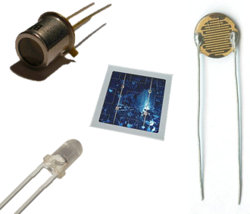


Community hub
0 subscribers8 pages, 0 posts
Recent from talks
All channels
Be the first to start a discussion here.
Be the first to start a discussion here.
Be the first to start a discussion here.
Be the first to start a discussion here.
Contribute something
Welcome to the community hub built to collect knowledge and have discussions related to Optoelectronics.
Nothing was collected or created yet.
Optoelectronics
View on Wikipediafrom Wikipedia
Not found
Optoelectronics
View on Grokipediafrom Grokipedia
Optoelectronics is the interdisciplinary field that integrates optics and electronics, focusing on the study, design, and application of devices that emit, detect, modify, or convert light through electronic processes, primarily involving interactions between photons and electrons in materials such as semiconductors.[1] This field encompasses technologies where optical radiation is generated from electrical energy or vice versa, leveraging principles like absorption, emission, and modulation of electromagnetic radiation in the ultraviolet, visible, and infrared spectra.[2] As a sub-discipline of photonics, optoelectronics has become foundational to modern technologies, enabling advancements in information processing, energy conversion, and sensing.[3]
The origins of optoelectronics trace back to foundational discoveries in the 19th and early 20th centuries, including Thomas Young's double-slit experiment demonstrating light's wave nature in 1801 and James Clerk Maxwell's equations unifying electricity, magnetism, and optics in the 1860s.[3] Albert Einstein's explanation of the photoelectric effect in 1905 laid the groundwork for understanding light-matter interactions at the quantum level, earning him the Nobel Prize in 1921 and inspiring subsequent developments in semiconductor physics.[3] The term "optoelectronics" emerged in the mid-20th century, coinciding with World War II applications like night-vision devices and post-war innovations such as the transistor in 1947, which enabled practical electronic control of light.[3] By the 1960s, the invention of the light-emitting diode (LED) in 1962 by Nick Holonyak and the semiconductor laser in 1962 by Robert N. Hall marked the field's maturation, establishing optoelectronics as a distinct scientific and technical trend.[4]
At its core, optoelectronics relies on the quantum properties of photons—quanta of electromagnetic energy with energy given by , where is Planck's constant, is the speed of light, and is wavelength—and their interactions with electrons in direct-bandgap semiconductors like gallium arsenide (GaAs).[2] Key devices include light-emitting diodes (LEDs), which produce spontaneous emission of light through electron-hole recombination; laser diodes, achieving stimulated emission for coherent, directional output above a threshold current in a resonant cavity; and photodiodes, converting incident light to electrical current via photon absorption that generates electron-hole pairs.[2] Other notable components are solar cells for photovoltaic energy conversion, optical fibers for light transmission, and liquid crystal displays (LCDs) for visual modulation.[3] These devices operate on principles of electroluminescence, photovoltaic effects, and electro-optic modulation, often in hybrid organic-inorganic materials like halide perovskites for enhanced efficiency.[1]
Optoelectronics underpins diverse applications that define the information age, including optical communications for high-speed internet via fiber optics, solid-state lighting with energy-efficient LEDs, and thin-film photovoltaics for renewable energy.[5] In healthcare, it enables medical imaging and diagnostic sensors; in automotive and aerospace sectors, it supports lidar and navigation systems; and in consumer electronics, it powers displays and cameras.[3] Emerging trends emphasize sustainable materials, self-powering devices integrated with indoor photovoltaics, and reduced environmental impact through recyclable components, driving future innovations in quantum optics and integrated circuits.[1]