Hubbry Logo
search
logo

Ordinal utility

logo
Community Hub0 Subscribers
Read side by side
from Wikipedia

In economics, an ordinal utility function is a function representing the preferences of an agent on an ordinal scale. Ordinal utility theory claims that it is only meaningful to ask which option is better than the other, but it is meaningless to ask how much better it is or how good it is. All of the theory of consumer decision-making under conditions of certainty can be, and typically is, expressed in terms of ordinal utility.

For example, suppose George tells us that "I prefer A to B and B to C". George's preferences can be represented by a function u such that:

But critics of cardinal utility claim the only meaningful message of this function is the order ; the actual numbers are meaningless. Hence, George's preferences can also be represented by the following function v:


The functions u and v are ordinally equivalent – they represent George's preferences equally well.

Ordinal utility contrasts with cardinal utility theory: the latter assumes that the differences between preferences are also important. In u the difference between A and B is much smaller than between B and C, while in v the opposite is true. Hence, u and v are not cardinally equivalent.

The ordinal utility concept was first introduced by Pareto in 1906.[1]

Notation

[edit]

Suppose the set of all states of the world is and an agent has a preference relation on . It is common to mark the weak preference relation by , so that reads "the agent wants B at least as much as A".

The symbol is used as a shorthand to the indifference relation: , which reads "The agent is indifferent between B and A".


The symbol is used as a shorthand to the strong preference relation: if:

[edit]

Indifference curve mappings

[edit]

Instead of defining a numeric function, an agent's preference relation can be represented graphically by indifference curves. This is especially useful when there are two kinds of goods, x and y. Then, each indifference curve shows a set of points such that, if and are on the same curve, then .

An example indifference curve is shown below:

indifference map

Each indifference curve is a set of points, each representing a combination of quantities of two goods or services, all of which combinations the consumer is equally satisfied with. The further a curve is from the origin, the greater is the level of utility.

The slope of the curve (the negative of the marginal rate of substitution of X for Y) at any point shows the rate at which the individual is willing to trade off good X against good Y maintaining the same level of utility. The curve is convex to the origin as shown assuming the consumer has a diminishing marginal rate of substitution. It can be shown that consumer analysis with indifference curves (an ordinal approach) gives the same results as that based on cardinal utility theory — i.e., consumers will consume at the point where the marginal rate of substitution between any two goods equals the ratio of the prices of those goods (the equi-marginal principle).

Revealed preference

[edit]

Revealed preference theory addresses the problem of how to observe ordinal preference relations in the real world. The challenge of revealed preference theory lies in part in determining what goods bundles were foregone, on the basis of them being less liked, when individuals are observed choosing particular bundles of goods.[2] [3]

Necessary conditions for existence of ordinal utility function

[edit]

Some conditions on are necessary to guarantee the existence of a representing function:

  • Transitivity: if and then .
  • Completeness: for all bundles : either or or both.
    • Completeness also implies reflexivity: for every : .

When these conditions are met and the set is finite, it is easy to create a function which represents by just assigning an appropriate number to each element of , as exemplified in the opening paragraph. The same is true when X is countably infinite. Moreover, it is possible to inductively construct a representing utility function whose values are in the range .[4]

When is infinite, these conditions are insufficient. For example, lexicographic preferences are transitive and complete, but they cannot be represented by any utility function.[4] The additional condition required is continuity.

Continuity

[edit]

A preference relation is called continuous if, whenever B is preferred to A, small deviations from B or A will not reverse the ordering between them. Formally, a preference relation on a set X is called continuous if it satisfies one of the following equivalent conditions:

  1. For every , the set is topologically closed in with the product topology (this definition requires to be a topological space).
  2. For every sequence , if for all i and and , then .
  3. For every such that , there exists a ball around and a ball around such that, for every in the ball around and every in the ball around , (this definition requires to be a metric space).

If a preference relation is represented by a continuous utility function, then it is clearly continuous. By the theorems of Debreu (1954), the opposite is also true:

Every continuous complete preference relation can be represented by a continuous ordinal utility function.

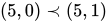
Note that the lexicographic preferences are not continuous. For example, , but in every ball around (5,1) there are points with and these points are inferior to . This is in accordance with the fact, stated above, that these preferences cannot be represented by a utility function.
Uniqueness

[edit]

For every utility function v, there is a unique preference relation represented by v. However, the opposite is not true: a preference relation may be represented by many different utility functions. The same preferences could be expressed as any utility function that is a monotonically increasing transformation of v. E.g., if

where is any monotonically increasing function, then the functions v and v give rise to identical indifference curve mappings.

This equivalence is succinctly described in the following way:

An ordinal utility function is unique up to increasing monotone transformation.

In contrast, a cardinal utility function is unique up to increasing affine transformation. Every affine transformation is monotone; hence, if two functions are cardinally equivalent they are also ordinally equivalent, but not vice versa.

Monotonicity

[edit]

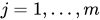
Suppose, from now on, that the set is the set of all non-negative real two-dimensional vectors. So an element of is a pair that represents the amounts consumed from two products, e.g., apples and bananas.

Then under certain circumstances a preference relation is represented by a utility function .

Suppose the preference relation is monotonically increasing, which means that "more is always better":

Then, both partial derivatives, if they exist, of v are positive. In short:

If a utility function represents a monotonically increasing preference relation, then the utility function is monotonically increasing.

Marginal rate of substitution

[edit]

Suppose a person has a bundle and claims that he is indifferent between this bundle and the bundle . This means that he is willing to give units of x to get units of y. If this ratio is kept as , we say that is the marginal rate of substitution (MRS) between x and y at the point .[5]: 82 

This definition of the MRS is based only on the ordinal preference relation – it does not depend on a numeric utility function. If the preference relation is represented by a utility function and the function is differentiable, then the MRS can be calculated from the derivatives of that function:
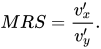
For example, if the preference relation is represented by then . The MRS is the same for the function . This is not a coincidence as these two functions represent the same preference relation – each one is an increasing monotone transformation of the other.

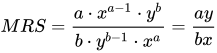
In general, the MRS may be different at different points . For example, it is possible that at the MRS is low because the person has a lot of x and only one y, but at or the MRS is higher. Some special cases are described below.

Linearity

[edit]

When the MRS of a certain preference relation does not depend on the bundle, i.e., the MRS is the same for all , the indifference curves are linear and of the form:

and the preference relation can be represented by a linear function:

(Of course, the same relation can be represented by many other non-linear functions, such as or , but the linear function is simplest.)[5]: 85 

Quasilinearity

[edit]

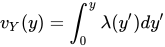
When the MRS depends on but not on , the preference relation can be represented by a quasilinear utility function, of the form

where is a certain monotonically increasing function. Because the MRS is a function , a possible function can be calculated as an integral of :[6][5]: 87 

In this case, all the indifference curves are parallel – they are horizontal transfers of each other.

Additivity with two goods

[edit]

A more general type of utility function is an additive function:

There are several ways to check whether given preferences are representable by an additive utility function.

Double cancellation property

[edit]

If the preferences are additive then a simple arithmetic calculation shows that

and
implies

so this "double-cancellation" property is a necessary condition for additivity.

Debreu (1960) showed that this property is also sufficient: i.e., if a preference relation satisfies the double-cancellation property then it can be represented by an additive utility function.[7]

Corresponding tradeoffs property

[edit]

If the preferences are represented by an additive function, then a simple arithmetic calculation shows that

so this "corresponding tradeoffs" property is a necessary condition for additivity. This condition is also sufficient.[8][5]: 91 

Additivity with three or more goods

[edit]

When there are three or more commodities, the condition for the additivity of the utility function is surprisingly simpler than for two commodities. This is an outcome of Theorem 3 of Debreu (1960). The condition required for additivity is preferential independence.[5]: 104 

A subset A of commodities is said to be preferentially independent of a subset B of commodities, if the preference relation in subset A, given constant values for subset B, is independent of these constant values. For example, suppose there are three commodities: x y and z. The subset {x,y} is preferentially-independent of the subset {z}, if for all :

.

In this case, we can simply say that:

for constant z.

Preferential independence makes sense in case of independent goods. For example, the preferences between bundles of apples and bananas are probably independent of the number of shoes and socks that an agent has, and vice versa.

By Debreu's theorem, if all subsets of commodities are preferentially independent of their complements, then the preference relation can be represented by an additive value function. Here we provide an intuitive explanation of this result by showing how such an additive value function can be constructed.[5] The proof assumes three commodities: x, y, z. We show how to define three points for each of the three value functions : the 0 point, the 1 point and the 2 point. Other points can be calculated in a similar way, and then continuity can be used to conclude that the functions are well-defined in their entire range.

0 point: choose arbitrary and assign them as the zero of the value function, i.e.:

1 point: choose arbitrary such that . Set it as the unit of value, i.e.:

Choose and such that the following indifference relations hold:

.

This indifference serves to scale the units of y and z to match those of x. The value in these three points should be 1, so we assign

2 point: Now we use the preferential-independence assumption. The relation between and is independent of z, and similarly the relation between and is independent of x and the relation between and is independent of y. Hence

This is useful because it means that the function v can have the same value – 2 – in these three points. Select such that


and assign

3 point: To show that our assignments so far are consistent, we must show that all points that receive a total value of 3 are indifference points. Here, again, the preferential independence assumption is used, since the relation between and is independent of z (and similarly for the other pairs); hence


and similarly for the other pairs. Hence, the 3 point is defined consistently.

We can continue like this by induction and define the per-commodity functions in all integer points, then use continuity to define it in all real points.

An implicit assumption in point 1 of the above proof is that all three commodities are essential or preference relevant.[7]: 7  This means that there exists a bundle such that, if the amount of a certain commodity is increased, the new bundle is strictly better.

The proof for more than 3 commodities is similar. In fact, we do not have to check that all subsets of points are preferentially independent; it is sufficient to check a linear number of pairs of commodities. E.g., if there are different commodities, , then it is sufficient to check that for all , the two commodities are preferentially independent of the other commodities.[5]: 115 

Uniqueness of additive representation

[edit]

An additive preference relation can be represented by many different additive utility functions. However, all these functions are similar: they are not only increasing monotone transformations of each other (as are all utility functions representing the same relation); they are increasing linear transformations of each other.[7]: 9  In short,

An additive ordinal utility function is unique up to increasing linear transformation.

Constructing additive and quadratic utility functions from ordinal data

[edit]

The mathematical foundations of most common types of utility functions — quadratic and additive — laid down by Gérard Debreu[9][10] enabled Andranik Tangian to develop methods for their construction from purely ordinal data. In particular, additive and quadratic utility functions in variables can be constructed from interviews of decision makers, where questions are aimed at tracing totally 2D-indifference curves in coordinate planes without referring to cardinal utility estimates.[11][12]

Comparison between ordinal and cardinal utility functions

[edit]

The following table compares the two types of utility functions common in economics:

Level of measurement Represents preferences on Unique up to Existence proved by Mostly used in
Ordinal utility Ordinal scale Sure outcomes Increasing monotone transformation Debreu (1954) Consumer theory under certainty
Cardinal utility Interval scale Random outcomes (lotteries) Increasing monotone linear transformation Von Neumann-Morgenstern (1947) Game theory, choice under uncertainty

See also

[edit]

References

[edit]
[edit]
Revisions and contributorsEdit on WikipediaRead on Wikipedia
from Grokipedia
Ordinal utility is a core concept in microeconomics that describes the satisfaction derived from consuming goods and services solely in terms of the ranking of preferences, without assigning quantifiable numerical values to the degree of satisfaction.[1] Unlike cardinal utility, which treats utility as measurable and comparable across individuals in absolute terms (such as utils), ordinal utility focuses only on the relative ordering of alternatives, where one bundle of goods is preferred to another or considered indifferent, but the magnitude of preference differences remains unspecified.[1] This framework assumes that consumer choices can be modeled through preference relations that satisfy properties like completeness, reflexivity, transitivity, and continuity, allowing for the representation of preferences via utility functions unique up to monotonic transformations.[2] The theory emerged as part of the "ordinal revolution" in economic thought between 1900 and 1932, with Vilfredo Pareto playing a pivotal role in shifting focus from cardinal measurements to preference orderings, as articulated in his works on indifference curves and ophelimity (a measure of relative desirability).[3] Pareto's contributions, building on earlier ideas from mathematicians like Andreas Heinrich Voigt, emphasized that economic analysis requires only the direction and shape of indifference curves—higher curves representing preferred bundles—without needing interpersonal utility comparisons, thus avoiding the ethical and measurement challenges of cardinal approaches.[4] This ordinal perspective became dominant in modern consumer theory during the 1930s, influencing models of demand, revealed preference, and welfare economics by enabling derivations of demand functions from constrained optimization problems, such as maximizing utility subject to budget constraints.[5] In practice, ordinal utility underpins key tools like the marginal rate of substitution (MRS), which measures the rate at which consumers are willing to trade one good for another while remaining indifferent, derived from the slope of indifference curves.[2] It supports diverse preference structures, including perfect substitutes (linear indifference curves), perfect complements (L-shaped curves), and Cobb-Douglas functions (logarithmic representations), all of which rely on ordinal rankings to predict behavior without cardinal assumptions.[2] While ordinal utility facilitates rigorous mathematical modeling and avoids the subjectivity of cardinal scales, it has limitations in contexts requiring intensity comparisons, such as cost-of-living indexes or risk analysis, where extensions like random utility models incorporate probabilistic elements.[6] Overall, ordinal utility remains the standard in contemporary economics for analyzing individual choice under scarcity, emphasizing behavioral consistency over psychological measurement.[7]

Fundamentals

Definition and Overview

Ordinal utility refers to a representation of consumer preferences where the focus is solely on the ranking or order of alternatives, without assigning measurable intensities or cardinal values to the differences between them. In this framework, a consumer's satisfaction from different bundles of goods is expressed through an ordinal scale, meaning that if bundle A is preferred to bundle B, and B to C, then A is preferred to C, but the "distance" between these preferences cannot be quantified numerically. This approach treats utility as a tool for ordering choices rather than measuring absolute pleasure or satisfaction.[2] The concept originated in the early 20th century as a critique of cardinal utility theory, which assumed utility could be measured in absolute units like temperature. Vilfredo Pareto introduced key ideas in his 1906 work, Manuale di Economia Politica, where he developed the notion of "ophelimity" as an ordinal index of preference satisfaction, emphasizing relative rankings over precise measurements to address the limitations of interpersonal utility comparisons. This ordinal perspective was later formalized in consumer theory by John R. Hicks and R. G. D. Allen in their 1934 paper, which integrated it into indifference curve analysis, shifting economic modeling away from cardinal assumptions toward observable preference orderings.[8][9] Ordinal utility builds on basic consumer preferences, assuming a complete and transitive preference relation over consumption bundles. Key elements include strict preference (denoted ≻, where bundle A ≻ B means A is strictly preferred to B) and indifference (denoted ~, where A ~ B means the consumer is equally satisfied with both). Indifference sets group bundles that are equivalent in preference, forming the basis for ordinal rankings without requiring numerical utility assignments. For instance, consider a consumer choosing between bundles of apples and oranges: they might rank (3 apples, 1 orange) ≻ (2 apples, 2 oranges) ~ (1 apple, 3 oranges) ≻ (0 apples, 4 oranges), capturing the order of satisfaction purely through comparisons.[2] This ordinal approach underpins modern microeconomics by enabling the representation of diverse preferences through utility functions that preserve only the order of choices, facilitating analyses of demand, equilibrium, and welfare without relying on unobservable cardinal intensities.[10]

Notation

In ordinal utility theory, preferences over consumption bundles are commonly represented using a binary relation \succeq denoting weak preference (i.e., xyx \succeq y means bundle xx is at least as preferred as bundle yy), with the associated strict preference \succ (where xyx \succ y if xyx \succeq y and not yxy \succeq x) and indifference \sim (where xyx \sim y if xyx \succeq y and yxy \succeq x).[11] These symbols standardize the description of ordinal rankings, where only the order matters, not the magnitude of differences.[11] The utility function uu maps consumption bundles xR+nx \in \mathbb{R}^n_+ (the non-negative orthant of Rn\mathbb{R}^n, representing feasible quantities of nn commodities) to real numbers u:R+nRu: \mathbb{R}^n_+ \to \mathbb{R}, preserving the preference order such that u(x)>u(y)u(x) > u(y) if and only if xyx \succ y.[11] This domain ensures non-negative consumption, while the range in R\mathbb{R} allows numerical representation without implying interpersonal comparability.[11] Such a representation presupposes that the preference relation satisfies the axioms of completeness (for all x,yR+nx, y \in \mathbb{R}^n_+, either xyx \succeq y or yxy \succeq x), transitivity (if xyx \succeq y and yzy \succeq z, then xzx \succeq z), and continuity (the sets {zzx}\{z \mid z \succeq x\} and {zxz}\{z \mid x \succeq z\} are closed for all xx).[11] These prerequisites enable the existence of a continuous utility function without delving into proofs of representation.[12] A representative example is the Cobb-Douglas utility function u(x1,x2)=x1αx21αu(x_1, x_2) = x_1^\alpha x_2^{1-\alpha} for 0<α<10 < \alpha < 1 and two goods, which captures preferences where bundles are ranked by their product weighted by α\alpha.[11] Ordinal equivalence holds because any strictly increasing transformation, such as v(x1,x2)=lnu(x1,x2)=αlnx1+(1α)lnx2v(x_1, x_2) = \ln u(x_1, x_2) = \alpha \ln x_1 + (1-\alpha) \ln x_2, preserves the order (u(x)>u(y)u(x) > u(y) iff v(x)>v(y)v(x) > v(y)), reflecting the non-uniqueness of ordinal utility representations.[11] This property aligns with monotonicity, ensuring that more of any good increases utility.[11]

Indifference Curve Mappings

Indifference curves serve as a graphical representation of ordinal utility, depicting the level sets of a utility function where all consumption bundles yield the same level of satisfaction. Formally, an indifference curve consists of the set {xu(x)=c}\{ x \mid u(x) = c \} for some constant cc, where uu is a monotonic representation of preferences, mapping ordinal rankings into visual contours that illustrate equivalent preference levels without quantifying the intensity of satisfaction.[13][14] Under standard assumptions of nonsatiation and convex preferences, indifference curves exhibit key properties: they slope downward, reflecting the need to compensate for an increase in one good with a decrease in another to maintain utility; they are convex to the origin, capturing diminishing marginal rates of substitution; and they never intersect, as this would violate the transitivity of preferences.[15] These characteristics ensure that higher indifference curves, farther from the origin, represent strictly preferred bundles.[9] The derivation of indifference curves from ordinal preferences involves partitioning the space of consumption bundles into equivalence classes based on indifference relations, then connecting the bundles within each class to form a curve. This process "slices" the complete preference ordering into non-overlapping contours, preserving the ordinal structure without requiring interpersonal comparisons or absolute utility measures.[2] For a simple example with two goods, xx and yy, an indifference curve traces combinations satisfying u(x,y)=cu(x, y) = c, such as those derived from preferences where the consumer ranks bundles ordinally. Ordinal data from such rankings yields unique mappings up to any strictly increasing transformation of the utility function, as transformations preserve the ordering and thus the curve shapes.[15] These mappings reveal trade-offs inherent in preferences without relying on cardinal utility measurement, forming the cornerstone of the Hicks-Allen framework introduced in their 1934 analysis.[9]

Revealed Preference

The revealed preference approach, introduced by Paul Samuelson in 1938, infers ordinal preferences from observed consumer choices under budget constraints, positing that if a consumer selects bundle xx over another affordable bundle yy (i.e., pxpyp \cdot x \leq p \cdot y, where pp denotes prices and the consumer's income covers both), then xx is revealed preferred to yy, denoted xyx \succ y.[16] This method avoids direct measurement of utility by focusing on behavioral data, such as market purchases, to derive strict preference relations without assuming cardinal utility.[16] To ensure consistency with an underlying ordinal utility function, the approach relies on axioms like the Weak Axiom of Revealed Preference (WARP), introduced by Samuelson, which requires that if xx is directly revealed preferred to yy, then yy cannot be directly strictly revealed preferred to xx. Houthakker in 1950 extended this to the Strong Axiom of Revealed Preference (SARP), applying the condition to chains of revelations for transitivity.[17] The Generalized Axiom of Revealed Preference (GARP), formalized by Afriat in 1967 and operationalized for empirical testing by Varian in 1982, generalizes this to transitive closures: if a chain of direct revelations implies xx is (weakly) revealed preferred to yy (denoted xRyx R y), then no chain can imply yy is strictly revealed preferred to xx (denoted yPxy P x).[18][19] Satisfaction of GARP is necessary and sufficient for the observed choices to be rationalizable by a continuous, concave, and monotonic ordinal utility function.[19] Testing for revealed preference consistency involves constructing the revealed preference relation from a dataset of price-income pairs and chosen bundles, checking for cycles in direct (xRDyx R^D y if pxypxxp^x \cdot y \geq p^x \cdot x) and indirect revelations; a violation, such as a cycle where xRyx R y and yPxy P x, indicates intransitive preferences incompatible with utility maximization.[19] For instance, in budget line analysis, a sequence of observed choices can rationalize indifference curves by enveloping the convex hull of revealed preferred sets, confirming the data's consistency with ordinal utility without eliciting subjective valuations.[19] This framework uniquely bridges theoretical ordinal utility with empirical observation, enabling recovery of preference orderings solely from choice data.[18]

Existence and Basic Properties

Necessary Conditions for Existence

The existence of an ordinal utility function hinges on the preference relation satisfying fundamental axioms that ensure it forms a complete preorder, allowing representation by a real-valued function that preserves the ordering. The core axioms are completeness, transitivity, and reflexivity. Completeness requires that for any two consumption bundles xx and yy in the domain, either xyx \succeq y or yxy \succeq x, meaning every pair is comparable. Transitivity stipulates that if xyx \succeq y and yzy \succeq z, then xzx \succeq z. Reflexivity applies to the indifference relation, ensuring xxx \sim x for all xx, which follows from completeness in standard formulations.[20] Under these axioms alone, a utility representation exists for countable domains, where preferences can be enumerated and assigned strictly increasing real numbers. However, for uncountable domains like R+n\mathbb{R}^n_+, additional conditions are necessary to guarantee existence. Debreu's theorem establishes that if the preference relation is complete, transitive, and continuous on a connected topological space (such as a compact convex set), then there exists a continuous real-valued utility function uu such that xyx \succeq y if and only if u(x)u(y)u(x) \geq u(y).[21] Limitations arise without continuity, even with completeness and transitivity. For instance, lexicographic preferences on R+2\mathbb{R}^2_+, where (x1,x2)(y1,y2)(x_1, x_2) \succ (y_1, y_2) if x1>y1x_1 > y_1 or if x1=y1x_1 = y_1 and x2>y2x_2 > y_2, satisfy the core axioms but lack a real-valued utility representation because they violate continuity—the preference ordering is not preserved under limits. This non-representability highlights that ordinal utility requires topological assumptions for broad economic applications. The existence of such a utility function enables the summarization of ordinal preference data into a single numerical index, forming the cornerstone of consumer theory by facilitating analysis of choice behavior without interpersonal comparisons.[20] Continuity extends these baseline conditions to ensure differentiability and broader domain applicability, as explored in subsequent properties.

Continuity

In ordinal utility theory, the continuity axiom plays a crucial role in ensuring that preference relations over consumption bundles in a continuous commodity space can be represented by a well-behaved utility function. A preference relation \succsim on the non-negative orthant R+n\mathbb{R}^n_+ is defined as continuous if, for every bundle xR+nx \in \mathbb{R}^n_+, both the upper contour set {yR+nyx}\{ y \in \mathbb{R}^n_+ \mid y \succsim x \} and the lower contour set {yR+nxy}\{ y \in \mathbb{R}^n_+ \mid x \succsim y \} are closed sets in the standard Euclidean topology. This closure property captures the intuitive notion that small perturbations in bundles do not lead to abrupt changes in preference rankings, preventing discontinuities such as sudden jumps in indifference. The implications of continuity extend to the structure of the representing utility function and the geometry of indifference curves. Under continuity, any ordinal utility function u:R+nRu: \mathbb{R}^n_+ \to \mathbb{R} that represents the preferences is itself continuous, meaning that the indifference curves—level sets of uu—are closed and exhibit smoothness properties that facilitate graphical and analytical analysis in consumer theory. This continuity ensures that the preference ordering is "Archimedean" in a topological sense, allowing for the interpolation of bundles between any two distinct points without violating the order.[21] A foundational result formalizing this is Debreu's representation theorem, which states that if a preference relation on R+n\mathbb{R}^n_+ is complete, transitive, and continuous, then there exists a continuous real-valued utility function that represents it. This theorem guarantees not only the existence of a utility representation but also its continuity, which is essential for applying topological arguments in economic models. Without continuity, even complete and transitive preferences may fail to admit any real-valued representation on uncountable spaces like R+n\mathbb{R}^n_+.[21] To illustrate the necessity of continuity, consider lexicographic preferences on R+2\mathbb{R}^2_+, where bundle (x1,x2)(x_1, x_2) is preferred to (y1,y2)(y_1, y_2) if x1>y1x_1 > y_1 or if x1=y1x_1 = y_1 and x2>y2x_2 > y_2. These preferences are complete and transitive but discontinuous, as the upper contour set for a point like (0,1)(0,1) includes sequences approaching (1,0)(1,0) from below without including the limit point itself, rendering the set non-closed.[22] Consequently, no continuous utility function exists to represent lexicographic preferences, and in fact, no real-valued utility function at all can represent them due to the dense ordering of indifference classes without a countable basis.[22] Beyond representation, the continuity axiom is indispensable for calculus-based optimization techniques in economic analysis, particularly in establishing the existence of Walrasian equilibria in general equilibrium models. In such frameworks, continuous preferences ensure that individual demand correspondences are upper hemicontinuous, leading to continuous aggregate excess demand functions that satisfy the conditions for fixed-point theorems like Brouwer's, thereby guaranteeing equilibrium prices.[23] This property underpins the mathematical rigor of competitive market analysis, where discontinuities could otherwise preclude equilibrium outcomes.[23]

Uniqueness

In ordinal utility theory, two utility functions uu and vv are said to represent the same preferences—or be ordinally equivalent—if there exists a strictly increasing function ff such that v(x)=f(u(x))v(x) = f(u(x)) for all bundles xx in the domain. This equivalence arises because ordinal utility captures only the ranking of preferences, preserving the order of bundles without regard to the intensity of differences between them. A key implication of this non-uniqueness is the absence of an absolute scale for utility values; any strictly increasing transformation yields an equally valid representation, in contrast to cardinal utility where differences have interpersonal or absolute meaning. This flexibility underscores that ordinal utility functions are defined only up to the order they induce on the consumption set, allowing analysts to choose convenient forms for modeling without altering the underlying preferences. Under the standard axioms of completeness, transitivity, and continuity of preferences, Debreu's representation theorem establishes that a continuous utility function exists and is unique up to such monotonic transformations. The continuity assumption ensures that the transformation ff is well-defined and preserves the topological structure of the preference ordering. For illustration, consider the functions u(x,y)=x+yu(x,y) = x + y and v(x,y)=(x+y)2v(x,y) = (x + y)^2 over positive bundles (x,y)>0(x,y) > 0; both represent identical preferences since v=fuv = f \circ u where f(t)=t2f(t) = t^2 is strictly increasing for t>0t > 0. This equivalence holds because the transformation maintains the relative ordering: if u(x1,y1)>u(x2,y2)u(x_1,y_1) > u(x_2,y_2), then v(x1,y1)>v(x2,y2)v(x_1,y_1) > v(x_2,y_2). The non-uniqueness of ordinal representations thus permits a wide array of functional forms—such as linear, logarithmic, or Cobb-Douglas specifications—to consistently model the same set of preferences, facilitating tractable analysis in economic models while ensuring invariance to the choice of representation.

Monotonicity

In ordinal utility theory, monotonicity refers to the property of preferences where consumers prefer bundles with greater quantities of goods, reflecting the "more is better" assumption. Weak monotonicity holds if, for any two consumption bundles xx and $ (x'$ where xxx' \geq x (i.e., xixix'_i \geq x_i for all goods ii, with at least one strict inequality), the bundle xx' is at least as preferred as xx, or xxx' \succeq x.[24] Strict monotonicity strengthens this condition, requiring that xxx' \succ x (strictly preferred) whenever x>xx' > x (i.e., xi>xix'_i > x_i for all ii).[25] These properties ensure that any ordinal utility function uu representing such preferences is non-decreasing (weakly) or strictly increasing, meaning u(x)u(x)u(x') \geq u(x) or u(x)>u(x)u(x') > u(x), respectively.[26] Monotonicity plays a key role in consumer theory by guaranteeing that indifference curves have negative slopes and that the marginal rate of substitution is positive, as more of one good must be offset by less of another to maintain indifference.[27] It also supports interior solutions in utility maximization problems subject to budget constraints, where optimal consumption occurs away from boundary points assuming positive prices.[28] Under monotonic preferences, local non-satiation holds—meaning no bundle is a local bliss point, as any neighborhood contains a strictly preferred bundle—preventing satiation and ensuring ongoing demand for goods.[29] While strict monotonicity assumes insatiable desire for more of every good, weak monotonicity accommodates cases like perfect complements. For Leontief preferences, represented by u(x1,x2)=min(x1,x2)u(x_1, x_2) = \min(x_1, x_2), monotonicity holds weakly since increasing both goods raises utility, but increasing only one does not, leading to flat segments in the indifference map.[30] Thus, these preferences satisfy weak monotonicity but violate strict monotonicity.[31] Monotonicity is critical in demand theory, as its violation—such as through satiation or inferior goods in excess—can result in corner solutions where consumers consume zero of some goods, complicating standard demand derivations and equilibrium analysis.[32]

Advanced Representations

Marginal Rate of Substitution

In ordinal utility theory, the marginal rate of substitution (MRS) between two goods xx and yy, denoted MRSxyMRS_{xy}, is defined as the negative ratio of the partial derivatives of the utility function:
MRSxy=u/xu/y. MRS_{xy} = -\frac{\partial u / \partial x}{\partial u / \partial y}.
This represents the slope of the indifference curve at a given point, indicating the rate at which a consumer is willing to trade good yy for good xx while maintaining the same level of utility.[33][34] The interpretation of MRSxyMRS_{xy} is the maximum amount of good yy that a consumer would be willing to forgo in exchange for an additional unit of good xx, without changing their overall satisfaction, assuming preferences are convex.[35][1] To derive the MRS, consider the total differential of the utility function along an indifference curve, where utility is constant (du=0du = 0):
du=uxdx+uydy=0. du = \frac{\partial u}{\partial x} dx + \frac{\partial u}{\partial y} dy = 0.
Solving for the slope dy/dxdy/dx yields
dydx=u/xu/y=MRSxy, \frac{dy}{dx} = -\frac{\partial u / \partial x}{\partial u / \partial y} = MRS_{xy},
which geometrically corresponds to the tangent to the indifference curve.[35][33] A key property of the MRS in ordinal utility is its tendency to diminish along an indifference curve under the assumption of convex preferences, meaning the consumer requires progressively more of good yy to compensate for additional units of good xx. This diminishing MRS arises from the convexity axiom and is often reinforced by Inada-like conditions on marginal utilities, such as their positivity and approach to zero at high consumption levels, ensuring smooth, bowed indifference curves.[36][14][37] For example, consider the utility function u(x,y)=x0.5y0.5u(x, y) = x^{0.5} y^{0.5}, a common representation of Cobb-Douglas preferences. The MRS is MRSxy=y/xMRS_{xy} = y / x, which decreases as xx increases relative to yy, illustrating diminishing substitution rates.[27][38] The MRS uniquely connects ordinal utility representations to consumer optimization problems, where the tangency condition requires MRSxy=px/pyMRS_{xy} = p_x / p_y at the point of budget constraint maximization, ensuring the chosen bundle equates the subjective value ratio to the market price ratio.[39][40][41]

Linearity

In ordinal utility theory, a linear utility function takes the form $ u(\mathbf{x}) = \mathbf{a} \cdot \mathbf{x} $, where a\mathbf{a} is a vector of positive coefficients representing the relative valuations of the goods in the bundle x\mathbf{x}. This representation implies a constant marginal rate of substitution (MRS) between any pair of goods, specifically $ \MRS_{x_i x_j} = -\frac{a_i}{a_j} $, reflecting the fixed trade-off rate across all consumption levels. Such functions capture preferences where goods are perfect substitutes, meaning the consumer views them as interchangeable at a constant proportion without diminishing satisfaction from additional units.[2] The indifference curves under linear utility are straight lines with a slope equal to the negative of the MRS, indicating that the consumer is indifferent between bundles along any ray from the origin at that fixed slope. This linearity simplifies the graphical depiction of preferences, as all curves are parallel and do not exhibit convexity or concavity typical of more general substitutable goods. For instance, with two goods xx and yy, the utility function $ u(x, y) = 2x + 3y $ implies that the consumer is willing to exchange goods at a fixed ratio of 2 units of xx for 3 units of yy, maintaining the same level of satisfaction regardless of the quantities involved.[42] A key ordinal property of linear utility functions is their invariance under positive affine transformations, where a new function $ u'(\mathbf{x}) = c + d \cdot u(\mathbf{x}) $ with $ d > 0 $ and constant $ c $ preserves both the original preference ordering and the linear structure. This uniqueness up to such transformations underscores the ordinal nature of the representation, as only the relative ordering and the constant substitution rate matter, not the absolute scale of utility values.[43] Linear utility functions lead to corner solutions in consumer demand problems, where the optimal bundle typically consists of consuming only the good offering the highest utility per dollar unless relative prices precisely match the coefficient ratios, thereby eliminating interior solutions. Moreover, relative demands between the goods exhibit no income effects, as the choice depends solely on price ratios and remains unchanged with variations in total income, focusing consumption entirely on the more favorable substitute.[44] This representational simplicity facilitates analytical tractability in models of substitution-dominated preferences, avoiding the complexities of income-driven adjustments seen in nonlinear cases.[45]

Quasilinearity

In economics, quasilinear utility refers to a representation of ordinal preferences where the utility function is linear in one argument, typically the numeraire good $ m $ (often interpreted as money), while allowing for nonlinearity in the other goods $ x $. Formally, it is expressed as $ u(x, m) = v(x) + m $, where $ v(x) $ is an increasing function. This form ensures that the marginal rate of substitution between $ x $ and $ m $ depends only on $ x $ and is independent of the consumption level of $ m $.[46] A primary implication of quasilinearity is the elimination of income effects on the demand for $ x $; increases in total income lead solely to higher consumption of $ m $, without altering the optimal quantity of $ x $, resulting in flat Engel curves for $ x .Thispropertysimplifieswelfareanalysisanddemandderivationbyisolatingsubstitutioneffectsfromincomechanges.Fortheunderlyingpreferencestoexhibitconvexityastandardassumptionforwellbehavedeconomicmodels. This property simplifies welfare analysis and demand derivation by isolating substitution effects from income changes. For the underlying preferences to exhibit convexity—a standard assumption for well-behaved economic models— v(x) $ must be concave, rendering the overall utility function quasiconcave.[26][46] A representative example is the utility function $ u(x, m) = \ln(x) + m $, which captures diminishing marginal utility in $ x $ while maintaining linearity in $ m $; this form is frequently employed in public goods provision and auction theory to model agent behavior under incentive-compatible mechanisms. Quasilinear utility's structure facilitates the separation of substitution and income effects in consumer choice, a key insight highlighted in standard intermediate microeconomics texts.[46][15]

Additive Forms

Additivity with Two Goods

In ordinal utility theory, additivity with two goods refers to a separable representation of preferences over consumption bundles (x,y)(x, y), where the utility function takes the form u(x,y)=f(x)+g(y)u(x, y) = f(x) + g(y), with ff and gg being strictly increasing functions that capture the contribution of each good independently.[47] This form implies that preferences over one good are independent of the level of the other, allowing for a decomposition without interaction terms between xx and yy.[48] A key property enabling this additive representation is the double cancellation axiom, which states that if (x1,y1)(x2,y2)(x_1, y_1) \sim (x_2, y_2) and (x1,y1)(x2,y2)(x_1', y_1') \sim (x_2', y_2'), then the implied trade-offs are consistent such that (x1,y2)(x2,y1)(x_1, y_2') \sim (x_2, y_1') and (x1,y2)(x2,y1)(x_1', y_2) \sim (x_2', y_1). This condition ensures fixed exchange rates between pairs of bundles, preventing inconsistencies in indifference that would arise from cross-effects, and is necessary and sufficient for additive separability when combined with continuity and monotonicity of preferences.[48] The implications of additivity include a marginal rate of substitution (MRS) given by u/xu/y=f(x)g(y)\frac{\partial u / \partial x}{\partial u / \partial y} = \frac{f'(x)}{g'(y)}, which depends only on the quantities of the respective goods and is free of cross-partial derivatives.[47] This independence from interaction effects simplifies demand analysis, as the slope of indifference curves varies solely with own-good levels, facilitating tractable solutions in consumer theory without requiring cardinal interpretations.[49] For instance, the utility function u(x,y)=lnx+2lnyu(x, y) = \ln x + 2 \ln y exemplifies additivity, representing a Cobb-Douglas form that yields constant expenditure shares and linear Engel curves in quantities versus income.[49]

Additivity with Three or More Goods

In ordinal utility theory, an additively separable utility function for three or more goods takes the form $ u(x_1, \dots, x_n) = \sum_{i=1}^n f_i(x_i) $, where each $ f_i $ is a function solely of the quantity $ x_i $ of good $ i $, representing fully separable preferences across all goods.[50] This structure extends the pairwise additivity from two goods to $ n $ goods by requiring complete independence in the utility contributions of each good.[51] A key condition for such additivity, assuming the utility function is twice continuously differentiable, is that all cross-partial derivatives vanish: $ u_{ij} = \frac{\partial^2 u}{\partial x_i \partial x_j} = 0 $ for all $ i \neq j $.[49] This stronger form of independence ensures that the marginal utility of any good does not depend on the consumption levels of others, beyond the ordinal ranking preserved by monotonic transformations. Debreu's theorem establishes that continuous, transitive preferences satisfying joint separability across at least three goods admit such an additive representation, unique up to positive affine transformations.[50] The implications for consumer demand are significant: under additively separable utility, the Marshallian demand for each good depends only on its own price and total income, with cross-price effects absent except through the income channel.[52] This decentralized structure simplifies solving the utility maximization problem, as subproblems for each good can be addressed independently after allocating income shares. For instance, consider $ u(x, y, z) = x + \ln y + z^2 $; the Hessian matrix of second derivatives is diagonal, confirming separability since off-diagonal elements (cross-partials) are zero.[49] Fully additive utility functions are rare in empirical applications due to the prevalence of complementarities and substitutabilities among goods, which violate the independence assumption.[53] Nonetheless, they prove useful in policy models, such as linear programming frameworks for resource allocation, where the additive form aligns with linear objectives to enable efficient decentralized optimization.[54]

Uniqueness of Additive Representation

In the theory of ordinal utility, when preferences admit an additive representation $ U(\mathbf{x}) = \sum_{i=1}^n f_i(x_i) $ under conditions of continuity, strict monotonicity, and strict convexity of the indifference curves, this representation is unique up to positive affine transformations of the individual functions $ f_i $, meaning any other additive representation takes the form $ \sum_{i=1}^n (a f_i(x_i) + b_i) $ with common $ a > 0 $.[50] This uniqueness arises because the additive structure imposes a cardinal scale on the components relative to purely ordinal representations, which are only unique up to arbitrary increasing transformations.[55] A sketch of the proof relies on the implications of additivity for the marginal rates of substitution (MRS). Additivity implies that cross-partial derivatives of the utility function are zero, i.e., $ \frac{\partial^2 U}{\partial x_i \partial x_j} = 0 $ for $ i \neq j $, which ensures the MRS between goods $ i $ and $ j $ depends only on their own quantities. Combined with integrability conditions from the exactness of the differential form of the utility gradient, this fixes the functional form up to the affine adjustments, assuming the domain is a connected open set in $ \mathbb{R}^n_+ $.[50] Strict convexity prevents flat spots in preferences that could allow multiple representations, while monotonicity ensures positive marginal utilities.[48] However, uniqueness holds only under these structural assumptions; with purely ordinal data—such as complete rankings without intensity measures—the additive functions cannot be uniquely recovered, as any monotonic transformation of the overall utility preserves the order but disrupts additivity unless it is affine on the components. Full recovery thus requires incorporating cardinal elements, like observed choices under uncertainty or budget constraints that reveal marginal intensities, to normalize the scales. For the case of two goods, the double cancellation axiom provides a specific condition ensuring uniqueness up to constants: if $ (x_1, y_1) \succ (x_2, y_2) $, $ (x_2, y_3) \succ (x_3, y_2) $, and $ (x_1, y_3) \succ (x_3, y_1) $, then the preferences admit a unique additive form $ U(x,y) = f(x) + g(y) $ up to additive constants, as this axiom eliminates cyclic dependencies that would permit non-additive representations.[50] This result builds directly on Debreu's foundational work and is crucial for econometric estimation of separability, as the affine uniqueness allows identification of individual $ f_i $ functions from demand data after normalization, facilitating tests for weak separability in consumer behavior models.

Construction Techniques

Constructing Additive Utility Functions

One common method for constructing additive utility functions from ordinal preference data, such as rankings or revealed choices under budget constraints, involves using revealed preference theory to estimate the separable components through optimization techniques that ensure consistency with observed behavior.[56] In particular, ordinal regression approaches, like the UTA method, employ linear programming to build a set of additive utility functions that reproduce the given preference orderings by minimizing errors in the ranking of alternatives.[57] The construction process typically proceeds in two main steps. First, the data is tested for separability using extensions of the Generalized Axiom of Revealed Preference (GARP), which check whether the observed choices are consistent with maximization of an additively separable utility function; these tests, rooted in nonparametric demand analysis, reveal if the data satisfy necessary conditions like the absence of cycles in revealed preference relations across subgroups of goods.[58] Second, if separability holds, the individual component functions fif_i are fitted by solving an optimization problem that minimizes deviations from the additivity assumption, often subject to the constraints imposed by the preference data or budget sets. For example, given choice data from consumer expenditures, an additive utility of the form u(x,y)αln(x)+βln(y)u(x,y) \approx \alpha \ln(x) + \beta \ln(y) can be recovered using nonlinear least squares to estimate the parameters α\alpha and β\beta, ensuring the implied demands match the observed quantities as closely as possible while respecting ordinal consistency. In more general nonparametric settings, tools such as numerical integration or spline approximations are applied to estimate the shapes of the fif_i functions, allowing flexible representations without assuming specific parametric forms.[59] These algorithmic approaches have become computationally feasible with modern optimization software and are widely applied in revealed preference econometrics, building on the nonparametric foundations established by Varian (1982). The resulting additive representations are unique up to monotonic transformations of the individual components, providing a theoretical guarantee for the constructed functions.[60]

Constructing Quadratic Utility Functions

A quadratic utility function is defined as $ u(\mathbf{x}) = \mathbf{x}^T A \mathbf{x} + \mathbf{b}^T \mathbf{x} + c $, where x\mathbf{x} is the vector of goods, AA is a symmetric matrix capturing interactions between goods, b\mathbf{b} represents linear terms, and cc is a constant; this form allows representation of non-separable preferences through quadratic interactions.[61] One common construction technique approximates an unknown utility function via a second-degree Taylor expansion around a reference point, yielding a quadratic form that locally captures curvature and interactions based on ordinal preference data such as rankings or indifferences.[61] The matrix AA is estimated to be symmetric and negative semi-definite to ensure concavity, reflecting diminishing marginal rates of substitution, while ordinal data like pairwise comparisons or indifference sets inform the approximation.[61] Parameters are solved by fitting the quadratic to observed ordinal data, often through least-squares minimization of errors on indifference hypersurfaces derived from equivalent alternatives, with constraints for monotonicity (positive partial derivatives) and quasi-concavity (convex preferences); this can involve matching marginal rates of substitution (MRS) at tangency points on indifference curves to ensure consistency with revealed trade-offs.[61][62] For example, with two goods xx and yy, observed trade-offs from indifferences can fit $ u(x,y) = \alpha x y + \beta x + \gamma y $, where α<0\alpha < 0 captures interaction concavity, estimated by minimizing deviations from stated equivalences while satisfying monotonicity constraints like β+αy>0\beta + \alpha y > 0.[62] This approach provides a local cardinal approximation to ordinal preferences, enabling numerical analysis; it has been employed in general equilibrium models, such as those developed by Scarf for computational purposes.[61]

Comparisons and Implications

Comparison with Cardinal Utility

Cardinal utility theory posits that the intensity of satisfaction can be measured on an absolute scale, where differences in utility levels between bundles, such as u(x)u(y)u(x) - u(y), hold meaningful interpersonal or intrapersonal significance, enabling comparisons of utility magnitudes across individuals.[63] This approach assumes utility is quantifiable in a way that preserves ratios or differences under affine transformations, facilitating analyses like interpersonal utility comparisons essential for ethical welfare judgments.[64] In contrast, ordinal utility focuses solely on the ranking of preferences without assigning numerical intensities, rendering differences like u(x)u(y)u(x) - u(y) incomparable or irrelevant.[65] A primary distinction lies in their implications for economic modeling: ordinal utility disregards the scale of utility differences, allowing any strictly increasing transformation of the utility function to represent the same preferences, whereas cardinal utility requires only linear (affine) transformations to preserve meaningful differences and ratios.[66] For instance, in analyzing risk aversion under uncertainty, expected utility theory—developed by von Neumann and Morgenstern—relies on cardinal properties, as the concavity of the utility function (indicating risk aversion) depends on interpretable differences in expected utility values, which ordinal approaches cannot capture without additional assumptions.[67] This limitation of ordinal utility stems from its inability to quantify how much more one outcome is preferred over another beyond mere ordering. Historically, the shift from cardinal to ordinal utility occurred in the late 19th and early 20th centuries, driven by the recognition that utility intensities are not directly observable through behavior, only revealed through choice rankings.[68] Pioneered by William Stanley Jevons in his 1871 work, cardinal utility assumed measurable pleasure units, but Vilfredo Pareto advanced ordinalism around 1906, arguing that demand theory could rely solely on observable preference orderings without invoking unmeasurable psychological intensities.[69] Consider an example: suppose a utility function assigns u(A)=4u(A) = 4 and u(B)=2u(B) = 2 to two bundles; under ordinal utility, doubling to 2u(A)=82u(A) = 8 and 2u(B)=42u(B) = 4 represents identical preferences, as only the order matters.[66] In cardinal utility, however, such scaling alters interpretable differences, impacting measures like the Gini coefficient, where ordinal invariance would distort inequality assessments that assume fixed utility scales for comparing distributions across agents.[70] Ordinal utility proves sufficient for core demand theory, deriving consumer behavior from preference orderings alone, but cardinal utility remains necessary for welfare economics, where interpersonal comparisons and utility differences underpin evaluations of equity and social optimality.[67][63]

Applications in Economic Theory

In consumer theory, ordinal utility forms the foundation for analyzing individual choice behavior by representing preferences through rankings that allow derivation of Marshallian demand functions. Consumers are assumed to maximize their ordinal utility subject to a budget constraint, leading to the tangency condition between the indifference curve and the budget line, which determines optimal consumption bundles without requiring interpersonal utility comparisons. This approach, pioneered in modern microeconomics, enables the prediction of how changes in prices or income affect demand while relying solely on observable choice data. The Arrow-Debreu model of general equilibrium theory employs ordinal utility to establish the existence of competitive equilibria in a multi-agent economy with complete markets. Agents' preferences, represented by continuous, convex, and monotone ordinal utility functions, ensure that market clearing prices coordinate decentralized decisions efficiently, without needing cardinal measurements of welfare. This framework demonstrates how ordinal rankings suffice to prove equilibrium outcomes under perfect competition and no externalities. In welfare economics, the first fundamental theorem asserts that any competitive equilibrium allocation is Pareto efficient, relying on ordinal utility to define efficiency in terms of preference orderings rather than absolute utility levels. This result holds under assumptions of local non-satiation and convexity of preferences, showing that decentralized markets achieve outcomes where no agent can be made better off without harming another, based purely on ordinal comparisons. The second fundamental theorem, however, requires additional structure like convexity to guarantee the existence of prices supporting any Pareto-efficient allocation, highlighting ordinal utility's limitations in redistributive contexts without supplementary assumptions. Modern extensions in behavioral economics critique the sufficiency of strict ordinal utility, as prospect theory introduces cardinal elements like loss aversion and reference dependence to explain deviations from standard choice patterns under risk. In prospect theory, value functions are defined over gains and losses relative to a reference point, incorporating nonlinear probability weighting that violates expected utility's ordinal invariance, thus challenging traditional models in predicting real-world decisions. Empirical industrial organization applies ordinal utility through random utility models in discrete choice analysis, where observed choices reveal underlying preference rankings for differentiated products, enabling estimation of market demands and firm strategies without cardinal scaling. Ordinal utility underpins positive economics by focusing on observable preference orderings to analyze resource allocation, avoiding the normative interpersonal comparisons inherent in cardinal approaches, though it proves incomplete for measuring inequality or social welfare distributions. This distinction, emphasizing scientific objectivity in economic analysis, allows rigorous predictions of behavior without ethical judgments on utility magnitudes across individuals.

References

User Avatar
No comments yet.