



Community hub
Recent from talks
Contribute something
Nothing was collected or created yet.
Pseudorandom binary sequence
View on Wikipedia
A pseudorandom binary sequence (PRBS), pseudorandom binary code or pseudorandom bitstream is a binary sequence that, while generated with a deterministic algorithm, is difficult to predict[1] and exhibits statistical behavior similar to a truly random sequence. PRBS generators are used in telecommunication, such as in analog-to-information conversion,[2] but also in encryption, simulation, correlation technique and time-of-flight spectroscopy. The most common example is the maximum length sequence generated by a (maximal) linear feedback shift register (LFSR). Other examples are Gold sequences (used in CDMA and GPS), Kasami sequences and JPL sequences, all based on LFSRs.
In telecommunications, pseudorandom binary sequences are known as pseudorandom noise codes (PN or PRN codes) due to their application as pseudorandom noise.
Details
[edit]A binary sequence (BS) is a sequence of bits, i.e.


- for .


A BS consists of ones and zeros.


A BS is a pseudorandom binary sequence (PRBS) if[3] its autocorrelation function, given by
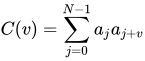
has only two values:
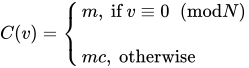
where

is called the duty cycle of the PRBS, similar to the duty cycle of a continuous time signal. For a maximum length sequence, where , the duty cycle is 1/2.

A PRBS is 'pseudorandom', because, although it is in fact deterministic, it seems to be random in a sense that the value of an element is independent of the values of any of the other elements, similar to real random sequences.

A PRBS can be stretched to infinity by repeating it after elements, but it will then be cyclical and thus non-random. In contrast, truly random sequence sources, such as sequences generated by radioactive decay or by white noise, are infinite (no pre-determined end or cycle-period). However, as a result of this predictability, PRBS signals can be used as reproducible patterns (for example, signals used in testing telecommunications signal paths).[4]
Practical implementation
[edit]Pseudorandom binary sequences can be generated using linear-feedback shift registers.[5]
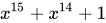
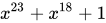
Some common[6][7][8][9][10] sequence generating monic polynomials are
- PRBS7 =

- PRBS9 =

- PRBS11 =

- PRBS13 =

- PRBS15 =
- PRBS20 =

- PRBS23 =
- PRBS31 =
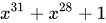
An example of generating a "PRBS-7" sequence can be expressed in C as
#include <stdio.h>
#include <stdint.h>
#include <stdlib.h>

int main(int argc, char* argv[]) {
    uint8_t start = 0x02;
    uint8_t a = start;
    int i;
    for (i = 1;; i++) {
        int newbit = (((a >> 6) ^ (a >> 5)) & 1);
        a = ((a << 1) | newbit) & 0x7f;
        printf("%x\n", a);
        if (a == start) {
            printf("repetition period is %d\n", i);
            break;
        }
    }
}
In this particular case, "PRBS-7" has a repetition period of 127 values.
Notation
[edit]The PRBSk or PRBS-k notation (such as "PRBS7" or "PRBS-7") gives an indication of the size of the sequence. is the maximum number[4]: §3 of bits that are in the sequence. The k indicates the size of a unique word of data in the sequence. If you segment the N bits of data into every possible word of length k, you will be able to list every possible combination of 0s and 1s for a k-bit binary word, with the exception of the all-0s word.[4]: §2 For example, PRBS3 = "1011100" could be generated from .[6] If you take every sequential group of three bit words in the PRBS3 sequence (wrapping around to the beginning for the last few three-bit words), you will find the following 7 word arrangements:

  "1011100" → 101
  "1011100" → 011
  "1011100" → 111
  "1011100" → 110
  "1011100" → 100
  "1011100" → 001 (requires wrap)
  "1011100" → 010 (requires wrap)
Those 7 words are all of the possible non-zero 3-bit binary words, not in numeric order. The same holds true for any PRBSk, not just PRBS3.[4]: §2

See also
[edit]References
[edit]- ^ "PRBS Pseudo Random Bit Sequence Generation". TTi. Retrieved 21 January 2016.
- ^ Daponte, Pasquale; De Vito, Luca; Iadarola, Grazia; Rapuano, Sergio. "PRBS non-idealities affecting Random Demodulation Analog-to-Information Converters" (PDF).
- ^ Naszodi, Laszlo. "Articles on Correlation and Calibration". Archived from the original on 11 November 2013.
- ^ a b c d "ITU-T Recommendation O.150". October 1992.
- ^ Paul H. Bardell, William H. McAnney, and Jacob Savir, "Built-In Test for VLSI: Pseudorandom Techniques", John Wiley & Sons, New York, 1987.
- ^ a b Tomlinson, Kurt (4 February 2015). "PRBS (Pseudo-Random Binary Sequence)". Bloopist. Retrieved 21 January 2016.
- ^ Koopman, Philip. "Maximal Length LFSR Feedback Terms". Retrieved 21 January 2016.
- ^ "What are the PRBS7, PRBS15, PRBS23, and PRBS31 polynomials used in the Altera Transceiver Toolkit?". Altera. 14 February 2013. Retrieved 21 January 2016.
- ^ Riccardi, Daniele; Novellini, Paolo (10 January 2011). "An Attribute-Programmable PRBS Generator and Checker (XAP884)" (PDF). Xilinx. Table 3:Configuration for PRBS Polynomials Most Used to Test Serial Lines. Retrieved 21 January 2016.
- ^ "O.150 : General requirements for instrumentation for performance measurements on digital transmission equipment". 1997-01-06.
External links
[edit]- OEIS sequence A011686 (A binary m-sequence: expansion of reciprocal) -- the bit sequence for PRBS7 =
Pseudorandom binary sequence
View on GrokipediaFundamentals
Definition
A pseudorandom binary sequence (PRBS) is a deterministic sequence of bits consisting of 0s and 1s that exhibits statistical properties approximating those of a truly random binary sequence, generated algorithmically to simulate noise-like behavior.[5] These sequences are designed to pass standard statistical tests for randomness while being fully reproducible from a known initial state.[6] In contrast to true random binary sequences, which arise from inherently unpredictable physical processes and lack periodicity, PRBS are periodic and generated by deterministic rules, ensuring identical outputs upon repeated initialization.[6] This repeatability makes PRBS suitable for controlled testing and synchronization in engineered systems, where true randomness would be impractical. The basic structure of a PRBS typically features a finite length N, often N = 2^k - 1 for maximum-length variants, comprising roughly equal numbers of 0s and 1s to maintain balance.[7] The term originated in the mid-20th century within the development of pseudonoise (PN) codes for signal processing and communications, with foundational analysis provided by Solomon Golomb in his 1967 work on shift register sequences.[8] Common types of PRBS include maximum length sequences (m-sequences), which achieve the longest period for a given generator degree; Gold codes, constructed for favorable cross-correlation properties in multi-user systems; Kasami codes, offering balanced autocorrelation in large sets; and JPL sequences, developed for ranging applications in deep-space communications.[9]Key Characteristics
Pseudorandom binary sequences (PRBS) exhibit a high degree of balance in their composition, featuring nearly equal numbers of 0s and 1s within each period. For a sequence of length , there are exactly ones and zeros, ensuring the disparity is at most one bit. This balance aligns with Golomb's first randomness postulate, which requires that in any period, the number of 1s differs from the number of 0s by at most one.[10][11] These sequences are inherently periodic, repeating deterministically every bits without deviation, which forms the foundation for their controlled yet random-like behavior in applications such as noise simulation in telecommunications. The fixed period guarantees that the sequence cycles predictably, allowing for repeatable testing while mimicking aperiodic randomness over short segments.[12][11] A key trait is the run-length distribution, where consecutive identical bits (runs of 0s or runs of 1s) occur in lengths that approximate those expected from a truly random binary source. According to Golomb's second postulate, in each period, at least half of the runs have length 1, at least one-fourth have length 2, at least one-eighth have length 3, and so on, with runs of 0s and 1s nearly equally distributed for each length. This distribution contributes to the sequence's utility in emulating stochastic processes.[10][13] Although fully deterministic and generated by a fixed rule, PRBS create an illusion of independence among bits, where consecutive elements appear uncorrelated, much like white noise. This property stems from the structured yet unpredictable arrangement of bits, enabling the sequence to pass informal randomness checks despite its mechanical origin.[12][14] The duty cycle of a PRBS, defined as where is the number of 1s, equals exactly 1/2 for maximal-length sequences, reinforcing their balanced nature and suitability for symmetric signal applications.[11]Properties
Statistical Properties
Pseudorandom binary sequences (PRBS) exhibit statistical properties that closely approximate those of ideal random binary sequences, making them suitable for applications requiring noise-like behavior without true randomness. These properties are formalized through specific measures of balance, run distribution, and spectral density, which collectively ensure that PRBS perform well on standard statistical tests of randomness. For maximum-length PRBS of period , where is the degree of the generating polynomial, the sequence satisfies criteria that align with expectations for uniform and independent bits. The balance property dictates that, in one full period, the number of 1s equals and the number of 0s equals , resulting in a proportion of 1s that approaches as increases. This near-equal distribution ensures uniformity, allowing ideal PRBS to pass the chi-square test, which assesses whether the observed frequency of 1s and 0s deviates significantly from the expected 50% under a null hypothesis of randomness. The run property further characterizes randomness by specifying the distribution of consecutive identical bits (runs). In a period of length , there are runs of each length for , with runs of length 1, and exactly one run of length . This approximates the geometric distribution for random sequences, where the probability of a run of length is , and enables PRBS to pass the poker test, which evaluates the frequency of overlapping bit patterns (e.g., treating groups of 5 bits as poker hands) against expected uniform distributions using chi-square statistics. Serial correlation, measuring dependence between adjacent bits or bit pairs, is minimal in ideal PRBS, with the expected correlation coefficient approaching zero for large periods. Consequently, PRBS pass the serial correlation test, confirming approximate independence akin to white noise sequences. The power spectral density of a PRBS is nearly flat across its frequency band up to half the bit rate, exhibiting white-noise-like characteristics that concentrate energy uniformly rather than at specific frequencies.[15] Despite these strengths, PRBS lack cryptographic security because they are deterministic and fully predictable once the initial seed (state) is known; moreover, their linear structure allows reconstruction of the generating polynomial and state using the Berlekamp-Massey algorithm after observing just consecutive bits.[16]Autocorrelation and Cross-Correlation
The autocorrelation function of a periodic pseudorandom binary sequence (PRBS) of period , where each , is defined as for integer shifts .[17] For maximum-length PRBS, also known as m-sequences generated by primitive polynomials over finite fields, this function exhibits the ideal two-level property: when , and otherwise.[17] This sharp peak at zero shift with constant low sidelobes elsewhere arises from the sequence's balance property, where the number of +1s exceeds the number of -1s by exactly one.[17] The duty cycle , with denoting the number of +1s in the sequence, influences the sidelobe levels in the autocorrelation function for non-ideal or truncated PRBS.[18] For m-sequences, , yielding and minimizing sidelobe variance, which contributes to the near-ideal behavior; deviations from balance in shorter or modified sequences elevate sidelobes, degrading correlation performance.[18] Cross-correlation between distinct PRBS measures their similarity and is critical for minimizing interference in multi-sequence systems. For families like Gold codes, constructed by combining two m-sequences of degree via modulo-2 addition to produce sequences of length , the absolute cross-correlation is bounded above by when is even and when is odd, ensuring low inter-sequence overlap compared to the autocorrelation peak.[17] The ideal two-level autocorrelation of maximum-length PRBS provides a sharp mainlobe at zero shift and uniformly low sidelobes, facilitating precise pulse compression in signal processing by concentrating energy efficiently while suppressing ambiguity.[17] This property distinguishes PRBS from truly random sequences, whose correlations would fluctuate more variably. The merit factor quantifies PRBS quality as the ratio of mainlobe energy to total sidelobe energy, given by . For m-sequences, this yields , a high value indicating excellent performance; lower merit factors in other constructions signal poorer sidelobe suppression.Generation
Linear Feedback Shift Registers
A linear feedback shift register (LFSR) consists of a chain of flip-flops connected in series, where the input to the first flip-flop is determined by the exclusive-OR (XOR) of the outputs from specific positions, known as taps, within the register. This feedback mechanism generates a sequence of bits that cycles through states in the finite field GF(2), producing pseudorandom binary sequences (PRBS) when configured appropriately. The operation relies on a characteristic polynomial that defines the tap positions, ensuring the sequence behaves like a maximal-length pseudonoise (PN) sequence under certain conditions. To generate a PRBS, the LFSR is initialized with a non-zero seed value, avoiding the all-zero state that would lock the register. On each clock cycle, the contents of the register shift right (or left, depending on convention), and the feedback bit—computed as the XOR of the tapped outputs—is inserted at the opposite end. For a k-stage LFSR, the feedback polynomial determines the taps; for example, in a PRBS7 generator (k=7), the polynomial x^7 + x^6 + 1 corresponds to taps at positions 7 and 6. The output is typically taken from the last stage of the register, yielding a periodic sequence. The sequence achieves maximal length, cycling through 2^k - 1 distinct non-zero states before repeating, only if the feedback polynomial is primitive over GF(2). Primitive polynomials generate m-sequences, which are binary sequences with properties approximating randomness, such as balanced runs of 0s and 1s. Non-primitive polynomials result in shorter periods, limiting their utility for PRBS applications. LFSRs can be implemented in two primary configurations: Fibonacci and Galois (also known as external and internal feedback, respectively). In the Fibonacci configuration, XOR gates are placed externally to compute the feedback bit fed into the input of the shift register. The Galois configuration integrates XOR gates directly into the feedback paths between stages, allowing multiple feedback signals and enabling higher clock frequencies due to reduced critical path length. Both produce equivalent sequences for the same polynomial but differ in hardware efficiency. LFSRs offer significant advantages for hardware implementation, requiring only k flip-flops and a few XOR gates, which minimizes area and power consumption compared to counter-based generators. This simplicity facilitates high-speed operation in digital circuits, making them ideal for embedded systems. In software, LFSRs can be simulated efficiently; for instance, the following C code implements a PRBS7 generator using bit shifts and XOR operations:#include <stdint.h>
uint8_t prbs7_lfsr = 0x7F; // Non-zero initial [seed](/page/Seed) (all 1s for 7 bits)
uint8_t generate_prbs7_bit(void) {
uint8_t lsb = prbs7_lfsr & 1; // Output the least significant bit
uint8_t feedback = lsb ^ ((prbs7_lfsr >> 1) & 1); // XOR taps at positions 0 and 1
prbs7_lfsr = (prbs7_lfsr >> 1) | (feedback << 6); // Shift right, insert feedback at MSB
return lsb;
}
#include <stdint.h>

uint8_t prbs7_lfsr = 0x7F;  // Non-zero initial [seed](/page/Seed) (all 1s for 7 bits)

uint8_t generate_prbs7_bit(void) {
    uint8_t lsb = prbs7_lfsr & 1;  // Output the least significant bit
    uint8_t feedback = lsb ^ ((prbs7_lfsr >> 1) & 1);  // XOR taps at positions 0 and 1
    prbs7_lfsr = (prbs7_lfsr >> 1) | (feedback << 6);  // Shift right, insert feedback at MSB
    return lsb;
}
Alternative Methods
Nonlinear feedback shift registers (NLFSRs) provide an extension to traditional linear methods by incorporating nonlinear feedback functions, such as the product of multiple state bits or combined logical operations like AND gates followed by XOR. These nonlinearities improve the cryptographic resilience of generated pseudorandom binary sequences (PRBS), particularly against linear cryptanalytic attacks that exploit the predictability of linear structures. For instance, NLFSRs can produce span- sequences with a period of and balanced bit distribution, similar to maximum-length LFSRs, but their design targets enhanced diffusion properties for stream cipher applications. However, the theoretical analysis of NLFSRs remains incomplete compared to LFSRs, lacking efficient algorithms for decomposition and synthesis, which complicates verification of their randomness and period length.[20][21][22] Software-based PRBS generators offer flexibility for computational environments where hardware constraints are absent, adapting established pseudorandom number generator (PRNG) algorithms to yield binary outputs. The Mersenne Twister (MT19937), renowned for its exceptionally long period of and equidistribution properties, can be modified for binary PRBS by extracting individual bits from its tempered 32-bit words via bitwise shifts and masks, enabling efficient generation of high-quality binary streams for simulations and testing. Alternatively, chaotic maps like the logistic map ( with ) are discretized to binary sequences by applying a threshold (e.g., 1 if , else 0), producing outputs that pass standard randomness tests such as NIST SP 800-22 due to their sensitivity to initial conditions and apparent unpredictability. These methods are particularly useful in software-defined systems, though they require careful parameter tuning to maintain statistical balance.[23][24][25] Hybrid approaches integrate LFSRs with nonlinear post-processing to address limitations in pure linear generators, yielding cryptographically robust PRBS for secure communications. In such designs, an LFSR produces an initial binary stream, which is then transformed via nonlinear components like substitution boxes (S-boxes) or additional chaotic mappings to obscure linear dependencies and enhance resistance to correlation attacks. Recent implementations, including those combining LFSRs with linear congruential generators or metastability-based entropy sources, demonstrate improved key space and secrecy levels, with sequences passing advanced cryptographic evaluations. These hybrids are especially valuable in resource-constrained devices, balancing efficiency with security.[26][27][28] In the 2020s, field-programmable gate array (FPGA)-based high-throughput PRBS generators have emerged to meet the demands of 5G and beyond-5G testing, where parallel architectures process multiple LFSR stages simultaneously to achieve throughputs over 28 Gbit/s at clock frequencies around 220 MHz. These implementations leverage pipelined designs on platforms like Xilinx Zynq UltraScale+ for applications in massive MIMO and cloud radio access networks (C-RAN), providing scalable, reconfigurable PRBS for bit error rate (BER) testing and channel emulation with minimal area overhead. Complementing these, pseudorandom impulse sequences (PRIS) convert binary PRBS into bipolar impulse trains, serving as wideband perturbation signals for in-situ parameter estimation in power systems; PRIS offer flat spectral density across broad frequencies with a low peak-to-average power ratio, enabling accurate identification without significant distortion.[29][30][31] Despite their advantages, alternative PRBS methods introduce trade-offs, including elevated design complexity and risks of suboptimal periods relative to well-tuned LFSRs. NLFSRs, for example, often require exhaustive search for maximum-period configurations, as nonlinear interactions can trap sequences in shorter cycles, and their analysis demands computational resources far exceeding those for linear cases. Software and chaotic approaches may also exhibit implementation-dependent biases if discretization is imprecise, while hybrids and FPGA designs increase hardware or software overhead, potentially limiting deployment in ultra-low-power scenarios. These limitations highlight scenarios where LFSRs remain preferable for straightforward, high-period PRBS needs.[32][33][21]Applications
Telecommunications and Signal Processing
Pseudorandom binary sequences (PRBS) play a crucial role in telecommunications for bit error rate (BER) testing, where standardized patterns such as PRBS7 (127 bits), PRBS15 (32,767 bits), and PRBS23 (8,388,607 bits) simulate random data traffic to evaluate system performance under noise-like conditions. These sequences are specified in ITU-T Recommendation O.150, which outlines methods for generating PRBS to measure error rates in digital transmission systems by comparing transmitted and received patterns, enabling detection of up to the full sequence length without synchronization loss. This approach ensures reliable assessment of channel impairments, as the noise-like properties of PRBS mimic real-world data while allowing deterministic verification.[4][34] In spread spectrum communications, maximal-length sequences (m-sequences), a type of PRBS, are employed in direct-sequence code division multiple access (DS-CDMA) systems to spread the signal bandwidth and enable multiple user access. The balanced nature of m-sequences, with nearly equal numbers of 1s and 0s, provides a flat power spectrum that minimizes interference and supports efficient despreading at the receiver. For instance, in global positioning system (GPS) applications, Gold codes—derived from pairs of m-sequences—facilitate CDMA by offering low cross-correlation, allowing simultaneous signals from multiple satellites to be distinguished. These codes, with lengths up to 1,023 chips, are integral to the coarse/acquisition (C/A) code in GPS for pseudoranging and navigation.[35][36][37][38] The sharp autocorrelation peak of PRBS enables precise synchronization and ranging in communication systems. In modems, this property supports timing recovery by correlating the received signal with a local PRBS replica to detect symbol boundaries, compensating for clock offsets in passband quadrature amplitude modulation schemes. Similarly, in radar applications, PRBS-based phase-modulated continuous-wave (PMCW) systems exploit the two-level autocorrelation function for range resolution and Doppler estimation, with sequences like m-sequences and Gold codes providing sidelobe suppression essential for target detection.[39][40] PRBS are widely used for channel characterization in both fiber optic and wireless systems, where they probe the impulse response to quantify dispersion, attenuation, and multipath effects. In fiber optics, transmitting PRBS through the link and performing cross-correlation at the receiver reveals the channel's transfer function, aiding in the evaluation of high-speed transceivers up to 16 Gbps in Fibre Channel standards. For wireless channels, PRBS testing in radio-over-fiber (RoF) setups characterizes end-to-end performance, including spectrum analysis for mmWave links, ensuring alignment with system requirements like bit error rates below 10^{-12}.[41][42][43] Recent advancements leverage PRBS for stimulated Brillouin scattering (SBS) suppression in high-power fiber lasers used in telecommunications infrastructure. Phase modulation with PRBS patterns broadens the laser linewidth, distributing power across multiple tones to reduce SBS gain below threshold, enabling output powers exceeding 2 kW while maintaining narrow effective linewidths under 10 Hz. This technique, demonstrated in ytterbium-doped amplifiers, uses higher-order PRBS (e.g., order 15) for optimal spectral shaping without inducing self-pulsing. In 5G New Radio (NR) conformance testing, PRBS patterns verify base station receiver sensitivity and transmitter linearity per 3GPP TS 38.141, simulating payload data for radiated and conducted evaluations in frequency ranges FR1 and FR2.[44][45][46][47]Testing and Other Engineering Uses
Pseudorandom binary sequences (PRBS) serve as effective input signals for system identification in control engineering, particularly for black-box modeling of nonlinear dynamics using nonlinear autoregressive exogenous (NARX) models. These sequences provide broadband excitation that mimics white noise, ensuring persistent stimulation across relevant frequencies to accurately estimate model parameters without prior knowledge of the system's structure. In a 2025 study on DC motor dynamics, PRBS was applied as the voltage input to a driver motor, enabling precise NARX identification through least-squares optimization and validation against measured responses, demonstrating superior performance over multisine signals in terms of estimation accuracy and computational efficiency. Similarly, the NonSysId package utilizes PRBS for nonlinear system identification, where it excites the system to capture polynomial NARX terms, achieving low mean squared error in benchmarks like the Silverbox dataset.[48] In electromagnetic interference (EMI) and noise source identification, PRBS perturbations are injected into printed circuit board (PCB) components to isolate dominant noise contributors. This technique exploits the sequence's autocorrelation properties to correlate input signals with radiated emissions, pinpointing interference paths in complex electronics. A seminal 2017 IEEE conference paper applied PRBS to a multi-IC PCB setup, revealing that clock drivers were the primary EMI sources by analyzing emission spectra, with correlation peaks indicating up to 80% noise attribution to specific components; subsequent extensions have adapted this for high-frequency boards up to 1 GHz.[49] For battery and sensor testing, PRBS enables fast, non-invasive impedance measurements critical for electric vehicle (EV) battery management. By superimposing PRBS currents on the battery's operating signal, broadband impedance spectra are obtained rapidly, supporting state-of-health and state-of-charge diagnostics. A 2025 method optimized PRBS orders (e.g., 2^{15}-1) for lithium-ion cells, achieving full-spectrum measurements in under 10 seconds with less than 5% deviation from traditional electrochemical impedance spectroscopy, while minimizing perturbation amplitude to avoid cell stress—ideal for online EV applications. This approach has been extended to sensor arrays, where PRBS excitation identifies impedance variations in real-time for fault detection.[50] PRBS finds utility in engineering simulations, including Monte Carlo methods for reliability analysis, where its deterministic yet random-like behavior approximates stochastic inputs efficiently. In signal processing simulations, PRBS-driven Monte Carlo runs model jitter and error propagation in high-speed links, as shown in a 2013 study simulating PRBS-23 patterns at 30 Gbps to quantify random jitter accumulation under low-pass filtering, yielding eye diagram closures that match empirical data within 2 ps.[51] Enhanced PRBS variants, such as chaos-enhanced linear feedback shift register (LFSR) designs, support lightweight cryptography in Internet of Things (IoT) devices by generating secure pseudorandom keys with low power overhead. A 2024 framework proposes robust LFSR-based PRBS for IoT stream ciphers, achieving 128-bit security with 20% reduced gate count compared to AES, suitable for sensor nodes.[13] Additionally, PRBS-based generators produce synthetic datasets for intrusion detection systems (IDS) in cybersecurity engineering, simulating diverse threat patterns to train models amid limited real data. A 2022 IEEE approach employs PRBS block circuits to create realtime cyber threat streams, incorporating attack vectors like DDoS via sequence modulation, resulting in datasets that improve IDS accuracy by 15% over static benchmarks through balanced class distribution.[52] For randomness validation, gap-based analysis evaluates PRBS quality by examining intervals between identical bits, assessing independence and uniformity. A 2024 study applied this to m-sequence PRBS (a PRBS subtype) from all-optical sources, confirming near-ideal gap densities (e.g., B=0.1218 burstiness for order 5) via simulation and experiment, outperforming traditional NIST tests for burst detection in cryptographic applications.[53]Notation and Examples
Standard Notations
Pseudorandom binary sequences (PRBS) are commonly denoted using the PRBS-k notation, where k indicates the length of the linear feedback shift register (LFSR) employed in their generation. The period of a PRBS-k sequence is given by bits, representing the maximum length before the sequence repeats. For instance, PRBS3 utilizes a 3-bit register and yields a period of 7 bits.[11] These sequences are also known by synonyms such as pseudonoise (PN) codes or pseudorandom noise (PRN) codes, especially in telecommunications applications where their noise-like properties are emphasized. PRBS are typically expressed as binary strings of 0s and 1s for direct implementation in digital systems. In signal processing contexts, particularly for autocorrelation and cross-correlation analysis, a common mapping converts the binary values to a bipolar representation: 0 maps to -1 and 1 maps to +1, resulting in a balanced sequence with equal numbers of positive and negative values and zero mean.[54] Standardization efforts define specific PRBS patterns to ensure interoperability in testing and measurement. The ITU-T Recommendation O.150 outlines general requirements for instrumentation, including detailed PRBS patterns for evaluating digital network performance. Similarly, the IEEE 802.3 standard specifies PRBS usage for physical layer testing in Ethernet systems, such as compliance verification and bit error rate assessment.[55] Key variants include signed PRBS, which adopt the +1/-1 bipolar mapping to preserve constant power levels and simplify correlation-based evaluations. Truncated PRBS consist of segments shorter than the full period, applied in scenarios requiring limited sequence lengths, although this can compromise ideal statistical properties like low sidelobe autocorrelation.[56]Common Patterns and Polynomials
Primitive polynomials over GF(2) are used to generate maximal-length pseudorandom binary sequences (PRBS) with period for an n-bit linear feedback shift register (LFSR). These polynomials ensure that the LFSR visits all possible non-zero states before repeating. Common choices for PRBS of various lengths include the following, where taps refer to the positions in the LFSR (numbered from 1 to n, with the highest-degree term corresponding to tap n+1 implicitly):| PRBS Length | Polynomial | Taps |
|---|---|---|
| PRBS7 | 7, 6 | |
| PRBS9 | 9, 5 | |
| PRBS15 | 15, 14 | |
| PRBS23 | 23, 18 | |
| PRBS31 | 31, 28 |