Hubbry Logo
Pacific Time ZonePacific Time ZoneMain
Open search
Pacific Time Zone
Community hub
Pacific Time Zone
logo
8 pages, 0 posts
0 subscribers
Be the first to start a discussion here.
Pacific Time Zone
Pacific Time Zone
from Wikipedia

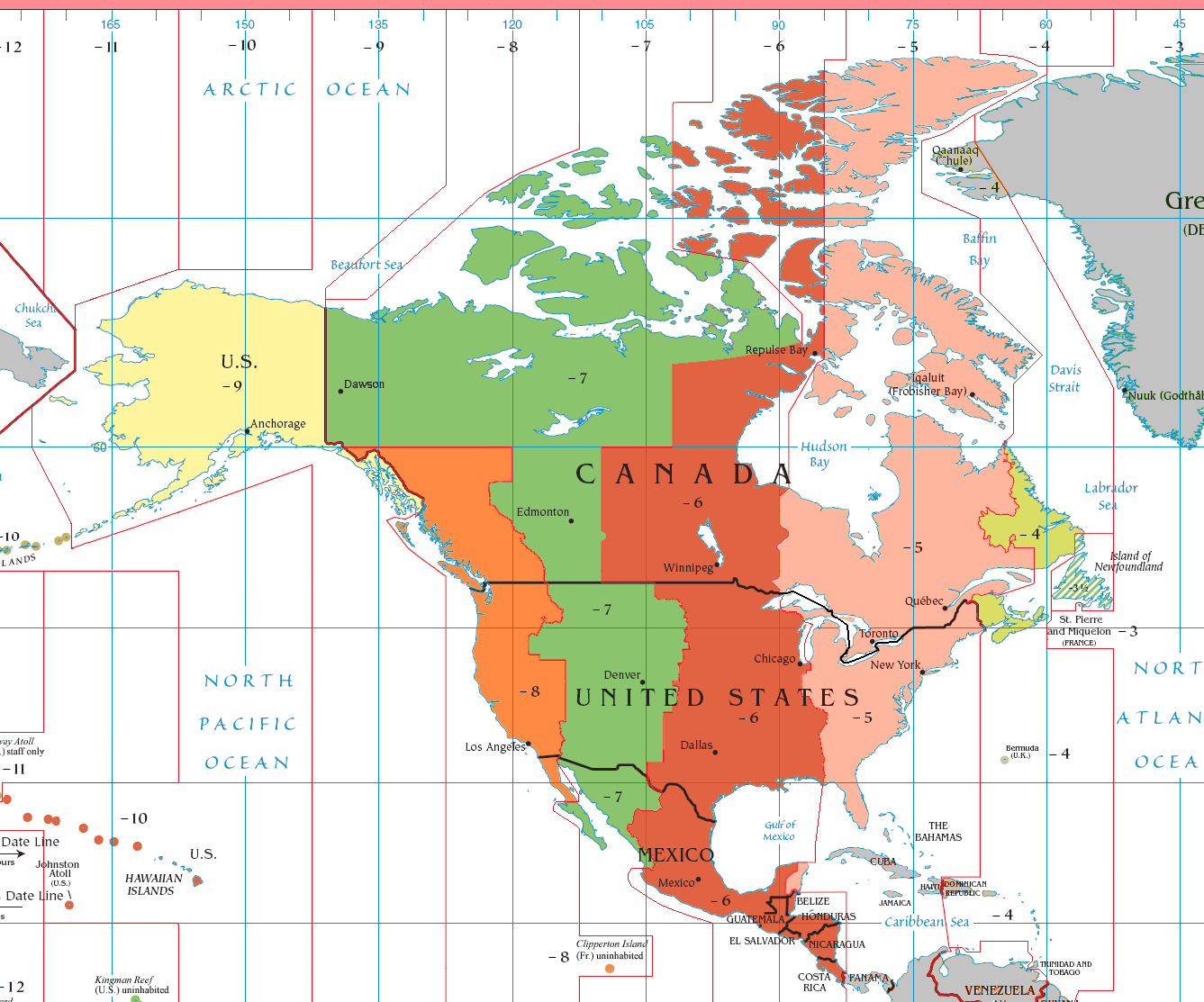
The Pacific Time Zone (PT) is a time zone encompassing parts of western Canada, the western United States, and western Mexico. Places in this zone observe standard time by subtracting eight hours from Coordinated Universal Time (UTC−08:00). During daylight saving time, a time offset of UTC−07:00 is used.

Key Information

In the United States and Canada, this time zone is generically called the Pacific Time Zone. Specifically, time in this zone is referred to as Pacific Standard Time (PST) when standard time is being observed (early November to mid-March), and Pacific Daylight Time (PDT) when daylight saving time (mid-March to early November) is being observed. In Mexico, the corresponding time zone is known as the Zona Noroeste (Northwest Zone) and observes the same daylight saving schedule as the United States and Canada. The largest city in the Pacific Time Zone is Los Angeles, whose metropolitan area is also the largest in the time zone.

The zone is two hours ahead of the Hawaii–Aleutian Time Zone, one hour ahead of the Alaska Time Zone, one hour behind the Mountain Time Zone,[a] two hours behind the Central Time Zone, three hours behind the Eastern Time Zone, and four hours behind the Atlantic Time Zone.

Canada

[edit]

One Canadian province is split between the Pacific Time Zone and the Mountain Time Zone:

The border between time zones in British Columbia was decided in a 1972 plebiscite held in northeastern and southeastern electoral districts due to their ties to neighbouring Alberta.[1]

As of September 24, 2020, Yukon officially switched from the Pacific Time Zone to a time zone "to be reckoned as seven hours behind Coordinated Universal Time (UTC−7)" after deciding to stop observing daylight saving time.[2]

Mexico

[edit]

In Mexico, the Zona Noroeste, which corresponds to Pacific Time in the United States and Canada, includes:[citation needed]

United States

[edit]

Two states are fully contained in the Pacific Time Zone:[3]

Three states are split between the Pacific Time Zone and the Mountain Time Zone:[3]

One state is split between the Pacific Time Zone (unofficially), the Alaska Time Zone, and the Hawaii–Aleutian Time Zone:

Daylight saving time

[edit]

Through 2006, the local time (PST, UTC−08:00) changed to daylight time (PDT, UTC−07:00) at 02:00 LST (local standard time) to 03:00 LDT (local daylight time) on the first Sunday in April, and returned at 02:00 LDT to 01:00 LST on the last Sunday in October.[11] The United States Congress passed the Energy Policy Act of 2005, which moved the local time changes from PST to PDT to the second Sunday in March and the reversal from PDT to PST to the first Sunday in November.[11] Like other Canadian provinces that observe daylight time, British Columbia adopted the same dates in April 2006, to take effect in March 2007 alongside the U.S.[12] Several Mexican states, including Baja California, implemented the new dates for the daylight time changes in 2010, ending a three-year period where cities across the Mexico–United States border had a one-hour difference for two months a year.[13]

Proposals to abolish the bi-annual time change and adopt year-round standard time or daylight time gained popularity among U.S. states in the 2010s. 59 percent of voters in California approved a 2018 ballot proposition that authorizes the legislature to use year-round daylight saving time, pending Congressional approval.[14] The Washington State Legislature passed a bill in May 2019 that would move the state to permanent daylight time, subject to Congressional approval;[15] the Oregon Legislative Assembly passed a similar bill a month later, while California's attempt failed.[16] The provincial government of British Columbia announced in 2019 that they would follow the U.S. states in whether the time changes were kept or removed in order to maintain a unified time zone.[17] In 2020, Idaho passed legislation to allow for permanent daylight time for the Pacific Time Zone.[18] Congressional approval was sought through the Sunshine Protection Act, which was submitted several times and passed by the U.S. Senate in 2022, but its equivalent in the House of Representatives failed to pass.[19]

See also

[edit]

Notes

[edit]

References

[edit]
[edit]
Revisions and contributorsEdit on WikipediaRead on Wikipedia
from Grokipedia
The Pacific Time Zone (PT) is a time zone primarily observed in the western regions of , where clocks are set to (PST), eight hours behind (UTC−08:00), during standard time periods, and advanced to Pacific Daylight Time (PDT), UTC−07:00, when is in effect. It covers the U.S. states of , , Washington, most of , and small portions of and west of the time zone boundary defined at approximately the 120th meridian west; in Canada, it includes and ; and in Mexico, the states of and parts of . This zone facilitates synchronized timekeeping for economic activities, transportation, and across major centers such as , , and , reflecting the longitudinal alignment of the region with the 120th meridian west as established by early 20th-century standardization efforts under the U.S. of 1918.

Definition and Technical Specifications

Standard Time Offset and UTC Relation

The Pacific Time Zone maintains a standard time offset of eight hours behind , denoted as , during periods without adjustments. This offset aligns the zone with solar noon occurring approximately at 12:00 for longitudes around 120° west, reflecting the empirical division of Earth's 360° into 24 hour-wide segments, each separated by 15° to approximate mean . UTC itself serves as the global reference timescale, maintained by atomic clocks and disseminated by institutions such as the International Bureau of Weights and Measures, superseding since 1972 for precision in international coordination. In practice, this relation positions Pacific Standard Time (PST) three hours behind Eastern Standard Time (EST, ) and two hours behind Central Standard Time (CST, ), with this offset to Central Time holding year-round due to both zones following the same daylight saving time schedule; PST is eight hours behind UTC, facilitating synchronization in , , and across the zone's jurisdictions in the , , and . The offset remains constant year-round in observance, independent of seasonal variations, ensuring predictable temporal alignment with UTC for non-DST periods typically spanning from early to mid-March in adopting regions.

Geographical Extent and Boundaries

The Pacific Time Zone encompasses the westernmost regions of the , extending northward into and southward into , primarily along the . It spans approximately from the near 49° N latitude to the southern tip of around 32° N, and longitudinally from the eastward to boundaries approximating 116°–120° W, though adjusted irregularly by political subdivisions rather than strict meridians. In the United States, the zone includes the entirety of California, Washington, and Nevada; nearly all of Oregon except Malheur County; and northern Idaho counties north of the Salmon River, encompassing the Idaho Panhandle. The eastern boundary with the Mountain Time Zone follows federal regulations outlined in 49 CFR § 71.9, which trace lines along state borders from the Montana–Idaho line southward through Idaho to Oregon, then along Nevada–Utah borders, incorporating exceptions such as West Wendover, Nevada, which observes Mountain Time to align with adjacent Utah communities. This political delineation prioritizes administrative continuity over solar time alignment. In Canada, the zone covers most of , excluding localized eastern areas like parts of the and northeast corridor that observe Mountain Time year-round, and the entire territory, which maintains Pacific standard offset permanently without seasonal changes. In Mexico, it is limited to the state of , aligning with U.S. Pacific offsets for cross-border synchronization, while adjacent peninsula areas like follow Mexico's Zona Pacífico (equivalent to Mountain Time). The northern boundary in abuts the Mountain-adjacent , and the southern extent ends at Mexico's international border with the , beyond which Central Time prevails inland.

Historical Development

Pre-Standardization Era

Prior to the widespread adoption of standardized time zones on , 1883, timekeeping along the of was governed by local , with clocks set so that noon corresponded to the sun's meridian transit—its in the sky at that longitude. This method produced time differences of roughly one minute per 15 miles of longitude east-west, resulting in over 144 distinct local times across , including numerous variations within the future Pacific Time Zone boundaries. Communities in , , Washington, and independently adjusted sundials, clocks, and public observatories to their local , often verified by astronomical observations at ports or universities. In major Pacific settlements like , local solar noon was the standard for civil and commercial activities until the late , lagging behind the eventual Pacific meridian (120° W ) by approximately 16 minutes due to the city's position at about 122.4° W. Similar discrepancies affected (further west at 118.2° W, ahead by about 11 minutes relative to the 120° meridian) and , where -based offsets compounded daily variations from the equation of time—up to 16 minutes seasonally between solar and mean time. These practices stemmed from pre-industrial reliance on the sun for , , and rudimentary horology, with minimal coordination even between adjacent towns. The expansion of railroads after the 1869 completion of the First Transcontinental Railroad intensified scheduling chaos, as trains crossing the region might adhere to "railroad time"—an arbitrary standard set by individual lines—diverging from local civic time by minutes or hours. For example, Central Pacific Railroad operations on the Pacific slope often used Sacramento local time for timetables, differing from San Francisco's by about 7 minutes, leading to errors in telegraphed arrivals and departures. In Canada, Vancouver and Victoria followed analogous solar-based local times, while Mexican Pacific ports like Ensenada operated independently without national synchronization. This fragmentation persisted because solar time aligned with natural light cycles for most non-transit activities, but it hindered precise coordination for growing intercity commerce and telegraphy.

Railroad-Led Standardization in 1883

Prior to 1883, North American railroads contended with over 100 local solar times, complicating the of train schedules across vast distances. This fragmentation arose from communities setting clocks based on local noon, leading to discrepancies of up to several hours between distant stations. Railroad managers, seeking efficiency without government mandate, convened through the General Time Convention to devise a standardized system. On November 18, 1883—known as the "Day of Two Noons"—U.S. and Canadian railroads simultaneously adopted four continental time zones at precisely 12:00 p.m. local standard time, resetting station clocks as the meridian noon passed each zone. The Pacific Time Zone, the westernmost, was defined with reference to the 120th meridian west of Greenwich, establishing a standard offset of eight hours behind Greenwich mean time, encompassing regions from the Pacific Coast eastward to approximately the 105th meridian's boundary with the Mountain zone. This meridian-based system, proposed in part by Canadian engineer Sir Sandford Fleming but implemented by railroad consortia, enabled precise timetable coordination for transcontinental lines reaching California and the West Coast. The adoption was voluntary and railroad-specific initially, yet it rapidly influenced civic clocks; by evening, many western cities, including and , aligned with to match rail operations. This railroad-driven reform marked a causal shift from solar-based locality to meridian-referenced uniformity, prioritizing operational reliability over traditional customs and laying the groundwork for the Pacific Time Zone's enduring framework. The of 1918, also known as the Calder Act, represented the first federal legislation in the United States to legally establish standard time zones, including the Pacific Time Zone, which was defined as encompassing regions approximately 120 degrees west of the Greenwich meridian and offset by eight hours behind UTC. Signed into law by President on March 19, 1918, the act divided the into five zones—Eastern, Central, Mountain, Pacific, and a preliminary Atlantic zone—and mandated the use of standard time for federal purposes, interstate commerce, and transportation schedules, effectively superseding the voluntary railroad system adopted in 1883. This measure addressed ongoing confusion from disparate local solar times and inconsistent railroad practices, enforcing uniformity to facilitate economic coordination amid demands. The act's implementation advanced clocks by one hour for from the last in to the last in in its initial wartime application, though this provision was repealed in 1919 before being reintroduced sporadically. For the Pacific Time Zone, boundaries generally followed state lines and natural features, covering most of , , Washington, and portions of and , with the initially tasked with enforcement and boundary adjustments. Subsequent amendments, such as the of 1966, refined observance but preserved the 1918 framework for zone definitions and federal oversight by the . In Canada, Pacific Time's legal adoption lacked a singular federal statute akin to the U.S. act, relying instead on provincial laws that progressively codified the 1883 railroad standards; , for instance, enacted regulations aligning with Pacific Standard Time through local ordinances, while federal involvement remained limited to coordination rather than mandate. Mexico formalized its time zones nationally in 1922 via decree, introducing standard time offsets including the Pacific equivalent (UTC-8) for Norte, transitioning from prior practices to align with North American commerce.

Implementation by Region

United States

The Pacific Time Zone covers the entire states of and Washington, the majority of and , and the northern panhandle of up to the Salmon River divide. These areas observe Pacific Standard Time (PST), which is eight hours behind (UTC-8), during the standard period, and Pacific Daylight Time (PDT, UTC-7) during . The zone serves approximately 50 million people, making it the third most populous time zone in the . Implementation follows the of 1918, which passed to establish the four main continental time zones including Pacific, assigning boundaries based on lines adjusted for geographical and economic factors such as railroad networks. The U.S. (DOT), granted authority in 1966, maintains and adjusts these boundaries, requiring petitions from affected states or counties for changes, which must demonstrate public benefit without disrupting interstate commerce. For instance, northern 's alignment with Pacific Time facilitates economic ties to Washington and , while southern uses Mountain Time to align with and other inland states. Daylight saving time observance in Pacific Time areas is mandated by the of 1966, which standardized the transition to the second in and reversion to the first in November across participating regions, unless a state fully opts out—a provision not invoked by any Pacific Time state. Exceptions include minor -level variations, such as most of Nevada's Elko observing Mountain Time year-round to match adjacent rural areas in and , approved by DOT in 1983 to reduce scheduling disruptions in and . Oregon's Malheur briefly petitioned in 2015 to switch to Mountain Time for alignment with , but the request was denied by the Oregon legislature and DOT due to insufficient evidence of economic advantage outweighing ties to Portland's . No U.S. territories observe Pacific Time; they maintain separate zones like Hawaii-Aleutian Time.

Canada

In Canada, the Pacific Time Zone is observed throughout most of the province of , encompassing major cities such as , Victoria, and Prince George. This region adheres to Pacific Standard Time (PST, UTC−08:00) from the first Sunday in to the second Sunday in March, and Pacific Daylight Time (PDT, UTC−07:00) during the intervening period. Daylight saving time transitions occur at 2:00 a.m. , advancing clocks forward in spring and backward in fall, in coordination with federal guidelines established by the . Exceptions exist in southeastern British Columbia, particularly the East Kootenay region including Cranbrook, and northeastern areas such as , where Mountain Standard Time (MST, ) is used year-round to align economically with neighboring . These deviations stem from historical railroad scheduling and local business needs, predating widespread . The Territory formerly observed Pacific Time but discontinued after advancing clocks on March 8, 2020, adopting Yukon Standard Time (UTC−07:00) permanently thereafter to promote consistency with year-round daylight in summer and avoid biannual disruptions. This shift effectively decoupled from the seasonal Pacific observance, reflecting public consultations favoring stable timing for health and economic reasons.

Mexico

In Mexico, the Pacific Time Zone, known locally as Zona Noroeste, is observed exclusively in the northern state of Baja California, encompassing major cities such as Tijuana, Mexicali, and Ensenada. This zone maintains a standard offset of UTC−08:00 (Pacific Standard Time, or PST) during winter months and advances to UTC−07:00 (Pacific Daylight Time, or PDT) during daylight saving time, aligning precisely with the schedule used in adjacent U.S. states like California. The adoption of this zone facilitates economic integration, including trade and tourism across the U.S.-Mexico border, where discrepancies could disrupt daily operations for the over 1.7 million residents of Baja California as of 2020 census data. Daylight saving time in Baja California begins on the second Sunday in March at 2:00 a.m. local time, advancing clocks forward by one hour, and ends on the first Sunday in November at 2:00 a.m., reverting to standard time; for example, in 2025, DST commenced on March 9. This practice persisted after Mexico's 2022 federal decision to abolish nationwide DST, as Baja California—along with select northern border municipalities elsewhere—retained it via local legislation to synchronize with U.S. counterparts, avoiding the economic friction of mismatched hours that affected cross-border commerce prior to alignment efforts in the 1990s. Unlike the adjacent state of Baja California Sur, which adheres to Mountain Standard Time (UTC−07:00) year-round without DST, Baja California's observance ensures seamless coordination for industries like manufacturing and logistics, which represent over 40% of the state's GDP. The zone's boundaries follow the state's administrative limits, extending from the U.S. border southward to the , excluding any overlap with Mexico's Zona Pacífico (UTC−07:00 standard, covering states like and , equivalent to non-DST Mountain Time). This distinction arose from historical standardization in the early , when divided its territory into zones mirroring North American counterparts, with Baja California's Pacific alignment formalized by decree in 1931 and refined through subsequent border-specific adjustments. Non-observance in interior regions underscores Mexico's broader reliance on Central Time (UTC−06:00 standard), but Baja California's Pacific adherence remains critical for its role as a key hub, processing goods valued at approximately $20 billion annually in exports to the U.S. as of 2023 trade figures.

Daylight Saving Time Practices

Historical Introduction and Changes

Daylight saving time (DST) in the Pacific Time Zone, which shifts clocks forward by one hour from Pacific Standard Time (PST, UTC−08:00) to Pacific Daylight Time (PDT, UTC−07:00), originated as a wartime conservation measure in the early . In the United States, the first national implementation occurred on March 31, 1918, under the , applying uniformly across time zones including the Pacific region to extend evening daylight for energy savings during ; this advanced clocks from the last in to the last in October. However, the act was repealed in 1919 amid opposition from agricultural and business interests, leading to inconsistent local observance in Pacific states like , where cities such as experimented with DST in the and but without statewide uniformity. During , Congress reinstated nationwide DST on February 9, 1942, as "war time," advancing clocks year-round until September 30, 1945, to conserve fuel; Pacific coastal states complied fully, with the shift justified by needs despite disruptions to farming schedules. Postwar, control reverted to states and localities, resulting in patchwork observance— mandated DST statewide by 1949 but faced legal challenges, while and Washington varied by municipality until federal intervention. In , followed suit with wartime DST in 1918, but peacetime adoption was voluntary and inconsistent until provincial standardization in the 1950s. Mexico's observed DST sporadically from 1931, primarily in border areas like to align with U.S. practices, though nationwide implementation lagged. The of 1966 established a consistent U.S. framework, mandating DST from the last Sunday in April to the last Sunday in October across observing jurisdictions, including all Pacific states; opt-outs required legislative approval, which few pursued in the zone. An prompted a year-round DST experiment from January 6, 1974, to October 27, 1975, in the U.S., affecting Pacific regions with reported disruptions to school start times and health patterns. The extended the DST period starting March 2007 to the second Sunday in March through the first Sunday in November, harmonizing U.S. and most Canadian Pacific observance— aligned its schedule accordingly in 2006. In , formalized DST in 1976 to synchronize with the U.S., but national abolition of DST in October 2022 exempted border municipalities, allowing continued observance to maintain cross-border commerce. Recent regional changes include Yukon's shift to permanent DST on November 3, 2020, and 's Fort Nelson opting out in 2015, reflecting localized pushback against biannual shifts.

Current Observance and Federal Coordination

In the United States, the Pacific Time Zone observes (DST) in accordance with the of 1966, as amended, which mandates that participating states begin DST on the second Sunday in March and end it on the first Sunday in November, with clock changes occurring at 2:00 a.m. . This results in Pacific Daylight Time (PDT, UTC-7) being used from mid-March to early November, while Pacific Standard Time (PST, UTC-8) applies otherwise; states such as , , and Washington fully comply without exemptions. The U.S. enforces uniformity to facilitate interstate commerce and transportation, requiring any exemptions to be enacted via state legislation and approved federally, though no Pacific Time states have opted out. In , , which spans the Pacific Time Zone, follows the same DST schedule as the U.S., advancing clocks on March 9, 2025, and reverting on November 2, 2025, to align with cross-border economic activities. The Yukon Territory, also in the Pacific Time Zone, adopted permanent DST in November 2020, maintaining PDT (UTC-7) year-round without seasonal changes, a provincial decision independent of federal mandate but coordinated to minimize disruptions with neighboring regions. 's DST practices lack a national law, relying on provincial authority, though most align with U.S. dates for practical synchronization in and . Mexico's Baja California state, encompassing the Pacific Time Zone portion, continues DST observance for border municipalities to harmonize with U.S. Pacific Time, starting March 9, 2025, and ending November 2, 2025, despite the federal government's 2022 abolition of DST nationwide to reduce energy use and health disruptions. This exception reflects federal coordination prioritizing economic ties with , as determined by the Secretariat of Energy, while the rest of remains on year-round. Overall, federal and provincial policies in these countries emphasize , with the U.S. serving as the de facto standard influencing regional adoption to avoid time discrepancies in , , and .

Controversies and Societal Impacts

Debates on DST Efficacy and Health Effects

The primary rationale for introducing (DST) in the early was to conserve by extending evening daylight for activities, thereby reducing artificial needs; however, empirical analyses have largely refuted significant savings. A of 44 studies found an average electricity consumption reduction of only 0.34% on DST days, with many reports indicating negligible or negative effects due to increased use in warmer evenings. Other research, including evaluations in regions with high cooling demands, shows DST can elevate overall use by prolonging evening heat exposure, offsetting any reductions. Weather-dependent factors further complicate outcomes, with benefits limited to mild climates and minimal in hot or cold extremes. Proponents argue DST promotes and through extended evening light, potentially reducing accidents and ; for instance, some observational links brighter evenings to lower evening rush-hour collisions. Critics counter that these gains are overstated, as total daily accident rates do not decline substantially, and morning darkness under DST increases commute risks during winter months when solar noon lags behind clock time. Economic claims of boosted from later daylight remain anecdotal, with rigorous studies showing fractions-of-a-percent impacts at best, insufficient to justify implementation costs. Health debates center on circadian disruption from both clock transitions and chronic misalignment with under DST. The spring forward shift acutely impairs , correlating with spikes in (up to 24% increase in some cohorts), , and hospital admissions for cardiovascular events in the week following. These effects stem from lost and abrupt phase advances misaligning , exacerbating conditions like depression and anxiety; fall-back transitions show milder but still elevated risks. Chronic DST enforcement delays morning light exposure, desynchronizing the body's clock from natural solar cues and contributing to metabolic dysregulation, cognitive deficits, and heightened rates persisting beyond transitions. The advocates permanent , citing evidence that DST's misalignment amplifies and overall morbidity, outweighing purported recreational benefits. While one questioned acute heart attack links after controlling for confounders, broader data affirm elevated and crash incidences.

Economic and Productivity Considerations

The three-hour offset between Pacific Time and Eastern Time hinders seamless business coordination across the , as Pacific-based firms and employees often start their days later, limiting real-time overlap with East Coast financial markets and headquarters. For instance, the opens at 6:30 AM Pacific Standard Time, requiring early adjustments for West Coast traders, while national remote teams experience strained collaboration, with synchronous communication dropping by about 11% for each hour of separation, resulting in extended project timelines and higher coordination costs. Geographic positioning within the Pacific Time Zone influences regional productivity, with western areas—such as coastal California—facing later sunsets relative to clock time, which promotes delayed bedtimes and chronic sleep deficits akin to social jetlag. Empirical analysis reveals that residents on the late-sunset (western) side of time zone boundaries sleep less than six hours more frequently, correlating with reduced economic output, including lower per capita GDP and diminished labor efficiency compared to eastern counterparts in the same zone. Daylight Saving Time shifts impose acute productivity drags in Pacific states, where the spring transition disrupts early-morning work rhythms, yielding measurable declines in employee output between 8 AM and 10 AM for up to two weeks afterward, alongside elevated error rates and absenteeism. Aggregate U.S. estimates attribute roughly $672 million in annual economic losses to DST overall, with Pacific regions contributing via heightened health-related costs and forgone labor hours, outweighing purported retail or leisure gains that lack robust causal evidence.

Recent Legislative Efforts

In the United States, the of 2025 (S. 29), introduced by Senator on January 7, 2025, seeks to establish permanent nationwide, eliminating biannual clock changes and affecting the Pacific Time Zone by maintaining Pacific Daylight Time year-round. A companion bill, H.R. 139, was introduced in the on January 3, 2025, with similar provisions, but both remain in the early stages of the legislative process without passage as of October 2025. This follows prior iterations, such as the 2022 Senate-passed version that stalled in the , highlighting ongoing federal gridlock despite bipartisan interest in resolving DST inconsistencies. At the state level in Pacific Time Zone jurisdictions, legislative momentum has shifted toward permanent Pacific to bypass federal restrictions on year-round . In , Senate Bill 51, introduced in the 2025-2026 session, proposes exempting the state from federal DST mandates to observe permanent , building on 7's 2018 voter approval granting legislative flexibility contingent on federal alignment. Similarly, Senate Bill 1413 aims to eliminate DST entirely for year-round , while two additional 2025 measures target the same goal, all awaiting committee action amid concerns over impacts from clock shifts. , Washington, and parts of joined in February 2024 with coordinated bills for permanent , reflecting regional coordination to standardize evenings without federal DST approval, though none have advanced to enactment. In Canada, British Columbia's efforts to end DST changes remain unresolved despite public support. A 2025 bill from the Official Opposition seeks to prohibit future time adjustments, aligning with a 2019 legislative amendment enabling a shift to year-round Pacific time (daylight variant), but implementation is delayed pending synchronization with neighboring provinces like . Federally, Liberal MP Marie-France Lalonde introduced a private member's bill in October 2025 to allow provinces to opt out of DST nationally, potentially enabling British Columbia to adopt permanent preferred in a 2021 non-binding where 56% favored ending changes. As of late 2025, British Columbia continues biannual observance, with conditioning permanent daylight time on cross-provincial agreement to avoid economic disruptions.

References

Add your contribution
Related Hubs
User Avatar
No comments yet.