Hubbry Logo
Alaska Time ZoneAlaska Time ZoneMain
Open search
Alaska Time Zone
Community hub
Alaska Time Zone
logo
8 pages, 0 posts
0 subscribers
Be the first to start a discussion here.
Alaska Time Zone
Alaska Time Zone
from Wikipedia

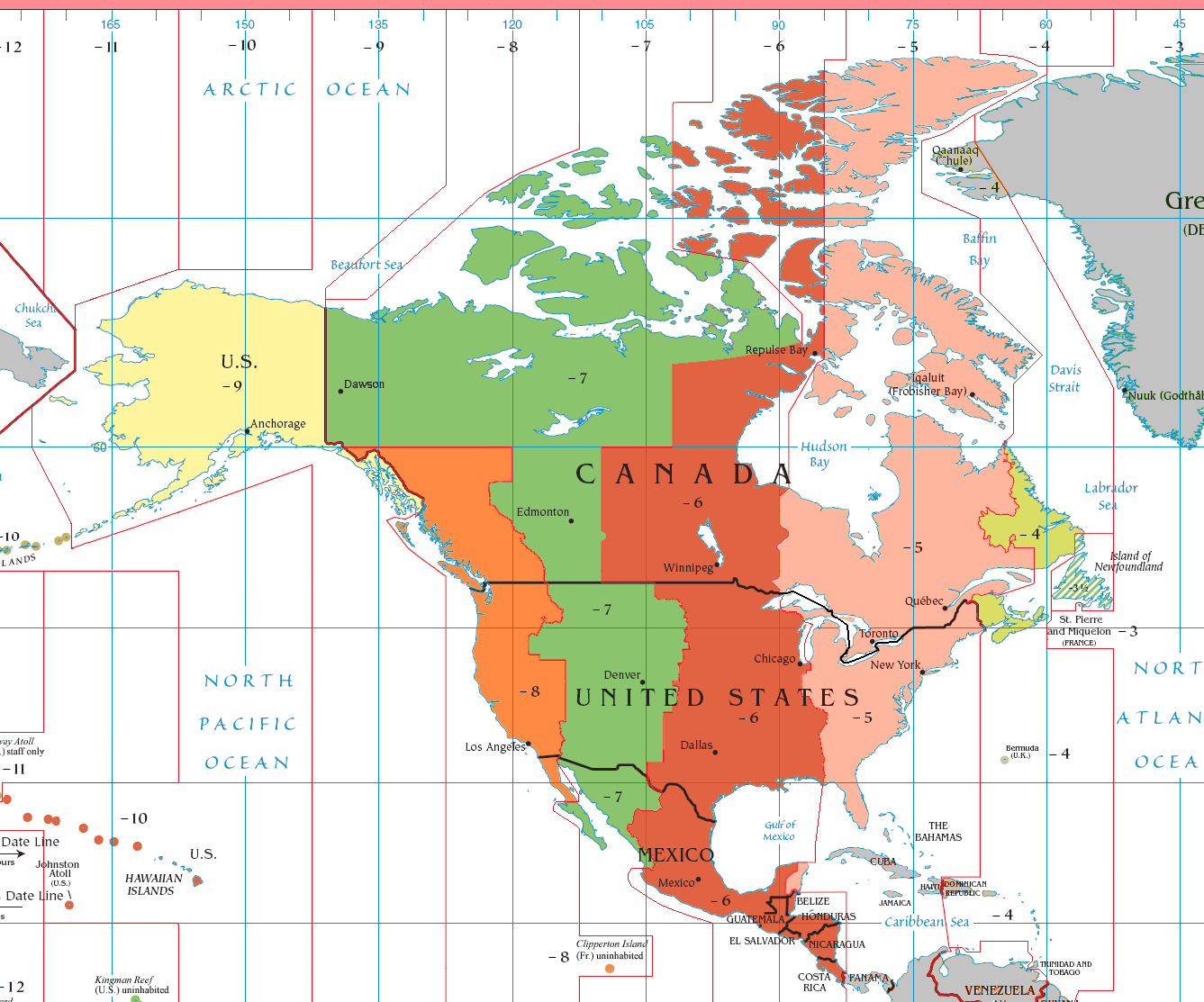
The Alaska Time Zone observes standard time by subtracting nine hours from Coordinated Universal Time (UTC−09:00). During daylight saving time its time offset is eight hours (UTC−08:00). The clock time in this zone is based on mean solar time at the 135th meridian west of the Greenwich Observatory.

Key Information

The zone includes nearly all of the U.S. state of Alaska and is one hour behind the Pacific Time Zone.

  • standard time: Alaska Standard Time (AKST)
  • daylight saving time: Alaska Daylight Time (AKDT)

The western Aleutian Islands observe Hawaii–Aleutian Time, one hour behind the remainder of the state.

The largest city in the Alaskan Time Zone is Anchorage, Alaska. The Anchorage Metropolitan Area is the largest metropolitan area in the zone.

Effective from 2007, the local time changes from AKST to AKDT at 02:00 AKST to 03:00 AKDT on the second Sunday in March and returns at 02:00 AKDT to 01:00 AKST on the first Sunday in November. As such, Alaska spends most of the year on daylight saving time rather than standard time.

History

[edit]
Period in use Time offset from UTC Name of time
Thursday, July 15, 1741 – Saturday, October 6, 1867 (Julian Calendar) UTC+14:59 (in Sitka) Local Mean Time
UTC+12:24 (in Aleutian Islands)
Saturday, October 18, 1867 – 1900 (Gregorian Calendar) UTC−09:01 (in Sitka) Local Mean Time
UTC−11:36 (in Aleutian Islands)
1900 – 1918 UTC−09:00 (including Aleutian Islands) Alaska Standard Time
1918 – January 19, 1942 UTC−08:00 (Panhandle Areas) Pacific Standard Time
UTC−09:00 (in Yakutat) Yukon Standard Time
UTC−10:00 Alaska Standard Time
UTC−11:00 (Nome, and Aleutian Islands) Bering Standard Time
January 20, 1942 – September 30, 1945 UTC−07:00 (Panhandle Areas) Pacific War Time
UTC−08:00 (in Yakutat) Yukon War Time
UTC−09:00 Alaska War Time
UTC−10:00 (Nome, and Aleutian Islands) Bering War Time
September 30, 1945 – March 31, 1967 UTC−08:00 (Panhandle Areas) Pacific Standard Time
UTC−09:00 (in Yakutat) Yukon Standard Time
UTC−10:00 Alaska Standard Time
UTC−11:00 (Nome, and Aleutian Islands) Bering Standard Time
April 1, 1967 – 1983 UTC−08:00 (Panhandle Areas) Pacific Standard Time
UTC−09:00 (in Yakutat) Yukon Standard Time
UTC−10:00 Alaska–Hawaii Standard Time
UTC−11:00 (Nome, and Aleutian Islands) Bering Standard Time
1983 – Present UTC−09:00 (in Juneau) Alaska Time Zone
UTC−10:00 (in Aleutian Islands) Hawaii–Aleutian Time Zone
2007 − Present UTC−09:00 (except in Aleutian Islands) Alaska Standard Time Time

Two time zones have been referred to as the "Alaska Time Zone": a zone based on UTC−10:00 that covered much of Central Alaska in the early 20th century, and a zone based on UTC−09:00 zone that has covered all of the state except the Aleutian Islands since 1983.

The Standard Time Act of 1918 authorized the Interstate Commerce Commission to define each time zone. The United States Standard Alaska Time was designated as UTC−10:00.[1] Some references prior to 1967 refer to this zone as Central Alaska Standard Time (CAST)[2] or as Alaska Standard Time (AKST). In 1966, the Uniform Time Act renamed the UTC−10:00 zone to Alaska-Hawaii Standard Time[3] (AHST[4]), effective April 1, 1967.[5] This zone was renamed in 1983[3] to Hawaii–Aleutian Standard Time when the majority of Alaska was moved out of the zone.

Prior to 1983, the current Alaska Time Zone (UTC−09:00) was known as the Yukon Time Zone, observing Yukon Standard Time (YST). This time zone included Canada's Yukon Territory and a small portion of Alaska including Yakutat. The Alaska Panhandle communities were in the Pacific Time Zone, while most of the interior was on UTC−10:00.[6] Nome and the Aleutians previously observed Bering Standard Time or UTC−11:00. In 1975, the Yukon Territory switched to Pacific Standard Time, leaving Yakutat the only land area in the zone.

With the consolidation of Alaska's four time zones into two in 1983,[7] the entire state was in either a zone based on UTC−09:00 or UTC−10:00.[8] The Yukon Time Zone based on UTC−09:00 was later renamed the Alaska Time Zone in 1984.[7][9]

Anomalies

[edit]

The Alaska Time Zone applies to the territory of the state of Alaska east of 169°30′ W, that is, the entire state minus the westernmost portions of the Aleutian Islands. Solar time zones are 15° wide.

UTC−09:00 time corresponds to the solar time at 9 × 15° = 135° W (roughly, Juneau, which is in the southeast panhandle). Thus, the westernmost locales of the Alaska Time Zone are off by up to 169°30′ − 135° = 34°30′ from local solar time, or slightly more than 2 hours and 17 minutes. At noon Alaskan Time at a location just east of 169°30′ W, local solar time is only about 9:42 a.m. The sun will not reach culmination for another 2 hours and 18 minutes.

When UTC−08:00 is applied in the summer (because of daylight saving time), this effect becomes even more apparent. For example, on June 12 at noon AKDT, the solar time at the extreme westerly points of the Alaskan time zone will be only 8:42 a.m., nearly 3 hours and 18 minutes behind clock time.

Very few people notice this, however, as these locations are virtually uninhabited, and for the very few people who do live there, the long days in the summer and short days in the winter make the sunrise and sunset times less important than areas closer to the equator. By contrast, in Juneau, which is much closer to the 135° west meridian, mean solar noon occurs around 11:57 a.m., very close to noon on the clock.

In Anchorage, visitors from more southerly latitudes are often surprised to see the sun set at 11:41 p.m. on the summer solstice while the solar time is 9:41 p.m. Anchorage is at 150° W, one hour further west from the solar time for UTC−09:00. Thus, Anchorage is one solar hour behind the legal time zone and observes daylight saving time as well for a two-hour discrepancy between legal time and solar time. Some local residents refer to this phenomenon as "double daylight time".[10]

In Fairbanks, the same circumstances cause sunset to occur at 12:47 a.m. the next calendar day and the solar sunset is at 10:47 p.m. Even without daylight saving time, another anomaly is that on the winter solstice in Nome, the sunrise is after "noon" clock time, at 12:02 p.m., about 4 hours before sunset at 3:56 p.m.

The territory of the state of Alaska spans almost as much longitude as the contiguous United States (57.5° vs. 57.6°)[10] so the use of only two time zones will inevitably lead to some distortions. Alaska would naturally fall into five time zones, with the greatest territory more correctly in UTC−10:00 and UTC−11:00, with Adak more correctly in UTC–12:00 and Cape Wrangell in UTC–13:00 as sunset can be late as midnight. But political and logistical considerations have led to the use of two time zones, leading to the distortions mentioned above.

Cities

[edit]

See also

[edit]

References

[edit]
[edit]
Revisions and contributorsEdit on WikipediaRead on Wikipedia
from Grokipedia
The Alaska Time Zone is a standard time zone observed in the majority of the U.S. state of , defined as UTC−09:00 during (, or AKST) and UTC−08:00 during (, or AKDT), which runs from the second Sunday in March to the first Sunday in November each year. It is based on the mean of the 135th meridian west of the and covers nearly all (over 99%) of Alaska's population, including major cities such as Anchorage, Fairbanks, and Juneau. Established as one of the original U.S. time zones under the Standard Time Act of 1918, the Alaska Time Zone has undergone significant changes to its boundaries over the decades to better align with geographic and economic realities. Prior to 1983, Alaska spanned four time zones—Pacific, Yukon, Alaska, and Bering—but federal legislation consolidated most of the state into the single Alaska Time Zone, with only the Aleutian Islands west of 169°30′ W longitude remaining in the separate Hawaii-Aleutian Time Zone (UTC−10:00 standard, UTC−09:00 DST). This adjustment, enacted via the Uniform Time Act amendments, aimed to simplify commerce and communication within the state while respecting its vast longitudinal extent. Alaska's observance of has been consistent with federal mandates since 1967, though the state has periodically debated opting out due to its extreme seasonal daylight variations and remote communities. The plays a critical role in coordinating activities across Alaska's diverse regions, from communities to coastal ports, and it positions the state nine hours behind (UTC) in winter, affecting international travel and . Recent legislative efforts, such as proposals in the Alaska State Legislature, reflect ongoing discussions about potential shifts to permanent or further boundary adjustments, but no changes have been implemented as of 2025.

Overview

Definition and Standards

The Alaska Time Zone is the standard time zone primarily observed throughout the U.S. state of Alaska, defined by a base offset of UTC−09:00. This places it nine hours behind Coordinated Universal Time (UTC) during standard time periods. Relative to adjacent zones, the Alaska Time Zone operates one hour behind the Pacific Time Zone, which uses UTC−08:00 for its standard time. The zone's standard time is denoted by the abbreviation Alaska Standard Time (AKST); during daylight saving time, clocks advance one hour to Alaska Daylight Time (AKDT, UTC−08:00), though the specific mechanics and dates of this observance are addressed in dedicated sections. This time zone encompasses nearly all of 's land area and approximately 90% of its population, with the primary exclusion being the west of 169°30′ W longitude, which instead follow the Hawaii-Aleutian Time Zone. The zone received its current official name, Time Zone, in 1984 via congressional action.

Current Time Offset

The Standard Time (AKST) observes a standard offset of year-round outside of (DST) periods. During DST, designated as Alaska Daylight Time (AKDT), the offset advances to and is observed annually under the , which extended the DST period by amending the of 1966. The DST schedule follows the second Sunday in March, when clocks are set forward one hour, through the first Sunday in , when clocks are set back one hour. The Alaska Time Zone lags one hour behind the , meaning that when it is 12:00 PM in , it is 11:00 AM in Anchorage. DST observance across Alaska is governed by the of , which permits states to but has been uniformly applied statewide since following the consolidation of time zones. Portions of the west of 169°30' W , however, remain excluded and adhere to the Hawaii-Aleutian Time Zone (UTC−10:00 standard, UTC−09:00 DST).

Historical Development

Pre-20th Century Practices

Before the imposition of standardized time zones, timekeeping in Alaska relied heavily on local solar observations, particularly among indigenous communities. Alaska Native peoples, such as the , , and , used natural cycles of the sun, , , and to track daily and seasonal time, with practices varying significantly by region and group due to the absence of a unified system. For instance, the divided the year into 12 to 13 lunar months named for ecological events, such as Xaat Dísi (Salmon Moon) in August for spawning season or S’eek Dís (Black Bear Moon) in November, integrating solar observations like sunrise (keex’é) and tidal patterns linked to phases for and . Similarly, communities employed circumpolar constellations and lunar phases to estimate time passage, seasons, and navigation; the star Aagjuuk signaled the return of daylight near , while asterisms like Ullaktut (The Three Hunters) helped mark nighttime hours. These methods prioritized relational and environmental cues over precise mechanical measurement, reflecting a cyclical view of time tied to survival activities like hunting and gathering. During the Russian colonial period from 1741 to 1867, timekeeping in settlements like Sitka remained informal and based on local mean solar time determined by longitude, with rudimentary clocks introduced in forts and administrative centers. Sitka, at approximately 135° West longitude, observed a local time roughly equivalent to UTC-9:01, while nearby Wrangell at 132° West differed by about 12 minutes, leading to discrepancies across the sparse network of outposts. Clocks were often inaccurate or absent, and operations in the Russian-American Company forts synchronized loosely with ship arrivals and natural light, as mechanical timepieces were rare even in the colonial capital. Following the U.S. acquisition of in 1867, initial time practices in key ports continued to follow these local solar conventions, exacerbating confusion in emerging telegraph and shipping networks. Ports like Sitka maintained independent local times, complicating coordination for trans-Pacific vessels and early communication lines, such as the aborted telegraph expedition that spanned the territory until news of the transatlantic cable's success reached a year late in 1867. In the early , the fur and faced similar inconsistencies, as traders and expeditions lacked a standard meridian, relying on ad hoc solar observations that varied by location and hindered synchronized scheduling for seasonal voyages and overland treks.

20th Century Standardization and Reforms

In the early , the adoption of standardized time in began with the establishment of in 1900, centered on the 135th meridian west and set at UTC−09:00, primarily to coordinate railway and telegraph operations in . This initial system aligned the region one hour behind Pacific Standard Time, addressing the growing need for synchronization amid expanding communication infrastructure. The of 1918 marked a significant federal intervention, officially designating a single U.S. Standard Time at UTC−10:00 for the entire territory, two hours behind Pacific Standard Time, to promote uniformity for commerce and transportation during . However, due to lax enforcement and the territory's vast longitudinal span, local practices persisted, effectively dividing into multiple informal zones: UTC−09:00 in the southeast, UTC−10:00 in central areas, and UTC−11:00 in the west, including Nome and the . This fragmentation complicated interstate coordination but reflected practical adaptations to variations. During , national security priorities led to a temporary statewide shift under the War Time Act, implementing year-round from February 9, 1942, to September 30, 1945, which advanced clocks by one hour across all existing zones, effectively aligning most of to UTC−09:00 for unified military and defense operations. Post-war, the time reverted to pre-war standards, restoring the multi-zone structure and exacerbating scheduling challenges for travel and commerce between regions. The of 1966, effective April 1, 1967, further reformed the system by formally recognizing four distinct zones in (UTC−09:00 for Yakutat and parts of the interior), Alaska-Hawaii (UTC−10:00 for most of the state), Bering (UTC−11:00 for western areas), and Pacific (UTC−08:00 for the southeast Panhandle)—while transferring oversight to the and standardizing observance. This legislation aimed to revert to and refine the fragmented pre-war arrangement but highlighted ongoing issues, such as a three-hour difference between Juneau and western communities, which hindered air travel, broadcasting, and economic interactions from 1918 to 1983. By the early 1980s, these disparities prompted major reforms; in April 1983, the Alaska Legislature passed a resolution requesting federal action, leading the to approve a consolidation reducing the zones to two effective October 30, 1983: Alaska Time (UTC−09:00, covering over 98% of the population including Anchorage, Fairbanks, and the former Yukon and southeast areas) and Hawaii-Aleutian Time (UTC−10:00, for the western ). This change, signed by Secretary on September 15, 1983, streamlined operations by minimizing cross-zone travel disruptions, such as the previous two- to three-hour gaps between major cities. The final adjustment came with the Supplemental Appropriations Act of 1984 (Public Law 98-181, enacted November 30, 1983), which renamed the primary zone "Alaska Time Zone" effective in 1984, replacing "Yukon Time" to better reflect the state's identity and consolidate the majority under UTC−09:00. No significant boundary or offset changes have occurred since, maintaining stability as of 2025.

Geographical Coverage

Primary Areas Included

The Alaska Time Zone encompasses the entirety of the U.S. state of situated east of 169°30′ west longitude, thereby including the mainland and the extending up to . This delineation ensures that the zone covers the vast majority of the state's territory, excluding only the remote western extremities of the chain, which fall under the Hawaii-Aleutian Time Zone. Within this scope, the zone incorporates Alaska's primary geographical regions, including the Southeast region (commonly known as the Panhandle), the Southcentral region (encompassing the ), the Interior, and the Arctic areas. These diverse areas range from temperate coastal rainforests in the southeast to vast landscapes in the north, all synchronized under the Alaska Time Zone for uniformity in timekeeping. The covered land area totals approximately 570,000 square miles, representing nearly all of Alaska's terrestrial expanse and including its principal population centers. Along its eastern boundary, the zone aligns precisely with the international border shared with Canada's , which maintains Mountain Time at , thereby avoiding any overlap in time zone observance across the frontier.

Boundaries and Exclusions

The Alaska Time Zone is delineated by a western boundary at 169°30′ W longitude, which separates it from the Hawaii-Aleutian Time Zone (UTC−10:00). This line runs through the chain, placing the majority of Alaska's territory, including the mainland and most offshore islands, within the Alaska Time Zone (UTC−09:00 ). Notable exclusions occur in the western west of this boundary, such as Adak and Attu, which remain in the Hawaii-Aleutian Time Zone, observing Hawaii-Aleutian Standard Time (UTC−10:00) during and Hawaii-Aleutian Daylight Time (UTC−09:00) during . These areas, part of the Aleutian Islands Borough, represent a small but distinct portion of Alaska's landmass, primarily uninhabited except for communities like Adak Station. To the east, the Alaska Time Zone follows the state's international with , aligning with the Territory, which uses year-round, resulting in a time difference across the border. The mainland of contains no enclaves, splits, or internal deviations from this zone. Remote islands such as the (including Saint Paul and Saint George, located around 170° W but not classified as part of the Aleutian chain) observe Alaska Time, falling east of the critical western boundary. These boundaries were established in 1983 through amendments to the , consolidating Alaska's previous four time zones into two to reduce administrative complexity and improve synchronization across the state's vast expanse. Prior to this reform, the state spanned zones including Bering, Alaska, , and Pacific, leading to significant time differences within short distances; the change aligned most populated areas under UTC−09:00 while preserving the far-western Aleutians' UTC−10:00 status.

Time Observance Practices

Daylight Saving Time Rules

The Alaska Time Zone observes (DST) on a mandatory statewide basis, as established following the 1983 consolidation of Alaska's time zones under the federal of 1966. This requires clocks to advance one hour from Alaska Standard Time (AKST, UTC−09:00) to Alaska Daylight Time (AKDT, UTC−08:00) at 2:00 a.m. local time on the second Sunday in March. For instance, on March 9, 2025, clocks shifted from 2:00 a.m. AKST to 3:00 a.m. AKDT. DST concludes on the first Sunday in , when clocks are turned back one hour at 2:00 a.m. AKDT to 1:00 a.m. AKST. This adjustment occurred on November 2, 2025, returning the zone to . No exceptions to DST observance exist within the Alaska Time Zone boundaries, ensuring uniform application across its coverage; this differs from the Hawaii-Aleutian Time Zone, where DST is not observed. The rationale for DST in the Alaska Time Zone emphasizes through extended evening daylight and economic benefits via enhanced alignment with contiguous U.S. time practices during summer, supporting and transportation coordination. As of 2025, no opt-out from DST has been enacted in , despite legislative proposals such as Senate Bill 26, which advanced in the but did not pass. DST transitions are implemented and synchronized using official time signals disseminated by the National Institute of Standards and Technology (NIST), ensuring precise adherence across the zone.

Solar Time Discrepancies

The Alaska Time Zone is centered on the 135° W meridian for mean alignment, but its extensive longitudinal coverage—from roughly 130° W in the east to 169°30' W in the west—creates substantial deviations between clock time and local solar noon. Eastern areas near the experience up to about 20 minutes before 12:00 PM AKST, while western regions, such as parts of the Yukon-Kuskokwim Delta, lag by as much as 2 hours and 18 minutes, meaning can occur as late as 2:18 PM AKST. This lag arises because each 15° of corresponds to one hour of , and the zone's 39.5° span exceeds two full hours. Alaska's high latitudes, spanning 51° N to 71° N, compound these longitude-based issues with extreme seasonal daylight variations, leading to pronounced mismatches between clock time and natural solar cycles. During the , the midnight sun phenomenon causes prolonged daylight, with sunsets occurring well after 11:00 PM in southern cities like Anchorage (61° N), where the sun sets at 11:42 PM AKDT on June 21. In winter, polar night effects dominate in northern areas, such as Nome (64.5° N), where the low sun angle results in sunrise delayed until after clock noon, around 12:02 PM AKST on the December 21 . These latitude-driven extremes mean daylight hours can range from nearly 24 hours in summer to under 4 hours in winter, far outpacing variations in lower-latitude zones. Specific examples illustrate the scale: In Anchorage (149.9° W), mean solar noon falls approximately at 1:00 PM AKST, a 60-minute delay from the zone's reference due to its 15° westward offset. Farther west in Nome (165.4° W), this shifts to about 2:02 PM AKST, a 2-hour discrepancy, aligning with the sunrise of 12:02 PM that same day. While these solar time mismatches minimally disrupt daily routines—thanks to widespread adaptation for unified scheduling in transportation, work, and communication—they pose challenges for astronomy, where precise solar positioning is essential for observations, and for , particularly in traditional practices relying on solar cues. No zonal adjustments, such as sub-zones or offsets, are implemented to mitigate them, prioritizing standardization over local solar alignment. Alaska's combination of a broad longitudinal extent (over 57°) and extreme latitudes produces more severe solar discrepancies than in contiguous U.S. time zones, amplifying both daily offsets and seasonal daylight imbalances unique to the region.

Usage and Implementation

Major Cities and Regions

The Alaska Time Zone encompasses the majority of the state's populated areas, including its primary urban centers and key regional hubs. Anchorage, with a 2024 population estimate of 289,600, stands as Alaska's largest city and serves as the state's primary economic hub, driving commerce, transportation, and government activities in the Southcentral region. As the logistical and financial core, it hosts major industries such as , , and resource extraction support, influencing time coordination across southern . Fairbanks, estimated at 31,732 residents in 2024, functions as the central hub for Alaska's Interior, located just south of the and facilitating northern logistics and supply chains. Its strategic position supports military operations at nearby bases, research institutions like the , and distribution networks for goods to remote northern communities, making it essential for regional time synchronization in high-latitude operations. Juneau, the state capital with a 2024 population of 31,572, anchors the Southeast Panhandle region and shapes timing practices for coastal communities along the Alexander Archipelago. As a hub for government administration and marine trade, it coordinates with ferry systems and fisheries that extend influence over the timing needs of the narrow, island-dotted Panhandle. Beyond these cities, the time zone covers significant regions such as the , home to approximately 61,259 people in its as of 2024 and a vital center for the oil and gas industry, where production facilities align operations with statewide . The Matanuska-Susitna (Mat-Su) Valley, with a 2024 population of 117,613, experiences rapid suburban growth as a commuter area for Anchorage workers, emphasizing residential expansion and infrastructure timed to urban rhythms. In the , remote villages like Utqiagvik (formerly Barrow), with 4,668 residents in 2024, represent northern outposts where the time zone supports subsistence activities and limited connectivity despite extreme seasonal light variations. Overall, these areas account for approximately 90% of 's total of about 741,000 as estimated in 2024, with no major cities falling outside the zone, ensuring broad adherence to Alaska Standard Time across population centers. The is enforced by the U.S. (DOT) under the of 1966, which authorizes the DOT to designate zones across the nation. In 1983, the DOT implemented a reconfiguration reducing 's time zones from four to two, establishing the current (UTC−09:00 ) for the majority of the state while designating the (UTC−10:00) for the western Aleutians. Alaska state law aligns with this federal framework, requiring compliance with DOT designations and prohibiting unilateral deviations without federal approval, as evidenced by ongoing legislative efforts to petition the DOT for adjustments. In practice, the Alaska Time Zone enables for , where local stations adjust national feeds to align with the one-hour offset from Pacific Time, ensuring timely delivery of programming to residents. Airlines, such as those operating at Anchorage International Airport, schedule flights and announcements in Alaska Standard Time (AKST) or Alaska Daylight Time (AKDT) to coordinate seamlessly with connections to Pacific Time destinations like . Commerce with Pacific states, including shipping and financial transactions, operates efficiently despite the offset, as standardized protocols account for the difference in daily . Travel between the main Alaska Time Zone and the ' Hawaii–Aleutian Time Zone necessitates a one-hour clock adjustment, complicating for ferries, flights, and supply chains in this remote region. , particularly aurora borealis viewing, is impacted by these discrepancies, as tours in areas like Fairbanks are scheduled in AKST/AKDT (typically 10 p.m. to 2 a.m. for optimal visibility), requiring visitors from other zones to recalibrate itineraries to avoid missing peak displays. As of November 2025, no alterations to the have been enacted, though Senate Bill 26—passed by the Alaska Senate in May 2025—proposes shifting the state to Pacific Time and eliminating , awaiting House consideration and DOT approval. Digital tools, including automatic time zone detection via GPS, help mitigate adjustment challenges for residents and visitors by updating clocks in real-time upon location changes. The Alaska Time Zone maintains coordination with Canada's Yukon Territory, which observes permanent Mountain Standard Time (UTC−07:00), aligning fully during Alaska's daylight saving period to support cross-border in goods like energy resources and tourism services without additional offsets.

References

Add your contribution
Related Hubs
User Avatar
No comments yet.