Hubbry Logo
H. W. L. PoonjaH. W. L. PoonjaMain
Open search
H. W. L. Poonja
Community hub
H. W. L. Poonja
logo
8 pages, 0 posts
0 subscribers
Be the first to start a discussion here.
H. W. L. Poonja
H. W. L. Poonja
from Wikipedia

Key Information

Quotation

No teaching, no teacher, no student.

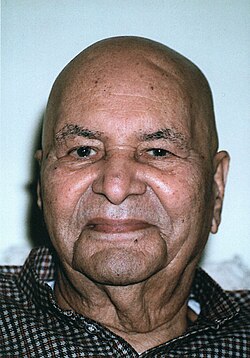
Hariwansh Lal Poonja (/ˈpʊnə/; born 13 October 1910 (or later) in Punjab, British India – 6 September 1997 in Lucknow, India) was an Indian sage. Poonja was called "Poonjaji" or "Papaji" /ˈpɑːpɑːi/ by devotees. He was a key figure in the Neo-Advaita movement.

Biography

[edit]

Early life

[edit]

At the age of eight, he claimed he had experienced an unusual state of consciousness:

The experience was so overwhelming it had effectively paralysed my ability to respond to any external stimuli. For about an hour they tried everything they could think of to bring me back to a normal state of consciousness, but all their attempts failed.[web 1]

Meeting Ramana Maharshi

[edit]

However, rather than giving another vision of God, Ramana Maharshi pointed him in the direction of his own self:

I cannot show you God or enable you to see God because God is not an object that can be seen. God is the subject. He is the seer. Don't concern yourself with objects that can be seen. Find out who the seer is.[web 2]

Transformation

[edit]

He found that he could no longer bring his mind to think of God, do japa or any other spiritual practice. He asked Ramana for help and was told that this was not a problem, that all his practice had carried him to this moment and it could be left behind now because it had served its purpose. Poonja recognised this as the same state he experienced when he was eight years old, but this time it was permanent.[web 3]

Teaching others

[edit]

Poonjaji met two other men "who convinced me that they had attained full and complete Self-realisation.",[web 4] a Muslim Pir and an unknown sadhu whom he met by the side of a road in Karnataka.[web 4]

At the end of 1968 Poonja met in Rishikesh Geneviève de Coux (born 1947), — later known as Ganga Mira — a young Belgian seeker, who became his disciple and with whom he would form a new family, after the ancient Vedic polygamic tradition. Their daughter Mukti was born in 1972.[1]

Poonjaji later settled in Lucknow where he received visitors from all around the world. Some well-known students of his and later self-appointed gurus of Neo-Advaita included Eli Jaxon-Bear, Gangaji, Mooji, and Andrew Cohen, who later distanced himself from Poonja. Sam Harris also visited Poonja several times in the early 1990s.[2]

David Godman, a devotee of Ramana Maharshi, moved to Lucknow in 1992 to spend time around Poonja and stayed until 1997. Godman wrote prolifically about Poonja, including Papaji Interviews, an anthology of interviews, and Nothing Ever Happened, a three volume 1,200-page biography.

Teaching through silence

[edit]

His teaching emphasises that words can only point to ultimate truth, but never are ultimate truth, and that intellectual understanding without directly realising the truth through one's own investigation is not enough. Like Sri Ramana he stressed that teaching through silence was more important than teaching through words. Once, when a French seeker informed Poonja that he was learning Sanskrit to better understand ancient scriptural texts, Poonja replied:

All your books, all the time lost in learning different languages! Are they any use for conversing with the atman, with the Self, for speaking to yourself? None of that leads anywhere useful. The atman has nothing to do either with books, or with languages or with any scripture whatever. It is — and that's all![3]

The process

[edit]

Poonja mentions several events in his own life which "illustrate, in a general way, how the process of realisation comes about."[web 5]

  1. "There must be a desire for God, a love for Him, or a desire for liberation. Without that, nothing is possible."[web 5]
  2. "This desire for God or realisation is like an inner flame. One must kindle it and then fan it until it becomes a raging fire which consumes all one's other desires and interests."[web 5]
  3. "If this inner fire rages for long enough, with sufficient intensity, it will finally consume that one, central, overwhelming desire for God or the Self."[web 5]
  4. The presence of the Master is the final ingredient: "When the Maharshi’s gaze met my vasana-free mind, the Self reached out and destroyed it in such a way that it could never rise or function again. Only Self remained."[web 5]

Self-enquiry

[edit]

His message, like that of his teacher Sri Ramana, was always that the Self is already enlightened and free. Like Sri Ramana, he taught self-enquiry, which involved locating a person's sense of "I" and focusing on and investigating this directly. Famous for eschewing all forms of practices or sadhana, Poonja nonetheless recommended self-enquiry as the only practice one should take up, but he didn't want people to take it up as a form of meditation. He would say, “Do it once and do it properly, and your spiritual quest will be over instantly."[3]

Liberation

[edit]

According to Poonja, Self-realization is in itself liberating from karmic consequences and further rebirth. According to Poonja "karmic tendencies remained after enlightenment, [but] the enlightened person was no longer identified with them and, therefore, did not accrue further karmic consequences."[4] According to Cohen, Poonja "insisted that the realization of the Self had nothing to do with worldly behavior, and he did not believe fully transcending the ego was possible."[4] For Poonja, ethical standards were based on a dualistic understanding of reality and the notion of an individual agent, and therefore were not indicative of "nondual enlightenment:[4] "For Poonja, the goal was the realisation of the self; the illusory realm of relative reality was ultimately irrelevant."[4]

Works

[edit]
  • Poonja, H. W. L. (1993). Godman, David (ed.). Papaji: Interviews. Avadhuta Foundation. ISBN 978-0963802200.
  • Poonja, H. W. L. (2000). This: Prose and Poetry of Dancing Emptiness. Red Wheel Weiser. ISBN 978-1578631766.
  • Poonja, H. W. L. (2000). De Jager, Prashanti (ed.). The Truth Is. Weiser Books. ISBN 978-1578631759.

References

[edit]

Further reading

[edit]
[edit]
Revisions and contributorsEdit on WikipediaRead on Wikipedia
from Grokipedia
H. W. L. Poonja (1910–1997), affectionately known as Papaji, was an influential Indian spiritual teacher and master renowned for his direct approach to and his role in popularizing teachings in the West. Born on October 13, 1910, in , western (now in ), into a family, Poonja experienced his first profound spiritual awakening around the age of eight or nine, during which he felt a direct connection to the while contemplating Lord Krishna. His maternal uncle was the renowned poet-saint Tirtha, which influenced his early devotional inclinations. In 1944, during a period of intense seeking, Poonja traveled to and met the sage , whose silent presence catalyzed his final realization of the Self; he remained at the until 1947, absorbing the teachings of self-inquiry. After serving in the , Poonja settled as a householder in , , raising a family while quietly embodying his realization. It was not until his retirement in 1966 that he began openly sharing his insights through satsangs (spiritual gatherings), attracting seekers from around the world with his direct pointers such as the instruction to "keep quiet"—a non-practice that points to effortless silence and the immediate revelation of one's true nature (the eternal Self)—alongside self-inquiry ("Who am I?"), emphasizing the immediacy of the present moment without reliance on prolonged methods or rituals. Poonja's teachings, which rejected gradual paths in favor of instant liberation through grace and direct pointing, profoundly impacted numerous contemporary spiritual figures, including , Andrew Cohen, and , thereby contributing to the global spread of non-dual awareness. He conducted his satsangs in until his death on September 6, 1997, leaving behind a legacy documented in works such as the three-volume biography Nothing Ever Happened compiled by David Godman and approved by Poonja himself.

Biography

Early Life

Hariwansh Lal Poonja, commonly known as H. W. L. Poonja or Papaji, was born on October 13, 1910, in , a town in the region of British India (now part of ), into a family. Some accounts suggest the birth year may have been 1913, reflecting minor discrepancies in biographical records. His father, Parmanand, and mother, Yamuna Devi, provided a stable home environment steeped in Hindu traditions. Notably, his mother was the sister of Tirtha, a prominent Vedantic poet and spiritual figure whose influence likely permeated the household from an early age. Poonja's upbringing occurred in a devout Hindu family where religious practices and storytelling formed a core part of daily life. At around the age of eight, while playing near a riverbank, he underwent a spontaneous and profound spiritual experience—a samadhi-like state of overwhelming bliss, boundless joy, and complete unity with an all-encompassing sense of the that dissolved all sense of separation. This episode, lasting nearly an hour, left a lasting impression on the young boy, though he could not fully articulate it at the time; his mother interpreted it as a divine visitation from Krishna, prompting him to deepen his devotional practices toward the deity. This early glimpse of non-dual awareness, as he later reflected, marked the beginning of his innate spiritual orientation, influencing his worldview long before formal guidance. Poonja received only limited formal , as his growing preoccupation with spiritual matters and devotion often distracted him from academic pursuits. In his early twenties, following an to a woman, he fathered two children and assumed family responsibilities. To support his growing household, he joined the as a commissioned officer during , serving in various capacities that took him across and beyond. Despite the demands of military life, his inner quest for the divine presence he had glimpsed in childhood persisted, shaping his personal discipline and resilience amid the era's upheavals. He left the army around 1942 to pursue his spiritual search more intensively.

Encounter with Ramana Maharshi

Following years of intense spiritual seeking marked by disillusionment with various gurus and practices—despite an early childhood experience of —H. W. L. Poonja felt an inner call in when a wandering appeared at his home in and directed him to seek at Sri Ramanasramam in . In , at the age of 34, with a young family, Poonja secured a job in Madras that provided funds and time for the journey south, traveling by train to the ashram at the foot of Hill. Upon arrival, Poonja initially mistook Ramana for the sadhu from and, annoyed by the apparent impossibility, nearly left in disgust; however, ashram resident Framji persuaded him to stay, noting Ramana had not left in decades. Entering the hall, Poonja confronted Ramana privately about the supposed visit to , but received only silence; Ramana's penetrating gaze then triggered a profound shift, with Poonja trembling as a vibrant energy entered his body and awakened awareness of the spiritual Heart on the right side of the chest. Ramana briefly spoke, confirming Poonja's prior glimpses of realization by stating, "You have come to the right place," and advising focus on the seer rather than objects. In that gaze, Poonja experienced visions of Krishna—his lifelong devotional focus—and other deities, which dissolved into the brilliant light of the Heart, revealing their illusory nature as projections of the Self; a closed, bluish bud within the Heart opened, flooding his being with pure consciousness. Ramana guided him that while devotion like Poonja's bhakti to Krishna could lead to truth, the direct path of knowledge through self-enquiry was essential to abide permanently in the Self, beyond transient visions. Poonja remained at the ashram for several months in 1944, immersing in Ramana's presence amid his new duties in Madras, and made regular follow-up visits, including weekends, until Ramana's death in 1950, during which time he also navigated India's partition to relocate his family south for safety.

Personal Transformation

Following his encounter with Ramana Maharshi in 1944, H. W. L. Poonja experienced a profound and permanent shift in consciousness, marked by an abiding realization of the Self. In Ramana's presence, Poonja underwent an instantaneous dissolution of the ego, describing it as a vibration that unified his body and mind into oneness, allowing him to perceive the world without dualistic separation. This realization persisted during his subsequent civilian professional life, where the ego's grip fully dissolved, enabling him to abide effortlessly in the Self amid daily duties. Poonja faced significant challenges that tested his newfound non-attachment, particularly during the post-war upheavals and India's partition in , which exposed him to displacement and chaos, yet reinforced his detachment from worldly outcomes. He rejected occult practices and other spiritual paths, such as those involving miracles or rituals, viewing them as distractions from direct self-knowledge; for instance, he discarded a mystic's stick, prioritizing silence over displays. These experiences solidified his commitment to unadorned , dismissing efforts that perpetuated the illusion of separation. Central to Poonja's insights was the recognition that true realization is effortless and ever-present, requiring no striving or practices, as the is already complete and unchanging. He emphasized that enlightenment arises simply by turning attention inward to the seer, without the need for devotion or once the initial glimpse occurs. This marked a decisive shift from his earlier bhakti-oriented devotion to Krishna, which had fueled visions and emotional surrender, toward the path of jnana, or direct knowledge, where the devotee identity dissolves into pure awareness. In the and , Poonja worked as a manager in a battery factory in , quietly integrating this realization into his everyday life in , maintaining a professional role while supporting his family after the 1947 partition. He avoided public spiritual activities, focusing instead on silent abiding and occasional private meetings with fellow seekers, allowing the transformation to unfold naturally without external expression. This period of seclusion enabled a deep, unspoken embodiment of non-dual understanding amid ordinary responsibilities.

Teaching Career and Family Life

Following his personal transformation, H. W. L. Poonja, known as Papaji, transitioned into a teaching role by offering informal guidance to spiritual seekers who visited him. After retiring from his career in 1966, he settled in Lucknow, India, where he began receiving visitors at his home and providing personal counsel on self-realization, drawing from his experiences with Ramana Maharshi. This guidance remained low-key and sporadic through the late 1960s and 1970s, often occurring during his travels or in private settings, as Poonja balanced spiritual inquiry with family responsibilities. By the early 1990s, however, the influx of international devotees led to the establishment of regular satsangs in a dedicated hall called Satsang Bhavan, where he held daily gatherings until shortly before his death, attracting thousands from around the world. In 1968, while in Rishikesh, Poonja met Geneviève de Coux, a Belgian seeker who later became known as Ganga Mira; their relationship deepened into marriage in 1972, the same year their daughter, Mukti, was born. The family traveled extensively across India and abroad during the 1970s, allowing Poonja to integrate his domestic life with his emerging role as a guide, while supporting the household through various means amid modest circumstances. Ganga Mira assisted in satsangs and household matters, and Mukti grew up immersed in this blend of family intimacy and spiritual community, with Poonja maintaining a grounded presence as both father and teacher despite the demands of seekers. This period reflected his commitment to a balanced existence, where personal relationships coexisted with his dedication to Advaita principles. Poonja's daily routine in emphasized simplicity, centered around his home in the Indira Nagar area, where he lived unpretentiously with basic furnishings and vegetarian meals shared with family and visitors. Mornings often involved personal or reading scriptures, followed by afternoon and evening satsangs in his or the nearby hall, interspersed with brief interactions or rest. In the , his began to decline due to mobility issues and respiratory problems, prompting him to abandon nomadic travels around 1990; yet he persisted with short darshans, even from his chair or bed, offering silent blessings to devotees until his final weeks. Poonja passed away on September 6, 1997, in at the age of 86, succumbing to complications from and after a brief hospitalization where he was placed on a . His drew hundreds of global disciples who carried his body through the streets chanting devotional songs, before at a on the ; his ashes were later immersed in the Ganga at , honoring traditional rites.

Teachings

Advaita Vedanta Principles

H. W. L. Poonja, known as Papaji, taught the core principles of as the recognition of absolute reality as , the unchanging that is pure and the sole existence. In this non-dual philosophy, the individual soul or atman is identical to , with no separation between the personal self and the ; the apparent individual is merely a misperception arising from ignorance. The world, including all phenomena and multiplicity, is considered an illusion or maya, a projection of the mind that veils the ever-present truth of oneness, much like a dream that dissolves upon awakening. Papaji emphasized immediate recognition of this non-dual truth over any gradual spiritual paths, rejecting rituals, ethical preliminaries, prolonged , or scriptural study as unnecessary veils that reinforce the of separation. He asserted that true liberation occurs instantly through the guru's direct pointing, without the need for preparatory practices, as the is already fully realized and requires only the cessation of seeking. This direct approach critiques orthodox Advaita practices, viewing them as mental constructs that distract from the simplicity of abiding in the . However, his rejection of traditional preparatory steps has drawn from some Advaita scholars, who argue it may lead to temporary glimpses rather than lasting realization. Papaji's teachings trace a direct lineage to , his guru, and the foundational Advaita of , adapting traditional non-dualism to a radical simplicity unencumbered by dogma. Upon realization, he taught, one is freed from the bondage of past karma, as the ego-doer dissolves, rendering actions impersonal and without consequence in the non-dual . This extends to an ethical neutrality, where distinctions of good and bad lose meaning in the absence of a separate actor, allowing natural behavior aligned with the Self's peace rather than moral striving.

Self-Enquiry Technique

H. W. L. Poonja, known as Papaji, taught self-enquiry as a direct and immediate method for realizing the , emphasizing the investigation of the "I"-thought to uncover its source in the Heart. This technique centers on the question "Who am I?", which serves to trace the arising of the egoic sense of individuality back to its origin, thereby dissolving the illusion of separation. By persistently inquiring into the nature of the "I" that claims experiences, the practitioner reveals the underlying pure consciousness free from objects. The process unfolds through simple yet profound steps: first, observe the arising thoughts without attachment or analysis, allowing them to appear and subside naturally without engagement. As the mind quiets and no new thoughts emerge, abide in the ensuing , turning attention inward to the of presence that persists. This abiding culminates in the recognition of pure as the eternal , beyond the transient play of mind. Papaji instructed that this enquiry requires no formal posture or prolonged effort, but rather a vigilant turning away from mental identifications in the present moment. Papaji adapted the technique for instant applicability, asserting that realization could occur spontaneously at any time without preparatory disciplines or dependence on a after the initial guidance. He stressed that is always available now, simply by choosing to drop all and return to the source of the "I", making the method accessible even to those unversed in spiritual practices. In his satsangs, Papaji shared examples of seekers achieving realization in a single sitting through this enquiry. For instance, he guided one visitor by asking "Who is thinking?" during a moment of mental activity, arresting the thought process and revealing the empty from which thoughts arise, leading to an immediate sense of inherent . In another case, a devotee dropped temporal upon enquiry, experiencing the as timeless presence without further doubt. These stories illustrate how surrendering the ego's grip through direct investigation dissolves bondage effortlessly.

Satsang and Silence

Poonja's were informal gatherings held at his home in , , beginning in September 1990 when health issues prevented further travel. Initially conducted in his , these sessions accommodated 40 to 50 devotees seated on the floor, with participants arriving in the morning and remaining through the evening. As interest surged, the meetings expanded to a dedicated hall at Satsang Bhavan, attracting large crowds of hundreds at their peak in the mid-1990s, with thousands of visitors coming to over the years. Poonja's physical presence itself acted as a catalyst, creating an atmosphere conducive to immediate spiritual insight without structured rituals or formalities. Silence formed the core of these satsangs, serving as the primary vehicle for direct transmission of realization through Poonja's gaze or profound stillness. Words played a secondary role, employed mainly to dismantle the seeker's mental concepts and induce doubt in egoic identifications, thereby guiding participants into inner quietude. Poonja frequently issued simple directives like "keep quiet" to halt thought processes and foster a no-mind state, emphasizing that true understanding arises in this unadorned silence rather than through intellectual discourse. "Keep quiet" represented the essence of his message: a direct pointer to cease all mental activity, thoughts, and effort, thereby immediately revealing one's true nature—the Self, eternal existence (satyam), peace, or happiness itself. He stressed that this is explicitly not a practice, technique, or sadhana—there is nothing to do, no effort required, and no ignorance or mind to remove, as these are mere illusions. For beginners, his guidance was straightforward: keep quiet for a single instant—do not start a thought, do not allow the mind to stir—and rest in silence. This reveals what one already is, without time or sequential steps needed. Practically, the satsangs followed no rigid timetable, unfolding spontaneously each day as devotees gathered to immerse themselves in Poonja's energy. The emphasis lay on unwavering devotion and complete surrender to the guru's presence, with attendees encouraged to simply openness, allowing the master's influence to dissolve personal efforts or expectations. This approach mirrored traditional Advaita transmission while prioritizing effortless abiding over prolonged practices. In historical context, Poonja's engagements evolved from intimate private interviews conducted during his earlier travels to open public events after his 1990 relocation to . This transition in the 1990s broadened accessibility, drawing an influx of Western seekers who traveled to for direct encounter, thus amplifying the international reach of his non-dual pointers.

Nature of Liberation

In H. W. L. Poonja's teachings, liberation, known as , is defined as the sudden and irreversible recognition of the true , wherein the illusory ego dissolves completely, bringing an immediate end to all . This recognition occurs in a moment of total , where one sees the ego without identifying as it, resulting in absolute freedom from bondage. Post-liberation, living becomes effortless, as the abides in an eternal state of , , and non-attachment, with actions arising spontaneously from the without the need for moral prescriptions or deliberate effort. The liberated being remains undisturbed by thoughts, much like an ocean unaffected by its waves, allowing life to unfold naturally without the interference of ego-driven desires. Poonja asserted that this realization is available to anyone in the present moment, requiring no prior practices, sadhanas, or consideration of past lives or karma, as the is already whole and ever-present. Verification of true liberation comes through the direct experience of abiding , where no doubt or seeking remains. To address potential critiques, Poonja distinguished genuine from temporary glimpses of the Self, emphasizing that real liberation is permanent and does not fade when the mind reactivates old habits or concepts. He warned against pseudo-realizations, where individuals mistake intellectual understanding or fleeting peace for the ego's dissolution, urging complete surrender to prevent the mind from reclaiming its illusory hold.

Influence and Legacy

Key Disciples

H. W. L. Poonja, known as Papaji, attracted a diverse group of disciples in the , including both Indian and international seekers who experienced profound realizations during his satsangs in . Among the most prominent were Western students who went on to establish their own teaching lineages, adapting his direct approach to in varied ways. These disciples often diverged in their emphases, with some incorporating elements of devotion or evolutionary , while others stayed closer to Poonja's radical call to immediate . Gangaji (born Arlie Argus) stands out as one of Poonja's key Western disciples, having met him in in 1990 alongside her husband, Eli Jaxon-Bear. During this encounter, Poonja invited her into a deep self-inquiry that led to her awakening, which she later described as shifting from a "story of suffering" to recognizing herself as pure life and . Gangaji's teachings focus on simple self-inquiry to uncover the formless truth, propagating Poonja's message through books, retreats, and online resources, often emphasizing direct recognition over prolonged practices. Mooji (born Anthony Paul Moo-Young), a Jamaican-British teacher, met Poonja in 1993 during his first trip to and spent several months in his presence, undergoing a transformative recognition of the as pure . Poonja's guidance prompted Mooji's shift from teaching to spiritual instruction, blending self-inquiry with devotion and humor to guide seekers toward silence and love. His approach highlights the devotional aspect of surrendering to the God-, attracting a global following through satsangs in and recorded talks that stress experiential freedom. Andrew , an American teacher, encountered Poonja in 1986 and spent limited time in —reportedly around 25 hours—before receiving acknowledgment of his realization and permission to teach. Cohen founded Evolutionary Enlightenment, diverging from Poonja's emphasis on effortless liberation by integrating a framework of ethical discipline and collective evolution to manifest in the world. His work, through communities and publications, aimed to address what he saw as the limitations of traditional non-dual paths. Cohen died on March 25, 2025, from a heart attack in , , but his teachings continue through the established Evolutionary Enlightenment communities. Sam Harris, the American neuroscientist and author, visited Poonja multiple times in the early 1990s, experiencing the intensity of his all-or-nothing teaching style during satsangs. Though Harris did not become a formal teacher in Poonja's lineage, the encounters influenced his exploration of non-dual awareness, as detailed in his writings on meditation and consciousness. Poonja's satsangs in the 1990s drew numerous other Western seekers, fostering a wave of realizations that contributed to the spread of direct-path teachings internationally.

Role in Neo-Advaita Movement

, also referred to as the movement, emerged as a streamlined adaptation of Advaita Vedanta's direct path teachings in the early , emphasizing immediate without reliance on prolonged traditional practices like scriptural study or ethical disciplines. H. W. L. Poonja, known as Papaji, played a central role as a post-Ramana Maharshi bridge, drawing thousands of Western seekers to his satsangs in , , during the and facilitating the global dissemination of these non-dual insights. This influx marked a shift toward accessible for diverse audiences, positioning Poonja as a key transmitter in the movement's expansion beyond Indian traditions. Poonja's primary contributions involved popularizing the notion of instant enlightenment through interactive formats, including group meditations, readings from Advaita texts, and personalized "pointing-out" instructions that aimed to dissolve the ego in the moment. By encouraging awakened students to immediately teach others, he catalyzed a rapid proliferation of instructors, influencing Western mindfulness practices that integrate non-dual awareness into everyday life. His approach has permeated contemporary non-duality literature and podcasts, with thousands of books and audio resources drawing on his emphasis on effortless recognition of the , contributing to a broader cultural interest in direct-path spirituality. Criticisms of Poonja's influence in often center on its perceived superficiality, as his method frequently omitted structured ethical guidance and preparatory sadhana, potentially fostering incomplete realizations. Traditional Advaita scholars argue that this led to an oversupply of self-proclaimed enlightened teachers lacking grounding in scriptures or moral virtues, sparking debates about the ethical behavior and authenticity of followers who bypassed conventional ego-transcendence processes. Such critiques highlight concerns that the movement's focus on instantaneous freedom sometimes neglected the holistic development required for sustained non-dual living. Poonja's posthumous legacy persists through active satsang centers, including the Sri Papaji Center in , which hosts ongoing meditation retreats, kirtans, and self-inquiry sessions rooted in his teachings as of 2025. In the United States and , his influence endures via centers established by disciples, such as those inspired by , continuing satsang traditions that emphasize direct transmission. This network has contributed to a cultural shift in the toward effortless , where non-dual principles are increasingly viewed as innate rather than achieved, reflected in the sustained growth of global non-duality communities.

Works

Published Books

H. W. L. Poonja's published books are compilations of his oral teachings, primarily edited by close disciples to capture the essence of his satsangs and make them accessible in written form. These works emphasize direct realization of the self, drawing from traditions without extensive doctrinal exposition. These works were published both during and after his lifetime, reflecting efforts by followers to preserve his spontaneous dialogues and expressions. Papaji: Interviews, published in 1993 by the Avadhuta Foundation, consists of transcripts of dialogues Poonja held with spiritual seekers, journalists, and scholars between 1990 and 1993. Edited by David Godman, the book features interviews with figures such as Catherine Ingram, , and Jeff Greenwald, where Poonja employs direct pointing to guide participants toward immediate self-recognition, often through simple questions that dissolve conceptual barriers. It includes a biographical account of Poonja's life and realization, underscoring his emphasis on effortless liberation over prolonged practices. Wake Up and Roar: Satsang with H. W. L. Poonja, a three-volume series published by the Foundation starting in 1992 (Volume 1), compiles transcripts of Poonja's from the early . Edited by Eli Jaxon-Bear, the volumes (1992 for Vol. 1, 1995 for Vols. 2 and 3) present dialogues with seekers, emphasizing immediate awakening, the rejection of spiritual practices, and abiding in the through grace. These books capture the dynamic energy of his gatherings and have been reissued in combined editions. This: Prose and Poetry of Dancing Emptiness, a from by Weiser Books, presents a curated selection of Poonja's poetic writings and drawn from his satsangs. Compiled by disciples, the 130-page volume distills his teachings into lyrical expressions of non-duality, portraying the as boundless free from duality, with verses that evoke and immediacy in realization. The work serves as a concise, meditative companion to his spoken guidance, highlighting the playful and artistic side of his pointers to the absolute. The Truth Is, also published posthumously in 2000 by Weiser Books, is a collection of spontaneous songs, discourses, and dialogues from Poonja's satsangs spanning 1990 to 1997. Edited by Prashanti de Jager, it organizes these elements thematically to illustrate the joy and simplicity of , with songs serving as rhythmic affirmations of non-dual truth that transcend intellectual understanding. The book preserves the vibrant, extemporaneous nature of his gatherings, encouraging readers to experience liberation in the present moment. These publications, largely assembled by devoted followers including David Godman, Eli Jaxon-Bear, and Prashanti de Jager, aim to transmit Poonja's oral wisdom to a broader audience while maintaining the directness of his living teachings.

Recorded Satsangs and Interviews

H. W. L. Poonja, known as Papaji, conducted numerous in during the 1990s, many of which were recorded on audio tapes capturing his direct dialogues with seekers on self-enquiry and liberation. These audio recordings, primarily from sessions held at his home and satsang bhavan, include compilations from 1991 to 1995, featuring unedited discussions and silent transmissions that emphasize the immediacy of realization. The Avadhuta Foundation archives these tapes, making them available for streaming and download to preserve Papaji's oral teachings. Video recordings of Papaji's satsangs and interviews from the same period provide visual insights into his teaching style, with full uncut sessions from 1992 to 1997 hosted on the official YouTube channel managed by the Avadhuta Foundation. Notable examples include interviews such as "Beyond Self Realization," conducted by Henner Ritter on January 4, 1993, where Papaji elaborates on transcending conceptual understanding to abide in pure awareness. Other videos feature talks on self-realization, such as early 1990s discourses at his Lucknow residence. Documentaries like "Call Off the Search" and "One Day of the Master" compile footage from these satsangs, illustrating Papaji's interactions and the atmosphere of his gatherings. As of 2025, these audio and video materials are widely accessible through digital platforms, including the Avadhuta Foundation's Papaji's Archive website and its associated YouTube channel, offering free streaming to global audiences. This online availability has played a key role in sustaining Papaji's legacy, allowing new generations to experience his satsangs and interviews without physical travel to India. The foundation, a non-profit supported by donations, ensures ongoing digitization and distribution of these recordings.

References

Add your contribution
Related Hubs
User Avatar
No comments yet.