


Community hub
Recent from talks
Contribute something
Nothing was collected or created yet.
Ethernet flow control
View on Wikipedia
Ethernet flow control is a mechanism for temporarily stopping the transmission of data on Ethernet family computer networks. The goal of this mechanism is to avoid packet loss in the presence of network congestion.
The first flow control mechanism, the pause frame, was defined by the IEEE 802.3x standard. The follow-on priority-based flow control, as defined in the IEEE 802.1Qbb standard, provides a link-level flow control mechanism that can be controlled independently for each class of service (CoS), as defined by IEEE P802.1p and is applicable to data center bridging (DCB) networks, and to allow for prioritization of voice over IP (VoIP), video over IP, and database synchronization traffic over default data traffic and bulk file transfers.
Description
[edit]A sending station (computer or network switch) may be transmitting data faster than the other end of the link can accept it. Using flow control, the receiving station can signal the sender requesting suspension of transmissions until the receiver catches up. Flow control on Ethernet can be implemented at the data link layer.
The first flow control mechanism, the pause frame, was defined by the Institute of Electrical and Electronics Engineers (IEEE) task force that defined full duplex Ethernet link segments. The IEEE standard 802.3x was issued in 1997.[1]
Pause frame
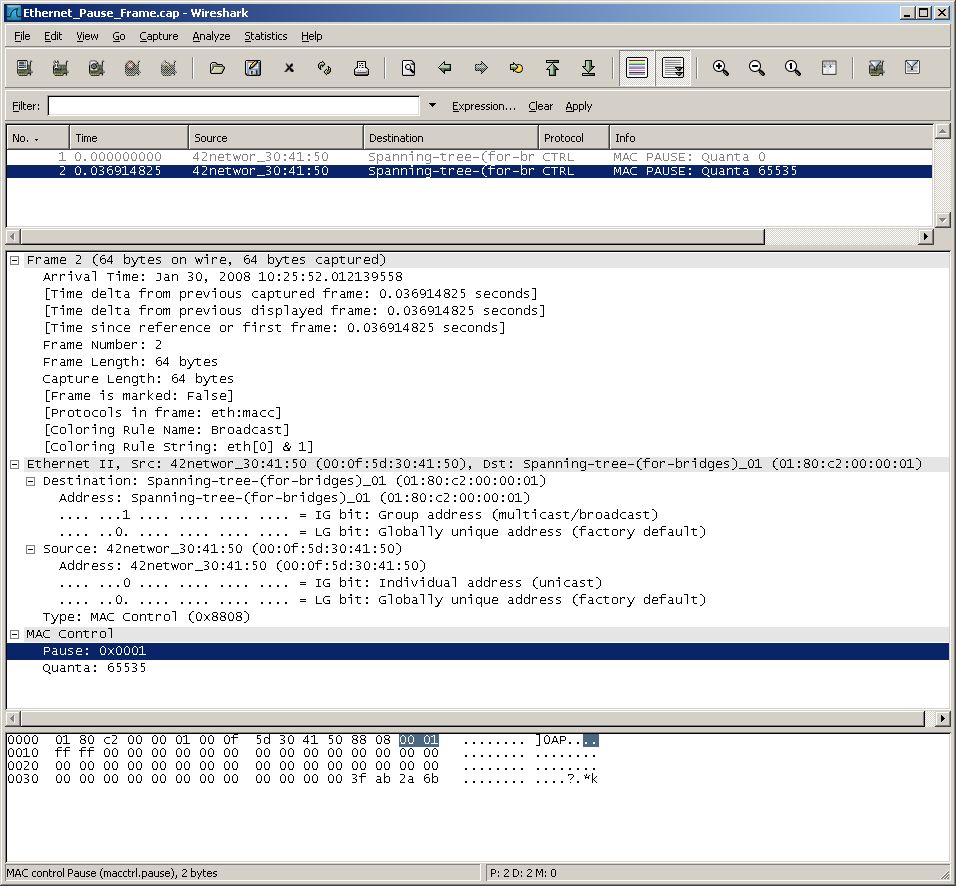
[edit]An overwhelmed network node can send a pause frame, which halts the transmission of the sender for a specified period of time. A media access control (MAC) frame (EtherType 0x8808) is used to carry the pause command, with the Control opcode set to 0x0001 (hexadecimal).[1] Only stations configured for full-duplex operation may send pause frames. When a station wishes to pause the other end of a link, it sends a pause frame to either the unique 48-bit destination address of this link or to the 48-bit reserved multicast address of 01-80-C2-00-00-01.[2]: Annex 31B.3.3 The use of a well-known address makes it unnecessary for a station to discover and store the address of the station at the other end of the link.
Another advantage of using this multicast address arises from the use of flow control between network switches. The particular multicast address used is selected from a range of address which have been reserved by the IEEE 802.1D standard which specifies the operation of switches used for bridging. Normally, a frame with a multicast destination sent to a switch will be forwarded out to all other ports of the switch. However, this range of multicast address is special and will not be forwarded by an 802.1D-compliant switch. Instead, frames sent to this range are understood to be frames meant to be acted upon only within the switch.
A pause frame includes the period of pause time being requested, in the form of a two-byte (16-bit), unsigned integer (0 through 65535). This number is the requested duration of the pause. The pause time is measured in units of pause quanta, where each quanta is equal to 512 bit times.
By 1999, several vendors supported receiving pause frames, but fewer implemented sending them.[3][4]
Issues
[edit]One original motivation for the pause frame was to handle network interface controllers (NICs) that did not have enough buffering to handle full-speed reception. This problem is not as common with advances in bus speeds and memory sizes. A more likely scenario is network congestion within a switch. For example, a flow can come into a switch on a higher speed link than the one it goes out, or several flows can come in over two or more links that total more than an output link's bandwidth. These will eventually exhaust any amount of buffering in the switch. However, blocking the sending link will cause all flows over that link to be delayed, even those that are not causing any congestion. This situation is a case of head-of-line (HOL) blocking, and can happen more often in core network switches due to the large numbers of flows generally being aggregated. Many switches use a technique called virtual output queues to eliminate the HOL blocking internally, so will never send pause frames.[4]
Subsequent efforts
[edit]Congestion management
[edit]Another effort began in March 2004, and in May 2004 it became the IEEE P802.3ar Congestion Management Task Force. In May 2006, the objectives of the task force were revised to specify a mechanism to limit the transmitted data rate at about 1% granularity. The request was withdrawn and the task force was disbanded in 2008.[5]
Priority flow control
[edit]Ethernet flow control disturbs the Ethernet class of service (defined in IEEE 802.1p), as the data of all priorities are stopped to clear the existing buffers which might also consist of low-priority data. As a remedy to this problem, Cisco Systems defined their own priority flow control extension to the standard protocol. This mechanism uses 14 bytes of the 42-byte padding in a regular pause frame. The MAC control opcode for a Priority pause frame is 0x0101. Unlike the original pause, Priority pause indicates the pause time in quanta for each of eight priority classes separately.[6] The extension was subsequently standardized by the Priority-based Flow Control (PFC) project authorized on March 27, 2008, as IEEE 802.1Qbb.[7] Draft 2.3 was proposed on June 7, 2010. Claudio DeSanti of Cisco was editor.[8] The effort was part of the data center bridging task group, which developed Fibre Channel over Ethernet.[9]
See also
[edit]References
[edit]- ^ a b IEEE Standards for Local and Metropolitan Area Networks: Supplements to Carrier Sense Multiple Access with Collision Detection (CSMA/CD) Access Method and Physical Layer Specifications - Specification for 802.3 Full Duplex Operation and Physical Layer Specification for 100 Mb/S Operation on Two Pairs of Category 3 or Better Balanced Twisted Pair Cable (100BASE-T2). Institute of Electrical and Electronics Engineers. 1997. doi:10.1109/IEEESTD.1997.95611. ISBN 978-1-55937-905-2. Archived from the original on July 13, 2012.
- ^ IEEE Standard for Ethernet (PDF). IEEE Standards Association. 2018-08-31. doi:10.1109/IEEESTD.2018.8457469. ISBN 978-1-5044-5090-4. Retrieved 2022-11-29.
{{cite book}}:|website=ignored (help)[dead link] - ^ Ann Sullivan; Greg Kilmartin; Scott Hamilton (September 13, 1999). "Switch Vendors pass interoperability tests". Network World. pp. 81–82. Retrieved May 10, 2011.
- ^ a b "Vendors on flow control". Network World Fusion. September 13, 1999. Archived from the original on 2012-02-07. Vendor comments on flow control in the 1999 test.
- ^ "IEEE P802.3ar Congestion Management Task Force". December 18, 2008. Retrieved May 10, 2011.
- ^ "Priority Flow Control: Build Reliable Layer 2 Infrastructure" (PDF). White Paper. Cisco Systems. June 2009. Retrieved May 10, 2011.
- ^ IEEE 802.1Qbb
- ^ "IEEE 802.1Q Priority-based Flow Control". Institute of Electrical and Electronics Engineers. June 7, 2010. Retrieved May 10, 2011.
- ^ "Data Center Bridging Task Group". Institute of Electrical and Electronics Engineers. June 7, 2010. Retrieved May 10, 2011.
External links
[edit]- "Ethernet Media Access Control - PAUSE Frames". TechFest Ethernet Technical Summary. 1999. Archived from the original on 2012-02-04. Retrieved May 10, 2011.
- Tim Higgins (November 7, 2007). "When Flow Control is not a Good Thing". Small Net Builder. Retrieved January 6, 2020.
- Linux Tool for generating flow control PAUSE frames Archived 2012-05-24 at the Wayback Machine
- Python Tool to Generate PFC Frames
- "Ethernet Flow Control". Topics in High-Performance Messaging. Archived from the original on 2007-12-08.
Ethernet family of local area network technologies | |
|---|---|
| Speeds | |
| General | |
| Organizations | |
| Media | |
| Historic | |
| Applications | |
| Transceivers | |
| Interfaces | |


Ethernet flow control
View on GrokipediaFundamentals
Definition and Purpose
Ethernet flow control is a data link layer mechanism standardized in IEEE 802.3x that regulates the rate of data frame transmission between directly connected full-duplex Ethernet devices to prevent buffer overflows at the receiver.[10] In Ethernet networks, particularly switched local area networks (LANs), buffer overflow occurs when the ingress traffic rate to a device's receive buffer exceeds its processing or forwarding capacity, potentially leading to frame discards if unchecked.[2] This mechanism enables receivers to signal senders to pause transmission temporarily when buffers near capacity, ensuring frames are not lost at the link layer.[11] The primary purpose of Ethernet flow control is to provide reliable delivery of Ethernet frames in full-duplex links without depending on retransmission protocols at higher layers, such as TCP, thereby maintaining end-to-end data integrity in environments with constrained buffer sizes.[10] By implementing backpressure through pause signals, it avoids the performance degradation from frame drops, which would otherwise trigger error recovery mechanisms and increase latency.[2] Key benefits include enhanced network efficiency, as it reduces the overhead of higher-layer retransmissions, and supports the deployment of cost-effective switches with limited memory while preserving lossless operation on point-to-point links.[4] Ethernet flow control predominantly relies on reactive methods, where the receiver detects congestion and responds by instructing the sender to halt transmission until buffers recover.[10] Proactive approaches, which forecast and mitigate congestion in advance using techniques like credit allocation, contrast with this but are not inherent to the core IEEE 802.3x framework.[12] This reactive nature is realized primarily through PAUSE frames sent between peers.[2]Historical Context
Early Ethernet networks, standardized under IEEE 802.3 in 1983, operated in half-duplex mode using the Carrier Sense Multiple Access with Collision Detection (CSMA/CD) protocol, which managed access to the shared medium through collision detection and backoff mechanisms but did not incorporate explicit flow control to regulate data transmission rates between sender and receiver.[13] This design sufficed for the 10 Mbps speeds of the era, where collisions served as a natural limiter, but as Ethernet evolved toward higher speeds and full-duplex operation in the 1990s—eliminating the shared medium and CSMA/CD—the absence of built-in congestion management became problematic, particularly with the advent of switched networks that could lead to buffer overflows.[14] The need for flow control intensified with the development of Gigabit Ethernet, where link speeds reached 1 Gbps, outpacing the buffer capacities of contemporary switches and risking frame loss during bursts.[2] In response, the IEEE 802.3 working group initiated proposals in 1996 to introduce a frame-based mechanism for full-duplex links, aiming to enable cost-effective switches with limited memory without resorting to packet drops.[2] These efforts culminated in the approval of IEEE 802.3x as an amendment by the IEEE Standards Board on March 20, 1997, with publication following on November 18, 1997, which was incorporated into the IEEE 802.3-1998 revision, standardizing PAUSE frames as the foundational tool for pausing transmission on congested links.[1] Following IEEE 802.3x, advancements addressed limitations in diverse environments, notably through the IEEE 802.1Qbb amendment ratified in 2011, which introduced Priority-based Flow Control (PFC) as part of the Data Center Bridging (DCB) enhancements to support per-priority pausing for lossless operation in converged networks.[6] Adoption progressed steadily: by the early 2000s, IEEE 802.3x flow control had become widespread in enterprise switches alongside Gigabit Ethernet deployment, enabling reliable performance in office and campus environments.[15] In the 2010s, focus shifted to data centers, where DCB and PFC gained traction to accommodate storage traffic like Fibre Channel over Ethernet, ensuring zero-loss fabrics amid 10 Gbps and higher speeds.[16]Core Mechanism
IEEE 802.3x PAUSE Frames
IEEE 802.3x specifies the MAC Control sublayer for full-duplex operation in Ethernet networks, providing a mechanism to implement flow control through PAUSE frames. This standard, incorporated into IEEE Std 802.3 since 1998, applies to full-duplex links at speeds ranging from 10 Mbps to 1 Gbps and beyond as Ethernet evolved.[17][2] Support for 802.3x flow control is optional for devices operating in full-duplex mode, while it is not applicable to half-duplex links, which rely on CSMA/CD for congestion management.[18][19] The PAUSE frame is a special 64-byte MAC control frame designed to request the temporary suspension of frame transmission from the receiving device. It uses the EtherType value 0x8808 to indicate a MAC control frame and the opcode 0x0001 specifically for the PAUSE operation. The destination address is fixed as the multicast address 01-80-C2-00-00-01, ensuring it is recognized by all compliant full-duplex Ethernet devices on the link. The source address is the MAC address of the sending device, and the frame includes a 2-byte pause time parameter that specifies the duration of the pause in units of 512 bit times (quanta), ranging from 0 to 65535. A pause time of 0x0000 signals the resumption of transmission, while non-zero values instruct the receiver to halt sending frames for the indicated period.[19][17] The structure of the PAUSE frame adheres to the minimum Ethernet frame size of 64 bytes, including padding if necessary. The pause quanta duration in seconds is calculated as (pause_time × 512) / link_speed, where link_speed is in bits per second; for example, at 1 Gbps, one quanta equates to approximately 0.512 microseconds.[19]| Field | Size (bytes) | Description |
|---|---|---|
| Preamble | 7 | Synchronization pattern (0xAAAAAAAAAAAAA, not transmitted on all media). |
| Start Frame Delimiter (SFD) | 1 | Marks the end of preamble (0xAB). |
| Destination Address | 6 | Multicast: 01-80-C2-00-00-01. |
| Source Address | 6 | MAC address of the sender. |
| Length/Type | 2 | 0x8808 (MAC control). |
| Opcode | 2 | 0x0001 (PAUSE). |
| Parameters | 4 | Pause time (2 bytes: 0-65535 quanta); reserved (2 bytes: 0x0000). |
| Pad | 0-44 | Zeros to reach minimum frame size. |
| Frame Check Sequence (FCS) | 4 | CRC-32 checksum. |
PAUSE Frame Operation
When a receiving device detects that its input buffer is approaching congestion, typically upon reaching a predefined high threshold such as 80% of its capacity, it generates and transmits a PAUSE frame to the sending device over the full-duplex Ethernet link.[11][20] This threshold is configurable and serves to prevent buffer overflow and frame loss by proactively signaling the need to halt incoming traffic. Upon receiving the PAUSE frame, the sending device immediately stops transmitting Ethernet frames for the duration specified in the frame's pause quanta field, which represents a timer value in slot times (each slot time being the transmission time of 512 bits at the link speed).[2][20] Transmission resumes automatically once this timer expires, or earlier if a subsequent PAUSE frame with a quanta value of zero is received, indicating that the receiver's buffer has sufficiently cleared below a low threshold.[11] If congestion persists, the receiver may send additional PAUSE frames to extend the pause period; the latest frame received always overrides any previous pause timer on the sender, allowing dynamic adjustment of the halt duration.[2][21] This mechanism supports sustained control by enabling repeated or prolonged pauses without requiring frame drops. PAUSE frame operation is strictly link-level and applies only to the point-to-point full-duplex connection between two directly attached devices, such as a switch port and an upstream host or another switch; it does not propagate across multi-hop Ethernet paths or through switching fabrics.[20][11] In a typical scenario within an Ethernet switch, if incoming traffic to a port exceeds the output buffer's processing capacity—such as during a burst from an upstream device—the port detects the buffer nearing its high threshold and sends a PAUSE frame upstream to throttle the source, preventing downstream congestion while the switch clears the backlog.[11][21] Once the buffer level drops below the resume threshold, a zero-quanta PAUSE frame is sent to unpause the link, restoring normal traffic flow.Limitations
Head-of-Line Blocking
Head-of-line (HOL) blocking is a significant limitation of Ethernet flow control using IEEE 802.3x PAUSE frames, occurring in multi-queue ports where the mechanism halts all traffic on the link, thereby preventing high-priority frames queued behind low-priority ones from being transmitted.[22] This phenomenon arises because PAUSE operates at the link level without distinguishing between traffic classes, causing unrelated packets to accumulate and delay forwarding.[23] The root cause lies in the global scope of 802.3x PAUSE, which signals congestion for the entire physical link rather than targeting specific priorities or flows, leading to indiscriminate pausing that affects all queues.[24] For example, in converged networks combining voice over IP (VoIP) with bulk data transfers, a PAUSE frame issued due to buffer overflow from large file downloads can stall low-latency VoIP packets, resulting in jitter and degraded call quality.[23] Basic 802.3x provides no mitigation through VLAN tagging or priority awareness, allowing such cross-traffic interference to persist unchecked. This blocking was prominently observed in early 2000s deployments of Gigabit Ethernet, where increasing traffic diversity highlighted the need for more granular control mechanisms.[22] In mixed-traffic scenarios, HOL can amplify latency by factors of up to 5 times, as round-trip times rise from baseline levels like 240 µs to over 1 ms due to prolonged pauses and buffer buildup.[25]Latency and Throughput Issues
The use of IEEE 802.3x PAUSE frames introduces variable delays into Ethernet networks, as the receiving device halts transmission for a specified quanta duration (up to 65,535 slot times, equivalent to approximately 33.6 ms on a 1 Gbps link) when buffers approach overflow.[26] These pauses create unpredictable latency spikes, rendering PAUSE-based flow control unsuitable for real-time applications such as networked storage (e.g., iSCSI) or voice traffic, where consistent low delays are critical to maintain performance.[26] In congested scenarios, empirical measurements on Gigabit Ethernet setups have shown baseline latencies increasing from 3 µs to 12 µs under background traffic loads, with flow control exacerbating these effects through enforced idle periods.[27] The oscillatory nature of PAUSE operation—alternating between pause and resume signals—further degrades network efficiency, particularly in bursty traffic patterns common to data centers and storage systems. During bursts, frequent pauses lead to underutilization of link bandwidth, with simulations indicating efficiency losses of 20-50% as devices repeatedly stop and restart transmission, wasting cycles on control frames and idle times.[28] Studies from the early 2000s on Gigabit Ethernet links under congestion reported throughput drops of up to 30%, as PAUSE mechanisms struggle to sustain full utilization amid rapid traffic fluctuations, dropping from near-line-rate (e.g., 1 Gbps) to as low as 700 Mbps in oversubscribed topologies.[28] This reduction stems from the coarse-grained link-level pausing, which halts all traffic indiscriminately, amplifying oscillations and preventing smooth recovery to peak rates.[26] Unpredictable pause durations also introduce significant jitter, compounding timing sensitivities in time-aware protocols like Audio Video Bridging (AVB) and Time-Sensitive Networking (TSN), where bounded end-to-end delays are essential for synchronized delivery.[26] Measurements in Gigabit Ethernet environments reveal jitter widening from a standard deviation of 1.1 µs in unloaded conditions to several microseconds under moderate congestion with PAUSE active, disrupting periodic streams and increasing variance in packet arrival times.[27] While PAUSE achieves link-level lossless operation by preventing immediate buffer overflows, it fails to guarantee end-to-end losslessness in multi-hop networks, as upstream congestion can propagate pauses without addressing downstream bottlenecks, potentially leading to indirect frame drops elsewhere.[28] Compared to no flow control (which results in lossy behavior and retransmissions under congestion), PAUSE improves reliability by avoiding packet discards at the link layer, yet it underperforms finer-grained alternatives like explicit congestion notification, which maintain higher utilization (e.g., over 99% in simulations) without widespread pausing.[28] Head-of-line blocking contributes to these issues by stalling non-congested queues during pauses.[26]Advanced Techniques
Priority-Based Flow Control
Priority-based flow control (PFC), defined in the IEEE 802.1Qbb-2011 standard, extends the basic Ethernet PAUSE mechanism to provide independent flow control for each of up to eight traffic priorities, as identified by the 802.1p class of service field in VLAN-tagged frames.[6] Approved on June 16, 2011, this standard enables receivers to pause transmission selectively for specific priorities on full-duplex links, thereby mitigating head-of-line blocking while preserving overall link utilization for non-paused traffic classes.[7] By operating at the link level within point-to-point connections, PFC ensures that congestion in one priority does not indiscriminately halt all frames, allowing concurrent support for latency-sensitive and best-effort traffic.[6] The core mechanism relies on specialized PFC frames, which share the same destination MAC address (01-80-C2-00-00-01) and opcode (0x0001) as standard 802.3x PAUSE frames but include additional fields for per-priority control.[6] Following the opcode, the frame contains a 2-octet priority enable vector, where the least significant 8 bits (e to e[29]) form a bitmask indicating which priorities are affected—set to 1 for enabled priorities and 0 otherwise.[6] This is followed by an 8-entry time vector, with each 2-octet entry specifying the pause duration (in quanta of 512 bit times) for the corresponding priority (0 to 65,535 quanta maximum).[6] Upon receiving a PFC frame, the MAC client pauses the specified priority queues for the indicated time, using MAC control primitives (M_CONTROL.request and M_CONTROL.indication) to enforce the pause without discarding frames.[6] Pause timers decrement based on the link transmission rate, resuming transmission once they reach zero, with a maximum delay constraint of 614.4 nanoseconds at 10 Gb/s to minimize latency impact.[6] A primary benefit of PFC is enabling lossless Ethernet operation for protocols requiring zero packet loss, such as Fibre Channel over Ethernet (FCoE), by dedicating specific priorities (e.g., priority 3 for storage) to pause only when necessary, while lower-priority best-effort traffic like IP flows continues unimpeded.[7] This selective pausing reduces buffer requirements and supports converged network infrastructures, lowering operational costs in environments mixing storage, clustering, and general data traffic.[7] For instance, in storage networks, PFC ensures reliable delivery without retransmissions, enhancing performance for applications sensitive to even minor frame drops.[6] Implementation requires devices to support PFC on at least one priority per port, with full compliance typically involving all eight 802.1p priorities to avoid partial blocking; negotiation of supported priorities occurs via the Data Center Bridging Capability eXchange (DCBX) protocol.[6] Ports must process incoming PFC frames and generate them reactively based on buffer thresholds, ensuring symmetric behavior between sender and receiver.[6] Since its ratification around 2010, PFC has become a cornerstone of data center Ethernet fabrics, particularly for high-performance computing and storage convergence, and is mandatory for reliable operation of RDMA over Converged Ethernet version 2 (RoCEv2) to maintain lossless paths across the network. In 2025, IEEE 802.1Q Amendment 38 introduced automated PFC headroom calculation and support for Media Access Control Security (MACsec) with PFC to enhance security and buffer management in high-speed networks.[7][30] Its adoption has facilitated the deployment of unified fabrics in enterprise and cloud environments, where it underpins protocols demanding sub-millisecond latency and zero loss.Data Center Bridging Integration
Data Center Bridging (DCB) is a suite of enhancements to the IEEE 802.1 standards designed to adapt Ethernet for data center environments, enabling converged networking that supports lossless and low-latency traffic for diverse applications such as storage, clustering, and IP-based communications over a single infrastructure.[31] Key components include IEEE 802.1Qbb for Priority-based Flow Control (PFC), which provides per-priority lossless operation; IEEE 802.1Qaz for Enhanced Transmission Selection (ETS), which manages bandwidth allocation; and IEEE 802.1Qau for Quantized Congestion Notification (QCN), which addresses end-to-end congestion.[31] These features collectively transform standard Ethernet into a unified fabric capable of handling protocols like Fibre Channel over Ethernet (FCoE) alongside traditional IP traffic without requiring separate networks. The Data Center Bridging Capability Exchange (DCBX) protocol facilitates integration by enabling automatic negotiation of DCB parameters between directly connected devices, building on the Link Layer Discovery Protocol (LLDP) defined in IEEE 802.1AB.[32] DCBX advertises and configures capabilities for PFC, ETS, and congestion management, ensuring consistent policies across peers to prevent mismatches that could lead to packet loss or suboptimal performance.[31] For instance, it exchanges type-length-value (TLV) information to enable PFC on specific priorities and allocate bandwidth via ETS, allowing devices to dynamically agree on flow control and resource sharing without manual intervention. Within DCB, ETS (IEEE 802.1Qaz) complements PFC by organizing traffic into priority groups (PGs) and assigning bandwidth limits or guarantees to each, ensuring fair sharing while unused bandwidth from paused or low-utilization groups can be borrowed by others.[33] This integration allows PFC to pause specific priorities without globally halting the link, maintaining throughput for non-paused traffic classes.[33] A primary use case for DCB integration is the convergence of storage traffic with Ethernet networks, such as iSCSI and FCoE, where PFC ensures zero packet loss for storage protocols that cannot tolerate retransmissions, while coexisting with loss-tolerant IP traffic.[34] In these scenarios, DCBX negotiates PFC enablement on the storage priority (e.g., VLAN 0 for FCoE), guaranteeing lossless delivery alongside ETS-managed bandwidth for LAN traffic.[35] DCB has evolved from its initial specification in version 1.01 around 2010, which focused on core enhancements like PFC and ETS, to later amendments incorporating Edge Virtual Bridging (EVB) concepts.[31] A notable advancement is IEEE 802.1BR, which standardizes Bridge Port Extension for virtualized environments, allowing edge devices to extend bridging functions and integrate DCB capabilities more seamlessly in multi-tenant data centers.Congestion Management
Explicit Congestion Notification
Explicit Congestion Notification (ECN) serves as a proactive congestion avoidance mechanism in Ethernet networks, enabling switches to signal impending overload to endpoints by marking packets rather than dropping them or issuing pauses. Defined initially for IP in RFC 3168, ECN has been integrated into Ethernet environments, particularly data centers, where switches monitor buffer queues and apply markings when thresholds are met. This adaptation leverages the two-bit ECN field in the IP header (bits 6 and 7 of the DiffServ code point).[36][37] The operation involves senders marking outgoing packets as ECN-Capable Transport (ECT) using codepoints 01 or 10 in the ECN field to indicate support. Upon detecting congestion—typically when a queue exceeds a configured threshold—switches probabilistically set the Congestion Experienced (CE) codepoint (11), with marking probability increasing based on queue depth via a Random Early Detection (RED)-like algorithm. Receivers detect the CE mark and feedback the congestion signal to senders, such as through TCP ACKs with the ECN-Echo (ECE) flag, prompting rate reduction by halving the congestion window; senders then acknowledge this with the Congestion Window Reduced (CWR) flag to prevent repeated feedback. This end-to-end feedback loop ensures timely adjustment without packet loss.[36][38] Compared to IEEE 802.3x PAUSE frames, ECN offers key advantages: it is proactive, intervening before severe congestion causes drops or pauses, avoids halting all transmissions on a link, and provides per-flow granularity ideal for TCP and RDMA over Converged Ethernet (RoCE) protocols. In practice, ECN enhances throughput and latency for bursty traffic by enabling smoother rate adaptations.[36][39] ECN integrates with Priority-based Flow Control (PFC) in hybrid setups under Data Center Bridging (DCB), assigning ECN to lossy traffic classes for best-effort handling while reserving PFC for lossless priorities like storage traffic. However, its effectiveness depends on end-to-end support across all devices in the path, as non-supporting nodes may strip or ignore marks, rendering it less suitable for heterogeneous networks unlike the link-local PAUSE mechanism.[38][40]Quantized Congestion Notification
Quantized Congestion Notification (QCN) is a rate-based congestion control protocol defined in the IEEE 802.1Qau standard for managing long-lived data flows in Ethernet networks, particularly suited for data centers with limited bandwidth-delay products.[41] It operates by enabling switches to signal congestion levels to sending devices, allowing proactive rate adjustments to prevent buffer overflows and frame loss.[42] QCN is integrated into Data Center Bridging (DCB) frameworks to support low-latency applications alongside traditional Ethernet traffic.[43] An extension known as Data Center QCN (DCQCN) adapts QCN for RDMA over Converged Ethernet (RoCE) in modern high-performance computing environments as of 2025.[44] The protocol distinguishes between two primary components: the reaction point (RP) at the source device, which limits transmission rates, and the congestion point (CP) at the switch or bridge, which detects and reports congestion.[41] Feedback messages are generated at the CP and transmitted back to the RP, carrying quantized congestion information to guide rate changes without requiring end-to-end acknowledgments.[42] These messages use a 6-bit field to encode speed-up or slow-down factors, providing a compact representation of network state that balances precision and overhead.[45] At the CP, congestion is assessed by monitoring queue occupancy relative to a target equilibrium level. The feedback value is derived as Q = \frac{\text{queue_length} - \text{target}}{\text{scale}}, which captures the deviation from the desired buffer state and is further refined to include queue change over time for responsiveness.[42] This value is quantized into the 6-bit feedback field and inserted into sampled frames or dedicated messages sent upstream to the RP.[45] Sampling occurs probabilistically based on the congestion severity to minimize signaling overhead while ensuring timely notifications. Upon receiving a feedback message at the RP, the transmission rate is updated multiplicatively to alleviate congestion. The adjustment follows the formula where is computed as an exponential moving average of prior feedback values to dampen oscillations and stabilize convergence.[42] This mechanism allows rapid rate decreases during congestion while incorporating gradual increases through periodic probing to probe available bandwidth.[45] QCN demonstrates strong scalability in incast scenarios, where multiple senders converge on a single receiver, by enabling coordinated rate limiting that avoids deep buffer usage.[42] Compared to Explicit Congestion Notification (ECN), it achieves lower tail latencies through direct rate feedback, reducing the risk of secondary bottlenecks in multi-hop paths.[42] These benefits stem from its hardware-friendly design, supporting implementation in switches with shallow buffers. Deployment of QCN has been used in converged networks requiring low-latency operation, such as those supporting RoCE for storage and compute traffic, and in early cloud fabrics to enhance reliability in DCB-enabled Ethernet domains, though adoption has evolved with advancements in higher-layer protocols.[41][43]Modern Applications
Role in Data Centers
In modern data centers, Ethernet flow control has become integral to the evolution from siloed local area networks (LANs) for compute and management traffic and storage area networks (SANs) for block storage to unified Ethernet fabrics. This shift, driven by the need for cost efficiency and simplified infrastructure, leverages Data Center Bridging (DCB) standards, particularly Priority-based Flow Control (PFC), to converge storage, compute, and management workloads over a single Ethernet layer without performance degradation.[46] By enabling lossless Ethernet, DCB eliminates the need for dedicated Fibre Channel fabrics, reducing cabling complexity and operational overhead while supporting higher bandwidth demands in scale-out environments.[47] Key applications of Ethernet flow control in data centers center on high-performance, low-latency protocols. RDMA over Converged Ethernet (RoCE) depends on PFC to deliver lossless transport, preventing packet drops that could disrupt remote direct memory access operations critical for distributed computing and storage.[48] For broader cloud-scale congestion management, Explicit Congestion Notification (ECN) and Quantized Congestion Notification (QCN) provide end-to-end feedback mechanisms, allowing endpoints to dynamically adjust transmission rates and avoid widespread bottlenecks in multi-tenant fabrics.[49] These techniques ensure reliable performance for east-west traffic patterns, where data flows predominantly between servers within the data center rather than to external networks. Practical implementations often feature top-of-rack (ToR) switches with 40 Gbps and 100 Gbps ports configured for lossless operation, supporting protocols like iSCSI for IP-based storage and Fibre Channel over Ethernet (FCoE) for legacy SAN integration. These switches apply PFC on specific priority queues to isolate storage traffic from best-effort compute flows, maintaining zero-loss guarantees across the rack while scaling to higher speeds.[50] In rack-scale deployments, such configurations enable converged networking without retransmission overhead, optimizing resource utilization in dense server environments.[51] Hyperscale operators have integrated hybrid flow control strategies combining traditional PAUSE frames with PFC to manage east-west traffic in their vast clusters. This approach balances lossless requirements for RDMA-based workloads with efficient handling of bursty application flows. Such adaptations address the unique challenges of hyperscale fabrics, where synchronized traffic bursts can overwhelm links.[49] A prominent challenge addressed by these mechanisms is incast collapse in rack-scale systems, where multiple upstream servers simultaneously transmit to a single downstream receiver, causing switch buffer overflows and severe throughput degradation. QCN mitigates this by providing quantized feedback from congested switches, enabling rapid rate limiting at senders to stabilize flows without relying solely on loss-based recovery.[52] This proactive control is particularly effective in storage-heavy scenarios, reducing tail latencies and improving overall cluster efficiency.[53] By 2020, over 70% of data center Ethernet ports supported DCB features like PFC and ECN, reflecting widespread adoption driven by the growth in converged infrastructures and high-speed port shipments exceeding 50 million units annually.[54] This penetration underscores Ethernet flow control's role in enabling scalable, reliable fabrics for contemporary data center operations.Developments for AI Networking
The Ultra Ethernet Consortium (UEC), formed in July 2023 by founding members including AMD, Arista, Broadcom, Cisco, HPE, Intel, Meta, and Microsoft, aims to enhance Ethernet's capabilities for high-performance AI and high-performance computing (HPC) workloads through an open, interoperable protocol stack.[55][56] This includes improvements to flow control at the link layer, such as credit-based extensions to traditional mechanisms like Priority Flow Control (PFC), to address the stringent requirements of AI training clusters, including ultra-low latency and lossless transmission.[57] A key development from UEC is Credit-Based Flow Control (CBFC), proposed as an optional addition to the Ethernet link layer in 2024 specifications, which uses virtual credits tracked via cyclic counters at sender and receiver ends to enable precise rate limiting and buffer management.[58][55] Unlike reactive pause-based approaches, CBFC operates proactively by confirming available buffer space before transmission, reducing head-of-line blocking and improving scalability in large-scale AI networks where collective operations demand synchronized, high-bandwidth communication.[57] This mechanism builds on PFC foundations while offering backward compatibility and enhanced efficiency for scale-out AI fabrics. Integration of Link-Layer Retry (LLR) with flow control protocols like PFC and CBFC further tailors Ethernet for AI environments, providing rapid, local recovery from packet loss without involving higher-layer protocols such as TCP.[59] LLR retransmits corrupted or lost frames at the link layer, minimizing tail latency in GPU clusters where even minor losses can disrupt all-reduce operations; it has been validated in high-speed Ethernet deployments up to 800 Gbps, ensuring near-lossless performance critical for AI model training.[60][57] This combination addresses the zero-loss tolerance of AI workloads beyond traditional Data Center Bridging (DCB) requirements, enabling reliable interconnects in massive accelerator pods.[61] In 2025, Broadcom's Tomahawk 6 switch series, delivering 102.4 Tbps capacity on a single 3 nm chip, incorporates AI-optimized enhancements to congestion management, including variants of Explicit Congestion Notification (ECN) and Quantized Congestion Notification (QCN) tuned for low-latency collective communications in AI clusters.[62] These switches support UEC features like CBFC and LLR, facilitating flat, non-oversubscribed topologies that reduce latency for scale-up AI networking while maintaining compatibility with standards-based Ethernet.[63][64] Industry efforts culminated at the Open Compute Project (OCP) Global Summit 2025, where announcements advanced standards-based Ethernet mechanisms for AI scale-up, including the formation of the Ethernet for Scale-Up Networking (ESUN) collaboration to promote open innovations in switching and framing.[65] These initiatives, building on QCN and PFC, focus on reducing tail latency in AI infrastructures through enhanced flow control, with demonstrations showing improvements in predictability for hyperscale training environments.[66][67]References
- 1Qbb specifies protocols for flow control per traffic class, aiming to eliminate frame loss due to congestion, similar to 802.3x PAUSE.