Hubbry Logo
Peace HousePeace HouseMain
Open search
Peace House
Community hub
Peace House
logo
8 pages, 0 posts
0 subscribers
Be the first to start a discussion here.
Peace House
Peace House
from Wikipedia
Peace House
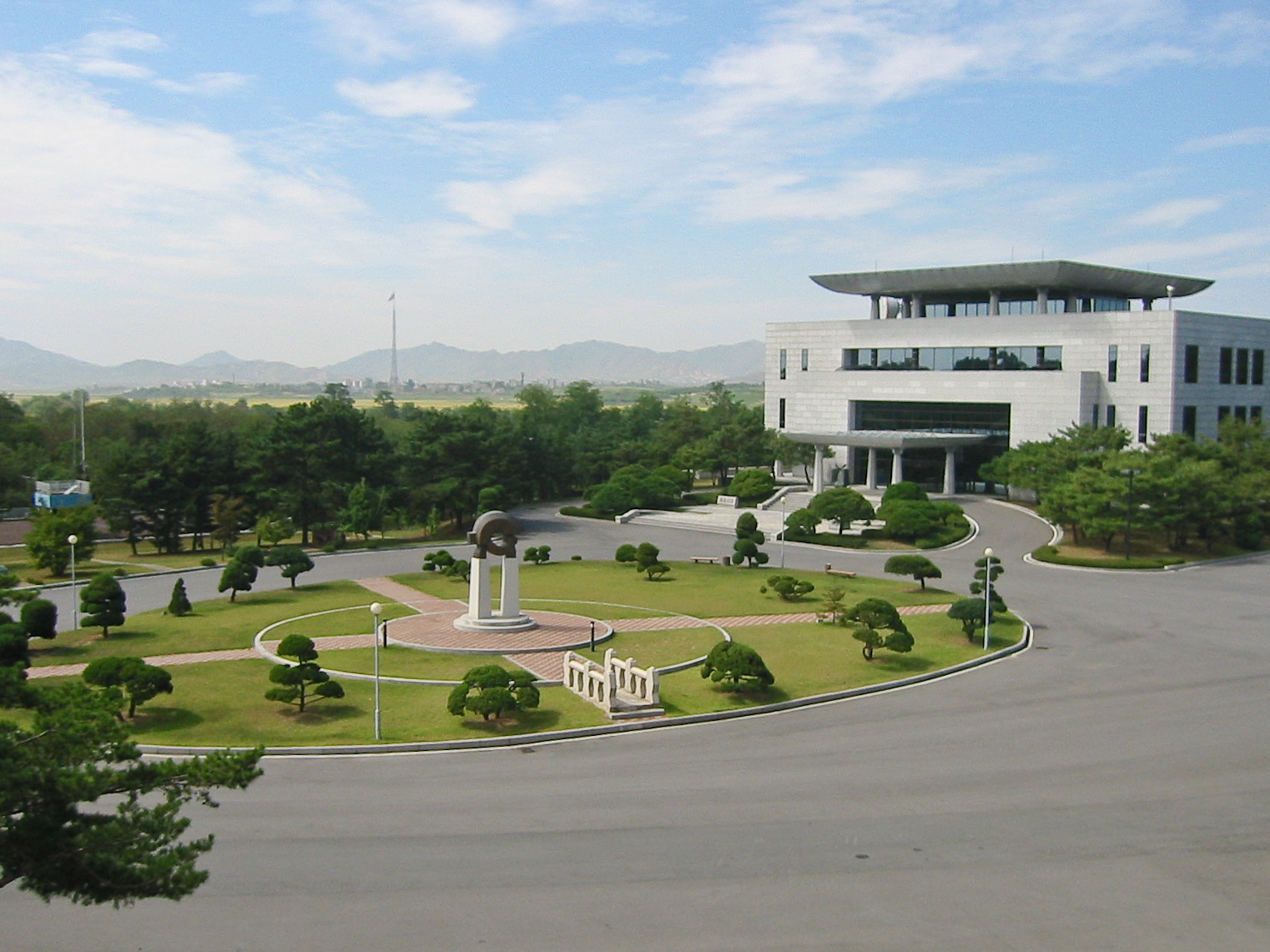
The Peace House, as seen from the House of Freedom, with the Sunken Garden in the foreground.
Korean name
Hangul
평화의 집
Hanja
平和의 집
Revised RomanizationPyeonghwaui jip
McCune–ReischauerP'yŏnghwaŭi chip

The Peace House (House of Peace or Home of Peace) is a venue for peace talks between North and South Korea. The building is situated in the Joint Security Area on the south side of the Military Demarcation Line bisecting the area. It is under the jurisdiction of the United Nations Command.[1]

Map of the Joint Security Area in Panmunjom. The Peace House is shown on the map as "Home of Peace"
  Military Demarcation Line
  Buildings under North Korean administration
  Under joint U.N./South Korean administration

The Peace House is a three-story building whose construction completed on December 19, 1989. The floor layout, which adds up to 998 square metres (10,740 sq ft), is as follows:[2]

  • First floor: a pair of rooms used mainly for press conferences and lower-level meetings.
  • Second floor: dedicated, for the most part, to an elaborate conference room
  • Third floor: two rooms, one dedicated for luncheons and dinners

The building is intended for non-military purposes, with the most notable usage being the April 2018 inter-Korean summit.[3][4][5]

The building is equipped with closed-circuit television and microphones, allowing real time audio and video monitoring of the facility at the South Korean presidential office in Seoul.

Notable usages

[edit]

The building has served as a venue for the following events:

See also

[edit]

References

[edit]
[edit]
Revisions and contributorsEdit on WikipediaRead on Wikipedia
from Grokipedia
The Peace House is a three-story conference building located on the South Korean side of the in , completed on December 19, 1989, to serve as a dedicated venue for inter-Korean dialogue and negotiations. With a total floor space of 3,293 square meters including a basement level, it features facilities such as VIP and press rooms on the first floor, a main on the second, and a banquet hall on the third, designed to host high-level meetings amid the heavily militarized . Established in line with efforts to implement the 1992 Inter-Korean Basic Agreement, the building initially housed a South Korean liaison office starting in February 1992, which facilitated over 100 rounds of inter-Korean talks before the office's relocation to the nearby in 1998 amid fluctuating relations. Its most notable use came during the April 27, 2018, inter-Korean summit, where South Korean President met North Korean leader Kim Jong-un in a specially renovated space symbolizing unity, marking the first such visit by a North Korean head of state to South Korean soil and resulting in the pledging denuclearization and peace. Despite these diplomatic milestones, the Peace House stands as a stark reminder of the Korean Peninsula's unresolved division, with North Korea's persistent nuclear advancements and provocations underscoring the fragility of such engagements.

Historical Context

The Joint Security Area and Panmunjom

Panmunjom served as the location for the signing of the on July 27, 1953, which halted active combat between (UNC) forces, supported by South Korea, and North Korean and Chinese forces. The agreement established the (DMZ), a 4-kilometer-wide buffer approximately 250 kilometers long, but did not constitute a , leaving the Korean Peninsula in a technical state of war. Within the DMZ lies the (JSA), the sole portion where armed personnel from North and directly confront each other across the , with the southern sector administered by the UNC. The JSA facilitates limited diplomatic and military liaison activities but has been the site of numerous armed confrontations since 1953, underscoring the fragility of the rather than any enduring mutual restraint. A prominent example of such tensions occurred during the Incident on August 18, 1976, when North Korean soldiers attacked a UNC work party trimming a poplar tree obstructing visibility near a South Korean checkpoint, using axes and clubs to kill two U.S. Army officers, Captain Arthur Bonifas and First Lieutenant Mark Barrett, and injure others. This unprovoked assault, later deemed deliberate aggression by U.S. assessments, prompted Operation , a large-scale UNC tree-cutting operation under heavy escort that avoided further violence after North Korean leader Kim Il-sung issued a rare apology. Deterrence failures persisted, as evidenced by the November 23, , shootout triggered by Soviet diplomat Vasily Matuzok's across the JSA into South Korean territory during a tour; North Korean guards pursued him, firing weapons and penetrating the southern sector, resulting in the deaths of three North Korean and one South Korean soldier in the ensuing exchange. These episodes highlight recurrent North Korean-initiated violations, driven by regime directives rather than symmetric threats, challenging assumptions of balanced stability in the truce village.

Evolution of Dialogue Venues in the DMZ

Following the Korean War armistice signed on July 27, 1953, in temporary tents at , initial post-armistice dialogues between North and South Korea occurred in rudimentary structures within the (JSA) of the (DMZ). These early meetings, managed by the and the Military Armistice Commission, relied on canvas tents and basic setups established during the 1951-1953 negotiations, reflecting the fragile cessation of hostilities without permanent infrastructure for sustained engagement. By the mid-1960s, escalating tensions prompted the construction of more formalized venues. completed the original in 1965 as a two-story facility to host liaison and Red Cross contacts, driven by n incursions including armed clashes in the DMZ during the 1966-1969 period. responded with the Panmungak building in September 1969, a three-story structure north of the , serving as its command post and mirroring 's efforts to institutionalize talks amid mutual suspicions. Causal factors for this evolution stemmed from North Korea's provocations, such as the discovery of infiltration tunnels under the DMZ starting in , which heightened South Korea's insistence on structured dialogue sites to monitor and negotiate security threats rather than fostering genuine trust. The July 4, 1972, South-North Joint Communiqué, resulting from secret high-level talks, represented a rare agreement on peaceful unification principles but occurred sporadically without addressing underlying military aggressions, including tunnel networks intended for surprise attacks. Despite these permanent buildings, dialogue infrastructure failed to yield verifiable progress on denuclearization or lasting , as North Korea's continued tunnel digging through the and —four major tunnels identified by —underscored persistent adversarial intent over reconciliation. This pattern of provocation amid formalized venues necessitated further advancements, such as South Korea's development of the Peace House, emerging not from optimistic convergence but from pragmatic requirements to sustain talks in an environment of eroded trust and repeated violations.

Construction and Design

Planning and Completion

Planning for the Peace House originated in the late 1980s under President Roh Tae-woo's , a diplomatic emphasizing engagement with and communist states to promote stability on the amid persistent military threats from . pursued this unilaterally funded to establish a dedicated, neutral venue for high-level inter-Korean , separate from military command structures, as part of broader efforts to reduce tensions without conceding to North Korean preconditions. Construction concluded in 1989, creating a three-story structure on the southern side of the specifically for non-military summits and negotiations, in contrast to North Korea's earlier Panmungak building, which served analogous functions but under Pyongyang's control. The project represented a pragmatic South Korean investment in diplomatic infrastructure, though exact costs remain undisclosed in . Despite its readiness, the Peace House saw minimal utilization in the ensuing years, as boycotted proposed prime ministerial talks and broader dialogue, highlighting the limits of unilateral venue-building in compelling reciprocal engagement amid unresolved security disputes. This initial dormancy underscored causal realities: physical facilities alone could not override 's strategic reticence or demands for concessions, rendering the investment symbolic until conditions aligned for use.

Architectural Features and Security

The Peace House is a three-story stone building with one basement level, constructed as a functional venue for inter-Korean and completed on December 19, 1989, with a total floor area of 3,293 square meters. Its layout prioritizes compartmentalized spaces for controlled interactions: the first floor includes VIP rooms, press facilities, and areas for lower-level or minor meetings; the second floor centers on the primary equipped for high-stakes talks, including a dedicated ; and the third floor contains a banquet hall for formal luncheons or dinners. This vertical separation supports sequential proceedings while maintaining separation between delegations in a shared adversarial space. The structure's design emphasizes practical utility over symbolic grandeur, positioned directly south of the in the to enable face-to-face negotiations under mutual scrutiny rather than isolated trust. Ahead of the April 27, 2018, inter-Korean summit, the building received comprehensive renovations, including aesthetic and functional upgrades to the conference spaces—such as refined interiors and precise adjustments to table placements for optimal lighting and protocol—while preserving its core engineering for secure, monitored diplomacy. Security features are embedded in the building's integration with Joint Security Area operations, where South Korean and North Korean armed guards maintain constant vigilance along the , enforcing strict access controls and real-time observation protocols during talks. The venue's proximity to military outposts and its designation as a special security zone for high-profile events underscore a realist approach, relying on physical deterrence and bilateral oversight to mitigate risks in an environment of entrenched hostility, rather than architectural flourishes implying . No public records detail internal reinforcements like , but the overall setup facilitates verifiable, low-trust engagements through enforced transparency and immediate guard presence.

Diplomatic Functions

Pre-2018 Working-Level Talks

The Peace House hosted initial working-level inter-Korean dialogues in the early 1990s, primarily through Red Cross channels addressing humanitarian concerns such as separated families and communication hotlines. These sessions, alternating with the North Korean side's Tongil Pavilion, laid groundwork for limited agreements like the establishment of direct military hotlines in 1997 to reduce border incidents. During South Korea's era (1998–2008), the venue facilitated over a dozen rounds of working-level talks on economic cooperation, family reunions, and tension-reduction measures, often in response to North Korean provocations like naval clashes. Outcomes included the August 2000 organization of the first separated family reunions at and sporadic halts in , such as loudspeaker broadcasts. However, these engagements yielded no verifiable or denuclearization progress, as evidenced by North Korea's continued tests in 2006 and its first nuclear detonation on October 9, 2006, shortly after stalled linked to inter-Korean dialogue. Dialogue lapsed after 2008 amid policy shifts and North Korean escalations, with the final pre-2018 working-level meeting on December 8, 2015, focusing unsuccessfully on implementing prior denuclearization pacts. Resumption occurred on January 9, 2018, when delegations convened at —likely in Peace House—to coordinate North Korea's participation in the Pyeongchang Winter Olympics, driven by Seoul's overtures amid reduced tensions following Pyongyang's 2017 salvos. This session produced agreements on unified teams and cheers squads but preceded renewed North Korean missile activity post-Olympics.

The 2018 Inter-Korean Summit

On April 27, 2018, South Korean President and North Korean leader Kim Jong-un convened the first inter-Korean summit since 2007 at in the of . Kim's delegation crossed the from the northern side, with Kim becoming the first North Korean leader to step into South Korean-controlled territory. The leaders exchanged handshakes at the dividing line, where Moon invited Kim southward, followed by a brief joint walk across the border in both directions at Kim's suggestion, symbolizing mutual engagement. Inside Peace House, the two sides held private and plenary discussions, emerging to plant a pine tree sourced from Baekdu Mountain and sign the Panmunjom Declaration. The declaration committed both parties to "complete denuclearization" for a nuclear-free Korean Peninsula, cessation of all hostile acts from May 1, 2018, and efforts to formally end the Korean War while seeking international cooperation. It outlined no specific verification mechanisms, timelines for disarmament, or economic incentives tied to compliance, focusing instead on aspirational goals like improved military trust and civilian exchanges. Media reactions ranged from acclaiming the event as a historic thaw following years of North Korean tests and nuclear advancements to critiques highlighting its propagandistic elements. Supporters emphasized the optics of , including the leaders' visible camaraderie and the halt of cross-border broadcasts as immediate confidence-building steps. Detractors argued the vague pledges masked North Korea's unchanged nuclear arsenal and delivery systems, serving primarily to bolster Kim's regime legitimacy without enforceable . North Korean portrayed the summit as validation of Pyongyang's strategic patience and diplomatic prowess, framing South Korea's overtures as responses to North's strength rather than mutual concessions. The absence of third-party monitoring underscored the declaration's reliance on bilateral goodwill, which empirical patterns of past agreements suggested was prone to breakdown absent external pressures.

Post-2018 Usage and Stagnation

Following the 2018 inter-Korean summit, the Peace House experienced sharply reduced activity, with only sporadic working-level military consultations occurring in late 2018 and early 2019 before halting amid mutual recriminations over unfulfilled denuclearization commitments. These efforts were undermined by North Korea's June 16, 2020, demolition of the in using explosives, an act framed by as retaliation against ' propaganda balloons but widely viewed as a broader rejection of mechanisms established post-2018. Concurrently, North Korea's border closures in response to the from early 2020 effectively precluded any DMZ-based engagements, including at the Peace House. Under South Korean President Yoon Suk-yeol, who assumed office on May 10, 2022, policy pivoted toward strengthened deterrence through alliances, such as the U.S.-South Korea-Japan trilateral framework, rather than resuming venue-based talks conditional on verifiable North Korean denuclearization steps. No high-level summits or substantive negotiations have occurred at the Peace House since 2018, rendering it dormant as North Korea conducted over 120 ballistic missile tests from 2022 through mid-2025, including multiple intercontinental ballistic missile (ICBM) launches in 2022 that advanced its nuclear delivery capabilities. This escalation, peaking at approximately 90 launches in 2022 alone, prioritized military intransigence over diplomatic engagement, further obviating the venue's utility. The structure remains maintained by South Korean forces within the , supporting resumed public tours of the DMZ as of March 2025, but it now primarily symbolizes the stalled inter-Korean amid North Korea's persistent nuclear advancements and refusal to reciprocate .

Impact and Analysis

Achievements in Symbolic Diplomacy

The 2018 inter-Korean summit held at Peace House on symbolized a rare moment of direct engagement, with North Korean leader Kim Jong-un crossing into South Korean territory for the first time and South Korean President stepping briefly into the North, fostering optics of reconciliation amid decades of hostility. The venue's selection on the southern side of the underscored South Korea's initiative in hosting, breaking from prior patterns where talks alternated sites, and facilitated the , which pledged mutual efforts toward denuclearization, a peace regime replacing the 1953 , and cessation of hostile acts including broadcasts. This declaration provided a framework for symbolic , enabling North Korea's announcement on April 20 of a self-imposed moratorium on nuclear tests and launches, effective from April 21, which contributed to a 15-month lull in such activities until short-range tests resumed in May 2019. Subsequent working-level talks at Peace House advanced humanitarian gestures, including agreements in June 2018 for separated family reunions on August 20-22, the first since 2015, allowing 89 South Korean participants to meet 183 Northern relatives after over 60 years of separation in some cases. These events, rooted in the summit's commitments, highlighted the venue's role in facilitating personal , though limited to select elderly individuals verified through prior lotteries. From a strategic standpoint, the summit's symbolism amplified 's narrative of restraint against Northern provocation, drawing international scrutiny to Pyongyang's aggression and sustaining multilateral sanctions , as evidenced by the UN Council's maintenance of resolutions despite the diplomatic thaw. Analysts from security-focused institutions have noted that such reinforced Seoul's moral positioning in an asymmetric conflict, bolstering deterrence through strengthened U.S.- alliances without conceding leverage on verification or sanctions relief. This approach aligned with broader efforts to leverage global attention for accountability, as the declaration's public commitments invited of North Korea's compliance, indirectly aiding of existing prohibitions on weapons proliferation.

Criticisms and Realpolitik Limitations

Despite the construction of advanced facilities like the Peace House to facilitate dialogue, inter-Korean talks at Panmunjeom have yielded no peace treaty to replace the 1953 armistice, nor any verifiable progress toward North Korean denuclearization. The 2018 Panmunjom Declaration committed to denuclearization in vague terms without specifying timelines, verification mechanisms, or fissile material dismantlement, allowing North Korea to continue its nuclear program unabated. North Korea's estimated nuclear arsenal expanded from approximately 10–20 warheads in 2018 to around 50 by 2024, with ongoing fissile material production sufficient for 70–90 weapons, underscoring the failure of symbolic summits to alter Pyongyang's strategic priorities. North Korea has repeatedly leveraged high-profile engagements at venues like the Peace House to extract economic concessions and sanctions relief without reciprocal disarmament steps, aligning with its regime's incentives for brinkmanship to ensure survival amid internal repression. Following the 2018 summit, Pyongyang intensified demands for early sanctions easing, including through proposals for phased relief tied to minimal actions like site visits rather than irreversible denuclearization, as evidenced by its pressure on the U.S. and for aid amid stalled talks. Critics, including conservative analysts and former U.S. officials, contend that the 2018 events provided a propaganda victory by conferring international legitimacy on his regime, which simultaneously expanded political camps—housing an estimated 120,000 inmates—and escalated cyber operations, such as attacks funding its weapons programs, thereby prolonging the existential to without extracting meaningful behavioral change. This pattern reflects the causal reality of North Korea's totalitarian system, where nuclear capabilities serve as an irreplaceable deterrent against collapse, incentivizing tactical over genuine reconciliation and rendering infrastructure like the Peace House mere theater for stalling adversaries. Left-leaning media outlets, prone to systemic in coverage of authoritarian engagements, amplified rhetoric of an imminent "end to the " post-2018, often downplaying Pyongyang's unyielding commitment to nukes as a survival imperative despite empirical stagnation five months after the summit. In contrast, assessments from non-partisan bodies highlight how such concessions, absent ironclad enforcement, merely embolden North Korea's cycle of provocation and negotiation without addressing root incentives.

Broader Role in Korean Peninsula Tensions

Despite its construction as a dedicated venue for inter-Korean dialogue within the (JSA), the Peace House has operated amid persistent border provocations that highlight the DMZ's volatility. Following the 2018 summits, North Korean troops repeatedly crossed the (MDL) in the central DMZ region during 2024, including at least three incidents in June where groups of 10 to 30 soldiers ventured south while conducting construction, prompting South Korean forces to fire warning shots to repel them. These crossings totaled 11 violations over the prior year, escalating tensions without any offsetting de-escalatory measures tied to the Peace House. Similarly, North Korea's deployment of units since April 2024 to lay landmines, erect anti-tank barriers, and reinforce frontline positions near the MDL has intensified in the JSA vicinity, reversing partial 2018 demilitarization efforts. In 2025, the Peace House remains largely dormant, emblematic of stalled engagement policies, even as U.S.-South Korean joint exercises like Ulchi Freedom Shield in August provoke threats of reprisals and vows for "additional military measures." 's response to these drills, which it labels as invasion rehearsals, includes heightened rhetoric and activities like hypersonic missile tests in October, underscoring a cycle where military posturing sustains hostilities rather than yielding to dialogue at sites like the Peace House. Speculation of potential U.S.- talks during President Trump's planned visit in late October led to temporary suspension of JSA tours, hinting at possible reactivation, though 's ongoing DMZ fortifications suggest entrenched confrontation. Analysts diverge on the venue's broader implications: proponents of , including some South Korean officials, regard it as a latent instrument for symbolic that could revive amid leadership changes, while skeptics emphasize its inefficacy against North Korea's persistent nuclear advancements and aggressions, viewing it as a costly fixture in a landscape defined by unresolved dynamics rather than genuine . A North Korean soldier's across the DMZ on October 19, 2025—the first military crossing of its kind in years—further illustrates the area's underlying instability, detached from the Peace House's aspirational framework.

References

Add your contribution
Related Hubs
User Avatar
No comments yet.