Hubbry Logo
Pedee peoplePedee peopleMain
Open search
Pedee people
Community hub
Pedee people
logo
8 pages, 0 posts
0 subscribers
Be the first to start a discussion here.
Pedee people
Pedee people
from Wikipedia

The Pedee people, also Pee Dee and Peedee, were a historic Native American tribe of the Southeastern United States. Historically, their population has been concentrated in the Piedmont of present-day South Carolina. It is believed that in the 17th and 18th centuries, English colonists named the Pee Dee River and the Pee Dee region of South Carolina for the tribe. Today four state-recognized tribes,[3][4] one state-recognized group,[3] and several unrecognized groups claim descent from the historic Pedee people.[5][6][7] Presently none of these organizations are recognized by the Bureau of Indian Affairs, with the Catawba Indian Nation being the only federally recognized tribe within South Carolina.[3]

Key Information

Etymology

[edit]

The precise meaning of the name Pedee is unknown.[1] The name has many variations, having been alternatively spelled as Pee Dee, PeeDee, Peedee, Peedees, Peadea, and Pidee.[8][9] In early Spanish accounts the name is rendered, Vehidi.[2] There has been contention among historians regarding which orthography is the more proper rendering of the name.[9] Traditionally, there was speculation that an early trader, Patrick Daley, carved his initials, P.D., on trees along a trail within the vicinity of the modern Pee Dee River, leading to the region and river's present name, potentially being imposed also onto the Indigenous tribe. However, some scholars and writers have disagreed with this theory.[9] In the early twentieth century, anthropologist Frank Speck suggested that the name might derive from the Catawban word pi'ri, meaning "something good," or pi'here, meaning "smart", "expert", or "capable".[1]

History

[edit]

Precontact

[edit]
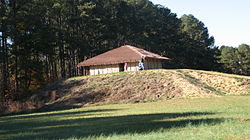
Artists conception of Town Creek Indian Mound during the late Town Creek-early Leak phases circa 1350 CE.

The Pee Dee culture is an archaeological culture spanning 1000 to 1500 CE. It is divided into the Teal phase (1000–1200), Town Creek phase (1200–1400), and Leak phase (1400–1500).[10] The Pee Dee were part of the South Appalachian Mississippian culture[11] that developed in the region as early as 980 CE,[12] extending into present-day North Carolina and Tennessee. They participated in a widespread trade network that stretched from Georgia to South Carolina, eastern Tennessee, and the mountain and Piedmont regions of North Carolina.

The Pee Dee culture had developed as a distinct culture by 980 CE[12] and thrived in the Pee Dee River region of present-day North and South Carolina during the pre-Columbian era. As an example, the Town Creek Indian Mound site in western North Carolina was occupied from about 1150 to 1400 CE.[11]

Town Creek Indian Mound in Montgomery County, North Carolina is a proto-historic Pee Dee culture site.[13] Extensive archeological research for 50 years since 1937 at the Town Creek Indian Mound and village site in western North Carolina near the border with South Carolina has provided insights into their culture.[14] The mound and village site has been designated as a National Historic Landmark.

16th century

[edit]

Around 1550, the Pedee migrated from the lower Pee Dee River of the Atlantic Coastal Plain to the upper Pee Dee River of the Piedmont and remained there for about a century. They displaced local hill tribes, such as the Saponi, who resettled the region when the Pedee left.[15] Historian Charles M. Hudson believes their migration may have been an effort to avoid Spanish slave raids along South Carolina's coast. These 16th-century Pedee practiced head flattening, as did the neighboring Waxhaw.[16] In 1567, Spanish explorers encountered the village Vehidi on the Pee Dee River, believed to be a Pedee settlement.[17]

17th century

[edit]

In 1600, the population of Pedee people was estimated to be 600.[18] Europeans, mostly from the British Isles, began settling in South Carolina in large numbers in the 17th and early 18th century. The English established a trading post at Euauenee or Saukey in 1716 to trade with the Pedee and Waccamaw. The Winyah and Cape Fear Indians migrated from the Atlantic Coast up the Pee Dee River to the trading post.[19][20]

In 1711, the Tuscarora War broke out in North Carolina,[21] and South Carolina tribes joined in the fighting. In 1712, Pedee warriors, along with the Saraw, Saxapahaw, Winyah, and Cape Fear Indians, served in British Captain John Bull's company[20] to fight alongside the British against the Tuscarora and helped defeat them. As a result, most of the Tuscarora left the area and migrated north, reaching present-day New York and Ontario to join the related Haudenosaunee Confederacy of Iroquois tribes.[21]

In 1715, English mapmakers recorded a Pedee village on the west band of the Pee Dee River's central course.[22]

The political relationships formed between the Pedee and other tribes in the area at this time carried over into their alliances of the Yamasee War. The Yamasee War of 1715–1717 resulted in major changes among the Southeastern tribes. Historian William James Rivers wrote in 1885 that the Pedee along with many other tribes were "utterly extirpated."[23] However, some survivors may have found refuge with the Siouan-speaking Catawba, who were located near the South and North Carolina border.[23]

In 1737, the Pedee tribe petitioned South Carolina for a parcel of land to live upon. They, along with their Natchez cousins were moved to a 100-acre (0.40 km2) parcel provided by James Coachman in 1738.[24] This land was in Berkeley County, along the Edisto River.[24]

In the 1740s, the Pedee, along with the Sara, Yuchi, Natchez, and Cape Fear Indians, were known as "settlement Indians," by South Carolinian English settlers.[25] Anthropologists James Mooney and John R. Swanton both wrote that in 1744 the Natchez and Pedee attacked and killed several Catawba people,[19] so the Catawba drove them into European settlements. Mooney wrote of the Pedee that, "In 1746 they and the Sara are mentioned as two small tribes, which had been long incorporated with the Catawba. They were restless under the connection, however, and again Governor Glen had to interfere to prevent their separation."[22] Like neighboring tribes during this era, the Pedee owned African-American slaves.[22]

In 1751, at an intertribal conference in Albany, New York, the Pedee were recorded as being a small tribe living among European colonists.[26] In 1752, Catawba envoys encouraged the Pedee to settle with their tribe.[22] Governor John Glen spoke to Catawba leader King Haigler on May 29, 1755, and said South Carolina had "persuaded the Charraws, Waccamaws, and some of the Pedees to join you [the Catawba]." When Cherokee killed Pedee and Waccamaw people in 1755, they were still living in European settlements.[27] This 1755 mention was the second-to-last historical record of the Pedee people[28] until the 20th century.

19th century

[edit]

Swanton wrote, "In 1808 White neighbors remembered when as many as 30 Pedee and Cape Fear Indians lived in their old territories,"[29] but "In 1808 the Pedee and Cape Fear tribes were represented by one half-breed woman."[19][30]

Language

[edit]
Pedee
Pee Dee
(unattested)
Native toUnited States
RegionSouth Carolina
EthnicityPedee
Extinctby 19th century
Language codes
ISO 639-3None (mis)
072
GlottologNone

The Pedee language was extinct by the 19th century. No words from the language were recorded, but linguists suspect it may have been an Eastern Siouan language.[19] Late linguist Blair A. Rudes believed Pedee may have been a Catawban dialect.[2]

State-recognized entities

[edit]

The State of South Carolina has acknowledged four state-recognized tribes, and one state-recognized group, who identify as being Pedee descendants.[3] The state-recognized tribes are:

The one state-recognized group is:

References

[edit]

Further reading

[edit]
[edit]
Revisions and contributorsEdit on WikipediaRead on Wikipedia
from Grokipedia
The Pedee people, also known as the Pee Dee, are an indigenous Native American group historically associated with the valley spanning northeastern and southern . Their prehistoric Pee Dee culture, part of the South Appalachian Mississippian tradition from approximately A.D. 1000 to 1400, featured complex societies with earthen platform mounds used for elite residences and temples, stockaded villages, central plazas for ceremonies, and reliance on intensive supplemented by hunting and gathering. Archaeological sites like Town Creek Indian Mound exemplify their mound-building and hierarchical , evidenced by elite burials with exotic goods such as and marine shells. This culture declined around the amid environmental stresses like drought and shifts toward more egalitarian organization. European contact began in 1521 with Spanish explorers at , introducing diseases that decimated populations, alongside later enslavement, displacement, and conflicts with settlers; the traded deerskins and allied with colonists but suffered severe losses, with the last recorded chief active in 1743. Originally controlling territory from the to the and westward to the , they cultivated crops including corn, beans, squash, and while utilizing riverine resources. Today, descendants form state-recognized tribes in , such as the Pee Dee Indian Tribe and the Pee Dee Indian Nation of Upper South Carolina, focused on cultural preservation, community programs, and maintaining ties to ancestral lands near towns like and McColl, though they lack federal recognition and vary in reported membership from under 200 to over 2,000 across groups.

Etymology and Identity

Name Origins and Historical Usage

The name "Pedee," along with variants such as "Peedee," "Pee Dee," and "Pidees," likely originated from the indigenous designation for the Pee Dee River, which the tribe inhabited along its middle course in what is now South Carolina; conversely, English colonists in the 17th and 18th centuries named the river and surrounding region after the people. The precise linguistic meaning remains unknown, though anthropologist Frank G. Speck proposed derivations from Catawba, an Eastern Siouan language akin to that potentially spoken by the Pedee, with pi'ri denoting "something good" or pi'here signifying "smart," "expert," or "capable." These suggestions arise from comparative vocabulary analysis among Siouan groups, underscoring the Pedee's affiliation with Siouan-speaking peoples rather than Algonquian or Iroquoian neighbors. European historical usage of the name first appears reliably in early 18th-century English records, including a that locates a Pedee village on the east bank of the , downstream from the and near present-day . This placement distinguishes the Pedee from adjacent tribes, such as the along the lower coastal rivers to the south and the Cape Fear Indians farther north near the river's upper reaches in . Spelling inconsistencies in these documents—e.g., "Pedee" versus "Peedee"—stem from European attempts to transcribe unwritten Siouan , often influenced by French or English cartographic conventions. By 1744, subsequent maps shifted the noted Pedee location to Lynches River, a Pee Dee tributary, reflecting possible mobility amid colonial pressures. Earlier potential references in 16th-century Spanish expedition logs, such as those from Lucas Vázquez de Ayllón's 1526 coastal voyage or Juan Pardo's 1566–1567 inland forays, do not explicitly name the Pedee, though their territory overlapped exploration routes; definitive identification awaits corroboration from primary sources beyond secondary tribal histories. Colonial accounts consistently portray the Pedee as a distinct small band, not conflated with coastal groups like the Winyaw, emphasizing their riverine identity in contrast to maritime-oriented neighbors. The Pedee inhabited the middle course of the Great Pee Dee River in present-day , a territory distinct from the upstream domains of the Catawba, who dominated headwater regions extending into and maintained larger, more centralized settlements. This separation is evidenced by colonial records noting Pedee lands as intermediate along the river, avoiding overlap with Catawba hunting grounds and trade routes that extended westward. Downstream, the Pedee differed from the Winyaw, a coastal Siouan group oriented toward estuarine resources near , with the Pedee focusing on riverine interiors rather than maritime adaptations. Linguistically and culturally Siouan, the Pedee contrasted with neighboring Muskogean tribes like the , whose matrilineal clans and ceramic styles reflected distinct southeastern traditions, even as temporary alliances formed during conflicts such as the of 1715–1717, where Pedee joined anti-colonial coalitions but retained independent village autonomy. Unlike Iroquoian groups such as the , who emphasized mountainous strongholds and long-distance raiding networks, Pedee strategies involved localized river defenses and opportunistic engagements, as seen in their avoidance of broader confederacies until pressures mounted. Tensions with related Siouan kin further underscored distinctions; in 1744, Pedee warriors killed several Catawba in disputes over territory, prompting retaliation that displaced some Pedee into colonial settlements while preserving records of their separate villages into the mid-18th century. Although post-1715 population losses led to mergers with remnants like the Cape Fear or by the late 18th century, colonial censuses and treaties, such as those from 1751 Albany conferences, continued to enumerate Pedee as a discrete entity with unique land claims until assimilation accelerated.

History

Pre-Columbian Period

The culture represents a South Appalachian variant of the broader Mississippian tradition, centered in the valley of southern , with occupation spanning approximately AD 950 to 1500 prior to sustained European influence. Archaeological surveys have identified 64 settlements, predominantly along the and Little Rivers, where riverine ecology provided fertile loamy soils conducive to and intensive . These sites include nucleated villages and farmsteads, with ceramic densities and structural remains indicating populations of several hundred per major village, yielding regional estimates in the low thousands based on settlement patterning and artifact volumes exceeding 300,000 at key locales like the Teal Site. A hallmark feature was the construction of platform mounds, exemplified at Town Creek Indian Mound, a civic-ceremonial center where a primary mound—measuring about 110 feet square and reaching 15 feet in height—was erected around AD 1200 during the Town Creek phase (AD 1050–1300). This mound, built in multiple stages with summit structures for public use, overlooked a village enclosing plazas and over 40 domestic buildings, as evidenced by posthole patterns and radiocarbon-dated features from AD 1150–1450. Subsistence relied heavily on (Zea mays) cultivation, with supplementary (Phaseolus vulgaris), corroborated by carbonized remains dated to AD 998±48 at the Teal Site and AD 1130±40 at Town Creek, leveraging the alluvial floodplains for reliable yields. lines, rebuilt multiple times with concentric enclosures, suggest defensive organization amid regional interactions. Trade networks integrated the into wider Mississippian exchange systems, as indicated by exotic materials recovered from burials and refuse at Town Creek, including marine shell gorgets with cross motifs sourced from Atlantic coastal regions and artifacts—such as axes, ear spools, pendants, and sheets—traded from northern areas like the . These items, alongside cut-outs and shell beads, appear in contexts like Structure 14 burials, reflecting participation in prestige-good circulation that reinforced social hierarchies without evidence of centralized coercion. assemblages, dominated by Pee Dee Plain and Complicated Stamped wares, further attest to local production adapted to regional clays, declining in stamped motifs by the Leak phase (AD 1300–1500). Occupation intensity peaked during AD 1150–1450, with subsequent dispersal inferred from reduced domestic features, prior to any documented post-1492 disruptions.

Early European Contact (16th-17th Centuries)

The initial European encounters with the Pedee people occurred during Spanish expeditions in the mid-16th century, particularly Juan Pardo's exploration of 1566–1568, which documented the province of Vehidi along the in present-day ; historians identify Vehidi with the Pedee based on linguistic and geographic correlations. Pardo's chronicler, Juan de la Bandera, noted interactions with local orata (chiefs) from Vehidi and neighboring groups, involving exchanges of food and intelligence, though no permanent settlements resulted. These overland entradas introduced pathogens via indirect contact networks, contributing to early demographic stress in the region, as evidenced by subsequent Spanish accounts of depopulated interiors. English colonization beginning with Charles Towne in 1670 initiated more sustained interactions, primarily through deerskin networks extending into the valley, where Pedee villages supplied hides for European goods like iron tools and cloth. Colonial records from the late indicate Pedee groups maintained villages along the middle , between modern and Marion counties, but faced gradual encroachment prompting upstream relocations to evade settler expansion and slave raids. Estimated at around 600 individuals circa 1600, Pedee numbers likely declined sharply from recurrent epidemics, including transmitted through routes, halving regional Siouan populations by the 1720s per ethnographic reconstructions. Pedee alliances with English colonists emerged amid escalating tensions, notably during the of 1715, where some Pedee warriors joined militias against aggressors, reflecting strategic alignments against shared threats but exacerbating losses from intertribal warfare and disease. This conflict accelerated village dispersals along the river, with survivors consolidating in smaller settlements or integrating into larger groups like the Catawba by the 1720s. Primary trade commissioner journals document these shifts, underscoring how indirect 17th-century contacts amplified vulnerability to introduced pathogens and economic dependencies.

Colonial Interactions and Conflicts (18th Century)

In the early decades of the 18th century, the Pedee engaged in alliances with British colonial forces, participating in expeditions against other Native groups amid regional warfare. In 1711, Pedee warriors joined Colonel John Barnwell's militia campaign against the Tuscarora during conflicts stemming from colonial expansion and slave raiding. Such pragmatic cooperation reflected the Pedee's position as a small Siouan-speaking group navigating pressures from larger tribes and European settlers, with their village documented on the east bank of the Pee Dee River in maps from 1715 and 1757. Inter-tribal violence and colonial influences exacerbated Pedee vulnerabilities throughout the century. Constant warfare among southern and northern Native groups in the early 1700s decimated populations, with some communities described as "utterly Extirpated" by 1716. In 1755, a Pedee individual from a settled community was killed by Notchee and raiders, highlighting ongoing hostilities. Colonial interference in internal affairs peaked in 1760, when traditional chief King John clashed with Prince, a rival appointed as captain-general by William Lyttelton, resulting in an exchange of gunfire that underscored tensions over leadership legitimacy. Land pressures and demographic decline prompted westward shifts and integration with neighboring groups. By the 1740s, segments of the Pedee had affiliated with the Catawba confederation, living as "settlement Indians" among English colonists or joining Catawba communities; a formal invitation from the Catawba to settle with them occurred in 1752. This migration westward, away from coastal encroachments, involved intermarriage and absorption into larger Siouan networks, reducing distinct Pedee autonomy without formal large-scale cessions recorded specifically for the tribe. Economic adaptations followed, with some Pedee transitioning from primary reliance on and deerskin to limited under colonial oversight, though records indicate instances of Pedee enslavement by other Natives, such as a 1753 capture by northern groups, and rare ownership of enslaved Africans by settled Pedee households.

19th Century Decline and Assimilation

The Pedee population reached its nadir in the 19th century amid ongoing pressures from prior colonial conflicts, including the (1715–1717) and the , which scattered remnants through warfare and displacement. During the Revolution, approximately 50 Pedee warriors allied with American colonial forces, serving in units such as the "Raccoon Company" under Captain John Alston in 1775, yet the conflict's guerrilla nature in the region exacerbated community fragmentation without providing lasting protection or land security. Epidemics and land encroachment further reduced numbers, with no distinct Pedee villages documented after the early 1800s and their Siouan language falling into disuse as families prioritized survival through intermarriage and economic integration. Without federal recognition or reservations—unlike the nearby Catawba—Pedee individuals sold or lost remaining land holdings, such as the small 100-acre tract granted in 1738, leading to dispersal into rural communities. Some temporarily joined the Catawba Nation in the late but soon departed, reflecting preferences for independent adaptation over collective relocation. By the 1830s, amid broader policies, Pedee remnants numbered fewer than 100, enumerated sporadically in censuses as "free persons of color" or integrated into white and mixed households rather than as a tribal entity. Economic self-reliance emerged through labor in the , with many engaging in and tenant farming on former communal lands now privatized, enabling individual agency in navigating post-Revolutionary land scarcity without reliance on tribal governance. This assimilation emphasized personal choice in blending into settler society, avoiding the forced removals faced by larger tribes, though it accelerated cultural dilution.

Culture and Society

Subsistence Economy and Settlement Patterns

The Pee Dee people maintained a mixed centered on riverine , supplemented by hunting, fishing, and gathering, as evidenced by archaeological remains from sites along the floodplain. Primary crops included (Zea mays), beans (), and squash, cultivated on fertile loamy soils such as Wedowee and Chewacla loams near stream channels and natural levees, which supported from the Phase (ca. AD 950–1200). Carbonized cobs recovered from features at the Payne Site (dated AD 1040±60) represent some of the earliest such evidence in , while beans appear in Leak Site Feature 4 (AD 1272±50), indicating adoption of the "three sisters" triad adapted to local floodplains for nutrient replenishment. Hunting focused on , , , and , with faunal assemblages from sites yielding deer bone fragments and small triangular projectile points suited for medium game; fishing targeted freshwater species like bass and shad using hooks and possible weirs, as shown by scales (2.52 g) and shells (449.67 g) in Leak Site Feature 1 (AD 1418±64). Gathering contributed nuts (acorns, , walnuts), fruits (persimmons, grapes, blackberries), and wild like maygrass, identified through plant remains in domestic features across phases. Middens at sites such as Town Creek and Leak reveal a balanced exploitation of terrestrial and aquatic resources, with 75% of surveyed localities (n=64) situated within 300 feet of major streams at elevations of 190–210 feet, optimizing access to seasonal floods for and protein sources. Settlement patterns emphasized permanent nucleated villages and dispersed farmsteads in riverine settings, contrasting with more mobile Archaic precedents. During the Town Creek Phase (ca. AD 1200–1400), communities featured oval domestic structures (e.g., 25-foot diameter at Leak Site), palisaded ceremonial centers with earthen mounds and plazas at Town Creek, and surrounding hamlets supporting year-round occupation near fields. Earlier Teal Phase sites show small clustered villages, while the terminal Leak Phase (ca. AD 1400–1600) reverted to compact settlements amid environmental or social shifts, with evidence of round cypress-bark or wattle-and-daub houses clustered by . This sedentary pattern, documented at over 60 sites along the and Little Pee Dee Rivers, facilitated resource stability in environments prone to seasonal inundation. Early post-contact interactions after introduced European trade, with the Pedee exchanging deer furs, hides, and possibly baskets for metal tools and cloth via posts like the English outpost at Saukey, integrating into broader deerskin networks reaching Georgia and . By the early 1700s, amid colonial expansion and conflicts like the (1715), traditional foraging declined as groups shifted toward wage labor on plantations and opportunistic trade, though archaeological continuity in riverine sites suggests persistent small-scale into the historic period.

Social Structure and Governance

The Pedee people, associated with the phase of circa A.D. 1000–1400, organized into -level polities characterized by hereditary leadership and . Archaeological evidence from sites like Town Creek indicates centralized authority, with platform mounds serving as residences for chiefs and temples for priests, distinguishing elites from commoners in a non-egalitarian society. This hierarchical structure marked a shift from earlier band-level organization to more complex segmentation under paramount chiefs. Social organization relied on groups, likely clans, with possible matrilineal descent patterns inferred from related Southeastern Siouan tribes such as the Catawba, into whom many Pedee were later absorbed. Males held roles in warfare and hunting, as documented in colonial-era accounts of regional conflicts, while leadership could occasionally include women, as noted in some Pee Dee-area tribes. European contact and events like the of 1715 disrupted these structures, fragmenting chiefdoms into smaller, less centralized bands amid population losses from disease and violence. A Pedee village was recorded on the in 1715, coinciding with the war's onset, after which centralized governance waned, giving way to more autonomous local groups.

Archaeological Evidence and Material Culture

The Town Creek Indian Mound site in , represents a primary archaeological locus associated with , featuring a platform mound constructed in multiple stages for temple structures. Excavations have uncovered evidence of ceremonial activities, including a central plaza and surrounding palisades, with placing primary occupation between approximately A.D. 1150 and 1400. A total of 563 burials have been documented, many containing such as shell gorgets, copper-covered wooden ear spools, and beads, indicating ritual practices tied to status or spiritual beliefs. Pee Dee , a hallmark of the culture's material assemblage, predominantly consists of shell-tempered vessels with cord-marked surfaces, often combined with incised or punctated decorations, distinguishing it from contemporaneous Woodland-period types like Yadkin or later Mississippian variants in adjacent regions. These ceramics, recovered in high concentrations from contexts and domestic features, have been analyzed through macroscopic paste examination and seriation, supporting chronologies aligned with radiocarbon assays from associated organic remains. Limited post-contact artifacts, such as iron tools found in peripheral deposits, suggest selective incorporation of European metal goods without widespread disruption to indigenous production techniques. Other artifacts include stone tools like and hoes for agricultural use, alongside marine shell beads and pendants sourced from coastal networks, evidencing regional exchange systems. items, such as pendants and sheets, likely derived from sources via long-distance procurement, appear in elite burials, highlighting technological proficiency in cold-working native metals. These findings, derived from systematic excavations since the 1930s, underscore a adapted to riverine environments with emphases on maize agriculture and communal ceremonies.

Language

Linguistic Classification and Features

The Pedee language is classified within the Catawban subfamily of the Eastern , a determination based on the tribe's documented associations with neighboring Catawban-speaking peoples such as the Catawba and , rather than extensive lexical or grammatical data. Linguistic affiliation is inferred from these cultural and migratory ties, as well as toponyms like the , potentially linked to Catawban roots denoting "something good" (pi'ri) or "expert" (pi'here), though direct etymological confirmation remains elusive due to the absence of Pedee-specific recordings. No , extensive vocabulary, or structural analyses of the Pedee survive, limiting insights into its features; available consists solely of scant, indirect references from 18th-century colonial accounts associating the Pedee with Siouan speakers. It likely exhibited traits common to , including agglutinative morphology where verbs incorporate pronominal affixes and derive nouns or adverbs, but such characteristics are unverified for Pedee itself. The fell extinct by the early amid tribal dispersal and assimilation, with no fluent speakers attested after the late 1700s.

Extinction and Legacy

The Pedee language, an unrecorded Eastern Siouan tongue closely related to Catawba, experienced swift in the wake of intensified European contact during the , driven by population decimation from introduced diseases, colonial warfare, and coerced relocations that fragmented communities and accelerated assimilation. Intermarriage with English-speaking colonists and absorption into larger groups like the Catawba further eroded transmission, as surviving Pedee individuals shifted to English for trade, governance, and survival amid land loss and cultural suppression. By the early 1800s, no fluent speakers remained, marking the language's effective disappearance without transitional documentation. The complete lack of a written corpus or preserved vocabulary—unlike partially recorded such as Catawba—poses insurmountable barriers to direct reconstruction, confining analysis to indirect with distantly related dialects. This evidentiary void underscores how colonial disruptions prioritized immediate survival over linguistic preservation, leaving no phonological, grammatical, or lexical data for empirical revival. Efforts at partial revitalization have thus relied on extrapolating from Catawba materials, though Catawba itself ceased native transmission with the of its last fluent speaker in the early , rendering such proxies speculative and low-yield for authenticity. Linguistic legacy manifests primarily in enduring toponyms, including the , whose name derives directly from the tribe and signifies their precontact territorial core in northeastern , a geographic imprint unaltered by linguistic extinction. Absent broader lexical survivals in settler records or pidgins, prospects for meaningful revival hinge on improbable archaeological finds of inscriptions, with current data indicating irreversible loss tied to the causal chain of contact-induced demographic collapse.

Modern Descendants

State-Recognized Entities

The state of recognizes two entities claiming descent from the historical Pedee people through its Commission for Minority Affairs: the and the . State recognition is granted based on criteria including demonstration of historical continuity, distinct community, and political influence under aboriginal governance, as evaluated by the commission. The Pee Dee Indian Tribe, with its headquarters in McColl, Marlboro County, was recognized on January 27, 2006. Its contact address is PO Box 5, McColl, SC 29570, under Chief Pete Parr. The tribe maintains a small enrolled membership and focuses operations along the region in northeastern . The Indian Nation of Upper , located in , Dillon County, received recognition in 2005, with approximately 532 members reported as of 2008. Its address is 3814 Highway 57 North, , SC 29567, led by Chief Chavis Bolton. In February 2025, leaders from nine state-recognized , including the Indian , signed the of Mutual Benefit and Aid to foster cooperation on cultural preservation, , and shared advocacy. The Indian Nation of Upper did not participate in the signing. This agreement establishes a council of chiefs to address common interests among 's recognized Native groups.

Population Estimates and Distribution

The state-recognized Pee Dee Indian Tribe, based in the region of northeastern , reports an enrolled membership of just under 200 individuals as of recent tribal records. These members are primarily dispersed across Dillon and counties, with no contiguous reservation lands; instead, the community relies on scattered private land holdings for cultural activities and gatherings. Broader estimates of Pedee descendants are challenging due to extensive historical intermarriage with European and African American populations, which has diluted distinct tribal identities and led to self-identification primarily through state-recognized entities rather than large cohesive groups. The Pee Dee Indian Nation of Upper , another state-recognized group claiming Pedee heritage, had 532 enrolled members in 2008, though updated figures are unavailable and likely reflect similar small-scale dispersion in the same counties. In context, South Carolina's overall American Indian and Alaska Native population (alone or in combination) stood at approximately 69,000 in 2020 Census data, representing 1.24% of the state's total, with Pedee claimants forming only a minor fraction concentrated in the area amid broader Native communities. This distribution underscores the absence of federally reserved territories and the reliance on voluntary enrollment for maintaining community ties.

Federal Recognition Efforts and Outcomes

The Pee Dee Indian Tribe of , pursued federal recognition through legislative means with the introduction of H.R. 1943, the Pee Dee Indian Acknowledgement Act, on March 16, 2021, which sought to grant the tribe federal status and eligibility for services and benefits available to other federally recognized tribes without requiring compliance with (BIA) administrative criteria. The bill stipulated that recognition would extend to descendants documented on the tribe's 1993 state-recognized roll and their lineal descendants, but it did not advance beyond introduction and ultimately failed to pass during the 117th . In parallel, the South Carolina General Assembly passed a concurrent resolution in the 2021-2022 session memorializing Congress to assist the Pee Dee Indian Tribe in obtaining federal recognition and associated rights, reflecting state-level support but yielding no federal action. Unlike the standard BIA process under 25 CFR Part 83, which evaluates seven mandatory criteria including sustained political influence, community distinctiveness from 1900 onward, and descent from a historical tribe, the Pee Dee efforts bypassed documented petition submission to the BIA, where no active or resolved application appears in federal records as of 2025. This administrative route has historically low success rates, with only 18 of 52 resolved petitions granted since the program's inception, often due to insufficient evidence of governance continuity or tribal coalescence post-European contact. Recent collaborative advocacy intensified in November 2023 when the joined the Edisto Natchez-Kusso Tribe, Wassamasaw Tribe, and Waccamaw Indian People in a unified push for federal acknowledgment, leveraging shared historical ties in 's . This effort culminated in a formal signed on February 5, 2025, among nine state-recognized tribes, including multiple Pee Dee entities, committing to joint lobbying and resource-sharing to overcome BIA evidentiary hurdles on continuity and political authority—criteria unmet in prior standalone attempts and echoed in denials for similar regional groups lacking uninterrupted structures. Despite these initiatives, no federal recognition has been achieved for any Pee Dee organization, leaving them reliant on state acknowledgment for limited benefits while the remains the sole federally recognized tribe in . Outcomes underscore the stringent BIA precedents favoring verifiable historical documentation over legislative shortcuts, with ongoing advocacy facing persistent evidentiary challenges.

Recognition Controversies

Debates on Tribal Continuity

Historical records indicate that the Pedee, a small Siouan-speaking tribe in the region of , suffered severe population declines by the early due to warfare, , and displacement, with survivors dispersing or assimilating into neighboring groups like the Catawba or colonial settlements. By 1716, contemporary accounts described the Pedee as nearly extirpated, though remnants persisted as "Settlement Indians" who adopted English customs, including slaveholding, as noted in 1752 correspondence from the Catawba to colonial authorities. An 1808 report by David Ramsay documented a small group of approximately 30 Pedee and Cape Fear individuals in St. Stephens and St. Johns parishes, led by figures titled King John and Prince, but highlighted one half-breed woman as potentially the last full-blood survivor, signaling the end of cohesive tribal structures. Arguments favoring unbroken descent emphasize oral histories transmitted within mixed-ancestry communities in the Pee Dee valley, alongside 19th-century entries classifying some residents as "free persons of color" or "" with self-reported Indian heritage, suggesting persistence through endogamous networks despite legal reclassification. projects have identified mitochondrial haplogroups such as A2 and C1, associated with broader Native American lineages including Siouan speakers, in individuals tracing surnames linked to historic Pedee areas, providing of ancestral continuity amid admixture. Proponents argue these elements demonstrate adaptive survival rather than extinction, with intermarriage serving as a deliberate strategy for socioeconomic integration in a post-contact landscape dominated by plantation economies. Counterarguments highlight significant documentary gaps after 1800, with no federal treaty rolls, reservations, or continuous tribal governance records for the Pedee, unlike larger Siouan nations, rendering genealogical chains unverifiable under Bureau of Indian Affairs standards requiring descent from enumerated historical members. Heavy genetic admixture, often involving European and African components, dilutes quantifiable Native ancestry below typical blood quantum thresholds (e.g., 1/4 or higher), as autosomal DNA tests reveal broad regional signals rather than tribe-specific markers, complicating claims of distinct Pedee identity. Assimilation occurred through both necessity—driven by land encroachment and demographic collapse—and choice, as small groups like the Pedee opted for individual incorporation into settler societies for access to trade and protection, rather than attributing continuity solely to external coercion..pdf) These factors underscore how causal pressures of isolation and resource scarcity favored dissolution of tribal boundaries over preserved endogamy.

Criticisms of State Recognition Processes

The state recognition process for Native American Indian s, codified in regulations approved via Bill in 2006, requires applicants to demonstrate descent from a historical , maintenance of a distinct community since first sustained contact with , possession of a , and other elements such as distinct cultural practices, but imposes no mandates for land bases, reservations, or preserved indigenous languages. This framework has drawn criticism for its comparatively lenient evidentiary standards relative to the federal process, which demands comprehensive proof across seven mandatory criteria including exhaustive genealogical records, anthropological field studies, and evidence of political influence under historical s. Federally recognized tribal leaders, such as Principal Chief Chuck Hoskins Jr., have characterized state recognitions like South Carolina's as inadequate for conferring authentic tribal status, asserting that they fail to verify the sustained communal and political structures essential to and instead validate loosely affiliated descent groups. In the , where state-recognized entities predominate absent federal acknowledgment, academic critiques highlight "pretendian" risks—individuals or families fabricating or exaggerating tribal ties—enabled by minimal descent proofs that overlook requirements for ongoing tribal governance or reservation histories, as evidenced in rejected federal petitions from extended kinship networks posing as communities. Such approvals carry potential for politicization, with state commissions occasionally influenced by legislative pressures or gubernatorial priorities rather than uniform historical scrutiny, as seen in post-2006 recognitions amid debates over capping new tribal designations to prevent proliferation. Proponents note ancillary gains like funding for cultural programs, yet opponents maintain these pale against the erosion of federal protections—such as trust lands and self-governance authority—ultimately promoting self-reliance over diluted claims that complicate genuine federal petitions.

Perspectives on Cultural Authenticity

Modern groups claiming descent from the historical Pedee people assert cultural continuity through the maintenance of riverine traditions tied to the , which derives its name from the tribe and reflects their historical reliance on its resources for sustenance and navigation. These efforts include organized tribal events focused on cultural and religious practices, such as dances aimed at revitalizing heritage elements, which proponents argue sustain identity amid historical disruptions. Following state recognition in , some groups have leveraged eligibility for designations allowing artisan crafts—often inspired by historical motifs—to be marketed and sold under Native American provenance, supporting economic ties to preserved practices. Advocates view these as verifiable embodiments of heritage, prioritizing adaptive preservation over rigid historical replication. Critics, however, question the depth of authenticity due to the complete loss of the Pedee , a Siouan with no surviving words or documented revival efforts, which undermines claims of unbroken ceremonial and oral traditions. Historical records indicate elaborate mound-building and ceremonies among pre-contact Pedee, but modern iterations, such as contemporary dances, lack direct lineage to these without linguistic or artifactual continuity, leading some observers to highlight empirical discontinuities from assimilation and intermarriage. Additionally, certain federally recognized tribes and watchdogs dispute the assertions of state-recognized Pedee claimants, portraying splinter groups as potentially opportunistic rather than continuous entities, especially amid broader concerns over "pretendian" claims enabling financial benefits without federal validation. Perspectives diverge along ideological lines: outlets with left-leaning tendencies often romanticize revival narratives, emphasizing sentimental reconnection and resilience against colonial erasure as sufficient for authenticity. In contrast, right-leaning analyses stress causal realism in heritage claims, arguing that individual integration into broader society—evidenced by triracial isolates and lack of distinct communal practices—overrides unsubstantiated assertions of tribal persistence, prioritizing documented discontinuity over self-identification. This tension reflects wider debates on state recognition processes, where verifiable practices like retention or ceremonial archives are deemed essential metrics over post hoc cultural assertions.

References

Add your contribution
Related Hubs
User Avatar
No comments yet.