Hubbry Logo
Pennaceous featherPennaceous featherMain
Open search
Pennaceous feather
Community hub
Pennaceous feather
logo
8 pages, 0 posts
0 subscribers
Be the first to start a discussion here.
Pennaceous feather
Pennaceous feather
from Wikipedia
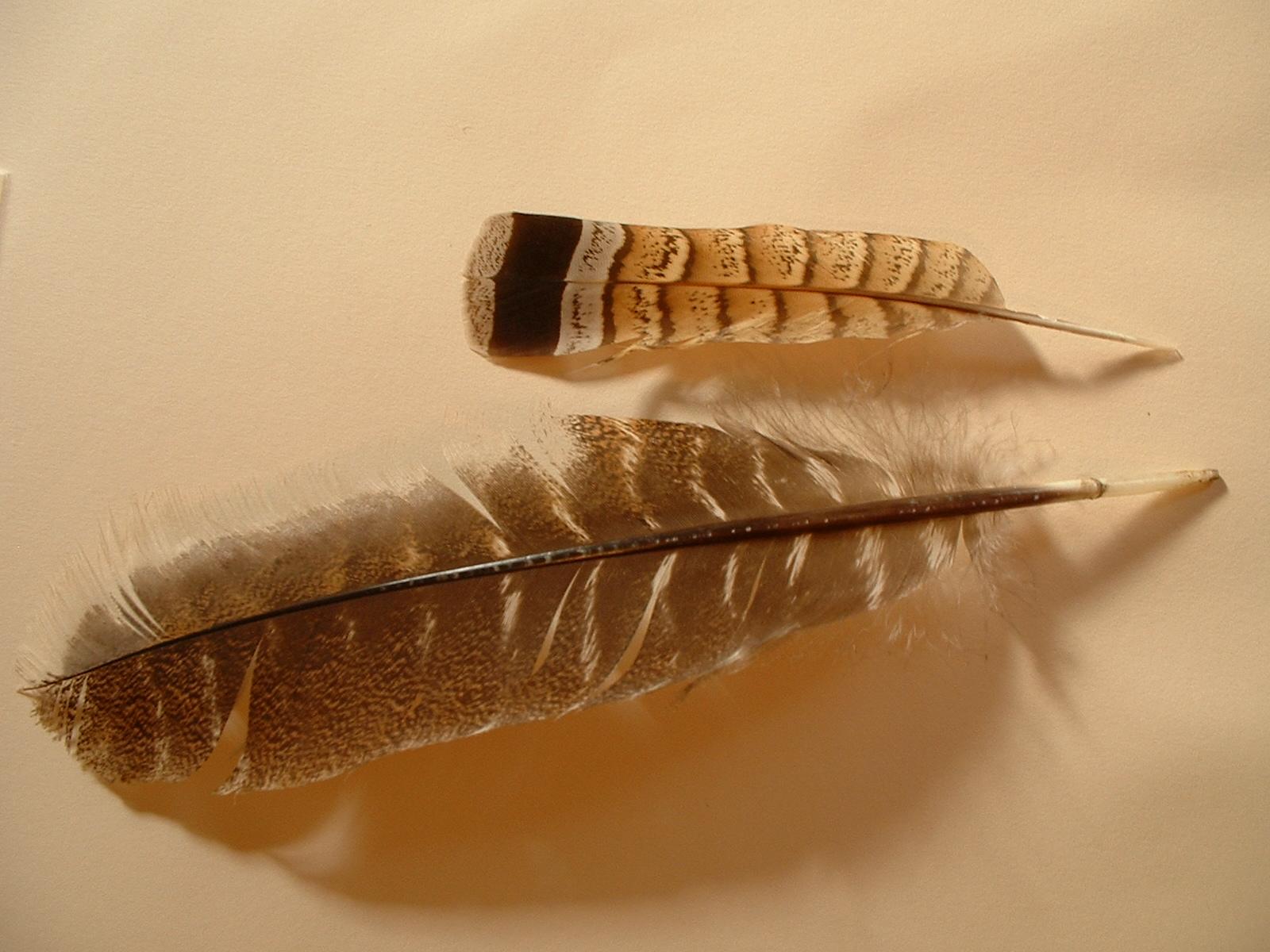
The rectrix and remex seen above are two examples of pennaceous feathers.
An ostrich down feather is an example of a plumulaceous feather. Its rudimentary rhachis with long flexible barbs and elongate barbules cannot form vanes.

The pennaceous feather is a type of feather present in most modern birds and in some other species of maniraptoriform dinosaurs.[1]

Description

[edit]

A pennaceous feather has a stalk or quill.[2] Its basal part, called a calamus, is embedded in the skin. The calamus is hollow and has pith formed from the dry remains of the feather pulp, and the calamus opens below by an inferior umbilicus and above by a superior umbilicus.[2] The stalk above the calamus is a solid rachis having an umbilical groove on its underside. Pennaceous feathers have a rachis with vanes or vaxillum spreading to either side. These vanes are composed of a high number of flattened barbs, that are connected to one another with barbules.

The barbules are tiny strands that criss-cross on the flattened sides of the barbs. This forms a miniature velcro-like mesh that holds all the barbs together, stabilizing the vanes.[3]

Pennaceous feathers on the wing, and elsewhere, where stresses related to flight or other activities are high, are accordingly attached especially strongly. This strong attachment is accomplished by ligaments under the skin, which in some birds and other feathered dinosaurs results in raised bumps or marks along the rear forelimb bone (ulna). These bumps, called quill knobs (ulnar papillae), are often used as an indirect indication of strongly-attached forelimb feathers in fossil species, and can also indirectly indicate the number of secondary flight feathers in a given specimen.[4][5]

Flight feathers (remiges and rectrices) are specialized types of pennaceous feathers, adapted for high loadings and often strongly asymmetric for improved flight performance.

See also

[edit]

References

[edit]
Revisions and contributorsEdit on WikipediaRead on Wikipedia
from Grokipedia
A pennaceous is a type of avian distinguished by its rigid, planar vane formed by a central shaft known as the rachis, from which parallel barbs extend laterally, each bearing barbules that interlock via hooklets to create a cohesive, flat surface. This structure contrasts with the looser, downy form of plumulaceous feathers and is primarily composed of β-keratin, providing strength and durability. The anatomy of pennaceous feathers includes a hollow calamus at the base, which anchors the feather in the follicle, transitioning into the solid rachis that supports the vane; barbs branch perpendicularly from the rachis, while distal barbules feature hooklets that attach to proximal barbules of adjacent barbs, mimicking a Velcro-like mechanism for cohesion. , such as remiges and rectrices, exhibit bilateral asymmetry in their vanes to optimize , with the leading vane edge narrower and the trailing edge broader for lift generation. Contour feathers, covering the body, are more symmetrical and contribute to streamlining the bird's form. Pennaceous feathers serve multiple critical functions, including enabling powered flight through airfoil properties that produce lift and , providing via overlapping vanes that trap air, and facilitating visual displays for or through iridescent or pigmented structures. In non-flight contexts, they aid in and sensory perception, with the vane's microstructure enhancing tactile feedback during . Evolutionarily, pennaceous feathers trace back to theropod dinosaurs around 160 million years ago, with fossil evidence from specimens like Anchiornis showing early vaned forms composed of β-keratin, suggesting an initial role in display or gliding before full aerial capabilities in birds. Their development involves complex epithelial-mesenchymal interactions in feather follicles, where signaling pathways like Wnt regulate barbule differentiation, allowing adaptive variations across species.

Structure

Calamus and Rachis

The calamus, also known as the , is the hollow basal portion of a pennaceous that embeds into the bird's within the follicle, providing anchorage and stability to the entire structure. It lacks barbs and features two key openings: the inferior umbilicus at its base, through which vessels enter the central pulp cavity to supply nutrients during growth, and the superior umbilicus at its distal end, marking the transition to the rachis and serving as a remnant of the early supply system. The calamus is typically cylindrical and hollow, formed from keratinized epidermal cells, with its length varying by feather type. The rachis extends proximally from the superior umbilicus as the solid central shaft of the , featuring an umbilical groove on its ventral surface that aligns with the pulp cavity remnants from development. Unlike the hollow calamus, the rachis is filled with a dense matrix, providing rigidity and serving as the primary axis for barb attachment, which supports the vane's formation. In large , the rachis can reach lengths of up to 30 cm and diameters of several millimeters, scaling with size and feather function to ensure structural integrity. The calamus and rachis develop within the epidermal collar of the feather follicle through a of and . Keratinocytes in the collar proliferate around the central dermal pulp, which supplies nutrients via blood vessels entering through the inferior umbilicus; as the feather grows, barb ridges form and fuse along the anterior midline to create the solid rachis, while the collar reverts to an undifferentiated cylindrical state proximally, keratinizing into the hollow calamus after the pulp recedes. This hollowing occurs as cells die and deposit , isolating the structure from further vascular supply, with the entire driven by helical growth from a posterior locus in the follicle. The barbs attach directly to the rachis, integrating the vane without altering the shaft's core formation.

Barbs and Barbules

Barbs are the primary branches that radiate perpendicularly from the rachis in pennaceous feathers, forming a series of side branches attached along its length. These barbs vary in length and density, with proximal barbs typically shorter and distal barbs longer, contributing to the feather's overall . Extending from the barbs as secondary branches, barbules are fine, hair-like structures arranged in rows along the barb's length, distinguished as distal and proximal types. Distal barbules, positioned toward the feather's tip, bear hooklets that face downward, while proximal barbules feature structures oriented upward to receive them, creating a Velcro-like hook-and-loop mechanism between adjacent barbs. This system relies on the hooklets of distal barbules catching onto the grooved edges of proximal barbules from neighboring barbs. At the microscopic level, barbules consist of a linear series of forming nodes and grooves that facilitate precise interlocking, with the hooklets arising from asymmetric cell junctions. These structures are primarily composed of β-keratin proteins, which provide the necessary rigidity and flexibility. During development, barbs emerge sequentially from the apex of the rachis through helical growth of barb ridges within the tubular germ, followed by the differentiation of barbules along these ridges. This begins with barb formation in early stages, progressing to the emergence of paired proximal and distal barbules as the matures.

Vane Formation

The vane of a pennaceous feather forms through a developmental process where the initially cylindrical structure emerges from the follicle encased in a protective keratinized sheath known as the calyptra. During molting, this sheath disintegrates, allowing the barbs—composed of barbules—to unfold and interlock, thereby flattening into the characteristic planar, web-like surface. This unfolding is facilitated by the precise alignment and engagement of barbule structures, transforming the tubular into a broad, functional vane. Pennaceous vanes exhibit two primary types based on : bilateral in contour feathers, where the vane is evenly proportioned on both sides of the rachis for general body coverage, and in , featuring a narrow and a wider trailing edge to optimize during locomotion. This arises from differential growth rates in barb ridge formation on opposing sides of the follicle collar, displacing the locus of new barb development laterally. Barbs and barbules serve as the foundational branches that integrate to produce these vane configurations. The physical properties of the vane stem directly from the microstructure of its components, providing a balance of achieved through the of hooked distal barbules with grooved proximal barbules on adjacent barbs, which creates a cohesive, rigid surface resistant to deformation and wear. This also imparts flexibility at the barbule joints, allowing the vane to bend under aerodynamic forces without fracturing, while the overall structure enhances durability against environmental abrasion. In terms of , vane contours are shaped during feather morphogenesis by , or , particularly through selective caspase-dependent mechanisms that eliminate cells in the feather sheath and pulp , converting the initial tubular form into a planar vane. in marginal plates and axial regions further refines barb ridge geometry, ensuring precise vane asymmetry and overall form, as guided by molecular signals like those involving homeoproteins. This process is integral to pennaceous feather maturation and has been elucidated in studies of avian follicle regeneration.

Functions

Aerodynamic Role

Pennaceous feathers play a pivotal role in avian flight by forming the primary structures for generating lift and , particularly through remiges on the wings and rectrices on the tail. Remiges, including primaries and secondaries, create an shape that produces lift during the downstroke and minimizes drag on the upstroke, while rectrices provide stability and additional lift, especially in maneuvers like turning or . The asymmetric vanes of these feathers, with broader trailing edges, enhance camber for efficient airflow control. Slotted tips on primary feathers further reduce induced drag by dispersing , allowing birds to maintain efficient flight paths. Adaptations in pennaceous feathers ensure structural integrity under intense aerodynamic forces. High barb in the vanes increases , particularly in distal primaries where forces are greatest, enabling resistance to bending during flight; for instance, continuous flappers exhibit denser barbs than soarers to support sustained . Quill knobs, bony projections on the and other bones, serve as secure attachment points for feather calami, transferring aerodynamic loads from the feathers to the and preventing detachment during high-stress conditions. These features collectively allow pennaceous feathers to withstand loads up to several times the bird's body weight. Specific examples illustrate these aerodynamic contributions. Alula feathers, small pennaceous structures on the leading edge of the wing, function like slats to delay by directing over the at low speeds or high angles of attack, crucial for . Primary feathers, the longest remiges, generate during by twisting and fanning, with their slotted configurations optimizing in like pigeons. In , the interlocking barbules of pennaceous vanes maintain vane cohesion and shape integrity during high-speed maneuvers, such as dives reaching up to 100 m/s in peregrine falcons, where aeroelastic deformation and rapid morphing prevent structural failure.

Insulation and Protection

Pennaceous feathers, particularly contour feathers, overlap in a shingled arrangement that forms a dense barrier against and water, preventing environmental elements from penetrating to the bird's skin. This interlocking structure, facilitated by hook-like barbules, ensures durability and maintains the integrity of the during exposure to harsh conditions. Birds enhance this waterproofing by distributing preen oil from the across their feathers during grooming, creating a hydrophobic layer that repels and reduces . In terms of thermal regulation, pennaceous feathers trap layers of air within and between their vanes, providing effective insulation by minimizing convective loss. This air-trapping mechanism can be adjusted through piloerection, where birds fluff their feathers to increase insulation during weather or smooth them to facilitate dissipation in warmer conditions. The keratin composition of these feathers further contributes to their protective role by offering resistance to abrasion and , ensuring long-term functionality in abrasive environments. Coloration in pennaceous feathers, derived from melanin granules embedded in the barbs, aids in by blending birds with their surroundings, reducing predation risk. Additionally, coloration from pigments and structural in pennaceous feathers facilitates visual displays for , species recognition, and territorial signaling. A notable example is seen in penguins, where dense layers of pennaceous contour feathers form an outer barrier that complements underlying down for superior aquatic insulation, enabling survival in frigid waters despite the absence of flight capabilities.

Types and Adaptations

Contour Feathers

Contour feathers are pennaceous feathers characterized by symmetric vanes that cover the bird's body, forming the external plumage known as the contour. These feathers consist of a central rachis from which barbs extend bilaterally, with barbules featuring interlocking hooks and grooves that create a smooth, cohesive vane for streamlined body shape. The proximal portions often include fluffy, plumulaceous bases that lie beneath the visible pennaceous vane, while the distal tips are stiff and waterproof, contributing to overall aerodynamics by reducing drag during movement. Additionally, the pennaceous structure provides UV protection by increasing the surface area that shields the skin from solar radiation. Variations among contour feathers include covert feathers, which are specialized contours that overlie the bases of flight feathers on the wings and tail, helping to smooth airflow and maintain an efficient airfoil shape. Femoral tract feathers, located on the thighs and legs, form part of the body coverage and are often accompanied by filoplumes that provide sensory functions by detecting environmental stimuli. These variations ensure comprehensive plumage that adapts to specific body regions, with afterfeathers occasionally present on some contours to enhance insulation by trapping air. Molting patterns for contour feathers involve sequential replacement, where old feathers are shed and new ones grow from follicles in a coordinated manner across tracts to preserve body coverage and avoid impairing flight or . This process typically occurs annually over several weeks, starting from the head and progressing caudally, with the timing adjusted to minimize gaps that could increase drag or expose the skin. The overlapping arrangement of contours during regrowth helps maintain insulation by preventing heat loss even as individual feathers are replaced. In birds, contour feathers grow from concentrated follicles in defined areas called pterylae, or feather tracts, which contrast with featherless regions known as apteria that separate the tracts and facilitate heat dissipation. For example, in passerines like the dusky flycatcher, distinct pterylae include capital (head), dorsal (back), ventral (belly), and femoral (thigh) tracts, while apteria remain bare between them, covered indirectly by adjacent feathers. In contrast, species such as exhibit denser feathering with reduced or absent apteria, allowing for greater coverage in aquatic environments. These patterns vary across taxa, with ratites showing more uniform distribution compared to the tract-based arrangement in most neornithine birds.

Flight Feathers

Flight feathers, or remiges and rectrices, represent specialized pennaceous feathers adapted for avian locomotion, providing the primary structures for lift, thrust, steering, and braking during flight. Remiges comprise the wing feathers, while rectrices form the tail feathers, both exhibiting robust pennaceous construction with interlocking barbs and barbules to maintain structural integrity under aerodynamic stresses. These feathers are anchored to skeletal elements via follicles, enabling precise control through muscular attachments. The remiges include primaries, secondaries, and tertials. Primaries, numbering 9 to 12 per wing, are attached to the manus (hand bones) and primarily generate during the downstroke of the wingbeat. Secondaries, typically 10 to 20 or more per wing, attach to the (forearm bone) and contribute to lift by forming the inner wing surface. Tertials, the innermost 3 to 7 secondaries, further support lift and streamline the wing's trailing edge. Together, these structures enable efficient propulsion and maneuverability. Rectrices consist of 10 to 12 tail feathers per bird, attached to the and surrounding muscles, functioning in , braking, and stability. These feathers possess a stronger rachis compared to body feathers, allowing them to withstand greater and bending forces during rapid maneuvers or landing. The robust central shaft distributes loads effectively across the tail assembly. Key adaptations in include asymmetric vanes, where the is narrower than the trailing edge to optimize and enhance lift generation. Emarginations, or notches along the vane margins particularly in distal primaries, promote flexibility by allowing independent movement of feather tips, reducing drag and improving slotting for better aerodynamic performance. During growth, receive vascular supply through a central pulp cavity in the developing calamus and rachis, nourishing the keratinizing tissues until maturation, after which the vessels regress. Fossil evidence, such as quill knobs on wing bones, provides insights into ancient flight feather configurations; for instance, Archaeopteryx specimens exhibit impressions indicating approximately 11 primaries, suggesting early adaptations for powered flight.

Evolutionary History

Origins in Dinosaurs

The earliest evidence of pennaceous feathers appears in the fossil record of Middle to Late Jurassic non-avian dinosaurs, particularly within the maniraptoran clade Pennaraptora, dating to approximately 160 million years ago. These feathers are prominently documented in specimens of Anchiornis huxleyi, a small theropod from northeastern China, where they exhibit symmetrical vanes formed by barbs and barbules on the forelimbs, forming proto-wing structures, as well as on the tail for stabilization. Similar pennaceous features are observed in other early pennaraptorans, indicating a rapid diversification of vaned feathers among these agile, predatory dinosaurs. The evolutionary progression toward pennaceous feathers in dinosaurs is best explained by the developmental model proposed by Prum and Brush, which outlines five sequential stages based on follicle and supported by intermediates. Although widely accepted, the precise origins of pennaceous feathers remain debated, with recent analyses (as of 2025) highlighting uncertainties in whether they evolved exclusively in theropods or more broadly across archosaurs. Stages I and II represent proto-pennaceous forms as simple, filament-like structures: Stage I consists of a hollow, tubular calamus without branching, while Stage II introduces multiple unbranched barbs emerging from the calamus, resembling tufts seen in early theropods like . Transitioning to Stages III and IV, these evolve into more complex pennaceous precursors, with Stage III featuring helical barb ridges that form a primitive rachis and branched barbs (open vane), and Stage IV adding differentiated barbules with hooklets for partial closure, as evidenced in s of and . This stepwise development from simple filaments to vaned structures highlights the incremental addition of epidermal specializations in theropod dinosaurs. Biochemical analyses of dinosaur fossils further confirm the pennaceous nature of these early feathers through the preservation of beta-keratins—the primary structural proteins—and melanosomes, the pigment-bearing organelles. In Anchiornis specimens, feather tissues contain both beta- and alpha-keratins, with melanosomes embedded in a keratin matrix, demonstrating molecular continuity with modern avian feathers despite a higher alpha-keratin proportion that may have limited early biomechanical strength. Complementary evidence from Early Cretaceous theropods like Sinosauropteryx and Microraptor reveals eumelanosomes and phaeomelanosomes within feather barbules, enabling reconstructions of iridescent or striped coloration and affirming an epidermal, beta-keratin-based composition akin to pennaceous vanes. Functional hypotheses suggest that pennaceous feathers in these non-volant dinosaurs initially served roles in visual display and aerodynamic assistance rather than powered flight, particularly among small, prey-hunting maniraptorans. Contrasting plumage patterns, such as the white-tipped tail fans in Caudipteryx, likely functioned to startle or flush hidden prey by stimulating visual escape responses, enhancing foraging success through a "flush-pursue" strategy observed in modern birds. Additionally, the symmetrical vanes on forelimbs and tails may have facilitated gliding or drag-based maneuvering during leaps and pursuits, providing selective advantages for evasion or short-distance aerial bursts in arboreal or terrestrial environments before the evolution of true flight.

Development in Birds

The development of pennaceous feathers in birds marked a significant evolutionary refinement during the period, particularly evident in early avian taxa like , dated to approximately 125 million years ago. These early birds exhibited elongated with highly asymmetrical vanes, adaptations that enhanced aerodynamic efficiency for powered flight by increasing lift and reducing drag. This elongation and asymmetry represented a transition from the more symmetrical protofeathers of non-avian dinosaurs, enabling sustained aerial locomotion in environments. At the molecular level, the of pennaceous feathers involved the expansion and diversification of β-keratin clusters, which encode the structural proteins forming the rigid vane. These clusters underwent subfunctionalization in birds, allowing for the production of specialized keratins that support barbule interlocking and vane integrity. Concurrently, BMP signaling pathways, including and BMP7, played a critical role in regulating barb ridge formation during embryogenesis, promoting the bilateral symmetry and complexity of pennaceous structures essential for vane development. This molecular framework facilitated the shift from simpler rachis-dominated feathers to fully vaned forms, driving functional diversification in avian lineages. In the diversification of following the Cretaceous-Paleogene extinction, pennaceous feathers adapted to ecological niches, with notable modifications in aquatic species. For instance, such as loons and grebes evolved denser vane structures in their flight and contour feathers, increasing resistance to water pressure and improving control during submersion. These adaptations, characterized by higher barbule and reduced interbarbule spacing, enhanced hydrodynamic performance while maintaining insulation. Such innovations underscore how pennaceous feather morphology diversified in response to habitat-specific selective pressures within , comprising over 95% of modern bird . In modern birds, molting cycles represent a key implication of pennaceous feather evolution, involving sequential replacement of vanes to maintain aerodynamic and thermoregulatory functions. Annual or biannual molts, regulated by hormonal cues like , ensure feather integrity against wear, with species-specific patterns influencing coloration and display. Feather tract evolution, or pterylosis, has further diversified to produce adaptive distributions, such as concentrated tracts for streamlined flight in raptors or expansive coverage for in passerines. These cycles and tract configurations highlight the ongoing evolutionary tuning of pennaceous feathers for ecological and behavioral roles.

Comparison to Other Feathers

Plumulaceous Feathers

Plumulaceous feathers are characterized by loose, fluffy barbs lacking interlocking barbules. Examples include natal down, where barbs branch directly from the calamus without a rachis, and semiplumes, which have a short rachis supporting these loose barbs, resulting in a downy appearance that excels at trapping air for insulation. These feathers, such as natal down in newly hatched , provide essential thermal protection during early development by forming a soft, voluminous layer close to the skin. In contrast to pennaceous feathers, plumulaceous ones lack the hooklets on barbules that create a rigid vane, leading to no cohesive surface formation and thus greater flexibility but lower mechanical durability suitable only for non-structural roles. This design enhances air retention for superior insulation in cold conditions, though it sacrifices the strength needed for flight or provided by pennaceous structures. Plumulaceous feathers commonly serve as an underlayer in adult birds, appearing as semiplumes that are mostly concealed beneath contour feathers to augment body insulation and fill feather tracts. In flightless ratites like ostriches, they form the primary body covering, with loose barbs enabling effective thermoregulation in varied climates without the need for aerodynamic rigidity. Evolutionarily, plumulaceous feathers represent the basal feather type, originating as tufts of barbs for primitive thermoregulation in early archosaurs, and persisting in modern birds where pennaceous forms evolved atop this foundation for added structural functions.

Filoplumes and Bristles

Filoplumes are thin, hair-like feathers characterized by a slender rachis with minimal barbs, typically limited to a small tuft at the distal tip, distinguishing them from the robust, vane-covered structure of pennaceous feathers. These feathers are sparsely distributed throughout the avian plumage, often embedded beneath contour and flight feathers, with higher concentrations at the base of the wings where up to 8–12 filoplumes may associate with each primary flight feather. In terms of function, filoplumes serve primarily as proprioceptors, equipped with nerve endings at their base that provide sensory feedback on the position and movement of overlying pennaceous feathers, aiding in the coordination of flight muscles and overall plumage adjustment. Bristle feathers, in contrast, are rigid, vane-less or minimally barbed structures with a stiff, tapered rachis that lacks the interlocking barbules essential for the aerodynamic and protective roles of pennaceous feathers. These feathers are prominently located around the mouth, particularly as rictal bristles extending from the base of the bill in species like flycatchers (Tyrannidae), where they form whisker-like projections. Their sensory role involves mechanoreception for tactile detection during prey capture, helping birds gauge insect proximity and orientation in flight while also offering incidental protection to the eyes from sharp appendages. Structurally, both filoplumes and bristles exhibit simplified architectures compared to pennaceous feathers: filoplumes have a reduced rachis and sparse, non-interlocking barbs that prevent the formation of a cohesive vane, while bristles feature an even more attenuated design with absent or vestigial barbs, emphasizing rigidity over vaned complexity. This minimalism supports their specialized mechanoreceptive functions rather than aerodynamic lift, , or , with filoplumes and bristles occurring in low densities to avoid interfering with the dominant pennaceous .

References

Add your contribution
Related Hubs
User Avatar
No comments yet.