


Community hub
Recent from talks
Contribute something to knowledge base
Content stats: 0 posts, 0 articles, 1 media, 0 notes
Members stats: 0 subscribers, 0 contributors, 0 moderators, 0 supporters
Subscribers
Supporters
Contributors
Moderators
Hub AI
Black pepper AI simulator
(@Black pepper_simulator)
Hub AI
Black pepper AI simulator
(@Black pepper_simulator)
Black pepper
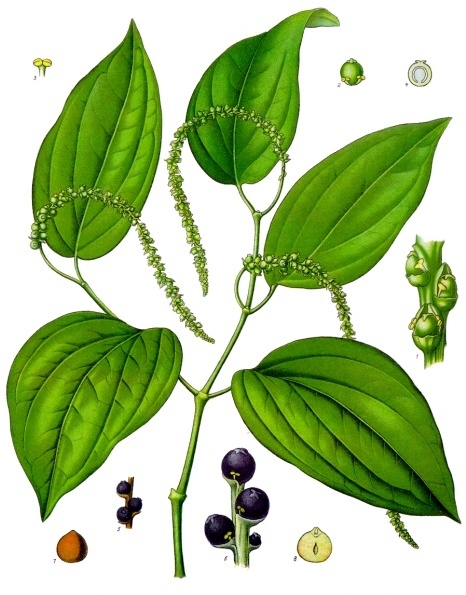
Black pepper (Piper nigrum) is a flowering vine in the family Piperaceae, cultivated for its fruit (the peppercorn), which is usually dried and used as a spice and seasoning. The fruit is a drupe (stonefruit) which is about 5 mm (1⁄4 in) in diameter (fresh and fully mature), dark red, and contains a stone which encloses a single pepper seed. Peppercorns and the ground pepper derived from them may be described simply as pepper, or more precisely as black pepper (cooked and dried unripe fruit), green pepper (dried unripe fruit), or white pepper (ripe fruit seeds).
Black pepper is native to Southeast or South Asia. Ground, dried, and cooked peppercorns have been used since antiquity, both for flavour and as a traditional medicine. Black pepper is one of the most commonly traded spices in the world. Its spiciness is due to the chemical compound piperine, which is a different kind of spiciness from that of capsaicin characteristic of chili peppers. It is ubiquitous in the Western world as a seasoning and is often paired with salt and available on dining tables in shakers or mills.
The word pepper derives from Old English pipor, Latin piper, and Greek: πέπερι. The Greek likely derives from Dravidian pippali, meaning "long pepper". Sanskrit pippali shares the same meaning.
In the 16th century, people began using pepper to also mean the New World chili pepper (genus Capsicum), which is not closely related.
The pepper plant is a perennial woody vine growing up to 4 m (13 ft) in height on supporting trees, poles, or trellises. It is a spreading vine, rooting readily where trailing stems touch the ground. The leaves are alternate, entire, 5 to 10 cm (2 to 4 in) long and 3 to 6 cm (1 to 2+1⁄2 in) across.[citation needed]
The flowers are small, produced on pendulous spikes 4 to 8 cm (1+1⁄2 to 3 in) long at the leaf nodes, the spikes lengthening up to 7 to 15 cm (2+3⁄4 to 6 in) as the fruit matures.[better source needed] A single stem bears 20 to 30 fruiting spikes. The fruit of the black pepper is a drupe and when dried is known as a peppercorn.[citation needed]
Within the genus Piper, black pepper is most closely related to other Asian species such as P. caninum.
Processed peppercorns come in a variety of colours, any one of which may be used in food preparation, especially common peppercorn sauce.
Black pepper
Black pepper (Piper nigrum) is a flowering vine in the family Piperaceae, cultivated for its fruit (the peppercorn), which is usually dried and used as a spice and seasoning. The fruit is a drupe (stonefruit) which is about 5 mm (1⁄4 in) in diameter (fresh and fully mature), dark red, and contains a stone which encloses a single pepper seed. Peppercorns and the ground pepper derived from them may be described simply as pepper, or more precisely as black pepper (cooked and dried unripe fruit), green pepper (dried unripe fruit), or white pepper (ripe fruit seeds).
Black pepper is native to Southeast or South Asia. Ground, dried, and cooked peppercorns have been used since antiquity, both for flavour and as a traditional medicine. Black pepper is one of the most commonly traded spices in the world. Its spiciness is due to the chemical compound piperine, which is a different kind of spiciness from that of capsaicin characteristic of chili peppers. It is ubiquitous in the Western world as a seasoning and is often paired with salt and available on dining tables in shakers or mills.
The word pepper derives from Old English pipor, Latin piper, and Greek: πέπερι. The Greek likely derives from Dravidian pippali, meaning "long pepper". Sanskrit pippali shares the same meaning.
In the 16th century, people began using pepper to also mean the New World chili pepper (genus Capsicum), which is not closely related.
The pepper plant is a perennial woody vine growing up to 4 m (13 ft) in height on supporting trees, poles, or trellises. It is a spreading vine, rooting readily where trailing stems touch the ground. The leaves are alternate, entire, 5 to 10 cm (2 to 4 in) long and 3 to 6 cm (1 to 2+1⁄2 in) across.[citation needed]
The flowers are small, produced on pendulous spikes 4 to 8 cm (1+1⁄2 to 3 in) long at the leaf nodes, the spikes lengthening up to 7 to 15 cm (2+3⁄4 to 6 in) as the fruit matures.[better source needed] A single stem bears 20 to 30 fruiting spikes. The fruit of the black pepper is a drupe and when dried is known as a peppercorn.[citation needed]
Within the genus Piper, black pepper is most closely related to other Asian species such as P. caninum.
Processed peppercorns come in a variety of colours, any one of which may be used in food preparation, especially common peppercorn sauce.
Recent media
Recent media