


Community hub
Recent from talks
Contribute something
Nothing was collected or created yet.
Percrocuta
View on Wikipedia
| Percrocuta Temporal range:
| |
|---|---|

| |
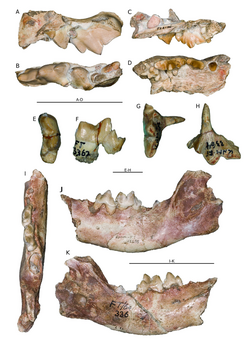
| Jaws and teeth of P. tobieni | |
Scientific classification 
| |
| Kingdom: | Animalia |
| Phylum: | Chordata |
| Class: | Mammalia |
| Order: | Carnivora |
| Family: | Hyaenidae |
| Subfamily: | †Percrocutinae |
| Genus: | †Percrocuta Kretzoi, 1938 |
| Type species | |
| Percrocuta carnifex[4] Pilgrim, 1913
| |
| Species | |
| |
| Synonyms | |
|
Capsatherium Kurtén, 1978 | |
Percrocuta is an extinct genus of percrocutid hyena. It lived in Eurasia and Africa, during the Miocene epoch.
Description
[edit]With a maximum length of 1.50 m (5 ft), Percrocuta was much bigger than its modern relatives. Like the spotted hyena, it had a robust skull and powerful jaws. Similar to modern hyaenids, its hind legs were shorter than the front legs, resulting in a characteristic sloping back.[5] However, not all species were larger than modern hyenas. P. xixiaensis is described to being close to size of the striped hyena. The zygomatic arch of this species was slender a hyena its size suggesting the cranium isn’t as strongly built was other bone crushing hyenas such as Dinocrocuta, Pachycrocuta, striped hyena, Adcrocuta, and Crocuta.[3]
P. miocenia was estimated to have weighed between 30–100 kg (66–220 lb).[6]
Classification
[edit]Percrocuta was introduced as a genus of Hyaenidae in 1938.[4] Percrocuta's relation to the family was debated until 1985, when Percrocuta, Dinocrocuta, Belbus, and Allohyaena were accepted as the four genera of Percrocutidae.[7] More recent evidence, however, has shown that Belbus and Allohyaena at least, are not percrocutids.[8]
Fossil evidence
[edit]P. abessalomi is known only from a skull, two mandibles, and two teeth. These fossils were all collected from the Belomechetskaja, Russia area and date from the sixth Mammal Neogene (MN) zone. This species is the best known of the family Percrocutidae.[citation needed] P. miocenica is known from only a few mandibles, found in Serbia, Bosnia and Herzegovina and Turkey.[9][10] These fossils are also dated to MN 6.[7]
References
[edit]- ^ Koufos, George D. (1995). "The late Miocene percrocutas of Macedonia (Greece)". Palaeovertebrata. 24 (1–2): 67–84.
- ^ Lars Werdelin (2019). "'Middle Miocene Carnivora and Hyaenodonta from Fort Ternan, western Kenya" (PDF). Geodiversitas. 41 (6).
- ^ a b c Xiong, W. (2022). "New species of Percrocuta (Carnivora, Hyaenidae) from the early middle Miocene of Tongxin, China". Historical Biology: An International Journal of Paleobiology: 1–22. doi:10.1080/08912963.2022.2067757. S2CID 248627038.
- ^ a b Kretzoi, M. (1938). "Die Raubtiere von Gombaszög nebst einer Übersicht der Gesamtfauna" (PDF). Annales Musei Nationalis Hungarici. 31: 88–153. Archived (PDF) from the original on 2023-05-06.
- ^ Palmer, D., ed. (1999). The Marshall Illustrated Encyclopedia of Dinosaurs and Prehistoric Animals. London: Marshall Editions. p. 221. ISBN 1-84028-152-9.
- ^ Morlo, Michael; Gunnell, Gregg F.; Nagel, Doris (2010). "10 - Ecomorphological analysis of carnivore guilds in the Eocene through Miocene of Laurasia". Carnivoran Evolution. Cambridge University Press. pp. 269–310. ISBN 9781139193436.
- ^ a b Raymond Louis Bernor; Volker Fahlbusch; Hans-Walter Mittmann (1996). The Evolution of Western Eurasian Neogene Mammal Faunas. Columbia University Press. pp. 261–265. ISBN 0-231-08246-0.
- ^ Lars Werdelin; Björn Kürten (1999). "Allohyaena (Mammalia: Carnivora): giant hyaenid from the Late Miocene of Hungary". Zoological Journal of the Linnean Society. 126 (3): 319–334. doi:10.1111/j.1096-3642.1999.tb01374.x.
- ^ Bastl, Katharina; Nagel, Doris; Morlo, Michael; Göhlich, Ursula B. (June 2020). "The Carnivora (Mammalia) from the middle Miocene locality of Gračanica (Bugojno Basin, Gornji Vakuf, Bosnia and Herzegovina)". Palaeobiodiversity and Palaeoenvironments. 100 (2): 307–319. doi:10.1007/s12549-018-0353-0. ISSN 1867-1594.
- ^ Radović, Predrag; Mayda, Serdar; Alaburić, Sanja; Marković, Zoran (2021-04-01). "Percrocuta miocenica (Percrocutidae, Carnivora) from the middle Miocene of Brajkovac (Central Serbia)". Geobios. 65: 41–49. doi:10.1016/j.geobios.2021.02.001. ISSN 0016-6995. S2CID 233574168.
 | This article related to a prehistoric carnivoran is a stub. You can help Wikipedia by adding missing information. |