



Community hub
Recent from talks
Knowledge base stats:
Talk channels stats:
Members stats:
Peristalsis
Peristalsis (/ˌpɛrɪˈstælsɪs/ PERR-ih-STAL-siss, US also /-ˈstɔːl-/ -STAWL-) is a type of intestinal motility, characterized by radially symmetrical contraction and relaxation of muscles that propagate in a wave down a tube, in an anterograde direction. Peristalsis is progression of coordinated contraction of involuntary circular muscles, which is preceded by a simultaneous contraction of the longitudinal muscle and relaxation of the circular muscle in the lining of the gut.
In much of a digestive tract, such as the human gastrointestinal tract, smooth muscle tissue contracts in sequence to produce a peristaltic wave, which propels a ball of food (called a bolus before being transformed into chyme in the stomach) along the tract. The peristaltic movement comprises relaxation of circular smooth muscles, then their contraction behind the chewed material to keep it from moving backward, then longitudinal contraction to push it forward.
Earthworms use a similar mechanism to drive their locomotion,[self-published source?] and some modern machinery imitate this design.
The word comes from Neo-Latin and is derived from the Greek peristellein, "to wrap around," from peri-, "around" + stellein, "draw in, bring together; set in order".
Peristalsis is generally directed caudal, that is, towards the anus. This sense of direction might be attributable to the polarisation of the myenteric plexus. Because of the reliance of the peristaltic reflex on the myenteric plexus, it is also referred to as the myenteric reflex.
The food bolus causes a stretch of the gut smooth muscle to cause serotonin to be secreted to sensory neurons, which then get activated. These sensory neurons, in turn, activate neurons of the myenteric plexus, which then proceed to split into two cholinergic pathways: a retrograde and an anterograde. Activated neurons of the retrograde pathway release substance P and acetylcholine to contract the smooth muscle behind the bolus. The activated neurons of the anterograde pathway instead release nitric oxide and vasoactive intestinal polypeptide to relax the smooth muscle caudal to the bolus. This allows the food bolus to effectively be pushed forward along the digestive tract.
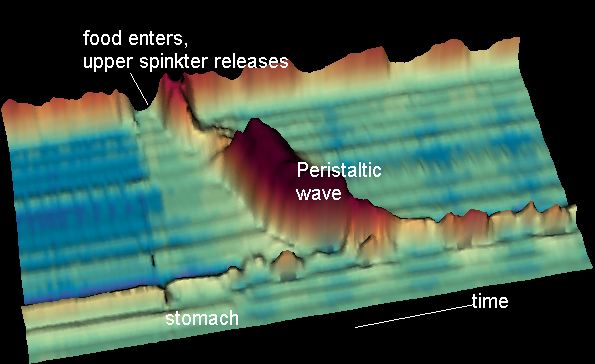
After food is chewed into a bolus, it is swallowed and moved through the esophagus. Smooth muscles contract behind the bolus to prevent it from being squeezed back into the mouth. Then rhythmic, unidirectional waves of contractions work to rapidly force the food into the stomach. The migrating motor complex (MMC) helps trigger peristaltic waves. This process works in one direction only, and its sole esophageal function is to move food from the mouth into the stomach (the MMC also functions to clear out remaining food in the stomach to the small bowel and remaining particles in the small bowel into the colon).
In the esophagus, two types of peristalsis occur:
Hub AI
Peristalsis AI simulator
(@Peristalsis_simulator)
Peristalsis
Peristalsis (/ˌpɛrɪˈstælsɪs/ PERR-ih-STAL-siss, US also /-ˈstɔːl-/ -STAWL-) is a type of intestinal motility, characterized by radially symmetrical contraction and relaxation of muscles that propagate in a wave down a tube, in an anterograde direction. Peristalsis is progression of coordinated contraction of involuntary circular muscles, which is preceded by a simultaneous contraction of the longitudinal muscle and relaxation of the circular muscle in the lining of the gut.
In much of a digestive tract, such as the human gastrointestinal tract, smooth muscle tissue contracts in sequence to produce a peristaltic wave, which propels a ball of food (called a bolus before being transformed into chyme in the stomach) along the tract. The peristaltic movement comprises relaxation of circular smooth muscles, then their contraction behind the chewed material to keep it from moving backward, then longitudinal contraction to push it forward.
Earthworms use a similar mechanism to drive their locomotion,[self-published source?] and some modern machinery imitate this design.
The word comes from Neo-Latin and is derived from the Greek peristellein, "to wrap around," from peri-, "around" + stellein, "draw in, bring together; set in order".
Peristalsis is generally directed caudal, that is, towards the anus. This sense of direction might be attributable to the polarisation of the myenteric plexus. Because of the reliance of the peristaltic reflex on the myenteric plexus, it is also referred to as the myenteric reflex.
The food bolus causes a stretch of the gut smooth muscle to cause serotonin to be secreted to sensory neurons, which then get activated. These sensory neurons, in turn, activate neurons of the myenteric plexus, which then proceed to split into two cholinergic pathways: a retrograde and an anterograde. Activated neurons of the retrograde pathway release substance P and acetylcholine to contract the smooth muscle behind the bolus. The activated neurons of the anterograde pathway instead release nitric oxide and vasoactive intestinal polypeptide to relax the smooth muscle caudal to the bolus. This allows the food bolus to effectively be pushed forward along the digestive tract.
After food is chewed into a bolus, it is swallowed and moved through the esophagus. Smooth muscles contract behind the bolus to prevent it from being squeezed back into the mouth. Then rhythmic, unidirectional waves of contractions work to rapidly force the food into the stomach. The migrating motor complex (MMC) helps trigger peristaltic waves. This process works in one direction only, and its sole esophageal function is to move food from the mouth into the stomach (the MMC also functions to clear out remaining food in the stomach to the small bowel and remaining particles in the small bowel into the colon).
In the esophagus, two types of peristalsis occur: