


Community hub
Recent from talks
Contribute something
Nothing was collected or created yet.
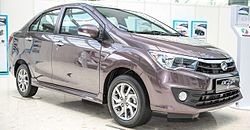
Perodua Bezza
View on Wikipedia
| Perodua Bezza | |
|---|---|
 Perodua Bezza Advance | |
| Overview | |
| Manufacturer | Perodua |
| Model code | B300 |
| Production | July 2016 – present |
| Assembly | Malaysia: Serendah (PGMSB) |
| Designer | Muhamad Zamuren Musa[1][2] |
| Body and chassis | |
| Class | City car (A) |
| Body style | 4-door sedan |
| Layout | Front-engine, front-wheel drive |
| Platform | Daihatsu A-Segment Platform |
| Related | |
| Powertrain | |
| Engine | |
| Transmission | |
| Dimensions | |
| Wheelbase | 2,455 mm (96.7 in) |
| Length | 4,170 mm (164.2 in) |
| Width | 1,620 mm (63.8 in) |
| Height | 1,525 mm (60.0 in) |
| Kerb weight | 865–940 kg (1,907–2,072 lb) |
The Perodua Bezza is a city car produced by Malaysian automobile manufacturer Perodua. It was launched on 21 July 2016 as Perodua's first sedan car, and a complement to the Axia hatchback.
The Bezza is based on the Axia's platform, and is powered by the latter's 1.0-litre engine, in addition to a new 1.3-litre plant. The Bezza is Perodua's first major in-house design. Perodua leads the styling and development of the Bezza's upper body structure, with technical support from Daihatsu. The Bezza is the second model to debut from Perodua's all-new factory in Serendah, Selangor.
The Perodua Bezza was developed with an emphasis on fuel efficiency, and is the company's first model to feature stop-start idling and regenerative braking. The Bezza is also the first Perodua to feature Vehicle Stability Control (VSC). The range-topping Bezza Advance scored a 5-star ASEAN NCAP rating.
Etymology
[edit]The name "Bezza" is derived from the Malay word beza, which means "different". Additionally, the letters "zz" in "Bezza" represents the number 22, as it was launched in Perodua's 22nd year in business. The Bezza logo was also designed to make both z's look like one z only.
History
[edit]Pre-launch
[edit].jpg)
.jpg)
Developed under the codename D63D, The production of Perodua's first sedan was first hinted during the 2010 Kuala Lumpur International Motor Show (KLIMS), when Perodua debuted their concept model called Bezza.[1] Three years later, another concept model was presented by Perodua during the 2013 KLIMS; this time, it was called Buddyz.[2] Both concept models were designed in-house by Perodua's own design and styling division led by Muhamad Zamuren Musa, without referring to any existing Daihatsu or Toyota car models, referring instead to the Chevrolet Aveo.[1][2] The production of Perodua's first sedan was approved in 2015 by its chief executive officer, Datuk Aminar Rashid. The production model would draw inspiration from the Buddyz concept model and was codenamed D63D.[3][4]
The Bezza is the first Perodua model that isn't directly based on any pre-existing Toyota or Daihatsu model. Perodua lead the styling and development of the Bezza's upper body structure, with technical support from Daihatsu.[5] Perodua claims that the Bezza has up to 95% local content, and was developed at a cost of RM 300 million. However, Perodua did not develop the Bezza from scratch, as it is powered by Toyota-engineered engines and is based on the Daihatsu-engineered Axia platform. Unlike their rival Proton, Perodua was able to develop their first sedan model secretly without public knowledge.[6] The Perodua Bezza competes with the Proton Saga in its home market.
Launch
[edit]The Perodua Bezza was launched on 21 July 2016.[7][8] Three variants were available at launch: Standard G, Premium X and Advance.[9]
In the beginning of April 2017, the Perodua Bezza was updated with the rear bumper given a deeper skirt for all the variants. The Premium X and Advance variant got chrome platinum trim on the air-conditioning controls and the Advance variant also gains new leather upholstery that does without the previous quilting.[10]
In April 2018, the Standard G was replaced by a GXtra variant. The GXtra comes with an enhanced kit list, where side skirts and chrome door handles have been added to the exterior. There’s also a new Ocean Blue exterior colour available – an option that was previously reserved for 1.3L variants of the Bezza. Piano black trim has been applied on the dashboard and panel surrounding the multimedia system, which itself has been improved with Bluetooth connectivity. In other areas, the air-con vent surrounds, steering wheel spokes and gear lever base now gain a satin finish. Rounding things off are chrome door handles to mimic those on the outside.[11]
On 11 April 2019, a Limited Edition Bezza limited to 50 units was launched. The variant was based on the Premium X and solely with an automatic transmission. Changes compared to the Premium X variant included every GearUp accessory as well as different finishes to various components.[12]
Facelift
[edit].jpg)
.jpg)
_%E2%80%93_f_13032025.jpg)
_%E2%80%93_h_13032025.jpg)
In early January 2020, the facelift version was launched in Malaysia which brought changes to the Bezza both inside and out with the variants 1.0 G Manual, 1.0 G Automatic, 1.3 X Automatic and 1.3 AV Automatic has remained.[13] The new Bezza now has a redesigned front and rear bumpers and upgraded LED headlamps for all variants.[14] The rear chrome strip and side skirts now have a gloss black finish. Wheels now are 14-inch turbine design rims (1.0L variants) or 15-inch double-tone alloys (1.3L variants). It also gets 2 new colour - Garnet Red and Granite Grey - to join the previous 4 colours. Variants now come in 1.0 G Manual, 1.0 G Automatic, 1.3 X and 1.3 AV
The Bezza now comes with an updated speedometer with white illumination. The gloss black bar that cuts through the dashboard in the pre-facelift model has been removed for a silver trim.
The new Bezza AV now also comes with a reverse camera and Advanced Safety Assist 2.0 (ASA 2.0), which includes Pedestrian Detection, Pre-Collision Warning, Pre-Collision Braking, Front Departure Alert and Pedal Misoperation Control. Each variant comes with rear bumper sensors, Anti-Lock Braking System (ABS) and Electronic Brakeforce Distribution (EBC) as standard, while the 1.3L variants get additional Vehicle Stability Control (VSC), Keyless Entry and Push Start and front bumper sensors.
Equipment
[edit]The Standard G variant is equipped with 14-inch seven-spoke alloy rims, fabric seats, polyurethane steering wheel, an audio system with USB, handphone or smartphone slot at the rear console, fixed rear seat headrests, 60:40 split folding rear seats, remote boot release, manual side mirrors without turn signals, body-mounted signal indicators, and power windows.[8]
Exterior
[edit]Source:[15]
| Equipment | 1.0 G Manual | 1.0 G Automatic | 1.3 X | 1.3 AV |
|---|---|---|---|---|
| Wheels | 14-inch Alloy Wheels | 14-inch Alloy Wheels | 15-inch Alloy Wheels(Two Tone) | 15-inch Alloy Wheels
(Two Tone) |
| Front & Rear Bumper | Body Coloured | Body Coloured | Body Coloured | Body Coloured |
| Front Grille | Glossy Black & Silver Finish | Glossy Black & Silver Finish | Glossy Black & Chrome Finish | Glossy Black & Chrome Finish |
| Led Headlamps | Yes | Yes | Yes | Yes |
| Front Fog Lamps | No | No | Yes | Yes |
| Electric Side Mirrors with Turn Signals | Yes | Yes | Yes | Yes (Retractable) |
| Two-tone Back Door Garnish | Yes | Yes | Yes | Yes |
| Door Handles | Chrome Finish | Chrome Finish | Chrome Finish | Chrome Finish |
| Front Corner Sensors | No | No | Yes | Yes |
| Reverse Sensors | Yes | Yes | Yes | Yes |
| Reverse Camera | No | No | No | Yes |
| Rear Combination Lamps | LED (light guide & stop lamp) | LED (light guide & stop lamp) | LED (light guide & stop lamp) | LED (light guide & stop lamp) |
| Blacked-out pillar | No | No | Yes | Yes |
Interior
[edit]Source:[16]
| Equipment | 1.0 G Manual | 1.0 G Automatic | 1.3 X | 1.3 AV |
|---|---|---|---|---|
| Seats | Fabric | Fabric | Fabric | Leather |
| Power Windows | Yes (Driver Side) | Yes
(Driver Side) |
Yes
(With Jam Protection on Driver Side) |
Yes
(With Jam Protection on Driver Side) |
| Smart Entry & Push Start/Stop Button | No | No | Yes | Yes |
| Electric Power Steering | Yes | Yes | Yes | Yes |
| Auto-off Headlamps | Yes | Yes | Yes | Yes |
| ISOFIX System | Yes | Yes | Yes | Yes |
| Multi-purpose Container | Yes | Yes | Yes | Yes |
| Audio System | Yes (With USB & Bluetooth) | Yes (With USB & Bluetooth) | Yes (With USB & Bluetooth) | Yes (Multimedia System with navigation & 'Smart Link', USB, Bluetooth & HDMI) |
| Multi-info Display | Yes | Yes | Yes | Yes (With 'Idle Stop' Indicator) |
| 12V Power Socket | Yes | Yes | Yes | Yes |
| Driver Seat Height Adjuster | No | No | Yes | Yes |
| Advanced Safety Assist (A.S.A 2.0) | No | No | No | Yes |
Powertrains
[edit]The Perodua Bezza is produced with two different engine options, paired to a manual or electronic automatic transmission. Both engines are manufactured by Perodua under license from Toyota Group member, Daihatsu.[17]
| Specifications[18] | ||
|---|---|---|
| Specification | 1.0 G | 1.3 X and AV |
| Engine Type | 1KR-VE | 1NR-VE |
| Format | I3 DOHC 12V | I4 DOHC 16V |
| Total displacement (cc) | 998 | 1329 |
| Compression Ratio | 11.5:1 | 11.5:1 |
| Bore x Stroke (mm x mm) | 71.0 x 84.0 | 72.5 x 80.5 |
| Maximum Output [hp(kW)/rpm] | 67 (50) / 6,000 rpm | 94 (70) / 6,000 rpm |
| Maximum Torque (Nm/rpm) | 91 / 4,400 rpm | 121 / 4,000 rpm |
| Variable Valve Timing With Intelligence (VVT-i) | Yes | Yes (Dual VVT-i) |
| Fuel tank capacity (litres) | 36 | 36 |
| Fuel Consumption (with Eco-Driving)
(km/l) |
1.0 G Manual: 22.8
1.0 G Automatic: 21.3 |
1.3 X: 21.0
1.3 AV(with Eco-Idle): 22.0 |
| Top Speed (km/h) | 172 | 198 |
The Standard G and GXtra variant is powered by Perodua's 1.0-litre, three-cylinder 1KR-VE engine, which is a modified and refined version of the 1KR-DE2 engine from the Perodua Axia.[17] The 1KR-VE engine produces 67 hp at 6,000 rpm and 91 Nm at 4,400 rpm, offering a mild 1 hp and 1 Nm increase over the Axia's 1KR-DE2 plant.[17] Perodua claims ECE fuel consumption figures of 22.8 km/L for the manual variant and 21.3 km/L with the automatic, both exhibiting a 1.2 km/L improvement over the old 1KR-DE2.[17]
The 1KR-VE engine features variable-valve timing with intelligence (VVT-i) on the intake valves.[17] Several minor changes and refinements were also introduced for increased fuel efficiency and more linear power delivery. Notable changes include a higher 11.5:1 compression ratio, a high-tumble intake port, a longer intake manifold, micro fuel spray injection and low-friction valve lifters.[17]
The Premium X and Advance variants are powered by Perodua's 1.3-litre, four-cylinder 1NR-VE engine, which is capable of 94 hp at 6,000 rpm and 121 Nm at 4,000 rpm.[17] The 1NR-VE is an evolution of the K3-VE engine from the Perodua Myvi.[17] Perodua claims ECE fuel consumption figures of 21.7 km/L for the manual variant and 21.0 km/L with the automatic, while the auto-only Advance variant is capable of 22.0 km/L, courtesy of the new Eco Idle stop-start system and regenerative braking.[17]
The 1NR-VE engine features dual variable-valve timing with intelligence (VVT-i) on both intake and exhaust valves.[17] Additionally, the 1NR-VE features longer ports in its intake system for improved low- and mid-range torque, and a low-friction roller rocker arm-based valvetrain for improved fuel efficiency.[17]
Both 1KR-VE and 1NR-VE engines are paired to a 5-speed manual (5MT) or 4-speed electronic automatic transmission (4E-AT).[17] The Standard G and Premium X variants are sold with both manual and automatic options, while the Advance variant is limited to the automatic. Both 1KR-VE and 1NR-VE engines are also Euro IV compliant.[17]
The 2020 facelift version saw the discontinuation of Premium X MT variant which meant a 1.3 litre engine could no longer be paired with a 5-speed manual.[14]
Safety
[edit]- ASEAN NCAP -
 (Advance) /
  (Standard G / Premium X)


The Perodua Bezza features a number of active and passive safety features, and is Perodua's first model to offer vehicle stability control (VSC). ASEAN NCAP has awarded a 5-star safety rating for the Advance variant, and a 4-star rating for the rest of the range.[8]
All Bezza variants are equipped with an anti-lock braking system (ABS) with electronic brake distribution (EBD), twin SRS airbags (for the driver and front passenger respectively), and twin rear reverse sensors as standard.[8]
The range-topping Advance is the only variant with vehicle stability control (VSC), traction control (TRC), brake assist (BA), hill-start assist (HSA), and seat belt reminders for the driver and front passenger.[8] The Advance variant is also equipped with a multimedia touchscreen head unit paired to a reverse camera.
The Premium X and Advance variants feature twin front parking sensors below the headlamps, solar & security window film, and anti-trap protection for the driver's side power window.[8]
The 2020 facelift version saw VSC added to the Premium X variant and A.S.A or Advance Safety Assist was added to the Advance variant. This debuted in the Perodua Aruz, which includes Forward Collision Warning with pedestrian detection, Automatic Emergency Braking (operative from speeds of 4–80 km/h), Pedal Misoperation Control and Front Departure Alert, which alerts the driver of the vehicle in front has proceeded ahead, e.g. from a traffic light.[14]
Notes
[edit]Sales
[edit]Perodua has achieved promising sales for the Bezza, with a total of 5,000 bookings received for the new model on the first day after its launch.[19] During Perodua's first half of 2016 review, it announced that it had received 10,115 bookings as of the morning of July 26, which averages out to about 1,000 cars per day since the Bezza was first opened for booking on July 16.[20] On August 30, 2016 Perodua reported it had delivered 10,000 Bezzas, with the bookings at 25,000.[21] In November 2018, it was reported that 138,800 Bezza have been produced.[22] As of 2021, the Perodua Bezza is Perodua's third best selling model, and outsells the Proton Saga with 42,698 units sold compared to the Saga's 42,627 units sold.[23]
| Year | Malaysia[24][i] |
|---|---|
| 2016 | 34,930 |
| 2017 | 53,540 |
| 2018 | 49,911 |
| 2019 | 45,656 |
| 2020 | 56,995 |
| 2021 | 42,698 |
| 2022 | 69,439 |
| 2023 | 89,265 |
| 2024 | 100,814 |
- ^ Figures based on registration
Export
[edit]Mauritius
[edit]On 1 May 2017, Perodua announced the launch of four Bezza variants into Mauritius market to capitalize on Mauritius' status as a popular international tourist destination.[25]
Singapore
[edit]Perodua Bezza is also sold in Singapore via Perocom Auto Pte Ltd in May 2017 with only one variant, 1.3X. The facelifted model was introduced in February 2020.[26]
Sri Lanka
[edit]On 7 June 2017, the Bezza 1.0L (automatic transmission) made its debut in Sri Lanka at a launch organised by Perusahaan Otomobil Kedua Sdn Bhd's (Perodua) official distributor, Unimo Enterprises Ltd. The 1.0L variant received a design upgrade in February 2020.[27]
Brunei
[edit]In mid-2017, Perodua Brunei's official distributor, GHK Motors Sdn Bhd made available the 1.3L Premium X variant with manual or automatic transmissions, optional body kits, and 2 years warranty.
In mid-2019, the Bezza 1.0 GXtra was launched while the manual or automatic transmissions were still unchanged but the 1.3 Premium X was dropped from the model range.
The Bezza's facelift update with the 1.0 G variant only with automatic transmission was launched on 18 September 2020 but the manual transmission of the variant was dropped.
Pakistan
[edit]The Bezza test drive model is spotted in Pakistan.[28][needs update]
Awards and accolades
[edit]- Best Child Occupant Protection (COP), Small Family Car Category - ASEAN NCAP Grand Prix Awards 2016[29]
- Best Adult Occupant Protection (AOP), Small Family Car Category - ASEAN NCAP Grand Prix Awards 2016[29]
- Best Family Ride of the Year (Below RM100k) - Carsifu Editor's Choice Awards 2016[30]
- Most Significant Design Achievement - Malaysia Car of the Year (COTY) 2016[31]
- People's Choice Award - Malaysia Car of the Year (COTY) 2016[31]
- Entry Level Car of the Year - Malaysia Car of the Year (COTY) 2016[31]
- Malaysia's Good Design Mark 2016[32]
- Car of the Year - Frost & Sullivan 2017 Best Practices Award[33]
- Debut Car of the Year - Frost & Sullivan 2017 Best Practices Award[33]
- Sedan & Hatchback (Below RM50k) - Malaysia Car of the Year (COTY) 2017[34]
- Best 3 City Cars of Malaysia - Aurizn Awards 2018 'Cars of Malaysia'[35]
- Budget Car (Silver Winner) - Carlist.my People's Choice Awards 2018[36]
References
[edit]- ^ a b c Lim, Anthony (2 December 2010). "Perodua Bezza concept – a peek into the P2 future?". Paul Tan. Retrieved 25 July 2016.
- ^ a b c Hafriz Shah (26 November 2013). "Perodua Buddyz sedan – thoughts behind the design". Paul Tan. Retrieved 25 July 2016.
- ^ Tan, Jonathan James (21 May 2015). "Perodua D63D sedan approved, out as soon as 2016". Paul Tan. Retrieved 25 July 2016.
- ^ "Perodua Bezza detailed in video walkaround". Indian Autos Blog. 23 July 2016.
- ^ "Daihatsu Begins Sales of New A-Segment Sedan BEZZA in Malaysia" (PDF). Daihatsu Motor Co., Ltd. 22 July 2016. Archived (PDF) from the original on 17 December 2016. Retrieved 17 December 2016.
- ^ Hezeri Samsuri (20 July 2016). "Bagaimana Perodua rahsiakan pembangunan projek Bezza" (in Malay). Careta. Retrieved 25 July 2016.
- ^ Danny Tan (14 July 2016). "DRIVEN: New Perodua Bezza 1.0L and 1.3L Dual VVT-i – P2's first-ever sedan is a game changer". Driven Communications. Archived from the original on 17 December 2016. Retrieved 17 December 2016.
- ^ a b c d e f Danny Tan (21 July 2016). "Perodua Bezza officially launched – first ever sedan, 1.0 VVT-i and 1.3 Dual VVT-i, RM37k to RM51k EEV". Driven Communications. Archived from the original on 17 December 2016. Retrieved 17 December 2016.
- ^ "Perodua Bezza – variant-by-variant equipment list". Retrieved 22 July 2016.
- ^ "Perodua Bezza updated new rear bumper, chrome interior trim, leather upholstery – no change in price". Paul Tan's Automotive News. 14 April 2017. Retrieved 17 April 2017.
- ^ "Perodua Bezza GXtra launched - replaces the 1.0 Standard G, more equipment but cheaper, fr RM35.5k". Paul Tan's Automotive News. 26 April 2018. Retrieved 18 January 2019.
- ^ "Perodua Bezza Limited Edition launched, RM44,890". Paul Tan's Automotive News. 11 April 2019. Retrieved 11 April 2019.
- ^ "2020 Perodua Bezza facelift launched in Malaysia - ASA 2.0, LED headlamps, 4 variants, from RM34,580 - paultan.org". Paul Tan's Automotive News. 8 January 2020. Retrieved 21 May 2021.
- ^ a b c Ho, Zachary (9 January 2020). "Perodua Bezza Facelift Launched; 5,600 Expected Deliveries By End January 2020". Autoworld.com.my. Retrieved 18 January 2020.
- ^ "2020 Perodua Bezza (Facelift)". Retrieved 1 March 2020.
- ^ "2020 Perodua Bezza (Facelift)". Retrieved 1 March 2020.
- ^ a b c d e f g h i j k l m Jonathan Lee (16 July 2016). "Perodua Bezza engines – 1.0 litre 1KR-VE VVT-i, new 1.3 litre 1NR-VE Dual VVT-i, updated 4-speed auto". Driven Communications. Archived from the original on 17 December 2016. Retrieved 17 December 2016.
- ^ "2020 Perodua Bezza (Facelift)". Retrieved 1 May 2020.
- ^ "Perodua Bezza – 5,000 bookings so far, 500 deliveries today; 100% loan available from Bank Rakyat". 22 July 2016. Retrieved 22 July 2016.
- ^ "Perodua Bezza hits 10,115 bookings, averaging 1,000 units per day; 9,000 units ready stock by end-July". Retrieved 26 July 2016.
- ^ "Perodua delivers its 10,000th Bezza, bookings now at 25,000 units". Archived from the original on 12 May 2017. Retrieved 30 August 2016.
- ^ "Perodua hits 500,000 EEV milestone - 344,000 Axias, 130,800 Bezzas and 75,800 Myvis produced". Paul Tan's Automotive News. 13 November 2018. Retrieved 14 November 2018.
- ^ "Perodua Axia, Bezza – 85,778 units sold in 2021, 45% of total P2 sales; dominates A-segment in Malaysia". Paul Tan's Automotive News. 4 January 2022. Retrieved 23 September 2022.
- ^ "PERODUA BEZZA: Popularity over the Years". data.gov.my.
- ^ "Perodua launches Bezza in Mauritius". The Edge Markets. 1 May 2017. Retrieved 1 May 2017.
- ^ "Perocom Auto Pte Ltd". Archived from the original on 10 October 2016. Retrieved 30 May 2017.
- ^ "Perodua Bezza enters Sri Lanka | The Star". 7 June 2017.
- ^ "INTIP: Toyota bawa masuk Bezza untuk pasaran Pakistan". funtasticko.net. 14 September 2018. Retrieved 14 November 2018.
- ^ a b "Perodua Bezza wins Asean NCAP awards for best occupant protection". NEW STRAITS TIMES. 19 November 2018. Archived from the original on 17 June 2018.
- ^ "First CarSifu awards a success". The Star Malaysia. 27 November 2018. Archived from the original on 17 June 2018.
- ^ a b c "Malaysia Car of the Year 2016 Awards". Motor Trader Online. Archived from the original on 27 November 2018. Retrieved 27 November 2018.
- ^ "Bezza wins 'Good Design Mark' award". New Straits Times. 19 November 2018. Archived from the original on 17 June 2018.
- ^ a b "Perodua Bezza secures Frost & Sullivan Malaysia's 2017 Car of the Year and Debut Car of the Year awards". paultan.org. Archived from the original on 27 November 2018. Retrieved 27 November 2018.
- ^ "2017 Malaysia Car of the Year Awards". Motor Trader Online. Archived from the original on 27 November 2018. Retrieved 27 November 2018.
- ^ "AURIZN AWARDS 2018". EVOMALAYSIA.COM. Archived from the original on 27 November 2018. Retrieved 27 November 2018.
- ^ "The people have spoken! Here are the Malaysian's most favourite car models as voted across all the categories". Carlist.my. Archived from the original on 25 November 2018. Retrieved 25 November 2018.
External links
[edit] Media related to Perodua Bezza at Wikimedia Commons
- Perodua Bezza official website

Perodua Bezza
View on GrokipediaIntroduction
Etymology
The name "Bezza" for Perodua's first sedan is derived from the Malay word "beza," which translates to "different" or "distinction," emphasizing the model's innovative departure from the company's traditional focus on hatchbacks and compact cars.[9][10] The deliberate spelling with a double "zz" is a stylistic choice that visually resembles the number 22, symbolizing Perodua's 22nd year of operation in 2016 when the model was introduced.[11][12] This numerical nod aligns with Perodua's occasional naming conventions that incorporate subtle references to milestones, as seen in models like the Axia, where the "x" evokes the number 10 for the company's tenth vehicle.[13]Overview
The Perodua Bezza is a subcompact sedan produced by the Malaysian automaker Perodua, marking the company's first dedicated sedan model when it launched on July 21, 2016, as a replacement for earlier Vios-based offerings. Designed primarily for urban commuters, it emphasizes fuel efficiency—achieving up to 22.8 km/L in the 1.0L variant—and affordability, with entry-level pricing starting at RM35,920 as of 2025.[14] The Bezza quickly became a bestseller in Malaysia's A-segment sedan market, appealing to budget-conscious buyers with its compact footprint and low running costs.[10][15] As a 4-door sedan seating five passengers, the Bezza measures approximately 4,170 mm in length, 1,620 mm in width, 1,525 mm in height, with a wheelbase of 2,455 mm and a boot capacity of 508 liters, providing ample space for city driving and family use. Its lightweight construction and efficient EEV-compliant engines contribute to its positioning as an economical daily driver.[16][17] The model is available in four main variants: the base 1.0 G (manual or automatic transmission, powered by a 1.0L three-cylinder engine producing 67 hp), the mid-range 1.3 X (1.3L four-cylinder, 94 hp, automatic), and the top-spec 1.3 AV (same 1.3L engine with added advanced safety features like ASA 2.0). Differences across variants focus on engine displacement for better performance in higher trims, along with escalating equipment levels such as touchscreen infotainment and enhanced comfort options.[17][18] Manufactured at Perodua's main assembly plant in Rawang, Selangor, Malaysia, the Bezza has seen robust production, exceeding 550,000 units as of 2025, underscoring its enduring popularity and contribution to Perodua's market dominance.[19][20]Development and history
Pre-launch development
The development of the Perodua Bezza began with the unveiling of its concept model at the 2010 Kuala Lumpur International Motor Show (KLIMS), where it was presented as a sleek, compact sedan measuring approximately 4 meters in length.[21] The Bezza concept featured innovative elements such as a B-pillarless design, sliding rear doors, and swivel front seats, positioning it as a "mobile living space" with integrated modern infotainment and communication features for enhanced interior spaciousness and practicality.[21] Designed by a team of 53 Malaysian engineers led by Muhammad Zamren Musa and fabricated in Thailand, the concept served as a blueprint for future Perodua vehicles, emphasizing styling cues tailored to urban mobility needs without a specified powertrain at that stage.[21] Following years of internal evaluation, Perodua granted production approval for its first sedan, codenamed D63D, in 2015 under the leadership of president and CEO Datuk Aminar Rashid Salleh, addressing the long-standing market demand for an affordable compact sedan in Malaysia.[22] This decision came after assessing consumer preferences for a budget-friendly model to expand Perodua's lineup beyond hatchbacks, with prototypes entering testing to refine platform, engine, and transmission options.[22] The approval marked a pivotal step, targeting a debut as early as 2016 to capitalize on the segment's growth potential.[23] Engineering efforts during pre-launch focused on lightweight construction to optimize fuel economy and handling, incorporating a higher proportion of high-tensile steel in the body structure to reduce overall weight while maintaining rigidity.[24] This approach drew from advanced materials strategies to enhance efficiency without compromising structural integrity, aligning with Perodua's goal of delivering an economical daily driver for Malaysian consumers.[24] The project relied heavily on collaboration with Perodua's technical partner, Daihatsu, which provided the core platform and engine technologies derived from its global A-segment architecture, enabling shared engineering efficiencies.[23] Perodua handled the upper body design in-house to suit local preferences, integrating Daihatsu's compact vehicle expertise for a balanced chassis that supported the sedan's extended wheelbase over the related Axia hatchback.[23] This partnership ensured the Bezza's platform was adaptable for Toyota-derived components, fostering cost-effective development while meeting regional standards.[4]Initial launch
The Perodua Bezza, Malaysia's first A-segment sedan from the manufacturer, was officially launched on 21 July 2016 at the Setia City Convention Centre in Shah Alam, Selangor.[10] The event highlighted the model's role as an entry-level offering, building on previews from earlier motor shows like the 2016 Kuala Lumpur International Motor Show. At launch, the Bezza was available in four variants priced from RM37,800 to RM50,800 (on-the-road without insurance for Peninsular Malaysia): the Standard G with a 1.0-liter manual transmission at RM37,800, the Standard G automatic at RM41,800, the Premium X with a 1.3-liter automatic at RM44,800, and the top-spec Advance 1.3-liter automatic at RM50,800.[25] These prices positioned the Bezza as an affordable alternative in the compact sedan segment, emphasizing low ownership costs through its lightweight construction and efficient powertrains.[4] Perodua marketed the Bezza as Malaysia's most fuel-efficient non-hybrid sedan, with claimed economy figures of up to 22 km/L for the Advance variant under ECE testing conditions, thanks to features like the Eco Idle idling-stop system and lightweight aluminum engines.[10] Promotions focused on its practicality for urban commuters, highlighting superior fuel savings over rivals and Perodua's extensive nationwide dealer network for easy accessibility.[26] The launch received strong immediate market reception, with Perodua reporting over 4,000 bookings within the first five days, indicating high consumer demand for its value proposition.[27] By late August 2016, the Bezza had achieved 10,000 unit sales—the fastest for any new model in Malaysian automotive history—and quickly outsold competitors like the Proton Saga, capturing significant market share in the A-segment due to its competitive pricing and Perodua's established service infrastructure.[28][29]Facelifts and updates
The Perodua Bezza received its mid-cycle facelift in January 2020, introducing revised front and rear bumpers that gave the sedan a sharper, more modern appearance. Higher-spec variants, such as the 1.3 X and 1.3 AV, were equipped with LED headlamps for improved visibility and aesthetics, while the top-spec Advance (AV) variant marked the debut of Perodua's Advanced Safety Assist 2.0 (ASA 2.0) suite, featuring pre-collision warning, pre-collision braking up to 80 km/h, and pedestrian detection up to 50 km/h via a front-mounted stereo camera. Pricing for the updated lineup started at RM34,580 for the base 1.0 G manual variant, with automatic and higher 1.3-litre models ranging up to RM49,980 on-the-road without insurance.[30] As of November 2025, Perodua has confirmed a next-generation full model change for the Bezza, expected later in the year, potentially featuring the Daihatsu New Global Architecture (DNGA) platform and updated powertrains.[31]Design and features
Exterior design
The Perodua Bezza adopts an aerodynamic exterior design optimized for fuel efficiency and everyday usability on Malaysian roads, featuring a sleek profile with a drag coefficient (Cd) of 0.286, the lowest achieved by any Perodua model at its introduction.[3] Its compact dimensions—4,170 mm in length, 1,620 mm in width, and 1,525 mm in height—provide a maneuverable footprint ideal for urban navigation while maintaining a sedan-like presence.[32] The overall styling emphasizes a modern, bold aesthetic with smooth lines that contribute to both visual appeal and reduced wind resistance.[33] Key exterior elements include a prominent horizontal front grille flanked by slim LED headlamps, introduced as standard across all variants in the 2020 facelift for enhanced visibility and a sharper look.[30] The design incorporates angular bumpers with faux air vents, particularly on higher trims, and wheel sizes vary from 14-inch alloys on base models to 15-inch two-tone alloys on premium variants, underscoring the car's sporty yet practical character.[30] Body color options total six, including Ivory White, Garnet Red, Glittering Silver, Granite Grey, Ocean Blue, and Sugar Brown, with Granite Grey added as a contemporary metallic shade in recent updates.[34] Trim-specific differences highlight escalating sophistication: the base 1.0 G variant features a silver-finished grille, halogen-equivalent lighting in pre-facelift models (upgraded to LED post-2020), 14-inch alloy wheels, and minimal chrome accents for a no-frills appearance.[35] In contrast, the top 1.3 AV trim includes a chrome-accented grille, front fog lamps integrated into the bumper, a rear spoiler, two-tone side skirtings, and chromed door handles, elevating its premium stance without altering the core silhouette.[30] These variations allow buyers to select aesthetics aligned with budget and preference while preserving the Bezza's cohesive, efficient form. The exterior evolved through the 2020 mid-cycle facelift, which introduced bolder front and rear bumpers with sharper contours and deeper skirts to improve aerodynamics and visual aggression, replacing the original's more rounded lines.[36] Subsequent minor running changes, such as extended rear skirting in 2017, addressed practical feedback on ground clearance visibility, ensuring the design remains relevant for contemporary Malaysian driving conditions.[37]Interior and equipment
The Perodua Bezza offers a functional and spacious cabin tailored for everyday family use, seating five passengers across two rows with 60:40 split-folding rear seats that allow for expanded cargo capacity when needed.[38][10] Upholstery consists of durable fabric on the entry-level 1.0 G and mid-spec 1.3 X trims, while the premium 1.3 AV variant steps up to leather-trimmed seats for improved comfort and a more upscale feel.[2][39] All variants include manual air conditioning for effective cooling, paired with steering wheel-mounted audio controls on the 1.3 X and 1.3 AV models to facilitate hands-free operation of the sound system.[17][10] The infotainment setup is basic on the 1.0 G, featuring a 2DIN head unit with Bluetooth connectivity, USB/AUX inputs, and two speakers, lacking navigation or touchscreen capabilities.[17] In contrast, the 1.3 AV trim provides a 7-inch touchscreen display supporting Smart Link mirroring for smartphone integration, along with enhanced audio output via four speakers.[17][10] Exclusive to the 1.3 AV are convenience-oriented additions such as a reverse parking camera, keyless entry with push-button start, and chrome interior accents for a refined ambiance.[10][39] With 508 litres of trunk volume, the Bezza delivers substantial boot space for groceries or weekend luggage, bolstered by generous front and rear legroom that prioritizes ergonomic comfort for occupants of varying heights in a family setting.[17][40]Powertrain
Engines
The Perodua Bezza features two naturally aspirated, EEV-compliant petrol engines sourced from Toyota and locally assembled, emphasizing fuel efficiency and low emissions in line with Malaysia's NAP 2014 standards.[41][42] These lightweight and compact units reduce vibration and noise while prioritizing economy for urban driving.[16] The entry-level 1.0-litre 1KR-VE inline-three-cylinder engine displaces 998 cc and produces 67 hp at 6,000 rpm with 91 Nm of torque at 4,400 rpm.[41] It incorporates VVT-i for optimized valve timing and achieves up to 22 km/L fuel efficiency, aided by the Eco Idle idling stop system on equipped variants.[41][16] Higher trims utilize the 1.3-litre 1NR-VE inline-four-cylinder engine, with a 1,329 cc displacement, generating 94 hp at 6,000 rpm and 121 Nm of torque at 4,000 rpm.[41] Equipped with Dual VVT-i, it delivers similar efficiency ratings of around 21-22 km/L, depending on transmission pairing.[41] Both engines run exclusively on petrol, with no hybrid options offered. As of November 2025, powertrains are unchanged from the 2020 facelift, though a next-generation model is anticipated soon.[43]| Engine | Displacement | Configuration | Power | Torque | Max Fuel Efficiency |
|---|---|---|---|---|---|
| 1KR-VE | 998 cc | Inline-3, DOHC VVT-i | 67 hp @ 6,000 rpm | 91 Nm @ 4,400 rpm | 22 km/L (manual) |
| 1NR-VE | 1,329 cc | Inline-4, DOHC Dual VVT-i | 94 hp @ 6,000 rpm | 121 Nm @ 4,000 rpm | 22 km/L (with Eco Idle) |