Recent from talks
Contribute something
Nothing was collected or created yet.
Wembley Arena
View on WikipediaThis article needs additional citations for verification. (February 2011) |
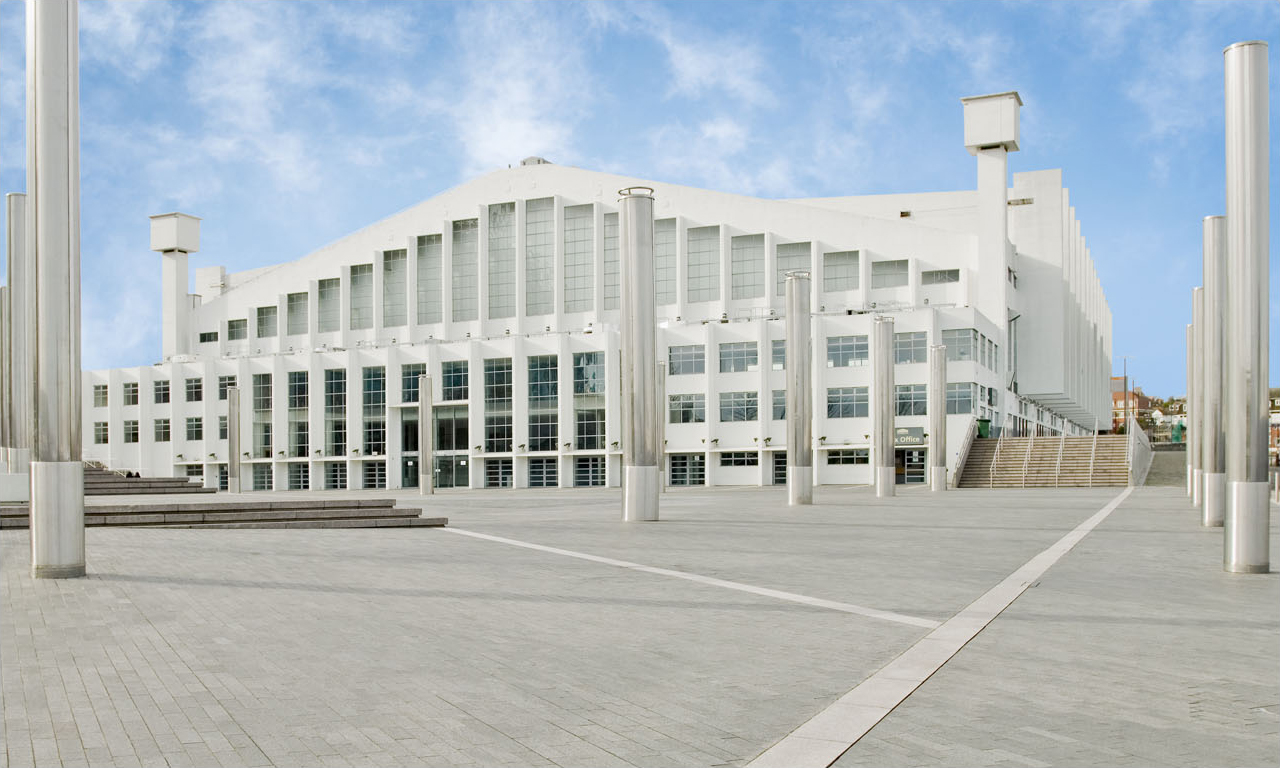
Wembley Arena (/ˈwɛmbli/) (originally the Empire Pool, currently known as OVO Arena Wembley for sponsorship reasons)[2] is an indoor arena next to Wembley Stadium in Wembley, Greater London, England. The 12,500-seat facility is Greater London's second-largest indoor arena after the O2 Arena, and the ninth-largest in the United Kingdom.
Key Information
The Empire Pool (also known as Empire Pool and Sports Arena)[3] was built for the 1934 British Empire Games by Arthur Elvin. As its original name suggested, it was where the games' swimming events were held. The pool was last used for the 1948 Summer Olympics. The modern arena is now used as a venue for music, comedy, family entertainment and sport.
History
[edit]The building was designed by the engineer Sir Owen Williams, without the employment of an architect. Williams built a unique structure, with cantilevers meeting in the middle, thus avoiding the need for internal pillars. He also used high quality concrete, meaning that it has aged far better than many more recent concrete buildings.[4] The building had a reinforced concrete frame of three hinged arches spanning 240 feet (73 m), which was the largest concrete span of any similar structure in the world at that time.[5]: 220–22 [4][6]: 147
Work on the Empire Pool began in November 1933, and it was opened on 25 July 1934 by Prince Henry, Duke of Gloucester. The swimming pool itself was 200 feet (61 m) long and 60 feet (18 m) wide with a removable deck for ice skating. As with the adjacent stadium, construction was supervised by R.J. Fowler, Wembley's chief building inspector.[5]: 138 The end of the building opened up and led to sunbathing terraces and lawns. The sides had 15 massive concrete buttresses and the tops of the ends were glazed with 20 narrow window lights of increasing height from the edges to the centre.[citation needed]
Ice hockey was introduced to the Empire Pool in October 1934.[6]: 148–49
In 1940 the Empire Pool was used to billet several hundred Gibraltarian evacuees who were removed from Gibraltar as the Fortress was extensively reinforced in expectation of heavy Axis attack and possible Invasion.[citation needed]
In October 1976, the Empire Pool was awarded Grade II Listed status, protecting it and recognising it as a building of special architectural interest, technological innovation and virtuosity.[7] On 1 February 1978, the Empire Pool was renamed Wembley Arena.[8]
When the venue was known as the Empire Pool, it hosted the annual NME Poll Winners Concerts during the mid-1960s. Audiences of 10,000 viewed acts like the Beatles, Cliff Richard & The Shadows, the Monkees, the Hollies, Dusty Springfield, Joe Brown & the Bruvvers, and Dave Dee, Dozy, Beaky, Mick & Tich. The individual performances were then finished by a famous personality joining the respective performer on stage and presenting them with their award. The Beatles were presented with one of their awards by actor Roger Moore, and Joe Brown was joined on stage by Roy Orbison who presented him with his own award. These ceremonies were filmed, recorded and later broadcast on television.[citation needed]
Musical acts who subsequently performed there include Led Zeppelin (who played a special two night "Electric Magic" concert during their 1971 Winter Tour; the poster for the event, designed by Steve Hardcastle,[9] sold on the night for 30p,[10] has become a collector's item, fetching over £500 at auction),[11][12] T. Rex (whose Ringo Starr-directed documentary film Born to Boogie is centred on a 1972 concert at the Empire Pool), Genesis, The Faces supported by the Pink Fairies and the New York Dolls (days prior to the death of drummer Billy Murcia), David Bowie, the Rolling Stones, Bon Jovi, INXS, Pink Floyd (who played there on their 1974 British Winter tour and 1977 "In the Flesh" tour), Roxy Music (played two nights there - 17 & 18 October 1975 - on their Siren tour), The Eagles (on their Hotel California 1978 tour), The Electric Light Orchestra played a then record of 8 consecutive nights in 1978, the Grateful Dead, Dire Straits (who played there on their "Brothers In Arms" tour in 1985 (13 consecutive nights) and "On Every Street" tour in 1991), Status Quo, Queen and the Who.[citation needed]
Renovation
[edit]The venue was renovated, along with Wembley Stadium, as part of the early-21st-century regeneration of the Wembley Park area. The arena was closed for fourteen months, starting in February 2005, for a refurbishment costing £35 million; events were moved to a neighbouring temporary 10,000-seat venue, the Wembley Arena Pavilion.[13][14] The new arena opened to the public on 2 April 2006, with a concert by Depeche Mode. The temporary pavilion was moved to Attard, Malta, opening as the permanent Malta Fairs & Conventions Centre in December 2006.[15]
In September 2013, it was announced that AEG Facilities had signed a 15-year contract to operate the arena.[16]

The building was renamed the SSE Arena on 1 June 2014 after energy company SSE plc bought the naming rights to the venue for 10 years.[17] Since early 2022 it has been known as OVO Arena Wembley.[18]
Returning acts
[edit]The Grateful Dead have released recordings of complete shows from 7–8 April 1972 as part of Europe '72: The Complete Recordings. The Grateful Dead also performed at Wembley Arena on 31 October 1990 as part of their fall 1990 European concert tour.[19] Bruce Hornsby accompanied the band for this concert.[20]
A notable attendance record was set in the early 1970s by David Cassidy in his first tour of Great Britain in 1973, when he sold out six performances in one weekend.[21] The experience and the associated mass hysteria was documented in a TV special called "David Cassidy: Weekend At Wembley".[22]
Queen first performed at Wembley Arena from 11 to 13 May 1978 on their News of the World Tour.[23] They would return on 8 to 10 December 1980 on The Game Tour, and in September 1984 on The Works Tour.[24]
ABBA played six sold-out concerts, from 5 to 10 November 1979. The shows were filmed by Swedish television for a documentary which was released in 2004 on DVD as ABBA in Concert.[25] In September 2014 Universal Music released Live at Wembley Arena, featuring most of the concert of 10 November on CD, vinyl LP and digital format. After the tour, the members of the band talked about the warmth of the Wembley audience. "It was like coming home after a couple of nights," said guitarist Björn Ulvaeus.[26] A finale from these concerts, "The Way Old Friends Do", is the closing track on ABBA's seventh studio album, Super Trouper. Vocalist Agnetha Fältskog said it was the vibe from the audience that made the track work so much better as a live performance than as a studio track.[26]
George Dalaras performed a sold-out concert at Wembley Arena on 27 June 1992.[27] It is the biggest Greek concert ever held in United Kingdom. It was a personal initiative of George Dalaras in order to support Cyprus and to promote the Cyprus problem. Among others, Vanessa Redgrave and Georges Moustaki had taken part in the concert.[28]
Tina Turner is the female artist with the most shows, with 25 and with 5 at Wembley Stadium (three in 1996 and two in 2000)[29] Cliff Richard is the male artist with the most number of shows with 61,[30] whereas Status Quo hold the record for a rock band with 45 performances.[31] Irish band Westlife are the pop band with most shows with 28.[32]
2000s
[edit]Christina Aguilera performed there on 2, 3 and 5 November 2003 as part of her Stripped Tour. The shows were filmed and later released as Stripped Live in the U.K. Destiny's Child performed there on 18 and 19 June 2002 as part of her Destiny's Child World Tour. Beyoncé performed there on 10 and 11 November 2003 as part of her Dangerously in Love Tour. Live at Wembley was filmed during these two concerts.[citation needed]
Pearl Jam hold the attendance record for one show, with 12,470 fans at their 2007 gig.[33] Madonna performed at the arena eight times during her Confessions Tour. The Confessions Tour album was filmed during these concerts.[citation needed]
2010s
[edit]On 3 August 2013, Nepathya became the first Nepalese band to perform at the Arena.[34] On 19 December 2015, Nightwish became the first Finnish act to headline the Arena.[35] On 2 April 2016, Babymetal became the first Japanese act to headline the Arena[36] and set the record for the Arena's highest ever merchandise sales.[37]
On 12 November 2017, the 2017 MTV Europe Music Awards ceremony was held at the arena. The event was hosted by Rita Ora and featured performances from Eminem, Demi Lovato, U2, The Killers, Kesha and more.[38] The Queen biopic Bohemian Rhapsody premiered at the Arena on 23 October 2018, in recognition of how Freddie Mercury and Queen gave the iconic Live Aid performance in 1985 at nearby Wembley Stadium.[39] On 17 November 2018, London based DJ Andy C performed a DJ set lasting five hours, the first all night event to take place in the venue's history. The event had sold out in three days six months prior.[40]
On 7, 8 and 9 March 2019, American musical duo Twenty One Pilots performed three shows at the arena as part of The Bandito Tour.[citation needed] On 10 March 2019, Chinese singer-songwriter Joker Xue headlined the arena as part of his Skyscraper World Tour.[41]
2020s
[edit]The 13th Global Siyum HaShas of Daf Yomi took place in January 2020, the largest of its kind in the UK.[42] The second series of BBC One's The Wall was filmed at the venue in 2020.[43][44]
On 17 March 2023, All Time Low filmed their live show Alive at Wembley, which was live streamed and released on vinyl.[45] On 25 October 2023, Critical Role filmed a live show, titled The Mighty Nein Reunion: Echoes of the Solstice, where they played Dungeons & Dragons.[46] It sold out "in less than 6 minutes" with 12,000 tickets.[47] On 19 November 2023, Chinese singer-songwriter Joker Xue returned as part of his Extraterrestrial World Tour.[48] On 21 June 2024, singer-songwriter IU became the first South Korean female soloist to headline the arena as part of her HEREH World Tour.[49] On 11 October 2024, Japanese band One Ok Rock performed at the arena for their Premonition World Tour, giving their largest show in the UK since their debut,[50] with a special appearance from Ed Sheeran.[51]
On 2 March 2025, Korean pop group, Aespa, performed at the arena as part of their "Synk: Parallel Line" tour, making it their second show in London, after their first tour, "Synk: Hyper Line". On 12 March 2025, Hong Kong singer-songwriter and actor Ian Chan, a well known member of Cantopop group MIRROR, will begin the first stop of his "Tears" in My Sight solo concert tour.[52] On 3 May 2025, Norwegian singer-songwriter Aurora performed at the arena for her What Happened to the Earth? tour, giving her biggest solo show in the UK.[53] Fredrik Svabø and Pomme were the opening acts. On 25 May 2025, Philippine pop group BINI performed in the arena as part of the Biniverse World Tour 2025.[54] On 13 December 2025, American pop-punk band Bowling for Soup are set to perform their biggest headline show at the arena, with Wheatus and Punk Rock Factory set to open.[55]
Sporting events
[edit]
Olympics
[edit]During the 1948 Summer Olympics, the venue hosted the Olympic boxing, Olympic diving, Olympic swimming, and Olympic water polo events.[56] The venue hosted Olympic badminton and Olympic rhythmic gymnastics at the 2012 Summer Olympics.[57]
Tennis
[edit]From 1934 until 1990, the Empire Pool / Wembley Arena was the venue for the Wembley Professional Tennis Championships which was a part of the professional Grand Slam from 1927 until 1967.[citation needed]
Cycling
[edit]From 1936 to 1939, the early 1950s and the late 1960s to the late 1970s, the Skol 6-Day cycle race was held there. An indoor velodrome of 166 metres was assembled from sections each September. This was Britain's first indoor velodrome. Top professional riders from the European 6-Day circuit came to London, including Eddy Merckx, Peter Post, Patrick Sercu and many others. British riders such as World pursuit champion Hugh Porter and British Champion Tony Gowland also competed.[citation needed] [58]
Ice hockey
[edit]The Wembley Lions and Wembley Monarchs were two ice hockey teams that used the venue regularly during the 1940s, 1950s, and 1960s, while the London Lions used the venue for a season in the 1970s. Wembley also hosted the British Hockey League play-off finals weekend at the end of each season up until the league's disbandment in 1996. The arena played host to two pairs of NHL preseason games: the Chicago Blackhawks versus the Montreal Canadiens in 1992 and the Toronto Maple Leafs versus the New York Rangers in 1993.[59]
Boxing
[edit]The boxing World Championship bout between then champion Alan Minter and challenger Marvin Hagler, which the latter won, was held at Wembley Arena in 1980. The arena hosted the MF & DAZN: X Series 004 and 007 events for KSI vs FaZe Temperrr and KSI vs Joe Fournier in 2023.[60]
Mixed martial arts
[edit]The arena played host to BAMMA mixed martial arts events on in May 2011 (BAMMA 6), September 2012 (BAMMA 10) and September 2017 (BAMMA 31) as well as UFC on Fuel TV: Barão vs. McDonald, in February 2013.[61]
Other sports
[edit]The Horse of the Year Show was held there from 1959 to 2002. From 1979 to 1983, indoor speedway was held during the winter, with the riders racing on concrete on a 181-yard track[62] Two NBA basketball exhibition matches were played at the arena in1 October 1993, featuring the Atlanta Hawks and Orlando Magic. It hosted the final of the Premier League Darts in 2009 and 2011 as well as the 2010 playoff finals. It also hosted the Masters snooker tournament from 2007 until 2011.[citation needed]
Esports
[edit]The European League Of Legends Championship Series, which is a competitive esports league in the computer game League of Legends, played its round of matches at the arena in 2014.[63] The 2015 League of Legends World Championship quarterfinals took place in the Arena.[64] In September 2018, the playoffs for the FACEIT Major: London 2018 Counter-Strike: Global Offensive Major Championship took place in the arena.[65]
Professional wrestling
[edit]The venue has hosted many professional wrestling events from Joint Promotions, WWE, NXT (TakeOver: London), World Championship Wrestling, World Wrestling All-Stars, Impact Wrestling, Progress Wrestling, and Revolution Pro Wrestling.[66][67]
Square of Fame
[edit]
With the reopening of Wembley Arena in 2006, a "Square of Fame" area has been created in front of the arena. Similar to the Hollywood Walk of Fame, notable Wembley Arena performers are invited to have bronze plaques imprinted with their names and handprints. The first star to have a plaque was Madonna, on 1 August 2006.[68] On 9 November 2006, Cliff Richard added his handprints to the Square. Rick Parfitt and Francis Rossi, of Status Quo, unveiled a plaque, with one of each of their handprints, on 16 December 2006. On 9 January 2007, Kylie Minogue included her handprints, on the final day of the London leg of her Showgirl Homecoming Tour.[citation needed]
Seven time World Snooker Champion Stephen Hendry added his handprints on 21 January 2007. International country superstar Dolly Parton unveiled her plaque, on the final night of her UK tour, on 25 March 2007. Canadian musician Bryan Adams unveiled his plaque, on 10 May 2007, just before his 25th appearance at the venue. Just three days later, singer Lionel Richie was presented with his plaque on 13 May 2007, after another sold-out performance at the arena. Irish boyband Westlife unveiled their plaque on 28 March 2008, after 27 sell-out shows, in the space of 10 years. They have sold 250,000 tickets. All four members, Shane Filan, Nicky Byrne, Kian Egan and Mark Feehily were presented with a cast of their hands, which can also be seen in the Square of Fame. Alice Cooper added his handprints in 2012 as the only solo artist to have headlined at the venue in each of the past five consecutive decades.[69]
Transport
[edit]Wembley Arena is served by Wembley Park station on the London Underground via Olympic Way, and Wembley Central station via the White Horse Bridge.[citation needed]
Train services are operated by Chiltern Railways from Wembley Stadium station to London Marylebone and Birmingham. London Buses routes 92 and 440 stop directly outside the arena. Wembley Central station is located nearby on High Road and is served by London Overground, London Underground, Southern and London Northwestern Railway services.[citation needed]
The onsite parking facility is shared with Wembley Stadium, essentially being the open-air surface parking surrounding the eastern flank of Wembley Stadium and the multistorey car park. These are called Green Car Park and Red Car Park respectively. There is disabled parking available onsite, at the Green Car Park, at a reduced rate but on a first-come, first-served basis.[citation needed]
See also
[edit]References
[edit]- ^ "SSE Arena Address". Archived from the original on 18 June 2017. Retrieved 10 January 2020.
- ^ Carter, Emily (15 February 2022). "Wembley Arena announces name change". Kerrang.com.
- ^ Wembley, The SSE Arena. "The SSE Arena Experience - The SSE Arena, Wembley". www.ssearena.co.uk. Archived from the original on 1 June 2014. Retrieved 8 April 2018.
- ^ a b "The Empire Pool, Wembley – Hurst Peirce + Malcolm". hurstpm.net. Retrieved 30 June 2016.
- ^ a b Hewlett, Geoffrey (1979). A History of Wembley. Brent Library Service.
- ^ a b Knight, Donald R.; Sabey, Alan (1984). The Lion Roars at Wembley.
- ^ "Wembley Arena - Designing Buildings Wiki". www.designingbuildings.co.uk. Retrieved 23 July 2018.
- ^ Wembley Arena 1934–2004 The First Seventy Years. Wembley Arena. 2004. p. 23.
- ^ Jon Bream (2008). Whole Lotta Led Zeppelin. Voyageur Press. pp. 71–72. ISBN 9781616731496.
- ^ Dave Lewis (10 April 2012). Led Zeppelin: A Celebration. Omnibus Press. p. 198. ISBN 9780857128195.
- ^ "Led Zeppelin". Christie's. Archived from the original on 17 November 2023.
- ^ "Wembley Empire Pool – November 20, 1971 / London". Led Zeppelin. 21 September 2007. Archived from the original on 4 February 2022.
- ^ Baldock, Lee (1 March 2005). "Wembley Arena Pavilion opens". LSi Online. Archived from the original on 27 September 2021. Retrieved 23 July 2018.
- ^ "Wembley music venue doors to open". BBC. 20 February 2005. Archived from the original on 23 July 2018. Retrieved 23 July 2018.
- ^ Henry, Chris (9 January 2007). "Arena Structure's supply new venue in Malta". LSi Online. Archived from the original on 26 January 2021. Retrieved 17 September 2018.
- ^ "AEG Facilities to run Wembley Arena". Wembley Arena. 2 September 2013. Archived from the original on 9 September 2013. Retrieved 7 October 2013.
- ^ Sweney, Mark (10 April 2014). "Wembley Arena to be renamed". The Guardian. Retrieved 3 May 2014.
- ^ Carter, Emily (15 February 2022). "Wembley Arena announces name change". Kerrang.com.
- ^ Dodd, D.; Spaulding, D. (2000). The Grateful Dead Reader. Readers on American musicians. Oxford University Press. p. 229. ISBN 978-0-19-972863-3. Retrieved 12 February 2015.
- ^ Sclafani, T. (2013). The Grateful Dead FAQ: All That's Left to Know About the Greatest Jam Band in History. Backbeat Books. p. 282. ISBN 978-1-61713-582-8. Retrieved 12 February 2015.
- ^ "Downfall of the daydream idol David Cassidy". Express.co.uk. 23 August 2013. Retrieved 7 April 2014.
- ^ "David Cassidy - Weekend At Wembley". 23 March 1973. Retrieved 23 October 2018.
- ^ Sexton, Paul (11 May 2020). "Champions Indeed: Queen Arrive At Wembley In 1978 Milestone". uDiscoverMusic. Retrieved 24 November 2020.
- ^ Travers, Paul (21 November 2022). "Queen in talks about final tour with Adam Lambert in 2023". Planet Radio. Retrieved 23 June 2023.
- ^ Carl Magnus Palm, "Bright Lights Dark Shadows" (2002)
- ^ a b Documentary "Words and Music", Polar Music International AB (1980)
- ^ operator (26 June 1992). "Στο Wembley του Λονδίνου". Γιώργος Νταλάρας (in Greek). Retrieved 26 May 2023.
- ^ "The Cavafy Project". www.kavafis.eu. Retrieved 26 May 2023.
- ^ "Search for setlists: Tina Turner wembley arena | setlist.fm". www.setlist.fm. Retrieved 21 March 2017.
- ^ "Search for setlists: cliff richard wembley arena | setlist.fm". www.setlist.fm. Retrieved 21 March 2017.
- ^ "Search for setlists: status quo wembley arena | setlist.fm". www.setlist.fm. Retrieved 21 March 2017.
- ^ "Search for setlists: westlife wembley arena | setlist.fm". www.setlist.fm. Retrieved 21 March 2017.
- ^ "Pearl Jam set new Wembley record". Music Week. 19 June 2007. Retrieved 7 May 2011.
- ^ Amos, Owen (2 August 2013). "Nepalese folk-rock band Nepathya to headline Wembley Arena". BBC News. Retrieved 19 June 2017.
- ^ "Nightwish, gig review: The show stuck rigidly to the established formula". The Independent. 21 December 2015. Retrieved 10 January 2020.
- ^ "6 things we learned at Babymetal's Wembley arena show". 4 April 2016.
- ^ "Babymetal break 2 UK records". 5 April 2016.
- ^ "MTV EMAs 2017 Recap: Shawn Mendes, Ed Sheeran & Camila Cabello Triumph as Eminem Makes Live Comeback". Billboard. 12 November 2017.
- ^ "'Bohemian Rhapsody' to World Premiere at London's Wembley Arena". The Hollywood Reporter. 10 September 2018. Retrieved 10 January 2020.
- ^ "Andy C makes history as all-night-long event at Wembley sells out". Mixmag. Retrieved 10 January 2020.
- ^ "Joker Xue at the SSE Arena, Wembley 10 Mar 2019". Wembley International Hotel. 10 March 2019.
- ^ "London: Thousands Pack Wembley Arena For Siyum HaShas [Videos & Photos]". The Yeshiva World. 7 January 2020. Retrieved 6 November 2020.
- ^ Henry, Grace (2 October 2020). "Danny Dyer hints at shocks for The Wall viewers as show returns for series two". Radio Times. Retrieved 1 November 2020.
- ^ Kanter, Jake (22 May 2020). "'The Wall': Danny Dyer Game Show Poised To Shift Production From Poland To UK Amid Coronavirus". Deadline. Retrieved 1 November 2020.
- ^ "All Time Low Setlist at OVO Arena Wembley, London". setlist.fm. Retrieved 11 May 2024.
- ^ Teh, Cheryl (8 October 2023). "How 8 nerds playing 'Dungeons & Dragons' on Twitch sold out an arena". Insider. Archived from the original on 9 October 2023. Retrieved 9 October 2023.
- ^ Harrop, Oliver (10 November 2023). "Critical Role on breaking their world for art". GamesRadar+. Retrieved 10 November 2023.
- ^ "Joker Xue". OVO Arena. 19 November 2023.
- ^ Arts, View of the (23 June 2024). "IU at OVO Arena Wembley: A Theatrical Musical Feast". View of the Arts. Retrieved 23 June 2024.
- ^ Shepherd, Charles (13 October 2024). "Ohe Ok Rock live at Wembley Arena: A landmark night for Japanese rock with a special appearance by Ed Sheeran". Electric Bloom Webzine. Retrieved 14 October 2024.
- ^ Shepherd, Charles (13 October 2024). "ONE OK ROCK live at Wembley Arena: A landmark night for Japanese rock with a special appearance by Ed Sheeran". Electric Bloom Webzine. Retrieved 20 October 2025.
- ^ Johnson, Laura. "Ian Chan To Bring Tears In My Sight Solo Concert Tour To London's OVO Arena Wembley In March - Stereoboard". Stereoboard.com. Retrieved 16 January 2025.
- ^ Johnson, Laura (6 June 2024). "Aurora Confirms OVO Arena Wembley Show As Part Of What Happened To The Earth? Part 5 European Tour". Stereoboard. Retrieved 6 June 2024.
- ^ "BINI Announce OVO Arena Wembley London Show As Part Of 2025 BINIverse World Tour". Stereoboard. 17 May 2025.
- ^ "Bowling For Soup on X: "And now for some good news.... 13 Dec, 2025 - Bowling For Soup - Wembley Arena!! Holy crap!! This is a literal dream come true!". Twitter. 24 January 2025.
- ^ 1948 Summer Olympic official report. Archived 8 April 2008 at the Wayback Machine pp. 43, 49.
- ^ "profile". London2012.com. Archived from the original on 7 September 2011. Retrieved 7 May 2011.
- ^ "1936 Wembley".
- ^ "NHL overseas history". NHL. Retrieved 29 January 2020.
- ^ Walker, Christopher (14 January 2023). "KSI calls out former UFC star, David Haye opponent, and Jake Paul after stopping FaZe Temper". DAZN. Retrieved 15 January 2023.
- ^ "Renan Barao v Michael McDonald announced for UFC title fight at Wembley Arena | UFC News". ESPN.co.uk. 6 December 2012. Retrieved 20 June 2014.
- ^ "W Tracks".
- ^ "EU LCS heads to London's Wembley Arena!". Archived from the original on 24 May 2014.
- ^ "2015 World Championship venues". Archived from the original on 11 April 2015. Retrieved 9 April 2015.
- ^ Steiner, Dustin (22 February 2018). "FACEIT to Host Next CS:GO Major in London Sept 20-23". Unikrn. Archived from the original on 15 September 2018. Retrieved 22 February 2018.
- ^ "TNA Impact Wrestling To Be Taped For Television Live At Wembley Arena". IMPACT Wrestling. 6 January 2012. Archived from the original on 3 July 2013. Retrieved 23 June 2013.
- ^ "TNA News: TNA announces first international TV taping scheduled for this month". Pro Wrestling Torch. 6 January 2012.
- ^ "Wembley Arena". LiveNation. Archived from the original on 28 September 2007. Retrieved 4 April 2007.
- ^ "Wembley Arena – Americana Hotel London UK - Last Minute Bookings – Special Offers – London Events – Regents Park – Dorset Square". www.americanahotel.co.uk. Archived from the original on 21 May 2018. Retrieved 23 July 2018.
External links
[edit]
Media related to Wembley Arena at Wikimedia Commons
Wembley Arena
View on GrokipediaOVO Arena Wembley, formerly known as Wembley Arena and originally the Empire Pool, is a multi-purpose indoor arena in Wembley Park, London, England.[1][2] Opened on 25 July 1934 as an Olympic-sized swimming pool and sports arena for the British Empire Games, the reinforced concrete structure was designed by engineer Sir Owen Williams.[1][3][4] Repurposed after World War II for concerts and other events, it hosted swimming, diving, boxing, and water polo competitions during the 1948 Summer Olympics.[1] With a seated capacity of 12,500, the venue has established itself as one of the United Kingdom's premier locations for live music, accommodating major artists and sell-out performances since the mid-20th century.[5][6] The arena underwent significant renovations in the 2000s and adopted its current name in 2022 through a sponsorship deal with energy company OVO.[2]
History
Origins and Construction
The Empire Pool was constructed as a multi-purpose venue primarily for aquatic sports, spearheaded by Arthur Elvin, chairman of the Wembley Stadium board, as a speculative investment to complement the adjacent stadium and capitalize on the 1934 British Empire Games.[7] Costing £150,000, the project aimed to host swimming, diving, and other events, reflecting the era's emphasis on imperial sporting spectacles following the British Empire Exhibition of 1924-1925.[7] Designed by structural engineer Sir Owen Williams, the building utilized innovative reinforced concrete construction to create an expansive, column-free interior space suitable for both water-based and dry-floor activities.[8] The pool measured 200 feet in length, with additional features including a wave machine—the first in Britain—and sunbathing terraces, emphasizing functionality and novelty in public recreation.[9] Williams' engineering approach prioritized durability and versatility, allowing the venue to transition between pool and arena configurations.[10] Construction commenced in November 1933, with the foundation stone laid by Lord Derby on 15 February 1934, enabling completion in time for the Games despite the tight schedule.[11] The venue opened on 25 July 1934, officiated by Prince Henry, Duke of Gloucester, just prior to the swimming and diving competitions of the British Empire Games, marking its debut as a key facility in London's sporting infrastructure.[3][9]Early Operations as Empire Pool
The Empire Pool opened on 25 July 1934, constructed specifically to host aquatic and related events for the British Empire Games held from 4 to 11 August 1934.[3] Commissioned by Arthur Elvin and designed by engineer Sir Owen Williams, the venue featured a 200-foot-long by 60-foot-wide swimming pool with depths ranging from a shallow beach to 16.5 feet, holding 700,000 gallons of purified water.[12] [9] It included innovative amenities such as a wave machine generating up to six-foot waves via four pistons, sunbathing terraces accessible from the building's end, a children's pool with a fountain, and 5,000 permanent seats supplemented by 7,500 temporary ones for events.[9] The pool's water was treated every four hours using a chloramine process to maintain luminous clarity, and the structure's 240-foot roof span with glass panels ensured natural lighting without obstructing pillars.[9] During the 1934 Games, the Empire Pool accommodated swimming, diving, boxing, and wrestling competitions, with a temporary 50-yard wall installed in the pool to create a 5.5-foot-deep section for aquatic events.[13] [9] Public access operated from 7 a.m. to midnight until mid-October, after which the facility transitioned to winter use by draining the pool and installing an ice rink above it.[9] Ice hockey debuted on 25 October 1934, supporting teams like the Wembley Lions and Wembley Monarchs, alongside public skating sessions.[14] [15] In subsequent years, the venue maintained dual seasonal operations, hosting national swimming events in 1936 and the European Swimming Championships in 1938, where Germany dominated the medal table.[16] [15] By 1937, the ice rink hosted the British Figure-Skating Championships, reflecting its versatility for winter sports amid decreasing summer pool usage due to competing events at Wembley Stadium.[17] This pattern of aquatic focus in warmer months and ice-based activities in winter defined its early multifunctional role until the outbreak of war in 1939 curtailed operations.[15]Mid-20th Century Developments
Following the 1948 Summer Olympics, where the Empire Pool served as the venue for swimming, diving, and subsequent boxing events after the pool was drained and a temporary floor installed, the facility increasingly prioritized multi-purpose usage over permanent aquatic functions.[18] The pool's last major swimming competition occurred during these Games, after which dry-floor events dominated programming to maximize revenue and adaptability.[19] In the late 1940s and 1950s, ice hockey emerged as the primary activity, with the Wembley Lions and Wembley Monarchs professional teams holding regular home games and drawing large crowds, including a peak membership of 61,000 for the Lions supporters' club in 1948.[20] [19] Ice skating spectacles, such as annual shows featuring professional performers, and exhibitions by the Harlem Globetrotters basketball team further established the venue's role in winter sports and family entertainment.[19] Boxing bouts remained a staple, with international matches like John Caldwell's 1960 outpoint victory over Finnish champion Risto Luukkonen exemplifying the arena's growing prominence in combat sports.[21] By the late 1950s, the introduction of music events signaled diversification, including the first major concert, "The Record Star Show," on April 25, 1959, which featured emerging pop acts and foreshadowed the venue's shift toward broader entertainment programming.[22] These developments reflected post-war economic recovery and demand for accessible spectator sports, without significant structural alterations to the original 1934 design.[19]2000s Renovation and Regeneration
The Wembley Arena underwent a major refurbishment beginning in February 2005, closing for 14 months while events were temporarily relocated to a 10,000-seat structure on adjacent land.[1][23] The project, costing £35 million, included a complete reorientation of the main entrance by 180 degrees to face the newly constructed Wembley Stadium and the emerging Arena Square, creating a triple-height façade that enhanced visibility and integration with the surrounding public space.[1][24][25] Key upgrades encompassed aesthetic restorations evoking the venue's original Art Deco style, alongside functional improvements such as non-slip flooring, enhanced lighting, and hearing loops for accessibility.[26][27] Capacity expansions formed a core element of the works, raising seated attendance from 10,500 to over 12,000 and standing capacity from 3,600 to 5,000, thereby accommodating larger crowds for concerts and events.[26][28] The arena reopened in April 2006 with these enhancements, coinciding with the final phases of Wembley Stadium's reconstruction, which had begun demolition in 2003 and completed in 2007 at a cost exceeding £750 million.[1][29] This refurbishment was executed by Quintain Estates and Development, which acquired surrounding land in 2002 to spearhead the broader regeneration of Wembley Park—a 34-hectare area transforming post-industrial terrain into a mixed-use district with residential towers, retail outlets, and public realms.[22][30] The arena's upgrades, including the creation of Arena Square (formerly the 'Square of Fame') as a community hub honoring performers, aligned with Quintain's masterplan to foster year-round vibrancy, complementing over £1 billion in investments that by the late 2000s laid groundwork for thousands of new homes and improved transport links.[1][22] Quintain's efforts, in partnership with Brent Council and the Football Association, addressed longstanding urban decay around the site, positioning the arena as a cultural anchor amid preparations for the 2012 London Olympics, where it hosted badminton and other events.[30][31]Operations in the 2010s
In 2012, Wembley Arena hosted badminton and rhythmic gymnastics events during the London Summer Olympics, utilizing its post-renovation configuration to accommodate up to 12,500 spectators for these competitions.[32][33] The venue's selection for these sports reflected its versatility for indoor multi-sport events, with badminton matches spanning singles and doubles formats across men's, women's, and mixed categories from July 28 to August 4, and rhythmic gymnastics from August 9 to 12.[32] The arena maintained robust operations as a premier entertainment hub throughout the decade, featuring high-profile concerts, sports fixtures, and family shows amid the broader Wembley Park regeneration.[22] On June 1, 2014, it adopted the name The SSE Arena, Wembley under a 10-year naming rights deal with energy firm SSE plc, which included enhancements to optimize facilities while preserving the structure's historic elements.[34][35] This sponsorship supported operational upgrades, such as improved audience amenities, contributing to sustained high occupancy rates. By 2018, the venue achieved its peak performance, welcoming over 1 million attendees across diverse programming, including landmark music tours and sporting spectacles, underscoring its economic significance with estimated footfall driven by sold-out calendars.[36] Operations emphasized efficient event turnaround, leveraging the 2006 refurbishment's legacy for acoustics and layout to host international acts without major interruptions.[7]Developments in the 2020s
In February 2022, the arena, formerly the SSE Arena Wembley, was rebranded as OVO Arena Wembley under a naming rights agreement with OVO Energy, the UK's third-largest energy supplier. This partnership emphasized sustainability goals, including funding for carbon-reduction initiatives and environmental enhancements to support a transition toward a carbon-free future.[37][38][39] Ownership of the venue changed hands in September 2022 when Quintain, the previous developer and asset manager, sold OVO Arena Wembley to Intermediate Capital Group (ICG), a global alternative asset manager. The transaction marked a shift in investment focus while maintaining operations under ASM Global.[40] Sustainability efforts advanced with the arena achieving Greener Arena certification in December 2022, recognizing reductions in emissions through measures like 100% renewable energy usage and resource optimization, without compromising event quality. These initiatives aligned with OVO Energy's broader environmental commitments and included annual accreditation processes for ongoing improvements.[41][42] By 2025, enhancements to premium facilities continued, with the introduction of the Coors Lounge in April, providing upgraded seating, private bars, and exclusive access to elevate attendee experiences during events. Additional upgrades to hospitality areas, such as improved lounges and connectivity, supported post-pandemic recovery and operational efficiency.[43][44][45]Architecture and Facilities
Original Engineering and Design
The Empire Pool, later known as Wembley Arena, was engineered by Sir Owen Williams as a multi-purpose aquatic venue for the 1934 British Empire Games, with construction commencing in November 1933 and completion in just nine months.[7][15] Williams, a pioneering structural engineer specializing in reinforced concrete, designed the facility without an architect's involvement, emphasizing functional efficiency and innovative spanning techniques.[7][46] The structure featured a reinforced concrete frame supporting a vast main hall configured as a three-hinged arch spanning 72 meters, which formed the core of the pool enclosure and allowed for unobstructed views and versatile event hosting.[46] The roof, comprising three hinged arches with a total span of 240 feet (approximately 73 meters), represented the widest reinforced concrete span in the world at the time of construction, stiffened by integrated planes of concrete to enhance rigidity without additional supports.[7][46] This design incorporated concrete counterweights at the truss ends to counterbalance loads and ensure stability, showcasing Williams' expertise in concrete's tensile and compressive properties for large-scale enclosures.[47] The pool itself was engineered as the world's largest at the time, measuring approximately 200 feet in length to accommodate swimming, diving, and water polo events, with auxiliary spaces including changing rooms, restaurants, and floodlit facilities for evening competitions.[7][46] The reinforced concrete construction provided durability against water exposure and seismic considerations inherent to expansive spans, while the Art Deco aesthetic integrated streamlined forms that aligned with contemporaneous modernist engineering trends.[48][49] The venue opened on 25 July 1934, hosting its inaugural events successfully and demonstrating the viability of Williams' monolithic concrete approach for indoor aquatic infrastructure.[9]Capacity, Layout, and Acoustics
The OVO Arena Wembley maintains a maximum capacity of 12,500 for fully seated events, positioning it as Greater London's second-largest indoor arena.[5] [6] This figure reflects configurations that include tiered seating and a central floor area adaptable for standing audiences during concerts, where capacity can exceed seated limits through general admission pits.[50] Prior to the 2005–2006 renovation, the venue accommodated around 11,500 spectators; the refurbishment expanded seating while preserving the circular footprint, though final adjustments settled at 12,500 rather than the initially projected 13,400.[51] The layout centers on an oval-shaped arena floor, approximately 100 meters in circumference, surrounded by three tiers of seating: lower blocks (e.g., N1–N20), mid-tier levels, and upper balconies providing elevated views.[52] For seated events, the floor transforms into blocks A–D with rows numbered sequentially, while end-stage setups prioritize central sightlines from blocks like A2–A4 nearest the performance area.[53] Premium options, such as Empire Seats in lower rows of blocks N5, N7, and N9, offer wider cushions and proximity to stages, enhancing comfort for high-demand shows.[54] Flexible rigging points and modular barriers allow reconfiguration for diverse formats, from basketball courts to theater-style raked seating, with load-in via multiple docks supporting rapid event turnarounds.[55] Acoustics rely on venue-wide systems from manufacturers like L-Acoustics, including KIVA II line arrays, KS21 subwoofers, and immersive L-ISA configurations for spatial audio in select productions.[56] These setups aim for even coverage across the 12,500 seats, with under-balcony fills and ground stacks mitigating dead zones in the tiered design. Event-specific enhancements, such as Martin Audio Wavefront arrays or Funktion-One for electronic music, have been deployed for clarity and bass response.[57] [58] Audience feedback varies, with praise for immersive experiences in optimized shows but frequent criticisms of echoing vocals, overpowering low-end frequencies, and inconsistent intelligibility, particularly in bass-heavy genres or when house systems interact with venue reverberation.[59] [60] These issues stem from the arena's rigid concrete structure, originally engineered for aquatics rather than optimized reverberation control, though post-renovation damping materials have improved baseline performance.[61]Modern Upgrades and Sustainability
The OVO Arena Wembley has implemented targeted upgrades to enhance premium guest experiences, including the launch of the Coors Lounge in April 2025, which features plush seating, a dedicated bar, and a memory wall honoring the venue's musical legacy to provide elevated access during events.[62][43] Concurrently, improvements to Empire Seats were introduced in 2025, focusing on upgraded comfort for long-duration shows.[63] Further enhancements encompass expanded premium lounge capacities and connectivity upgrades to support high-demand event internet usage, ensuring reliable digital services for modern productions.[44][45] Sustainability efforts emphasize carbon reduction and operational efficiency, with the arena securing Greener Arena certification at the "Improvers" level via the Alliance for Green Arenas framework following an eight-month audit process completed in December 2022; this recognizes proactive measures in emissions cuts and resource management, notable for the UK's oldest operational arena.[42][41][64] The venue runs on 100% renewable energy and continues LED lighting retrofits across facilities to lower consumption, contributing to its status as having the lowest embodied carbon footprint among UK arenas.[65][42] Waste minimization includes onsite recycling stations and policies urging visitors to reduce single-use items, while partnerships with OVO Energy under its Plan Zero initiative fund targeted decarbonization projects.[42][66] These initiatives integrate with broader Wembley Park regeneration goals, prioritizing verifiable environmental gains over symbolic gestures.[67]Ownership and Management
Historical Ownership Changes
The Empire Pool, opened on July 25, 1934, for the British Empire Games, was developed under the direction of Arthur Elvin, who served as chairman of the Wembley Stadium and Greyhound Racecourse Company following its 1927 acquisition of the site; the pool and arena functions were integrated into the broader Wembley complex owned by this entity and its successors, including Wembley plc after the stadium's 1999 sale to the Football Association.[7][68][69] In August 2002, Quintain Estates and Development plc purchased Wembley Arena along with 44 acres of adjacent exhibition land and conference facilities from Wembley plc for £48 million, initiating a major regeneration of the Wembley Park area that included significant upgrades to the venue.[70][69][71] Quintain retained ownership through a 2013 management transition to AEG Facilities (later ASM Global) and a 2015 acquisition of Quintain itself by Lone Star Funds for £700 million, which supported further investments but preserved the arena under Quintain's direct control.[72][73] On September 7, 2022, Quintain completed the sale of the arena—by then rebranded as OVO Arena Wembley—to Intermediate Capital Group (ICG), a private equity firm, for a reported value of up to £50 million, marking the venue's transfer to new investment ownership amid ongoing Wembley Park development.[71][74]Current Operator and Sponsorship Deal
ASM Global serves as the current operator of OVO Arena Wembley, handling day-to-day management, event booking, and sustainability initiatives in partnership with the naming rights sponsor.[38][75] The venue's ownership transferred to Intermediate Capital Group (ICG) in September 2022 following its sale by Quintain, the prior developer and asset manager of the surrounding Wembley Park area.[71] The primary sponsorship deal is with OVO Energy, a UK energy supplier, which secured naming rights on February 15, 2022, rebranding the venue as OVO Arena Wembley to align with goals for greener live events, including support for ASM Global's decarbonization efforts.[76][38] This partnership emphasizes energy efficiency and sustainability, though specific financial terms and duration remain undisclosed in public announcements.[77] Additional partnerships, such as the March 2025 agreement with Molson Coors for a dedicated lounge, supplement but do not supersede the OVO naming rights.[78]Role in Wembley Park Regeneration
The renovation of Wembley Arena, undertaken by developer Quintain between 2005 and 2006 at a cost exceeding £30 million, formed a pivotal component of the broader Wembley Park regeneration initiative, which sought to transform a post-industrial area into a mixed-use urban neighborhood surrounding the newly rebuilt Wembley Stadium.[79] This upgrade preserved the venue's Grade II-listed structure, including the original 1934 Empire Pool beneath the floor, while modernizing facilities to enhance its capacity for concerts and events, thereby positioning it as an anchor attraction to draw consistent visitor footfall and stimulate adjacent commercial and residential development.[79] Quintain, which acquired significant land holdings in the area starting in 2002, integrated the arena into its masterplan for an 85-acre site featuring over 7,000 homes, retail outlets, and public parks, with the venue's operational continuity ensuring economic viability for these expansions. As a high-profile entertainment hub hosting upwards of 100 events annually and attracting millions of attendees, Wembley Arena—rebranded as OVO Arena Wembley in 2022—has driven measurable economic uplift in Wembley Park by generating spillover demand for local amenities, including the London Designer Outlet and nearby hospitality venues, which collectively support job creation estimated at over 10,000 positions in the vicinity.[80] This footfall, peaking during major concerts by artists such as Taylor Swift in 2018 and subsequent tours, has justified Quintain's cumulative investment exceeding £2 billion by 2023, fostering a self-sustaining ecosystem where event-driven revenue bolsters property values and retail occupancy rates above 95%.[80] Independent analyses, such as those from the Urban Land Institute, highlight the arena's synergy with the stadium in catalyzing private-sector funding, reducing reliance on public subsidies beyond initial infrastructure grants from the Greater London Authority.[31] Critics of the regeneration, including local community groups, have noted challenges such as increased housing costs and displacement pressures, attributing these partly to the arena's role in elevating land values without proportional affordable housing delivery in early phases, though Quintain reports over 30% affordable units in later developments.[81] Nonetheless, Brent Council's assessments affirm the arena's net positive impact, with regeneration metrics showing a 20% rise in local employment and improved public realm connectivity via enhanced transport links to Wembley Park station.[82] By 2025, the venue's sustainability upgrades, including 100% renewable energy usage certified under the AGF Greener Arena scheme in 2022, align with Wembley Park's low-carbon goals, further embedding it as a model for event-led urban renewal.[42]Hosted Events
Music Concerts and Performances
Wembley Arena has hosted music concerts since 1959, when Shirley Bassey performed the inaugural event at the then-Empire Pool to an audience of 9,000.[83] This marked the beginning of a storied legacy in live music, transforming the multi-purpose venue into a key stop for international tours.[1] Early highlights included The Beatles' final scheduled UK performance on 1 May 1966 during the NME Poll Winners' concert, drawing over 10,000 fans before a crowd exhibiting disruptive behavior that influenced the band's retreat from live touring.[84] Subsequent decades saw rock and pop icons like Queen, who debuted there from 11 to 13 May 1978 on their News of the World Tour, and ABBA, who played six sold-out shows from 5 to 10 November 1979.[85][5] The 1980s and 1990s amplified the arena's prominence with residencies from artists such as Tina Turner, who holds the record for most performances by a female artist, and Sir Cliff Richard, the male record-holder with 37 shows.[5] Performances by Michael Jackson, U2, Bruce Springsteen, Oasis, and Spice Girls underscored its status as a testing ground for major acts, often serving as a precursor to stadium tours.[1] In the 2000s and beyond, the venue continued attracting global stars including Prince, Take That, and Adele, maintaining capacities around 12,500 while adapting to modern production demands.[1] Its acoustics and central London location have made it a staple for sold-out runs, contributing to over 150 million attendees across its music history.[5]Sporting Competitions
Originally opened as the Empire Pool in 1934, the venue hosted swimming, diving, boxing, and wrestling at the British Empire Games that year.[86] It later served as the primary site for aquatic competitions during the 1948 Summer Olympics, including swimming events from 30 July to 7 August with 249 competitors from 34 nations across 11 events, as well as diving and water polo.[87] After these aquatics, the pool was drained to accommodate boxing bouts for the remainder of the Games.[18] In the 2012 Summer Olympics, Wembley Arena hosted badminton competitions from 28 July to 5 August, featuring high-profile matches such as Lin Dan versus Lee Chong Wei in the men's singles final.[88] The venue also staged rhythmic gymnastics events during the Games. Beyond the Olympics, the arena has been a longstanding hub for indoor sports, regularly hosting professional boxing matches, ice hockey games for teams like the Wembley Lions, basketball events including British Basketball League finals and exhibitions by the Harlem Globetrotters, and professional wrestling bouts.[89] It has also featured other competitions such as snooker tournaments, darts championships, netball, and indoor athletics meets.[90]Other Entertainment and Competitions
The OVO Arena Wembley has hosted prominent stand-up comedy performances, including Lee Evans' Wired and Wonderful on November 9, 2002, marking the first solo comedy show at the venue with a runtime exceeding two hours excluding intermission.[91] Eddie Izzard delivered four sold-out shows in 2009, drawing a cumulative audience of 44,000 spectators.[92] More recent events feature Ricky Gervais' Mortality tour dates starting October 31, 2025, and Jimmy Carr's Laughs Funny on December 19, 2025, continuing the arena's role in large-scale comedy productions.[93][94] Professional wrestling events have been staged regularly, with WWE conducting major shows such as Insurrextion 2002 on May 4, 2002, alongside TV tapings like RAW on October 8, 2004, and a SmackDown event on April 21, 2006.[95] TNA Wrestling has utilized the venue for tours, including iMPACT! Wrestling on January 28, 2012, while Revolution Pro Wrestling announced its 14th anniversary show for August 29, 2026, emphasizing British and international talent.[96][97] Family entertainment includes ice skating productions tied to the arena's origins as the Empire Pool, which featured ice rinks and pantomimes post-1934 opening.[98] Disney on Ice has held multiple runs, such as Magical Ice Festival from February 20-23, 2025, and Into the Magic from March 25-29, 2026, accommodating children under 2 on laps for free.[99][100] Stunt-based shows like Hot Wheels, scheduled for October 2025 starts, add to diverse non-musical programming.[101]Cultural Impact
Notable Records and Achievements
Cliff Richard holds the record for the most performances by any artist at Wembley Arena, with at least 62 shows as of 2009 and reports of over 70 total appearances including support slots by 2007.[102][103] In April 2002, Jamiroquai's two-night stand broke the venue's attendance record through a reconfiguration of seating that increased capacity beyond the standard layout, drawing sell-out crowds for the band's A Funk Odyssey tour.[104] Opened in 1934 as the Empire Pool, the arena achieved a milestone as the world's first indoor pool to host international competitions, debuting at the British Empire Games and later serving as a key venue for the 1948 Summer Olympics, where it accommodated swimming, diving, water polo, and boxing events with capacities exceeding 4,000 spectators.[7][1] ABBA's six consecutive sold-out concerts from November 5 to 10, 1979, underscored the arena's prominence in pop music history, attracting over 75,000 fans during the band's Voulez-Vous tour era.[105] In 1989, Level 42's live performance broke the then-current attendance record, as documented in their album Live at Wembley, recorded during a high-demand show that filled the venue to its limits.[106]Legacy in Entertainment History
Wembley Arena, initially constructed as the Empire Pool and opened on July 25, 1934, pioneered large-scale indoor entertainment in the United Kingdom by evolving from a multi-sport facility into a premier venue for music concerts and live performances.[1] Its rapid nine-month build by 800 workers established it as an engineering feat, enabling year-round events that bypassed weather constraints typical of outdoor stadiums.[1] This adaptability positioned it as a foundational hub for the growth of rock and pop concerts during the mid-20th century, when indoor arenas were scarce in Europe.[19] The venue's entry into music history began with "The Record Star Show" on an unspecified date in 1959, followed by Shirley Bassey as the first major solo musical act that year, signaling its shift toward entertainment beyond aquatics and ice sports.[22][19] By the 1960s, it hosted the NME Poll Winners Concerts annually, showcasing emerging icons including The Beatles in their last scheduled live performance on May 1, 1966; The Rolling Stones; and The Who, which helped define the era's youth culture and amplified the venue's status as a rite of passage for international acts touring Britain.[1] In the 1970s, extended residencies like Pink Floyd's nine consecutive nights exemplified its suitability for progressive rock spectacles, while acts such as T. Rex achieved sell-out doubleheaders on March 18, 1972—the second instance of such feats at the venue—highlighting its commercial viability for high-demand artists.[1][107] The 1980s brought performances by David Bowie, Tina Turner, and Bob Dylan, cementing its role in global tours, followed by 1990s records like Boyzone's 20 shows and Take That's 15, which underscored its influence on pop residencies.[1] Refurbishments, including a £35 million upgrade completed in 2006, have sustained its legacy as one of Europe's busiest arenas, with over a century of adaptations ensuring it remains a benchmark for production standards, artist handprints in the Arena Square, and cultural milestones in live entertainment.[1] This evolution reflects causal drivers like technological advances in staging and audience demand for intimate yet massive-scale experiences, rather than transient trends, fostering an unbroken chain of historic events.[1]

