Hubbry Logo
Matka CanyonMatka CanyonMain
Open search
Matka Canyon
Community hub
Matka Canyon
logo
8 pages, 0 posts
0 subscribers
Be the first to start a discussion here.
Matka Canyon
Matka Canyon
from Wikipedia
Matka Canyon

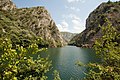
Matka (Macedonian: Матка; Albanian: Matkë) is a canyon located west of central Skopje, North Macedonia. Covering roughly 5,000 hectares,[1] Matka is one of the most popular outdoor destinations in North Macedonia and is home to several medieval monasteries. The Matka Lake within the Matka Canyon is the oldest artificial lake in the country.[2]

Geology

[edit]
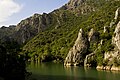
View from above

There are ten caves at Matka Canyon, with the shortest in length being 20 metres (65.6 feet) and the longest being 176 metres (577.4 feet). The canyon also features two vertical pits, both roughly extending 35 metres (114.8 feet) in depth.[1]

Vrelo Cave

[edit]
Vrelo Cave in Matka Canyon

Located on the right bank of the Treska River, Vrelo Cave was listed as one of the top 77 natural sites in the world in the New7Wonders of Nature project.[3]

Vrelo Cave has many stalactites including a large one in the middle of the cave known as the "Pine Cone" due to its shape. There are two lakes at the end of the cave, with one larger than the other. The smaller lake is 8 metres (26.2 feet) at its longest length and 14.92 metres (48.9 feet) in depth at its deepest point. The larger lake is 35 metres (114.8 feet) at its longest length, and 18 metres (59 feet) at its deepest point.[4]

Though the exact depth of the cave is unknown, it is believed to be among the deepest in Europe and/or the world.[5][6]

Biology

[edit]

Matka Canyon is home to a wide variety of plants and animals, some of which are unique to the area. Roughly 20% of the plant life found at Matka is endemic and only found there. The canyon is also home to 77 indigenous species of butterfly, in addition to the most venomous snake in south Europe, the horned viper. [7] The canyon's caves are home to large populations of bats.[8]

Attractions

[edit]

Due in large part to its proximity to Skopje, Matka Canyon is a popular destination for citizens and tourists. The canyon is one of North Macedonia's foremost areas for alpine hiking. The climbing season begins around Easter and ends in November. Kayaking on the Treska River is a popular activity, as are fishing, hunting, and swimming.[7]

Monasteries

[edit]
St. Andrew's Monastery on the water

The canyon area is home to several historic churches and monasteries. St. Andrew's Monastery, founded around 1388 by Prince Marko's brother Andrew, is situated in the gorge of the Treska River.

Matka Monastery, or Monastery of the Holy Mother of God, built in the 14th century,[9] is located on the left bank of the Treska. According to an inscription on the church, someone named Milica found the church in poor condition and without a roof in 1497. She replaced the roof, added new frescoes, built a portico and created a vineyard.

St. Nicholas Šiševski Monastery is located on a cliff above the canyon and St. Andrew's Monastery. The date of construction of the church is unknown. The first mention of it was in the 17th century, during Ottoman rule. The iconstasis of the church was painted in 1645, while the western side was frescoed in 1630. The monastery was deserted in the 18th century. An archmonk found the church roofless in 1816 and attempted to revive it, though it was again deserted in 1897. The monastery offers a unique view high above the canyon.

[edit]

See also

[edit]

References

[edit]
Revisions and contributorsEdit on WikipediaRead on Wikipedia
from Grokipedia
Matka Canyon is a deep gorge in , located approximately 15 kilometers southwest of the capital city along the Treska River, a right tributary of the River. Covering an area of around 5,000 hectares, it features dramatic cliffs, formations, and an artificial lake formed by the Matka Dam, constructed in 1938 as the country's first hydroelectric power station and the oldest artificial lake in . The canyon's morphology is characterized as a breakthrough gorge with significant features, including ten accessible caves ranging from 20 to 176 meters in length and two precipices up to 35 meters deep, making it a prime site for and . Notable among these is Vrelo Cave, an underwater cavern explored to depths exceeding 200 meters (with recent dives reaching up to 230 meters as of October 2025), recognized as one of Europe's deepest caves. The area also hosts the "Jovica Grozdanovski" Speleological Park, encompassing caves such as Ubava and Krstena, and supports rich with around 1,000 plant —20% of which are endemic or relict, including rare flora like Viola kosaninii and Ramonda nathaliae—as well as diverse fauna, such as 119 of diurnal and numerous endemic . Historically, Matka Canyon served as a refugial center during the glacial periods, preserving unique ecosystems, and later became a for early , ascetics, and revolutionaries fleeing Ottoman rule, leading to the establishment of several medieval monasteries perched along its cliffs. Key religious sites include the 14th-century Church of Sveti Andrej, built in 1389 with preserved frescoes, and the Sveta Bogorodica Monastery, featuring a with 16th-century frescoes and remnants of a 6th-century church. Today, the canyon is a major destination, offering activities like on the jade-green lake (rentals starting at 300 MKD per hour), tours to caves, along cliffside trails, and on alpinist routes, all while providing serene spots for picnicking amid its natural and .

Geography

Location and Access

Matka Canyon is situated in the Matka Valley of , approximately 15 kilometers southwest of the capital city, , within the Saraj Municipality. Its geographical coordinates are roughly 41°58′N 21°18′E. The canyon forms a deep gorge along the Treska River, a right of the River, and encompasses an area of about 5,000 hectares. It is bordered by low mountain ranges, including the mountain to the southeast. Access to Matka Canyon is straightforward and primarily facilitated by road from , taking about 20 to 30 minutes by car via the route passing through the Saraj area, following signs toward Treska Lake and the Matka gorge. Public transportation options include bus number 60, which departs from Skopje's main and reaches the canyon entrance in approximately 50 minutes, with tickets costing around 50 Macedonian denars (about €0.80). For those preferring non-motorized access, hiking trails connect from nearby villages such as Dolna Matka, offering scenic approaches through the surrounding terrain. Parking at the main is free and ample, though it can fill up on weekends; there is no entry fee to the canyon itself. The Treska River plays a key role in defining the canyon's dramatic landscape, carving through the to create its steep walls and accessible entry points.

Physical Features

Matka Canyon is formed by the Treska River, a 138 km long waterway that originates in the Stogovo Mountains and flows as a right tributary into the River near , carving a narrow gorge through the landscape. The river's path creates a breakthrough gorge spanning approximately 9 km from the Matka Dam to the subsequent Matka 2 accumulation, with steep walls that reach up to 120 meters in places. The canyon's central feature is Matka Lake, North Macedonia's oldest artificial reservoir, constructed in 1938 by damming the Treska River primarily for hydroelectric power generation and . The lake stretches about 7 km along the gorge, with a maximum depth of around 29 meters and a narrow profile that supports its role in energy production. The topography of Matka Canyon features steep limestone cliffs that rise dramatically on both sides of the Treska River, forming a confined that occasionally widens into broader sections suitable for settlements and access points. The slopes are covered in dense mixed forests, predominantly species such as and , interspersed with coniferous elements, contributing to the area's lush, verdant appearance. The overall canyon spans roughly 5,000 hectares, encompassing a karst-dominated with prominent vertical features. The climate in Matka Canyon is continental with Mediterranean influences, characterized by mild winters and warm summers, an average annual of about 12°C, and totaling around 515 mm per year, which fosters the region's supportive vegetation cover.

Geology

Formation and Rock Formations

Matka Canyon originated from tectonic processes associated with the in the Balkan Peninsula, where uplift during the period ( to ) elevated the terrain in the zone, setting the stage for subsequent . This uplift, part of the broader collision between the African and Eurasian plates, exposed older sedimentary layers and facilitated the development of the canyon's dramatic relief. The canyon's bedrock consists predominantly of limestones, including and formations, interspersed with marbles and minor dolomite layers that characterize the landscape. These soluble rocks have undergone extensive dissolution by acidic over millions of years, contributing to the formation of jagged profiles and subsurface features. Erosional development was driven primarily by the Treska River's fluvial incision during the period, carving a deeply incised breakthrough gorge through differential uplift rates of 1-2 mm per year. This process was intensified by Pleistocene glacial meltwaters that increased river discharge and abrasive power, while regional fault lines along the zone enhanced vertical incision and localized the gorge's steep walls. Prominent surface features include sheer vertical limestone cliffs, expansive overhangs formed by undercutting, and talus slopes accumulated from rockfalls. Evidence of historical seismic activity is evident in fractured bedrock and tectonic waterfalls within the Treska valley, reflecting ongoing neotectonic influences in the region.

Caves and Karst Phenomena

Matka Canyon features a diverse array of cave systems shaped by its underlying topography, primarily composed of marbles and limestones that cover approximately 11.9% of North Macedonia's terrain. These formations host over ten documented caves, ranging in length from 20 to 176 meters, including both dry and underwater types such as Ubava, Krstena (also known as Krštalna), Chebre, and the prominent Vrelo Cave. The dry caves, like Ubava and Krstena, are accessible on foot and exhibit classic dissolution features resulting from prolonged water percolation through soluble bedrock. Vrelo Cave stands out as a siphon-type underwater cave, recognized as one of Europe's deepest, with its accessible large lake reaching 18 meters in depth. The cave's lower levels, flooded due to the damming of the Treska River creating Matka Lake, include a water-filled passage highlighting the hydrogeological connectivity of the . Speleothems within Vrelo, such as the notable 3-meter-high "Pine Cone" and surrounding stalactites, formed through the deposition of from dripping , exemplify the canyon's active processes. Similar formations, including intricate stalactites and stalagmites, adorn the interiors of Chebre and other nearby caves, contributing to their scenic and scientific value. Broader phenomena in the canyon include sinkholes, underground rivers, and poljes, which reflect the dissolution of rocks over millennia and support resources critical to the region's . These features, part of North Macedonia's estimated 400–500 cavities, demonstrate ongoing landscape evolution influenced by fluvial erosion and tectonic uplift in a deeply incised gorge. Exploration of the canyon's caves began in the mid-20th century, with Vrelo Cave developed for partial tourist access in 1998 and opened as a in 2000, allowing guided visits to 180 meters of its passages. Significant speleological advances occurred through diving expeditions, including Italian diver Luigi Casati's 2010 penetration to a depth of 212 meters using technology, revealing flooded chambers and further potential for discovery. Subsequent dives, such as those by Polish explorer Starnawski in 2017, extended records and underscored the cave's unexplored extents. In October 2025, Polish divers further advanced exploration to a depth of 287 meters, establishing Vrelo as the deepest underwater cave in the as of November 2025. Geologically, these caves preserve evidence of ancient aquifers and offer paleoenvironmental records through datable paleobiota and layers, providing insights into past climatic and hydrological conditions in the . The systems also host unique troglobitic ecosystems, emphasizing their role in broader environmental and conservation efforts.

Biodiversity

Flora

Matka Canyon is renowned for its rich botanical diversity, hosting approximately 1,000 species that constitute about 29% of North Macedonia's total of around 3,500 species. Roughly 20% of these plants are endemic or species unique to the , highlighting the canyon's status as a key center of in the region. This diversity is supported by the canyon's varied microhabitats, including steep cliffs that provide refugia for specialized . The vegetation is organized into distinct zones reflecting elevation and moisture gradients. Along the Treska River, riparian forests feature moisture-loving trees such as willows (Salix spp.) and poplars ( spp.), forming dense curtain-like stands on sandy-clay soils. Mid-slope areas are dominated by forests of oaks (Quercus spp.) and European (), which thrive in the canyon's temperate conditions and contribute to the area's lush canopy. At higher elevations, coniferous elements like pines (Pinus spp.) and junipers (Juniperus spp.) appear, adapted to rockier, wind-exposed terrains. Overall, the canyon encompasses over 15 distinct plant communities, ranging from thermophilous oak woods to rocky shrublands. Among the notable species are Balkan endemics such as Natalie's ramonda (Ramonda nathaliae), a tertiary relict with pink flowers that clings to damp cliff faces, and Kosanin's violet (Viola kosaninii), a delicate perennial found in shaded understories. The Macedonian birthwort (Aristolochia macedonica), an endemic vine, grows along steep slopes within shrub communities, while medicinal herbs like yellow gentian (Gentiana lutea) occur in meadows, valued for its bitter roots used in traditional remedies. Orchids, including species from genera like Dactylorhiza, bloom in open grassy areas, adding to the floral spectacle. Plant adaptations in the canyon emphasize resilience to the rugged environment. On exposed cliffs, drought-resistant shrubs such as those in the and Mathiola genera feature thick leaves and deep roots to conserve water amid low humidity and high insolation. Flowering peaks in spring and summer, when increased rainfall supports bursts of color from geophytes and annuals in meadows and edges, before drier conditions prevail.

Fauna

Matka Canyon harbors a rich diversity of animal life, functioning as an exclusive refugium for numerous species that survived the Pleistocene era, including through its varied habitats of forests, rivers, and caves. The canyon supports significant populations, particularly , with 119 of diurnal recorded, of which 77 are Balkan endemics, alongside 140 of nocturnal ; these thrive in the area's microhabitats and contribute to pollination and dynamics. Among vertebrates, the canyon is home to approximately 35 mammal species, including river otters (Lutra lutra) that inhabit the Treska River for fishing, cave-dwelling bats such as the greater mouse-eared bat (Myotis myotis) that roost in the karst formations, and forest mammals like (Capreolus capreolus) that graze in the surrounding woodlands. Amphibians and reptiles are represented by species adapted to the moist, rocky environments, such as the (Salamandra salamandra), which emerges nocturnally near streams, and the Balkan green lizard (Lacerta viridis), a diurnal reptile basking on sunlit rocks. Riverine habitats sustain fish like (Salmo trutta), which are key to the aquatic ecosystem and prey for otters and birds. The avifauna is particularly notable, with 112 bird species documented, exceeding 150 when accounting for occasional vagrants and seasonal visitors; this includes over 50 resident species and 34–37 breeding migratory species that utilize the canyon as a stopover during Afro-Palearctic migration routes. Raptors such as the globally threatened (Neophron percnopterus), with one breeding pair present, and the (Aquila chrysaetos) dominate the skies, preying on small mammals and scavenging in the rugged terrain, while the site's status as a proposed Important and Area underscores its role in conserving 16 species protected under the EU Birds Directive. Cave ecosystems further host specialized , including endemic arthropods that have persisted as populations in the stable, dark conditions.

Human History

Medieval Period

The Matka Canyon region exhibits evidence of early human presence dating back to the Byzantine era, with monastic settlements emerging as early as the 4th to 5th centuries, reflecting a tradition of anchorite monks and early Christian basilicas that contributed to the area's spiritual isolation. During the 14th to 17th centuries, several monasteries were constructed or renovated within the canyon, serving as refuges for Orthodox Christians amid the Ottoman conquest and rule that began in the late 14th century, leveraging the canyon's steep cliffs and remoteness for protection. Prominent among these is the of St. Andrew (Sveti Andrej), founded in 1388–1389 by Andreash, son of King Vukašin, and featuring well-preserved frescoes painted by metropolitan John and his brother hieromonk in the late 14th century, which depict biblical scenes and donor portraits in the style of the School. The cliffside of St. Nicholas Shishevski, with origins in the 13th–14th centuries and renovations documented around 1345 by Nenad, its elevated position enhancing its role as a secluded hermitage. The of the Holy Mother of God (Dormition of the Virgin Mary), established around 1337, underwent significant renovation in 1496–1497 by the noblewoman , who added a and commissioned frescoes honoring local saints like St. . These sites held profound cultural significance, earning the canyon the moniker "Little " for its network of Orthodox hermitages and skits along trails like Machin Dol, where ascetics practiced —a meditative tradition linked to figures such as St. —fostering a spiritual environment akin to the Greek monastic peninsula. The monasteries played a vital role in preserving Macedonian Orthodox heritage during Ottoman rule, housing literary workshops that produced illuminated manuscripts, such as the 1488 Minei and Pentecostarion at St. Nicholas Shishevski and a 1564–1580 at the Holy Mother of God monastery, alongside rare documents like a 1766 Hrisovul decree at St. Andrew's, which safeguarded religious texts, art, and traditions against external pressures. Archaeological remnants along the canyon's trails include ruins of medieval fortresses and churches, such as the remnants of Markovgrad (Marko's Town), a 14th-century stronghold associated with that served defensive purposes until its abandonment and partial destruction by fire in the 15th–16th centuries under Ottoman expansion, underscoring the region's strategic isolation amid its dramatic physical features.

Modern Development

The construction of the Matka Hydroelectric Dam from 1935 to 1938, under the Kingdom of Yugoslavia, represented the primary 20th-century human intervention in the canyon, damming the Treska River to form an artificial lake that flooded lower canyon areas—including some cave churches—and enabled hydroelectric generation. This 29-meter-high arch-shaped concrete structure powered an initial installed capacity of 4.8 MW at the associated power plant, marking it as one of the earliest large-scale infrastructure projects in the region and contributing to the electrification of nearby . Following , the facility saw expansions in the 1950s as part of broader Yugoslav efforts to industrialize energy production along the Treska River cascade, with planning for upstream enhancements like the Kozjak plant initiating in the 1960s to boost overall output. By the 1970s, improvements to access roads from increased connectivity, allowing for easier maintenance and resource utilization in the area. These developments enhanced the canyon's economic utility, providing a steady supply of that supported Skopje's postwar urban and industrial growth, with the Matka plant alone averaging 30 GWh annually in modern operations. In the , a major reconstruction in 2008 upgraded the power plant to 9.6 MW capacity through new Kaplan turbines and a modern machine room, while the original structure was repurposed into an educational center in 2016 to highlight its historical significance. EU-funded initiatives under the IPA II Cross-Border Cooperation Programme in the 2010s further advanced infrastructure by constructing a leveled, marked bicycle path linking Shishevo village to the canyon, facilitating low-impact access and sustainable economic uses. Since 2000, the addition of facilities such as restaurants and docks along the lake has amplified the site's role as a regional economic hub, transitioning it from isolated natural terrain to a multifaceted asset for energy and limited recreational support. These interventions have preserved key medieval sites amid modernization, ensuring cultural continuity while prioritizing and controlled development. The socioeconomic impacts include sustained to Skopje's grid, fostering regional stability and attracting investment in adjacent sectors.

Tourism and Conservation

Visitor Activities

Matka Canyon offers a variety of recreational opportunities centered on its dramatic landscapes and Treska River, attracting adventurers and nature enthusiasts year-round. Popular pursuits include water-based explorations, hiking along scenic trails, and specialized activities like and . Water-based activities provide immersive experiences on Matka Lake and the Treska River. Boat tours, lasting 30 to 60 minutes and costing €5 to €10 per person, navigate the canyon's depths and often include access to Vrelo Cave, explored to a depth of 287 meters as of October 2025, one of Europe's deepest underwater caves. Kayaking rentals start at €3 for 30 minutes for a single-seater, allowing paddlers to explore calm waters or navigate mild rapids independently. Rafting on the Treska River's rapids offers a more thrilling option for groups, typically organized through local operators for half-day excursions. Land-based pursuits emphasize the canyon's rugged terrain and vertical features. trails, such as the 4-kilometer route to St. Nikola Šiševski Monastery with a difficulty rating of 4/10 and 250 meters of elevation gain, take about 2 hours one way and reward visitors with panoramic views. enthusiasts can tackle over 100 bolted and traditional routes on cliffs along the canyon walls, suitable for various skill levels from beginners to advanced climbers. Additional activities enhance the canyon's appeal for relaxation and observation. Guided cave visits to Vrelo reveal underground formations accessible via short walks. Birdwatching tours highlight the area's diverse avian species, including migratory birds, best spotted from trails or boats. Picnicking at designated splashside spots and summer swimming in the clear Treska waters provide leisurely options, often combined with brief visits to nearby monasteries like St. Nikola Šiševski for cultural insight. For optimal experiences, visit in spring (May-June) or autumn (September-October) when temperatures are mild (15-25°C) and foliage is vibrant, minimizing crowds and heat. Winter offers solitude but features icy paths and limited access, while summer suits but brings higher visitor numbers.

Protected Status and Challenges

Matka Canyon was designated as a in 1994 by the City Assembly of , classifying it under IUCN Management Category III as a protected natural feature of outstanding or unique character. This status integrates it into North Macedonia's broader network of protected areas, covering approximately 6,576 hectares and emphasizing the preservation of its geological, hydrological, and biological significance. The designation aims to safeguard the canyon's formations, caves, and ecosystems from degradation, with ongoing efforts to re-proclaim and refine boundaries under the national Law on Nature Protection. In October 2025, divers explored Vrelo Cave to a record depth of 287 meters, confirming it as the deepest underwater cave in the . Conservation initiatives in Matka Canyon have focused on restoration and monitoring, led by local organizations such as the Macedonian Ecological Society. In the and , projects addressed trail maintenance, control, and the of endemic and , including bats and aquatic in key caves like Vrelo and Ubava. The Development Programme's Small Grants Programme supported sustainability efforts, such as community-based environmental monitoring and educational workshops to promote awareness. These activities build on the canyon's high value, where endemic require targeted to prevent population declines. Despite protections, Matka Canyon faces significant threats from human activities and environmental pressures. has led to along trails, litter accumulation, and disturbance to wildlife habitats, particularly in sensitive systems where visitor access disrupts colonies. Illegal constructions along the reservoir's banks and infrastructure developments, such as road expansions, further exacerbate and hydrological alterations. is compromised by potential from the Matka II accumulation, introducing contaminants into the Treska River system that affect downstream ecosystems. Management strategies include proposals for strict protection in vulnerable areas like Krštalna Cave, sustainable use zones with guided tours in Vrelo Cave, and active enforcement by local authorities. Regulations limit off-trail , impose fines for violations such as littering or unauthorized access, and promote eco-friendly practices through public campaigns. initiatives encourage certifications and community involvement to balance visitor access with long-term preservation, though challenges persist due to overlapping jurisdictions and insufficient monitoring resources.

References

Add your contribution
Related Hubs
User Avatar
No comments yet.