Hubbry Logo
Redtail catfishRedtail catfishMain
Open search
Redtail catfish
Community hub
Redtail catfish
logo
8 pages, 0 posts
0 subscribers
Be the first to start a discussion here.
Redtail catfish
Redtail catfish
from Wikipedia

Redtail catfish
Temporal range: Miocene - Recent [1]
Scientific classification Edit this classification
Kingdom: Animalia
Phylum: Chordata
Class: Actinopterygii
Order: Siluriformes
Family: Pimelodidae
Genus: Phractocephalus
Agassiz, 1829
Species:
P. hemioliopterus
Binomial name
Phractocephalus hemioliopterus
(Bloch & Schneider, 1801)
Synonyms
  • Silurus hemioliopterus Bloch & Schneider, 1801
  • Pimelodus grunniens Humboldt, 1821
  • Rhamdia grunniens Humboldt, 1821
  • Phractocephalus bicolor Spix & Agassiz, 1829

The redtail catfish (Phractocephalus hemioliopterus), is a large species of South American pimelodid (long-whiskered) catfish. It is known in Venezuelan Spanish as cajaro; in Guyana, it is known as a banana catfish, and in Brazil it is known as pirarara,[3] a fusion of words from the indigenous Tupi language: pirá and arara.[4] It is the only extant species of its genus, Phractocephalus.

The redtail catfish is quite common in the aquarium trade, although it is often sold in its juvenile state, only measuring a few centimeters or inches at the time of sale. Additionally, they are often sold with little to no information for novice or uninformed buyers, with vague warnings, if any, regarding the fish's massive adult size. Thus, many redtail catfish are sold and subsequently purchased as very small specimens, soon outgrowing their new aquariums—something which makes them highly unsuitable for all but the largest, usually public, aquariums (or outdoor stock tanks, pools, ponds, lakes, etc).[5] Unfortunately, many have likely been purchased when young, by uninformed shoppers, and later released by these same individuals when their true size and voracity became evident. In this way, humans have directly contributed to the species' spreading in areas outside of its natural range.

Hatchling (fry) and juvenile redtail catfish are most at-risk of being consumed by a range of predators, both aquatic and terrestrial. Larger adult specimens generally have little to fear, becoming voracious, opportunistic hunters themselves. Nevertheless, at any age or size, the redtail catfish is always at-risk of being consumed by humans, jaguars, giant otters, Orinoco and American crocodiles, and caimans, among other species.

Unlike other, bottom-dwelling catfish species, the redtail is an active swimmer, and does not lie in-wait on the river bottom to ambush passing prey. The redtail catfish is also not a picky eater, and is known for consuming anything that fits into its mouth. Meals range from other types of fishes, crustaceans, aquatic worms, and even amphibians, such as frogs, to fallen fruits, seeds and tree nuts, such as those of palms or Ficus.[6] In captivity, it has been reported that the redtail catfish will eat dry cat food.

Fossil species

[edit]

Although the redtail catfish is the only living representative of this genus, there are other members that date back to the upper Miocene, and are only known from fossil remains. P. nassi was described in 2003, from the Urumaco Formation at Urumaco, Venezuela. Another fossil species, P. acreornatus, is known from the Solimões Formation, Acre, Brazil.[1][3] This genus has a minimum age of about 13.5 million years.[3]

(video) Juvenile redtail catfish swimming in an aquarium

Description

[edit]

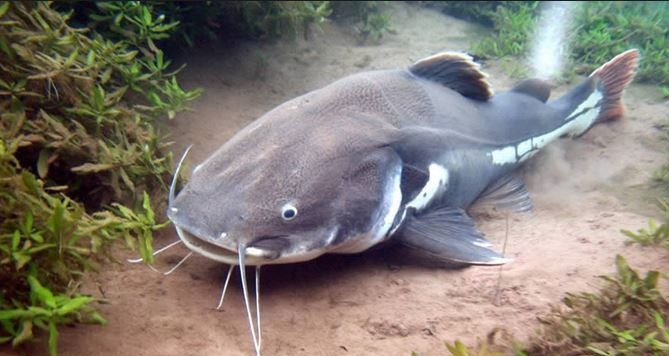
Phractocephalus hemioliopterus can reach about 1.8 m (5 ft 11 in) in length, and about 80 kg (180 lb) in weight.[7] However, this is exceptionally rare, and most do not approach this size. They average 3 ft 6 in – 4 ft 6 in; 1.1–1.4 m in length. These colorful large catfishes have a brownish back, with yellow sides, and characteristic orange-red dorsal fin and caudal fin (hence the common name). Sometimes the dorsal, pelvic and anal fins are also red. They have a broad head with long whiskers, dark black body and white underneath that extends from the mouth to the caudal fin. It has a pair of barbels on the upper jaw, and two pairs on the lower jaw. Their whiskers are sensitive and have chemical reception cells which are used as the sense of smell. They breed using external fertilization after laying their eggs. They communicate by making a clicking sound to warn off potential dangers.[6]

An 1865 watercolor painting of a redtail catfish from Brazil by Jacques Burkhardt.
An 1865 watercolor painting of a Brazilian redtail catfish by Jacques Burkhardt

Distribution and habitat

[edit]

The redtail catfish is native to the Amazon, Orinoco, and Essequibo river basins of South America, in Ecuador, Venezuela, Guyana, Colombia, Peru, Suriname, Bolivia, and Brazil.[3] It is found only in fresh water, and inhabits larger rivers, streams, and lakes.[8][5] They eat during the evening and night and stay motionless during the day. They are bottom-dwellers and move about quite slowly. Red-tailed catfish are territorial fish.[6] Redtail catfish is also an invasive species in Malaysia; they are now found mostly in the Perak River and Pahang River.[citation needed]

Relationship with humans

[edit]

Due to the potentially large size of this species, redtail catfish are considered a game fish by anglers. The current IGFA world-record for weight is from 2010 and belongs to Gilberto Fernandes, of Brazil, with a specimen that weighed-in at 56 kg (123 lb 7 oz).[9]

It is said that the South American tribes living in the forests do not eat the meat of redtail catfish as it is "black" in coloration.[10]

Globally, in places such as Thailand, Taiwan, Hong Kong, and Florida,[11] the redtail catfish is an alien species that has likely been released into local waterways by humans, similarly to other large freshwater species (like the common pleco, zebra tilapia, or the alligator gar).[12] In some regions, it is feared as a potential danger to human life; it is believed, by some, to be the cause of the many mysterious drownings of passengers aboard the ship Sobral Santos II when it sank.[citation needed]

In the aquarium

[edit]
Phractocephalus hemioliopterus in an aquarium

The redtail catfish is an extremely popular fish in Amazonian-themed exhibits at public aquaria, where they are often housed with other large fish, such as Colossoma macropomum or pacu, and other large catfish.

Juveniles are often available as aquarium fish, despite their eventual large size. In an aquarium where they may be well-fed, these fish can grow quite rapidly,[10] and require tanks of at least 10,000 L (2,600 US gal) when fully mature.[5] Weekly feeding is appropriate for this catfish; overfeeding is a common cause of death in this species.[13] It feeds heavily on live and dead fishes and other meat. Even as a juvenile of only a few inches in length, they are able to swallow many of the more common aquarium fish (such as tetras or guppies), and it is only appropriate to house this fish with other species of relatively large size. Redtail catfish also have a habit of swallowing inedible objects in the aquarium. Though these are often regurgitated, both the swallowing and the regurgitation can present a problem for the fish, and these objects are best kept out of the aquarium.[13]

The redtail catfish has been hybridized with other fish, such as the Pseudoplatystoma or Tiger Shovelnose Catfish, through the use of hormones, in attempts to create a viable food fish: the Tiger Redtail Catfish. These hybrid fish sometimes make it into the aquarium hobby under a variety of common names.[13]

See also

[edit]

References

[edit]
Revisions and contributorsEdit on WikipediaRead on Wikipedia
from Grokipedia
The Redtail catfish (Phractocephalus hemioliopterus) is a large, predatory species of long-whiskered belonging to the family , endemic to the freshwater systems of the Amazon and River basins in . Characterized by a body, a broad head, and a distinctive bright red or orange caudal fin that gives it its common name, it typically reaches a common length of 60 cm total length (TL) but can grow to a maximum of 135 cm TL and weigh up to 44.2 kg. As a demersal inhabitant of slow-moving rivers, floodplains, and associated wetlands, it thrives in warm, acidic waters with a range of 5.5–6.8 and temperatures between 20–26°C. This species exhibits potamodromous migration, undertaking seasonal movements within freshwater systems influenced by the hydrologic cycle, such as upstream migrations during low-water periods in tributaries like the . Ecologically, it functions as an opportunistic carnivore at trophic level 4.2, preying primarily on smaller and like while also consuming fallen fruits, which supplements its diet during fruiting seasons in floodplain forests. Sexual maturity is reached at around 85 cm TL, and it is known for its nocturnal and predatory behavior, often hiding among submerged vegetation or structures during the day. The Redtail catfish holds minor commercial importance in regional fisheries for human consumption and is a popular gamefish due to its size and fighting ability when hooked. It is also widely traded in the international aquarium industry, though its rapid growth and substantial adult size make it unsuitable for all but very large public or specialized private setups, leading to occasional releases that have resulted in non-established introductions outside its native range, such as in , . Conservation-wise, the species is assessed as Least Concern by the IUCN, with a stable across its extensive range, though localized threats from habitat alteration due to , , and warrant ongoing monitoring.

Taxonomy

Classification

The redtail catfish (Phractocephalus hemioliopterus) is classified within the family , known as long-whiskered catfishes, in the order Siluriformes. The full taxonomic hierarchy is Kingdom: Animalia; Phylum: Chordata; Class: ; Order: Siluriformes; Family: ; Genus: Phractocephalus (a monotypic genus with this as the only extant species); Species: Phractocephalus hemioliopterus. This placement reflects its position among Neotropical catfishes characterized by prominent barbels and a streamlined body adapted to riverine environments. The was originally described in 1801 by and Johann Gottlob Theaenus Schneider as Silurus hemioliopterus in their work Systema Ichthyologiae. The genus Phractocephalus was later established in 1829 by , transferring the species and recognizing its distinct cranial features, such as the fenced-like head structure (from Greek phraktos meaning fence and kephale meaning head). Subsequent synonymy includes names like Pimelodus grunniens (Humboldt, 1821) and Phractocephalus bicolor (Spix & Agassiz, 1829), all now considered junior synonyms of P. hemioliopterus. Common names for the species vary regionally, reflecting its cultural significance in South America; it is widely known as redtail catfish or banana catfish in English, pirarara in Brazil, and cajaro in Venezuela. Phylogenetically, Phractocephalus forms part of the diverse Pimelodidae family, which comprises over 100 species of South American catfishes. Molecular analyses place the genus in a well-supported clade with Leiarius, sister to other pimelodid lineages such as Steindachneridion and Hypophthalmus, highlighting its basal position among long-whiskered forms diversified in the Amazon basin during the Miocene. This positioning underscores its evolutionary ties to other Neotropical pimelodids adapted to large river systems.

Fossil record

The fossil record of the genus Phractocephalus is limited but significant, primarily consisting of two extinct species from the late Miocene epoch in South America. Phractocephalus nassi was described from cranial and postcranial remains recovered from the Urumaco Formation in Falcón State, Venezuela, dating to approximately 11.6–5.3 million years ago. These fossils, including neurocrania, suspensorium elements, and vertebrae, indicate a large-bodied pimelodid catfish adapted to fluvial environments similar to those of the modern Orinoco River basin. Similarly, Phractocephalus acreornatus is known from isolated bones such as premaxillae and dentaries found in the Solimões Formation near Niterói, Acre State, Brazil, also from the late Miocene around 10–9 million years ago, reflecting occupation of ancient Amazonian river systems. These Miocene deposits indicate the presence of the genus Phractocephalus in the late Miocene, with the earliest confirmed fossils from the Urumaco Formation indicating a minimum age of approximately 11–13 million years for its distinctive osteological features, such as robust cranial elements and specialized dentition for crushing prey. The locations in the proto-Amazon and proto-Orinoco basins highlight an ancient presence in freshwater habitats predating the current distributions of the living species. Morphologically, the fossils exhibit continuity with the extant P. hemioliopterus in , including a depressed head, long barbels, and a laterally compressed caudal peduncle, implying evolutionary stability in adaptations to riverine niches over millions of years. A Pliocene record of indeterminate Phractocephalus sp. has been reported from the Sincelejo Formation in northern , extending the genus's temporal range into the early (approximately 5.3–2.6 Ma). No fossil records of Phractocephalus have been documented from the Pleistocene epoch.

Description

Physical characteristics

The redtail catfish (Phractocephalus hemioliopterus) is a large pimelodid species known for its impressive size, with a maximum verified total length of 135 cm (4 ft 5 in) TL and weights up to 44.2 kg (97 lb), though adults typically reach 85–130 cm TL after . Scientific records confirm common lengths around 60 cm TL. The body is elongated and robust, featuring a broad head, large suited for predatory feeding, and three pairs of barbels—two on the lower and one on the upper—that aid in and prey detection. The skin lacks scales and has a smooth, viscous texture, contributing to its streamlined, shape adapted for riverine environments. The is short and equipped with a strong spine, the anal fin is notably long, and the caudal fin is deeply forked, enhancing maneuverability. Coloration varies by age and individual, but adults typically exhibit a mottled brownish-black back and sides with subtle yellow undertones on the flanks, contrasting sharply with bright orange-red hues on the dorsal, caudal, and pectoral fins. The belly is often pale or white, sometimes with a blackish tint, and small dark-grey spots may appear on the back. Juveniles display more pronounced spotting across the body for , transitioning to a more uniform pattern as they mature. is minimal, with no obvious external differences outside of breeding periods; females tend to be slightly larger and heavier than males, though standard lengths are similar.

Sensory and behavioral traits

The redtail catfish exhibits specialized sensory adaptations suited to its murky, riverine habitats. Its prominent barbels are lined with numerous and chemoreceptors, enabling the detection of chemical cues from prey even in low-visibility conditions. The species also possesses a well-developed system, a series of sensory pores along the body that detect vibrations and movements from nearby organisms. Complementing these, its relatively small eyes are positioned for forward vision and function effectively in low-light environments, aligning with its preference for shaded or turbid waters. Behaviorally, the redtail catfish is predominantly nocturnal, with peak activity occurring at night to and avoid diurnal predators, though it may show crepuscular tendencies during dawn and . Juveniles often form loose schools for protection, transitioning to solitary and territorial habits as adults, where they aggressively defend preferred bottom territories against conspecifics and other large . Individuals can produce distinctive clicking sounds, likely serving as acoustic signals for communication, in dark waters, or deterring threats. In terms of locomotion, the redtail catfish is a powerful swimmer, propelling itself through undulating lateral body movements powered by its strong caudal fin, which allows bursts of speed during pursuits. As a demersal species, it spends much of its time foraging along the river bottom but will occasionally ascend to the surface to gulp air, facilitating survival in oxygen-depleted floodplain waters. Juveniles demonstrate rapid growth, supporting their quick transition from schooling to independent lifestyles. In the wild, individuals may live up to about 15 years, though precise longevity varies with environmental factors and predation pressures.

Distribution and habitat

Native range

The redtail catfish (Phractocephalus hemioliopterus) is endemic to northern South America, with a native distribution spanning the Amazon River basin in Peru, Brazil, and Colombia; the Orinoco River basin in Venezuela and Colombia; and the Essequibo River basin in Guyana. Its range also includes Ecuador and Suriname, primarily within lowland freshwater systems of these regions. Within these basins, the species occupies large lowland rivers, floodplain lakes, and seasonally flooded forests known as várzea. It prefers slow-moving, warm waters with temperatures typically ranging from 20–26°C and pH levels from 5.5–7.0, often in environments with high dissolved oxygen due to river flow. The redtail catfish is demersal, favoring microhabitats with sandy or muddy bottoms and vegetation cover for shelter and ambush hunting. As a potamodromous species, it undertakes upstream migrations during seasonal floods to access flooded areas for enhanced feeding and breeding opportunities. Overall environmental tolerances include temperatures from 20–28°C and avoidance of fast currents or cold highland waters, confining it to tropical lowland habitats.

Introduced populations

The redtail catfish (Phractocephalus hemioliopterus) has been introduced to non-native regions primarily through releases from the aquarium trade and accidental escapes from fish farms. In , this species appeared in Malaysian rivers such as the and since the 1990s, likely originating from discarded aquarium specimens or farm outflows. Similar introductions occurred in via stocking in recreational lakes, Singapore's Pandan Reservoir, and sporadic releases have been noted in and , where individuals were likely abandoned by hobbyists. In , the species has been documented in several U.S. states including , , , , and since the late , but these stem from isolated aquarium discards rather than intentional releases. Established breeding populations exist in Malaysian rivers, where the species has successfully reproduced and spread, becoming a recognized invasive. In contrast, populations in Florida and other U.S. states remain sporadic and unestablished, with no confirmed reproduction despite multiple sightings over decades. The redtail catfish's broad tolerance for varying water temperatures, salinities, and habitats—ranging from freshwater rivers to brackish systems—heightens the risk of further expansion in suitable tropical and subtropical environments. Ecologically, introduced redtail catfish act as apex predators, preying on native and , which disrupts local food webs and may reduce populations of smaller species. In , they have been observed consuming endemic like Notopterus notopterus (tenggala) and Mystus spp. (baung), contributing to declines in . While no significant economic damages from fisheries or have been documented, the species is actively monitored as invasive due to its potential long-term effects on balance. Control measures focus on prevention and removal. In and other U.S. states, fisheries agencies encourage and reporting to eradicate vagrant individuals before establishment. Asian regions, particularly , have introduced regulations limiting aquarium imports of large predatory fish; for instance, the Pahang Fisheries Department has updated policies to restrict non-native species and promote public awareness to curb further releases.

Ecology

Diet and foraging

The redtail catfish (Phractocephalus hemioliopterus) is an omnivorous predator with a diet primarily consisting of fish such as characins and other catfishes, supplemented by crustaceans including crabs and shrimp, as well as fruits and seeds. Amphibians like frogs are also consumed opportunistically. This varied intake reflects its adaptability to the nutrient-rich environments of South American river basins. As a bottom-dwelling species, the redtail catfish employs ambush predation strategies, relying on its highly sensitive barbels for chemosensory and tactile detection of prey in low-visibility, murky waters. It is predominantly nocturnal, conducting most foraging activities at night in shallow waters where it probes the substrate or waits in cover to strike at passing prey. This opportunistic behavior extends to scavenging dead fish and , as well as ingesting floating fruits and occasional insects that drift into its habitat. In its native , the redtail catfish occupies a high trophic position, with an estimated level of 4.2, indicating its role as a significant piscivorous predator that influences populations. Adults function as apex predators in many riverine food webs, while juveniles face predation from larger carnivores; additionally, its consumption of fruits positions it as a key agent in , aiding forest regeneration across the Amazon and basins. Dietary composition exhibits seasonal shifts tied to flood cycles in floodplain habitats, with increased intake of fruits and seeds from inundated trees during the , when these resources become accessible, and a greater reliance on animal prey like and crustaceans during drier periods when vegetation is less available.

Reproduction and development

The redtail catfish (Phractocephalus hemioliopterus) employs for reproduction, with spawning triggered by seasonal flooding in its native Amazonian rivers. In the basin, reproductive activity peaks between January and February, aligning with the onset of high-water periods that facilitate migration to floodplain margins for egg-laying. This timing corresponds to the broader rainy season (approximately November to March) across the Amazon, when rising waters create suitable habitats for breeding. In the basin, is attained at a total length of about 77.8 cm (range 76.3–79.3 cm), based on gonadal development in wild populations there. Females release eggs that are externally fertilized by males, with no evidence of following spawning. In the sole documented event, a female deposited over 200 round, copper-colored eggs measuring approximately 6 mm in diameter into selected spots within the tank, where sperm was applied. Eggs hatch after 4–5 days under aquarium conditions mimicking tropical temperatures, yielding fry that require further rearing, though detailed larval development remains poorly studied in this . Juveniles exhibit rapid growth, transitioning to solitary adults that can exceed 1 m in length. faces significant threats from anthropogenic changes, particularly like the Belo Monte project, which alter hydrological regimes and block migratory routes essential for reaching spawning grounds. Natural breeding in is exceedingly rare, with only one verified spawning recorded to date, highlighting challenges in replicating wild flood-pulse dynamics.

Conservation and human uses

Conservation status

The redtail catfish (Phractocephalus hemioliopterus) is classified as Least Concern on the , with the most recent assessment conducted in 2020. This status reflects its extensive distribution across major South American river basins and its high reproductive capacity, which support stable wild populations despite localized pressures. Major threats to the species include habitat degradation from and the construction of , which disrupt the seasonal pulses essential for migration and spawning in Amazonian floodplains, as exemplified by the impacts of the on the . for human consumption poses an additional risk, particularly in commercial fisheries where the species is targeted or caught incidentally in nets. Population trends indicate no overall significant decline, with high estimated abundance maintained in core unaltered river ranges; however, local reductions have been observed in modified habitats such as impounded rivers. Studies from the , for instance, document robust population parameters, including balanced sex ratios and growth rates that suggest resilience, though vulnerability to hydrological alterations remains a concern. Protective measures encompass habitat conservation efforts within Amazon protected areas, such as national parks and reserves that safeguard flood-dependent ecosystems critical for the ' breeding cycles. Ongoing research focuses on its flood-reliant to inform management strategies, including minimum size limits and seasonal closures to mitigate local impacts.

Aquarium trade and fisheries

The redtail catfish (Phractocephalus hemioliopterus) is popular in the international ornamental trade due to its striking orange-red tail and fins, which make it visually appealing for aquarists. Juveniles, often wild-caught from the Amazon and basins, are commonly imported and sold at small sizes of a few inches, but they grow rapidly to over 1 meter in length, requiring enormous enclosures that exceed the capacity of most home setups. In captivity, adults demand a minimum size of 1,500 gallons (approximately 5,678 liters) to accommodate their active swimming and territorial behavior, with water parameters mimicking their native habitat: 6.0–7.5 and temperatures of 75–82°F (24–28°C). Husbandry challenges include their predatory nature, as they are opportunistic ambush hunters that prey on smaller , , and even fruits in the wild; in aquaria, they thrive on a diet of high-protein sinking pellets, frozen bloodworms, , and occasional small or crustaceans, fed 2–3 times weekly to prevent . Due to their aggression toward tankmates under 6 inches, they are best kept singly or with other large, robust in species-only setups, and their nocturnal habits necessitate dim and ample hiding spots. Rapid growth often leads hobbyists to release oversized specimens into local waterways, resulting in non-established introductions and sightings in places like , USA, and parts of such as and . Many public aquaria, such as the , receive donations of these outgrown , where they are displayed in large riverine exhibits alongside other Amazonian . In the , the redtail catfish supports minor commercial fisheries, where it is harvested as a food known locally as pirarara, with its lean meat valued despite traditional superstitions among some indigenous and local communities that discourage consuming dark-fleshed . The is also captured for its durable , which is processed into leather for crafts and accessories in . As a sport , it is prized for powerful fights, with the International Game Association all-tackle standing at 123 pounds 7 ounces (56 kg), caught by angler Gilberto Fernandes in 's in 2010. Exports of redtail catfish for the aquarium trade originate primarily from and , where they rank among the top ornamental species by value, though illegal trafficking persists and exacerbates overexploitation and accidental introductions abroad. While not listed under , trade is regulated by national quotas and permits in these countries to ensure , with imposing strict limits on wild collection to protect . In Amazonian indigenous lore, the redtail catfish holds symbolic importance as a representation of the river's strength and abundance, with some communities viewing its capture as a sign of prosperity, though consumption taboos related to its flesh color persist in traditional practices.

References

Add your contribution
Related Hubs
User Avatar
No comments yet.