Hubbry Logo
TambaquiTambaquiMain
Open search
Tambaqui
Community hub
Tambaqui
logo
8 pages, 0 posts
0 subscribers
Be the first to start a discussion here.
Tambaqui
Tambaqui
from Wikipedia

Tambaqui
Temporal range: Middle Miocene to present
Scientific classification Edit this classification
Kingdom: Animalia
Phylum: Chordata
Class: Actinopterygii
Order: Characiformes
Family: Serrasalmidae
Subfamily: Colossomatinae
Genus: Colossoma
C. H. Eigenmann & C. H. Kennedy, 1903
Species:
C. macropomum
Binomial name
Colossoma macropomum
(G. Cuvier, 1818)
Synonyms
  • Myletes macropomus Cuvier, 1816
  • Myletes oculus Cope, 1872
  • Myletes nigripinnis Cope, 1878
  • Melloina tambaqui Amaral Campos, 1946

The tambaqui (Colossoma macropomum) is a large species of freshwater fish in the family Serrasalmidae. It is native to tropical South America, but kept in aquaculture and introduced elsewhere.[2] It is also known by the names black pacu, black-finned pacu, giant pacu, cachama, gamitana, and sometimes as pacu (a name used for several other related species).

The tambaqui is currently the only member of Colossoma, but the Piaractus species were also included in this genus in the past.[3]

Distribution

[edit]

The tambaqui is native to freshwater habitats in the Amazon and Orinoco basins of tropical South America.[2] In nutrient-rich whitewater rivers such as the Madeira, Juruá, Putumayo (Içá) and Purus it ranges throughout, all the way up to their headwaters.[4] In nutrient-poor blackwater rivers such as the Rio Negro and clearwater rivers such as several rightbank tributaries of the Madeira it generally only occurs in the lower c. 300 km (200 mi) and is rare beyond the lowermost c. 150 km (100 mi).[4] It is widely kept in aquaculture outside its native range in South America.[2]

Middle Miocene-aged fossils of C. macropomum are known from northern Colombia and the Peruvian Amazon. Their occurrence in Colombia suggests that prior to further uplift of the Andes, they also inhabited western South America.[5][6] Their fossil range includes the modern Magdalena River basin, but modern occurrence in this river is due to introductions by humans.[7]

Description

[edit]

The tambaqui is the heaviest characin in the Americas (the lighter Salminus can grow longer) and the second heaviest scaled freshwater fish in South America (after the arapaima).[8] It can reach up to 1.1 m (3.6 ft) in total length and 44 kg (97 lb 0 oz) in weight,[7] but a more typical size is 0.7 m (2.3 ft).[2] The largest caught by rod-and-reel and recognized by IGFA weighed 32.4 kg (71 lb 7 oz),[9] although other systems have a 37 kg (81 lb 9 oz) fish caught in Peru in 2013.[10] After the flood season, around 10% of a tambaqui's weight is the visceral fat reserves and at least another 5% is fat found in the head and muscles.[8]

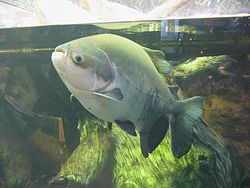
It is similar in shape to the piranha and juveniles are sometimes confused with the carnivorous fish; the tambaqui is tall and laterally compressed with large eyes and a slightly arched back. Unlike more predatory species, the teeth of the tambaqui are molar-like, an adaption for crushing plant seeds and nuts.[8] The lower half of its body is typically mainly blackish. The remaining is mainly gray, yellowish or olive, but the exact hue varies considerably and depends in part on habitat with individuals in blackwater being much darker than individuals from whitewater.[8] The pelvic, anal and small pectoral fins are black. The tambaqui resembles the red-bellied pacu (Piaractus brachypomus), but the latter species has a more rounded head profile (less elongated and pointed)[11] and a smaller adipose fin that lacks rays, as well as differences in teeth and operculum.[12][13]

Hybrids between the tambaqui and the similar Piaractus (both species) have been produced in aquaculture,[14] and are occasionally seen in the wild.[7] The hybrid offspring can be difficult to identify by appearance alone.[14]

Ecology

[edit]
Skull

Habitat, breeding and migration

[edit]
At the National Zoological Park
Preserved specimen
Showing size
In Carauari, Amazonas

This species is mostly solitary,[2] but it migrates in large schools.[8] During the non-breeding season, adults stay in flooded forests of white (várzea), clear and blackwater (igapó) rivers.[2][8] They stay there for four to seven months during the flood season, but as the water level drops they move into the main river channels or to a lesser extent floodplain lakes.[4][8] At the start of the next flood season, large schools move into whitewater rivers where they spawn between November and February.[4][8] The exact spawning location in the whitewater rivers is not entirely certain, but apparently along woody shores[4] or grassy levees.[8] The schools then break up as the adults return to the flooded forest of white, clear and blackwater rivers, and the annual pattern is repeated.[4][8] Larvae are found in whitewater rivers, including the Amazon River itself.[4] Juveniles stay near macrophytes in floodplains and flooded forests year-round, only switching to the adult migration pattern when reaching sexual maturity.[2][4] Maturity is reached at a length of about 60 cm (2 ft).[7]

The species regularly reaches an age of 40 years and may reach up to 65.[7]

Oxygen, salt and pH resistance

[edit]

When there is not enough oxygen in the river or lake, tambaqui obtain oxygen from the air. They are able to do this by their physical and inner body parts, such as their gills and swim bladder vascularization.[15]

Tambaqui is a fish that lives in freshwater. Juveniles can survive in brackish water when the salinity is gradually raised. Salinity levels above 20 g/L result in death.[16] When juveniles are reared in salinities above 10 g/L, there is a significant detrimental effect on growth, haematological parameters and osmoregulation.[16]

In an experiment, tambaqui had the pH of their water changed. No deaths occurred to tambaqui if the pH did not fall to 3.0. The only internal difference that was noted in tambaqui when the pH was being altered was a change in the acid-base of the plasma and red cells.[17]

In another experiment, tambaquis were exposed to pH drops from 6.0 to 4.0, similar to what they would encounter in their natural habitat. Researchers found that the microbial communities of the tambaqui fish gut were very resilient to the pH drops, which could explain part of the ability of tambaquis to migrate between black and white water streams in the Amazon.[18]

Diet

[edit]
Juvenile, in Bolivia

Tambaqui consume fruits and seeds, especially from woody angiosperms and herbaceous species. Depending on the quantity and food quality of these foods, it causes the fish to decide on their location of their habitat.[19][20] In one study during the high-water season, 78—98 percent of the diet consisted of fruits.[19] Another study of the stomach content of 138 specimens during the high-water season found that 44% of the weight was fruits and seeds, 30% was zooplankton and 22% was wild rice.[8] Among 125 specimens during the low-water season, a higher percentage had empty stomachs (14%, about ten times more than in the high-water season) and about 70% of the total stomach content weight was zooplankton.[8] In addition to seeds, fruits, wild rice and zooplankton, smaller levels of insects, snails, shrimps, small fish, filamentous algae and decaying plants are consumed.[2][8]

Seed dispersal

[edit]

The tambaqui plays an important role in dispersing plant seeds.[21][22][23] The fruit seeds that fall in the water are consumed by tambaqui and the seed is dispersed somewhere else; this is similar to what birds do. This consumption includes about 35% of the trees and lianas during flood season and these seeds can grow after the floodwater calms down. Compared to the younger and smaller tambaqui, larger and older tambaqui are able to disperse the seeds in a faster rate.[24] The gut of a well-fed 10 kg (22 lb) tambaqui can contain more than 1 kg (2.2 lb) seeds.[7] In general, more seeds are able to pass undamaged through the red-bellied pacu (Piaractus brachypomus) than the tambaqui, meaning that the former overall is a more efficient seed disperser.[19]

Relationship to humans

[edit]
A tambaqui for sale in the Manaus Fish Market, Brazil. This fish was approximately 85 cm (33+12 in) long.

The meat of the tambaqui is popular and fetches top prices in fish markets in its native range.[4] It is marketed fresh and frozen.[2]

Wild populations of the tambaqui have declined because of overfishing and many currently caught fish are juveniles.[4] In Manaus alone, the landings fell from c. 15,000 metric tons (14,800 long tons) per year in the 1970s to 800 metric tons (790 long tons) in 1996.[4] Based on a review by IBAMA, it was the 11th most caught fish by weight in the Brazilian Amazon in 1998 (just ahead of the closely related pirapitinga, Piaractus brachypomus).[4]

The tambaqui is now widely kept in aquaculture. It can live in oxygen-poor waters and is very resistant to diseases.[25] In Brazil, tambaqui is one of the main farmed fish species, and therefore important to the country's economy.[26] Studies of farmed tambaqui in Brazil have revealed a genetic diversity similar to that seen among wild populations.[27] In fish farms this species is sometimes hybridized with Piaractus to produce offspring that accept a wider temperature range (colder water) than pure tambaqui.[14]

In Thailand, this fish, known locally as pla khu dam (ปลาคู้ดำ), was introduced from Hong Kong and Singapore as part of fish-farming projects, but has adapted to local conditions and thrives in the wild in some areas.[28] There is also an introduced population in Puerto Rico and singles (likely deliberate releases by aquarists) have been caught in a wide range of U.S. states,[12] but only those in the warmest regions can survive.[29]

Juveniles 5–7.5 cm (2–3 in) long, sometimes labelled as "vegetarian piranha", are frequently seen in the aquarium trade, but they rapidly grow to a large size and require an enormous tank.[29]

References

[edit]
Revisions and contributorsEdit on WikipediaRead on Wikipedia
from Grokipedia
The tambaqui (Colossoma macropomum) is a large, omnivorous in the family Serrasalmidae, native to the tropical Amazon and river basins of . Characterized by a robust, deep-bodied form with molar-like teeth and specialized gill rakers for filtering food, it primarily consumes fruits, seeds, grains, and plant matter, supplemented by , , snails, and decaying vegetation. Reaching maximum lengths of 108 cm and weights of 40 kg, the species inhabits diverse aquatic environments and supports vital ecological processes in systems while holding substantial economic value in regional fisheries and . It is classified as Near Threatened by the IUCN. Tambaqui thrives in warm, tropical freshwater habitats such as rivers, lakes, and flooded forests, with a preferred range of 26–29°C and tolerance for pH levels from 5.0 to 7.8, as well as low up to 10 ppt. It displays potamodromous migratory behavior, with adults entering flooded forests during the high-water season to exploit abundant fruits and grains, while juveniles and subadults occupy nutrient-poor blackwater floodplains until reaching around 3–4 years of age. The species reproduces via during flood peaks, with eggs hatching in marginal lagoons; larvae initially feed on before shifting to a more herbivorous diet. Its solitary nature and resilience to environmental fluctuations, including disease resistance, enable survival in variable conditions like mineral-poor waters. Economically, tambaqui is a of Latin American , particularly in , where production surged from 13,000 tonnes in 2000 to 156,600 tonnes in 2023 (primarily from , including hybrids), accounting for the majority of global output as of 2023. Valued for rapid growth—attaining 3.5 kg market size in 18–24 months under farmed conditions—it is cultured in ponds, cages, and tanks using cost-effective feeds derived from local sources like forest fruits and , promoting for small-scale farmers. The fish is marketed fresh or frozen at sizes of 700 g to 3.5 kg, serving as a minor commercial resource, gamefish, and exhibit species in public aquariums, with yields up to 100 kg/ha/year in reservoirs and 20–30 kg/m³ in cages.

Taxonomy and nomenclature

Scientific classification

The tambaqui, scientifically known as Colossoma macropomum (Cuvier, 1816), is a species within the genus Colossoma in the family Serrasalmidae, order . This classification places it among the characins, a diverse group of primarily freshwater fishes native to the Neotropics. The full taxonomic hierarchy is as follows: Historical synonyms for C. macropomum include Myletes macropomus Cuvier, 1816, and Colossoma oculus Cope, 1872, reflecting taxonomic revisions over time. Fossils attributable to C. macropomum or closely allied forms date to the Middle (approximately 13–16 million years ago), with remains reported from the Formation in and the Pebas Formation in the Peruvian Amazon, indicating an ancient lineage with remarkable morphological stasis. Phylogenetically, C. macropomum is closely related to other species in the genus Colossoma, such as C. bidens (golden ), forming part of a monophyletic " clade" within Serrasalmidae that includes herbivorous genera like Mylossoma and Piaractus. This diverged from more carnivorous serrasalmids, such as piranhas, during the early .

Etymology and common names

The name tambaqui derives from the , specifically the term tamba'ki or tambaky, which was adopted into to refer to this species of native to the . In , particularly in the Amazonas and Pará regions, it is commonly known as tambaqui or tambaquí, with other local variants including bocó and ruelo; these reflect the integration of indigenous Tupi nomenclature into Portuguese colonial language practices across the Amazon. Beyond , regional names vary due to linguistic influences from other indigenous groups and Spanish-speaking countries: pacú in and , gamitana in and , paco in , cachama and morocoto in , and the general term pacu applied across much of for related serrasalmid species. These variations highlight the cultural diversity of Amazonian naming traditions, blending Tupi-Guarani roots with local adaptations in trade and fisheries.

Physical description

Morphology and anatomy

The tambaqui (Colossoma macropomum) possesses a deep, laterally compressed body shape that facilitates maneuverability in dense vegetation and flooded forests of its native habitat. This rhomboid form in juveniles transitions to a more elongated profile in adults, with a of approximately 2–3, enhancing hydrodynamic efficiency for migration. The species features large eyes positioned high on the head, adapted for vision in low-light conditions prevalent in turbid Amazonian waters. Coloration in tambaqui varies with age, habitat, and water clarity, serving as in diverse aquatic environments. Adults exhibit , appearing black or olive-green dorsally and yellow to olive-green ventrally in clear waters, shifting to darker tones in blackwater habitats or yellowish in muddy conditions. Juveniles display a silvery body with dark spots, darkening and acquiring reddish hues with maturity. The includes multicusped, molariform teeth arranged in double rows along the jaws and additional rows on the pharyngeal arches, specialized for crushing hard and fruits. These robust enable efficient processing of tough material, reflecting the ' frugivorous adaptations. Tambaqui are covered in large scales, with 57–60 along the , providing protection while allowing flexibility. The include a deeply forked caudal fin with 10 upper and 9 lower principal rays, a single with 14–16 rays, a long-based anal fin with 27–30 rays, and well-developed pectoral and pelvic . An adipose fin is present behind the dorsal. The performs aquatic surface respiration by gulping air at the surface during hypoxic conditions. Sensory structures include a well-developed system along the scaled midline, aiding in schooling behavior and detection of water movements in groups. This organ supports coordinated social interactions essential for predator avoidance and in schools.

Size, growth, and lifespan

The tambaqui (Colossoma macropomum) attains a maximum total length of 108 cm and weight of 40 kg, though individuals exceeding 1 m and 30 kg are less common in natural populations. Typical adults reach a common length of 70 cm and weigh 10-20 kg, reflecting sizes observed in commercial catches and wild surveys. Juveniles exhibit rapid growth, attaining 20-30 cm in the first year under favorable conditions in floodplain environments. Growth slows after , which occurs at 3 years for males and 4 years for females. In the wild, tambaqui lifespan extends up to approximately 17 years. In aquaculture settings, tambaqui are typically harvested at 18–24 months when they reach market size of around 3.5 kg, seldom reaching their full lifespan. Sexual dimorphism becomes evident at maturity, with females growing larger and heavier than males, often reaching 10-20% greater body mass by adulthood to support higher .

Distribution and habitat

Native range

The tambaqui (Colossoma macropomum) is natively distributed across the Amazon and River basins in tropical , encompassing major river systems and their tributaries. This range includes portions of , , , , , , and , where the species inhabits lowland freshwater environments. Within these basins, tambaqui occupies diverse riverine habitats, including nutrient-rich rivers, as well as clearwater and blackwater systems. The is particularly associated with floodplain forests known as várzea, which form during seasonal flooding and provide essential vegetated shallows for . These areas, along with lakes and floating meadows in the Amazon's expansive 150,000–200,000 km² , support the largest populations, with tambaqui favoring slow-moving, shallow waters rich in aquatic vegetation during high-water periods. Historically, prior to 20th-century river alterations such as dam construction, tambaqui distributions extended more continuously across these basins, allowing for broader migratory access to spawning and feeding grounds in unfragmented floodplains. Dams like those on the and Rivers have since restricted these movements, reducing access to upstream habitats in some regions.

Introduced populations and aquaculture

Tambaqui (Colossoma macropomum) has been introduced to several non-native regions primarily for and ornamental purposes, with documented establishments in the basin in , where it was translocated for farming and has since formed self-sustaining populations. In , populations are possibly established following releases from aquaculture facilities, while in , the species has become established after introductions in the late for commercial production. Introductions to the , including and , occurred via pond aquaculture and aquarium trade, but no self-sustaining populations have been confirmed in these continental sites; however, escapes from farms into natural waters have been reported, particularly in southern . These introductions carry a potential for invasiveness in tropical freshwater systems, as the species exhibits medium climate suitability in regions like southern and , though ecological impacts remain largely undocumented and unestablished outside its native range. Aquaculture of tambaqui began gaining prominence in during the , driven by pressures on wild stocks and advancements in induced spawning techniques pioneered by local researchers, leading to large-scale artificial propagation by the in northeastern regions. Early efforts included introductions of fingerlings to non-native Brazilian areas in the and to support restocking and farming, with techniques like pituitary hormone induction adapted specifically for the species around 1983. By the 2020s, dominates global production, accounting for over 95% of output, with annual yields reaching approximately 114,000 metric tons in 2023, reflecting sustained growth from 13,000 tons in 2000 to over 140,000 tons by 2016. Worldwide production mirrors this, estimated at around 140,000–150,000 tons annually in the late to early 2020s, primarily from Latin American operations. Farming methods emphasize pond-based systems, with being prevalent for targeted growth to market sizes of 750 g to 3 kg over 18–24 months, utilizing natural pond productivity supplemented by feeds containing 18–25% crude protein from sources like and . integrates tambaqui with compatible species such as ( niloticus), often at ratios like 25% tambaqui and 75% tilapia in semi-intensive ponds, to optimize resource use and achieve yields up to 10 tons per annually. Intensive systems employ formulated aquafeeds with 25–40% protein and high stocking densities in cages or fertilized ponds, enhancing growth while integrating with local agriculture for sustainability. These introductions and farming practices provide economic benefits in , such as , where established supports local fisheries and markets, and in , including and , bolstering and export revenues through commercial production. However, the risk of unintended escapes heightens concerns for potential disruption in non-native ecosystems, necessitating monitoring to balance gains with environmental safeguards.

Biology and ecology

Reproduction, breeding, and migration

The tambaqui (Colossoma macropomum) reaches at 4–5 years of age in the wild, with females typically maturing at a standard length of about 58 cm and a weight of around 6.3 kg. Males mature slightly earlier. In settings, maturity can be achieved in 3–4 years. Spawning occurs during the rainy season, primarily from to , when water levels in rivers rise rapidly due to floods. This period coincides with warmer water temperatures around 27°C, triggering reproductive activity. Adult tambaqui undertake upstream migrations of up to 1,000 km or more to reach headwater breeding grounds in rivers. These migrations occur in large schools, with during the journey. Post-spawning, they migrate downstream to areas. Breeding involves group spawning with . Males and females form large aggregations, releasing gametes in littoral areas near canals. Females produce 100,000 to 300,000 eggs per kg of body weight, resulting in 0.5–1.5 million eggs for a typical 5–8 kg female. The non-adhesive eggs are buoyant and drift downstream, along with the larvae, to nutrient-rich lakes that serve as nursery habitats.

Diet and feeding behavior

The tambaqui (Colossoma macropomum) exhibits a primarily frugivorous diet, with fruits and seeds comprising over 90% of stomach contents during the high-water () season, when riparian forests inundate and provide abundant allochthonous material. This seasonal abundance drives opportunistic omnivory, as the species shifts to include higher proportions of animal matter during the low-water period, with contributing up to 67% of the fraction in stomach contents and stable isotope analyses. Insects and small supplement the diet opportunistically year-round, particularly when fruit availability declines, reflecting the fish's adaptability to hydrology. Feeding occurs mainly at the surface, where tambaqui target fallen fruits and seeds drifting in flooded waters, using visual cues and schooling to exploit patches of resources. Specialized molariform oral teeth in the jaws crush and process hard-shelled items, enabling efficient breakdown of nuts and drupes before . Daily intake can reach up to 10% of body weight during peak resource availability, supporting rapid growth and fat storage for leaner periods. Juveniles display a more zooplanktivorous habit than adults, relying heavily on and small in shallow, productive waters, which transitions to greater frugivory as they mature and increase in size. This ontogenetic shift aligns with anatomical adaptations, such as developing rakers for filtering finer particles in early life stages (as detailed in morphology).

Physiological adaptations

The tambaqui (Colossoma macropomum) exhibits remarkable physiological adaptations to cope with hypoxic conditions prevalent in its Amazonian habitats, where dissolved oxygen (DO) levels can drop below 2 mg/L during seasonal flooding or stagnation. Rather than true air-breathing, it employs aquatic surface respiration (ASR), facilitated by a unique morphological adaptation in which the lower lip swells rapidly—expanding up to 200% in volume within minutes—to form a funnel-like structure that skims oxygen-rich surface water. This response is triggered by orobranchial O₂ chemoreceptors, enhancing ventilation amplitude and frequency while minimizing energy expenditure in low-DO environments (<1-3 mg/L). Such adaptations allow tambaqui to maintain aerobic metabolism and avoid anaerobic stress, with no significant mortality observed even after prolonged exposure to severe hypoxia. Tambaqui demonstrates broad pH tolerance, surviving in waters ranging from pH 4.0 to 8.0 with minimal physiological disruption, a trait evolved in response to the acidic blackwater rivers of the Amazon, where pH often falls below 5.0 due to humic acids. At low pH (e.g., 4.0), the species shows no increase in ammonia excretion or acid-base disturbances, indicating efficient ionoregulatory mechanisms that prevent net ion loss in soft, ion-poor waters. In contrast, alkaline conditions (pH 8.0) elevate metabolic rate by up to 40% and double ammonia efflux in larger individuals (>150 g), accompanied by negative balance due to impaired Cl⁻/base exchange at the gills, though smaller juveniles (<15 g) exhibit compensatory reductions in oxygen consumption. Growth rates remain robust or even higher in acidic media, underscoring its acidophilic adaptations without mortality across the tested range. Regarding salinity, tambaqui juveniles are , tolerating up to 20 g/L (approximately 20 ppt) with gradual acclimation, though survival declines above 15 g/L in prolonged exposures due to osmoregulatory stress. At these levels, hematological parameters such as and decrease, and feeding ceases, signaling sublethal ionic imbalances, but first mortalities occur only beyond 11 g/L in acute tests. Adults, however, are strictly freshwater stenohaline, showing poor performance and high mortality above 10 g/L, as their Na⁺, K⁺-ATPase activity is insufficient for hyperosmotic regulation in brackish conditions. This ontogenetic shift reflects larval stages' exposure to estuarine-like mixing in floodplains, enabling recruitment survival. The species thrives in temperatures of 25–34°C, with optimal growth and metabolic performance between 26–31°C, aligning with Amazonian seasonal variations from flooding (∼26°C) to (up to 33–40°C). Under at 33°C, tambaqui suppresses oxygen consumption by up to 40% during fasting, conserving energy via metabolic downregulation, while fruit-fed individuals maintain higher aerobic capacity through elevated enzymatic activities (e.g., ). Elevated temperatures induce , reducing hematological indices ( by 20–30%) and profiles, yet the upper critical thermal maximum exceeds 42°C in juveniles, preventing immediate lethality but impairing long-term growth. These responses highlight tambaqui's resilience to warming trends, though chronic exposure beyond 34°C risks cumulative cellular damage.

Ecological significance

Role in seed dispersal

The tambaqui (Colossoma macropomum) plays a pivotal role in within Amazonian floodplains through ichthyochory, where it consumes fruits and passes seeds intact through its digestive tract. This process allows the to seeds over distances ranging from 1 to 5 km before , facilitated by gut retention times of up to 212 hours and migratory movements between fruiting patches during flood seasons. The mechanism relies on the tambaqui's distensible and multicuspidate teeth, which crush pulp but spare hard-coated seeds, enabling their survival and deposition in nutrient-enriched far from parent trees. Tambaqui disperses seeds from up to 21% of the fruiting during the flooded season at study sites, including notable examples such as and . In one study, nearly 700,000 intact seeds from 22 plant were recovered from the guts of 230 tambaqui, indicating a substantial per-fish load with gut capacities exceeding 1 kg of seeds for every 10 kg of body weight. This capacity underscores the fish's efficiency as a disperser, particularly for large-seeded adapted to dynamics. Ecologically, tambaqui-mediated dispersal promotes forest regeneration by depositing viable seeds in suitable habitats, with over 90% of dispersed reaching depositional sites conducive to . Seed viability post-digestion remains high for many , and gut passage often enhances speed, aiding seedling establishment before floodwaters recede. Quantitatively, tambaqui populations contribute to dispersing large numbers of seeds across the 250,000 km² of Amazonian floodplains, sustaining structure and in these dynamic ecosystems.

Interactions with ecosystems and other species

The tambaqui (Colossoma macropomum) occupies a herbivore-omnivore in Amazonian aquatic ecosystems, primarily consuming fruits, seeds, and plant matter (44% of diet) during high-water periods, and and other invertebrates (70% of diet) during low-water seasons. As such, it serves as prey for apex predators including caimans, freshwater dolphins (Inia geoffrensis), giant otters (Pteronura brasiliensis), and larger piscivorous fish like trahiras (Hoplias spp.). These interactions position tambaqui within a complex , where its abundance influences predator populations in habitats. Tambaqui exhibits schooling behavior, forming large aggregations numbering in the hundreds to thousands of individuals, particularly during upstream migrations for spawning in response to rising water levels. This behavior enhances predator avoidance through dilution effects and coordinated movement, while also facilitating mass movements into forests for feeding. Schools typically disperse post-spawning, allowing individuals to exploit dispersed resources in inundated areas. The species engages in mutualistic interactions with fruiting trees in forests, where its contributes to plant reproductive success, forming an ancient that has shaped co-evolutionary dynamics. However, tambaqui competes for resources with other frugivorous fishes, including some species ( spp.) that opportunistically consume fruits, leading to niche partitioning based on fruit availability and size preferences during seasonal floods. As a in Amazon floodplains, tambaqui significantly impacts by structuring community dynamics through its foraging and migratory patterns. Its consumption of allochthonous plant material from flooded forests and subsequent excretion of nitrogenous wastes facilitate nutrient cycling, transferring and essential elements like and from terrestrial to aquatic systems, thereby supporting primary productivity in rivers and wetlands. This process enhances overall fertility during both and dry phases.

Relationship to humans

Fisheries, aquaculture, and economic importance

The tambaqui (Colossoma macropomum) has historically been a key species in wild Amazonian fisheries, particularly around , , where annual catches peaked at 15,000 tonnes in the 1970s, representing up to 45% of total fish landings in the region. By 1996, however, landings had sharply declined to approximately 800 tonnes due to and pressures, underscoring the of wild stocks to intensive harvesting. Despite this downturn, tambaqui remains an important target for artisanal and commercial fishers in lakes and rivers, contributing to security and livelihoods in the Amazon Basin. Aquaculture has emerged as the dominant production method for tambaqui, with leading global output at 113,600 tonnes in 2023 and approximately 121,000 tonnes in 2024, primarily from farms in the northern states like Amazonas and . This farmed production supports exports to markets in (such as and ), where tambaqui is valued for its mild flavor and versatility in processed products like fillets. The sector generates substantial economic value, with native species aquaculture including tambaqui contributing around $200-300 million annually to 's through domestic sales and international trade, bolstering rural employment and regional development. As a food fish, tambaqui is prized for its nutritional profile, offering high-quality protein (17-20 g per 100 g of edible portion) and relatively low fat content (5-6 g per 100 g), making it a lean source of essential and omega-3 fatty acids for Amazonian diets. Juveniles are occasionally traded in the ornamental aquarium sector due to their attractive silver coloration and adaptability, though this remains a compared to food production. Management practices for tambaqui fisheries and aquaculture emphasize sustainability to mitigate environmental impacts and ensure long-term viability. In aquaculture, polyculture systems integrating tambaqui with species like curimbatá (Prochilodus sp.) or enhance resource efficiency and reduce waste through nutrient recycling, as demonstrated in integrated multitrophic approaches. Additionally, initiatives, such as those under Brazil's aquaculture environmental standards, are promoting responsible farming practices among producers to address concerns over water use and feed .

Conservation status and threats

The tambaqui (Colossoma macropomum) is currently classified as Near Threatened (NT) on the , with the assessment dated 17 December 2020, reflecting its widespread distribution but ongoing regional declines across much of its native range in tropical . However, this global status masks significant regional declines in wild populations, particularly in the central Amazon, where landings have dropped by up to 97% over the past three decades due to intense exploitation. These declines highlight vulnerabilities despite the species' overall stability, with no major range-wide threats identified at the time of assessment, though local pressures are intensifying. Primary threats to tambaqui include , which has reduced census population sizes by approximately 90% in some areas through unsustainable harvest levels, and habitat loss driven by hydroelectric dams that fragment migration routes and alter floodplains essential for spawning and feeding, resulting in catch reductions of 39% in affected Amazon basins such as the Madeira River. Additional risks stem from , which degrades fruiting floodplains critical for the ' diet, from and , and potential invasive impacts in non-native regions where introductions have occurred. Conservation efforts focus on stocking programs that release genetically diverse juveniles to bolster wild stocks, with broodstock management emphasizing maintenance of variability to avoid inbreeding in hatchery-reared fish. In Brazil, fishing quotas, zoning in floodplain lakes, and community-based agreements regulate catches, promoting sustainable practices in regions like Amazonas. Research into tambaqui genetics supports breeding for resilience against environmental stressors, while aquaculture expansion provides market alternatives to ease pressure on wild populations. Recent data post-2020 indicates aquaculture has partially offset wild declines by supplying farmed fish, yet accelerating floodplain habitat loss from dams and land conversion continues to undermine long-term recovery.

References

Add your contribution
Related Hubs
User Avatar
No comments yet.