Hubbry Logo
Pinus rigidaPinus rigidaMain
Open search
Pinus rigida
Community hub
Pinus rigida
logo
8 pages, 0 posts
0 subscribers
Be the first to start a discussion here.
Pinus rigida
Pinus rigida
from Wikipedia

Pitch pine
Scientific classification Edit this classification
Kingdom: Plantae
Clade: Tracheophytes
Clade: Gymnospermae
Division: Pinophyta
Class: Pinopsida
Order: Pinales
Family: Pinaceae
Genus: Pinus
Subgenus: P. subg. Pinus
Section: P. sect. Trifoliae
Subsection: P. subsect. Australes
Species:
P. rigida
Binomial name
Pinus rigida

Pinus rigida, the pitch pine,[2][3] is a small-to-medium-sized pine. It is native to eastern North America, primarily from central Maine south to Georgia and as far west as Kentucky. It is found in environments which other species would find unsuitable for growth, such as acidic, sandy, and low-nutrient soils.[4]

Description

[edit]

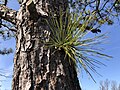
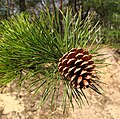
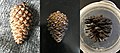
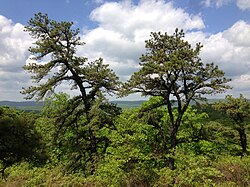
The pitch pine is irregular in shape, but grows to 6–30 metres (20–98 ft)). Branches are usually twisted, and it does a poor job at self-pruning. The needles are in fascicles (bundles) of three, about 6–13 centimetres (2+14–5 inches) in length, and are stout (over 1 millimetre or 116 inch broad) and often slightly twisted. The cones are 4–7 cm (1+122+34 in) long and oval, with prickles on the scales. Trunks are usually straight with a slight curve, covered in large, thick, irregular plates of bark. Pitch pine has a high regenerative ability; if the main trunk is cut or damaged by fire, it can re-sprout using epicormic shoots. This is one of its many adaptations to fire, which also include a thick bark to protect the sensitive cambium layer from heat. Burnt pitch pines often form stunted, twisted trees with multiple trunks as a result of the resprouting. This characteristic makes it a popular species for bonsai.[citation needed]

Pitch pine is rapid-growing when young, gaining around 30 cm (12 in) height per year under optimal conditions, until growth slows at 50–60 years. By 90 years of age, the amount of annual height gain is minimal. Open-growth trees begin bearing cones in as little as three years, with shade-inhabiting pines taking a few years longer. The cones take two years to mature. Seed dispersal occurs over the fall and winter, and trees cannot self-pollinate. The lifespan of a pitch pine is about 200 years or longer, up to a maximum recorded age of 398 years.[5]

Pitch Pine being trained as bonsai. This specimen was collected in the wild.

Taxonomy

[edit]

It was given its scientific name, Pinus rigida, by the British botanist Philip Miller.[4] It belongs to the family Pinaceae and the subgenus Pinus, along with other hard pines.[5]

Distribution and habitat

[edit]

Pitch pine is found mainly in the southern areas of the northeastern United States, from coastal Maine and Ohio to Kentucky and northern Georgia. A few stands occur in southern Quebec and Ontario, mostly in two pockets along the St. Lawrence River. It is known as a pioneer species and is often the first tree to vegetate a site after it has been cleared away. It is a climax vegetation type in extreme conditions, but in most cases it is replaced by oaks and other hardwoods. This pine occupies a variety of habitats, from dry, acidic sandy uplands to swampy lowlands, and can survive in very poor conditions. It is the primary tree of the Atlantic coastal pine barrens ecoregion.[6]

Hybrids

[edit]

This species occasionally hybridizes with other pine species, such as loblolly pine (Pinus taeda), shortleaf pine (Pinus echinata), and pond pine (Pinus serotina); the last is treated as a subspecies of pitch pine by some botanists.

The pitlolly pine (Pinus × rigitaeda) is a natural hybrid with the loblolly pine which combines the tall size of the loblolly pine and the cold-hardiness of the pitch pine. This hybrid was used as substitute of loblolly pine and has been extensively planted in South Korea.[7]


Ecology

[edit]

Pitch pines provide habitat and food for many wildlife species. They are used for cover and nesting by birds such as the pine warbler, wild turkey, red-cockaded woodpecker, great-crested flycatcher, blue jay, black-capped chickadee, black-and-white warbler, Nashville warbler, and chestnut-sided warbler. Deer consume seedlings and new sprouts, and small mammals and birds eat the seeds.[8]

Uses

[edit]

Because it frequently grows multiple or crooked trunks, pitch pine is not a major timber tree, nor is it as fast-growing as other eastern American pines. However, it grows well on unfavorable sites. In the past, it was a major source of pitch and timber for ship building, mine timbers, and railroad ties because the wood's high resin content preserves it from decay. As such, it has also been used for elaborate wood constructions, e. g. radio towers.

Pitch pine is currently used mainly for rough construction, pulp, crating, and fuel. However, due to its uneven growth, quantities of high quality can be difficult to obtain, and long lengths of pitch pine can be very costly.

Archaeology indicates that the Iroquois, Shinnecock, and Cherokee all utilized pitch pine. The Iroquois used the pitch to treat rheumatism, burns, cuts, and boils. Pitch also worked as a laxative. A pitch pine poultice was used by both the Iroquois and the Shinnecock to open boils and to treat abscesses.[9] The Cherokee used pitch pine wood in canoe construction and for decorative carvings.

[edit]

References

[edit]
Revisions and contributorsEdit on WikipediaRead on Wikipedia
from Grokipedia
Pinus rigida, commonly known as pitch pine, is a medium-sized in the family () that typically grows to 20–30 meters (65–100 feet) tall with a trunk of up to 90 cm (3 feet), though it can vary from a in harsh conditions to a taller in favorable sites. It features stiff, yellow-green needles in bundles of three (occasionally up to five), each 5–10 cm (2–4 inches) long, and ovoid to conic seed cones 3–9 cm (1–3.5 inches) long with thick, armed scales that are often serotinous, meaning they remain closed until opened by . The bark is thick, red-brown, and deeply furrowed, providing resistance, while the 's high content gives it a sticky, pitchy quality. Native to eastern , Pinus rigida ranges from southern and southeastern southward to northern Georgia and western , with disjunct populations in and , primarily occurring on the Atlantic Coastal Plain at elevations from to 1,400 meters (4,600 feet). It thrives in nutrient-poor, acidic soils including dry sandy barrens, rocky ridges, coastal plains, and wetland edges, tolerating extreme conditions such as , cold temperatures down to -40°C (-40°F), and moderate . Ecologically, pitch pine is a fire-adapted that dominates early-successional and is often considered a on xeric sites like rocky outcrops, where it can live up to 200 years or more. Its serotinous cones release seeds post-fire, and the regenerates vigorously through basal and epicormic sprouting, enabling rapid recolonization in fire-prone ecosystems with return intervals of 5–150 years. Without frequent fires, it is typically succeeded by hardwoods like oaks, and it supports diverse , including birds that feed on its seeds (e.g., ) and deer that browse its foliage. Historically, Pinus rigida has been valued for its resinous wood, used in , , and the production of , , and pitch, though it is now considered low-value timber due to its coarse grain. It also plays a role in on poor soils and provides habitat for species like the endangered in certain regions. Taxonomically, it belongs to subgenus Pinus, section Trifoliae, subsection Australes, and occasionally hybridizes with species like and .

Biology

Description

Pinus rigida is a medium-sized typically reaching heights of 15 to 25 m, with exceptional specimens attaining up to 30 m. The trunk commonly measures 0.5 to 1 m in diameter, though a maximum of 1.09 m has been recorded. Its bark is thick, scaly, and colored reddish-brown to gray-black, offering resistance to damage. The branches are irregular and often crooked, supporting an open crown that is oval to irregular in shape and can spread up to 15 m in open-grown trees. The needles are arranged in bundles of three (occasionally two or four), measuring 7 to 13 cm in length, and are dark green, stiff, twisted, and sharply pointed, persisting on the for 2 to 4 years. Cones are ovoid to conical, 4 to 7 cm long and 2.5 to 3.5 cm wide when closed, with reddish-brown coloration and prickly scales armed with short, stout prickles. Many cones are serotinous, remaining sealed by resin until heated by fire to release seeds, while non-serotinous cones open at maturity in the second summer. Seeds are three-angled, 4 to 5 mm long, equipped with wings 15 to 21 mm in length for wind dispersal. The wood of P. rigida is coarse-grained and highly resinous, featuring light yellow to orange-brown heartwood and pale sapwood, with a density of 513 kg/m³. It exhibits a medium growth rate of 0.3 to 0.6 m per year after initial slow establishment, achieving a lifespan of 100 to 200 years, with some individuals exceeding 350 years. The species demonstrates physiological resilience through its ability to sprout from the root collar following fire or mechanical injury.

Taxonomy

Pinus rigida is the accepted for the pitch pine, first described by the British Philip in 1768 in the eighth edition of his The Gardeners Dictionary. The generic name Pinus derives from the Latin word for pine tree, reflecting its long-standing recognition in classical literature, while the specific epithet rigida means "rigid" or "stiff" in Latin, alluding to the tree's characteristically rigid needles. In the taxonomic hierarchy, P. rigida is classified within Kingdom Plantae, Phylum Tracheophyta, Class Pinopsida, Order , Family , Genus Pinus, Subgenus Pinus (the hard or yellow pines), Section Trifoliae, and Subsection Australes. This placement aligns it with other three-needled pines characterized by persistent fascicle sheaths and closed cones. Historical synonyms include Pinus taeda var. rigida (Aiton) and Pinus triflora Salisb., though these are no longer recognized. The variety Pinus rigida var. serotina (Michx.) Loudon, sometimes applied to pond pine (P. serotina), is not widely accepted in modern due to distinct morphological and genetic differences between the species. Phylogenetically, P. rigida belongs to the group within Pinus, specifically the , which comprises six southeastern U.S. species. It is closely related to P. serotina (pond pine), with transcriptome analyses positioning them as sister taxa, and to P. echinata (shortleaf pine), with which it hybridizes naturally. Nuclear DNA studies indicate regional variation, linking southern populations to P. taeda (loblolly pine) and northern ones to P. serotina. The diversification of Pinus, including Subsection Australes, occurred primarily during the epoch (approximately 23–5 million years ago), as part of a broader radiation that gave rise to about 90% of extant pine species. Genetically, P. rigida is diploid with a number of 2n = 24, consistent across the family. Allozyme studies reveal relatively low levels of genic diversity compared to other species, with most variation occurring within populations rather than between them, attributed to historical population bottlenecks during Pleistocene glaciations.

Distribution and Habitat

Native Range

Pinus rigida, commonly known as pitch pine, is native to eastern , with its primary range extending from central and southern southward to northern Georgia, and westward to western and . This distribution encompasses a broad swath of the Atlantic coastal plain and adjacent uplands, including disjunct populations in southwestern and southeastern Ontario along the . The species occurs across approximately 20 states and provinces, with fragmented inland stands reflecting post-glacial dispersal patterns. Core concentrations of P. rigida are found in the , which represent the largest contiguous stand of this species at around 450,000 hectares, as well as on and the coastal plain from to . These areas feature extensive pine-oak barrens where P. rigida dominates due to its adaptation to sandy, fire-prone soils. Inland populations are more scattered, often in isolated pockets on glacial outwash plains or mountainous regions. The elevation range of P. rigida spans from to about 1,700 meters (5,600 feet), though it primarily inhabits lowlands below 600 meters and is less common at higher altitudes except in southern portions of its range. Historically, the species has maintained a stable distribution since post-glacial colonization around 10,000 years ago, originating from multiple refugia in the ; minor contractions occurred due to agricultural clearing, offset by expansions into abandoned fields. The total native range covers roughly 1.5 million square kilometers, characterized by discontinuous stands that highlight its preference for disturbed, nutrient-poor sites. Outside its native range, P. rigida has been introduced to , including the and , and to for experimental plantings and trials, though it has not widely naturalized in these regions.

Preferred Conditions

Pinus rigida thrives in a variety of abiotic conditions typical of disturbed or marginal sites, particularly those with poor soil quality and exposure to environmental stresses. It prefers sandy, gravelly, or thin soils that are infertile and acidic, often with a pH ranging from 3.4 to 4.5, though can occur across a broader pH of 4 to 8.3. These soils are typically well-drained to rapidly draining, such as those found in glacial outwash or coastal sands, but the species also tolerates poorly drained or swampy conditions in lowland areas. It performs best on nutrient-impoverished substrates like Spodosols, , Alfisols, and Ultisols, avoiding heavy clay or high-fertility loams that favor more competitive vegetation. Topographically, Pinus rigida is commonly associated with flat to gently sloping coastal plains, inland ridges, rocky outcrops, and dry sand plains, occurring from up to elevations of about 1,700 meters. In terms of , it adapts to humid continental to subtropical regimes with annual of 940 to 1,420 mm, well-distributed throughout the year, and temperature extremes from -40°C to 40°C. The frost-free period typically spans 112 to 196 days, allowing establishment in regions with moderate growing seasons. Regarding water relations, mature Pinus rigida exhibits high , surviving prolonged dry periods on xeric sites, while seedlings require consistent for initial . It also withstands periodic flooding in lowlands, with young showing improved survival through flood-hardening mechanisms. is a critical factor, as the species demands full sun and is highly shade-intolerant, functioning as a pioneer in open, exposed habitats where it can achieve optimal and growth on bare mineral . Among its tolerance limits, Pinus rigida demonstrates notable resistance to salt spray along coastal margins, though extreme exposure may restrict its distribution to slightly inland positions.

Ecology

Life Cycle and Reproduction

The life cycle of Pinus rigida, commonly known as pitch pine, is characterized by a fire-adapted strategy that integrates via wind-dispersed seeds and asexual regeneration through sprouting, enabling persistence in disturbance-prone habitats. typically requires of the seed coat and exposure to mineral soil, which can be achieved naturally by or mechanically in cultivation; optimal temperatures for germination range from 20°C to 30°C, with seedlings emerging in 10 to 20 days under these conditions. During the seedling stage, growth is initially slow, with first-year height often less than 10 cm, rendering young particularly vulnerable to and competition; successful establishment occurs preferentially on exposed mineral soil substrates. Trees reach reproductive maturity between 10 and 20 years of age, at which point they produce pollen cones and ovulate cones annually in spring, supporting ongoing production. is anemophilous, relying on dispersal, with fertilization delayed until approximately 13 months post-, a common trait among pines that aligns cone maturation with seasonal cues. Cone development in P. rigida features a mix of serotinous and non-serotinous types, with serotinous cones comprising 60-98% of the total depending on site conditions (higher in uplands); these remain sealed by for decades until exposure to temperatures exceeding 49°C melts the seals, releasing seeds en masse, while non-serotinous cones open naturally upon maturity. Regeneration post- is robust, involving from epicormic buds, bole, or root collar with survival rates up to 90% in resprouting individuals, complemented by wind-dispersed seeds that typically travel 50-100 m from parent . The species progresses through distinct life stages: a juvenile phase (0-10 years) marked by rapid height growth to establish canopy position; a mature phase (20-100 years) during which cone production peaks and fire resilience is maximized; and a senescent phase (>150 years) with declining vigor, though individuals can persist up to 200 years in favorable conditions.

Ecological Interactions

Pinus rigida forms ectomycorrhizal associations with various fungi, including Pisolithus tinctorius and species of Suillus, which enhance nutrient uptake, particularly phosphorus, in nutrient-poor soils. These symbioses are common, with mycorrhizal colonization observed on roots of seedlings as young as two months old in New Jersey pine barrens. The associations improve seedling growth under phosphorus limitation, allowing the tree to thrive in acidic, sandy environments. Pollination in P. rigida is anemophilous, relying on to transfer between male and female cones. occurs primarily by over short distances, but animals play a key role in longer-range dissemination; birds such as eastern towhees and small mammals like squirrels cache seeds, promoting establishment away from parent s. Herbivory affects P. rigida at various life stages, with browsing seedlings and sprouts, leading to up to 65% damage in some populations. pests include the pine tip moth (Rhyacionia spp.), which causes shoot defoliation, the southern pine beetle (Dendroctonus frontalis), responsible for mortality during outbreaks, and the pitch mass borer (Synanthedon spp.), which attacks trunks and weakens mature s. Pathogens such as cause , while Lophodermium spp. induce needle cast, resulting in foliage loss; however, the species' high content provides against many invaders. In ecosystems, P. rigida dominates communities, where it creates acidic litter layers with below 4, inhibiting plant growth and maintaining open-canopy conditions. It acts as a subclimax in fire-prone s, facilitating succession to mixed oak-pine forests following disturbances that release serotinous seeds. P. rigida supports diverse wildlife, providing nesting for birds like the (Setophaga pinus), which favors pine-dominated stands for breeding. Its cones serve as mast for gray squirrels, and seeds are consumed by eastern chipmunks, with predation rates varying annually but often exceeding 80% of the cone crop in high-predator years.

Conservation

Status and Threats

Pinus rigida is assessed as globally secure (G5) by NatureServe, indicating that the species maintains large, stable populations across its range with no immediate threats to its persistence. The International Union for Conservation of Nature (IUCN) classifies it as Least Concern, based on a 2013 assessment that has not been updated as of 2025, reflecting its widespread distribution and abundance in suitable habitats. Regionally, the species ranks as secure (S5) in core states such as and New York, apparently secure (S4) in , and apparently secure (S4) in , though it faces greater vulnerability at the periphery of its range where populations are smaller and more fragmented. Habitat loss due to urban and agricultural development poses a significant threat, particularly in the , where forest patches have decreased in size and increased in fragmentation since the , disrupting connectivity and reducing available area for natural regeneration. Fire suppression, a common management practice in fire-adapted , alters natural disturbance regimes and inhibits seedling establishment, leading to sparse regeneration and shifts toward dominance in pitch pine stands, with some areas experiencing up to 50% reduction in pine cover over decades. exacerbates these pressures through increased droughts, warmer winters, and shifting pest ranges, with projections indicating potential northward range expansion of up to several hundred kilometers by 2100, alongside habitat loss in southern portions due to unsuitable conditions. Invasive species contribute to competitive stress and defoliation; for instance, the spongy moth (Lymantria dispar) causes significant radial growth reductions in P. rigida through repeated defoliation events, particularly in oak-pine woodlands. Other invasives, such as black locust (Robinia pseudoacacia), encroach into pitch pine habitats, altering soil dynamics and outcompeting native regeneration. Additional stressors include air pollution, where P. rigida shows high tolerance to acid rain but sensitivity to ozone, which damages seedlings and reduces photosynthetic efficiency even at ambient levels. Overbrowsing by white-tailed deer (Odocoileus virginianus) in regrowth areas further hampers seedling survival, compounding drought effects and slowing recovery in disturbed sites. Overall population trends remain stable in protected areas like national seashores and preserves, where management maintains habitat integrity, but declines occur in urban fringes due to combined development and suppression of natural fires.

Management and Protection

The Pinelands National Reserve, encompassing approximately 1.1 million acres across seven counties, serves as a primary for Pinus rigida ecosystems, designated as a Reserve in 1988 to preserve the unique pygmy forests dominated by pitch pine. The Albany Pine Bush Preserve in New York, covering about 1,300 hectares, protects globally rare inland where P. rigida dominates with over 60% canopy cover, supporting fire-adapted communities through active management. In , the contributes to regional conservation by managing fire-prone pine habitats that include P. rigida stands, integrating prescribed burns to maintain amid ecosystems. Restoration efforts for P. rigida emphasize prescribed burns to mimic natural fire regimes, typically conducted every 10 to 30 years to promote recruitment and reduce fuel loads, with studies showing enhanced regeneration rates following such treatments. Mechanical scarification and mowing prepare seedbeds by exposing mineral soil, facilitating in disturbed sites, while 1- to 2-year-old are often planted at spacings around 1.5 by 1.5 meters to optimize growth in restored barrens. These practices have demonstrated success in reestablishing pitch pine dominance, with post-burn sprouting exceeding 55% for resilient and overall community recovery in fire-suppressed areas. Policy frameworks support P. rigida conservation through state-level protections in , where the species is considered sensitive within the Pinelands under the New Jersey Pinelands Protection Act of 1979, guiding land use to prevent . Federally, the U.S. Forest Service provides guidelines for fire management in pitch pine communities, recommending low-intensity burns to enhance survival and reduce wildfire risk, as outlined in silvicultural practices for eastern . Monitoring programs assess genetic diversity in P. rigida populations using molecular markers, including simple sequence repeats (SSR), to evaluate structure and variation across ranges, revealing higher intrapopulation diversity in outbreeding stands. Population viability models incorporate fire management scenarios, predicting up to 80% long-term persistence for actively restored sites by simulating disturbance-dependent dynamics. Ex situ conservation includes seed banking of P. rigida at the USDA National Seed Storage Laboratory, where orthodox pine seeds are stored for long-term genetic preservation as part of broader U.S. analyses. Botanical gardens such as the maintain living collections of P. rigida, supporting efforts with over 500 taxa to safeguard against threats. Community involvement is integral through New Jersey Department of Environmental Protection (NJDEP) programs in the , which coordinate prescribed burns and removal to restore P. rigida-dominated habitats, engaging local stakeholders in fuel reduction and ecological monitoring initiatives.

Uses

Commercial Applications

Pinus rigida, commonly known as pitch pine, serves primarily as a low-value in commercial , utilized for production, mine timbers, railroad ties, posts, and rough materials such as beams and poles. Its wood is coarse-grained and highly resinous, which contributes to moderate decay resistance in the heartwood, particularly in wet environments where the resin acts as a natural , though overall rot resistance is rated as moderate to low. Commercial harvest volumes remain limited, reflecting its secondary role compared to more productive pine species, with no dominant contribution to national timber output. Historically, pitch pine was tapped for to produce , , and pitch, especially during the colonial when it was known as "lightwood" for its resinous knots used in torches and naval stores. This was extracted by scarifying bark on standing trees or distilling oleoresins, yielding products essential for waterproofing and adhesives. In modern contexts, extraction is limited, with occasional use in specialty adhesives derived from its high-terpene content. As fuelwood, pitch pine has been employed in rural areas, offering a calorific value of approximately 19 MJ/kg for dry wood, though it has largely been supplanted by higher-energy hardwoods in contemporary use. Other minor products include needles processed into , bark for landscaping applications, and essential oils distilled from needles with yields around 0.08%. These niche outputs derive from the 's abundant foliage and resinous byproducts. Its commercial viability is declining relative to faster-growing species like loblolly pine (Pinus taeda), due to pitch pine's knotty form and slower growth on marginal sites. Historically, it held greater significance in 18th- and 19th-century shipbuilding, where pitch served as a key caulking material to seal hulls and rigging against water.

Ecological and Ornamental Roles

Pinus rigida plays a significant role in ecological restoration projects, particularly for stabilizing sandy and disturbed soils in coastal and inland environments. It is commonly employed in reclaiming coastal dunes and degraded sites due to its tolerance for poor, acidic, and nutrient-deficient conditions, where it helps prevent through its . The species' roots can extend to depths of 0.9 to 1.5 meters even in saturated soils, providing effective soil binding and contributing to long-term site stabilization. In regions like the , including , pitch pine is integrated into conservation plantings to restore critical areas such as dunes and outwash plains, enhancing and recovery. In ornamental landscaping, Pinus rigida is valued for its adaptability and resilience, often planted in parks and urban green spaces as windbreaks and for on slopes or exposed sites. Its irregular, open growth habit makes it suitable for naturalized settings, while selected cultivars, such as the narrow-form 'Fastigiata', offer more compact options for smaller landscapes. The tree is hardy in USDA zones 4 through 7, enduring cold temperatures down to -34°C and thriving in full sun with minimal maintenance. It tolerates a range of challenging conditions, including dry, rocky soils and salt spray near coastlines, making it ideal for low-maintenance ornamental applications. For wildlife enhancement, Pinus rigida is promoted in managed habitats to support species dependent on open pine woodlands, such as the (Dryobates borealis), which excavates cavities in mature pitch pines. These stands provide essential nesting and foraging opportunities, with the tree's structure facilitating the bird's requirements for fire-maintained, open canopies. Additionally, pitch pine offers thermal cover during winter, sheltering small mammals and birds from harsh weather in its dense lower branches and needle litter. In the , pitch pine often forms an overstory canopy in habitats with blueberries, contributing to through needle litter decomposition, which maintains the low preferred by acid-loving plants like blueberries. Cultivation of Pinus rigida for ecological and ornamental purposes typically involves seed propagation, with rates improved by cold stratification for several weeks prior to sowing, achieving viable establishment on exposed mineral soil. Recommended planting spacing is approximately 3 meters by 3 meters to allow for natural development while promoting stand density; the species tolerates urban pollution and compacted soils but benefits from simulated fire pruning to mimic natural disturbance and encourage regeneration. Recent initiatives highlight Pinus rigida's role in climate-resilient , including post-hurricane replanting efforts in the , where its wind resistance and rapid recolonization potential aid in recovering storm-damaged coastal ecosystems. These projects emphasize like pitch pine to enhance landscape durability against increasing storm frequency.

References

Add your contribution
Related Hubs
User Avatar
No comments yet.