



Community hub
Recent from talks
Knowledge base stats:
Talk channels stats:
Members stats:
Tar
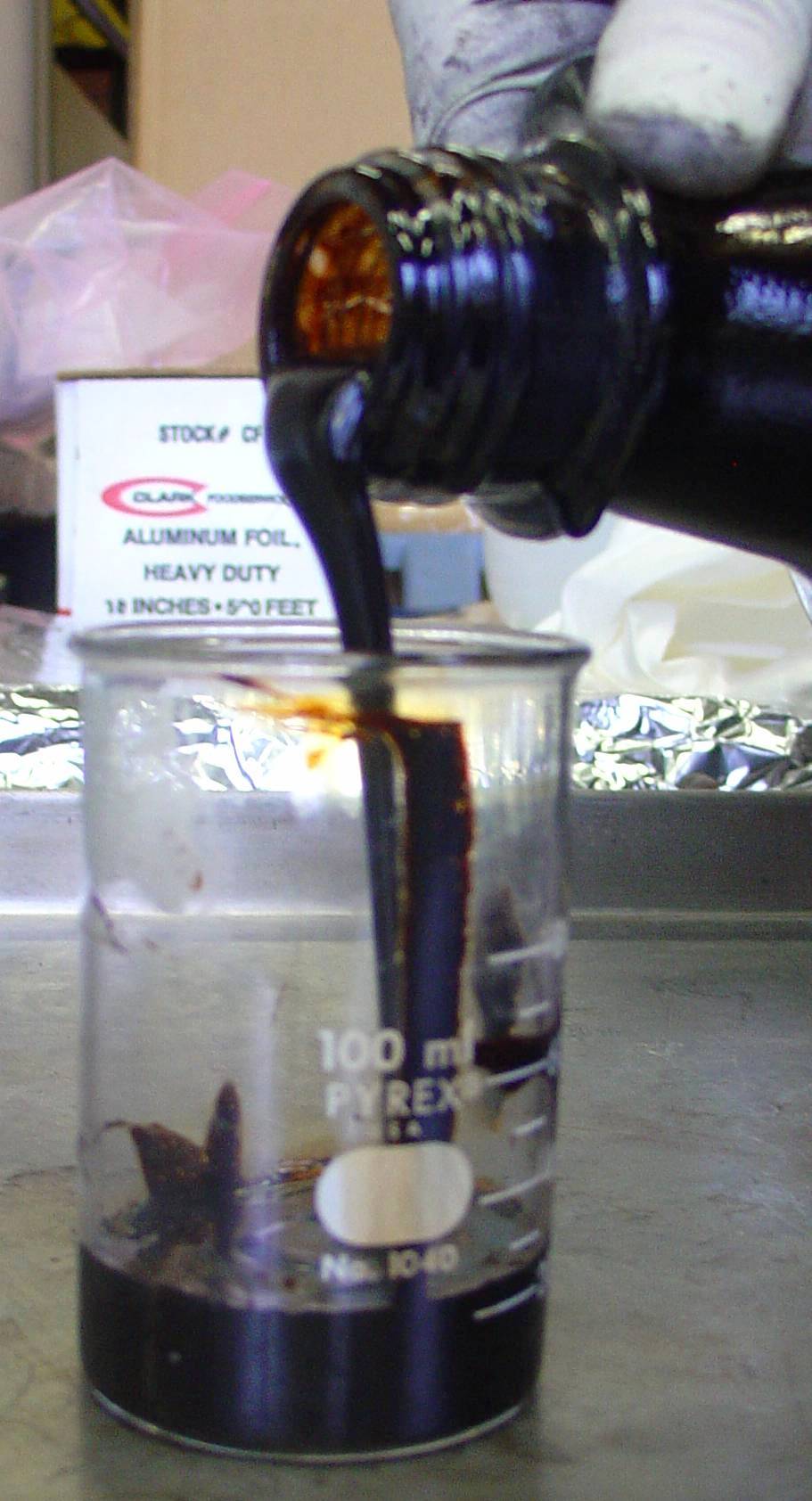
Tar is a dark brown or black viscous liquid of hydrocarbons and free carbon, obtained from a wide variety of organic materials through destructive distillation. Tar can be produced from coal, wood, petroleum, or peat.
Mineral products resembling tar can be produced from fossil hydrocarbons, such as petroleum. Coal tar is produced from coal as a byproduct of coke production.
"Tar" and "pitch" can be used interchangeably. Asphalt (naturally occurring pitch) may also be called either "mineral tar" or "mineral pitch". There is a tendency to use "tar" for more liquid substances and "pitch" for more solid (viscoelastic) substances. Both "tar" and "pitch" are applied to viscous forms of asphalt, such as the asphalt found in naturally occurring tar pits (e.g., the La Brea Tar Pits in Los Angeles). "Rangoon tar", also known as "Burmese oil" or "Burmese naphtha", is also a form of petroleum. Oil sands, found extensively in Alberta, Canada, and composed of asphalt, are colloquially referred to as "tar sands".
Since prehistoric times wood tar has been used as a water repellent coating for boats, ships, sails, and roofs. In Scandinavia, it was produced as a cash crop. "Peasant Tar" might be named for the district of its production.
Wood tar is still used as an additive in the flavoring of candy, alcohol, and other foods. Wood tar is microbicidal. Producing tar from wood was known in ancient Greece and has probably been used in Scandinavia since the Iron Age. Production and trade in pine-derived tar was a major contributor in the economies of Northern Europe and Colonial America. Its main use was in preserving wooden sailing vessels against rot. For centuries, dating back at least to the 14th century, tar was among Sweden's most important exports. Sweden exported 13,000 barrels of tar in 1615 and 227,000 barrels in the peak year of 1863. The largest user was the Royal Navy of the United Kingdom. Demand for tar declined with the advent of iron and steel ships. Production nearly stopped in the early 20th century. Traditional wooden boats are still sometimes tarred.
The heating (dry distilling) of pine wood causes tar and pitch to drip away from the wood[citation needed] and leave behind charcoal. Birch bark is used to make particularly fine tar, known as "Russian oil", used in Russian leather protection. The by-products of wood tar are turpentine and charcoal. When deciduous tree woods are subjected to destructive distillation, the products are methanol (wood alcohol) and charcoal.
Tar kilns (Swedish: tjärmila, Danish: tjæremile, Norwegian: tjæremile, Finnish: tervahauta) are dry distillation ovens, historically used in Scandinavia for producing tar from wood. They were built close to the forest, from limestone or from more primitive holes in the ground. The bottom is sloped into an outlet hole to allow the tar to pour out. The wood is split into dimensions of a finger, stacked densely, and finally covered tight with earth and moss. If oxygen can enter, the wood might catch fire, and the production would be ruined. On top of this, a fire is stacked and lit. After a few hours, the tar starts to pour out and continues to do so for a few days.
Tar was used as seal for roofing shingles and tar paper and to seal the hulls of ships and boats. For millennia, wood tar was used to waterproof sails and boats, but today, sails made from inherently waterproof synthetic substances have reduced the demand for tar. Wood tar is still used to seal traditional wooden boats and the roofs of historic, shingle-roofed churches, as well as painting exterior walls of log buildings. Tar is also a general disinfectant. Pine tar oil, or wood tar oil, is used for the surface treatment of wooden shingle roofs, boats, buckets, and tubs and in the medicine, soap, and rubber industries. Pine tar has good penetration on the rough wood. An old wood tar oil recipe for the treatment of wood is one-third each genuine wood tar, balsam turpentine, and boiled or raw linseed oil or Chinese tung oil.[citation needed]
Hub AI
Tar AI simulator
(@Tar_simulator)
Tar
Tar is a dark brown or black viscous liquid of hydrocarbons and free carbon, obtained from a wide variety of organic materials through destructive distillation. Tar can be produced from coal, wood, petroleum, or peat.
Mineral products resembling tar can be produced from fossil hydrocarbons, such as petroleum. Coal tar is produced from coal as a byproduct of coke production.
"Tar" and "pitch" can be used interchangeably. Asphalt (naturally occurring pitch) may also be called either "mineral tar" or "mineral pitch". There is a tendency to use "tar" for more liquid substances and "pitch" for more solid (viscoelastic) substances. Both "tar" and "pitch" are applied to viscous forms of asphalt, such as the asphalt found in naturally occurring tar pits (e.g., the La Brea Tar Pits in Los Angeles). "Rangoon tar", also known as "Burmese oil" or "Burmese naphtha", is also a form of petroleum. Oil sands, found extensively in Alberta, Canada, and composed of asphalt, are colloquially referred to as "tar sands".
Since prehistoric times wood tar has been used as a water repellent coating for boats, ships, sails, and roofs. In Scandinavia, it was produced as a cash crop. "Peasant Tar" might be named for the district of its production.
Wood tar is still used as an additive in the flavoring of candy, alcohol, and other foods. Wood tar is microbicidal. Producing tar from wood was known in ancient Greece and has probably been used in Scandinavia since the Iron Age. Production and trade in pine-derived tar was a major contributor in the economies of Northern Europe and Colonial America. Its main use was in preserving wooden sailing vessels against rot. For centuries, dating back at least to the 14th century, tar was among Sweden's most important exports. Sweden exported 13,000 barrels of tar in 1615 and 227,000 barrels in the peak year of 1863. The largest user was the Royal Navy of the United Kingdom. Demand for tar declined with the advent of iron and steel ships. Production nearly stopped in the early 20th century. Traditional wooden boats are still sometimes tarred.
The heating (dry distilling) of pine wood causes tar and pitch to drip away from the wood[citation needed] and leave behind charcoal. Birch bark is used to make particularly fine tar, known as "Russian oil", used in Russian leather protection. The by-products of wood tar are turpentine and charcoal. When deciduous tree woods are subjected to destructive distillation, the products are methanol (wood alcohol) and charcoal.
Tar kilns (Swedish: tjärmila, Danish: tjæremile, Norwegian: tjæremile, Finnish: tervahauta) are dry distillation ovens, historically used in Scandinavia for producing tar from wood. They were built close to the forest, from limestone or from more primitive holes in the ground. The bottom is sloped into an outlet hole to allow the tar to pour out. The wood is split into dimensions of a finger, stacked densely, and finally covered tight with earth and moss. If oxygen can enter, the wood might catch fire, and the production would be ruined. On top of this, a fire is stacked and lit. After a few hours, the tar starts to pour out and continues to do so for a few days.
Tar was used as seal for roofing shingles and tar paper and to seal the hulls of ships and boats. For millennia, wood tar was used to waterproof sails and boats, but today, sails made from inherently waterproof synthetic substances have reduced the demand for tar. Wood tar is still used to seal traditional wooden boats and the roofs of historic, shingle-roofed churches, as well as painting exterior walls of log buildings. Tar is also a general disinfectant. Pine tar oil, or wood tar oil, is used for the surface treatment of wooden shingle roofs, boats, buckets, and tubs and in the medicine, soap, and rubber industries. Pine tar has good penetration on the rough wood. An old wood tar oil recipe for the treatment of wood is one-third each genuine wood tar, balsam turpentine, and boiled or raw linseed oil or Chinese tung oil.[citation needed]