
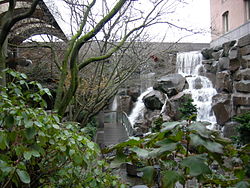


Community hub
Recent from talks
Contribute something
Nothing was collected or created yet.
Pocket park
View on Wikipedia
A pocket park (also known as a parkette, mini-park, vest-pocket park or vesty park) is a small park accessible to the general public. While the locations, elements, and uses of pocket parks vary considerably, the common defining characteristic of a pocket park is its small size.[1] Typically, a pocket park occupies one to three municipal lots and is smaller than 0.5 hectares (1 acre) in size.[2]
Pocket parks can be urban, suburban or rural, but they customarily appear in densely urbanized areas, where land is very expensive and space for the development of larger urban parks is limited.[1] They are frequently created on small, irregular pieces of public or private land, such as in vacant building lots, in brownfields, beside railways, beneath utility lines, or in parking spots.[3]
Pocket parks can create new public spaces without the need for large-scale redevelopment. In inner-city areas, pocket parks are often part of urban regeneration efforts by transforming underutilized or blighted spaces into vibrant community assets.[3] They may also be created as a component of the public space requirement of large building projects.
Pocket parks can serve as focal points of activity and interest in urban areas.[4] Common elements of pocket parks include benches, tables, fountains, playgrounds, monuments, historic markers, art installations, barbecue pits, flower beds, community gardens, or basketball courts.[1][5] Although they are often too small for many space-intensive physical activities, pocket parks provide communities with greenery, a place to sit and rest, and an ecological foothold for urban wildlife.
History
[edit].jpg)
The first pocket parks appeared in Europe in the aftermath of World War II. As cities began to recover from the large-scale physical damage incurred by warfare, such as from bombings, limitations in capital, labor, and building materials necessitated cheap, easy, and minimalistic solutions to restore urban landscapes. These constraints promoted the conversion of heavily damaged sites into small public parks which echoed the neighborhood's original peacetime identities.[1][3]
By the 1950s, the first pocket parks appeared in the United States as an adaptation of these small European parks. Inspired by this readaptation of urban space, landscape architect and professor Karl Linn proposed the transformation of vacant lots in Baltimore, Philadelphia, and Washington D.C. into neighborhood commons.[1] These small urban spaces served as low-cost interventions to improve the quantity and quality of community gathering spaces and recreational facilities in dense urban areas.[1]
In 1964, Whitney North Seymour Jr. advocated for the creation of pocket parks in New York City during his tenure as president of the Park Association of New York.[6] Congressman John Lindsay endorsed the creation of pocket parks in his 1965 campaign for New York City mayor, and Paley Park, a premier privately owned public space and prominent example of a pocket park, opened during his mayoralty in 1967.[6]
One of the first municipal programs to fund and structure the creation of pocket parks in the United States occurred in Philadelphia. In 1967, a $320,000 urban beautification campaign encouraged community groups to identify and nominate disused parcels for development into pocket parks. Upon approval, the city provided technical knowledge and financial support to residents, who would collaborate with city officials to design, construct, and maintain the new parks. From their onset, these pocket parks were well received by municipal workers and residents.[3] To this day, the City of Philadelphia manages over 150 neighborhood parks.[1] Baltimore features a pocket park, Robert Baker Park, commemorating widely recognized horticlturalist and botanist Robert Lewis Baker — almost adjacent to its large and historic Federal Hill Park.
Development and design
[edit]
Pocket parks typically develop on small, solitary, irregularly shaped, and physically damaged lots. Because these parcels may not be conducive to commercial development, the land on which they are situated is often relatively cheap to acquire, and transforming the neglected parcel into public or green space may be the only viable opportunity for redevelopment.[1] Thus, the placement and creation of pocket parks tends to be an opportunistic product of environmental circumstance rather than through deliberate master planning.[5]
Due to their small size, pocket parks typically serve a hyperlocal population, and the limited opportunities for park form and function are closely tied to these local community needs.[5] For example, a pocket park in a business district may prioritize tables and seating for employees to take a lunch break, while a pocket park in a residential area may prioritize a structure for children to play on.[citation needed]
Consequently, the development of pocket parks generally entails extensive public participation and collaboration between community members, landscape architects, municipal officials, and local institutions such as businesses or schools.[3] Through this community organization, the development of pocket parks promotes grassroots planning and strengthens relationships between residents and local authorities.[citation needed]
Community impact
[edit]
Despite their small footprint, pocket parks can dramatically enhance the quality of life of their surrounding communities.[1]
Pocket parks prevent overdevelopment in dense neighborhoods and vary the form of the built environment with islands of shade, quiet, and privacy, which may otherwise be difficult to find in urban areas.[5] Well-maintained pocket parks can deter visual signs of urban neglect by discouraging the vandalism which occurs in otherwise abandoned lots.[1] The beautification efforts of pocket parks can increase a neighborhood's aesthetic appeal and shape a distinct, positive visual identity for a city as a whole.[5]
The creation of pocket parks encourages public participation and residential collaboration towards a meaningful long-term improvement to the community.[1] In turn, this community participation can foster community pride and empower residents to tackle additional neighborhood improvement projects.
Unlike a singular large scale urban park, numerous pocket parks can be distributed throughout a single neighborhood, and multiple pocket parks can be spaced close together. This distribution increases the usefulness and accessibility of green urban spaces by decreasing the distance and time between parks and their users, especially for users who have difficulty travelling long distances, such as children, the elderly, or individuals with mobility impairments.[1] This close proximity can also generate strong personal attachments and positive associations of place identity, especially among children who grow up in neighborhoods containing pocket parks.[1]
These positive impacts are magnified in neighborhoods with low-income or racial minority populations, where green space may be scarce and the new development of larger-scale parks may be infeasible due to spatial or financial constraints.[1][4] These benefits also particularly improve the quality of urban life for women, who are more likely to use pocket parks than men.[8]
Economic impact
[edit]One study conducted in Greenville, South Carolina, found that "attractively maintained small and medium parks have a positive influence on neighboring property values."[9] Despite this potential to inflate local housing costs, pocket parks are less likely to contribute to environmental gentrification than larger urban parks.[10]
Ecological impact
[edit]Patches of green landscaping and permeable surfaces within pocket parks can mitigate the urban heat island effect, aid in stormwater management, and help control microclimates.[11] This greenery can also attract and harbor urban wildlife, especially birds. However, pocket parks are typically designed for human use and therefore may only provide limited ecological benefits to non-human species.[5]
The establishment of local pocket parks can reduce the stress upon larger urban parks, such as by eliminating overcrowding. The use of local pocket parks instead of more distant large urban parks reduces the traffic, pollution, and energy consumption associated with automobile travel and can allow larger parks to dedicate more space to uses beyond what a pocket park can offer, such as for large-scale natural habitats.[5]
Public health and safety impact
[edit]Pocket parks can deter the accumulation of unsanitary and potentially biohazardous waste, promoting positive externalities on public health.[1]
A study in Los Angeles concluded that pocket parks were more effective than larger existing parks and playgrounds at promoting moderate to vigorous physical activity in low-income neighborhoods. This is likely due to increased pedestrianism, for the short distance between user's homes and pocket parks encourages users to walk to access outdoor public spaces.[12]
The creation of pocket parks can improve resident perceptions of public safety. One study from the University of Pennsylvania concluded that converting vacant lots into pocket parks reduces crime rates.[2] In Los Angeles, where there are restrictions on how close registered sex offenders can live to parks, local officials planned three pocket parks to drive "undesirables" from a given area.[13]
Around the world
[edit]Chile
[edit]In Santiago, Chile, the first pocket park (plaza de bolsillo) was created beside of Palacio La Moneda at Morandé Street.[14] It was an initiative of Architecture Department of the Ministry of Public Infrastructure and Regional Government of Santiago.[15]
Mexico
[edit]
In Mexico City, there is a city program to facilitate the creation of up to 150 pocket parks of 400m2 or less on vacant lots and former road intersections, such as Jardín Edith Sánchez Ramírez and Condesa pocket park.[16]
Poland
[edit]In Krakow, the Municipal Green Areas Management Board launched a 2018 initiative to improve the quality of public space and the quantity of green space by creating eighteen new pocket parks, which were modeled after the successes of New York City's Paley Park and Philadelphia's John F. Collins Park.[6]
United Kingdom
[edit]In England, a 1984 project to involve the local community in the creation and running of small, local parks has fostered several pocket parks in Northamptonshire,[17][18] and was later developed by the Countryside Commission into the Millennium Green and Doorstep Green projects.
Gallery
[edit]-
 A pocket park in Marburg, Germany features a cobblestone walking path, flower beds, and a sitting area.
 -
 In Columbus, Ohio, Polaris Founder's Park was opened in 2011 and holds a 35-foot wind sculpture.[19]
 -
 Broad Street Park in Texarkana, Arkansas occupies a single lot between two commercial buildings on a main street.
 -
 The Branch "Pocket Farm" is a free, open farm in a pocket park managed by local artists and used to host eco art workshops. It is one of a handful of urban gardens in the Kitakagaya Creative Village neighborhood in Suminoe-ku, Osaka, Japan.
 -
 St. Anne's Road Pocket Park in Dublin, Ireland occupies a sliver of land, backed by the high wall of Drumcondra railway station.


.jpg)


See also
[edit]
References
[edit]- ^ a b c d e f g h i j k l m n o Faraci, Piero (December 1967). "Vest Pocket Parks" (PDF). Chicago: American Society of Planning Officials. Retrieved July 11, 2023.
- ^ a b "Creating Mini-Parks for Increased Physical Activity" (PDF). National Recreation and Park Association.
- ^ a b c d e f "Pocket Park Tool Kit" (PDF). The Trust for Public Land.
- ^ a b Junior, Seymour, Whitney North (1969). Small urban spaces: the philosophy, design, sociology and politics of vest-pocket Parks and other small urban open spaces. New York Univ. Pr. OCLC 248445356.
{{cite book}}: CS1 maint: multiple names: authors list (link) - ^ a b c d e f g Blake, Alison. "Pocket Parks" (PDF).
- ^ a b c Labuz, Rita (2019-02-24). "Pocket Park – A New Type of Green Public Space in Kraków (Poland)". IOP Conference Series: Materials Science and Engineering. 471 (11) 112018. Bibcode:2019MS&E..471k2018L. doi:10.1088/1757-899x/471/11/112018. ISSN 1757-899X. S2CID 186571197.
- ^ MacGowen, Tempe (1 May 2012). "Balfour Street Pocket Park". ArchitectureAu. Retrieved 2015-08-10.
- ^ Balai Kerishnan, Praveena; Maruthaveeran, Sreetheran; Maulan, Suhardi (2020-04-01). "Investigating the usability pattern and constraints of pocket parks in Kuala Lumpur, Malaysia". Urban Forestry & Urban Greening. 50 126647. Bibcode:2020UFUG...5026647B. doi:10.1016/j.ufug.2020.126647. ISSN 1618-8667. S2CID 216469931.
- ^ Lin, I-Hui (August 2016). Assessing the Effect of Parks on Surrounding Property Values Using Hedonic Models and Multilevel Models (PhD thesis). University of Wisconsin-Milwaukee. Retrieved July 12, 2023.
- ^ Liu, Shu; Wang, Xinhao (2021-09-01). "Reexamine the value of urban pocket parks under the impact of the COVID-19". Urban Forestry & Urban Greening. 64 127294. Bibcode:2021UFUG...6427294L. doi:10.1016/j.ufug.2021.127294. ISSN 1618-8667. PMC 9761299. PMID 36568566. S2CID 238690718.
- ^ Lin, Pingying; Lau, Stephen Siu Yu; Qin, Hao; Gou, Zhonghua (2017-12-01). "Effects of urban planning indicators on urban heat island: a case study of pocket parks in high-rise high-density environment". Landscape and Urban Planning. 168: 48–60. Bibcode:2017LUrbP.168...48L. doi:10.1016/j.landurbplan.2017.09.024. ISSN 0169-2046. S2CID 90153148.
- ^ Cohen, Deborah A.; Marsh, Terry; Williamson, Stephanie; Han, Bing; Derose, Kathryn Pitkin; Golinelli, Daniella; McKenzie, Thomas L. (2014-01-01). "The Potential for Pocket Parks to Increase Physical Activity". American Journal of Health Promotion. 28 (3_suppl): S19 – S26. doi:10.4278/ajhp.130430-QUAN-213. ISSN 0890-1171. PMC 4091959. PMID 24380461.
- ^ Jennings, Angel (February 28, 2013). "L.A. sees parks as a weapon against sex offenders". Los Angeles. Los Angeles Times. Retrieved July 8, 2014.
- ^ Gaete, Constanza Martínez (14 January 2016). "Morandé 83, la primera "Plaza de Bolsillo" de Santiago". Plataforma Urbana (in Spanish). Retrieved 2016-04-17.
- ^ Fajardo, Marco (7 April 2016). "La Plaza de Bolsillo Morandé 83, un oasis en la selva de cemento, un punto de fuga". El Mostrador (in Spanish). Retrieved 2016-04-17.
- ^ "Parques Públicos de Bolsillo". Secretariat of Urban Development and Housing, Mexican Federal District (in Spanish). Archived from the original on 2014-10-12. Retrieved 2014-10-07.
- ^ Somerset, Caroline (2006). "Opening Green Doors" (PDF). Natural England. The Countryside Agency. Retrieved July 12, 2023.
- ^ "Pocket Parks". Northamptonshire Country Council. Archived from the original on February 5, 2012.
- ^ Evans, Walker (4 October 2011). "Polaris Pocket Park Opens to the Public". Columbus Underground. Retrieved October 4, 2011.
Pocket park
View on GrokipediaDefinition and Characteristics
Core Definition and Size Criteria
A pocket park is a small, publicly accessible outdoor space intended to provide greenery, seating, and limited recreational opportunities within densely built urban environments, often utilizing leftover or vacant lots amid surrounding structures. These parks emphasize proximity and convenience for local residents, workers, or passersby, serving as micro-scale interventions to enhance urban livability without the infrastructure demands of larger parks. The concept prioritizes adaptation of underutilized sites, such as narrow alleys, building gaps, or former lots, to foster informal social interaction and brief respite from city density.[1][2] Size criteria distinguish pocket parks from neighborhood or community parks, with typical dimensions limited to no more than one-quarter acre (approximately 1,012 square meters or 10,890 square feet), equivalent to one to a few residential lots. This upper limit ensures manageability and cost-effectiveness in maintenance, as larger areas shift toward conventional park classifications requiring broader facilities like sports fields. Historical urban planning guidelines, such as those from the American Planning Association, recommend capping at four vacant urban lots to preserve the intimate scale, while variations exist—some definitions extend to under half an acre (0.2 hectares)—the core emphasis remains on sub-acre footprints to fit interstitial urban voids. Minimum viable sizes can dip to a few hundred square feet for basic seating areas, though functionality increases with at least 0.1 hectares (about 0.25 acres) to accommodate essential elements like paths and benches.[1][10][11]Distinguishing Features from Larger Parks
Pocket parks differ from larger urban parks in their constrained scale, typically spanning less than 0.25 acres—often just a few house lots or equivalent to 4,000 to 10,000 square feet—allowing placement on residual urban sites like vacant lots, rooftops, or interstitial spaces.[8][12] In comparison, neighborhood parks usually cover 2 to 20 acres to accommodate broader facilities and user capacities.[13] This compactness limits pocket parks to passive functions such as seating, minimal greenery, and brief respite, eschewing the active recreation options like sports fields or playgrounds prevalent in larger parks.[2][5] Their hyper-local orientation enhances accessibility within dense neighborhoods, with ideal distribution enabling one park every few blocks to serve immediate residents, contrasting the wider service radii—often up to a mile or more—of larger parks that draw from broader populations.[10][8] Design emphasizes simplicity and adaptation to site constraints, prioritizing visual relief and social interaction over extensive infrastructure, thereby filling equity gaps in green space distribution where expansive parks prove infeasible.[12][14] This model promotes frequent, opportunistic encounters with nature amid urban density, yielding benefits like reduced walking distances to open space without the land acquisition demands of traditional parks.[10]Historical Development
Origins in Mid-20th Century Urban Planning
Pocket parks, also known as vest pocket parks, emerged in mid-20th century urban planning as a response to the challenges of dense inner-city environments and limited open space. Originating from post-World War II European efforts to reclaim small urban sites with minimal resources, the concept was adapted to the United States in the early 1950s by landscape architect Karl Linn, who advocated for transforming tax-delinquent vacant lots into neighborhood commons in cities such as Baltimore, Washington, D.C., and Philadelphia.[10] This approach aligned with broader urban renewal initiatives under the 1954 Housing Act, which often left blighted lots after slum clearance, prompting planners to prioritize low-cost, community-oriented green spaces over large-scale parks to address recreation deficits in overcrowded areas.[10] By the 1960s, dedicated programs formalized the creation of these small parks, emphasizing resident involvement and efficient use of under one acre. In Philadelphia, the vest pocket park initiative launched in 1965 with a $25,000 grant from a private foundation, focusing on neighborhood resources and participation; by 1967, it had expanded to a $323,000 budget, resulting in 60 operational parks, 60 under construction, and 30 planned, at an average cost of about $3.50 per square foot.[10] Similarly, in New York City, Mayor John Lindsay's 1965 campaign and subsequent "White Paper" on parks endorsed tiny vest pocket playgrounds on quarter-acre or smaller vacant lots; ten such parks were completed in 1967 under Commissioner August Heckscher, featuring portable play equipment inspired by European adventure playgrounds, with the first opening in Harlem at West 128th Street in May 1965.[4][15] A landmark private-sector example, Paley Park in Midtown Manhattan, opened on May 23, 1967, on the former Stork Club site, funded by CBS founder William S. Paley as a memorial to his father and designed by Robert Zion of Zion & Breen Associates.[16] Spanning just 1/10th of an acre with features like a 20-foot waterfall wall and honey locust trees, it served as a prototype for privately owned public spaces, demonstrating how small-scale interventions could provide respite amid urban density and influencing subsequent designs.[16] These developments underscored the causal role of economic constraints and community needs in driving innovative, site-specific planning solutions during an era of fiscal urban challenges.[10]Expansion and Policy Influences Post-1960s
In the mid-1960s, New York City pioneered the widespread adoption of vest pocket parks through Mayor John V. Lindsay's campaign, which targeted vacant lots in dense urban neighborhoods to combat green space shortages and slum conditions. The initiative began with the opening of the first such park in May 1965 on West 128th Street, followed by 18 operational parks by year's end and ambitious plans for a citywide network.[15][10] Lindsay's administration leveraged federal funding to construct additional sites with modern features like play equipment, expanding the total amid broader urban restoration efforts that included a $750 million capital investment by the late 1970s.[17][4] This model rapidly disseminated to other American cities facing similar post-war urban challenges, including Philadelphia and Baltimore, where planners adapted the approach to repurpose blighted lots into accessible recreational areas. In Philadelphia, 1960s programs specifically involved low-income community members in site selection and development, fostering local ownership and aligning with anti-poverty objectives.[10][18] By the 1970s, the concept had influenced initiatives in cities like Detroit, emphasizing community-driven transformations of derelict spaces into functional greenspaces.[19] Policy drivers stemmed primarily from municipal responses to urban decay rather than federal mandates, though Great Society-era funding streams—such as those from the Department of Housing and Urban Development—facilitated implementation by subsidizing land acquisition and construction in renewal zones.[20] The 1978 Urban Park and Recreation Recovery Act further bolstered expansion by authorizing grants for distressed urban recreation areas, enabling upgrades and new pocket parks in high-need locales without requiring large-scale infrastructure.[21] These efforts reflected pragmatic adaptations to fiscal constraints and land scarcity, prioritizing incremental green infrastructure over grand designs, though maintenance funding often lagged, leading to variable long-term viability.[22]Design Principles and Implementation
Site Selection and Adaptation of Vacant Spaces
Site selection for pocket parks prioritizes vacant or underutilized urban lots typically smaller than 0.25 acres, situated in dense residential or mixed-use areas with limited green space access.[2] Key criteria include proximity to pedestrian pathways, high population density, and underserved neighborhoods lacking larger parks within a quarter-mile radius, ensuring equitable distribution of recreational amenities.[23] [10] Environmental factors such as soil contamination levels, flood risk, and impervious surface coverage guide suitability, with preference for sites amenable to stormwater management and urban heat mitigation.[23] Ownership status is assessed early, favoring publicly held or city-acquired vacant lots to minimize acquisition costs and legal hurdles.[24] Adaptation of selected vacant spaces begins with site assessment, including geotechnical surveys to evaluate soil stability and remediation needs for brownfields or debris-laden lots.[2] Clearance of rubbish and invasive vegetation follows, often coordinated with community volunteers to foster local buy-in, as demonstrated in Philadelphia's initiatives reclaiming derelict lots for leisure use since the 1970s.[18] Infrastructure integration adapts to constraints like irregular shapes or adjacency to buildings, incorporating permeable paving and native plantings to enhance drainage without expanding footprints.[25] In Houston's Third Ward, a 2021 community-driven conversion of a city-owned vacant lot into a pocket park addressed park equity deficits by prioritizing resident input on features like shaded seating, illustrating how tactical adaptations can yield rapid usability gains.[26] Engineering adjustments, such as retaining walls for sloped terrains or noise barriers near traffic, ensure safety and functionality while preserving the site's micro-scale character.[11]Key Landscape and Functional Elements
Pocket parks emphasize compact, multifunctional design elements that integrate natural landscapes with utilitarian features to foster accessibility, comfort, and activity within urban voids. Landscape components typically prioritize vegetation for ecological and aesthetic benefits, including native trees, shrubs, and ground covers that provide shade, reduce urban heat, and support biodiversity, while vertical gardens or elevated planters adapt to spatial limitations. Permeable pathways constructed from pavers or concrete facilitate pedestrian movement, stormwater infiltration, and compliance with accessibility standards such as ADA requirements.[2][25] Functional elements focus on user engagement and safety, with seating arrangements like fixed benches, picnic tables, or movable furniture enabling relaxation, social gatherings, and informal events for 500-1,000 nearby residents. Recreational amenities often include age-specific playground equipment for children aged 2-5 or 5-12, such as climbers or interactive water spouts, alongside fitness stations like pull-up bars or hoops to promote physical activity and mitigate sedentary lifestyles. Water features, including fountains or evaporation pools, add sensory appeal and cooling effects, while structures like pergolas offer sheltered spaces.[1][2][25] Safety and sociability are enhanced through design principles such as clear sightlines, prospect-refuge configurations, and connectivity to surrounding paths, which encourage optional leisure while deterring isolation. Durable materials, including poured-in-place rubber surfacing and solar-powered lighting where feasible, support low-maintenance operations and visibility, ensuring the space serves as a refuge amid dense surroundings. Community gardens may integrate edible plantings to boost neighborhood interaction and food security.[27][2][1]Engineering and Sustainability Considerations
Engineering designs for pocket parks must account for dense urban constraints, including subsurface utilities, variable soil conditions, and proximity to infrastructure, often necessitating geotechnical assessments and minimal excavation to avoid disrupting adjacent buildings or services. Modular components, such as prefabricated seating and lightweight pergolas secured with metal connectors and screws, facilitate rapid installation while ensuring structural stability in confined footprints typically under 0.1 hectares. Permeable pavements and bioretention cells are integrated to manage drainage without extensive grading, as demonstrated in Rochester, Minnesota's 1st Avenue and 3rd Street pocket park, where these features handle localized runoff effectively.[28][29] Sustainability focuses on green infrastructure to mitigate urban heat islands and stormwater overload, with rain gardens and swales using native plants to infiltrate water, filter pollutants, and support biodiversity in otherwise paved environments. These elements can reduce peak stormwater flows by leveraging soil and vegetation absorption, aligning with nature-based solutions that outperform traditional gray infrastructure in small-scale applications by promoting evapotranspiration and habitat creation.[30][2] The Trust for Public Land emphasizes selecting low-water, site-adapted vegetation to minimize irrigation needs and enhance ecological resilience, as pocket parks contribute to citywide biodiversity by providing micro-habitats amid fragmentation.[2][31] Maintenance-oriented engineering, including durable, recyclable materials and automated irrigation tied to sensors, supports long-term viability, though initial costs for permeable surfaces can exceed conventional paving by 20-50% before offset by reduced flooding repairs. Empirical reviews confirm pocket parks' role in sustainable urbanism, with designs prioritizing causal links between vegetation density and improved air quality via particulate capture, though efficacy depends on local climate and upkeep.[32][33]Evaluated Impacts
Economic Effects on Property and Local Economies
Pocket parks have been shown through hedonic pricing models to positively influence nearby residential property values, with effects concentrated within short distances due to their small scale. In Baltimore, Maryland, community-managed open spaces smaller than 0.24 acres—comparable to many pocket parks—increased house prices by 5.93%, with premiums reaching 8.69% within one-eighth mile and 8.96% between one-eighth and one-quarter mile.[34] Similarly, in Madison, Wisconsin, proximity to pocket parks of 1.5 acres or less raised house values, with a 0.1-mile increase in distance reducing values by $417, indicating a localized premium that diminishes rapidly beyond immediate vicinity.[35] These findings align with broader empirical evidence on small urban green spaces, where premiums for parks under 9.65 acres averaged 2.36% in the same Baltimore analysis, underscoring that pocket parks' compact nature limits spillover but provides tangible value to abutting or adjacent properties.[34] The elevated property values from pocket parks expand the local tax base, enabling municipalities to generate additional revenue without proportional increases in park maintenance costs. For instance, hedonic estimates translate park-induced value uplifts into higher assessed values, as observed in case studies assuming 4.4% increases from repurposing vacant lots into pocket parks, which directly boost property tax yields.[36] This fiscal mechanism supports reinvestment in urban infrastructure, though the net benefit depends on low ongoing expenses typical of pocket parks' minimalistic design. On local economies, pocket parks enhance neighborhood desirability, indirectly spurring commercial activity by drawing pedestrians to adjacent businesses through increased foot traffic and events. While quantitative studies specific to pocket parks remain limited, analogous research on small urban open spaces indicates they foster economic vitality by revitalizing underutilized lots, attracting visitors who patronize nearby retail and services, thereby elevating sales in high-density areas.[37] However, these effects are modest and hyper-local, confined to blocks surrounding the park, contrasting with larger parks' broader tourism draw, and require empirical validation beyond general park literature to confirm revenue uplifts.[38]Ecological and Environmental Outcomes
Pocket parks, due to their compact scale, offer localized ecological enhancements in densely built urban environments, primarily through the provision of vegetation and permeable surfaces that support modest biodiversity gains. Research indicates that these spaces can preserve urban butterfly diversity by serving as micro-habitats amid fragmented green infrastructure, with studies in urban settings demonstrating higher species richness in pocket parks compared to adjacent impervious areas.[39] A systematic review of 276 studies further confirms pocket parks' role in fostering biodiversity, including pollinator habitats and native plant integration, though their small size limits them to supplementary rather than primary ecological corridors.[32] Environmentally, pocket parks mitigate urban heat island effects via tree canopy shading and evapotranspiration, with design elements like permeable paving enhancing soil moisture retention and cooling microclimates.[2] [8] They also contribute to air quality improvement by filtering particulate matter such as PM10 through foliar deposition and stomatal uptake, akin to broader urban green space mechanisms, though efficacy scales with vegetation density and maintenance.[40] In terms of hydrological outcomes, pocket parks reduce stormwater runoff by promoting infiltration through vegetated soils and porous materials, thereby decreasing peak flows and pollutant loading in urban waterways.[8] [41] Empirical assessments of small green spaces, including pocket parks, show they can absorb rainfall equivalent to several millimeters per event, supporting groundwater recharge and alleviating localized flooding in high-density areas.[42] However, their limited footprint means aggregate implementation across neighborhoods is necessary for city-wide environmental impact, as individual sites sequester negligible carbon relative to larger parks.[32]Social, Health, and Safety Influences
Pocket parks contribute to social cohesion by providing accessible spaces for informal interactions in high-density urban environments, particularly in underserved neighborhoods. A study in Stapleton, Colorado, documented that residents viewed pocket parks as positive amenities that foster community engagement, with users reporting increased neighborly connections through casual encounters.[43] Empirical reviews further support that these small greenspaces encourage social benefits, such as reduced isolation, by serving as low-barrier venues for group activities and passive socialization.[5] [44] On health outcomes, pocket parks yield restorative effects that mitigate mental fatigue and enhance psychological well-being. Experimental research comparing park types found that exposure to pocket parks significantly lowered self-reported mental exhaustion among young adults, with physiological indicators like heart rate variability improving post-visit.[45] They also promote physical health by facilitating light activities; proximity to such spaces correlates with reduced anxiety and depression levels, especially in lower-income groups, per a 2021 analysis of urban green access.[46] Systematic literature syntheses confirm potential for both mental restoration and physical activity promotion, though usage depends on design features like seating and greenery density.[32] [7] Safety influences include crime deterrence via land stabilization; in Philadelphia, converting blighted vacant lots to pocket parks reduced shootings by 8%, gun assaults by 4.5%, and nuisance offenses like public drinking by 7%, based on longitudinal data from 2010 onward across multiple neighborhoods.[47] [48] Optimized pocket park layouts have also lowered pedestrian accident rates by an average of 36.88% in simulated urban models.[49] However, in low-income areas, perceived threats can suppress usage despite these gains, as safety concerns deter visitation per neighborhood surveys.[50] Overall, evidence links pocket parks to safer micro-environments through increased guardianship and visibility, though maintenance lapses may undermine benefits.[51]Criticisms and Limitations
Maintenance Challenges and Fiscal Burdens
Maintaining pocket parks presents distinct challenges due to their small scale and urban locations, often exacerbating issues like vandalism, litter accumulation, and vegetation overgrowth that demand frequent intervention. In irregularly shaped or vacant-lot conversions, such as those common in dense cities, irregular land use patterns complicate routine upkeep, leading to uneven wear on features like fencing and pathways.[52] Vandalism and litter are particularly acute in lower-income neighborhoods, where parks exhibit higher incidences of debris compared to higher-income areas, necessitating regular cleanups to prevent further degradation.[13] These factors contribute to a cycle of deterioration if not addressed promptly, as unrepaired damage encourages additional acts of vandalism.[53] Fiscal burdens arise primarily from the mismatch between initial low-cost creation—often $150,000 to $600,000 for development—and ongoing operations, where public funding for maintenance remains scarce.[54] [2] Grants typically cover capital projects but rarely sustain long-term needs like mowing, tree care, or fence repairs, straining municipal budgets amid austerity measures that have led to declining maintenance standards across urban green spaces.[2] [55] Annual upkeep costs for similar small urban parks can range from $2,500 to $6,000 per acre, but fixed expenses such as staffing and equipment deployment do not scale linearly with pocket parks' sub-acre size, amplifying per-unit fiscal pressure.[56] In practice, cities like Philadelphia have relied on periodic nonprofit interventions for basic tasks, yet this model highlights dependency on external support rather than self-sustaining public financing.[51] To mitigate burdens, some implementations shift responsibility to community groups or volunteers, potentially reducing city costs by up to 100% through garden-style conversions that require less intensive care than formal park features.[1] However, without such partnerships, neglected pocket parks risk becoming liabilities, incurring indirect costs from public health complaints or legal claims over unsafe conditions.[57] Empirical assessments underscore that while pocket parks offer localized benefits, their fiscal viability hinges on dedicated, non-grant funding streams to avoid broader taxpayer strain in resource-limited municipalities.[2]Debates on Efficacy and Opportunity Costs
Debates persist regarding the extent to which pocket parks deliver measurable benefits relative to their scale and costs, with empirical studies indicating modest gains in targeted areas but questioning their superiority over larger parks or alternative land uses. A 2014 study in Philadelphia found that pocket parks promoted moderate-to-vigorous physical activity at rates comparable to existing playgrounds in nearby larger parks, suggesting efficacy in encouraging short-term exercise among users, particularly children.[58] However, a 2025 comparative analysis in Nanjing revealed that pocket parks exhibited lower restorative efficacy—measured via perceived stress reduction and attention restoration—than community parks of similar vegetation density, attributing this to spatial constraints limiting enclosure and prospect views essential for psychological recovery.[14] These findings highlight a core debate: while pocket parks enhance accessibility in dense urban settings, their small size (often under 0.25 acres) restricts biodiversity, social gathering capacity, and sustained usage, potentially yielding diminishing returns per invested resource compared to consolidated green spaces.[32] On opportunity costs, allocating urban lots to pocket parks foregoes potential revenue from residential or commercial development, exacerbating housing shortages in high-demand cities where land values exceed $1 million per acre in central areas. For instance, a 2022 analysis posited that converting pocket park sites to buildings could maintain or increase local property values without the ongoing public maintenance burden, assuming neutral effects on crime, though empirical validation remains sparse.[59] Economic modeling of urban greening further underscores that the shadow price of public space—often proxied by real estate rents—represents a significant trade-off, as small parks may not generate sufficient economic multipliers (e.g., via tourism or events) to offset foregone tax base expansion from taxable developments.[60] Critics argue this allocation inefficiency is amplified in fiscally strained municipalities, where initial low acquisition costs for vacant lots (as low as $150,000 in some cases) belie annual upkeep expenses averaging $20,000–$50,000 per site, diverting funds from infrastructure like roads or schools.[61] Proponents counter that such costs are justified by crime reductions from greening vacant lots—up to 13% in gun assaults per a randomized trial—yet skeptics note these benefits accrue primarily from remediation rather than park-specific features, achievable via simpler fencing or mowing at lower long-term expense.[62]| Aspect | Evidence Supporting Efficacy | Counterarguments and Opportunity Costs |
|---|---|---|
| Health and Restoration | Comparable activity levels to playgrounds; improved subjective comfort in tactical implementations.[58][63] | Inferior restoration vs. larger parks; limited empirical scale for population-level health impacts.[14] |
| Economic | Potential property value uplift in low-crime areas via vacancy remediation.[62] | Negative or negligible effects for small parks; foregone development revenue in land-scarce cities.[64][60] |
| Social/Safety | Accessibility boosts usage in underserved neighborhoods.[5] | Underutilization risks if design flaws persist; alternatives like mixed-use zoning may yield broader vitality without dedicated space loss.[32] |
Equity and Accessibility Concerns
Pocket parks, due to their constrained dimensions often spanning less than 0.1 hectares, frequently present physical accessibility challenges for individuals with mobility impairments, as narrow pathways and minimal space hinder the installation of compliant ramps, wide aisles, or adaptive equipment.[65] A 2023 evaluation of a pocket park in Albania revealed that while users with psychosocial disabilities rated the space as generally pleasant and navigable, they highlighted insufficient lighting and cramped areas as barriers to full utilization, underscoring the need for deliberate design modifications to accommodate diverse needs.[65] Larger parks typically offer more robust infrastructure for universal access, but pocket parks' integration into irregular urban lots amplifies these issues unless retrofitted with universal design principles, such as gradual slopes and tactile paving, which are inconsistently applied in practice.[66] On equity grounds, the siting of pocket parks often correlates with socioeconomic disparities, with empirical analyses indicating that green space distribution—including smaller formats—tends to favor higher-income neighborhoods, perpetuating environmental inequities where low-income and minority communities experience 20-30% less access to proximate recreation areas.[44] Although pocket parks can mitigate this by repurposing vacant lots in distressed urban zones, a systematic review of 276 studies found that post-2015 developments increasingly prioritize walkability and equity, yet implementation gaps persist, as conversions in high-poverty areas like Philadelphia's vacant-lot greening initiatives reduced gun assaults by 22% but primarily benefited adjacent properties rather than broader demographics.[32][51] Usage patterns further reveal divides, with surveys in Nanjing showing higher visitation among middle-income residents for leisure activities, while lower-income groups report lower engagement due to perceived safety concerns or maintenance neglect in underserved sites.[67] Critics argue that pocket parks, while cost-effective for incremental green provision, may inadvertently exacerbate opportunity costs in equity terms by diverting funds from comprehensive park equity strategies, such as those addressing systemic underinvestment in public land acquisition for larger facilities in marginalized areas.[68] Frameworks for equitable design emphasize community input to counter biases in planning, but academic sources note that without such measures, these micro-spaces risk reinforcing gentrification patterns, where revitalized pockets attract higher-value developments without proportionally enhancing access for original residents.[69][27] Empirical data from urban planning literature supports targeted placement in equity-deficient zones to yield health benefits, including increased physical activity among children in nearby low-access households, yet underscores the causal link between uneven distribution and persistent health disparities if not monitored.[58][44]Global Examples and Variations
North American Implementations
Pocket parks, often termed "vest-pocket parks" in North American urban planning, gained prominence in the United States during the 1960s as a response to limited open space in densely built cities. These small green areas, typically under one acre, were developed by converting vacant lots, abandoned alleys, or underutilized parcels into accessible public amenities. The first documented vest-pocket park opened in May 1965 at 65 West 128th Street in Harlem, New York City, spanning 100 feet by 20 feet and exemplifying early efforts to integrate greenery into inner-city neighborhoods.[70] A landmark implementation is Paley Park in Midtown Manhattan, which debuted on May 23, 1967, on the site of the former Stork Club. Financed by CBS chairman William S. Paley at a cost of approximately $1 million and designed by Zion Breen Richardson Associates, the 1,800-square-foot space incorporates a 20-foot waterfall for noise masking, honey locust trees, ivy-clad walls, and modular seating to foster tranquility amid urban bustle.[16][71] This privately owned public space has influenced subsequent designs by demonstrating how compact features can enhance pedestrian appeal and local economic activity.[10] Municipal programs accelerated adoption in multiple cities. In Philadelphia, from 1961 to 1967, around 60 such parks were established, averaging 3,000 square feet and often initiated by community groups or foundations reclaiming blighted sites.[8] New York City Parks Department converted numerous vacant lots into vest-pocket parks during the same era, equipping them with portable play structures as part of broader restoration initiatives.[4] Urban planning analyses from the period, including those reviewing experiences in New York, Philadelphia, and Baltimore, highlighted their role in revitalizing neighborhoods without requiring large land acquisitions.[10] Contemporary efforts build on these foundations, with nonprofits like the Trust for Public Land offering toolkits since 2020 to guide community-driven projects, emphasizing equitable access in underserved urban zones.[2] Cities such as Los Angeles have seen increased proliferation since 2012, embedding pocket parks into built environments to mitigate urban density effects.[72] In Canada, implementations remain less widespread but include Toronto's Pocket Park Program, launched to incentivize development on underused land for public benefit.[73] Montreal has added alleyway pocket parks with artistic elements since around 2022 to draw foot traffic downtown.